

INTRODUCTION
Fiddler crabs are distributed all over the tropical and sub-tropical regions of the world, with 62 species recognized (Crane, Reference Crane1975) and around 94–100 species reported by Hirose & Negreiros-Fransozo (Reference Hirose and Negreiros-Fransozo2008) and Spivak & Cuesta (Reference Spivak and Cuesta2009). They may play a significant role, particularly in mangrove ecosystems (Gerlach, Reference Gerlach1958 a, Reference Gerlachb; Von Hagen, Reference Von Hagen1970; Litulo, Reference Litulo2005).
In the Red Sea, the family Ocypodidae includes 11 species, of which Uca is represented by Uca (Cranuca) inversa and Uca (Paraleptuca) albimana. Uca (Cranuca) inversa (=Uca inversa inversa) is common in the mangrove areas of the Red Sea and inhabits burrows in the upper eulittoral zone (Edney, Reference Edney1961; Crane, Reference Crane1975; Lewinsohn, Reference Lewinsohn1977; Vannini & Valmori, Reference Vannini and Valmori1981; Sheppard et al., Reference Sheppard, Price and Roberts1992; Litulo, Reference Litulo2004). The geographical range of this species extends from the Red Sea to Natal and Madagascar (Vannini & Valmori, Reference Vannini and Valmori1981). Eshky et al. (Reference Eshky, Atkinson and Taylor1995, Reference Eshky, Taylor and Atkinson1996) studied the physiology, ecology and behaviour of Uca (Cranuca) inversa of the Red Sea, and Litulo (Reference Litulo2004, Reference Litulo2005) studied the above mentioned parameters of this species from the Mozambique Channel.
The planktonic larval stages, especially the zoeal stages of brachyuran crabs, are still unknown or poorly known for most species occurring off the coasts of the Red Sea. More than fifteen zoeal stages of Uca species have been described by several authors: Uca minax, U. pugilator and U. pugnax (Hyman, Reference Hyman1920); U. lactea (Mauroka, Reference Mauroka1976); U. annulipes and U. marionis (Hashmi, Reference Hashmi1968); U. annulipes and U. triangularis (Feest, Reference Feest1969); U. subcylindrica (Rabalais & Cameron, Reference Rabalais and Cameron1983); U. tangeri (Paula, Reference Paula1985); U. arcuata (Ohtani, Reference Ohtani1988); U. thayeri (Anger et al., Reference Anger, Montu, de Bakker and Loureiro Fernandes1990); U. tangeri (Rodriguez & Jones, Reference Rodriguez and Jones1993); U. uruguayensis, U. burgersi, U. mordax and U. vocator (Rieger, Reference Rieger1996, Reference Rieger1997, Reference Rieger1998); U. uruguayensis (megalopa by Armendariz, Reference Armendariz2005); U. urvillei and U. annulipes (Ghory & Siddiqui, Reference Ghory and Siddiqui2006); U. minax (Lopez-Durate & Tankersley, Reference Lopez-Duarte and Tankersley2009); U. maracoani (Negreiros-Fransozo et al., Reference Negreiros-Fransozo, Hirose, Fransozo and Bolla2009); U. tangeri (Spivak & Cuesta, Reference Spivak and Cuesta2009); and U. marguerita (Ortiz, Reference Ortiz2009).
In the present study, the first stage zoea of Uca (Cranuca) inversa was obtained in the laboratory and is described and illustrated for the first time. This zoea shows obvious differences when compared with the descriptions of the zoeae of other Uca species.
MATERIALS AND METHODS
The ovigerous crabs of Uca (Cranuca) inversa were collected from the Avicennia marina mangrove area of Ras-Hatiba Bay, Dahban (22°N 39°E), on the eastern coast of the Red Sea, Saudi Arabia. The females were transported to the laboratory of the Faculty of Marine Sciences, kept in glass aquaria, with aerated clean seawater at room temperature of 27°C and 39 psu salinity, under a natural day/night regime until the eggs hatched. The first stage zoeae were preserved in alcohol (70% ethanol). Specimens were dissected in polyvinyl-lactophenol under a Leica MZ16 stereo-microscope and line diagrams were drawn using camera lucida attached to an Olympus BH-2 microscope fitted with a Nomarski interference contrast. At least five replicates of each structure or appendage were observed to determine the variation. The females and the un-dissected zoeae were preserved in the museum of the Faculty of the Marine Sciences, King Abdulaziz University, Saudi Arabia.
RESULTS
Description of the first zoea
Uca (Cranuca) inversa
(Figures 1–3)
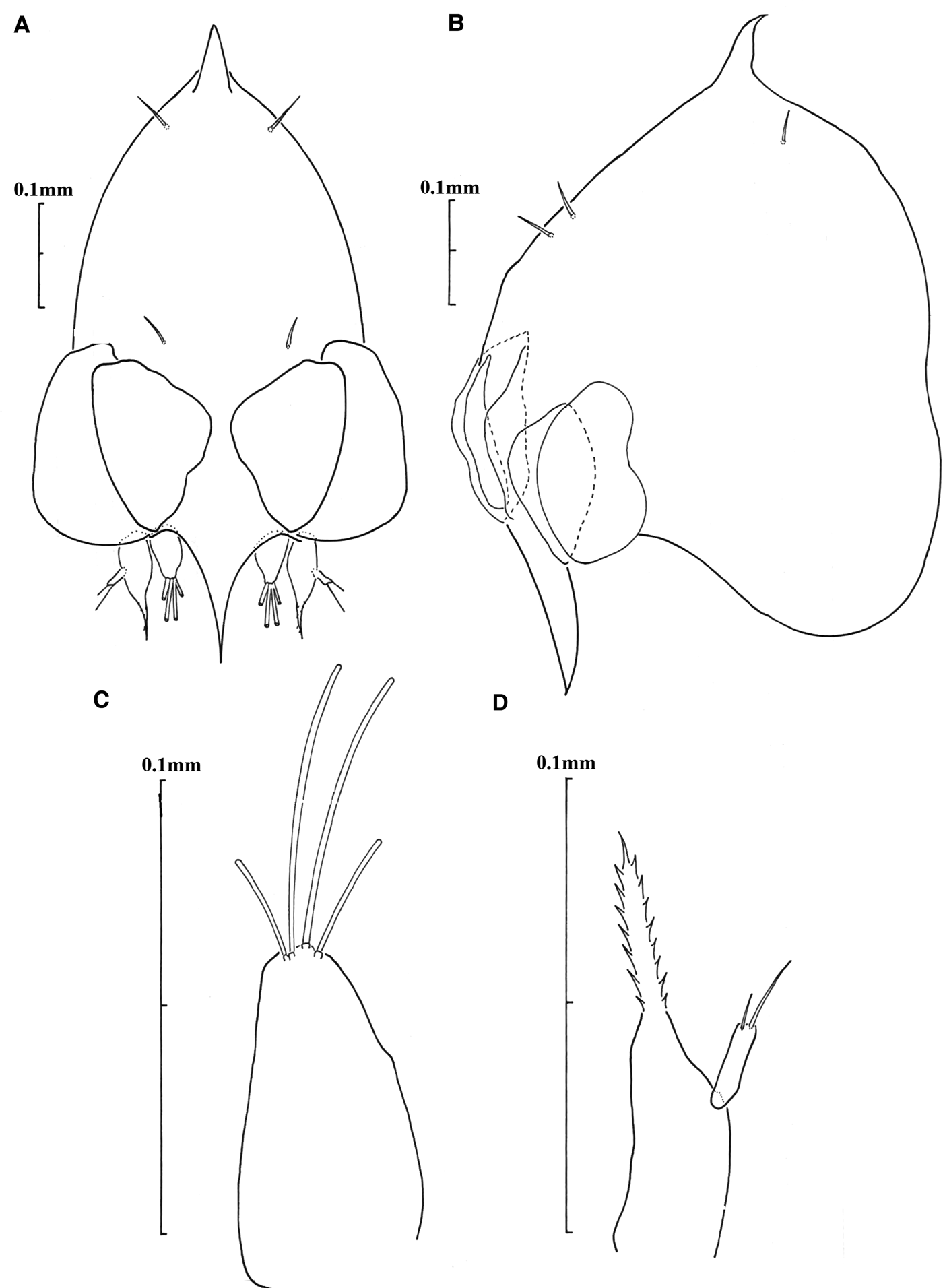
First zoeal stage of Uca (Cranuca) inversa (Crustacea: Brachyura: Ocypodidae): (A, B), carapace; (C) antennule; (D) antenna.

First zoeal stage of Uca (Cranuca) inversa (Crustacea: Brachyura: Ocypodidae): (A) maxillule; (B) maxilla; (C) first maxilliped; (D) second maxilliped.

First zoeal stage of Uca (Cranuca) inversa (Crustacea: Brachyura: Ocypodidae): (A, B) abdomen; (A, B) telson.

FIRST ZOEA
Carapace (Figure 1A, B): short dorsal spine present and without setae; rostral spine approximately twice in length of that of dorsal spine; lateral spines absent; one pair of medial-dorsal setae; one pair of anterior setae; each ventral margin without setae, eyes sessile.
Antennule (Figure 1C): endopod absent, exopod unsegmented with four terminal aesthetascs of unequal length.
Antenna (Figure 1D): spinous process distally spinulate; exopod with two unequal setae; endopod absent.
Mandible: endopod palp absent.
Maxillule (Figure 2A): coxal endite with five setae, basal endite with five setal processes; inner margin with two teeth; endopod 2-segmented, proximal segment without distal seta; distal segment with four terminal setae.
Maxilla (Figure 2B): coxal endite bilobed with 5 + 3 setae; basal endite bilobed with 5 + 4 setae; endopod bilobed with 2 + 1 terminal setae; exopod (scaphognathite) margin with four setae and one distal stout process.
First maxilliped (Figure 2C): coxal segment with one seta; basis with ten setae arranged 2, 2, 3, 3; endopod 5-segmented with four terminal plumose natatory setae.
Second maxilliped (Figure 2D): basis with four setae, endopod 3-segmented, with 0, 0, 3 + 2 respectively; exopod 2-segmented, distal segment with four terminal plumose natatory setae.
Third maxilliped: absent.
Pereiopods: absent.
Abdomen (Figure 3A, B): five somites; somite 2 with one pair of lateral processes directed anteriorly; somite 3 with one pair of lateral processes directed posteriorly; somites 1–5 with a simple postero-lateral processes; somites 2–5 with one pair of postero-dorsal setae; pleopod buds absent.
Telson (Figure 3A, B): each fork short; posterior margin with three pairs of stout spinulate setae.
DISCUSSION
The Red Sea coast of Saudi Arabia extends in a north north-west–south south-east (NNW–SSE) direction to a distance of 1700 km, covering about 4/5th of the entire length of the sea, between the Yemeni and Jordanian borders.
The ocypodid Uca (Cranuca) inversa occurs at the top of the eulittoral zone where it constructs burrows (Eshky et al., Reference Eshky, Atkinson and Taylor1995). Negreiros-Fransozo et al. (Reference Negreiros-Fransozo, Hirose, Fransozo and Bolla2009) studied the first zoeal stages and megalopa of Uca (Uca) maracoani, with comments on the larval morphology of South American species of Ocypodidae. Masayuki (Reference Masayuki1979) worked on the zoeal stages of Uca lactea. Uca (Cranuca) inversa adults survive maximum temperature of 39°C and their reproductive abilities are stronger and adapted to the hot and humid environment (Eshky, Reference Eshky1992).
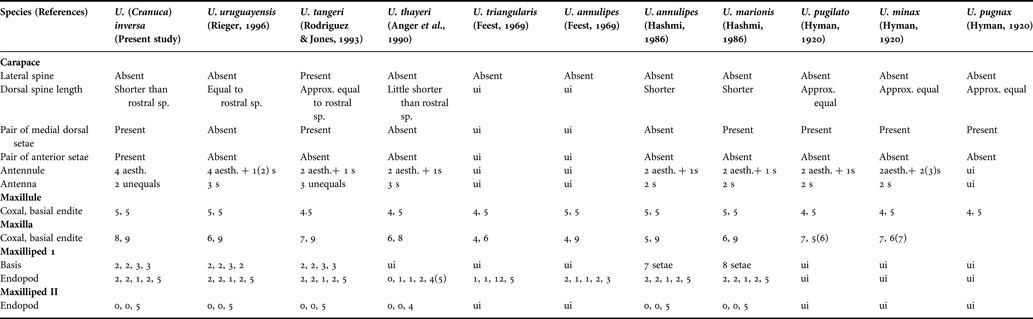
In the present study the appendage setations of the first zoea on the lateral spine of Uca (Cranuca) inversa were found to be absent. Similar absence had been reported earlier in U. uruguayensis (Rieger, Reference Rieger1996), U. thayeri (Anger et al., Reference Anger, Montu, de Bakker and Loureiro Fernandes1990) and U. triangularis (Feest, Reference Feest1969). Uca tangeri typically showed a unique presence of carapace lateral spine (Rodriguez & Jones, Reference Rodriguez and Jones1993) (Table 1).
Appendage setations of the first zoeal stages of Uca species. s, setae; sp., spines; aesth., aesthetascs; ui, unidentified; Approx., approximately.

Dorsal spine length in Uca (Cranuca) inversa was shorter than rostral length unlike U. uruguayensis in which both were found to be equal (Rieger, Reference Rieger1996), U. thayeri in which the dorsal spine was a little shorter than the rostrum (Anger et al., Reference Anger, Montu, de Bakker and Loureiro Fernandes1990) and in U. tangeri the dorsal spine was approximately equal to the rostrum (Rodriguez & Jones, Reference Rodriguez and Jones1993).
A similarity between the first zoeae of U. (Cranuca) inversa of the present study and U. tangeri (Rodriguez & Jones, Reference Rodriguez and Jones1993) was that the pair of medial dorsal setae were identically present in both species, whereas it was absent in U. uruguayensis (Rieger, Reference Rieger1996) and U. thayeri (Anger et al., Reference Anger, Montu, de Bakker and Loureiro Fernandes1990). Regarding the pair of anterior setae, this feature was present only in Uca (Cranuca) inversa. About the antennule, U. tangeri (Rodriguez & Jones, Reference Rodriguez and Jones1993) and U. thayeri (Anger et al., Reference Anger, Montu, de Bakker and Loureiro Fernandes1990) had two aesthetascs and one seta. Uca (Cranuca) inversa and U. uruguayensis (Rieger, Reference Rieger1996) bear four similar aesthetascs but the latter has 1(2) setae too. Antennary formations with three setae are found in U. uruguayensis (Rieger, Reference Rieger1996) and U. thayeri (Anger et al., Reference Anger, Montu, de Bakker and Loureiro Fernandes1990). Unequal antennary setae are the characteristic of U. (Cranuca) inversa (2 unequal) and U. tangeri (3 unequal) (Rodriguez & Joens, Reference Rodriguez and Jones1993) (Table 1).
Pertaining to the maxillule, Uca (Cranuca) inversa and U. uruguayensis bear 5, 5 coxal, basial endite; 4, 5 coxal, basal endite was reported for U. tangeri, U. thayeri and U. triangularis. Describing the structure of maxilla, no similarity was found amongst the Uca species. Each species showed some difference from the other species viz., 8, 9 for U. (Cranuca) inversa, 6, 9 for U. uruguayensis, 7, 9 for U. tangeri, 6, 8 for U. thayeri and 4, 6 for U. triangularis.
Morphologically, the maxilliped I of U. (Cranuca) inversa, U. uruguayensis and U. tangeri showed an identical configuration of 2, 2, 1, 2, 5. Contrastingly, U. thayeri reported 0, 1, 1, 2, 4(5) and U. triangularis reported 1, 1, 12, 5. The basis was similar for U. (Cranuca) inversa and U. tangeri with a series of 2, 2, 3, 3. Maxilliped II of U. thayeri had endopod with a configuration of 0, 0, 4 which was different from the configuration (0, 0, 5) of U. (Cranuca) inversa, U. uruguayensis and U. tangeri (Table 1).
Summing up and comparing the various descriptive features of Uca species, it is assumed that the short dorsal spine of the first zoeal stage of U. (Cranuca) inversa could be an important larval identifying character for this species.