


Introduction
Worry in children is a common phenomenon. Approximately 50% of 5 year olds can report personal worries (Muris, Merckelbach, Gadet and Mouleart, Reference Muris, Merckelbach, Gadet and Mouleart2000) and by primary school 70% children report worrying (Muris, Meesters, Merckelbach, Sermon and Zwakhalen, Reference Muris, Meesters, Merckelbach, Sermon and Zwakhalen1998). For some children this “normal” worry becomes pathological, usually as part of an anxiety or mood disorder (Weems, Silverman and La Greca, Reference Weems, Silverman and La Greca2000). Theories of pathological worry in children need to account for the perceived intensity and uncontrollability of such worry (Wilson, Reference Wilson2010), and adult models of pathological worry and Generalized Anxiety Disorder (GAD) may help.
In the adult literature there are several accounts of pathological worry. For example, Borkovec and colleagues (Sibrava and Borkovec, Reference Sibrava, Borkovec, Davey and Wells2006) propose that worry is a cognitive avoidance strategy. Wells (Reference Wells, Davey and Wells2006) proposes that positive and negative beliefs about worry are crucial in understanding the nature of pathological worry, and Davey (Reference Davey, Davey and Tallis1994a) has suggested that worry may be a problem-solving strategy that is somehow thwarted. Dugas and colleagues combine many of these different aspects of pathological worry and propose that cognitive avoidance, negative problem orientation, positive beliefs about worry, and intolerance of uncertainty interact to produce pathological worry (Koerner and Dugas, Reference Koerner, Dugas, Davey and Wells2006). Although these different factors have been studied in adolescents (Laugesen, Dugas and Bukowski, Reference Laugesen, Dugas and Bukowski.2003), there is less research with younger children and therefore exploring beliefs about worry and problem solving may be a useful first step.
Problem solving and worry
Worry is often viewed as a problem-solving exercise (Borkovec, Robinson, Pruzinsky and DePree, Reference Borkovec, Robinson, Pruzinsky and DePree1983; Tallis, Davey and Capuzzo, Reference Tallis, Davey, Capuzzo, Davey and Tallis1994). However, levels of worry have been found to be unrelated to problem-solving ability, but significantly associated with poor problem-solving confidence (Davey, Reference Davey1994b). Furthermore, manipulating problem-solving confidence impacts on perseveration in subsequent worry in predictable ways (Davey, Jubb and Cameron, Reference Davey, Jubb and Cameron1996). However, this might be different for younger children, who are only just beginning to develop problem-solving skills. For this age group the lack of ability to problem solve may lead to perseveration of worry. Two key processes might be particularly important in anxious children's problem-solving attempts; anxious children may not be able to generate as many responses as non-anxious children, or they may choose more avoidant responses rather than problem-focused strategies (Daleiden and Vasey, Reference Daleiden and Vasey1997). There is little research on the association between worry and the ability to generate effective solutions to problems. In one study of 10 year olds, the number of solutions children gave in response to threatening and ambiguous social situations was not associated with worry, but the quality of their solutions was. Furthermore, problem-solving confidence was associated with worry in Caucasian participants and not African-American participants (Suarez-Morales and Bell, Reference Suarez-Morales and Bell2006). In a second study of 8–11 year olds (Parkinson and Creswell, Reference Parkinson and Creswell2011) low worriers were compared to high worriers on an adapted version of the Problem-Solving Inventory (Heppner and Petersen, Reference Heppner and Petersen1982) and the Alternative Solutions Test (Caplan, Weissberg, Bersoff, Ezekowitz and Well, Reference Caplan, Weissberg, Bersoff, Ezekowitz and Well1986). High worriers did not differ from low worriers on number of solutions generated, but did differ on problem-solving confidence. Unfortunately, the measure of avoidant solutions the authors planned to use did not have good psychometric properties and could therefore not be used in the analyses.
Further studies have shown that a negative problem orientation is associated with high levels of worry in non-referred young people aged 8 years and above (Gosselin and Martin, personal communication; Laugesen et al., Reference Laugesen, Dugas and Bukowski.2003), but no study to date has explored associations between worry and problem solving in children younger than 8 years, despite evidence that worry is prevalent as young as five years. Furthermore, although the evidence suggests that worry is not associated with ability to generate solutions to problems, but is associated with poor problem-solving confidence, we do not know whether it is associated with choosing avoidant solutions. The current study therefore aimed to test whether worry was associated with the ability to generate solutions, with generation of avoidant solutions, and with problem-solving confidence in children 6 to 10 years old.
Meta-cognition and worry
Wells’ meta-cognitive model of GAD focuses on understanding the negative aspects of worry (Wells, Reference Wells1995, Reference Wells and Wells2000, Reference Wells, Davey and Wells2006). In Wells’ model, events that trigger intrusive thoughts activate positive beliefs about worry as a coping strategy, which in turn lead the person to worry about the event in order to cope. As negative outcomes are processed, the person becomes more anxious and the act of worrying triggers negative beliefs about worry. These beliefs lead to worry about worry or “Type-2 Worry”. Furthermore reassurance seeking, avoidance and thought control strategies lead to escalation and maintenance of worry.
There is growing evidence to support the model. Adults with GAD endorse more positive and negative beliefs about worry than non-worriers, and endorse them more strongly (Borkovec and Roemer, Reference Borkovec and Roemer1995; Wells and Carter, Reference Wells and Carter2001). The positive beliefs reported include beliefs that worry helps avoid problems, helps to solve problems, helps get things done, helps distract from more emotional issues and shows that you are caring (Borkovec, Hazlett-Stevens and Diaz, Reference Borkovec, Hazlett-Stevens and Diaz1999; Cartwright-Hatton and Wells, Reference Cartwright-Hatton and Wells1997). Negative beliefs that have been reported include beliefs that worry is dangerous, uncontrollable, can affect concentration and can make you ill or go mad (Cartwright-Hatton and Wells, Reference Cartwright-Hatton and Wells1997).
Less is known about beliefs about worry in children. Cartwright-Hatton and colleagues (Reference Cartwright-Hatton, Mather, Illingworth, Brocki, Harrington and Wells2004) found that adolescents aged 13–17 years reported the full range of meta-cognitive beliefs as had been identified in adults, using a version of the meta-cognitions questionnaire modified for adolescents (MCQ-A). The authors concluded that meta-cognitive beliefs are well-established by the age of 13 years. This is perhaps unsurprising because by this age children's ability to think about their own mental states is quite sophisticated. In younger children, however, this ability is more limited. In very young children evidence that they experience mental states can be inferred from their use of mental state language (Harris, Reference Harris1989), but there is little evidence that they can reflect on their own mental states. From about 4 years of age most children can understand that others can think and feel something different to what they think and feel (Wimmer and Perner, Reference Wimmer and Perner1983), suggesting some understanding of how mental states work. Children are starting to think about their own thoughts in more complex ways only by about the age of 6 or 7 years (Flavell, Reference Flavell2000; Kuhn, Reference Kuhn and Le-Monda1999). It is therefore hypothesized that by age 6 or 7 children should be starting to think about their worry and developing a range of both positive and negative beliefs about it.
However, in adults it appears to be the pattern of beliefs about worry that distinguishes people with and without pathological worry. Both positive and negative beliefs about worry have been found to be associated with proneness to pathological worry (Cartwright-Hatton and Wells, Reference Cartwright-Hatton and Wells1997), but negative beliefs about worry have been found to be stronger predictors of pathological worrying than positive beliefs (Wells, Reference Wells, Davey and Wells2006).
It is unclear whether this is also the case for children and adolescents. Cartwright-Hatton et al. (Reference Cartwright-Hatton, Mather, Illingworth, Brocki, Harrington and Wells2004) found no differences in positive beliefs about worry in a clinically anxious group of adolescents compared to a non-referred group, but did find differences in negative beliefs. However, Gosselin et al. (Reference Gosselin, Langlois, Freeston, Ladouceur, Laberge and Lemay2007) found that positive beliefs about worry did distinguish high and low adolescent worriers and Wilson et al. (Reference Wilson, Budd, Chernin, King, Leddy, MacLennan and Mallandain2011) found that positive beliefs were associated with worry in non-referred adolescents, even after trait anxiety was controlled for. Bacow, Pincus, Ehrenreich and Brody (Reference Bacow, Pincus, Ehrenreich and Brody2009) recruited participants from age 7 to 17 years and found that although both positive and negative beliefs about worry were associated with worry, only cognitive monitoring distinguished a clinical group from a non-clinical group and the non-clinical group showed higher cognitive monitoring. This study adapted the MCQ for use with children and examined the results in a largely clinically anxious group (78/98 participants). Although the MCQ- Child version (MCQ-C) showed good reliability and validity (Bacow et al., Reference Bacow, Pincus, Ehrenreich and Brody2009), it was adapted from the MCQ-A (Cartwright-Hatton et al., Reference Cartwright-Hatton, Mather, Illingworth, Brocki, Harrington and Wells2004), which in turn was adapted from the shortened adult version of the MCQ (Cartwright-Hatton and Wells, Reference Cartwright-Hatton and Wells1997; Wells and Cartwright-Hatton, Reference Wells and Cartwright-Hatton2004). This downward extension of adult measures may well miss important developmental aspects of meta-cognition. For example, children may endorse items on a questionnaire, but these may not be the beliefs that are most important to them. Furthermore, some of the concepts may be quite difficult to grasp for younger children. Bacow et al. (Reference Bacow, Pincus, Ehrenreich and Brody2009) used a wide age range and a clinical sample. The current study aimed to complement this research by studying a non-referred sample of younger children (6–10 years). Furthermore, in order to access meta-cognitions that are important to children of this age, it used open ended questions to assess positive and negative beliefs about worry.
In summary, this study of 6- to 10-year-old children had three aims. The first aim was to test the hypotheses that levels of worry are associated with: (i) poor or avoidant solution generation for social problems; and (ii) poor problem-solving confidence. Our second aim was to explore beliefs about worry in these young children, in order to assess: (i) the extent to which these beliefs are similar or different to those reported by adults and adolescents; and (ii) whether there are developmental changes in children's ability to reflect on their cognitive-emotional processes. The third aim was to test the hypothesis that levels of worry or anxiety would be related to reports of positive and negative beliefs about worry.
Method
Ethical review
Permission to conduct this study was given by the University of Cambridge Ethics committee. All children and their parents gave written consent to their participation.
Recruitment and procedure
The sample was recruited via parents who had participated in a previous postal questionnaire study and expressed an interest in taking part in further research. Of the 104 participants who were sent the questionnaire, 57 postal replies were received. There were no differences in demographics between the participants and the wider sample. Following receipt of written consent, questionnaires were sent to the children. These were returned in stamped envelopes and participants were paid £10 for their time.
Participants
The participants were 57 children (22 boys, 35 girls) between the ages of 6 and 10 years old (18 were aged 6 to 7; 22 were aged 7 to 8; 13 were aged 8 to 9; and 4 were aged 9 to 10, based on school years). The mean age of parents was 37 years old (SD = 5 years for both mothers and fathers). Two participants came from a British Asian ethnic background, with the other participants reporting that they came from a White British background. The majority of the families were two-parent families (80%) and in most families both parents were working (66%). The parents were also well educated. Twenty-eight percent of mothers had studied to A-level (18 years old) and a further 9% had a degree or equivalent. Seventeen percent of fathers had studied to A-level, with a further 25% having a degree or higher degree. These percentages are very similar to the larger sample and are representative of the area in which the study took part.
Measures
Multidimensional Anxiety Scale for Children (MASC; March, Parker, Sullivan, Stallings and Conners, Reference March1997). This 39-item questionnaire assesses different dimensions of anxiety in children and also yields a total score (used in the present study). Each item is rated on a 4-point scale, and therefore total scores range from 0 to 117. It has good reliability and validity (March et al., Reference March, Parker, Sullivan, Stallings and Conners1997; March, Sullivan and Parker, Reference March, Sullivan and Parker1999; Muris, Merckelbach, Ollendick, King and Bogle, Reference Muris, Merckelbach, Ollendick, King and Bogle2002).
Penn State Worry Questionnaire for Children (PSWQ-C; Chorpita, Tracey, Brown, Collica and Barlow, Reference Chorpita, Tracey, Brown, Collica and Barlow1997). This 14-item questionnaire measures the tendency of children to engage in excessive, generalized, and uncontrollable worry. Each item is rated on a 1–5 scale, where 1 is not at all typical and 5 is very typical. Muris, Meesters and Gobel (Reference Muris, Meesters and Gobel2001) found that the reliability of the measure increased for younger children if three reversed items were removed. The present study therefore used the adapted 11-item questionnaire where total scores range from 0 to 44. This version has good validity and internal consistency (Muris et al., Reference Muris, Meesters and Gobel2001).
Problem-solving questions (Webster-Stratton, Reference Webster-Stratton1990). In order to assess children's problem-solving ability an adaptation of the Wally Social Skills and Problem Solving Game was used. This is designed to assess qualitative and quantitative aspects of problem solving and therefore was appropriate to assess the number of solutions given as well as the nature of those solutions. Children were given 10 hypothetical social situations: asking a friend to play and them refusing, breaking your mother's vase, sibling teasing, being teased at school, not getting a toy you really want, wanting to play with someone at school, sibling eats the cake you've been saving, sibling wrecks something you have made, only one piece of pizza left and two of you who want it, and teacher is cross because you're late in after playtime. They were asked to write down all the different things they could think of to do in order to solve each problem. In the original game the child was prompted by the researcher or clinician to come up with as many strategies as they could. However, this does not reflect the process of everyday problem solving where children are left to come up with their own strategies. The number of different strategies written down was counted, and then each strategy was coded as to whether it was avoidant of the problem or solution focused. For example, in a situation where the child was feeling lonely in the playground at school, an avoidant response would involve playing alone, rather than attempting to play with other children. In a situation where the child had broken her mother's vase, an avoidant response would involve hiding the vase or saying nothing, rather than telling someone or trying to make amends. There were no limits to the number of strategies or avoidant strategies that children could report. Other coding systems were available such as the original coding system that focused on pro-social vs. anti-social responses (Webster-Stratton, Reference Webster-Stratton1990). However, there were no coding systems that focused on avoidant strategies. Therefore a simple coding system was used that dichotomized the answers into avoidant and non-avoidant (problem focused). Reliability of the coding system is provided in the results section. The original Wally game showed good construct validity and showed sensitivity to change (Webster-Stratton, Reference Webster-Stratton1990), but no other psychometric information is reported.
Problem-solving confidence. An adapted version of the problem-solving confidence sub-scale of the Problem-Solving Inventory (Heppner and Petersen, Reference Heppner and Petersen1982) was used to assess problem-solving confidence. The original 11 items were retained, but the language was adapted to be appropriate for younger children. Children were asked whether they agreed or disagreed with each statement and the number of statements they agreed with was counted (two items were reverse coded), leading to scores between 0 and 11. The original measure including the problem-solving confidence sub-scale showed good internal consistency (α = .85), test-retest reliability (r = .85) and concurrent validity with other measures of problem solving, and no effect of intelligence or social desirability (Heppner and Petersen, Reference Heppner and Petersen1982). The current adaptation also showed acceptable internal consistency (α = .72).
Open ended questions for beliefs about worry. The present study was interested in whether children could spontaneously express beliefs about worry at a young age. At the time of the study there were no measures of both positive and negative beliefs about worry suitable for this age group. Furthermore, seminal papers on worry in adults (Tallis et al., Reference Tallis, Davey, Capuzzo, Davey and Tallis1994) and children (Muris et al., Reference Muris, Meesters, Merckelbach, Sermon and Zwakhalen1998) had used open ended questions to access beliefs about worry. We therefore used open ended questions that had been successful in eliciting beliefs from children in clinical settings. These were:
“Worry can sometimes be helpful and good. Tell me some reasons why worry is good.”
“Worry can sometimes be unhelpful and bad. Tell me some reasons why worry is bad.”
This was thought to be a very conservative method of assessing these beliefs, as it required the child to have access to the belief and to retrieve it.
Results
In the first results section we report reliability data for the coding of problem-solving solutions and beliefs about worry. We then provide descriptive data for problem-solving solutions, problem-solving confidence, worry and anxiety and test the first two study hypotheses (namely that levels of worry will be associated with: (i) poor or avoidant solution generation for social problems; and (ii) poor problem-solving confidence). In the next section, we report on children's responses to the open questions about beliefs about worry, including numbers and percentages of children who did and did not report positive and/or negative beliefs about worry. This section also examines the extent to which these beliefs are similar or different to those reported by adults and adolescents and whether there are developmental changes in children's ability to reflect on their cognitive-emotional processes. Finally, we address the hypothesis that levels of worry and anxiety will be associated with reports of negative and positive beliefs about worry.
Reliability
Responses to the problem-solving questions and the beliefs about worry questions were initially coded by the first author. They were then coded by a researcher blind to the study hypotheses. Agreement for the number of problem-solving solutions was adequate (Kappa = .81). Each of these solutions were coded into avoidant or non-avoidant (solution focused), and the Kappa for agreement was .82. For beliefs about worry, each response was coded as a belief or not a belief about worry. The Kappa for agreement was .61.
Descriptive data
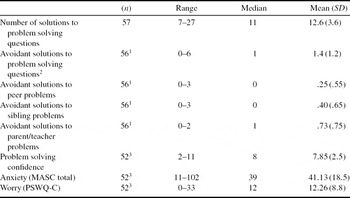
The first step was to examine the face validity of the children's responses. The questionnaires were sent to homes and therefore could have been completed by parents rather than children. However, on examination of the responses, the spelling, grammar and writing suggested that the responses were written by the children. The second step was to count the number of responses each child provided and to categorize them into avoidant strategies in the three types of social situations: peer interactions, sibling interactions, or parent/teacher interactions (see Table 1). Most children produced one solution per problem, and most children produced at least one avoidant solution across the 10 problems. Scores on the measures of anxiety and worry were similar to the validation studies (Chorpita et al., Reference Chorpita, Tracey, Brown, Collica and Barlow1997; March, Reference March1997).
Descriptive data for study variables

1 One child who gave solutions for only seven problems was excluded from the analyses.
2 For five children who gave solutions to nine out of ten problems, the number of avoidant solutions was pro-rated. Forty-three children produced at least one avoidant solution
3 Five children did not complete questionnaire measures
There were no significant gender differences in anxiety, worry, number of solutions, number of avoidant solutions or problem-solving confidence (t < 1.7, p > .1).
Worry, anxiety and problem solving
The total number of problem-solving solutions and the number of avoidant solutions were not normally distributed and efforts to normalize them were unsuccessful. Therefore Spearman rank correlations were used. As expected, worry and anxiety were highly inter-correlated (rho = .719, p < .005). Problem-solving confidence was inversely associated with the number of avoidant solutions (rho = –.368, p < .025), but neither of these were correlated with the overall number of solutions (rho < .28, p >.05) and these measures were all unrelated to child age (rho <.25, p >.08).
For hypothesis testing a significance level of p < .025 was set as correlations were performed with both anxiety and worry, but there were a priori hypotheses about each of the three dependent variables. In support of the hypotheses neither worry nor anxiety showed a significant association with the total number of problem-solving solutions (rho = .022 and .103 respectively, p >.025), but both were significantly associated with the number of avoidant solutions provided (rho = .322 and .364 respectively, p < .025). In addition, worry, but not anxiety, was significantly inversely associated with problem-solving confidence (rho = –.318, p < .025 and –.138, p > .025 respectively).
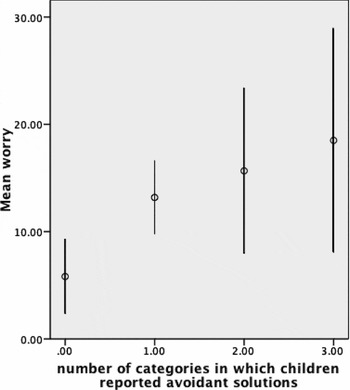
As a further test, children were grouped into those children who did not report any avoidant solutions (n = 13), those who reported an avoidant solution in only one category of problem (peers, parents/teachers or siblings; n = 28), or those who reported an avoidant solution in two (n = 11) or three (n = 4) categories of problem. A multivariate ANOVA was computed, with worry, anxiety, and problem-solving confidence as dependent variables (NB: total number of strategies was dropped from the analysis as it wasn't normally distributed nor associated with worry and anxiety). The overall model was significant (F (3, 51) = 1.87, p<.05), and worry was the only factor showing significant differences between the groups (worry F (1, 51) = 3.71, p = .02; anxiety F (1, 51) = 2.53, p = .07; problem-solving confidence F (1, 51) = 2.07, p = .12). Simple post-hoc tests suggested that the differences were between children who reported 0 avoidant solutions, and those who reported avoidant solutions in 1 category (p = .02), 2 categories (p = .01) and in all 3 categories (p = .01) (see Figure 1).
Mean worry scores for children who reported avoidant solutions in 0–3 categories of problem

Children's beliefs about worry
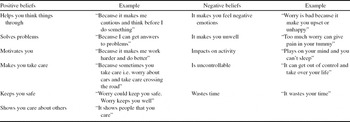
Children's written responses were next coded to index both the number of separate expressed beliefs about worry and the nature of these beliefs (positive or negative). Of the 57 children, 32 (56%) expressed at least one positive belief about their worry (with 4 children reporting 2 positive beliefs and 1 child reporting 3 positive beliefs). In total, 44 children (77%) expressed a negative belief about their worry (with 14 children reporting 2 negative beliefs and 3 reporting 3 negative beliefs). Table 2 describes the categories of beliefs about worry for both positive and negative beliefs. Examples of positive beliefs included “worry makes you think things through first” and “worry keeps you safe from bad things happening”. Examples of negative beliefs included “worry can make your tummy hurt” and “worry makes you not concentrate”. In the main, the beliefs reported were, as predicted, very similar to those endorsed by adolescents and adults (Cartwright-Hatton et al., Reference Cartwright-Hatton, Mather, Illingworth, Brocki, Harrington and Wells2004; Cartwright-Hatton and Wells, Reference Cartwright-Hatton and Wells1997). Note also that chi-square tests showed no age-related differences in children's expressed beliefs about worry (positive belief, χ2 = 2.16, df = 3, p >.1, ns; negative belief, χ2 = 5.84, df = 3, p >.1, ns).
Categories of beliefs about worry

Excluding data from five children who did not complete the anxiety and worry questionnaires, we next used separate independent t-tests to compare levels of anxiety and worry in children who did (n = 30) or did not (n = 22) express positive beliefs about worry. Neither of these comparisons showed a significant contrast (anxiety, t = –.86, df = 50, p > .1, ns; worry, t = –.51, df = 50, p > .1, ns). Next we conducted parallel tests to compare children who expressed negative beliefs (n = 40) to those who did not (n = 12). Once again there were no significant differences (anxiety, t = .75, df = 50, p > .1, ns; worry, t = 1.0, df = 50, p > .1, ns).
Discussion
The results from this study of 6- to 10-year-olds are largely consistent with those from previous studies of adults and adolescents. It appears that a high level of worry is not associated with problem-solving ability per se, but is associated with avoidant solutions and with low confidence in problem-solving ability (hypothesis 1). Similarly, from as early as 6 years of age, some children already have a range of beliefs about worry that are similar to those endorsed by adolescents and adults (hypothesis 2). Note, however, that this study did not reveal differences in anxiety and worry between those children who did or did not express either positive or negative beliefs about worry (hypothesis 3). Below, we discuss each of these findings in turn.
Worry and problem solving
The present study found no association between worry and the total number of problem-solving solutions children reported. Verbal ability, particularly verbal fluency, might impact on children's ability to produce solutions. If so, one would predict an age-related increase in the number of solutions produced, and no such age-related increase was found. However, this may be important to rule out in future studies. As Daleiden and Vasey (Reference Daleiden and Vasey1997) report, there is little evidence for poor solution generation being associated with anxiety and worry in children, and they suggest that it might be in enactment of solutions that the problems occur. In addition, it is perhaps more likely that, as in adults, it is problem-solving confidence that is more closely associated with worry, rather than ability to come up with several solutions. It is particularly interesting given that problem-solving confidence was associated with worry and not anxiety, suggesting a specific relationship.
Worry and avoidant problem-solving solutions
The current study found evidence of associations between higher levels of worry and anxiety and increased reporting of avoidant solutions. This is consistent with research that suggests that anxious children talk more about avoidant solutions to social problems (Barrett, Rapee, Dadds and Ryan, Reference Barrett, Rapee, Dadds and Ryan1996; Dadds, Barrett, Rapee and Ryan, Reference Dadds, Barrett, Rapee and Ryan1996) and that avoidant solutions to problems may not be specific to worry. However, it is important to explore whether this reporting of avoidant solutions translates into actually choosing avoidant solutions.
Age and beliefs about worries
It is interesting that children's reporting of their positive and negative beliefs about worry was not found to be affected by age, and a small number of children as young as 6 years could spontaneously report positive or negative beliefs about worry. Further research could fruitfully focus on whether cognitive ability impacts on whether or not children hold these beliefs, and also whether it impacts on their ability to report them.
Anxiety and worry and beliefs about worries
No differences were found between children who did and did not report beliefs about worry on measures of worry and anxiety. One explanation for this could be that the associations found between beliefs about worry and levels of worry and anxiety in adolescents and adults are not yet established in children this young. Alternatively, the differences could be present in children this young but the methods used in the present study were not sensitive enough to find them. First, the present study was focused on beliefs about worry in children with a range of worries and anxieties, and therefore cannot compare clinically anxious and non-anxious groups. Second, asking children open ended questions may give quite different results than when asking children to endorse items on a questionnaire. Furthermore, the simple categorical distinction between children who did and did not report beliefs adopted in the present study may be a less sensitive index of beliefs than a continuous measure based on questionnaire scores. However, the beliefs reported by the children in the current study are very similar to those assessed using the MCQ-C (Bacow et al., Reference Bacow, Pincus, Ehrenreich and Brody2009), and therefore further research using this questionnaire is warranted.
Limitation of the current study
There are a number of limitations of the current study that need to be taken into account when interpreting the results. First, the sample size is relatively small to answer the number of questions posed, and therefore the results may be subject to type 1 error. However, the significant correlations found between worry and problem-solving variables were in the moderate range, suggesting the problem-solving model might be worth pursuing in children of this age. The sample is also a white middle class sample, limiting the generalizability of the results. Second, the measures used allowed children to respond openly to both problem-solving situations and to questions about their beliefs about worry. This may access particular aspects of problem solving or worry beliefs and also may limit variation in the answers and thus the analyses that can be done. Finally, the problem-solving measure does not assess enactment of problem-solving solutions, which may be crucial to understanding problem-solving deficits in anxious and worried children. A third limitation was not having a measure of cognitive or verbal ability. Age was used as a proxy for cognitive ability, but measuring it directly would have allowed a more thorough test of whether cognitive and verbal ability impact on the ability to produce problem-solving solutions and report beliefs about worry.
Summary
In summary, this study extends present research by showing that it is problem-solving confidence and the endorsement of avoidant solutions rather than problem-solving ability per se that is associated with worry in children. In addition, children as young as 6 years old can report both positive and negative beliefs about worry in response to open ended questions, but this ability does not appear to be age related. Further research is required to determine how different factors such as these interact and whether cognitive and verbal ability impact on children's beliefs about worry and problem-solving solutions.



Comments
No Comments have been published for this article.