INTRODUCTION
How to constrain local governments from abusing their eminent domain power? The conventional answers are to limit the scope of eminent domain by the public use doctrine or force the local governments to internalize the financial cost of eminent domain through the just compensation doctrine (e.g., Cooter 2000, 288–90). But if we understand eminent domain as an administrative power, as it is, something is missing. In the post-Kelo context, Professor Thomas Merrill (Reference Merrill2005, 16) wrote in a statement submitted to the US Senate Committee on the Judiciary that, “as an administrative law professor,” he was struck by “how outmoded eminent domain processes appear to be in most jurisdictions.” As it is widely known and debated among political scientists and administrative law scholars, administrative procedures are an important instrument of controlling administrative agents (e.g., McCubbins, Noll, and Weingast Reference McCubbins, Noll and Weingast1987; Mashaw Reference Mashaw1990; Jordão and Rose-Ackerman Reference Jordão and Rose-Ackerman2014). Can administrative procedures constrain local governments’ eminent domain power? In the Fifth Amendment to the US Constitution, there is not only the takings clause, which stipulates that “nor shall private property be taken for public use, without just compensation,” but also the due process clause, which provides that no person shall be “deprived of … property, without due process of law.” Which of the three legal doctrines of public use, just compensation, and due process is the most effective in constraining abuses of eminent domain power? So far there has been little research on this question in the American context (Claeys 2005).
From a comparative law perspective, constraining the abuse of eminent domain power is a worldwide challenge (e.g., Dagan 2015, Kim, Lee, and Somin Reference Kim, Lee and Somin2017), with China as a most-noted example (Qiao and Upham Reference Qiao, Upham, Graziadei and Smith2017). Between 2005 and 2015, Chinese local governments nationwide expropriated in the range of 10,000 to 50,000 hectares of rural land without approval each year. Considering that Chinese farmers own, on average, 0.09 hectares, this means that local governments took land away from 100,000 to 500,000 farmers every year, in violation of national land use laws and quotas (Qiao Reference Qiao2017, 1683). In urban China, housing demolition in the name of urban renewal has frequently resulted in bloodshed, conflicts, and social instability (He 2014).
At the core of China’s eminent domain regime is the principal-agent problem. “Authoritarian regimes, like all governments, face the need to control lower level officials who work for the regime” (Ginsburg Reference Ginsburg, Ginsburg and Moustafa2008, 59). The central government has instituted a top-down approval and monitoring system for local governments’ exercise of eminent domain power, but the sheer size of the country and its numerous subnational units make it costly, if not impossible, for the central authority to monitor local governments effectively. A single national authority cannot overcome the huge information and administration costs involved in micromanaging several thousand local government units. One way to beat these numbers, and to defend national laws, would be to mobilize and empower individual citizens to monitor the local governments that are violating individual rights by granting them access to challenge those governments in court (He Reference He, Balme and Dowdle2009, 2013; Qiao Reference Qiao2017; Zhang and Ginsburg Reference Zhang and Ginsburg2019).
In response to the increasing insufficiency of the top-down control system, the Chinese central government has turned to administrative law as a tool for monitoring local government officials (Ginsburg Reference Ginsburg, Ginsburg and Moustafa2008), though to what degree this tool is effective is yet to be empirically examined. Scholars have documented both a rise in administrative litigation in China (Ginsburg Reference Ginsburg, Ginsburg and Moustafa2008; Li Reference Li2013; He 2014) and the expansion of the Chinese judiciary in general, though it is an open question that to what extent the party-state would allow such an expansion (e.g., Peerenboom Reference Perenboom2010). However, to date there has been no study of the role of law, or, more specifically, of legal doctrines, in the context of administrative litigation in China. The extant research on Chinese administrative litigation has set legal doctrines aside, assuming the details of law to be superfluous and the role of law epiphenomenal; what matters is the political, social, and institutional context of the litigation. But doctrines are not just a cloak for the political and social considerations of courts and judges. They also impose constraints on judicial choices and define the scope of judicial discretion (Lax Reference Lax2011). This is not to deny that the choice and interpretation of legal doctrines are structured by institutional settings and influenced by political and social concerns. Nevertheless, we need to take legal doctrines seriously to fully understand the landscape of Chinese administrative litigation.
The critical question is what form of legal doctrine matters in the Chinese institutional context. Legal theorists have revealed that different doctrines, particularly determinate rule-like doctrines versus indeterminate standard-like doctrines, score differently in overcoming the principal-agent problem in hierarchical organizations (Jacobi and Tiller Reference Jacobi and Tiller2007). Determinate doctrines leave less discretion to the agent, and therefore reduce the principal-agent problem, but tend to be rigid and therefore less adaptable to the specific context in which the agent needs to implement the doctrine.
Real estate expropriation is a significant source of administration litigation in China (Liu Reference Liu2018). It is an area in which scholars and policymakers have debated one another over the optimal choice of legal doctrines to constrain the government’s eminent domain power, making it an ideal case to study the “judicial politics of legal doctrine” (a term borrowed from Lax (Reference Lax2011)). In the past two decades, Chinese scholars and policymakers have made various proposals for how to constrain local governments’ expropriation power. The methods they have proposed fall into three categories. The first is to define and narrow the scope of public interest in Chinese law. This proposal has drawn the most attention, with Chinese scholars still engaged in lively debate over such issues as whether urban renewal should be considered a public interest (Zhang Reference Zhang2005; Wang Reference Wang2009; Jiang Reference Jiang2019). The second is to determine what constitutes just compensation, in particular whether farmers are entitled to the post-condemnation urban value of condemned rural land (Zhang Reference Zhang2005; Wang Reference Wang2005; Jiang Reference Jiang2019). The third is to address the problems with eminent domain procedures and the lack of due process in the Chinese eminent domain regime (Cheng Reference Cheng2006; Zhang Reference Zhang2009; Liu Reference Liu2012; Peng Reference Peng2017; Jiang Reference Jiang2019). Instead of focusing on the indeterminate substance of public interest or just compensation, these scholars argue that the courts should concentrate on the expropriation process and ensure that eminent domain decisions are being made in an accountable, transparent, and responsive manner that draws on credible information and necessary expertise.
On the one hand, administrative procedures are determinate and therefore easy to monitor. On the other hand, they focus on the process of administrative expropriation, and thus leave the outcome open and adaptable to the specific context. The procedural control of local governments’ eminent domain power provides a solution to the principal-agent problem in balancing economic development and social stability. It also aligns nicely with the “due process revolution” in Chinese administrative law over the past two decades. The Chinese legislature incorporated procedural legality as a core requirement for administrative action for the first time in the 1989 Administrative Litigation Law (ALL) (Wang Reference Wang1998). However, it took another two decades for Chinese courts to proactively apply due process principles in adjudicating administrative litigation (He 2008; Reference He, Balme and Dowdle2009). Today, it is widely accepted among Chinese legal scholars that due process is, or at least should be, a fundamental principle of Chinese administration law, although its implementation in different areas of said law is the subject of empirical investigation.
How do Chinese courts choose among the three doctrines of public interest, just compensation and due process in adjudicating eminent domain litigation? Are the courts capable of enforcing administrative procedures to constrain local governments’ eminent domain power? Making use of newly available data from the Chinese judiciary, the first-ever systematic, quantitative examination of the judicial review of eminent domain in China reported herein sought to answer these questions.
The remainder of the article is organized as follows. Part 2 examines the choice of legal doctrines in the judicial review of eminent domain in detail. Part 3 introduces our data source and empirical methodology. Part 4 describes the dataset, and Part 5 presents our research results and interpretation. Part 6 concludes.
CHOICE OF DOCTRINE IN JUDICIAL REVIEW OF EMINENT DOMAIN
China’s central government has turned to the country’s judiciary to constrain the eminent domain power of local governments, and Chinese courts have become more proactive in conducting judicial reviews of eminent domain. However, this is not a case of judicial empowerment without limits. Expropriation procedures are more determinate than the vague doctrines of public interest and just compensation, and therefore serve to confine both local eminent domain power and judicial review power. Focusing on the process of eminent domain also leaves the outcome of expropriation to local dynamics. This brief comparison leads to our hypothesis that Chinese courts favor the procedural control of administrative expropriation over substantive control through the legal doctrines of public interest and just compensation.
Subtle Role of the Chinese Judiciary in Eminent Domain
The past two decades have witnessed the transformation of the Chinese courts. They have moved from being part of the local growth machine, defined as an alliance of local governments and developers (Pritchett and Qiao Reference Pritchett and Qiao2018) that has proactively and systematically expropriated rural land and conducted urban renewal for the purpose of economic development, to an important pillar of the central government’s decentralized monitoring and control of local governments. Professor Donald Clarke (Reference Clarke2003, 91), a leading legal scholar of the Chinese property regime, assumed in his seminal paper, “The China Problem,” that “the institutions by which rights are enforced, in particular courts, are perceived to be weak, and thus rights are perceived to be unenforceable.” He was right. The 2001 Urban Housing Demolition Regulation stipulated both that disputes over compensation should be arbitrated by the urban housing demolition agency or people’s government immediately overseeing such an agency and that the arbitration process, and subsequent litigation if the condemnee so insists, should not suspend execution of the demolition (State Council 2001, Article 16). In 2005, the Supreme People’s Court (SPC) emphasized in an instruction to local courts that compensation disputes in the area of urban housing demolition should be resolved by the government before being addressed by the courts (SPC 2005).
The 2011 Urban Housing Expropriation Regulations (“the 2011 Regulations” hereafter), which the central government promulgated in response to public outcry over brutal forced demolitions that, in many cases, resulted in bloodshed or even death, eliminate the requirement for preliminary administrative arbitration, granting condemnees the right to sue the government directly. Going even further, they also require judicial approval for the forced demolition of urban housing (State Council 2011, Articles 25, 26).
In rural areas, challenges to a compensation decision in the eminent domain arena needed to go through administrative arbitration by the condemnor’s upper-level authority as late as 2011 (SPC 2011, Article 10). However, the 2014 revision to the ALL explicitly recognized expropriation and compensation decisions, be they in rural or urban areas, as a legitimate cause for administrative litigation (National People’s Congress Standing Committee 2014, Article 12).
In the same year, the SPC issued a notice to provincial-level high people’s courts (HPCs) across the country encouraging them to defend the “bottom line” of law and to fight hard, “obeying only law and facts and decisively resisting various illegal intervention.” More specifically, the notice stated that HPCs should not bias local government interests but should have the courage to confirm the illegality of or even revoke eminent domain decisions if appropriate. It also required HPCs to take the lead in resisting illegal intervention in judicial adjudication by local governments, invalidate illegal expropriation by local governments, and supervise and support local courts in combating local government intervention through their own adjudication (SPC 2014).
It should be noted that the expansion of judicial protection of property rights in the area of real estate expropriation also fits into the general rise in rights consciousness in China, as exemplified by the 2004 Amendment to the Chinese Constitution and promulgation of the 2007 Property Law. What we would like to emphasize here, however, is that the expansion of judicial protection in the expropriation context has been driven primarily by the central government’s concern with monitoring and controlling local governments. For example, the expansion of judicial review power has never been extended to decisions made by the central and provincial governments, the levels of government with the ultimate power to approve local governments’ expropriation plans. Although a textual interpretation of the 2014 ALL revision suggests that such expropriation decisions fall within the scope of judicial review, senior SPC judges have stated that Chinese courts should not take that route because the courts have neither the real authority nor expertise needed to review such decisions (Geng and Yin Reference Geng and Qin2019, 83–84).
Three Legal Doctrines in Eminent Domain
How are Chinese courts supposed to review eminent domain decisions? Overall, the Chinese legal system governing eminent domain allows for three types of eminent domain claims: public interest, just compensation, and due process. Article 10 of the Chinese Constitution requires the expropriation of land to be in the “public interest” and compensation to be paid. Article 13 institutes the same two requirements for the expropriation of private property, including privately owned accommodation. Although procedural control does not accompany the public interest and compensation requirements in the Chinese Constitution, it does appear in the Property Law, which is the basic law applicable to all kinds of property, the Land Administration Law, which applies to rural land expropriation, and the 2011 Regulations, which govern eminent domain in the urban context—China’s three most important laws in relation to eminent domain (Qiao and Upham Reference Qiao, Upham, Graziadei and Smith2017). Article 42 of the Property Law stipulates that real estate expropriation must be conducted “in accordance with the scope of power and procedures provided by laws.”
These three legal doctrines address the principal-agent problem between the central government and local governments in different ways and their effectiveness also differ. Due process is more effective than public interest and just compensation in overcoming the principal-agent problem because it provides determinate and clear rules to monitor the agents’ behaviors while keeps the outcome open-ended and adaptable to specific contexts in which the agents exercise the necessary discretion to optimize what the principal wants.
The public interest requirement limits the agency cost in eminent domain by delineating the scope of the power. It is a natural choice and has drawn the most attention from scholars and policymakers in China. However, it is too broad to constitute any effective constraints on local government decisions. It is also at fundamental tension with the land-based development model of economic development which most Chinese local governments follow (Qiao Reference Qiao2017; Pritchett and Qiao Reference Pritchett and Qiao2018).
Before promulgation of the 2011 Regulations, there was no specific definition of public interest in Chinese law. The 2011 Regulations, which govern urban housing expropriation and represent a laudable effort to contain the local governments’ abuse of eminent domain power, narrow public interest to five categories (Article 8). However, some of the uses included in these five categories are still quite broad, such as urban renewal, which has been widely used by local governments to justify their eminent domain decisions. Even for the so-called “public affairs,” the 2011 Regulations define them as the need of science, education, culture, sports, environmental protection, disaster relief, social welfare, etc. They also add a sixth category, namely, “other public interests stipulated by law and administrative regulations,” leaving the scope of public interest open to legislative and executive definition at the central government level. With this broad definition of public interest, it is hard to believe that it could limit the agency cost and abuse of eminent domain power by local governments, as testified in the ongoing wave of urban renewal projects across the country.
With respect to rural land expropriation, using public interest to prevent the abuse of eminent domain power is contradictory to the fundamental nature of China’s dual-land system. Expropriation is the major way of converting rural land to urban land and putting the land into productive use beyond agriculture. Chinese local governments have long relied on taking rural land and selling it to developers to obtain revenue or giving such land to investors for the purpose of economic development (Qiao Reference Qiao2017). There is no way to limit expropriation of rural land into any specific uses as far as the dual-land system continues.
The just compensation doctrine could theoretically limit the agency cost and the abuse of eminent domain power by forcing the local governments to internalize the financial costs of expropriation. But just compensation is an indeterminate standard. Firstly, the Chinese law has explicitly rejected the criteria of fair market value (Qiao and Upham Reference Qiao, Upham, Graziadei and Smith2017), which itself is subject to the uncertainty of appraisal (Chang Reference Chang2011). Secondly, and to make the standard more complicated and uncertain, expropriation is always profit-making for Chinese local governments.
In the context of rural land, farmers’ compensation is based on the value of the land as arable land, whereas their land is sold after expropriation as urban construction land, the value of which can be fifty times higher. In the context of urban renewal, rezoning always makes for a much bigger pie, but the owners of urban housing are entitled only to the original housing value. What is at dispute on the ground is how to allocate the surplus value (Qiao and Upham Reference Qiao, Upham, Graziadei and Smith2017): condemnees are rarely satisfied with what they are legally entitled to and always bargain for more, including through litigation (He 2014). Compensation is thus widely considered to be the key issue in expropriation disputes exactly because of the unclear standard of compensation (Geng and Yin Reference Geng and Qin2019; Zhu et al. 2006, 805–06).
Procedural control, including whether the expropriation agency has sought proper approval and whether it has followed proper procedures, focuses on the process instead of the outcome of eminent domain. Empirical studies have shown that procedures matter to Chinese farmers’ acceptance of expropriation projects (e.g., Liu et al. Reference Liu2012). On the one hand, procedures are more determinate and certain than either the publicness of a project or fairness of the compensation offered. On the other hand, procedures dictate only the process through which the substantive outcomes of public interest and just compensation can be achieved in a specific context. Overall it allows the central government to monitor local governments through determinate rules while leaving discretion to local governments to optimize and balance economic development with social stability in a local context, which is what the central government—the principal—desires.
How useful the due process doctrine is in the context of eminent domain has yet to be empirically investigated. It we take the United States as an example, as scholars usually do, we can see that despite the US Constitution’s explicit guarantee that landowners will receive notice of any taking and be granted an opportunity for a hearing on the legality thereof, many state courts hold the view that due process does not apply to the eminent domain actions of states (Hudson Reference Hudson2010, 1283). In one case in Rhode Island, for example, the property owners concerned did not become aware of the condemnation of their property until they arrived there the day after the court order had been issued to find state employees in control (Hudson Reference Hudson2010, 1284; Merrill and Smith Reference Merill2017, 1172–733). This is a rather shocking state of affairs considering the importance of due process as an effective means of controlling administrative power. Is due process thus useless in the eminent domain arena?
Politics can influence judicial choices and interpretations of legal doctrines. For example, in a democratic society, so long as the condemnation is the genuine result of the ordinary processes of majoritarian democratic politics, the courts generally do not second-guess legislative decisions about the public interest (Alexander Reference Alexander2005, 963). Under the different political structure of the Chinese government, the eminent domain power of local governments is subject to approval and monitoring by the provincial and central governments. Chinese courts are supposed to monitor local governments on behalf of the provincial and national authorities but are themselves subject to party-state control (Zhang and Ginsburg Reference Zhang and Ginsburg2019). How does this political dynamic underpinning eminent domain influence Chinese courts’ choice of legal doctrines? A condemnee can challenge a government’s eminent domain decision based on any one of the three aforementioned doctrines or a combination thereof. Do judges respond to the three doctrines in the same way, however? If they do not, which doctrine is most likely to be supported by the courts and the most determinative of the final litigation results?
Procedural Control of Eminent Domain in China
There are two types of procedural control in the context of real estate expropriation in China: internal procedures local governments need to follow to obtain approval of expropriation from upper-level governments; and procedures that enfranchise condemnees in the condemnation decision-making process. Details of such procedures vary between rural and urban areas, but both follow the Property Law and the Administrative Litigation Law, and they are designed to overcome the principal-agent problem discussed above.
The first is the oversight and internal procedures that local governments need to follow in making an expropriation decision. In applying for approval of rural expropriation projects, local governments need to submit documents specifying what land is to be expropriated, what that land is to be used for, the feasibility of the compensation plan, and the project’s consistency with national land policy (Ministry of Land and Resources 2016, Articles 11, 15, and 16). This top-down approval system is designed to mitigate the information disadvantages that upper-level governments face in dealing with local governments to constrain the latter’s expropriation power. Upper-level governments exercise their discretion in deciding whether an expropriation project serves the public interest, including economic development and social stability, which is gauged in part by the feasibility of the compensation plan. The number and size of projects approved each year are also constrained by national land use and economic development plans.
There are at least three problems with this top-down approval and monitoring system. First, as mentioned at the beginning of this article, a significant amount of rural land is taken every year without any approval at all. It is costly to detect such illegal expropriation and enforce the law against local officials. Second, there are issues with the credibility and verifiability of the documents submitted by local governments. For example, local governments can change the category of rural land from “basic arable land,” a heavily protected category, to “waste land” to improve the chances of the expropriation being approved (Liu Reference Liu2012, 129). Third, even for an approved project, the approval authority has limited capacity to ensure that the project is implemented in accordance with the plan laid out in the application documents. A common problem is that local governments expropriate land beyond the scope of what has been approved. Courts can help to enforce the top-down approval system to a certain degree. If condemnees can prove that the local government never obtained approval for the expropriation project in question or that it exceeded the project’s approved scope, consistent with their function as a decentralized monitoring and enforcement system, the courts should have no problem invalidating said expropriation. We found a number of decisions in our dataset in which a local government had intentionally miscategorized rural land as urban land to avoid the top-down approval system, to which urban real estate is not subject.
For urban condemnation, the 2011 Regulations still specify procedures for balancing economic development and social stability, such as the preliminary evaluation of the social stability risk, approval by the standing council of the city government for projects that involve a certain number of people, and the deposit of compensation funding into a special account before an expropriation decision is made (State Council 2011, Articles 3, 9, and 12). These internal procedures are difficult for upper-level governments to enforce, but, again, the courts can decide whether they have been followed in reviewing the legality of expropriation decisions.
The second type of procedural control enfranchises condemnees in the condemnation decision-making process, thereby ensuring that local governments are responsive to their interests. Such procedural control therefore channels an expropriation decision toward a substantive outcome that balances the local government’s demand to expropriate land for economic development with the central government’s need to maintain social stability by protecting property rights without anyone being aware of what the substantive outcome will be in a given context (McCubbins, Noll, and Weingast Reference McCubbins, Noll and Weingast1987, 244). The types of procedure concerned are those conventionally associated with procedural due process in the Western context, including the right to notice and a public hearing (State Council 2004, Sections 14 and 15; State Council 2011, Articles 10, 11, and 13). There are also additional procedures designed to force local governments to negotiate with condemnees and try their best to reach agreement before using their coercive expropriation power. By enfranchising condemnees to participate in the decision-making process and requiring negotiation with them as a preliminary procedure to coercive expropriation, these procedures transform the indeterminate doctrines of public interest and fair compensation into more determinate procedures. We call this transformation the proceduralization of public interest and just compensation (Fang Reference Fang2010), and argue that it can both facilitate and limit the judicial review of expropriation power.
The two types of procedures serve three purposes. First, they affect the outcomes of expropriation, pushing them in the direction of balancing economic development and social stability to the benefit of the central government. To be clear, it is difficult to stop an expropriation ex ante by challenging the procedures involved (He 2014), but that does not mean that such challenges are pointless. Violation of expropriation procedures leads to the invalidation or revocation of the expropriation and compensation decisions (National People’s Congress Standing Committee 2014, Articles 70 and 74) and is a legitimate reason to demand state compensation (National People’s Congress Standing Committee 2010, Article 4). Second, the procedures may be ends in their own right (McCubbins, Noll, and Weingast Reference McCubbins, Noll and Weingast1987, 253). Regardless of the outcome, condemnees are likely to derive greater value from processes that give the appearance of rationality than from processes that are perceived to be cruel, unfair, and arbitrary.
Third, they are also a means of self-control for the judiciary. Using the courts to monitor and control local governments inevitably leads to an expansion of judicial power. However, there is a principal-agent problem between the Chinese central government and the judiciary too. The former does not want the latter to go too far in encroaching upon the prerogatives of other branches of government, and an expansion of judicial power is more likely when the mandate of judicial review is vague than when it is clear and specific. The Chinese judiciary has an interest in self-preservation, and therefore may prefer to rely on procedures than on the more ambiguous requirements of either public interest or just compensation to confine its own judicial review power in the expropriation arena.
DATASET
Data Source: China Judicial Decisions Website
Our data are taken from the China Judicial Decisions Website (中国裁判文书网; “the Website” hereafter), which the SPC officially launched on July 1, 2013. The SPC requires that, as of January 1, 2014, effective judgments, verdicts, and conciliation agreements at all levels of the people’s courts be published on the Website, which serves as a mass digitalization initiative to unify the disclosure of Chinese judicial decisions. Prior to the Website’s launch, several local courts launched their own websites with different standards and formats. The Central Committee of the Chinese Communist Party (CCP) has mandated efforts to promote judicial transparency, and the SPC issued several related opinions in 2013 and 2016, including the Provisions on Publishing Judgments, Verdicts and Conciliation Agreements on Internet by People’s Court. By the end of 2016, the Website had accumulated more than 26 million judicial documents, 21,000 of which had been issued by the SPC. According to Liu Xuewen, a member of the SPC’s adjudicative committee, the Website receives a daily average of 20 million views, with total views exceeding 5.2 billion as of January 19, 2017 (Liu Reference Liu2017). Further, He Rong, a former vice president of the SPC, reported that on November 17, 2016, the Website became the world’s largest online court record database (Xinhua News Agency 2016). The SPC (2016) places particular emphasis on the completeness of the database, and has laid out exemptions for the online release of judgments. They include: (1) state secrets; (2) crimes involving juveniles; (3) personal privacy; (4) other unsuitable cases; and (5) cases settled by mediation.
A caveat is necessary: the online publication of Chinese judicial decisions remains a work in progress, and the guidelines outlined above are imperfectly enforced. We compared the number of judicial decisions released on the Website with the official number of cases reported in the SPC President’s Annual Reports to the National People’s Congress from 2014 to 2016, and documented a release ratio of 43.05 percent, Footnote 1 meaning that more than 50 percent of cases are missing. Although the aforementioned exemptions account for part of the missing data, “state secrets” and “other unsuitable cases” are ambiguous concepts that are subject to local court discretion, and both courts and individual judges may also deviate from SPC requirements. It is thus difficult to gauge the amount of missing data or ascertain a consistent logic or motivation among courts of different levels in different parts of the country. The challenge is particularly acute for courts at the intermediate and basic levels, whose decisions constitute the majority of cases adjudicated by the Chinese courts as a whole.
Quantitative analysis of Chinese court data is by no means scarce, with such analysis having appeared in leading law and social science journals (He and Lin 2017; He and Su Reference He and Su2013; Li Reference Li2013; Long and Wang 2015; Liebman Reference Liebman2006, 2013). However, the SPC’s Website provides the most authoritative and sizeable dataset ever made available by the Chinese judiciary (Liebman et al. 2017). As scholars, including the authors of this article, are still trying to determine what data are missing, however, we do call for caution in the Website’s use. It should also be noted that its usefulness depends on the issue being considered and that a careful research design is necessary to verify the data used and to avoid systematic bias.
Data Collection Strategy: High People’s Court Eminent Domain Decisions from 2014–2015
High People’s Courts and Eminent Domain
In China, eminent domain is implemented by city and county governments or their agencies. In all of the judgments in our dataset, the original eminent domain decisions were made by either city governments or the governments below them. Our research focuses on China’s HPCs, which are the highest judicial authority in each province, and are therefore not under the direct control or influence of the city or county governments that exercise eminent domain power. The SPC is the highest court in China. Although it is also independent of local governments, it rarely adjudicates eminent domain administrative litigation, which makes the HPCs the highest judicial authority from which the individual holders of property rights can seek remedy in their respective provincial-level jurisdictions. As explained above, the SPC requires HPCs to “take the lead” in constraining local governments’ eminent domain power and supervising and supporting local courts to protect them from local intervention and interference in judicial review.
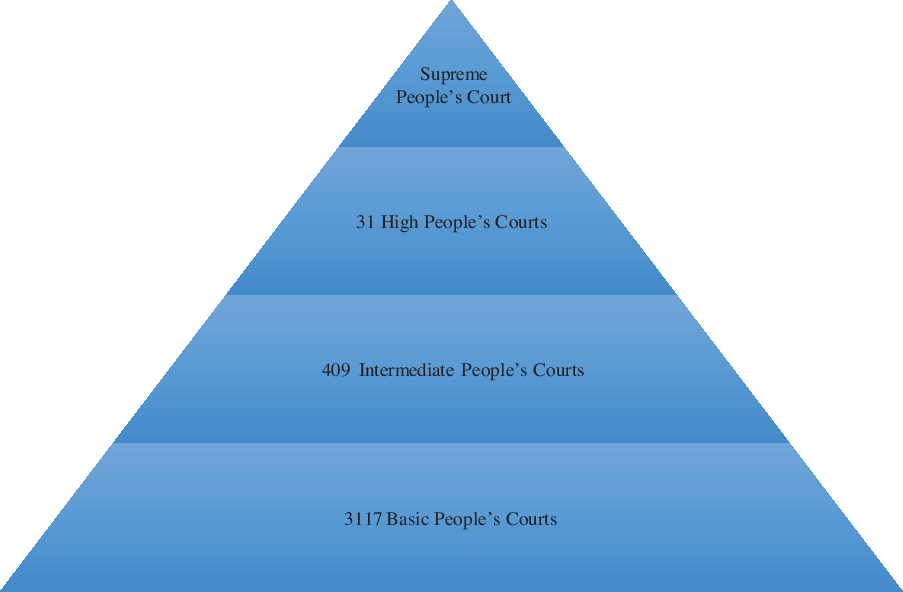
Although the various levels of the Chinese courts differ from one another, examining how the HPCs adjudicate eminent domain disputes offers a first step toward understanding the role of the courts in curbing eminent domain power in China. Figure 1 illustrates the overall structure of the Chinese judiciary.
Structure of the Chinese Judiciary.

Our specific interest in this research was determining how the HPCs choose among the three legal doctrines in eminent domain, namely, public interest, just compensation, and due process, and whether court support for or rejection of the application of a doctrine is correlated with the final litigation results. Regarding the proceduralization of just compensation and public interest we discussed earlier, we include all procedures in the category of due process, including prior notice to condemnees, public hearing in which the purpose of the condemnation can be debated, and a preliminary procedure of negotiation between the condemnor and condemnee to achieve just compensation. What remain in the categories of public interest and just compensation are substantial discussions on what public interest mean and what constitute just compensation without referring to specific procedures.
High People’s Courts and Judicial Transparency
The HPCs are also the main implementers of the SPC’s decision to publicize judicial decisions, and on average are more transparent than lower-level courts (Ma et al. Reference Ma2016). They are also more rule-oriented and subject to closer monitoring than lower-level courts, largely because of their much lighter case load and proximity to the SPC.
We investigated the mechanism by which cases are released to the Website and interviewed judges who specialize in eminent domain administrative litigation therein to gauge whether there is a systematic practice in not uploading certain kinds of eminent domain decisions. We interviewed one judge from the Guangdong HPC and one from the Shanghai HPC. Both confirmed that they have uploaded all of the eminent domain cases they have handled. We also interviewed an SPC judge and an official from the CCP Central Committee’s Bureau of Legal Affairs who had worked at both an intermediate court and the Supreme People’s Procuratorate before assuming his current position. In these interviews, we focused on how judges upload their decisions to the court system, what motivates them not to upload a decision, and what approval is needed if they decide not to upload a case.
Uploading is conducted by the handling judge’s secretary, who archives case files after a case is closed. Since the SPC’s launch of the Website, judges’ secretaries must also upload judicial decisions to the Website. There is a unified system within the courts, and the default rule is to upload judicial decisions. Otherwise, the judge concerned needs to tick one of the boxes at the bottom of the webpage indicating which exception applies, Footnote 2 and his or her decision then needs to be reviewed and approved by a more senior judge.
Because of the default rule and the extra work involved in not uploading a case to the Website, judges require a strong motivation to apply for an exception. Unlike their counterparts in lower-level courts, HPC judges have no personal interest in eminent domain cases, and nor do their leaders. The best strategy for judges, an HPC judge informed one of the authors, is to follow the law and make the final result of a case publicly available.
All three judges and the party official rejected the view that eminent domain cases are too sensitive to upload to the Website. Although their denial does not of course constitute conclusive evidence of the completeness of our data, considering that our primary concern is judges’ choice of legal doctrines, it does suggest that there is no reason to believe that the Chinese courts are biased against one doctrine or another in deciding whether or not to upload a decision.
Data Extraction Strategy
As a first step in our systematic investigation of Chinese judicial decisions on eminent domain, we chose to focus on judgments awarded from January 1, 2014 to December 31, 2015 because the Website was launched in 2014 and we collected our data in 2017. Data from before 2014 are significantly fewer in number than and incomparable with those from 2014 and 2015. Given the lag in the uploading of eminent domain cases, we decided to wait until a later stage to analyze cases adjudicated in 2016.
The SPC (2013) has promulgated technical and format rules on publishing judicial decisions on the Website, including a rule for naming cases. According to this rule, a case in which an individual property owner challenges an eminent domain decision should be named following the format “X Sues Y Government Expropriation/Demolition Administrative Adjudication No. 123.” Accordingly, we extracted all administrative adjudication judgments whose title contained the word “demolition” or “expropriation.” We made our last extraction on December 19, 2016. Extraction resulted in 678 cases in total (557 expropriation decisions and 121 demolition decisions). After reading through all of these decisions, we discarded ninety-two that did not directly target the effectiveness of eminent domain decisions. In the end, we hand-coded 586 effective judicial decisions. A detailed description of our data is presented in the following section.
An Explanation of Coding
Chinese adjudication decisions (判决书) are standardized documents that include the seven following parts.
-
Part I: Dispute Parties and Their Representatives
-
Part II: Basic Facts and Litigation Process
-
Part III: Key Dispute Points
-
Part IV: Plaintiff’s Argument
-
Part V: Defense’s Response
-
Part VI: Evidence
-
Part VII: Court Decision: 1. Decision on Dispute Points; 2. Decision on Case Result
We determined whether a claim was raised as a key dispute point by examining Part III of the judicial decisions in our dataset, and then considered how the point had been decided with reference to Part VII.1. In the standardized, clearly structured documents, the answer concerning whether a claim was raised in Part III and how the court decided it in Part VII was a straightforward yes or no. In the small number of cases in which a claim raised in Part III was not explicitly addressed in Part VII, we coded them as the court overruling the claim.
Postgraduate students with LLB degrees from leading Chinese law schools implemented the coding process for us. The authors developed a coding book with the assistance of two research assistants (RAs) by carefully reading fifty decisions. We then conducted a pilot project in which four additional RAs coded another twenty decisions separately and then compared their results in group meetings to ensure that all RAs understood the coding book, which was revised on occasion to ensure clarity in the same way. Finally, we assigned the remainder of the decisions to all six of our RAs and periodically conducted mutual checks.
DATA DESCRIPTION
Overall Characteristics of the Data
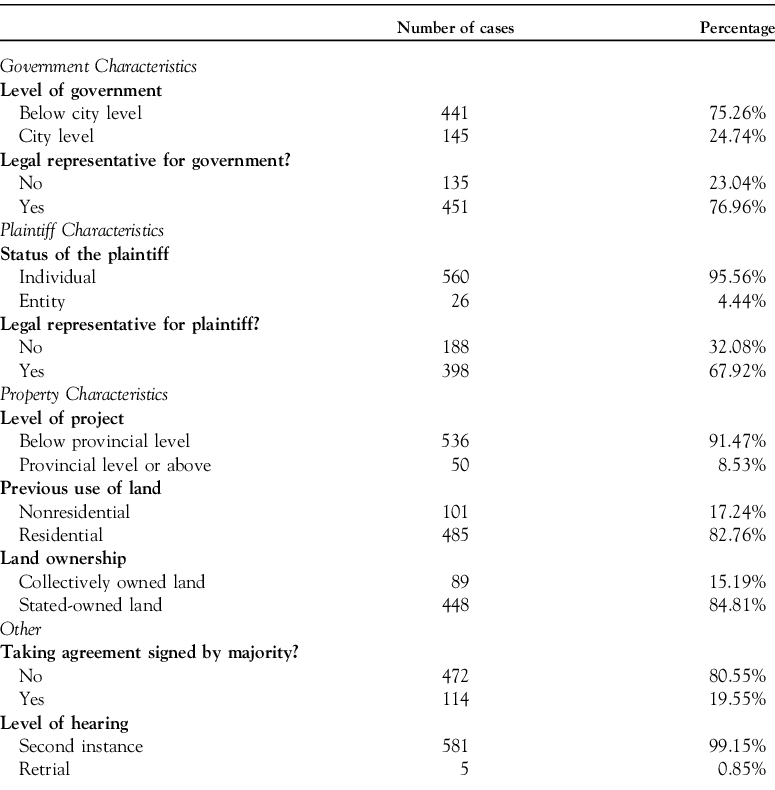
Table 1 presents the overall characteristics of the 586 cases considered. It can be seen from the table that it is city-level governments or below that plaintiffs sue for illegal condemnation. This was the situation in 100 percent of the cases we considered, with city-level governments being sued in about 25 percent of the cases, and local governments below that level in about 75 percent, which reflects the fact that under Chinese law city- and county-level governments and their agencies are in charge of eminent domain. In roughly 77 percent and 68 percent of the cases, the government and plaintiff, respectively, had legal representation. Projects implemented by city- or lower-level governments often require approval from a higher-level government. However, only fifty of the projects in the 586 cases considered had been approved by a provincial or higher-level government. All of the others remained in the hands of city- and county-level governments. Table 1 also shows that in most of the cases, the previous land use was residential, which may also explain why the plaintiffs in most cases were individuals. Further, the expropriated land in about 85 percent of the cases was stated-owned, with the remaining 15 percent being collectively owned.
Overall Characteristics of Eminent Domain Cases

Moreover, the judgments in 114 cases (roughly 20 percent) mention that the majority of “condemnees” affected by the project concerned had already signed an agreement with the “condemnor.” This is an interesting finding because Chinese law does not consider the status of such agreements to be a factor in determining the legality of a takings decision. Does majority approval have an impact on a court’s final decision concerning the legality of an eminent domain project? Scholars (e.g., Heller and Hills 2007) have proposed land assembly districts in which the majority decides whether an economically driven redevelopment project should go ahead despite minority owners holding out, but none to date has written about such practices in any given jurisdiction. Accordingly, we could find the answer through regression analysis.
Finally, most of the judgments in our dataset are second-instance decisions, which is unsurprising because, under Chinese law, the first-instance jurisdiction over eminent domain belonged to either basic-level (i.e., county- or district-level) or intermediate-level (i.e., city-level) courts before the 2015 amendment to the ALL. As that amendment took effect on May 1, 2015, cases initiated in accordance with the amended ALL could not have reached the second-instance stage by the end of 2015. Hence, the previous ALL applied to all second-instance judgments issued by the HPCs from 2014 to 2015. Retrials are part of China’s trial supervision procedure, and take place after cases have been finalized and are effective. However, litigants are not entitled to a retrial, which is at the discretion of the courts. There were only five retrial cases in our dataset.
Table 2 presents the overall outcomes of the 586 cases. In our dataset, the plaintiff won 28.33% of cases against the government, which is not a low percentage compared with the overall success rate for plaintiffs in administrative litigation. Professor He Haibo (2016) of Tsinghua University reports that the success rate in administrative litigation against the government in all Chinese courts stood at just 13.3 percent from 2014 to 2015. In 2014, the deputy director of the SPC administrative division revealed that the overall win rate for plaintiffs involved in such litigation after 2010 was less than 10 percent (Zhang 2014). Various Chinese news agencies have reported a similar success rate for plaintiffs in administrative litigation (e.g., People.cn 2014; Xinhua Net 2017).
Overall Final Adjudication of Cases

Apparently, different levels of the courts perform differently in administrative litigation. Higher-level courts have more autonomy and independence from the lower-level government agencies that are the defendants in such litigation, and hence may rule in favor of the plaintiffs more often. Simply transferring a case from a court within a government defendant’s jurisdiction to a court outside it can increase the plaintiff success rate. In Henan province, individual plaintiffs won roughly 26 percent of first-instance administrative litigation cases after the province began experimenting with transferring such litigation to courts outside the jurisdiction of the defendant government (He 2016). Although it is reasonable to speculate that individual plaintiffs have a greater chance of winning their case in the HPCs and the SPC, which are relatively independent compared with lower-level courts, without further data we are unable to determine whether the success rate of plaintiffs in eminent domain cases is higher or lower than that of plaintiffs in other kinds of administrative litigation.
Three Grounds for Reviewing Eminent Domain Decisions: Public Interest, Just Compensation, and Due Process
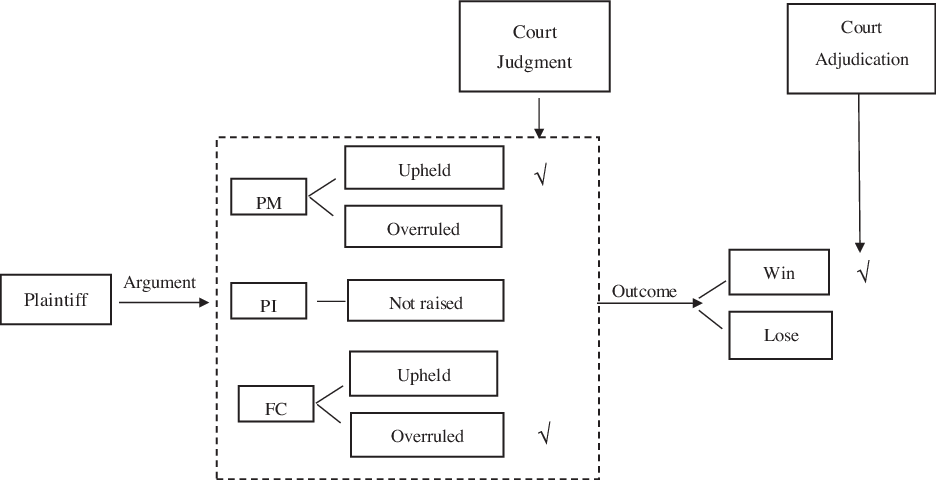
As described, there are three types of arguments that a plaintiff can present in eminent domain litigation against the government: (1) the government’s decision contains procedural mistakes; (2) the eminent domain project does not fulfill the public interest requirement; and (3) the compensation is not just. We dub the first type of argument Procedural Mistakes, the second Public Interest, and the third Just Compensation. A plaintiff can raise one, two, or all the three arguments in court, and the court can decide to uphold or overrule a particular argument. However, upholding a particular argument does not necessarily lead to the plaintiff winning the case. For example, we found quite a few cases in which the court confirmed that there had been a procedural mistake but still concluded that the mistake was not sufficient grounds to revoke the government’s eminent domain decision. Therefore, there are three layers of a judicial decision: (1) whether a particular argument is raised; (2) whether the court upholds that argument; and (3) whether the plaintiff wins his or her case against the government. Figure 2 illustrates the flow of a typical eminent domain case in court decisions.
Choice of Arguments, Decision on Arguments, and Litigation Result.
Note: PM = a Procedural Mistakes argument, PI = a Public Interest argument, and JC = a Just Compensation argument. √ = the court’s corresponding action.

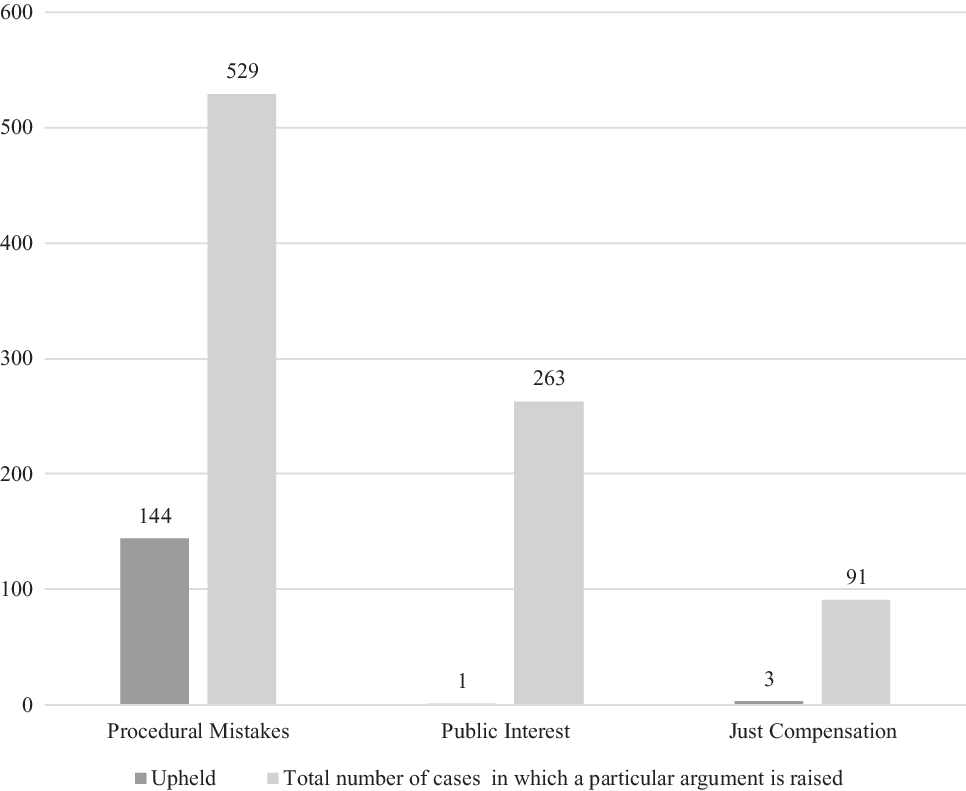
In 529 of the 586 cases, plaintiffs raised a procedural claim. In 263 cases, plaintiffs raised the claim that the government had taken private property with no public interest basis, and in ninety-one cases, the claim was that the compensation offered was not just. What is more interesting to note is that the courts upheld 144 of the procedural claims (27.2 percent), but rarely supported claims that a project had not been in the public interest or properly compensated.
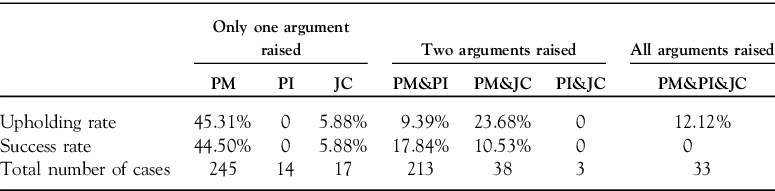
As noted above, a plaintiff can raise more than one argument in a given lawsuit. We therefore further sorted the cases into three categories: (1) those in which only one argument is raised; (2) those in which two are raised; and (3) those in which all three are raised. The results presented in Table 3 show that in most cases the plaintiffs raised only one or two arguments in court, with Procedural Mistakes and Public Interest arguments the most frequently raised, which is consistent with the general pattern depicted in Figure 3. However, the upholding rates for the three arguments differ. In general, the Procedural Mistakes argument was the most likely to be upheld, with cases based on that argument also the likeliest to succeed. In 245 of the cases, the plaintiffs raised only one argument. When that argument was based on procedural mistakes made by the government, the courts upheld it in 45.31 percent of cases, with the success rate for such cases standing at 44.5 percent. In no case considered was the Public Interest argument raised on its own, whereas the Just Compensation argument was raised in isolation in just seventeen cases, only one of which was won by an individual plaintiff. These results further confirm the dominance of due process in the eminent domain decisions of Chinese courts.
Upholding and Success Rates for Different Combinations of Arguments

Note: PM = Procedural Mistakes argument; PI = Public Interest argument; JC = Just Compensation argument. The upholding rate in the case of two arguments refers to both or either of those arguments being upheld, for four upholding situations: 1) both PM and PI upheld; 2) both PM and JC upheld; 3) PM upheld and PI overruled; and 4) PM upheld and JC overruled. In cases in which all the three arguments were raised, PM alone was upheld.
Number of Cases in which a Particular Argument Was Raised by a Plaintiff or Upheld by the Court.

The foregoing tables and figures afford us a rough idea of the various impacts of the three arguments on the final outcomes of the cases considered. As we have seen, the Procedural Mistakes argument is far likelier than the other two arguments to be upheld by the courts, with the Public Interest and Just Compensation arguments often overruled. To further examine the impact of particular arguments on the final litigation outcome, we conducted empirical estimation, the results of which are reported in the following section.
EMPIRICAL METHODOLOGY AND RESULTS
Variables
Litigation Outcome
The dependent variable in this article is the final litigation outcome. The plaintiff loses the suit when the court decides to sustain the administrative act of the government concerned. The plaintiff wins the suit when the court repeals the administrative act or confirms its illegality or the government withdraws the act voluntarily. Therefore, we constructed a dummy variable, i.e., Win, as an indicator of whether a plaintiff wins his or her case:
-
Win = 0 if the court sustains the administrative act, i.e., the plaintiff loses the case; and
-
Win = 1 if the court repeals the administrative act or rules it to be illegal or the government withdraws the act voluntarily, i.e., the plaintiff wins the case.
Arguments Raised by Plaintiffs
Our key independent variables are the arguments that a plaintiff can raise in opposition to a given government administrative act, i.e., Procedural Mistakes, Public Interest, and Just Compensation. Not every argument has to be presented, and each one presented can be either upheld or overruled by the court. In other words, each argument has three possible statuses: (1) not raised by the plaintiff; (2) raised by the plaintiff and also upheld by the court; and (3) raised by the plaintiff but overruled by the court. Accordingly, to determine how a court’s judgment regarding the arguments raised (i.e., to uphold or overrule them) affects the litigation outcome (i.e., whether the plaintiff wins or loses the case), we proxy each argument by adding two dummy variables. Take the Procedural Mistakes argument for example. Its status is indicated by two dummy variables: PM_Upheld and PM_Overruled. If that argument is both raised by the plaintiff and upheld by the court, then the two variables (PM_Upheld, PM_Overruled) take the value of (1,0); if it is overruled by the court, they take the value of (0,1); and if it is not presented at all, they take the value of (0,0). Similarly, we proxy the Public Interest and Just Compensation arguments by adding the dummy variables of PI_Upheld and PI_Overruled and JC_Upheld and JC_Overruled, respectively. Therefore, the coefficients of Upheld and Overruled for each argument are our main interest in estimating the influence of a court judgment concerning a particular argument (i.e., to uphold or overrule it) on the final adjudication of the case (i.e., whether the plaintiff win or loses the case).
Other Attributes
Although the arguments presented by the plaintiff in a given case are the crucial determinants of the court’s final adjudication in that case, we also need to take other potentially influential factors into consideration. Hence, we include plaintiff characteristics, government characteristics, property characteristics, and other characteristics as control variables.
Plaintiff characteristics include Number (measured by the number of litigants in the case), Plaintiff representative (a dummy variable indicating whether the plaintiff has legal representation), and Individual (a dummy variable indicating whether the plaintiff is an individual). Government characteristics include Government representative (a dummy variable indicating whether the government hires legal representatives) and Level of government (a dummy variable indicating whether the government is at the city level). Property characteristics include Project level (a dummy variable indicating whether the project necessitating the taking of land is approved by a government at the provincial level or above), State-owned (a dummy variable indicating whether the land is state-owned or collectively owned), and Residential (a dummy variable indicating whether the previous land use was residential). Finally, other characteristics include Hearing level (a dummy variable indicating whether the case is a retrial) and Majority (a dummy variable indicating whether the majority of individuals or parties affected by the eminent domain issue signed the takings agreement offered by the government).
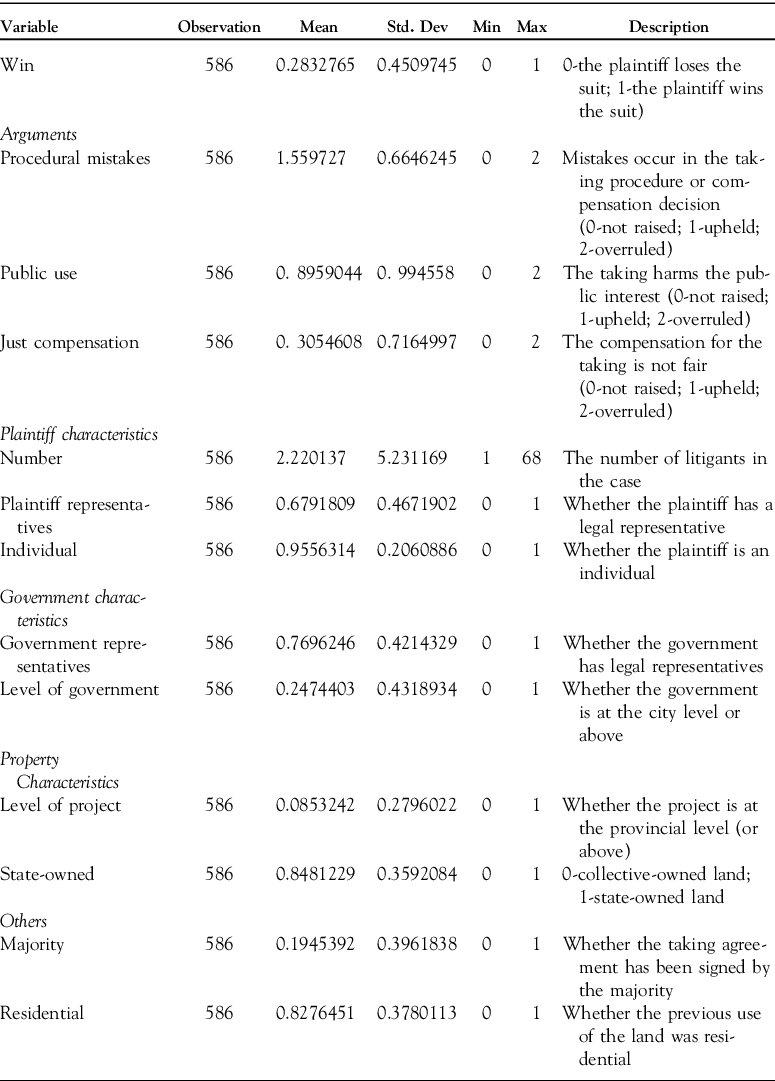
Table I in the appendix presents statistics on and a description of the dependent, independent, and control variables.
Regression Model and Results
We establish our empirical estimation using a simple ordinary least squares (OLS) modelFootnote 3 :
 $$\matrix{
{{\rm{\& }}Win = {\alpha _0} + {\alpha _1}\;PM\_Upheld + {\beta _1}\;PM\_Overruled} \cr
{{\rm{\& }}\;\;\;\;\;\;\;\; + {\alpha _2}\;PI\_Upheld + {\beta _2}\;PI\_Overruled} \cr
{{\rm{\& }}\;\;\;\;\;\;\; + {\alpha _3}\;JC\_Upheld + {\beta _3}\;JC\_Overruled} \cr
{{\rm{\& }}\;\;\;\;\;\;\;\; + Controls\;\zeta + \varepsilon ,} \cr
} $$
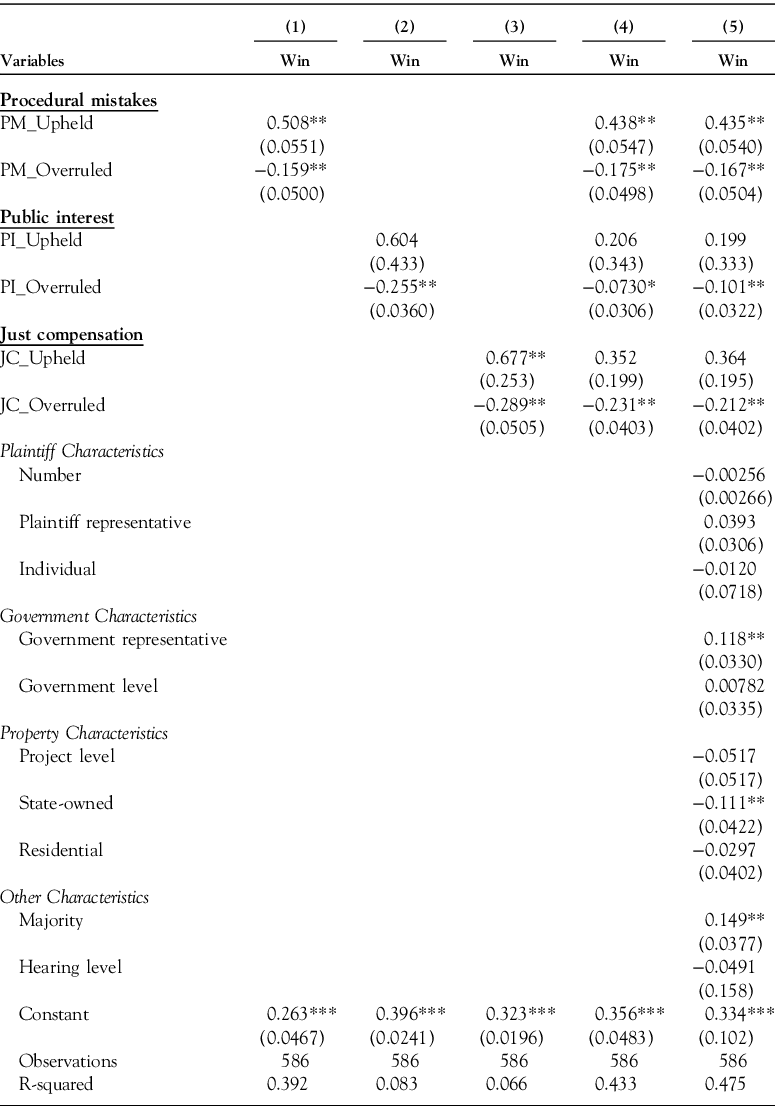
where Win is the dependent variable (Win = 0 if the plaintiff loses the case; Win = 1 if the plaintiff wins the case); PM_Upheld, PM_Overruled, PI_Upheld, PI_Overruled, JC_Upheld, and JC_Overruled are independent variables indicating whether the particular argument raised by the plaintiff is upheld or overruled by the court; αi and βi are the coefficients of those variables; i = 1,2,3; αo is a constant; Controls is a set of control variables, with ζ the corresponding coefficients; and ε is a random error term that follows a standard normal distribution. We first ran the regression with each argument and with all three arguments separately, and then ran the full model with the controls added. The results are presented in Table 4, with several findings singled out for note in the following paragraphs.
Regression Results

Note: Standard errors are in parentheses; * represents a p-value of less than 0.05, and ** represents a p-value of less than 0.01.
(1) Procedural Mistakes is the determinative argument
For the Procedural Mistakes argument, PM_Upheld is found to exert a significantly positive effect on a case win for the plaintiff, whereas PM_Overruled exerts a significantly negative such effect, which indicates that the plaintiff is more likely to win (lose) the case if that argument is upheld (overruled) by the court. This pattern holds for the Procedural Mistakes argument in all models, i.e., columns (1), (4), and (5) of Table 4.
For the Public Interest argument, in contrast, a significant result is found only for PI_Overruled in all models (i.e., columns (2), (4), and (5) of Table 4), which implies that having the court uphold that argument fails to significantly increase a plaintiff’s chances of winning the suit, although having it overruled significantly lowers those chances. The explanation is simply that, overall, the courts in our dataset upheld only one public interest claim, and therefore the impact on the case outcome of upholding such a claim was insignificant. Also, condemnees may throw in a public interest claim when their core procedural claim is weak, which explains why overruling such a claim significantly lowers a plaintiff’s chance of winning.
Finally, the results for the Just Compensation argument display a similar pattern to those for the Public Interest argument, i.e., significance appears only in the negative coefficient when the argument is overruled by the court. Note that when we tested the correlation between the Just Compensation argument and the final case outcomes without considering the other variables, significance was obtained for both JC_Upheld and JC_Overruled, as shown in column (3) of Table 4. However, when we pooled all of the arguments together and added the controls, the positive correlation disappeared, as shown in column (5). Intuitively, this result means that individual plaintiffs win very few just compensation claims, although the courts’ upholding of such a claim does increase the odds of a case win.
The differing performance of the three arguments is consistent with our conjecture that courts are more likely to support a plaintiff (i.e., the plaintiff is more likely to win the suit) if they uphold a procedural claim, whereas claims based on public interest or just compensation have no such positive effect.
(2) Other factors: Lawyers, land ownership, and majority approval
It can be seen from column (5) of Table 4 that several control variables, i.e., Government representative (Government characteristics), State-owned (Property characteristics), and Majority (Other characteristics), are significant.
Do lawyers help? The positive coefficient on Government representative indicates that individual plaintiffs are more likely to win a case against the government if the government hires external counsel, which is a counterintuitive result. One potential explanation is that governments are more willing to hire external counsel when they are less confident about the strength of their case. It should also be noted that governments in China usually employ internal lawyers, which is why the government did not hire external counsel in 23.04 percent of the cases considered in this research. Interestingly, we find no significant result for Plaintiff representative, which indicates that hiring a lawyer does not necessarily increase a plaintiff’s probability of winning. Overall, lawyers make an insignificant contribution to the final case outcomes in our dataset.
Does land ownership matter? The significantly negative coefficient on State-owned land indicates that it is difficult for a plaintiff to win a case involving the expropriation of state-owned land. A fairly common argument that governments make in cases involving the taking of houses located on state-owned land is that those houses are illegal, either because the householder failed to apply for a permit or because the house exceeds the terms of the land use permit concerned. There are fifty such cases in our dataset, all of which were lost by the plaintiffs. The implication is that the governments of cities in which land is state-owned can use zoning to facilitate eminent domain projects.
Does majority approval help? As discussed above, negotiation with condemnees is required as a preliminary procedure to a coercive expropriation decision. Condemnees who sign an expropriation agreement with the government may still dispute the way in which that agreement is enforced, but in general it is dissenting condemnees who do not sign such an agreement who face coercive expropriation and engage in administrative litigation as a remedy. The positive coefficient on Majority is thus a little puzzling. We expected the opposite, as it would be natural to assume that a taking with majority approval would be more likely than one without to conform to the public interest and attract little opposition, meaning that the administrative act in question should be more likely to be sustained.
To find an explanation for this unexpected empirical result, we looked more closely into the cases in which the majority had signed an agreement with the government. We found that of the 114 cases mentioning that the majority of condemnees had signed such an agreement, the courts sustained the government’s eminent domain decision in seventy-eight cases. They revoked it in six cases and confirmed its illegality in four. In the remaining twenty-six cases, the government voluntarily revoked its decision regarding the plaintiff’s property. Why would a government revoke an eminent domain decision in cases in which it had signed an agreement with the majority of property owners concerned? In answering that question, it must be noted that it was only the government’s decision regarding the plaintiff’s property that was revoked in these cases; its agreements with other property owners remained valid. It is highly likely that the governments involved in these cases simply did not want to expend the time and resources needed to respond to the suits, and thus removed the disputed property from the eminent domain project concerned. In other words, with the majority already having signed the takings agreement, the loss of one or two so-called “nail houses” (owned by the plaintiffs in the suits concerned) might not necessarily affect the overall eminent domain project. It is difficult to speculate about what the final adjudication outcome or its impact on the project as a whole might have been had the governments in question devoted greater effort to fighting the suits. It is completely rational for a condemnor to revoke an eminent domain decision concerning a plaintiff’s property, thereby removing it from the project concerned. Doing so makes even more sense considering that economic development is the purpose of most eminent domain projects in China and that most properties within the scope of eminent domain are not strategically located.
Robustness Checks
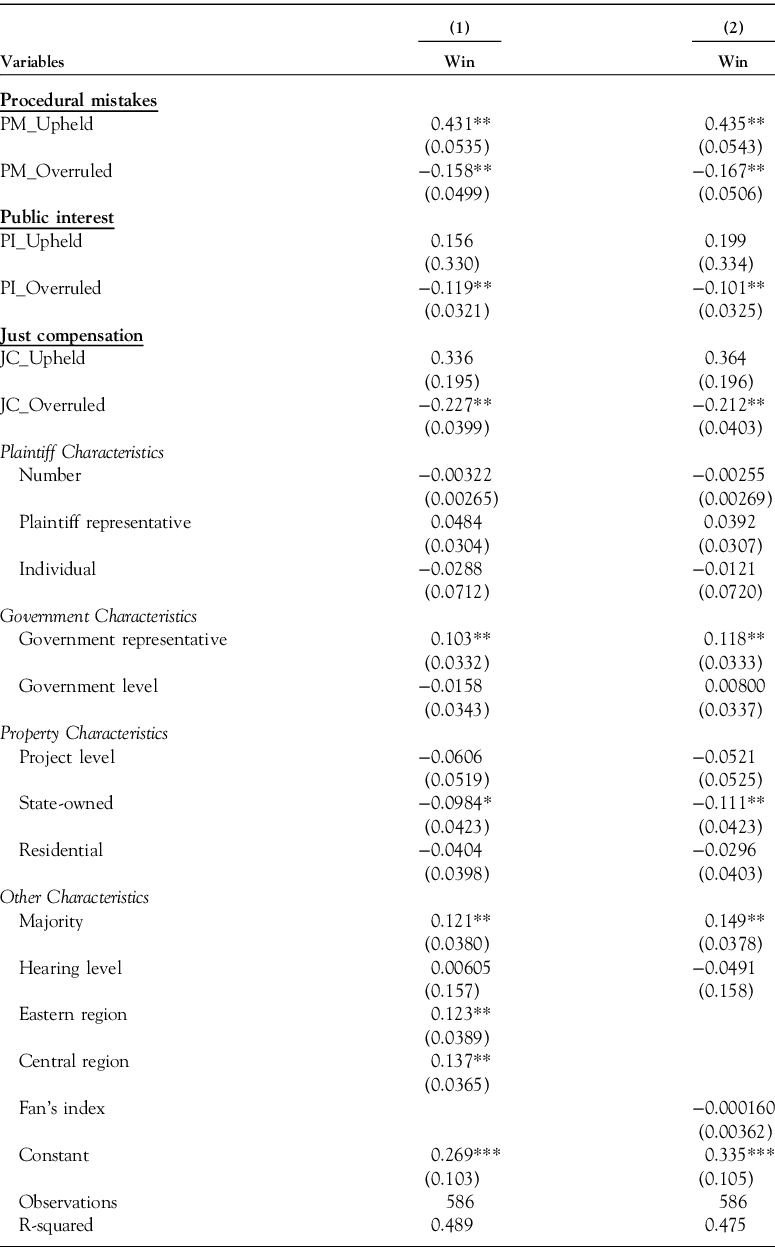
We checked the robustness of our results by adding additional controls to our original OLS model. More specifically, we ran the full OLS model (with all of the independent variables and controls noted in the previous analysis) separately, controlling for (1) regional differences and (2) legal environment.
Regional Differences
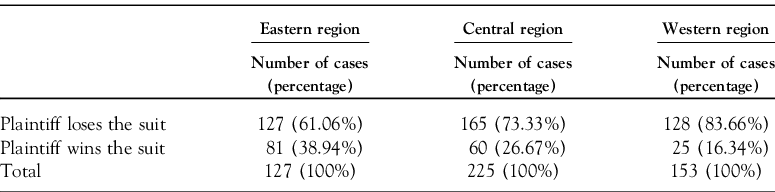
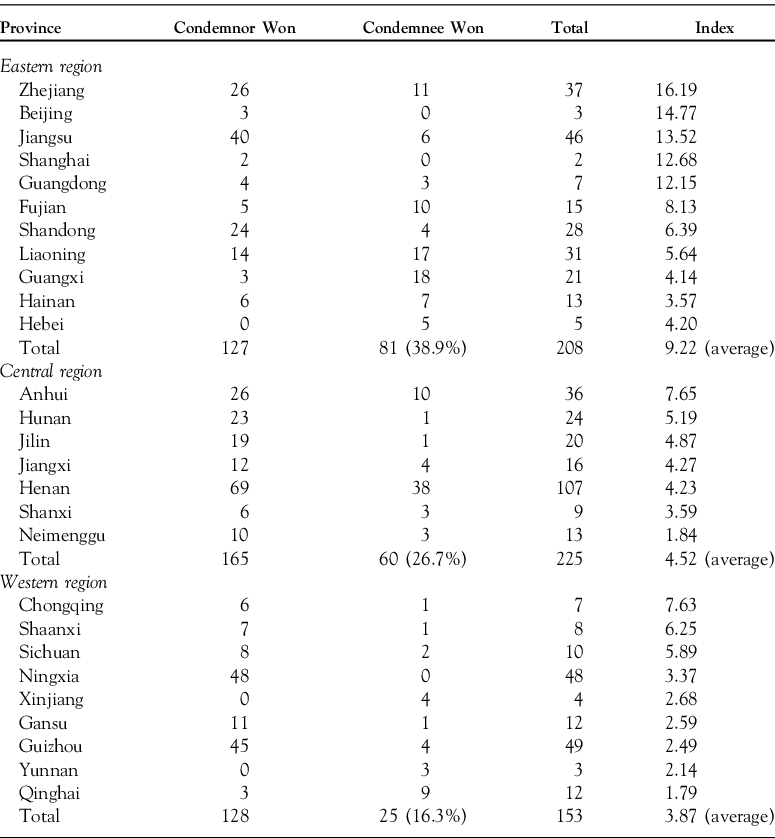
We first separated the cases according to the location of the court in question. Eleven provinces (or cities) in the eastern region of China, seven in the central region, and nine in the western region are represented in our dataset. Table 5 summarizes the outcomes of cases heard in these three regions of the country.
Final Adjudication of Cases in Three Main Regions

It is clear from the table that central China accounts for the largest number of cases, i.e., 225, most of which took place in Henan province, as shown in Table 7. We then constructed two dummy variables, Eastern and Central, indicating the region to which a case belongs, with the western region set as our baseline. It can be seen from column (1) of Table 6 that our main result holds when regional differences are taken into consideration: the coefficient on the upholding of the Procedural Mistakes argument (i.e., PM_Upheld) is significantly positive, whereas the two other arguments are not significant, and all of the coefficients on Overruled (i.e., PM_Overruled, PI_Overruled, JC_Overruled) are significantly negative. The results also remain the same for the coefficients on Government representative, State-owned, and Majority. Moreover, the significantly positive coefficients on Eastern and Central indicate that cases in these two regions are more likely to result in a win for the plaintiff than those in the baseline western region.
Robustness Check

Note: Standard errors are in parentheses; * represents a p-value of less than 0.05, and ** represents a p-value of less than 0.01.
Legal Environment
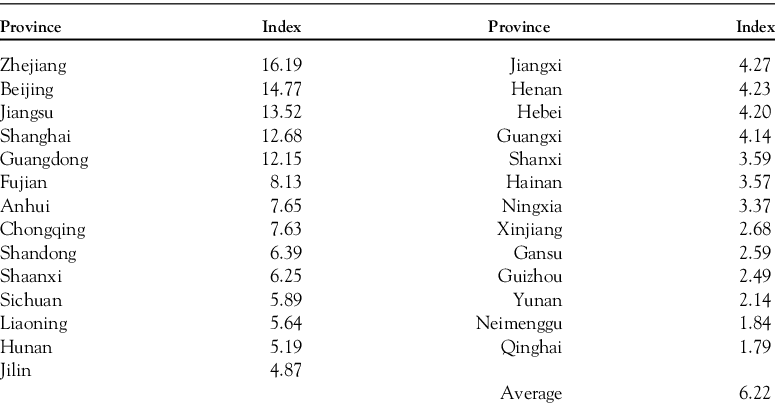
As a second robustness check, we used the province-level marketization subindex for Legal environment produced by the National Economic Research Institute (NERI) of China to approximate the efficiency of the legal system in different provinces in resolving legal disputes.Footnote 4 This subindex, which is calculated from official statistics and surveys of enterprises and households using 2001 as the base year, is scored from 0 to 10, with a higher score indicating a more complete, well-formed legal environment. Researchers have shown these NERI subindex scores to effectively reflect the progress of marketization in China (Wang et al. 2008; Fan et al. 2011). Because most of the cases in our dataset were heard in 2014, we used the index scores for that year. Table II in the appendix lists the index score for each province. It can be seen that Zhejiang province has the highest (i.e., 16.19), indicating that its legal system is much better developed than those of other provinces. Qinghai province, in contrast, has the lowest index score (i.e., 1.79), indicating an imperfect such system. We also calculated the average index value for each of the three aforementioned regions, with the eastern region found to have the highest value, followed by the central and then the western region. This pattern is quite consistent with the economic development of the three regions. Table 7 lists the final adjudication outcomes of cases heard in various provinces. As previously noted, Henan province accounts for the most eminent domain cases (i.e., 107), whereas Beijing accounts for the fewest (i.e., 3), and there is clear interprovince variation in the adjudication outcomes: condemnees have the highest chance of winning in eastern provinces (38.9 percent), and the lowest in the western provinces (16.3 percent), with the central provinces falling in between (26.7 percent).
Litigation Outcome by Province

Note: Our search revealed no cases adjudicated by the HPCs of Tianjing, Heilongjiang, Hubei, or Tibet
As the extent of a legal system’s completeness may influence the judgments made by its courts, we included the legal environment index variable as a control variable to determine whether our main result holds. Column (2) of Table 6 shows that all of the previous results for Arguments, Government representative, Stated-owned, and Majority still hold, and, in fact, the coefficient on the index is not significant, indicating that a court’s choice of legal doctrine is little affected by the perfect or imperfect nature of the legal environment in which it operates.
CONCLUSION: A DUE PROCESS REVOLUTION IN EMINENT DOMAIN?
Which of the three legal doctrines of interest in this article, i.e., public interest, just compensation, or due process, is the most effective in constraining abuses of eminent domain power by Chinese local governments? How do Chinese courts choose among the three doctrines in adjudicating expropriation litigation? In 529 of the 586 cases we investigated, the plaintiffs raised a procedural claim. In 263 cases, they claimed that the government had taken private property with no public interest basis, and in ninety-one that the compensation offered was not just. Just to clarify, these findings do not mean that the plaintiffs involved in such cases are primarily concerned about due process per se. Their concern is to achieve a particular end. For plaintiffs, that end is most likely to be obtaining additional compensation from the government. In other words, the proceduralization of just compensation is also in operation in condemnees’ claims.
Overall, the HPCs in our dataset supported 27.22 percent of the procedural claims brought before them (see Figure 3). The percentage was higher for cases in which the plaintiff raised procedural claims alone, with judges supporting 45.31 percent of such claims and the cases concerned achieving a win rate of 44.5 percent (see Table 3). Our regression results also revealed a positive correlation between upheld procedural claims and a win for the individual plaintiffs concerned. In contrast, the courts supported only 0.38 percent of public interest claims and 3.30 percent of just compensation claims (see Figure 3), and no significant correlation was observed between the upholding of either claim and the condemnee’s chance of winning in court. How can Chinese courts’ preference for procedure be explained?
As discussed in Part 2 above, procedures are more determinate than public interest and just compensation and can enfranchise condemnees in the eminent domain decision-making process. Ascertaining whether a public hearing has been held is much easier than determining—substantially and policy-wise—whether a project is in the public interest. It is also easier to check whether a property appraisal agency has been randomly selected than to decide whether the amount of compensation is just. For external procedures that enfranchise condemnees, it is easy to verify whether such procedures have or have not been followed. The determinate nature of procedural rules also resolves one of the dilemmas the Chinese judiciary faces: the Chinese central government empowers the judiciary to monitor and control local governments, but does not want it to become too powerful. Accordingly, for self-preservation purposes, the courts do not want to go too far in checking administrative power. Sticking to due process on the one hand fulfills their function as defined and desired by the central government and, on the other hand, confines the scope of judicial empowerment.
Another notable aspect of due process is that it focuses on the process rather than the outcome of eminent domain. As explained in Part 2 above, Chinese local governments rely on real estate expropriation for revenue and economic development. The question of how to balance economic development and social stability is a policy question that local government leaders are much better at answering than judges. Just compensation in China is not about the fair market value of the condemned property; it is about how to allocate the surplus value generated by expropriation. Current Chinese law on the one hand entitles condemnees only to the pre-condemnation value of their real estate and, on the other hand, imposes negotiation as a preliminary procedure to coercive expropriation. Hence, Chinese judges can at most check whether procedural requirements have been followed. They have no authority or expertise to decide what specific allocation of the surplus value is just.
On the whole, it is politically safe and practically feasible for the Chinese courts to review whether local governments have exercised their eminent domain power in accordance with the procedures laid out in national laws. In reviewing procedures, the courts are not challenging the political authority, but rather helping upper-level governments to monitor lower-level governments and granting limited justice to aggrieved condemnees. In this sense, our research also represents the first attempt to introduce the “judicial politics of legal doctrine” approach to the study of Chinese administrative litigation and the Chinese courts in general. We need to take both legal doctrines and political institutions seriously in studying Chinese law.
Many Chinese scholars and policymakers have focused on clarifying the meaning and scope of public interest and just compensation as means to protect individual property rights. From the perspective of the Chinese courts, which are essential to the implementation of legislative definitions of public interest and just compensation, however, the hope of constraining local governments’ eminent domain power by substantial standards is futile. Focusing instead on the procedures by which local governments exercise such power has proved to be a far more feasible approach, and one that also offers some protection for individual property rights. Any future reform of China’s eminent domain regime would be advised to place more emphasis on due process than on public interest or just compensation. Of course, proceduralization of the latter two doctrines, i.e., defining the procedures for determining public interest and just compensation in a given context, is already an effective approach in Chinese law and worthy of further pursuit.
The due process revolution in American administrative law is well-documented: contemporary administrative law doctrine and scholarship still give administrative agencies broad substantive deference, but far less procedural deference than they did before 1960. Nevertheless, this revolution has not touched eminent domain research and practice in the United States (Claeys 2005), which is unfortunate and serves to explain why, in the aforementioned Rhode Island case, the property owners remained unaware of the eminent domain decision until the government had taken control of their property. As demonstrated herein, in the Chinese case, administrative procedures provide a middle road for reforming eminent domain practices. Legislators, judges, scholars, and the general public alike are divided on what constitutes public interest (Somin Reference Somin2016) and just compensation (e.g., Bell and Parchomovsky 2010; Chang Reference Chang2011; Lee Reference Lee2013), both of which are context-specific and difficult to agree upon in the abstract. Eminent domain procedures, in contrast, are determinate rules with indeterminate outcomes. They serve the function of constraining administrative power while leaving sufficient administrative flexibility to the contemporary administrative state.
APPENDIX
Summary Statistics and Description

Note: To conveniently show the status of arguments, in Table I, each Argument variable takes three values (i.e., 0-not raised; 1-upheld; 2-overruled), whereas in the regression model, each Argument variable is transformed into two dummies, i.e., Upheld and Overruled, to indicate the status of an argument.
Index of Various Provinces

Source: National Economic Research Institute (NERI) data, as reported by Fan et al. (2016).