What do we mean when we say something is ‘Shakespearean,’ and how can we tell whether something is Shakespearean or not?
Ron RosenbaumFootnote 1No, Lear is easy. He's like all of us, really: he's just a stupid old fart.
Laurence OlivierFootnote 2Ian McKellen says that only nice people go to the theatre; they do, but sometimes on automatic pilot.
Brian CoxFootnote 3Between the summer of 2007 and 2008, theatre enthusiasts in Singapore were treated to a particularly Shakespearean year. Although there were other performances of Shakespeare's plays throughout the year, it is unusual to have two large-scale productions based on the same play in such a short span of time. In July 2007, the Royal Shakespeare Company (RSC) brought Trevor Nunn's internationally acclaimed production of King Lear, with Ian McKellen in the lead role, to the Esplanade Theatre. Less than a year later, Ho Tzu Nyen and Fran Borgia presented an ambitious work about Lear – The King Lear Project: A Trilogy – as part of the 2008 Singapore Arts Festival, just weeks after its premiere at the 2008 ‘Kunstenfestivaldesarts’ in Brussels. As its title suggests, Ho and Borgia's work is a three-part play, performed over three consecutive evenings (11–13 June 2008) at the Drama Centre Theatre.
The King Lear Project is especially provocative in relation to Nunn's King Lear and we cannot fully appreciate its mechanisms without first considering the reception of the RSC performance. Reviews of the Nunn–McKellen production are remarkably consistent. In England, the Telegraph observed, ‘It's been a long and frustrating wait for this King Lear, but Nunn and McKellen have undoubtedly achieved something beautiful and profound.’Footnote 4 In the United States, the New York Times announced, ‘the show never disappoints’.Footnote 5 The Straits Times of Singapore praised McKellen for his ‘uncompromising interpretation of this formidable role, one that reveals Lear's kindness and cruelty with equal force, to a standing ovation from a full house’.Footnote 6 The consistency of the reviews in all three continents and the sold-out performances suggest that the general public – critics and audiences – has a preconceived idea of what a definitive, ideal Lear production is like. Ho and Borgia's three-part Lear Project confronts these assumptions as the directors conduct their metatheatrical experiments through creative renderings of three critical works on Lear: Marvin Rosenberg's ‘Lear Enters’, Jonathan Goldberg's ‘Representations of Dover Cliff’ and G. Wilson Knight's ‘The Lear Universe’.Footnote 7
11 June 2008: Lear Enters
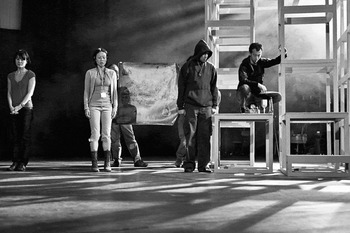
Ho and Borgia make no pretensions about their Lear Project: their advertisement in the Singapore Arts Festival 2008 catalogue tells audiences that it is not a production of Shakespeare's King Lear, but rather a series of plays that consider the processes of staging Lear.Footnote 8Lear Enters thus assumes the most basic aspect of putting together any play: casting. The set is minimal and is modelled after an audition-in-progress scene; it opens with a modest camera crew, a director (Kaylene Tan) and her assistant (Elizabeth Tan) onstage.Footnote 9 Props and costumes are brought onto the stage together with the rest of the cast: Goneril (Tan Kheng Hua), Regan (Janice Koh), Cordelia (Shu An Oon), Kent (Brendon Fernandez) and Lear's fool (Crispian Chan).Footnote 10 This scene sets up the underlying frame for Marvin Rosenberg's ‘Lear Enters,’ which considers the different archetypal and memorable Lears in performance history. Rosenberg does not conclude that one Lear is ‘better’ than another, but weighs their contributions, and in some cases their flaws, against what many believe to be Shakespeare's greatest tragedy.
The first auditionee in Lear Enters, or Lear No. 1, is played by the actor Remesh Panicker. Rosenberg's essay is brilliantly framed through the negotiation between director and actor as Kaylene – the director – presents the situation to the potential Lear. She gives Panicker full creative control over the audition. However, he must choose to audition for one of the following Lears: (1) God-Lear, (2) Mad-Lear or (3) Everyman-Lear. Panicker chooses the first, and picks out costumes and props that will fit God-Lear: a fur cloak, a large stick to substitute a sword, and a large map. Every item is oversized. He tells Elizabeth that the cast should prostrate themselves when he enters. But mere prostration, or kneeling, does not sufficiently elevate the divine status of this Lear:
ASSISTANT: What do you mean prostrate? Like this [?] (bows)
KING LEAR NO. 1: Lower.
ASSISTANT: Lower? (kneels down)
KING LEAR NO. 1: All the way.
(ASSISTANT lies flat on the floor.)Footnote 11
Under God-Lear's directions, the cast agrees to re-enact this exaggerated act for the opening scene, and the audition begins.
The division of the kingdom in Lear Enters. From left, Regan (Janice Koh), Goneril (Tan Kheng Hua), Kent (Brandon Fernandez) and Lear's Fool (Crispian Chan), perched on Lear's makeshift throne. All photos courtesy of Kunstenfestivaldesarts, Academie Anderlecht (Brussels). Additional thanks to Paul Rae and Ho Tzu Nyen.

A royal sennet ushers God-Lear and his procession onto the stage, and at once the audience can see that Panicker has made the right choice. His large frame, topped with a fur cloak, makes him a truly imposing Lear. And he carries himself well, too; his gait is purposeful and he hardly glances at those prostrated at his feet. This Lear knows he is a god. Accompanied by his loyal fool, he makes his way to the makeshift throne. Crispian Chan plays a magnificent fool. His small frame and childlike prance create a stark contrast to the comportment of his master, yet the profound relationship between king and fool is revealed in his flippant movements and his proximity to Lear. He is a restless fool who cannot keep still, yet in all his restlessness he remains reachable at an arm's length, thus creating an invisible bond between himself and the king, of which neither is intrinsically aware.
In a brief interview that follows the audition, Kaylene asks Panicker to explain the factors that motivated his decision: why God-Lear? For Panicker, Lear is not merely God-Lear – he is all three, but, he claims, there are ‘moments of divinity’ in everyone. Panicker's ideas of Lear, however, appear idealistic and convoluted at the same time: he associates the divinity of Lear with a characteristic inherent in Everyman, yet he performs the ‘moments of divinity’ as a stark contrast to Everyman. This Lear fails to find a place between humanity and divinity, and Panicker's explanations are not convincing. But is Lear supposed to be convincing?
DIRECTOR: Do you think Lear is a plausible or realistic character?
KING LEAR NO. 1: I mean Lear is not real. He is just a character from a play – and he can only be real only within the metaphor that the playwright created . . .
DIRECTOR: So are you a character from a play or just yourself?
KING LEAR NO. 1: I am just Remesh Panicker.
As God-Lear leaves the stage and the set is taken apart, preparing for the next audition, Kaylene takes centre stage and asks the audience, ‘So what do you think?’ The violation of the fourth wall never fails to cause confusion, and the audience responds in dead silence. A few awkward moments ensue, and when the lights begin to dim, the pressure is taken off the audience with the exception of one member, illuminated by a single spray of light. He is seated in the centre, in the front rows of the stalls. The audience now realizes that Kaylene's question is directed at this individual, who turns out to be the ghostly, mysterious dramaturge (Paul Rae).Footnote 12
The dramaturge is not unlike his director: his tone is cold and composed, yet his (perceived) expertise and remarks are tinged with self-importance, even arrogance. He is unimpressed with Panicker's God-Lear: Panicker's portrayal of Lear is a cliché as old as Shakespeare and God himself. But the dramaturge's main complaint concerns God-Lear's inadequate representation of humanity:
God-like Lear can dominate the stage, but it is never really about me. And if it's not about me, it's not about anything. Certainly, the actor has taken care to create a God who is flawed; and it is the flaw that authenticates the image as a work of art . . . But beyond a flaw, my question is whether this God-like Lear is capable of change . . . he seems to lack inwardness, interiority. Perhaps he becomes great only when he realizes that he is like any other man; an extraordinary Lear whose reduction to common humanity would be not the end of his greatness – but the beginning of it.Footnote 13
The search for Lear must continue.
Lear No. 2 (played by K. Rajagopal) is given the same audition instructions as Lear No.1. He chooses to play Mad-Lear. The cubes from the first audition are re-arranged into a horizontal U-shaped structure, and when this Lear is asked to pick his props, he selects a rope and a large map, but no costumes. The audition begins, and a whimsical sennet is sounded for Lear's entrance. He enters – naked save a white loincloth – dancing like a madman. His followers and daughters do the same; they chant, scream and prance about their leader with arms raised, as if possessed in a holy ritual. Lear No. 2 announces his darker purpose to the rest of cast, seated on the ground in a circle around him. In their exaggerated declarations of love, Goneril and Regan appear to be as mad as their father; Cordelia remains slightly less so. Yet it is not Lear's madness that appears strangely disturbing, but rather the rope around his torso that leashes him to his fool. This image gives another dimension to the Lear–Beckett connection in Jan Kott's study; Rajagopal's mad Lear world is more Waiting for Godot than Endgame.Footnote 14 No wonder this king is mad.
If Mad-Lear is too extreme to represent humanity, then we must turn to Everyman-Lear (performed by Gerald Chew). There is no throne in the last audition and the cubes are arranged into a lengthy table, which functions as a centerpiece for the cocktail-party setting. Clad in handsome business attire, Everyman-Lear commands undoubted respect and adoration from his followers. The actions of this Lear are carefully calculated, and he approaches his performance as he would a business proposition. The attendees at the party have been invited to witness the announcement of an important piece of news; the division of the kingdom. Before the audition, Everyman-Lear breaks a small map into three parts and inserts them into three folios – these are his title deeds. His announcement is in itself a performance within a performance as he lovingly approaches one daughter after another, clearly keen to display his paternal pride to bystanders. Cordelia's refusal to follow his self-penned script does not faze him – he merely laughs it off – though one can detect a sense of rage, forcibly contained, lest he lose his social graces. The self-conscious performativity of this Lear is made all the more apparent when, in a desperate attempt to salvage the embarrassment Cordelia has caused, he takes her aside and privately urges her: ‘How, how Cordelia! mend your speech a little, / Lest it may mar your fortunes.’Footnote 15 Lear appears to be more angered by the damage to his public image than by his seemingly ungrateful child. Thus, even when he displays his disbelief and hurt, we are not quite convinced whether he is truly shaken by Cordelia's brutal honesty or whether, to avoid looking foolish, he is stubbornly improvising on the invisible script that she has thwarted. But when did the middle-class Everyman become a CEO? Chew's Lear is hardly an Everyman by modern, capitalist sensibilities. And as for the dramaturge:
The King Lear of today is not a God, or a Madman or an Everyman. He is a pragmatic king, possessing neither body nor a tangible form, there is nothing but a self-deforming cast in a state of continuous transformation. Its power, when we sense it, is real, concrete and singular (pause). You and I . . . we are just figments of its imagination.Footnote 16
Rae's cryptic comments seem eerily plausible. He recognizes the cast and the audience as ‘figments of [Lear's] imagination’, but he does not seem quite ready to acknowledge that their Lear ceases to exist because of his approach. His Lear is an ideology, an abstraction, and not a playtext. He is a symptom of bardolatry. Along with the experimental nature in which the auditions are set, Rae's character is unwelcomed in Singapore and Brussels theatres.
Critics are generally sceptical of Ho and Borgia's anti-Lear. Lear Enters sets the tone for the two productions to follow, and even though the makers of The King Lear Project are praised for their innovative approach, critics – local and foreign – appear unsatisfied and unconvinced with the overall concept that underlies the work. Critics at the Singapore performance are immensely irritated with Rae's character and their objections against his role are so strong that they verge on suggesting that the play would be much improved without this character, or rather without his over-the-top brand of didacticism. A polite reviewer at the New Sunday referred to his commentaries as ‘convulated’ [sic], but others did not hesitate to express their annoyance: ‘[Rae], who gets the bulk of text book lines, delivered them with such cock-sure pretentiousness you wanted to duct-tape his mouth’.Footnote 17 (Rae ‘strikes back’ with his own responses, as a critic, scholar, and actor, in his contribution to this dossier, aptly entitled ‘Duct Tape His Mouth! On Being Judged’.) In Brussels, Michael Lathan lauded the play as a ‘bold experiment’ but could not locate the message that it was trying to convey: ‘I applaud experimentation, but the work staged here should have been part of the research process. They [Ho and Borgia] have moved from research to concept to stage too quickly . . . If this is experimental work, what exactly is the experiment?’Footnote 18 Lathan's question, echoed in other reviews, completely misses the whole point of the Lear Project. It is precisely the staging of the research process that works towards the theme of Ho and Borgia's work: can Lear be staged, and is there an ideal Lear? Indeed, if the research process is removed from the play, there will be no Lear Project to speak of: there is only mere Lear; and even though Ho and Borgia tell audiences that theirs is not a Lear production, audiences and critics – as this essay will reveal – cannot leave behind their expectations of a Lear-proper production, which in turn questions: has four hundred odd years of Shakespearean scholarship made it impossible for Shakespeare's play to have a life beyond the margins of the playtext? Can we tolerate representations of representing Lear? The second installment of The King Lear Project intensifies the investigation of these issues.
12 June 2008: Dover Cliff – The Conditions of Representation
Next, in Dover Cliff – The Conditions of Representation, the Lear Project's dramatization of what it takes to bring a playtext to the stage shifts from the scene of the audition to the more technical aspects of theatre production, framed as a series of rehearsals. Panicker (God-Lear) has been chosen to play the lead role. The cubes from Lear Enters are stacked to create a mini-mountain, and the play opens with Lear and his fool, both in raincoats. The king dons a pair of goggles, perched atop the structure. Against the sound of heavy rain and interspersed thunderclaps, Lear curses the storm.
The director interrupts this rehearsal and the scene onstage freezes. She addresses Paul, who, predictably, dismisses the rehearsal as a failure, and rightly so; the storm is so loud that the audience can hardly hear Lear's lines, much less his rage. In this storm, the urgency of Lear's words is all but lost in his meaningless shouts, and the audience is largely to be faulted for this:
DIRECTOR: (frustrated) Ok – never mind. Where are the sound, light and set designers? Don't you think you are overdoing the Sound and Fury?
SOUND [technician]: (referring to notes) It is written here in your script – that you wanted the most ferocious storm possible – that's why I gave you the loudest thunderclap,
LIGHT [technician]: (referring to notes) And the fiercest lightning.
In response, the actors agree that a realistic ‘Sound and Fury’ storm does not work, and from there they make several trial-and-error attempts at finding one that does.
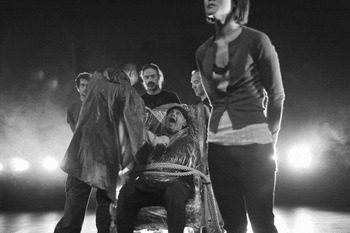
Blinding Gloucester in Dover Cliff – The Conditions of Representation. Foreground from left, Brendon Fernandez (Cornwall), K. Rajagopal (Gloucester) and Janice Koh (Regan).

Panicker suggests that the actor can ‘conduct’ the storm; it is all in the movement. Using a twig to symbolically demonstrate the forces of the fearsome storm, Lear and his fool shiver violently, this time against the more muted effects of thunderclap and lightning. Still worried about audience reception, Kaylene rejects Panicker's approach: ‘the audience of today might be disappointed, thinking the effect tame and lame, and the grandeur of the scene replaced by mere distress’. For her, the actor's skills are not enough to bring out ‘the turbulence Shakespeare designed’.
The second rehearsal in Dover Cliff comes from Act III, sc. vii, where Regan orders Gloucester's eyes to be plucked out. The preoccupations with this rehearsal are much the same as those in the storm scene: how realistic, and, more importantly, how spectacular should the act be. The set consists only of a chair, placed centre stage, in which Gloucester (Rajagopal) is bound. Cornwall's method of blinding Gloucester is not particularly spectacular, although he is keen to demonstrate the grotesqueness of the act by using his bare hands to gouge out the old man's eyes. Because of the position of the chair, Cornwall's back blocks the blinding.
The solution, then, is to turn the chair ninety degrees so that the audience can see Cornwall plunging his fingers into Gloucester's eyes. This second attempt seems successful. Not only do we see Cornwall's act, but we are also in full view of its consequence: massive amounts of red liquid spray out of Gloucester's eyes. The intended gore ends up looking comical, making Gloucester look more like a clown than a torture victim. Unsatisfied, Cornwall is convinced he can make the scene even more violent, more spectacular:
CORNWALL: (to director). . . can I say something?
The script reads:
‘See't shalt thou never. Fellows, hold the chair.
Upon these eyes of thine I'll set my foot.’
(pause)
Don't you think I should be stamping on GLOUCESTER?
REGAN: Yes, that's right, that's right!Footnote 19
The director fetches a set of spurs which Cornwall attaches to his boots, and the scene is rehearsed again. He declares: ‘Upon these eyes of thine I'll set my foot’, the servants quickly lower the chair (with Gloucester still bound to it), and Cornwall begins stamping his spurs into Gloucester's eyes to blind him. Needless to say, the act draws roars of laughter from the audience.
The final attempt – after a seemingly endless series of comical ones – turns out to be well worth the wait. Gloucester's chair is once more placed centre stage, in full view of the audience. The very second that Cornwall thrusts his fingers into Gloucester's eyes, the audience members are unexpectedly blinded by a row of floodlights and they instinctively shield their eyes. The experience, made even more disturbing by Gloucester's screams, is timed to precision with the flash of the floodlights and is startlingly disconcerting: we are blinded with Gloucester.
The last segment of the play dramatizes the staging of the Dover Cliff scene in Act IV, sc. vi, where Edgar talks (or tricks) Gloucester into an unsuccessful suicide attempt. The scene is central to Jonathan Goldberg's 1984 essay ‘Dover Cliff and the Conditions of Representation’. Goldberg considers the textual and theatrical implications that come into play in audience perception: do we accept Edgar's description of the cliff as an illusion, and in doing so, do we acknowledge that we know that Gloucester is being tricked? Or, do we suspend our disbelief – knowing full well that there is no cliff on the flat stage – and join Gloucester in thinking that he is about to plunge to his death? Ho and Borgia test this question through the staging of two Dover Cliff rehearsals.
The first is refreshingly creative and original. With bandages over his eyes, Gloucester enters with Edgar (Gerald Chew, Everyman-Lear from Lear Enters). The director and her assistant watch from stage left:
GLOUCESTER: When shall we come to the top of that same hill?
EDGAR: You do climb up it now: look, how we labour.
GLOUCESTER: Methinks the ground is even.
EDGAR: Horrible steep.
Hark, do you hear the sea?
There is nothing unusual about the exchange except the large projection screen in the background, centred directly behind the two actors. The screen projects a series of literal images that correspond with the metaphorical ones in the actors’ lines. Thus, when Gloucester asks Edgar if they are at the top of a hill, the audience sees an image of a plateau on the screen. The technicians’ timing of sound and image is amazingly precise; the lines and the images are delivered so smoothly and flawlessly that it seems as if machine is engaged in a dialogue with man. The resulting effect is immensely comical, especially as the metaphorical images in Shakespeare's text intensify. When Edgar conjures the dizzying heights of the cliff – ‘crows and choughs that wing the midway air . . . Show scarce so gross as beetles’ – the projection displays an image of crows and choughs and cuts to an image of beetles. When he claims, ‘As I stood here below, methought his eyes / Were two full moons; he had a thousand noses’, the screen flashes an image of a moon, and ridiculously, a thousand noses.
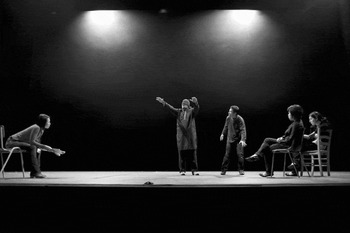
Gloucester's leap in Dover Cliff – The Conditions of Representation. From left, actress Tan Kheng Hua observes Gloucester (K. Rajagopal) and Edgar (Gerald Chew), and Director (Kaylene Tan) and her assistant (Elizabeth Tan) look on from stage right.

The hilarity of the first Dover Cliff rehearsal is no doubt provided by the literal-mindedness with which it is put together. Hence multimedia technology is abandoned for a more Shakespearean Dover Cliff scene. This time, with a staff in hand, Gloucester and Edgar perform Dover Cliff as they enter, walking laboriously, miming the actions of climbing a steep cliff. Edgar's shaky voice and strained expressions realize the cliff. The silence in the theatre suggests that there is no ambiguity to the existence of cliff, even if it exists only as an abstraction; the cliff must be rendered real, and reality must reveal itself to be illusion for Edgar to ‘save’ Gloucester.
By the end of Dover Cliff, it becomes clear that The King Lear Project is a work that thrives on repetitions, yet ‘thrive’ is perhaps not a term that critics would consider in their judgement of the play. While there are many comical moments in Dover Cliff to sustain audience attention, the repetitive cycle proves to be tedious and pointless to some. Amos Toh's review in the Substation Magazine noted that, ‘Ho and Borgia entertained indulgent readings of the three most difficult scenes of the play – namely Lear's railing against the storm, Gloucester's blinding, and Edgar's theatrical deception – with often cringe-worthy repercussions.’Footnote 20 Toh's comment is not unlike that of the Brussels critic Michael Lathan (see above), who failed to see one of the most pressing imperatives of Ho and Borgia's underlying intentions: the experimentations of the cast and their repeated attempts to decide on the ‘best’ interpretation of Lear are intrinsically tied to audience expectations, and this notion raises questions about the relationship between the production crew and the audience. Both have very different visions of what an ideal Lear should be like, and, because the fictitious rehearsals of Dover Cliff are obsessed with convincing the audience, the crew's efforts repeatedly fail for want of a better, more spectacular, more authentic rendition of the Lear scenes. What Ho and Borgia reveal, whether it is their intention or not, is the tyranny of the audience. And the reviewers’ rejection of their methods is a clear indication that the relationship between stage crew and audience can be an antagonistic one, but as we shall see, the creators of The King Lear Project are unafraid to address this idea head-on at the risk offending their paying patrons.
13 June 2008: The Lear Universe
The finale of the Lear Project begins with Act V, sc. iii. The scene, always difficult to watch, is the climax of Shakespeare's great tragedy as God-Lear is reduced to a creature more wretched, more tormented than the one stripped of his royal privileges and rejected by his ungrateful offspring. Panicker's performance is commendable, and he plays the grief-stricken king with the same force and consistency as the once-infallible king in Lear Enters. The scene is all the more heartbreaking to watch because Panicker's gestures and the delivery of his lines retain the subtle remnants of the former king and the scene is movingly played to the end. At this closure, the curtains are lowered, and Kaylene and Elizabeth take the stage.
The play becomes increasingly confusing from this point on, because the existence (or non-existence) of the fourth wall is again in question when Elizabeth faces the audience to solicit more applause. The performance, however, is not over. A row of chairs and a long conference table are set up after the cast has left the stage, and a moderator (Ben Slater) takes the stage for a post-show discussion, with the cast and dramaturge, inspired by G. Wilson Knight's ‘The Lear Universe,’ an essay from the influential Wheel of Fire (1930). Slater has the ‘good’ characters lined up on stage right; they include Lear's fool, France, Edgar, Albany, Kent, Cordelia and Gloucester. The ‘bad’ characters are seated stage left: Lear, Goneril, Regan, Cornwall, Edmund, Burgundy and Oswald. Knight's essay points out that ‘[i]t has been remarked that the persons in King Lear are either very good or very bad’, and that such perceptions of the play are not only simplistic but problematic.Footnote 21 Slater turns to this notion and echoes much of Knight's essay, asking the actors to justify the moral characteristics of their roles. Slater then invites questions and comments from the audience. Again, there is a long silence because audience members cannot tell if they are being addressed or if the invitation is a part of the script. The silence becomes disturbingly uncomfortable as the brightness of the lights in the theatre increases progressively and an eerie sound drowns the silence.
Finally, an audience member raises his hand. He claims to speak for the collective audience when he comments that he is uncertain of what he is to ask because he is not sure what he is supposed to have seen. Paul responds with an overview of Lear criticism, reiterating A. C. Bradley and Charles Lamb. The explanation is rather lengthy and of little significance to those who have no interest in Shakespeare studies. Another awkward silence ensues, and a second audience member complains that he needs ‘filling in’ because The Lear Universe only plays the ending of King Lear. The cast obliges, and the director narrates the Lear scenes that were left out of Lear Enters and Dover Cliff. The progression of this particular act, which leads to the quick replay of three condensed Lears (from the quarto, folio, and Nahum Tate's seventeenth-century adaptation) makes it apparent that the questions are posed by actors planted in the audience.
As with most experimental productions of this scale, Ho and Borgia's Lear Project demands an extreme form of critical attention and perceptiveness in audience members. This, however, is not to say that only theatre and literary critics are equipped to ‘understand’ the work, though negative reviews tend to associate their dissatisfaction with the play with these ideas. In Brussels, a critic notes that ‘while the programme notes tell us that the concept [of the play] entails exploring the staging of the play from the perspective of one major academic critic, one is quickly reminded that critics are academics not theatremakers.’Footnote 22 Reviewers in Singapore express similar sentiments: Subhadra Devan at the New Sunday Times Magazine ‘found it dated and even academic’; Adeline Chia's Straits Times review, like many others, finds fault with Rae's ‘extensive footnotes . . . which gave the shows an air of intellectual inquiry, but sometimes the cerebral prose was not sufficiently theatrical to sustain the attention of the audience and risked sounding preachy’; and Amos Toh speaks for the hostility against this ‘intellectual inquiry’ outright by entitling his review ‘Pointless Didacticism.’Footnote 23 The irony of Toh's title can be found in his complaint of Ho and Borgia's trivialization of ‘Goneril and Cornwall's cruelty, and Gloucester's suffering’. The repetitive didacticism ought to have served well to remind the reviewer that it is in fact Regan, and not Goneril, who is responsible for blinding poor Gloucester, but it did not. The hastiness with which these critics attempt to draw a distinction between what they seem to think of as academic and non-academic leads us to reconsider the poignancy of Brian Cox's remark that nice people go to the theatre on ‘automatic pilot’. The innovations and impulses of the theatre are rendered redundant if critics and audience continue to conveniently catalogue the aesthetic development of a work according to the great academic/non-academic divide, and indeed insist on doing so. Watching and trying to understand The King Lear Project is a demanding task, but its demand is a basic and not unreasonable one: audiences must approach the plays with an open mind, free of presumptions and expectations. A ‘perfect’ Lear resists performance because it can never live up to the genius that the audience attributes to its author. In the case of The Lear Project, laughter is above all an indicator and recognition of the absurdity of a one-Lear-fits-all idea. The audience laughs at the concept of a Mad-Lear, at Cornwall taking out Gloucester's eye with his boot, and at a PowerPoint representation of Edgar's cliffs. These interpretations are rejected: they are not ‘Shakespearean’, they are not King Lear, and they are certainly not very Ian McKellen. In the end, The King Lear Project demonstrates indisputably that the ‘perfect’ Lear is really one of the audience's making: what is considered to be ‘Shakespearean’ is in essence made concrete by the unanimous ‘approval’ of the playgoing community.