Introduction
Galeruca daurica (Joannis) (Coleoptera: Chrysomelidae) has become one of the most important insect pests in the Inner Mongolian grasslands of China since its abrupt outbreak in 2009 (Yang et al., Reference Yang, Huang, Ge, Bai and Zhang2010). It is mainly distributed in Mongolia, Russia (Siberia), Korea and China including Inner Mongolia, Xinjiang and Gansu province. This leaf beetle forages only on the species of Allium plants, including Allium mongolium, Allium polyrhizum and Allium ramosum (Hao et al., Reference Hao, Zhou, Pang, Zhang and Ma2014, Reference Hao, Zhou, Pang, Zhang and Bao2015). Extensive outbreaks of this pest since 2009 have caused great losses to pasture in the Inner Mongolian grasslands and the damage continues to increase (Li et al., Reference Li, Zhou, Pang and Chang2014). Thus far, molecular studies on this pest is limited with much focus on the occurrence (Ma et al., Reference Ma, Wei, Li and Cao2012), host plant selection (Hao et al., Reference Hao, Zhou, Pang, Zhang and Ma2014), life history (Hao et al., Reference Hao, Zhou, Pang, Zhang and Bao2015), cold hardiness (Li et al., Reference Li, Zhou, Pang and Chang2014, Reference Li, Zhou, Pang, Zhang, Chang and Shan2015a ; Gao et al., Reference Gao, Zhou, Pang, Bao and Luo2015), insecticide screening (Chang et al., Reference Chang, Zhou, Li and Pang2015), genetic diversity (Zhang et al., Reference Zhang, Zhou, Pang, Chang, Shan and Zhang2015), diapause (Zhou et al., Reference Zhou, Gao and Pang2016a ), thermal requirement (Zhou et al., Reference Zhou, Han, Hao, Pang, Yang and Zhang2016b ) and mitochondrial genome (Zhou et al., Reference Zhou, Han, Pang and Zhang2016c ).
Odorant binding proteins (OBPs) are small amphipathic proteins involved in insect olfaction (Vogt, Reference Vogt, Blomquist and Vogt2003). They have six cysteines in general with a conserved spacing pattern leading to the formation of three disulfide bridges (Vogt, Reference Vogt, Gilbert, Latro and Gill2005). In insects, OBPs may be the first specific biochemical step in odor reception (Vogt et al., Reference Vogt, Rogers, Dickens and Callahan1999). They are concentrated in the sensilla lymph of the antennae and are thought to play an important role in transporting odors to the odorant receptors, thus triggering a behavioral response (Zwiebel, Reference Zwiebel, Blomquist and Vogt2003). Gene transcripts encoding OBPs are mainly found in chemosensory tissues, and can bind pheromones and other odorants (Vogt, Reference Vogt, Gilbert, Latro and Gill2005). Functionally, OBPs have roles in the behavioral responses of insects to pheromones (Laughlin et al., Reference Laughlin, Ha, Jones and Smith2008) and taste perception (Matsuo et al., Reference Matsuo, Sugaya, Yasukawa, Aigaki and Fuyama2007). Therefore, studying insect OBPs is useful for developing novel pest management strategies to interfere with pest insect behaviors such as host location and mating. Moreover, the studies of OBPs reveal the molecular mechanisms of insect olfaction.
In the order Insecta, Coleoptera has the most number of species and diversity with many species classified as important pests of agricultural crops, forestry as well as humans. Current knowledge of coleopteran olfaction stems from studies of olfactory genes in coleopterans such as Ips typographus and Dendroctonus ponderosae (Andersson et al., Reference Andersson, Grosse-Wilde, Keeling, Bengtsson, Yuen, Li, Hillbur, Bohlmann, Hansson and Schlyter2013), Holotrichia parallela (Ju et al., Reference Ju, Li, Jiang and Qu2014), Monochamus alternatus and Dastarcus helophoroides (Wang et al., Reference Wang, Li, Min, Mi, Zhou and Wang2014), Colaphellus bowringi (Li et al., Reference Li, Zhou, Pang, Zhang, Chang and Shan2015 Reference Li, Zhu, Wang, Wang, He, Chen, Sun, Deng and Zhang b ), Dendroctonus valens (Gu et al., Reference Gu, Zhang, Kang, Dong and Zhang2015), Rhynchophorus ferrugineus (Antony et al., Reference Antony, Soffan, Jakše, Abdelazim, Aldosari, Aldawood and Pain2016), and Ambrostoma quadriimpressum (Wang et al., Reference Wang, Chen, Zhao and Ren2016). However, the olfactory genes of G. daurica are unknown.
In the present study, using the transcriptome data of G. daurica adults assembled in our laboratory (unpublished), 29 putative OBP genes were identified and analyzed by using bioinformatics. Moreover, the tissue-specific and developmental stage-specific expression profiles of the OBP genes were analyzed using semi-quantitative reverse transcription PCR (RT-PCR) and quantitative real-time PCR (qRT-PCR). The findings of this study provide insights for future functional research on the olfactory reception in G. daurica and will help design pest management strategies to control this insect pest.
Materials and methods
Insects and sample collection
The larvae of G. daurica were collected from Xilinhot, Inner Mongolia, China (43°54′53″N, 115°39′13″E) in 2015, and reared with A. mongolicum in incubators at 26 ± 1°C, 16 h light: 8 h dark cycle and 60–80% relative humidity. Antennae, heads (without antennae), thoraxes, abdomen, legs and wings were obtained from both 3-days-old male and female adults, which fed on A. mongolicum without mating, transferred to Eppendorf tubes, frozen in liquid nitrogen and stored at −80°C until RNA extraction.
Identification and analysis of OBP transcripts
We identified putative OBP genes by searching the transcriptome database of G. daurica adults assembled in our laboratory (unpublished). Putative OBP genes were searched using ‘OBP’ and ‘odorant-binding protein’ as the key words to screen the annotated sequences in the transcriptome database (Zhang et al., Reference Zhang, Zhou, Pang, Chang, Shan and Zhang2015). Moreover, tBlastn was used to screen the transcriptome database and identify putative OBP genes using known OBP sequences of Chrysomelidae as ‘query’. All putative OBP genes were manually confirmed using the Blastx program against the NR nucleotide database at NCBI with a cut-off E-value 10−5. The open reading frames (ORFs) of the putative OBP genes were predicted using the ORF Finder (http://www.ncbi.nlm.nih.gov/gorf/gorf.html). The signal peptides of the amino acid sequences were predicted using Signal IP 4.1 server (http://www.cbs.dtu.dk/services/SignalP/). The molecular weight and isoelectric point (pI) of the amino acid sequences were predicted using DNAMAN V6 and the amino acid identity between the putative OBP genes was calculated using Clustal Omega (www.ebi.ac.uk/tools/msa/clustalo/).
Phylogenetic analysis of OBPs from G. daurica and other insects
Phylogenetic analysis was performed based on the putative amino acid sequences of 29 OBPs from G. daurica and 181 OBPs from seven other insect species from six different orders obtained from the NR nucleotide database in GenBank. Amino acid sequences were downloaded in FASTA format. Putative N-terminal signal peptide sequences predicted using Signal IP (http://www.cbs.dtu.dk/services/SignalP/) were removed before alignment. The tree was constructed using the neighbor-joining method with Poisson correction for distances as implemented in MEGA6 (Tamura et al., Reference Tamura, Stecher, Peterson, Filipski and Kumar2013). Branch support was assessed with 1000 bootstrap replicates.
Expression analysis of G. daurica OBP genes by semi-quantitative RT-PCR
Total RNA was extracted with TaKaRa Mini BEST Universal RNA Extraction Kit (Takara, Dalian, China) from the dissected antennae, heads (without antennae), thoraxes, abdomens, legs, and wings of male and female adults. The cDNA was synthesized using PrimeScript™ 1st Strand cDNA Synthesis Kit (TaKaRa) according to the manufacturer's instructions. The primers were designed using Primer Premier 5.0. The succinate dehydrogenase complex (SDHA) gene was used as a reference gene (Tan et al., Reference Tan, Zhou and Pang2016). Reactions were conducted on a BIO-RAD T100™ Thermal Cycler (Bio-Rad, Hercules, CA, USA) using the following conditions: denaturation at 94°C for 3 min followed by 30 cycles of 94°C for 30 s, primer-specific temperature (50–55°C) for 30 s, 72°C for 1 min and a final extension at 72°C for 10 min.
Expression analysis of G. daurica OBP genes by qRT-PCR
Total RNA was extracted from eggs, first- to third-instar larvae, pupae, and antennae of male and female adults. Gene-specific primers of 28 OBPs (one OBP did not have a complete ORF) were designed using Primer3 Input (http://primer3.ut.ee/). Experiments were performed using the FTC-3000P Real-Time Quantitative Thermal Cycler (Funglyn Biotech, Canada) with BRYT Green®dye as the fluorescence reporter for each elongation cycle (GoTaq®qPCR Master Mix, Promega, USA). The SDHA gene was used as a reference gene (Tan et al., Reference Tan, Zhou and Pang2016). qRT-PCR was performed in a 10 µl reaction mixture and repeated three times for each sample. All reactions used the following conditions: denaturation at 95°C for 10 min followed by 45 cycles at 95°C for 15 s, 60°C for 1 min and a dissociation at the end. Each reaction was performed with three biological replicates and three technical replicates. The relative expression levels of each OBP gene was estimated using the 2−ΔΔCT method (Livak and Schmittgen, Reference Livak and Schmittgen2001).
Results
Identification of putative OBP genes in G. daurica
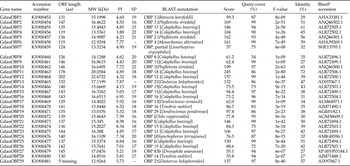
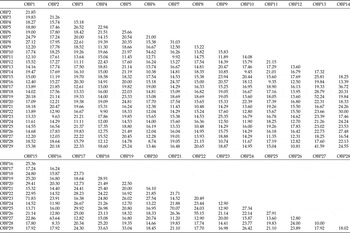
From the transcriptome database, a total of 29 putative OBP genes were identified, which were named as GdauOBP1–29 (GenBank ID: KX900453–KX900481), and all except GdauOBP29 had the full-length ORFs. Summary statistics was compiled for each GdauOBP gene discovered (table 1). The ORFs for these genes ranged in length from 119 to 202 amino acids and their calculated molecular weights ranged 12–22 kDa. Their isoelectric points ranged from 3.88 to 8.84. Signal peptides consisting of 15–22 amino acid residues were present in all except OBP6, OBP13, and OBP29, which had no predicted signal peptides. The amino acid identities between the 29 OBPs ranged 8.33–71.83%, which showed high divergence (table 2).
List of OBP genes in Galeruca daurica transcriptome. ‘—’means not detected.

The consensus (%) of 29 GdauOBP amino acid sequences alignment.

Alignment of the amino acid sequences of all 29 GdauOBPs is shown in fig. 1. Based on the number and location of the conserved cysteines, the 29 GdauOBPs could be divided into two subfamilies: GdauOBP1–12 had six conserved cysteines and belonged with the Classic OBPs while the others belonged with the Minus-C OBPs and had four conserved cysteines with C2 and C5 missing.
Alignment of 29 putative OBPs in G. daurica. Red boxes show conserved cysteines.

Phylogenetic analysis of OBPs in G. daurica and other insects
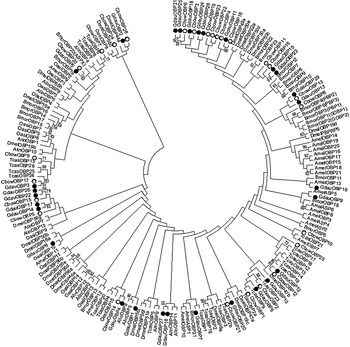
A phylogenetic tree was generated to infer the relationships between the 29 OBPs of G. daurica and 181 OBPs of seven other insect species from six orders (fig. 2). The GdauOBPs did not form a single clade, although six pairs of clusters were observed (GdauOBP14/GdauOBP17, GdauOBP15/GdauOBP23, GdauOBP16/GdauOBP27, GdauOBP21/GdauOBP25, GdauOBP22/GdauOBP26, and GdauOBP24/GdauOBP28) with bootstrap support ranging from 59 to 96%. At the same time, the phylogenetic tree showed that ten pairs of GdauOBPs/CbowOBPs were clustered into the same clade (Gdau2/Cbow26, Gdau3/Cbow17, Gdau4/Cbow14, Gdau5/Cbow20, Gdau6/Cbow2, Gdau11/Cbow18, Gdau12/Cbow12, Gdau18/Cbow3, Gdau20/Cbow21, Gdau29/Cbow13). However, GdauOBP1, GdauOBP7–GdauOBP9, and GdauOBP19 did not cluster into the same clade.
Phylogenetic tree was constructed by neighbor-joining method using the program MEGA 6.0 with 1000 bootstrap replications. Bootstrap values >50% are shown. Red dots indicate G. daurica OBPs. Blue dots indicate C. bowringi OBPs. Amel: Apis mellifera; Dmel: Drosophila melanogaster; Bmor: Bombyx mori; Tcas: Tribolium castaneum; Alin: Adelphocoris lineolatus; Oasi: Oedaleus asiaticus.

Tissue-specific expression profiling of OBP genes by semi-quantitative RT-PCR
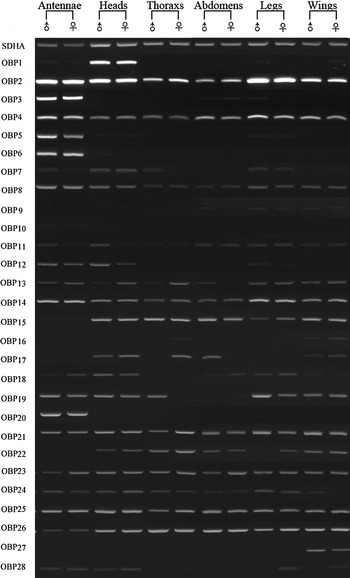
Tissue-specific expression profiling by RT-PCR was performed with cDNA prepared from total RNA extracted from antennae, heads (without antennae), thoraxes, abdomens, legs and wings of male and female adults. Figure 3 shows that GdauOBP2, 4, 8, 11, 13–15, 17, 19, 21–26, and 28 were ubiquitously expressed in all tested adult tissues, whereas GdauOBP15, 17 and 22 were expressed at lower levels in the antennae. Moreover, GdauOBP17 was expressed in female thoraxes but it was undetectable in male thoraxes; GdauOBP24 was expressed in male wings whereas it was not detectable in female wings while GdauOBP7 was expressed in female wings but it was undetectable in male wings. Both GdauOBP7 and GdauOBP12 were ubiquitously expressed in the antennae, heads, thoraxes, legs, and wings. GdauOBP9 and GdauOBP18 were expressed in the antennae, heads, abdomens, legs, and wings. The expression of GdauOBP10 and GdauOBP20 were limited to the antennae in both genders, and GdauOBP16 was primarily expressed in thoraxes and wings. GdauOBP27 was uniquely expressed in the antennae and wings, and the PCR amplification showed robust expression in the wings than in the antennae. GdauOBP3, 5 and 6 were primarily expressed in the antennae, and the intensity of the PCR bands of these OBPs in other tissues were very weak, such as GdauOBP3 in abdomens and legs, GdauOBP5 in heads and legs, and GdauOBP6 in heads.
Tissue expression of 28 OBP genes in G. daurica. SDHA: the succinate dehydrogenase complex (SDHA) gene of G. daurica.

Sex-biased expression of OBP genes in antennae by qRT-PCR
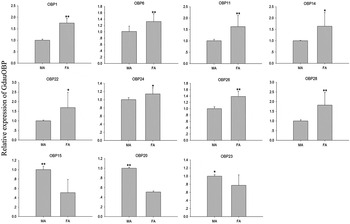
Sex-biased expression of GdauOBP1–28 in antennae was analyzed by qRT-PCR and relative expression levels of each GdauOBP gene was estimated in the antennae of males and females with the antennae of male selected as the reference. The results showed that the expression levels of GdauOBP15, 20 and 23 in the male antennae were significantly higher than in the female antennae. In contrast, GdauOBP1, 6, 11, 14, 22, 24, 26, and 28 had significantly higher expression levels in females than in males (fig. 4). The remaining 17 GdauOBPs did not show significant differences in gene expression levels between males and females; these include GdauOBP2–6, 7–10, 12, 13, 16–19, 21, 25, and 27.
Sex-biased expression of some OBP genes in G. daurica antennae measured by qRT-PCR (t-test; *, P < 0.05; **, P < 0.01). MA: male antennae; FA: female antennae. Columns indicate the mean ± standard error of three independent experiments.

Expression profiling of OBPs genes in different developmental stages by qRT-PCR
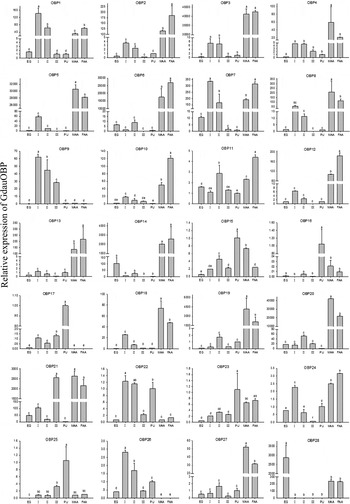
We further conducted qRT-PCR to assess the expression of GdauOBP genes during the various developmental stages of G. daurica. The expression level of each GdauOBP gene was estimated in eggs, first- to third- instar larvae, pupae, and adult antennae; the expression level in pupae was selected as the reference (fig. 5). Among the 28 OBP genes tested, the expression levels of 15 OBPs including GdauOBP2–6, GdauOBP8, GdauOBP10, GdauOBP12-14, GdauOBP18-20, GdauOBP24, and GdauOBP27, were significantly higher in the adult antennae than in other stages. Notably, GdauOBP28 was found to be expressed mainly in the eggs with the expression levels approximately 12–2800-fold higher than in other stages. Furthermore, five OBPs (GdauOBP15–17, GdauOBP23 and GdauOBP25) had significantly higher expression levels in the pupae than in the other stages. GdauOBP9 was highly expressed in larvae but the expression levels decreased from the first-instar larvae to third-instar larvae. The expression levels of GdauOBP21 were about 2500-fold higher in the third-instar larvae and adult antennae than in other stages. The expression levels of GdauOBP7 were approximately 160 to 300-fold higher in the first- and second-instar larvae and adult antennae than in other stages.
Expression profiles of G. daurica OBPs in different development stages. EG, egg; I, first instar larvae; II, second instar larvae; III, third instar larvae; PU, pupae; MA, male antennae; FA, female antennae. Columns indicate mean ± standard error of three independent experiments. Different letters above each column denote significant differences (P < 0.05).

Discussion
In this study, we identified 29 OBP genes from the G. daurica transcriptome, all of which are reported here for the first time. This number is close to the number of OBP genes identified in the antennal transcriptomes of C. bowringi (26) (Li et al., Reference Li, Zhou, Pang, Zhang, Chang and Shan2015a , Reference Li, Zhu, Wang, Wang, He, Chen, Sun, Deng and Zhang b ) and D. ponderosae (31) (Andersson et al., Reference Andersson, Grosse-Wilde, Keeling, Bengtsson, Yuen, Li, Hillbur, Bohlmann, Hansson and Schlyter2013) while more than that reported in D. valens (21) (Gu et al., Reference Gu, Zhang, Kang, Dong and Zhang2015), but much less than in Tribolium castaneum (49) (Dippel et al., Reference Dippel, Oberhofer, Kahnt, Gerischer, Opitz, Schachtner, Stanke, Schütz, Wimmer and Angeli2014) and in Rhynchophorus ferrugineus (38) (Antony et al., Reference Antony, Soffan, Jakše, Abdelazim, Aldosari, Aldawood and Pain2016). The likely factors that may have influenced the numbers of these OBP genes may include the evolution of divergent behaviors of different insects during their adaptation to various environmental factors, such as diets, mating, and oviposition (Lavagnino et al., Reference Lavagnino, Serra, Arbiza, Dopazo and Hasson2012; Zhou et al., Reference Zhou, Slone, Rokas, Berger, Liebig, Ray, Reinberg and Zwiebel2012; Goldman-Huertas et al., Reference Goldman-Huertas, Mitchell, Lapoint, Faucher, Hildebrand and Whiteman2015). The phylogenetic analysis showed that GdauOBPs are closely related to CbowOBPs from C. bowringi, which is also a member of Chrysomelidae (Coleoptera) like G. daurica. Thus, it is reasonable that they have homologous chemosensory systems. However, there are also many differences between the GdauOBPs and CbowOBPs, and the likely reasons for the differences may be the evolution of unique chemosensory systems to adapt to different environments.
Some studies have suggested that the OBPs that have high expression in non-antennal tissues may be associated with taste perception and could participate in other physiological functions (Shanbhag et al., Reference Shanbhag, Hekmat-Scafe, Kim, Park, Carlson, Pikielny, Smith and Steinbrecht2001; Jeong et al., Reference Jeong, Shim, Oh, Yoon, Kim and Moon2013). In this study, the cumulative results of RT-PCR and qRT-PCR showed that not only all GdauOBPs were expressed in the antennae of both male and female adults, but also that most GdauOBPs were expressed in non-antennal tissues such as heads, thoraxes, abdomens, legs, and wings of adults, suggesting that these genes might also participate in taste or general functions. Our results are consistent with previous reports that OBPs are expressed in different tissues (Zhang et al., Reference Zhang, Jin, Jin, Xia, Zhou, Deng and Dong2013; Zhu et al., Reference Zhu, Zhang, Ze, Wang and Yang2013; Dippel et al., Reference Dippel, Oberhofer, Kahnt, Gerischer, Opitz, Schachtner, Stanke, Schütz, Wimmer and Angeli2014; Sparks et al., Reference Sparks, Bohbot and Dickens2014). Moreover, in our study, there were significant differences in expression levels between males and females; three OBPs (GdauOBP15, 20, and 23) were male-biased, indicating that these OBPs may detect pheromones released by females, like in moths (Gong et al., Reference Gong, Miao, Duan, Jiang, Li and Wu2014). In contrast, eight OBPs (GdauOBP1, 6, 11, 14, 22, 24, 26, and 28) were female-biased and may be involved in female-specific chemosensory processes, such as egg laying (Zheng et al., Reference Zheng, Peng, Zhu, Zhang, Saccone and Zhang2013).
Surprisingly, chemosensory genes have been seldom investigated in different developmental stages of insects. Several studies have shown that OBPs are expressed not only in adults but also in larvae of insects, such as Spodoptera littoralis (Poivet et al., Reference Poivet, Gallot, Montagne, Glaser, Legeai and Jacquin-Joly2013) and Cryptolaemus montrouzieri (Pan et al., Reference Pan, Zhang, Xie, Li and Pang2016). In our study, the developmental stage-specific expression showed difference in the expression levels of these OBPs in the eggs, larvae, pupae, and adult antennae of G. daurica. Moreover, among the 28 OBPs of G. daurica, half (14) were significantly up-regulated in adult antennae than in other developmental stages, suggesting an olfactory role for these genes with antennae being the major olfactory organ. However, one OBP (GdauOBP28) in eggs, two OBPs (GdauOBP9 and 26) in larvae and three OBPs (GdauOBP15, 17, and 25) in pupae were significantly up-regulated than in adult antennae, and most OBPs (21) were expressed at the lowest levels in eggs and pupae. Gong et al. (Reference Gong, Miao, Duan, Jiang, Li and Wu2014) reported that all 18 OBPs in Sitodiplosis mosellana pupae were scarcely expressed or not expressed at all. Qin et al. (Reference Qin, Cai, Zheng, Cheng and You2016) indicated that one OBP (PxyIOBP31) from Plutella xylostella was expressed highly in adult antennae but weakly in eggs, larvae and pupae. The qRT-PCR results of Jia et al. (Reference Jia, Hao, Du, Zhang, Qin, Wang, Wang and Ji2015) showed that CpunPBP1 from Conogethes punctiferalis was dominantly expressed in adult antennae, whereas scarcely expressed in egg stage and not expressed in larval and pupal stages. We presume that the low or no expression of OBPs in eggs and pupae indicate an evolutionary significance because insect eggs and pupae live in immobile status when an advanced olfactory system is not necessary. Interestingly, one OBP (GdauOBP28) was abundantly expressed exclusively in eggs, suggesting its involvement in egg development. This is the first report of an OBP that has abundant expression in insect eggs. Taken together, our results show the extremely complex expression profile of OBPs both in tissues and developmental stages, which are likely due to their different roles in G. daurica behaviors. These findings provide insights for further research on the molecular mechanisms of chemical communication in G. daurica.
Acknowledgements
This work was supported by the National Natural Science Foundation of China (31360441). The authors thank LetPub (www.letpub.com) for its linguistic assistance during the preparation of this manuscript.