INTRODUCTION
Hawksbill sea turtles Eretmochelys imbricata (L.) occur throughout the central Atlantic and Indo-Pacific regions (Márquez, Reference Márquez1990), and are classified as critically endangered due to extensive declines in subpopulations throughout its range, with degradation of nesting beaches noted as one of the main contributing factors to these declines (Mortimer & Donnelly, Reference Mortimer and Donnelly2008). Hawksbill turtles nest throughout the wider Caribbean region, although most nesting sites accommodate only small rookeries (Piniak & Eckert, Reference Piniak and Eckert2011). Nevertheless, this wide spread of nesting activity coupled with the intensive coastal development in many parts of the Caribbean region, is an obvious cause for concern regarding the health of regional hawksbill populations.
The Caicos Bank lies at the southern end of the Lucayan Archipelago, and sea turtles are commonly encountered on its coral reefs, sand flats and seagrass meadows (Carr et al., Reference Carr, Meylan, Mortimer, Bjorndal and Carr1982; Fletemeyer, Reference Fletemeyer, Bacon, Berry, Bjorndal, Hirth, Ogren and Weber1984). Green turtles Chelonia mydas and hawksbill turtles are the most prominent species, although loggerhead turtles Caretta caretta are also known to inhabit the Bank (Carr et al., Reference Carr, Meylan, Mortimer, Bjorndal and Carr1982; Fletemeyer, Reference Fletemeyer, Bacon, Berry, Bjorndal, Hirth, Ogren and Weber1984). Additionally, there are anecdotal reports of transient leatherback turtles Dermochelys coriacea (Richardson et al., Reference Richardson, Bruford, Calosso, Campbell, Clerveaux, Formia, Godley, Henderson, McClellan, Newman, Parsons, Pepper, Ranger, Silver, Slade and Broderick2009). Although these are all primarily populations engaged in foraging, nesting is known to take place on a number of islands and cays across the Bank, with the majority of nesting activity attributable to hawksbill turtles (Richardson et al., Reference Richardson, Bruford, Calosso, Campbell, Clerveaux, Formia, Godley, Henderson, McClellan, Newman, Parsons, Pepper, Ranger, Silver, Slade and Broderick2009).
A number of inhabited and uninhabited islands and cays line the Caicos Bank's periphery, with the largest islands being found along the western, northern and eastern margins. Although South Caicos is one of the smallest islands in the group, it is one of the most populous and is the main centre of fishing activity in the Turks and Caicos Islands. The island is set to undergo considerable development in the coming years, with two large hotels already under construction. A third hotel with a golf course is in the planning stage, and construction work has started on a number of planned up-market coastal private residences.
METHODS AND RESULTS
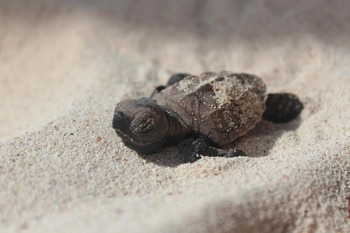
Richardson et al. (Reference Richardson, Bruford, Calosso, Campbell, Clerveaux, Formia, Godley, Henderson, McClellan, Newman, Parsons, Pepper, Ranger, Silver, Slade and Broderick2009) reported that turtle nesting had been extirpated from South Caicos in recent decades, and that most nesting on the Caicos Bank appeared to be limited to remote and uninhabited cays. However, on 2 December 2012, at approximately 11:00 am, two hatchling turtles were observed by one of the authors (M.N.) emerging from the upper reaches of a small sandy beach located in Shark Bay, on the south-eastern corner of South Caicos (Figure 1). The hatchlings were identified as hawksbill turtles due to the fact that they exhibited two pairs of prefrontal scales, four pairs of lateral scutes and two claws per anterior flipper (Figure 2). In the early afternoon, a further four hatchlings were observed by the authors emerging from the sand at the exact same location. The nest was periodically observed by the authors during daylight and at night over the following three weeks, but the only further activity observed was the emergence of two more hatchlings, approximately two weeks after the initial observations (and once again, during daylight). The straight carapace length of one of these hatchlings was measured with Vernier callipers and was found to be 44.2 mm. Measurements were not taken from the second hatchling in order to minimize interference.
Diagram illustrating the position of South Caicos on the Caicos Bank (inset) and the location of Shark Bay (SB).

Hatchling hawksbill turtle Eretmochelys imbricata on the beach at Shark Bay, South Caicos.

Using the Ruler tool in Google Earth (Google Inc.), the beach on which the nest was located was estimated to be 65 m in length, and is bordered by rocky shoreline on each side. A barrier reef lies approximately 180 m offshore. Beach slope was estimated with the plumb-line in the iToolz app (Pocket World Software) on an Apple iPhone 4, and this was found to be 15o between spring low and high tide marks, but decreases to 5o above the high tide mark. The nest was located at the landward periphery of the beach (21o29′26.78N 71o30′10.69W), at an elevation of 1.6 m above mean sea level and a distance of 13 m from the mean water mark (8 m from the spring high tide mark, and 18 m from the spring low tide mark.) Low-lying shrubs were present along the landward margin of the beach, but they were insufficient to have provided the nest site with any appreciable shade.
On 31 January 2013, the nest site was excavated in order to estimate the clutch size and to determine hatching success. In total, 142 eggs were recovered from the nest, of which 128 (90.1%) appeared to have hatched successfully, and 14 contained embryos that had failed to develop completely. Where possible, the straight carapace length of the embryos was measured with Vernier callipers, but the contents of five of the eggs were badly decomposed and could not be assessed. Four eggs contained yolk, with no evidence of developing embryos, while the remainder contained well-developed yolked embryos, with straight carapace lengths ranging from 21.8 mm to 31.1 mm (mean ± SD; 27.9 ± 3.9 mm). One dead, fully-developed hatchling was also recovered from the nest site, apparently having successfully hatched, but then failing to reach the surface. The shallowest eggs were located approximately 49 cm below the surface, while the deepest eggs were 62 cm below the surface.
DISCUSSION
The clutch size reported here is similar to that reported for the species within the Caribbean region and elsewhere previously (e.g. Diamond, Reference Diamond1976; Moncada et al., Reference Moncada, Carrillo, Saenz and Nodarse1999; Kamel & Delcroix, Reference Kamel and Delcroix2009; Liles et al., Reference Liles, Jandres, López, Mariona, Hasbún and Seminoff2011; Zare et al., Reference Zare, Vaghefi and Kamel2012). Hatching success is quite variable in hawksbill nests, and this may be due to local conditions, such as the degree of shade cover provided by adjacent vegetation (Moncada et al., Reference Moncada, Carrillo, Saenz and Nodarse1999) and nest inundation due to rough seas (Kamel & Delcroix, Reference Kamel and Delcroix2009). Although success rates of >80% are not uncommon (Diamond, Reference Diamond1976; Moncada et al., Reference Moncada, Carrillo, Saenz and Nodarse1999; Kamel & Delcroix, Reference Kamel and Delcroix2009), the success rate of 90.1% reported here is particularly high. The reason for this is unclear, but it certainly cannot be attributed to shade in this case.
It is common for sea turtle hatchlings to emerge from the nest together, although asynchronous emergence has been reported in green (Hendrickson, Reference Hendrickson1958), hawksbill (Diamond, Reference Diamond1976) and loggerhead turtles (Witherington et al., Reference Witherington, Bjorndal and McCabe1990; Hays et al., Reference Hays, Speakman and Hayes1992). This asynchrony generally extends over 3–4 days, although emergence asynchrony over 11 days has been observed in loggerhead hatchlings (Hays et al., Reference Hays, Speakman and Hayes1992). The interval of two weeks between observed hatchling emergences here appears to be the most asynchronous hatchling emergence reported from a sea turtle. On the Greek Island of Kefalonia, different developmental rates in loggerhead embryos were found to be due to thermal gradients within the nests (Houghton & Hays, Reference Houghton and Hays2001), and it seems plausible that this is the primary cause of emergence asynchrony, including in the present case.
The emergence of turtle hatchlings during daylight is uncommon, but not unheard of. In such cases it is thought that the vast majority of hatchlings succumb to terrestrial predation or thermal stress (Moran et al., Reference Moran, Bjorndal and Bolten1999; Glen et al., Reference Glen, Broderick, Godley and Hays2006). The hatchlings observed during the present study did not appear to be affected by either, although it seems probable that prospective predators may have been deterred by the presence of humans. These hatchlings also did not display any difficulty in orientating themselves towards the water, perhaps explainable by the fact that Shark Bay faces south, and therefore towards the brighter horizon. Beach slope and vegetation also impact hatchling sea-finding ability (Horrocks & Scott, Reference Horrocks and Scott1991; Kamel & Mrosovsky, Reference Kamel and Mrosovsky2005), and these may also have been important factors in the present case.
Although only one nest was observed during the present study, it is possible that the same turtle may have nested at the same site previously. Female hawksbill turtles generally produce multiple clutches each season (Diamond, Reference Diamond1976; Márquez, Reference Márquez1990; Mortimer & Bresson, Reference Mortimer and Bresson1999; Beggs et al., Reference Beggs, Horrocks and Krueger2007; Kamel & Delcroix, Reference Kamel and Delcroix2009) although different beaches may be used (Diamond, Reference Diamond1976; Allen et al., Reference Allen, Shah, Grant, Derand and Bell2010). Hence, it is unclear if Shark Bay is a regular nesting site, or if this nesting event was a transient occurrence. However, the physical characteristics of the beach (e.g. slope) and the position of the nest relevant to the water (elevation, distance, etc.) conform to the reported nesting preferences of female hawksbill turtles (Horrocks & Scott, Reference Horrocks and Scott1991; Moncada et al., Reference Moncada, Carrillo, Saenz and Nodarse1999; Kamel & Mrosovsky, Reference Kamel and Mrosovsky2005; Cuevas et al., Reference Cuevas, de los Ángeles Liceaga-Correa and Mariño-Tapia2010; Zare et al., Reference Zare, Vaghefi and Kamel2012), suggesting that this could be a preferred site.
Although a single nest can hardly be considered of monumental importance to the regional hawksbill population, this species has a tendency to nest in low densities (Piniak & Eckert, Reference Piniak and Eckert2011), so all nests should be afforded protection. A hotel and golf course are planned for the land immediately adjacent to Shark Bay, with construction of the hotel due to commence in 2014. It is imperative that all related construction and development takes into consideration any potential negative impact on nesting turtles.