Every year, millions of people in the world are victims of disasters, whether caused by natural events or by human intervention.Reference Aitsi-Selmi, Egawa and Sasaki1–Reference Brown, Daigneault and Tjernstrom3 Disasters present people with situations that can often be perceived as exceeding their physical, emotional, or material/nonmaterial resources. Recently, Puerto Rico (PR) experienced a natural disaster in which there was a 62% increase in mortality (compared with the same period in 2016), with approximately 33% of the total deaths being attributed to late or interrupted healthcare services (HS).Reference Kishore, Marqués and Mahmud4, Reference Fink and Squire5 These stressful experiences have been linked to increases in risk behaviors and decreases in self-care behaviors. Such experiences produce high levels of stress, consequently having an impact on people’s health.Reference Kishore, Marqués and Mahmud4, Reference Fink and Squire5 This impact can be much higher in people with individual vulnerabilities, such as those with mental/physical conditions, and among disadvantaged individuals.Reference Davis, Wilson and Brock-Martin6–Reference Lowe, Ebi and Forsberg10 In terms of individuals who have previously been diagnosed with mental health disorders, chronic physical conditions, or both,Reference Rhodes, Chan and Paxson11, Reference Ford, Mokdad and Link12 there is extensive literature that indicates how the impact of a disaster experience can undermine the already weakened health status of individuals with chronic physical and mental health conditions (MHCs).Reference Lowe, Kwok and Payne13–Reference Acierno, Ruggiero and Galea15 Similarly, the prevalence of mental health disorders in the population affected by disasters is 2 to 3 times higher compared with the prevalence of that in the general population, without considering the presence of the subclinical symptoms of a mental disorder or disorders.Reference Math, Nirmala and Moirangthem16, Reference Shultz17
The most severe mental disorders are uncomplicated to detect and can emerge in the short term after a disaster experience; however, in the longer-term, other disorders may arise that were not initially detected.Reference Math, Nirmala and Moirangthem16 Some symptoms can manifest subclinically, potentially associated with the disorders mentioned below and can include, for example, feelings of hopelessness, the fear of losing control of one’s emotions, and thoughts of death or suicide. All these symptoms can interfere significantly with an individual’s quality of life,Reference Evans, Banerjee and Leese18, Reference Brenes19 as well as with his or her self-care behaviors and interpersonal relationships.Reference Walker, Hall and Hurst20, Reference Dixon, Holoshitz and Nossel21 The literature shows that some of these symptoms might be self-limiting, often disappearing in approximately 3 months; however, it is possible that such symptoms will not resolve, lasting for 6 months or longer, and furthermore, that a previously undiagnosed disorder might be detected.Reference Kar, Chavan, Nitin, Priti, Ajeet and Sushrut22 Likewise, in situations where the cause of the disaster is a natural event (eg, a hurricane), some symptoms may be activated before a specific season.Reference Frahm, Barnett and Brown23 The most frequent emotional reactions to disaster experiences among survivors are linked to disorders related to anxiety, posttraumatic stress, adjustment, major depression, and substance abuse.Reference Ali, Farrell and Alexander24–Reference James, Noel and Favorite26
After the passing of Hurricane Maria (HM) through PR in 2017, a temporary healthcare unit (THCU) was created to accommodate patients of low-socioeconomic status and with chronic health conditions (CHCs) and identify which patients were extremely affected by the hurricane often because of the loss of their homes and/or loss of basic services (eg, water and electricity), which affected their health outcomes. The unit incorporated common HS and added a mental health services (MHS) model that considered the cultural characteristics of the target population. The purpose of this article is to present our experience regarding the incorporation of an MHS model, with its respective benefits and challenges, into a THCU, after HM.
METHODS
The Impact Disastrous Events Have on Mental Health
Current research in the field of disasters and mental health states that exposure to disasters is associated with a variety of mental-health consequences.Reference Goldmann and Galea2 The World Health Organization (WHO) has made epidemiological projections of post-disaster mental health problems, in which mild distress to very severe mental health problems have been evaluated. Affected populations have been shown to suffer psychological distress that can range from mild (20-40%) to moderate/severe (30-50%). The WHO states that, following a disaster, a portion of individuals develop new and debilitating mental disorders, while people with pre-existing mental health disorders need more help than they did before the disaster.27 For example, during a preliminary assessment of Hurricane Harvey’s overall effect and impact on mental health, a survey was conducted. The results showed that 44% of the survey participants met the threshold for post-traumatic stress disorder (PTSD). Regarding individuals in PR who had pre-existing mental health disorders, a needs-assessment study of mental health and substance-use disorders and service usage in this (adult) population, reported that 23.7% met the criteria for at least 1 diagnosis of mental health problems (including substance-use disorders).Reference Mattei, Tamez and Ríos-Bedoya28, 29 This report provided an estimation of the number of individuals who were most likely to require post-disaster psychological care.
MHCs often accompany and exacerbate physical conditions, resulting in poor health outcomes and a reduced quality of life.Reference Payne, Abel and Guthrie30 The relationship between mental and physical illnesses has been established across studies.Reference Leventhal, Weinman and Leventhal31, Reference Brannon, Feist and Updegraff32 After a disaster, symptoms of MHCs and physical conditions often co-occur.Reference Martin9 The occurrence of a disaster and the presence of an MHC can further worsen the state of a given patient’s physical condition(s). In addition, having a physical condition can also exacerbate a patient’s current MHC or increase the likelihood that he or she will develop one.Reference Martin9 The impact that a disaster can have on both physical and mental illnesses is evident.Reference Kishore, Marqués and Mahmud4, Reference Michaud and Kates33
Integrating HS and MHS: A Key Approach During the Disaster Response Phase
A common goal for healthcare systems is to provide the right care, in the right place, at the right time, and according to the needs of the patient.34 This goal also fits in with the need of healthcare providers to achieve positive health outcomes, while simultaneously considering variables related to cost-effectiveness. The integrated HS model responds to this vision. In practice, the integration of HS should consider questions related to how to achieve the needs of the patient in specific circumstances and sociocultural contexts. The process of integrating HS requires the identification of resources that respond to patients’ needs in different areas, which also acts in a coherent and interconnected manner, facilitating the navigation of patients through the healthcare system. Integrated HS result in lower costs compared with interventions that focus on health problems separately.Reference Davis, Wilson and Brock-Martin6
The consequences of a natural disaster can affect HS in many ways, such as interruption of specialized medical services, reduction of the number of healthcare providers available in a given community, interruption of essential services (eg, electricity, water), and limitations in terms of access to medicines.Reference Michaud and Kates33, Reference Carameli, Eisenman and Blevins35 Any of these situations can cause fragmentation of resources and reduce access to the appropriate HS. These circumstances were present during and after the impacts of the Harvey, Irma, and Maria hurricanes, storms that were devastating to entire populations, caused significant damage and destruction, and merited implementation of disaster management programs.Reference Winfield36 Disaster management is defined as “the coordination and integration of all activities necessary to build, maintain, and improve capacities to prepare, respond, recover, or mitigate disasters or real threats.”37 Undoubtedly, everything related to healthcare represents a priority area when planning response programs for disaster situations, especially considering that natural disasters can impact and possibly worsen health conditions by generating barriers to accessing HS and resources.Reference Kessler38
Integrated healthcare is based on the concepts of prevention and cure, both of which are crucial in populations that include patients who have physical and mental comorbidities. For example, patients with a mental health diagnosis accompanied by physical conditions could benefit especially from interdisciplinary interventions that are focused on those patients’ unique needs. Units configured around the integrated HS model better respond to the needs of this population, thus reducing the adverse effects of the HS fragmentation provoked by disasters.Reference Reiss-Brennan, Brunisholz and Dredge39
The need to integrate HS in disaster situations becomes evident upon consideration of the consequences caused by the impact of devastating natural phenomena. Hurricane Sandy caused enormous distruction, which in turn generated massive interruptions in access to HS, preventing many people from receiving medical attention. A study conducted with people in New York and Long Island, who did not have access to medical services during the event, revealed that these individuals had a significantly higher probability of showing symptoms of PTSD, depression, and anxiety than did those who had such access.Reference Ruskin, Rasul and Scheinder40 A study conducted with older adults affected by Hurricane Ike showed that patients with a history of PTSD or depression and those with autonomic symptoms required special psychological attention at the time of the event. This study underlined the need to promptly evaluate symptoms of acute stress and depression to identify people who could develop psychopathologies when experiencing a disaster.Reference Pietrzak, Southwick and Tracy41
A study in a group of 392 low-income parents affected by Hurricane Katrina explored changes in mental and physical health associated with Katrina-related stressors and losses. Those respondents with higher levels of hurricane-related loss and stressors were frequently linked with worse health outcomes. Additionally, participants who experienced more losses and symptoms related to stress suffered adverse health consequences that were more severe and lasted for longer times.Reference Rhodes, Chan and Paxson11 The previously mentioned studies emphasize the importance of MHS during the disaster response phase of a disaster event; by improving access to such services, the short- and long-term impacts (eg, the relapse of an individual recovering from a mental health issue) of the disaster experience on mental health can be mitigated.
Experience in the Development and Implementation of an MHS Model in a THCU
During the response phase of HM, multiple health-related agencies in southern PR established collaborative relationships, creating a coalition of health institutions. This southern health coalition combined the efforts and resources of different general hospitals; primary and specialized healthcare service providers (a community clinic and hemodialysis service centers); federal (U.S. Military Armed Forces), state (PR Health Department), and local (community support provided by the municipality and social workers) government agencies; and Ponce Health Sciences University (PHSU), an academic institution involved in the health field. The coalition group led different immediate response plans aimed at offering medical services, providing medicines, and distributing medical supplies.
In collaboration with the aforementioned agencies and organizations, a THCU was organized, for which a coliseum, initially housing 100 beds for the medical attention of low-income patients in need of intermediate medical care, especially those with CHCs, was prepared. The main objective of the THCU was to reduce the risk of overload, to which the general hospitals were prone due to the high number of patients who were seeking HS. This unit received patients from southern PR, most with medical conditions that merited frequent attention, including the need for hydration, wound healing, and medical equipment that required electricity, but who did not require general hospital services.
Calling on previous, collective experiences, the School of Behavioral and Brain Sciences of PHSU implemented an MHS model for all the patients admitted to this unit. The model established in the THCU was based on one previously implemented in community hospitals in both Aibonito and Ponce, PR.Reference Jiménez, Rivera and Benítez42 Through this model, the personnel offered psychological assessments and diagnosed mental health disorders (using the fifth edition of the Diagnostic and Statistical Manual of Mental Disorders [DSM-V]). Furthermore, short-term psychotherapy sessions were given (when needed) to patients, and their families/caregivers were given emotional/psychological support. The MHS program established an interdisciplinary team with other members of the unit (social workers, nurses, and doctors). Every day, a member of the MHS team attended a morning briefing to discuss, make decisions about, and update information relevant to the physical and mental health of the patients. Additionally, when possible, the team involved the patient in the decision-making process. The primary mission and goals of the MHS program at the THCU were as follows:
Mission
The primary mission of the THCU mental health program was to guarantee that every person that was admitted to the unit received integrated health care and, furthermore, to reduce the psychological impact caused by HM on patients with medical conditions, considering primary, secondary, and tertiary levels of prevention.
Objectives
The objectives of the THCU included the following: to (A) assess the symptoms of mental health disorders in people receiving HS at the THCU, (B) identify people previously diagnosed with mental health disorders, (C) prevent relapses among patients diagnosed with MHCs, (D) prevent the development of disorders related to stressful and traumatic experiences, and (E) facilitate access to MHS for patients affected by HM, after their having gone through the referral system of which local mental healthcare providers are a part.
Protocol
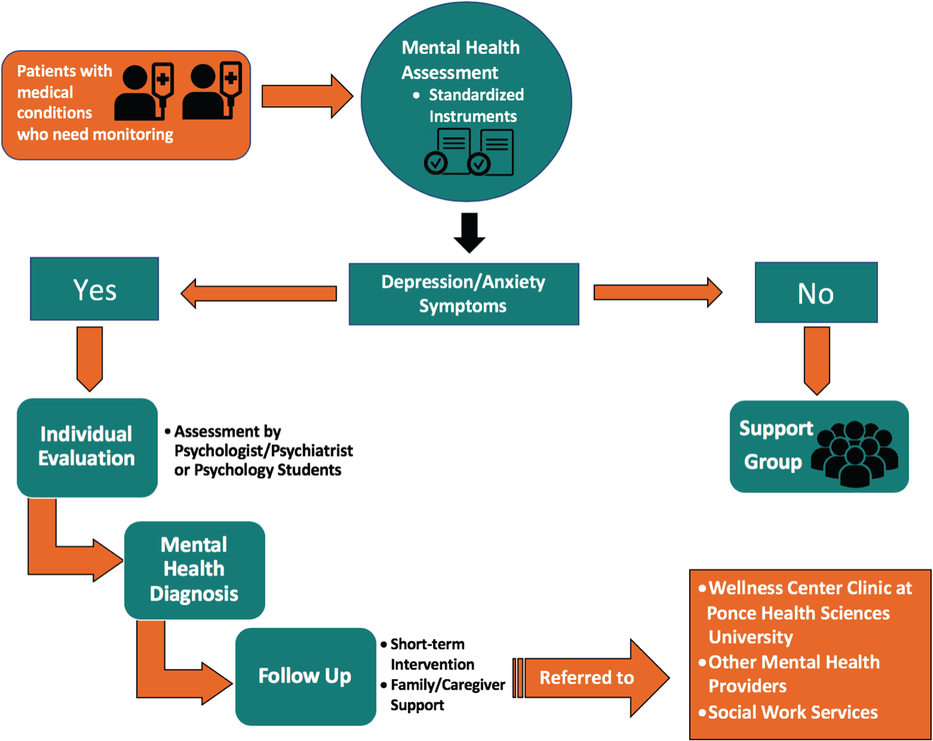
A mental healthcare team composed of licensed psychologists and advanced clinical psychology doctoral students from PHSU, trained in evaluation, diagnosis, and short-term psychological intervention in a general hospital setting, provided services through a series of steps. To provide MHS to patients admitted at the unit, our program was standardized and divided into the following steps (see Figure 1):
Protocol of Mental Health Services at a Temporary Healthcare Unit in Puerto Rico (PR) After Hurricane Maria.

Step 1: Screening interviews were carried out with all the admitted patients at the THCU. As part of each interview, the team used culturally appropriate short scales (Patient Health Questionnaire-9 [PHQ-9] and Generalized Anxiety Disorder-7 [GAD-7]) to evaluate depression and anxiety symptoms.
Step 2: (A) After providing informed consent, persons identified with depression and anxiety symptoms, among other MHCs, were evaluated through a standardized clinical-psychological interview and an assessment, using the following scales: The Beck Anxiety Inventory, Beck Depression Inventory, and Mini-Mental State Examination (MMSE). Both the Beck Anxiety Inventory and the Beck Depression Inventory have adequate reliability and validity properties and appropriate cultural equivalence for Latinos.Reference Rodríguez-Gómez, Davila-Martínez and Collazo-Rodríguez43, Reference Contreras, Fernandez and Malcarne44 (B) If a given participant met the criteria for at least 1 mental-health-disorder diagnosis, the supervisor, a licensed clinical psychologist, and an associated doctoral student (advanced clinical psychology) would discuss the case, deciding on the short-term psychological intervention strategy (based on the cognitive-behavioral model) to be implemented.
Step 3: (A) Patients diagnosed with a mental health disorder received an initial psychological intervention and follow-up sessions during their stay at THCU.
(B) Patients who required follow-ups after being discharged from the THCU received referrals to health clinics with MHS or to their private MHS provider.
Step 4: The team provided 1 support-group session per day to individuals who consented to and required it. Groups were composed of 8 to 12 participants. During these sessions, the team provided a private space to facilitate emotional venting by group members.
All stages of the process were conducted by a doctoral student (advanced clinical psychology) and 2 psychology practitioners, under the supervision of a licensed clinical psychologist.
RESULTS
An exploratory study of the population of patients who had been attended at the THCU was conducted using secondary data analysis; the study was approved by the Institutional Review Board (IRB-PHSU). Fifty-four records of patients of the THCU were gathered, from October to December 2017. Univariate and bivariate analyses were performed with the Statistical Package for the Social Sciences program (IBM SPSS, Version 24.0).
The average age of the patients was 66 years (SD = 18.5), more than half were female (51%), almost three-fourths had a high school degree or less (73%), and approximately 12% reported having a history of mental health treatment. Eighty-seven percent of the patients were unemployed; of them, 62% were retired. The most prevalent chronic physical conditions among the patients in the unit were cardiovascular disease (CVD) (37%), diabetes (13%), neurocognitive disease (13%), and bronchopulmonary disease (13%). Among the most frequent psychological symptoms reported by the patients evaluated at the THCU were depression and feelings of hopelessness (50%), anhedonia (67%), loss of appetite (67%), insomnia (63%), feelings of failure and disability (58%), and concentration problems (42%).
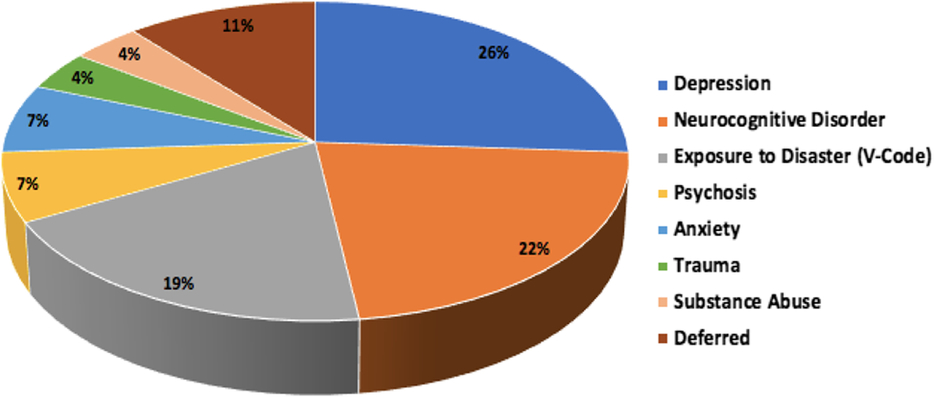
Fifty-two percent of all the patients treated at the THCU met the criteria for a mental health disorder, according to the DSM-5, and 27% had a previous mental health diagnosis. Of these, 73% reported being unemployed, of which 52% were retired, and half had an income of $900 per month or less. The most prevalent MHCs were major depressive disorder (26%), neurocognitive disorder (22%), and catastrophe exposure (19%; V- or Z-coded) (Figure 2). Forty-three percent of the patients with diabetes and 25% of the patients with cardiovascular conditions met the criteria for a major depressive disorder.
Frequency of Mental Health Diagnoses of Patients Evaluated at a Temporary Healthcare Unit (THCU).

DISCUSSION
The purpose of this article is to present our experience regarding the incorporation of MHS into a THCU, from October to December 2017, after the passage of HM. Because meteorological and human-made disasters are increasing in frequency and magnitude every year, as time passes, it becomes more critical to create effective disaster response programs (DRPs), programs that must take into account multiple variables related to healthcare. A vast number of reports in the literature have offered evidence of the damage (mental, physical, economic) sustained by the people who experience devastating events.Reference Nomura, Parsons and Hirabayashi45, 46
Mental health is a topic that is specifically addressed, and considered a priority, when evaluating the impact of a disaster in terms of primary, secondary, and tertiary prevention. Every 2 years, the conference on International Preparedness and Response to Emergencies and Disasters is held, with the objective of sharing experiences, ideas, and lessons learned in disaster situations. In January 2016, this conference brought together senior representatives of various organizations from different countries. These individuals emphasized the need to plan and establish regional and global collaborations, establish collaborative channels between private and public sectors, strengthen leadership, and establish family and community networks to increase the resilience of the people affected. The topic of mental health was addressed, and the need to promote the prevention and recovery of the affected populations was highlighted.Reference Adini, Ohana and Furman47
Based on the various ideas and recommendations of the conference described above, MHS were immediately implemented in a THCU in PR after the passage of HM. The immediate response consisted of the integration of an interdisciplinary healthcare team, the aim of which was to respond to the biopsychosocial needs of those affected by the event. A disaster of the magnitude of that seen in PR demands the close collaboration of the public, private, and academic sectors; and this collaboration came to be. In this case, PHSU, a graduate school with programs in several health-related fields (medicine, public health, and clinical psychology), was the academic institution that participated to the greatest degree in this collaboration.Reference Pourhosseini, Ardalan and Mehrolhassani48 Its purpose was to provide socially vulnerable patients with a coping and treatment model to alleviate the mental-health impact of this atmospheric phenomenon. The incorporation of MHS in the THCU was intended to prevent not only relapses but also the development of mental health disorders in the admitted patients. During this time, patients were given MHS and, before leaving, were given referrals (to provide continuity to their services), if needed.
The group of people served by the program brought together socioeconomic and health characteristics that placed them in a position of vulnerability when they were forced to face the critical situation that followed the assault of HM. Clearly, the passage of a disaster affects a society without distinction, but groups that are socially vulnerable (eg, those whose members have low socioeconomic status) and those composed of individuals who have chronic physical and mental conditions sustain the most significant impact.Reference Gray49–Reference Bethel, Burke and Britt52 These characteristics were present in all the patients admitted to the THCU. These were people with limited economic resources, low educational levels, and at least 1 chronic disease. These patients belong to the lowest-income sectors and communities in PR.
The Census Bureau’s QuickFacts, Puerto Rico (2017), reports that 44% of the over 3 million people who inhabit the island live in poverty.Reference Census Bureau53 The American Community Survey’s 5-year estimate for 2017 stated that people living in PR had a median household income of $19,775 and that 8.4% (under age 65 years) were without health insurance coverage. In 2016, Puerto Ricans’ median age was 39 years; in that same year, 53.3% of individuals who were 25 years old and older were found to have completed up to a high school degree and no more, while 45.1% were below the poverty level. The poverty rate increased (to 62.6%) in the population of people who were 25 years or older and who had less than a high school education. Among this population, the median earnings in the past 12 months (for 2016) were $10,646 (inflation adjusted) (U.S. Census Bureau, 2012-2016 American Community Survey, 5-Year Estimates).54 These factors, as well as the predispositions, of a person or group increase the physical, economic, and social susceptibilities of that person or group to damage, which influences their ability to foresee, cope with, resist, and recover from disasters.Reference Ranabir Singh, Reza Eghdami and Singh55, Reference Bara56
The 54 individuals evaluated by the MHS program all had at least 1 diagnosis of a physical health condition, and 12% of them reported having a diagnosis of at least 1 MHC before being admitted. More than half of the patients admitted at the THCU (52%) met the criteria for at least 1 mental health diagnosis, according to the DSM-5, a percentage which shows a high frequency of comorbidity (physical and mental disorders) among the people served. Twenty-seven percent of the patients previously mentioned had received a diagnosis of a mental health disorder by the MHS program. The most prevalent mental health diagnosis was depression, being present primarily in patients suffering from CVDs and diabetes, which are the most common chronic diseases in PR.
On the island, the most recent reports show that there is a high prevalence of chronic physical illnesses and mental disorders, a reality that must be considered when planning the healthcare component of a DRP. In 2016, the Department of Health of PR published statistics demonstrating a high prevalence of such CHCs as hypertension (39.4%), obesity (30.5%), and diabetes (13.7%) in the local population; these rates indicate that a significant number of people (in PR) are physically vulnerable to disaster.Reference Mattei, Tamez and Ríos-Bedoya28, 29, 57 Regarding mental health, the needs-assessment study of mental health and substance-use disorders and service usage in the adult population of PR reported that 23.7% of that population met the criteria for at least 1 diagnosis of a mental health problem (including substance-use disorders).Reference Mattei, Tamez and Ríos-Bedoya28, 29, 57 Most of the patients who requested the support of the THCU did so because they lived in areas that had suffered the long-term loss of electricity or water (usually both); without those critical resources, these patients were unable to satisfy the treatment needs of their pre-existing medical conditions.
On the other hand, of the patients who were diagnosed by the MHS program with a mental health problem, a little more than 25% already had a previous mental health diagnosis, and some of them were already receiving MHS. These figures are based on statistics provided by several studies that explored the issue of mental health in the population of PR; mental health is, arguably, a significant public health concern on the island today. Frequently, MHCs accompany and exacerbate physical conditions, resulting in poor health outcomes and reduced quality of life.Reference Payne, Abel and Guthrie30
Because they are often cause interruptions in health care, natural disasters tend to affect the overall health of the population going through the disaster event. Patients with chronic conditions are part of an especially vulnerable population as they require specialized pharmacology and/or life-sustaining equipment that depends on electricity (eg, renal patients on dialysis and patients with chronic respiratory diseases requiring mechanical assistance to breathe).Reference Miller and Arquilla58, Reference Bethel, Foreman and Burke59 In 2015, the United Nations held the third World Conference on Disaster Risk Reduction in Sendai, Japan. The resulting agreement, the Sendai Framework for Disaster Risk Reduction 2015-2030, outlines actions aimed at preventing and reducing disaster-impact risks, including the loss of life and the negative impact of a disaster on the health, life, and economic well-being of persons, communities, and countries.60 Under Priority 3, investing in disaster risk reduction for resilience (national and local levels), the Sendai Framework affirmed that “people with life-threatening and chronic disease, due to their particular needs, should be included in the design of policies and plans to manage their risks before, during, and after disasters, including having access to life-saving services.”61
We would like to share some thoughts regarding our participation in a DRP. Our practice suggests and reinforces the need to regularly integrate MHS in THCUs as part of the normally offered HS during the response phase to a disaster event, especially if one considers that comorbid mental and physical conditions are increasing in many countries and are expected to grow in the coming years.Reference Pourhosseini, Ardalan and Mehrolhassani48, Reference Sartorius62 The impact of the consequences of an event such as that experienced in PR requires significant support from local, national, and international organizations. Responses must be effectively coordinated and timed so as to ensure that the available resources reach the individuals and communities most affected by a given disaster event. In addition, when designing DRPs, it is crucial to consider the cultural factors of the population being served, to increase the effectiveness of the interventions. Considering cultural sensitivity, including language (eg, when nonlocal responders directly interact with community members), is especially relevant when developing interventions aimed at dealing with mental health issues.
We recommend, for future DRPs, that these services be provided not only in a THCU but also in hospitals, ambulatory clinics, and even shelters during disaster events.Reference Pourhosseini, Ardalan and Mehrolhassani48, Reference López-Ibor, Christodoulou and Maj63, Reference Veenema, Rains and Casey-Lockyer64 By incorporating these services, we can not only address the psychological and behavioral difficulties that may arise in these conditions but also prevent the prolonged symptoms that can lead to psychopathology, which itself can aggravate physical conditions.
We highly recommend that future DRPs do the following: (A) incorporate MHS in all phases of emergency management and evaluate the impact that these services have on patients’ short- and long-term mental health; (B) carry out systematized investigations related to the subject of mental health in natural disasters with the purpose of having an evidence-based model; (C) provide training to mental health professionals regarding emergency psychology in the face of a natural disaster; (D) through teaching, promote, guide, and train future mental health professionals on the importance of integrating psychological services in immediate response to natural disasters; and (E) create a follow-up system to evaluate the long-term overall health of those affected by a disaster.
CONCLUSIONS
The integration of MHS in future DRPs could reduce the impact that a disaster might have on pre-existing mental or physical health conditions as well as on those developed during or after the event, especially in members of socially vulnerable populations. When creating future response programs, vulnerability and cultural sensitivity should also be taken into consideration. We hope that this work contributes to the development of future DRPs and in the creation of conceptual frameworks for post-disaster interventions.