Introduction
Translating materials science concepts into K–12 outreach activities requires creating a connection between the science and the students. Although researchers may be confident in their knowledge of the content, translating these concepts effectively can be another matter. Understanding how kids learn and how to motivate them to engage in activities are key issues.
The primary goal of this article is to offer a taste of theory and techniques to help in the translation and activity generation process, assisted by available resources. The secondary goals are to inspire an appreciation of the gained knowledge, reflect on personal experiences, and connect with resources and collaborators to help with endeavors.
Most scientists and engineers prefer learning by doing—reading, experimenting, collaborating, and learning from experiences with students. One or more of the approaches outlined in this article can be adapted to serve a set of outreach objectives. What works can be surprising, and results do not necessarily come out as intended—often leading to new avenues in which the researcher is not only a teacher, but a learner as well.
Distill content; do not dilute it
The translation of materials science concepts into K–12 outreach activities takes most scientists and engineers out of their typical realm of expertise. They know how to generate and analyze these concepts and communicate them to colleagues. When they attempt to do the same with non-specialists, such as family members or K–12 students, challenges often arise.
When communicating with colleagues, most scientists have been trained to be complete and extremely accurate in presenting their work. The details are crucial for peers to review and reproduce their work. Naturally, they may feel a need to generalize this approach and be complete and accurate in presenting their work to any audience. K–12 education and outreach experts usually advise a seemingly contradictory approach. Recommendations include development of content learning goals that are simple and succinct and not too lofty or numerous, as discussed in other articles in this issue (see Reed-Rhoads and Zenner Petersen). Because a lack of completeness and accuracy appears to be the opposite of what they have learned about good communication, scientists and engineers fear having to water down their content to make it understandable for K–12 and public audiences.
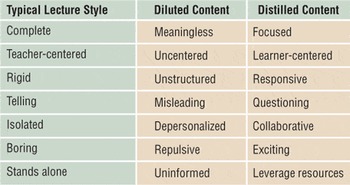
This fear may be alleviated when the underlying goals of the communication are brought to mind. The key here is to be completely and accurately thoughtful about the goals and procedures for translating materials science concepts into K–12 outreach activities. As discussed in the Zenner Petersen article in this issue, communicating science is not just about explaining the facts or the experimental process. Instead, the National Research Council’s publication Surrounded by Science: Learning in Informal Environments Reference Fenicheland and Schweingruber1 lists six of the many intertwined purposes: “(1) sparking interest and excitement, (2) understanding scientific content and knowledge, (3) engaging in scientific reasoning, (4) reflecting on science, (5) using the tools and language of science, and (6) identifying with the scientific enterprise” (see Zenner Petersen). These communication goals are in some manners different from those of communicating with professional colleagues. The goal of K–12 audiences is not to review and reproduce the work. In fact, they may not even pay attention unless the reason they should care becomes evident. So, rather than thinking about watering down content, scientists should concentrate on finding points of relevance and then properly boil down content in order to make connections with the audience. Completeness gives way to relevancy, while accuracy is retained in the essence of the content that is distilled rather than diluted. Table I contrasts characteristics of approaches that distill and dilute content with a typical lecture-style approach. The Sidebar “Translating a difficult topic: Nanoscience and nanotechnology” illustrates the concept of distilling content and based on that distilled content, utilizing available resources.
Translating a difficult topic: Nanoscience and nanotechnology
Nanoscience and nanotechnology (nano) are difficult topics to translate for K–12 audiences. Leaders of the Nanoscale Informal Science Education Network (NISE Net) tackled the challenge of distilling content into relevant key points by ascertaining current levels of understanding and interest in the topic.28 Educators and scientists then refined these into a small list of main messages:
• Nanoscale effects occur in many places. Some are natural, everyday occurrences; others are the result of cutting-edge research.
• Many materials exhibit startling properties at the nanoscale.
• Nanotechnology means working at small size scales, manipulating materials to exhibit new properties.
• Nanoscale research is a people story.
• No one knows what nanoscale research may discover or how it may be applied.
• How will nano affect you?
A catalog of educational programs and materials has been developed that addresses these key points and utilizes various techniques to connect on a human level. The Materials Research Society has developed a database of scientists interested in collaborating to bring an authentic voice to these activities29 and regional hubs for partnership assistance. NanoDays annually supports community activities around the globe by bringing people together to explore nano. Activities and kits developed to support NanoDays include stories and techniques (scripts) to get inside students’ heads—particularly, opportunities for inquiry (experiments) and dialogue (forums). In many cases, scientists collaborate hand-in-hand with educators to complement each other’s strengths and to learn from each other.
Translation efforts for nano can be found around the globe. For example, the European Network for Science Centres and Museums (ecsite) has created Time for Nano to engage science center visitors in nine nations, with a special focus on young people, on the benefits and risks related to nanoscale research, engineering and technology, and to collect opinion and feedback from the participants.30
Contrasting characteristics of approaches that distill and dilute content with a typical lecture-style approach.

Identify the key points and why students should care
Zenner Petersen’s article in this issue discusses the choice of content learning goals for the audience. What message is being delivered? What does the audience want to hear? In choosing key points (i.e., learning goals, big ideas, desired outcomes), success rests upon the thoughtful preparation and delivery of activities. In the students’ eyes, the researcher is also a teacher. In his book Thoughtful Teaching,Reference Clark2 Clark reported the results of what children say about good teachers: “Good teachers nurture them by treating them as intelligent people who can become even more intelligent, by taking the time to learn who we are and what we love, treating us fairly by treating us differently, by explaining why he teaches and acts as he does, by telling stories of her own life . . . and listening to ours . . . She puts thought into surprising us in ways that we will never forget. He draws pictures that show how ideas are connected . . . The good teacher loves what he is teaching, but does not show off or put distance between us. The good teacher sets up things so children can learn how to learn from each other.”
In preparing activities, researchers should learn about the audience first and think deeply about their own interests, passions, and capacity to respond to each of these qualities of a good teacher. For example, they should not underestimate the audience. Researchers should create opportunities to interact with K–12 students and teachers so that they may learn from them. Consulting with K–12 teachers is important, as they know the student population and their interests. Students’ previous experiences, knowledge, and curiosities and the richness they may bring to activities are advantageous.
Translation of materials science concepts necessitates making functional and dynamic connections between personal interests and knowledge and that of the audience. Connecting with students’ interests and experiences will help capture their attention and enhance their motivation to learn. Indeed, according to the constructivist view of learning, in which learners are acknowledged to construct their own knowledge based upon experience in their physical and social environment, “content cannot be prespecified.”Reference Bednar, Cunningham, Duffy, Perry, Duffy and Jonassen3 While the activities must be planned, to be successful, they should provide a level of flexibility to accommodate the specific interests and background knowledge the learners bring to the activities. One way to accommodate this is to translate the same concepts in different ways and in various contexts. That is, “revisit the same material, at different times, in rearranged contexts, for different purposes, and from different conceptual perspectives.”Reference Spiro, Feltovich, Jacobson, Coulson, Duffy and Jonassen4 Besides thinking of specific information to be conveyed and specific tasks to be accomplished, it is important to think more broadly about “designing environments in which learning can take place—environments characterized by rich contexts, authentic tasks, collaboration for the development and evaluation of multiple perspectives, an abundance of tools to enhance communication and access to real-world examples and problems, reflective thinking, modeling of problem-solving by experts in the content domain, and apprenticeship mentoring relationships to guide learning.”Reference Jonassen, Duffy and Jonassen5
In order to create a flexible learning environment, scientists should think about the unique gifts they can bring to schools. They should give their audience insights into and a tangible taste of the rich context of their working environment. They should share authentic tasks in which they engage in their work and find ways to give their audience first-hand experience with those activities. The activities should have a design that allows students to work together and with the scientist and other adults to collaborate and consult. Scientists should create communication tools (e.g., worksheets for individuals or time for small groups to confer and present their experience to the whole group). Providing easy-to-understand, real-world examples demonstrates how scientists and their colleagues think about and solve problems. It is helpful to anticipate time for diverging from a plan of action to respond to interests expressed by the audience. Some of the most valuable time is the unplanned response to the discovery of what they really care about.
Connect on a human level
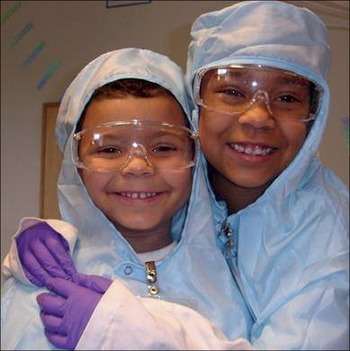
Effective translation of materials science concepts for K–12 audiences requires more than connecting at the proper cognitive level and correlating to the curriculum. It calls for connecting on a human level (e.g., see engaged students in Figure 1).
Children try on clean room suits in the NISE Net lesson plan Tiny Particles, Big Trouble! This program explains why nanoscale science and technology is carried out in the controlled environment of a clean room, what clean rooms are like, and how scientists keep the clean room clean. (Sciencenter, Nanoscale Informal Science Education Network, 2010).

Be a storyteller and try to get inside students’ heads
One of the best ways to find that human connection is for the researcher to embed their activities in stories in which students may find some element of connection. How did you become interested in your topic in the first place? Was there some event or phenomenon that incited your curiosity? Was there some person or life event that brought you into your field? Are you working on a problem that promises to solve an important human problem or fundamental question (e.g., related to energy, health, food and water, structures, communication, transportation, where did we come from, where are we going, how can we live more sustainably)? What and who have gone before you? What does the future’s potential hold?
Alan Alda, actor and host of the U.S. Public Broadcasting System’s (PBS) “Scientific American Frontiers” series, urges researchers “Don’t be afraid to share your excitement about science. We will get caught up in the emotion of it. Let’s tell stories and excite the lust in one another for the curiosity that we have and let’s fall in love (with science).”Reference Hicklin6
Researchers should embed activities in a story—either their own or authentic contextual stories underlying the concepts they hope to convey. An example of an activity embedding personal and contextual stories is an online multiplayer game.7 The personal stories came from characters whose narratives were extracted from interviews of diverse engineers connected with members of the Engineers Week Diversity Council, such as the engineer who tells of her love of art in school and how she uses it in her job.7 The contextual stories in this game revolve around the materials and technologies required for renewable energy supplies and their effect on the environment.
Another technique to connect on a human level is to try to get inside students’ heads. Researchers should build concrete mechanisms into their activities to generate feedback from children about what they are thinking to monitor how well they understand the concepts conveyed. “Not only are you responsible for expressing your ideas; you’re also responsible for finding out whether the person you’re talking to understands what you’re talking about.”Reference Brandt and Lampert8
Reed-Rhoads takes a comprehensive look at activity assessment in her article in this MRS Bulletin issue. The imperative emphasized here is to create student assessment techniques to measure how well activities are achieving their goals by embedding tasks that allow the students, teachers, and presenters to evaluate in real-time whether the students are getting the concepts and if their interests and needs are being effectively addressed. This helps teachers and presenters know if the students have an understanding of a concept. This opportunity can be used to address misconceptions, lack of interest, or specific interests that provide unique opportunities for learning. This type of assessment allows the designer of an activity to build in tools for teachers to tailor modifications to meet specific student needs in the midst of the activities.
Some of the best embedded student assessment methods involve creation of activities in which students must explain to others what they have learned (e.g., make a short presentation, or participate in a skit or game) or apply their knowledge in a design challenge. The Tech Museum in California provides useful examples in which students must use what they have learned to design and make something that attempts to meet certain simple criteria, such as creating and testing a wind-dispersed seed.9
Question everything
Inquiry is a natural way to fabricate a human connection. Ask engaging questions. Inspire students to ask their own questions. Attempt to explore answers to those questions together. One of the unique gifts scientists have to offer K–12 audiences is insight into an authentic scientific or engineering process. Differences between experience as a professional and textbook science or recipe-driven experimental science learning can be accentuated. Mark St. John, a scientist, engineer, and education expert, said “the process of science is very much one in which you put your thinking on the line, watch an event or phenomenon, and then match the two—pressing and probing until you find the place where there’s a contradiction, or where you encounter something you cannot understand or explain. This process of ‘looking for trouble’ is not something we often value in the classroom. Children are rarely taught that there is anything useful to be gained in examining what you do not know. Yet, for children, this is the essence of how they might learn to find things out for themselves, and thereby become authors of their own knowledge.”Reference St. John10
Highlight the true nature of science
Student activities can and should be designed to reflect the authentic nature of science. This includes collaboration in the scientific process, providing role models, and having fun.
Support collaboration
Create activities for students that reflect the collaborative nature of science and engineering. Researchers have specific expertise and working objectives, but nobody can know and do all things (presumably). Scientists are part of a collaborative team with shared goals and complementary tasks. Design activities that give students a chance to take on different roles (e.g., designer, measurement-taker, project manager, problem-solver, communicator). Provide structured opportunities for small-group and whole-group discussions of materials science concepts and activities. Explain and model how materials scientists and engineers routinely use professional argumentation to challenge each others’ ideas and observations. “Argumentation that extends the collectively valid and the individual understanding involves not only shifts in perspective, but also the development of task definitions and appropriate strategies for problem-solving as well as the establishment of facts and working definitions for describing and classifying reality.”Reference Rogoff11 Provide mechanisms not only for the presentation of ideas, but mediated discussion of the understanding of those ideas through collaborative activities aimed at collective problem-solving, sharing results, or debating an issue of shared relevance (e.g., energy research project with a local focus).7
Provide role models
For many students, scientists and engineers are abstractions. Be a role model. Let K–12 students see you, graduate and undergraduate students, and your colleagues as real people. Demonstrate that researchers come from diverse backgrounds, are motivated by different factors, and live in the same world as the students. Try to remember your view of science and scientists when you were young. Tell authentic stories of personal challenges as well as triumphs. Attempt to include others who represent the diversity of the audience (and some closer in age to the students) so that K–12 students can begin to identify aspects of themselves reflected in the activity facilitators and any stories, presentations, and illustrations that accompany the activities. Consider creating a longer-term relationship for yourself and other facilitators as mentors to K–12 teachers and/or students. Be very clear about how much time and effort you are willing to expend. Leverage resources to support career development and highlight the backgrounds, humanity, and diversity of real scientists and engineers (e.g., TryEngineering.org, TryNano.org, CareerCornerstone.org).12–14
Have fun!
Pay attention to the tenor of the activities as well as their content. Translation involves not only what is said, but how it is communicated. Perry’s research has identified six important components that help make learning fun, satisfying, and successful (generalized from what has been learned from museums):15
• Curiosity: Surprise and intrigue the learner.
• Confidence: Help learners feel safe and smart.
• Challenge: Encourage learners to do or learn something new.
• Control: Help learners feel “in charge.”
• Play: Encourage playfulness and sensory exploration.
• Communication: Stimulate meaningful conversations.
Do not reinvent the wheel
When translating materials science concepts into activities for K–12 audiences, there is usually no need to create these resources from scratch. There are many resources that are already available.
Use available resources
Adapt existing strategies, support materials, and activities. Leverage the work that has already gone into researching, trying, evaluating, and disseminating them. These resources may take the form of helpful information, physical kits, or people who are in a position to assist. Useful resources are available globally, in many languages, and often through the Internet.
Look for resources that promote active engagement of students in scientific activities (e.g., experiments, demonstrations, and other hands-on activities) and social learning experiences (e.g., presentations, debates, community-based interactions). While many good resources may be found through individuals and small groups, for the sake of efficiency, also take advantage of organizations and consortia whose missions include development and sharing of resources.
Professional organizations for materials researchers (e.g., Materials Research Society [MRS], American Physical Society [APS], The Minerals, Metals & Materials Society [TMS], ASM International, American Chemical Society [ACS]) often include educational outreach in their missions. A combination of dedicated staff and member volunteers create, implement, and share relevant resources. As membership in these organizations has become increasingly international in nature, resources for K–12 activities target a global audience. For example, the MRS Public Outreach Committee has developed the following resources:16
• “Making Stuff”:17 Developed in partnership with the U.S. Public Broadcasting System (PBS), the NOVA television series “Making Stuff” provides resources to support public events, demonstrations, workshops, and science cafes.
• Strange Matter: Activities related to this traveling exhibition can be found on an interactive Web site18 and in freely available guides for families, teachers, and demonstrators.
• MRS Meetings:Reference Patterson, Marshall, Wade, Nucci and Dunham19 Education and outreach symposia and workshops regularly form part of MRS Spring and Fall Meetings.
• NISE Network (Nanoscale Informal Science Education Network):20 A national infrastructure that links science museums and other informal science education organizations with nanoscale science and engineering research organizations. Collaboration and activity guides are freely available. MRS has thus created these mechanisms to make it easy for materials scientists to get involved in high-impact outreach projects in their own communities.
Diversity-serving professional organizations provide resources to support reaching a K–12 audience who are underrepresented in science and engineering professions. For example, member organizations of the Engineers Week Diversity Council each create programs and associated support resources tailored specifically to impact underrepresented groups.21
Many professional organizations have paid staff that creates freely available resources. For example, the American Physical Society develops resources ranging from websites to comic books.22, 23
Informal science education institutions, such as hands-on science centers and museums, also create resources. TryScience.org 24 provides hands-on activities from hundreds of the best science and technology museums around the globe and has translated them into nine different languages (e.g., make your own mummy, program a robot, be a Star Trek character, and save the planet from ecological destruction by creating renewable energy sources). NISENet.org offers a catalog of nano-related resources.
Research organizations (i.e., universities, government, and corporate) often develop and share resources. For example, NSF-sponsored Materials Research Science and Engineering Centers (MRSECs) provide online resources.25
Turn to human resources
Look for an office or individual whose job is to support public outreach and education efforts where you work. They may prove to be the most useful resource. Many government-supported research centers and grants include funding for outreach and education staff. Some universities coordinate support in offices, for example, Ohio State University’s Office of University Outreach and Engagement.26 Companies such as IBM have a global support network for employees volunteering in community outreach through their On Demand Community.27
Take advantage of the trials and tribulations of others. Those who have seen what works may serve as advisors and mentors who can help jumpstart the process and connect you with relevant resources, review work along the way, and offer assistance during difficulties. Seek out others who have done something similar and try to learn from them. Similarly, seek out those with similar aspirations and collaborate with others to share expertise and workload. Education and outreach articles and proceedings are a good place to start.Reference Patterson, Marshall, Wade, Nucci and Dunham19 Do not forget to involve others at all levels—from students to senior management.
Acknowledgment
Supported, in part, by the National Science Foundation (ES1-0532536).