1. Introduction
Darwin (Reference Darwin1859/1911; Reference Darwin1871/1901) regarded the greater proneness to physical aggression by men than women as part of a general mammalian pattern, which can be explained by one aspect of sexual selection, inter-male competition. Within the social sciences there is a long tradition of explaining sex differences in social behavior, including aggression, in human-centered terms, as a consequence of social influences. In this article, I argue that sexual selection provides a better explanation for human sex differences in aggression than the main contemporary social science approach, the social role theory.
Aggression is typically defined as behavior intended to harm another individual, and its study was originally restricted to direct physical and verbal forms. Psychologists began systematically documenting human sex differences in these types of aggression in the 1920s, and studies have continued to the present time. The forms of aggression now include indirect (or “relational”Footnote 1) aggression, which Feshbach (Reference Feshbach1969) and Lagerspetz et al. (Reference Lagerspetz, Björkqvist and Peltonen1988) found to be more typical of girls than boys. They suggested that the sex difference, hitherto characterized as involving “aggression,” was more accurately viewed as involving its form. Contemporary studies include both direct and indirect aggression. A separate extensive literature documents sex differences (or similarities) in physical aggression between partners, although this is not usually considered in discussions of sex differences in aggression. I do consider the evolutionary and social forces underlying aggression between partners in this article, so as to provide a comprehensive explanation of sex differences in aggression. Nevertheless, most of the discussion is devoted to within-sex differences, the main concern of sexual selection and social role accounts. In assessing the evidence, I address the issues of ultimate origins, development, mediating variables, and sources of individual differences, in relation to predictions derived from the two theories. I argue that sexual selection provides the more complete explanation of the origins of sex differences in aggression, and that these differences are linked to a range of other features indicting the operation of sexual selection in humans. Although reformulations of social role theory do encompass some evolved differences, they are restricted to physical attributes, which form only part of the sexual selection view.
2. Aggression between same-sex individuals
2.1. Sexual selection as an explanatory framework for human aggression
2.1.1. Principles of sexual selection
Sexual selection involves the choice of members of one sex by the other, and competition by members of one sex for access to the other (Darwin Reference Darwin1871/1901). The more competitive and aggressive sex is usually the male, particularly in mammals. Sexual selection forms a basis for understanding sex differences in aggression in animals, although it is not the only explanation (Ralls Reference Ralls1976; Selander Reference Selander and Campbell1972). Trivers (Reference Trivers and Campbell1972) proposed that the reason why males are typically the more competitive sex is their lower parental investment, defined as any contribution by a parent that increases an offspring's chances of survival and reproduction, while reducing the parents' ability to produce further offspring. Examples include the energy expended in gamete production (Bateman Reference Bateman1948), and feeding or guarding the young. The initial greater contribution by the female to the gametes will make desertion to seek access to other mates a more beneficial option for males than for females, providing that one parent can care for the offspring.Footnote 2 The sex showing higher parental investment becomes a limiting resource, the other sex competing for reproductive access. Competition can take forms other than direct aggression, for example, sperm competition, or features that aid mate attraction, or securing a dispersed resource (Andersson Reference Andersson1994, pp. 10–13; Archer Reference Archer1988, pp. 106–107).
When parental care by both sexes is required, inter-male competition will be countered by the male's greater paternal investment, as occurs in monogamous birds. Where the female can leave the male to brood the eggs and care for the young alone, as occurs in polyandrous wading birds, females will be the more competitive, and the larger and more aggressive, sex (Jenni Reference Jenni1974). This reversal of the usual sex differences provides crucial support for Trivers' theory. In mammals, fertilization is internal and the female feeds the developing offspring, so that parental investment is further female-biased, and polygyny is the usual outcome. In terrestrial mammals, this is typically associated with inter-male aggression, accompanied by large size and musculature, and a greater variation in male than female reproductive success (Andersson Reference Andersson1994).
Differential reproductive rate can be regarded as a more fundamental principle driving sexual selection than parental investment (Clutton-Brock & Vincent Reference Clutton-Brock and Vincent1991). It reflects the rates at which males and females are able to mate again, after producing offspring (and therefore is closely related to parental investment). Differences in reproductive rate were associated with sex differences in mating competition in 29 species where the male shows some parental care (Clutton-Brock & Vincent Reference Clutton-Brock and Vincent1991), and females had higher reproductive rates than males when the usual sex difference was reversed (i.e. when females were larger and more competitive than males).
The basic principles of sexual selection are complicated by ecological constraints on the degree to which one sex can compete for, and monopolize, access to the other sex (Emlen & Oring Reference Emlen and Oring1977). Where resources that are important for reproduction are located in one place, there will be accentuated competition for access to the sex with the lowest reproductive rate, usually the female, and polygyny is more likely. Where resources are widely distributed, the potential for reproductive competition is less, and monogamy is more likely. These principles also apply to variation within a species. For example, the mating system of the dunnock (Prunella vulgaris) varies from polygyny to monogamy to polyandry (Davies & Hartley Reference Davies and Hartley1996; Davies & Lundberg Reference Davies and Lundberg1984), depending on the food distribution, which affects female range size. Underlying these associations is the ability of males to control access to females, or more precisely, the concept of operational sex ratio (OSR; Emlen & Oring Reference Emlen and Oring1977) – the ratio of sexually active males to fertilizable females at any given time and place. This will be biased in the female direction as a consequence of males being excluded from the breeding group by higher mortality, or being ejected as a result of competition, or maturing more slowly (Clutton-Brock & Harvey Reference Clutton-Brock and Harvey1977), and in the male direction if females only gradually become fertile or available to males (e.g., Smuts Reference Smuts, Smuts, Cheney, Seyfarth, Wrangham and Struhsaker1987b). The OSR is essentially an index of the degree of male competition for mates, and is associated with greater variance in male than female reproductive success.
Pomiankowski and Møller (Reference Pomiankowski and Møller1995) found greater variability in sexually selected than non-sexually selected traits in males than females from a range of species, and they attributed this to sexual selection producing traits exaggerated beyond those that were optimal for survival. An alternative explanation in species where there is some degree of paternal care is that males of many monogamous species retain traits associated with polygynous mating, and can therefore be regarded as facultatively polygynous (Andersson Reference Andersson1994, pp. 157–58; Trivers Reference Trivers and Campbell1972). The degree to which this occurs depends both on the context (e.g., the availability of alternative mates) and the individual (e.g., the ability to attract alternative mates). Such individual differences are said to arise from the extent to which reproductive effort is concentrated on parental or mating effort, which is termed a conditional reproductive strategy (Gross Reference Gross1996). It would lead to greater variation in sexually selected traits among males than among females.
2.1.2. Sexual selection applied to human aggression
Because gestation in female mammals is internal, males must show a higher potential reproductive rate than females, and this is associated with being the competitive sex. The necessity of biparental care in some species will counter this and reduce the degree of sexual dimorphism. The extent to which this applies to humans is a matter of contention (Geary Reference Geary2000), and humans have been regarded as basically monogamous or polygynous (sect. 2.1). However, even males of monogamous species are likely to be facultatively polygynous (Trivers Reference Trivers and Campbell1972), and therefore reproductive competition is likely to be higher in men than women, irrespective of the basic human mating pattern.
Daly and Wilson (Reference Daly and Wilson1988; Reference Daly and Wilson1990) applied the principles of sexual selection to human homicide, which they regarded as indicative of the strength of aggressive dispositions in different individuals and under different circumstances. They viewed the much higher frequency of male than female same-sex homicides, and the concentration of these among men with few resources (sect. 1.8), as consequences of sexual selection. An alternative evolutionary view (Campbell Reference Campbell1999) explained the lower incidence of women's engagement in risky and violent aggression in terms of their relatively greater parental investment, which increases the importance of remaining alive to rear their offspring. As a consequence, women have evolved a psychological disposition to be more risk-averse. This can be viewed as either an alternative to the sexual selection view, which concentrates on male competition, or as complementary. It is still derived from unequal parental investment, and it generates very similar predictions to sexual selection.
The basic principle underlying all evolutionary explanations of aggression, including sexual selection, is a cost-benefit analysis, in which the costs and benefits of behavior are determined by natural selection. For male aggression, the benefits will be successful reproduction, and the costs those resulting from injury. For men with few resources, successful reproduction may only be possible if they challenge other men and risk injury in escalated encounters (Daly & Wilson Reference Daly and Wilson1988; Reference Daly and Wilson1990): consistent with this, an evolutionary simulation demonstrated the increasing payoffs for risky (dangerous) tactics as the value of victory increased (Daly & Wilson Reference Daly and Wilson1988, pp. 164–65). For women, access to a mate is less dependent on within-sex competition, and they typically have more to lose in terms of reproductive fitness from potentially damaging confrontations (Campbell Reference Campbell1999). The emphasis in these explanations is on higher potential reproductive benefits for males, and higher potential costs for females, of damaging aggressive encounters. It follows that the sex difference would be largest for dangerous forms of physical aggression, and be greater for physical than for direct verbal aggression. Indirect aggression is less dangerous in terms of inviting immediate retaliation, and has therefore been viewed as a lower-cost form of aggression, typically used more by females (Björkqvist Reference Björkqvist1994; Geary Reference Geary1998; Hess & Hagen Reference Hess and Hagen2006). The cost-benefit analysis locates the source of the sex difference in the damaging nature of physically aggressive encounters and would not predict a difference in features of aggressive motivation, such as the ease with which the two sexes are aroused to anger.
Typically, evolved dispositions such as those underlying a sex difference in aggression should not have to rely on socialization practices that could vary from culture to culture. How and when they first occur in development is an issue that is not precisely specified by a functional explanation, which primarily addresses adaptive significance. As Darwin (Reference Darwin1871/1901) noted, sex differences may be small or minimal before reproductive maturity. The sex difference in size and strength conforms to this pattern, developing at puberty under the control of testosterone (Tanner Reference Tanner1989). Some researchers have suggested that testosterone controls the greater male physical aggression in humans (e.g., Book et al. Reference Book, Starzyk and Quinsey2001), following the link found in many mammals and birds (Archer Reference Archer1988, pp. 135–42). An alternative is that the sex difference in direct aggression begins early in life (Bjorklund & Pellegrini Reference Bjorklund and Pellegrini2000), before the cumulative impact of gendered social influences, possibly as a result of a direct or indirect effect of prenatal androgens (Berenbaum & Resnick Reference Berenbaum and Resnick1997; Pasterski et al. Reference Pasterski, Hindmarsh, Geffner, Brook, Brain and Hines2007). It would be associated with other early-developing dispositional sex differences, such as those in activity (Archer & Lloyd Reference Archer and Lloyd2002, p. 74; Campbell & Eaton Reference Campbell and Eaton1999; Eaton & Enns Reference Eaton and Enns1986), and social preferences for larger competitive groups rather than smaller, more supportive ones (Geary et al. Reference Geary, Byrd-Craven, Hoard, Vigil and Numtee2003). Since sex-segregation, and the relationship styles accompanying this, occur early in life (Archer Reference Archer and McGurk1992a; Maccoby Reference Maccoby1988; Reference Maccoby1998; Pellegrini Reference Pellegrini2004), we would expect sex differences in aggression to occur then too. A further possibility, not necessarily inconsistent with an early emergence of sex differences, arises from the finding that males of many polygynous species delay risky encounters with older males until they are large enough to compete effectively with them (Andersson Reference Andersson1994). If this applied to humans, the peak years for high-risk confrontations would be when young adults become physically mature and enter the mating arena (Geary Reference Geary2002). Overall, the most likely prediction from a sexual selection perspective is an early emergence of sex differences in aggression combined with a peak in risky competition during young adulthood, with a possible influence of pubertal testosterone.
Just as the course of development cannot be precisely specified from an evolutionary explanation, nor can the precise mechanisms underlying human sex differences in aggression. Sexual selection does, however, imply the following: (1) that the sex differences are not wholly the result of a general-purpose learning mechanism, although this is likely to be involved; (2) that there are sexually dimorphic neuroendocrine mechanisms underlying aggression, accompanying other aspects of sexual dimorphism, such as size and strength; (3) that the mechanism is unlikely to reside in a general sex difference in responses to frustration or in ease of arousal to anger; (4) that the sex difference is more likely to involve either greater risk-taking by males or more fear of physical danger by females: either or both of these would represent the way that the motivational system underlying aggression had responded to evolutionary costs and benefits. These would represent basic predispositions that could be modified in development (sect. 2.5), or overridden by environmental contingencies (sect. 2.8).
Based on Trivers' analysis (sect. 2.1.1), sexual selection theory can also predict individual differences among men according to their relative specialization for mating or parental effort. One prediction is that there should be a coherent set of individual differences associated with mating or parental effort; a second is that variability in sexually selected traits such as physical aggression should be greater in men than in women, whereas traits that are not sexually selected, such as anger, should not show sex differences in variability.
Sexual selection theory also predicts variability in sex differences in aggression as a consequence of social conditions affecting the cost-benefit contingencies of reproductive competition. For example, inter-male competition will be accentuated where resources are scarce, and where there are fewer females than males of reproductive age; that is, where the OSR is high. Where the OSR is in the other direction, with fewer males, we would expect greater female competition and overt aggression.
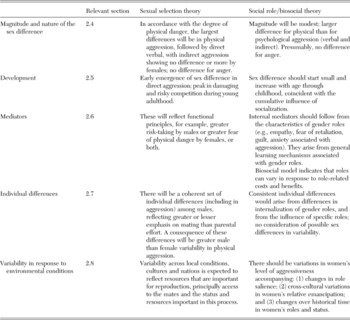
Table 1 provides a summary of the main points of the predictions set out in this section, together with the sections that consider the evidence relating to them.
Summary of predictions about sex differences in aggression from sexual selection and social role theories

2.2. Social role theory as an explanatory framework for human aggression
2.2.1. Principles of social role theory
The main alternative explanation of the origins of human sex differences in social behavior is the “biosocial”Footnote 3 reformulation (Wood & Eagly Reference Wood and Eagly2002) of social role theory (Eagly Reference Eagly1987; Eagly et al. Reference Eagly, Wood, Diekman, Eckes and Trautner2000). The basic tenet of social role theory is that sex differences in behavior arise “from the societal division of labor between the sexes” (Eagly Reference Eagly1997, p. 1381). Although it is primarily the societal positions of men and women, as breadwinner and homemaker, and in the workforce of modern societies, that are important, social role theory acknowledges that the roles of men and women are complex. Thus, more specific roles, such as those in the family (e.g., father, grandmother) and in occupations (e.g., police officer, nurse) also contribute to sex differences in social behavior and to within-sex variations.
The biosocial reformulation of social role theory (Wood & Eagly Reference Wood and Eagly2002) represents an extension of the earlier accounts to address issues raised in exchanges with evolutionary theorists (e.g., Archer Reference Archer1996; Buss Reference Buss, Higgins and Kruglanski1996; Eagly & Wood Reference Eagly and Wood1999), specifically the origins of sex differences, and the principles through which men and women are distributed in societal roles. It is also wider in scope, incorporating evidence from social and physical anthropology. The biosocial account explains how recurrent forms of the division of labor based on sex arose from an interaction between the requirements of the social and physical environment and constraints imposed by the mammalian method of reproduction and sex differences in size and strength. Thus, women's childbearing and nursing of infants, and men's greater size and strength, make it easier for women to perform certain activities and men to perform others. This explains the cross-cultural consistency in gender roles. The interaction between these biological differences and particular ecological, social, economic, and technological forces, explains the variability in gender roles. The behavior associated with the specific sex-typed social roles that emerge from these interactions form the basis of behavioral sex differences, including those in aggression.
Social roles are therefore viewed as being rooted in human history, but they originate from phylogenetic history in the form of reproductive and physical sex differences. Nevertheless, Wood and Eagly (Reference Wood and Eagly2002) stated that their biosocial model does not assume a major role for sexual selection in producing psychological sex differences such as those in aggression. Their argument rested on two points: (1) that sexual selection operates “primarily” in polygynous mating systems; and (2) that other indications of sexual dimorphism in humans, such as size and canine teeth, are low compared with other primates. I return to these issues in section 3.
The notion that certain activities are more efficient under particular circumstances implies cost-benefit maximization. Although this is superficially similar to the reasoning in evolutionary explanations (sect. 2.1.2), no explicit connection is made with reproductive success in the biosocial account (Wood & Eagly Reference Wood and Eagly2002, p. 704). Instead, the terms “cost” and “benefit” refer to individual utility maximization (Wood & Eagly Reference Wood and Eagly2002, p. 719), which is more in line with their meaning in the social sciences, to indicate that individuals are behaving according to their own estimation of the outcomes of their actions (e.g., Kirkpatrick & Epstein Reference Kirkpatrick and Epstein1992; Tedeschi & Felson Reference Tedeschi and Felson1994).
The developmental processes identified in social role explanations are largely those described in social learning accounts of how socialization produces sex-typed behavior. This was the initial focus of psychological explanations of sex differences in behavior, and gender roles were an important feature of these (e.g., Maccoby & Jacklin Reference Maccoby and Jacklin1974; Sears et al. Reference Sears, Rau and Alpert1965). Social role theory incorporated social learning (e.g., Bandura Reference Bandura1973; Bussey & Bandura Reference Bussey and Bandura1999; Perry & Bussey Reference Perry and Bussey1979) as one of one of several processes underlying the social transmission of gender roles (Eagly Reference Eagly1987, p. 31; Eagly et al. Reference Eagly, Wood, Johannesen-Schmidt, Eagly, Beall and Sternberg2004, p. 270; Wood & Eagly Reference Wood and Eagly2002, p. 717). According to social learning theory, gender-typed behavior occurs as a result of the incremental effects of influences by parents, teachers, peers, and the media on the children's developing self-concepts, beliefs, and motives (Leaper & Friedman Reference Leaper, Friedman, Grusec and Hastings2007).
A variety of processes studied by social psychologists have been identified as underlying the way that shared characteristics of roles influence men's and women's behavior (Eagly et al. Reference Eagly, Wood, Johannesen-Schmidt, Eagly, Beall and Sternberg2004). These can be regarded as the proximate causes of sex differences in social behavior. They include expectancies, situational contingencies, incorporation into self-concepts, and the acquisition of different skills and beliefs. One straightforward way that gender roles may influence behavior is through the internalization of gender-stereotypic traits (Eagly Reference Eagly1987), whose content is derived from roles, in the form of feminine communal traits (e.g., helpful, kind, nurturant), and masculine agentic traits (e.g., dominant, self-reliant, aggressive). The traits are not only internalized but also operate externally as expectations of behavior by men and women.
Later versions of social role theory (Eagly et al. Reference Eagly, Wood, Johannesen-Schmidt, Eagly, Beall and Sternberg2004, p. 280; Wood & Eagly Reference Wood and Eagly2002, pp. 701–702) also included neuroendocrine mechanisms. It is known that a range of hormones, principally those concerned with reproduction, and with stress reactions, are responsive to inputs from the social environment. For example, testosterone levels respond to sexual stimuli, the outcomes of competition, and fatherhood (Archer Reference Archer2006b). Wood and Eagly (Reference Wood and Eagly2002) interpreted these as reactions to the demands of social roles.
In social role accounts, within-sex variations in sex-typed behavior can arise in several ways. One of these is through differences in the extent to which individuals internalize the gender roles of their society (Eagly et al. Reference Eagly, Wood, Johannesen-Schmidt, Eagly, Beall and Sternberg2004, p. 280). Another is through the operation of specific roles, for example, family and occupational roles. Social role accounts also predict when external circumstances would accentuate or diminish sex differences. When gender roles are made more salient, the magnitude of the difference should increase. We would also expect sex differences to be influenced by variations in gender roles across cultures or historical times. Eagly and Wood (Reference Eagly and Wood1999) found that sex differences in mate preferences were larger in nations where gender roles were more traditional. Attitudes among college students changed from 1970 to 1995, in the direction of more frequent endorsement of equal rights for women (Twenge Reference Twenge1997a), and in accordance with this, women's own endorsement of agentic traits also increased over these years (Twenge Reference Twenge1997b).
2.2.2. Social role theory applied to human aggression
According to the original social role theory (Eagly Reference Eagly1987, pp. 71–73), sex differences in aggression occur because aggressiveness is a component of masculine roles, and because traditional feminine roles discourage it, although both sets of roles involve norms that encourage and discourage aggression under different circumstances. Specific masculine roles, such as the military, and training in skills for physical aggression, further accentuate the sex difference. The higher societal status of men provides another route to greater direct aggression, since people perceive higher status to be associated with agentic characteristics (Eagly & Steffen Reference Eagly and Steffen1984). Social role analyses view status as one attribute of gender roles, although others distinguish between roles and status as influences on sex differences (e.g., Conway et al. Reference Conway, Irannejad and Giannopoulos2005).
The original social role theory (Eagly Reference Eagly1987) predicted that men should be more aggressive than women, to a moderate extent, consistent with other sex differences in social behavior. Although the main research on indirect aggression had not yet been published, Eagly (Reference Eagly1987) distinguished physical from psychological aggression in relation to experimental studies. The first was defined as producing physical harm and the second psychological or social harm, including what was later termed indirect or relational aggression (Archer & Coyne Reference Archer and Coyne2005). Like sexual selection, social role theory predicts larger sex differences for physical than psychological aggression, on the basis that physical aggression is more clearly linked with masculine roles. Social role theory makes no specific predictions about anger, although the emphasis on sex differences in aggressive responses to anger-arousing situations implies that it predicts no difference in anger.
There is usually no explicit treatment of when sex differences in aggression are first expected to appear in socialization accounts, and no indication of their subsequent progression, since the emphasis is on the mechanisms underlying gender-differentiated behavior. However, in view of the cumulative nature of the processes of learning, it is reasonable to expect, as others have (e.g., Baillargeon et al. Reference Baillargeon, Zoccolillo, Keenan, Côté, Pérusse, Wu, Boivin and Tremblay2007; Tremblay et al. Reference Tremblay, Japel, Pérusse, McDuff, Boivin, Zoccolillo and Montplaisir1999), that aggression should increase with age through childhood, and that this will be more marked for boys than for girls, leading to larger sex differences in aggression with age throughout childhood. From this, we would expect a gradual onset of sex differences, and aggression in general, during early childhood, consistent with a gradual and cumulative learning process (Keenan & Shaw Reference Keenan and Shaw1997; Tieger Reference Tieger1980).
From social role theory, we would expect internal mediators of sex differences in aggression to follow general and specific features of gender roles. General features would be the internalization of masculine or agentic traits, which includes those associated with aggression. Variables such as empathy, fear of retaliation, and guilt and anxiety associated with the consequences of aggression, have been viewed as mediators of women's lower levels of aggression, as consequences of internalized gender roles (Bettencourt & Miller Reference Bettencourt and Miller1996; Eagly & Steffen Reference Eagly and Steffen1986). In the biosocial account, neuroendocrine mechanisms are viewed as playing a different role than in sexual selection explanations. They are the consequences of role-related activity, which may then help to orient men and women to role-related activities.
In social role accounts, within-sex variability in aggression would arise from differences in the internalization of gender roles, and in the adoption of specific roles. Variability as a consequence of different environmental conditions would largely follow variations in the extent to which gender roles are operating. Decreasing the salience of gender roles should lead to a much reduced sex difference in aggression (Eagly & Steffen Reference Eagly and Steffen1986; Lightdale & Prentice Reference Lightdale and Prentice1994). We would expect larger sex differences in nations with more traditional gender roles, and for the difference to have declined over the last 50 years in Western nations, in accordance with the increase in gender role equality.
Table 1 also provides a summary of the main predictions set out in this section, together with the sections that consider the evidence relating to them.
2.3. Sources of evidence
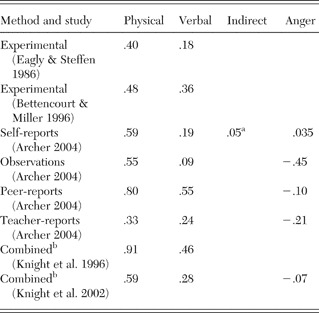
Much of the evidence discussed in the following sections is taken from meta-analyses of sex differences in aggression, which provide systematic summaries of several hundred research reports, involving observations, and reports from self, peers, and teachers, of “real-world” aggression, and experimental studies, both laboratory and naturalistic. Self-reports and experimental studies mainly involve adults, whereas the other methods involve children. The findings are reported for the different types of aggression, and for different measurement methods (Table 2). The values are Cohen's d, which is the difference between male and female mean values, standardized in units of the overall standard deviation. If positive, it represents a higher value for males, and if negative it represents a higher value for females. The types of aggression sampled in these analyses were physical, verbal, and indirect, and one analysis of self-reported trait anger (Table 2). The methods used in laboratory and field experiments are not directly comparable with those used in the “real-world” studies, and the effect sizes for the sex differences tend to be smaller (Archer Reference Archer2004), but they provide a useful alternative to self-reports for adult ages where observations and peer reports are no longer practical options.
Sex differences in types of aggression for different methods of assessment

Note: Values are weighted mean effect sizes (d). d values from Archer's studies are those with outliers removed.
a This value excludes values from the indirect hostility scale of the Buss-Durkee Hostility Inventory, which measures a composite of indirect and displaced aggression (see Archer Reference Archer2004).
b This category refers to a combination of measurement methods (all of those listed above, and projective methods in the case of the 1996 source). The 1996 source was a reanalysis and extension of a previous analysis (Hyde Reference Hyde1984; Reference Hyde, Hyde and Linn1986).
Self-reports (194 samples: Archer Reference Archer2004), typically involve young adults. Laboratory and field experimental studies (50 samples: Eagly & Steffen Reference Eagly and Steffen1986; 107 samples: Bettencourt & Miller Reference Bettencourt and Miller1996) are likely to include a high proportion of college students. In Archer's (Reference Archer2004) meta-analyses, there are 64 samples using observations, with an age range of 1.8 to 13.2 years; 51 samples using peer reports, with an age range of 5 to 17 years; and 40 samples using teacher reports, with ages ranging from 3 to 15 years. Most studies are from the United States, although self-report studies come from 23 other countries.
These summaries of sex differences in aggression refer to measures for which the sex of opponent is unspecified. Observational studies of childrenFootnote 4 that do not specify the sex of the opponent are likely to involve same-sex encounters, since children tend to interact in sex-segregated groups (Archer Reference Archer and McGurk1992a; Maccoby Reference Maccoby1988; Reference Maccoby1998; Pellegrini Reference Pellegrini2004). Self-report methods for studying adults' aggression do not typically specify the sex of the opponent. Where they do (Gergen Reference Gergen1990; Harris Reference Harris1992; Hilton et al. Reference Hilton, Harris and Rice2000; Richardson & Green Reference Richardson and Green1999), the values for same-sex physical aggression are very similar to those found in general questionnaires, and the values for opposite-sex encounters are in the female direction, consistent with findings for physical aggression to an opposite-sex partner (Archer Reference Archer2000a). It is therefore reasonable to conclude that general questionnaires are largely measuring same-sex aggression (Archer 2000; Reference Archer2000b; Reference Archer2004).Footnote 5
Meta-analyses have the advantage of precision, but they are limited to the data-bases used, which are typically from studies of aggression between individuals in Western societies. Evidence from other sources is therefore included, for example, criminological sources in relation to changes with age (sect. 2.5), and psychological studies for possible causal mechanisms (sect. 2.6).
2.4. Overall pattern of sex differences in aggression
The overall pattern of sex differences in aggression enables an assessment to be made of the prediction, from sexual selection, that the magnitude of the sex difference will follow the cost or danger involved. Thus, higher d values in the male direction are expected for physical aggression, a lower one in the male direction for verbal aggression, no sex difference or one in the female direction for indirect aggression, and no sex difference in anger. Table 2 shows the values for the three forms of aggression, for various measurement methods, and for trait anger. Across a range of measures at different ages, d values were higher for physical than for verbal aggression, which were still consistently in the male direction, whereas those for indirect aggression were in the female direction in childhood and adolescence, and very slightly in the male direction for adults. Values for the self-reported experience of anger were around zero, indicating no sex difference, which is consistent with the results for anger in a meta-analysis of temperament in childhood (Else-Quest et al. Reference Else-Quest, Hyde, Goldsmith and Van Hulle2006).
These findings support the view that the magnitude of sex differences follows the degree of immediate risk the actions entail (Archer Reference Archer and Archer1994; Björkqvist Reference Björkqvist1994). Statistics on the proportion of men and women using weapons, and killing members of their own sex, are also consistent with this position. In several surveys of United States youth, reported in Archer (Reference Archer2004), 80% of those who reported carrying a weapon were male. Aggregating data from 20 studies of nearly 14,000 same-sex homicides (Daly & Wilson Reference Daly and Wilson1990) showed an even higher sex difference, with 97% of the perpetrators being male.
Of the meta-analyses listed in Table 2, only Archer (Reference Archer2004) sampled studies outside North America, and most studies in this analysis did come from the United States. There were, however, sufficient studies from other nations to show that the effect size was consistently in the male direction for physical aggression across 13 nations for self-reports, 9 for observations, and 5 for peer reports. Practically all the nations involved were industrial states with an effective rule of law. Historical evidence indicates that, in pre-industrial societies, men have the capacity for intense inter-male competition, which is likely to take a physical form, whereas in modern industrial states they typically use other ways of competing for resourcesFootnote 6 (e.g., Courtwright Reference Courtwright1996; Daly & Wilson Reference Daly and Wilson1988; Reference Daly, Wilson, French, Kamil and Leger2001; Eisner 2004).
Another limitation of the meta-analytic evidence is the emphasis on aggression between individuals. There is little systematic evidence on relative male and female involvement in coalitional aggression, which also occurs in chimpanzees (e.g., Wilson & Wrangham Reference Wilson and Wrangham2003). It has been greatly extended in humans, in the form of raiding parties, primitive warfare in pre-industrial societies (Keeley Reference Keeley1996), gangs, organized crime, and the military in modern nations. These are all activities typically involving men. Keeley (Reference Keeley1996) concluded, from several extensive cross-cultural surveys, that in non-state societies, intergroup warfare typically occurred more or less continuously, involving the mobilization of up to 40% of the male population, and the death of around 30% of the young men. It is possible that, as a consequence of their participation in group aggression, men's behavior and cognition are more intergroup-oriented than women's (van Vugt et al. Reference van Vugt, De Cremer and Janssen2007). Men (but not women) increased altruistic group contributions during intergroup competition (van Vugt et al. Reference van Vugt, De Cremer and Janssen2007), and they showed more risky decision choices when in the presence of other men (Daly & Wilson Reference Daly, Wilson, French, Kamil and Leger2001).
2.5. Age trends in sex difference in physical aggression
In section 2.1.2, I indicated some broad predictions from sexual selection theory concerning the development of sex differences in aggression. They would not be solely determined by cultural learning throughout childhood; they would be subject to some biological developmental influence, either early in postnatal life, or at puberty; and they would be largest in young adulthood. From a socialization perspective, we would expect sex differences to be small or nonexistent at preschool ages (see Keenan & Shaw Reference Keenan and Shaw1997), and to increase throughout childhood, reflecting the cumulative influences of gendered learning.
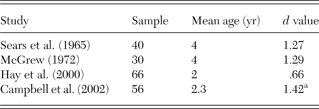
Three lines of evidence show that the sex difference begins early in life, and can be substantial at young ages, supporting an evolutionary analysis (Bjorklund & Pellegrini Reference Bjorklund and Pellegrini2000). First, individual observational studies (Table 3) show that sex differences in physical aggression are large early in life. Second, although Keenan and Shaw (Reference Keenan and Shaw1997) claimed that there was no sex difference in direct aggression for toddlers, on the basis of a narrative review of five observational studies, a meta-analysis of the same studies showed a significant difference (d=.44; p=.003: Archer & Côté Reference Archer, Côté, Tremblay, Hartup and Archer2005). Third, a longitudinal study of mother's reports of children's physical aggression at 17 and 29 months found sex differences at the first of these times, with no change in magnitude at 29 months (Baillargeon et al. Reference Baillargeon, Zoccolillo, Keenan, Côté, Pérusse, Wu, Boivin and Tremblay2007). The large-sample longitudinal study of Tremblay et al. (Reference Tremblay, Japel, Pérusse, McDuff, Boivin, Zoccolillo and Montplaisir1999), represented in Figure 1 here, also found that the sex difference in physical aggression was present at 2 years of age, and that physical aggression showed a peak between 2 and 3 years of age, followed by a decline in the childhood years. They concluded that socialization must largely entail learning to inhibit physical aggression, rather than learning it from role models.
Changes in physical aggression of boys and girls with age (mothers' reports).

Sex differences in physical aggression in four observational studies at young ages
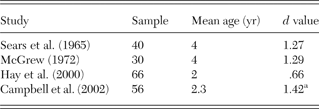
Note: d values were calculated using DSTAT (Johnson Reference Johnson1989), and have previously been used for a meta-analysis (Archer Reference Archer2004) or reported in a book chapter (Archer & Côté Reference Archer, Côté, Tremblay, Hartup and Archer2005).
a This value was for “grabbing another child's toy.”
A meta-analysis of age trends for self-reported physical aggression showed no increase from before to after puberty (6–11 years: d=.56; 12–17 years: d=.46: Archer Reference Archer2004), coincident with the action of testosterone on reproductive physiology and secondary sexual characteristics (Tanner Reference Tanner1989). Consistent with this, several longitudinal studies showed no increase in aggression for boys at puberty, and two others showed no link between testosterone levels and physical aggression at puberty (Archer Reference Archer2006b).
Crime figures from a variety of historical times and cultures (Courtwright Reference Courtwright1996; Daly & Wilson Reference Daly and Wilson1990; Reference Daly, Wilson, French, Kamil and Leger2001; Eisner Reference Eisner2003; Quetelet Reference Quetelet and Hayez1833/1984), show that men's involvement in violent crimes, and in same-sex homicides, is highest between the ages 18 and 30 years. This is as expected if they represent reproductive competition that is delayed until men have attained optimum size and strength (sect. 2.1.2). Effect sizes for sex differences in self-reported physical aggression are also largest in the 18–21 and 22–30 age categories (Archer Reference Archer2004).
2.6. Mediators of sex differences in physical aggression
The implications of sexual selection for the mechanisms underlying sex differences in aggression are that they are likely to involve sexually dimorphic neuroendocrine mechanisms, and that they will be concerned with variables such as risk-taking, lack of inhibition, or fear of physical harm (sect. 2.1.2). The available evidence (sect. 2.5) did not support the view that male escalated aggression arises at puberty as a result of increased testosterone levels. Nevertheless, temporarily raising a woman's level of testosterone to that of a man enhances her cardiac defense reflex to angry (but not other) faces, in a masked Stroop test (van Honk et al. Reference van Honk, Tuiten, Hermans, Putman, Koppeschaar, Thijssen, Verbaten and van Doornen2001). The rationale behind this procedure is that a greater initial reaction to an angry face is associated with threat rather than appeasement responding (Putman et al. Reference Putman, Hermans and van Honk2004). A subsequent functional MRI (fMRI) study (Hermans et al. Reference Hermans, Ramsey and van Honk2008) showed that in response to an angry face there was extensive activity in a range of cortical and subcortical brain areas known to be associated with aggression in nonhuman mammals. Further, administering testosterone affected the responses in these areas, primarily by increasing the excitability of subcortical structures involved in regulating aggression. Further studies have shown that laboratory measures of two suggested mediators of the sex difference in aggression, fear and empathy, are also reduced by administering testosterone to women (Hermans et al. Reference Hermans, Putman, Baas, Koppeschaar and van Honk2006a; Reference Hermans, Putman and van Honk2006b). These findings seem to indicate a direct influence of testosterone on brain mechanisms underlying aggression, at least in one specific aggression-related measure, and also an influence on two attributes that may mediate direct aggression. It is not easy to see how this research fits with the lack of a testosterone-induced increase in aggression at puberty, or the evidence that sex differences in aggression begin early in life. It may be that the brain areas are affected by pubertal testosterone, but that they only gradually manifest themselves in overt behavior over subsequent years.
Evolutionary analyses (sect. 2.1.2) emphasize greater risk-taking by males than females as underlying the differences in their aggression. Overall, men show more risk-taking than women (Byrnes et al. Reference Byrnes, Miller and Schafer1999), although the sex differences are greater for certain types of risk: Effect sizes are highest for risks such as driving, drug and alcohol use, gambling, and everyday risks such as crossing a road (Byrnes et al. Reference Byrnes, Miller and Schafer1999; Daly & Wilson Reference Daly, Wilson, French, Kamil and Leger2001; Harris et al. Reference Harris, Jenkins and Glaser2006; Pawlowski et al. Reference Pawlowski, Atwal and Dunbar2008; Zuckerman & Kuhlman Reference Zuckerman and Kuhlman2000). A mediator of these differences may be a sex difference in a related characteristic, such as fear (Byrnes et al. Reference Byrnes, Miller and Schafer1999; Campbell Reference Campbell1999), impulsivity (Campbell Reference Campbell2006), or sensation-seeking (Wilson & Daly Reference Wilson and Daly2006; Zuckerman Reference Zuckerman1994; Zuckerman et al. Reference Zuckerman, Kuhlman, Joireman, Teta and Kraft1993).
A study by Harris et al. (Reference Harris, Jenkins and Glaser2006) suggests that several variables may underlie men's greater risk-taking: Men anticipated being less upset or harmed by possible negative outcomes; they judged negative consequences as being less likely to occur; and they reported higher enjoyment of risky activities. Applied to physical aggression, that would mean women anticipate greater harm from its consequences, which is highlighted in Campbell's (Reference Campbell1999) evolutionary analysis and in social role theory (Eagly & Steffen Reference Eagly and Steffen1986). Women would also view such negative consequences as being more likely to occur, and show less enjoyment of physical aggression than men: This would fit the very large sex difference found for children's enjoyment of physical aggression (Benenson et al. Reference Benenson, Carder and Geib-Cole2008).
Campbell (Reference Campbell1999; Reference Campbell2006) argued that higher levels of fear experienced by women in confrontational situations could mediate the sex difference in physical aggression. Consistent with this, the sex difference in fear occurs at an early age (Else-Quest et al. Reference Else-Quest, Hyde, Goldsmith and Van Hulle2006), and is pronounced in situations involving physical danger. In experimental studies of adults (Bettencourt & Miller Reference Bettencourt and Miller1996; Eagly & Steffen Reference Eagly and Steffen1986), the sex difference in aggression was higher under conditions of greater danger. Campbell (Reference Campbell2006) also considered a related process, effortful control, as another possible mediator of sex differences in physical aggression. This is the ability to suppress a dominant (and immediately attractive) response in favor of a subdominant (and later beneficial) one. It shows a large sex difference in favor of girls from early in postnatal life (Else-Quest et al. Reference Else-Quest, Hyde, Goldsmith and Van Hulle2006).
Social role theory predicts that sex differences in aggression will vary according to a number of external and internal variables associated with gender roles. Both guilt and anxiety about others' suffering, and exposure to danger to the self, are important aspects of internalized gender roles, corresponding to the fear and risk-taking identified in evolutionary analyses, and to empathy, which also features in evolutionary accounts. Eagly and Steffen (Reference Eagly and Steffen1986) found that women viewed their aggression as more likely to pose a danger to themselves than men did, and the extent of the perceived danger predicted the magnitude of the sex difference. Meta-analyses of experimental studies (Bettencourt & Kernahan Reference Bettencourt and Kernahan1997; Bettencourt & Miller Reference Bettencourt and Miller1996; Eagly & Steffen Reference Eagly and Steffen1986) found that women showed more empathy with the victim of their aggression (i.e., more anxiety and guilt after aggressing), than men did. For empathy to act as a mediator of the sex difference in physical aggression, it would have to operate to a greater extent as the level of escalation increased, as indeed it could as the consequences for the other person will be greater. It would have to be minimized in cases of indirect aggression, where the victim's emotional distress may be less apparent. It would also have to be lessened for aggression between partners where there is no sex difference in physical aggression in Western nations (sect. 4). This would be possible in cases where male suffering is minimized or disregarded (Felson Reference Felson2002).
Another aspect of social role theory concerns the expectancies associated with status differences between men and women. These expectancies can either be internalized or reside in the others' expectations. Conway et al. (Reference Conway, Irannejad and Giannopoulos2005) found that expectancies for men's and women's aggression were similar to those for people differing in status. Low-status individuals were, like women, viewed as experiencing more guilt and anxiety, and causing less harm by aggressing, than were high-status individuals. Low-status individuals were also viewed as less physically aggressive. This study concerned the expectancies attributed to people by others. If they also represent internalized expectancies, as suggested by social role theory, they could guide the behavior of men and women, and therefore act as mediators of sex differences. One problem with this view is that cross-cultural and historical evidence has repeatedly shown that lower-status individuals with little to lose are those who are most inclined to engage in physical aggression (sect. 2.7).
Possible mediators of sex differences in aggression need to be viewed in terms of their social and developmental context, as contributors to the outcome of a developmental sequence arising from the interaction of internal and external influences. Individual components coalesce to produce the typical outcome only when embedded in a typical male or female sequence of development. For example, it is possible that prenatal testosterone alters predispositions for fear of physical danger, and for activity and play preferences, which manifest themselves in overt behavior only through interactions with other boys. The behavior so produced would then become viewed in terms of the gender roles operating in that culture, which will themselves influence behavioral development. Similarly, testosterone secretion at puberty may produce the dispositions shown in laboratory studies, but these produce sex differences in escalated physical aggression only under the social conditions that are manifest in early adulthood. Such specific dispositions will also be subject to activating and inhibiting social influences operating throughout development. For example, a culture that emphasizes the need to respond to the slightest provocation (the “culture of honor”: sect. 2.8) is activating, and an effective rule of law is inhibiting. This perspective on mediators of sex differences in aggression involves social roles as both emerging from the interaction of dispositions and the social environment, and also feeding into this process.
2.7. Within-sex individual differences in physical aggression
A prediction derived from sexual selection is that, in species where there is parental investment, there will be individual differences among males reflecting a different emphasis on mating or parental effort. A number of studies show that individual differences in measures indicative of mating versus parental effort are associated with testosterone levels (Archer Reference Archer2006b), and with a range of antisocial activities and behavioral and personality variables, including dominance and aggressiveness. These appear to be long-term dispositions, present before puberty.
Such individual differences among males will lead to greater variability among males than females in traits such as physical aggression, but not in those on which the sexes do not differ, such as anger and self-esteem. Archer and Mehdikhani (Reference Archer and Mehdikhani2003) tested this prediction in a sample of questionnaire studies, and found that male variability was indeed significantly greater than female variability for physical aggression but not for anger or self-esteem. Although these findings are consistent with the hypothesis that individual differences reflect variability in male mating strategies, a more direct test is needed to establish whether this is the case.
Social role theory makes no comparable predictions of differences in within-sex variability in aggression. It does identify a number of variables that will produce within-sex variability in both sexes. One is the different extent to which people internalize gender role norms (Eagly et al. Reference Eagly, Wood, Johannesen-Schmidt, Eagly, Beall and Sternberg2004, p. 280). Consistent with this, self-reported physical aggression was highly correlated with agentic traits among a sample of men (Archer, submitted), and three other studies have found low to moderate associations between a measure highly related to self-reported aggression and endorsement of gender role traits (Campbell & Muncer Reference Campbell and Muncer1994; Campbell et al. Reference Campbell, Muncer and Gorman1993; Thanzami & Archer Reference Thanzami and Archer2005). Specific gender-related roles provide another influence on within-sex variability: Campbell and Muncer (Reference Campbell and Muncer1994) found that occupation (soldier or nurse) was a better predictor of a person's attributions about his or her own aggression than was the person's sex.
2.8. Variability in sex differences in aggression in response to environmental conditions
Sexual selection predicts variability in response to conditions that affect the extent of inter-male or inter-female competition, notably resources that are important for reproduction, such as access to mates, and the status and resources important in this process. Consistent with this, violence is higher among men who have few economic resources or prospects (Courtwright Reference Courtwright1996; Daly & Wilson Reference Daly and Wilson1988; Eisner Reference Eisner2003), and is lower among married men than those who are single, divorced, or widowed (Daly & Wilson Reference Daly, Wilson, French, Kamil and Leger2001). In an analysis of Japanese homicide figures, Hiraiwa-Hasegawa (Reference Hiraiwa-Hasegawa2005) found that the rate of homicides by young males had declined considerably since 1955, and that this coincided with smaller families, an increase in GDP per person, and a high proportion of young adults in education, all indicators of greater resource availability. The annual rate of homicides for young males from 1960 to 1996 was inversely related to college enrollment and the degree of financial equality in the society. These influences are very different from those found to account for the more limited decline in violent crime in the United States in the 1990s (Levitt Reference Levitt2004), but are similar to the likely causes of the longer-term large decline in violent crime since the fifteenth century in Europe (Eisner Reference Eisner2003).
A simple prediction from the concept of Operational Sex Ratio (OSR; Emlen & Oring Reference Emlen and Oring1977), the ratio of sexually active males to fertilizable females in the population (sect. 2.1.1), is that inter-male competition will be intensified where there are a greater number of males of reproductive age. Hudson and Den Boer (Reference Hudson and Den Boer2002; Reference Hudson and Den Boer2004) showed from historical records that where there had been high male-biased sex ratios (e.g., in nineteenth century China and medieval Portugal), there was social unrest, individual and collective violence, and expansionist military campaigns. The consequences of a low OSR were indicated by Campbell (Reference Campbell1995), who reported localized high rates of physical aggression among young women where a large proportion of young men were not regarded as suitable mates as they had debilitating drug habits. Schuster (Reference Schuster1983; Reference Schuster, Haug, Benton, Brain, Olivier and Mos1985) also documented escalated female aggression in Zambia and in China when there was competition for desirable men.
In these examples, environmental conditions accentuate the relative benefits of successful direct competition. In other cases, social forces operate in the opposite direction. One that has been particularly important in human history is the effectiveness of a rule of law. Where this makes men secure in their own safety and the security of their property, the costs of ignoring a challenge will be relatively low. There are also likely to be benefits from this course of action, such as avoiding injury and legal penalties. When there is no effective rule of law, and a man's possessions and livelihood can readily be taken by force, the costs of ignoring a challenge will be high. Consequently, establishing a reputation for effective retaliatory power is necessary, and not to do so is to risk one's personal safety, possessions, and family. A “culture of honor” (Nisbett & Cohen Reference Nisbett and Cohen1996) emerges under these circumstances.
Social role theory predicts that there will be variations in sex differences in aggression accompanying differences in the salience or nature of men's and women's roles. Since provoked aggression is viewed as justified aggression, this justification was regarded as freeing women from the constraints normally imposed by gender roles (Bettencourt & Miller Reference Bettencourt and Miller1996). Consistent with this, experimental studies showed a smaller sex difference in aggression when participants were provoked (Bettencourt & Miller Reference Bettencourt and Miller1996). Another influence on the salience of roles is whether the behavior occurs in public or private settings, although the prediction that roles are more salient in public is complicated by the varied effects of different audiences: Experimental findings were ambiguous on this issue (Eagly & Steffen Reference Eagly and Steffen1986).
One particular study was regarded by its authors, and by Bettencourt and Miller (Reference Bettencourt and Miller1996), as specifically supporting a social role explanation of sex differences in aggression. Lightdale and Prentice (Reference Lightdale and Prentice1994) experimentally reduced role salience by creating a sense of anonymity and unaccountability regarding the opponent in a video-game task involving dropping bombs on an opponent following provocation. There was a striking reversal of the usual sex difference under these conditions (d=−.41, from the authors' Table 3) compared with those in which opponents were identifiable and known to one another (d=.92). A more recent study (Evers et al. Reference Evers, Fischer, Rodriguez Mosquera and Manstead2005) reported similar findings, but explained them in terms of the social appraisal of emotions rather than role salience. Men showed a higher aggressive response than women did when they expected to meet the person who had angered them (d=2.42, from the authors' Table 2), but there was no sex difference (d=.11) when people believed they would not meet the person who had angered them. An alternative explanation for both findings would be that the aggression required under the anonymous condition is indirect aggression, involving a lesser likelihood of anticipated retaliation (Björkqvist Reference Björkqvist1994). This would link the findings to a larger set of studies on indirect aggression (Archer & Coyne Reference Archer and Coyne2005), and to Campbell's (Reference Campbell1999) evolutionary view that emphasizes women's greater anticipation of negative consequences for their direct (but not indirect) aggression.
Social role theory predicts that sex differences will be larger when more traditional gender roles operate (e.g., Eagly & Wood Reference Eagly and Wood1999). Although sex differences in physical aggression are available for a variety of countries (Archer Reference Archer2004), and all show a difference in the male direction, they could not be used to test this prediction as the measures and samples were inconsistent. Lippa (in press) assessed the association between the relative empowerment of women in different nations and sex differences in the personality trait agreeableness, which is inversely related to aggressiveness (Gleason et al. Reference Gleason, Jensen-Campbell and Richardson2004; Sharpe & Desai Reference Sharpe and Desai2001). He found lower sex differences where there were more traditional gender roles, the opposite of that expected if sex differences were accentuated by more pronounced gender roles.
Another prediction from social role theory is that there would be a lowering in the magnitude of sex differences in physical aggression coinciding with changes in gender roles in North America since the 1960s (Twenge Reference Twenge1997a; Reference Twenge1997b). Although there is no direct evidence on this, sex differences in the related characteristics of assertiveness and dominance did decrease during this time period (Twenge Reference Twenge2001). Women's assertiveness and dominance rose and fell over a longer time period, from 1931 to 1993, in accordance with changes in women's status and roles. From 1968 to 1993, there was a change in the sex difference in assertiveness from a moderately higher level in men (d=.40) to a slight female advantage (d=−.07). A direct investigation of changes over time in women's aggression in relation to changing roles is hampered by the lack of consistent measures and the availability of studies throughout the whole time period.
2.9. Conclusions for sex differences in aggression between same-sex individuals
The evidence reviewed in section 2.4 supports the first prediction from a sexual selection analysis that sex differences in aggression will increase in magnitude as the form of aggression becomes potentially more costly. Thus, physical aggression shows a substantial effect size in the male direction; verbal aggression a smaller one in the male direction; indirect aggression shows no sex difference, or is in the female direction; and there is no difference in anger. Weapons use and homicide statistics show even larger sex differences. The social role prediction that sex differences in aggression should be modest applies only to its less damaging forms, although social role theory does predict differences in effect sizes between physical and indirect aggression. Sexual selection provides a better fit with the overall pattern of greater sex differences for more risky and costly forms of aggression.
The finding that a sex difference in physical aggression occurs early in postnatal life, together with an increase in the magnitude of the sex difference in young adulthood, when there are also very large sex differences in violent crime and homicide, fits one of the two patterns expected from sexual selection. There is no evidence of an increase in aggression coinciding with puberty. The absence of a progressive increase in the size of the sex difference in physical aggression during childhood is inconsistent with an explanation in terms of the gradual differential learning of aggression by boys and girls, inferred from social learning accounts.
From sexual selection, we would expect mediators of the sex difference in aggression to follow functional principles, such as greater risk-taking by males and/or greater fear of physical danger by females. Although there are currently no direct tests of these as possible mediators, indirect evidence showed sex differences in these variables, consistent with this prediction, and some evidence that they were influenced by testosterone. Both greater risk-taking by men and fear of physical danger by women also feature as possible mediators in social role accounts, in this instance connected to masculine and feminine roles. I have outlined a developmental perspective that encompasses biological dispositions interacting with the social environment, with the resulting outcomes being reflected in social roles, which in turn influence the process of development.
There is evidence consistent with the prediction that there would be a coherent set of individual difference variables among males, reflecting greater specialization for mating versus parental effort. These variables are associated with testosterone levels. The greater variability in men's than women's physical aggression levels also supports this prediction. Social role theory does not predict greater variability for males than females. However, there is clear evidence that individual differences reflecting internalization of gender roles are associated with aggression-related measures, supporting predictions from social role theory.
Context-dependent variability is approached differently by sexual selection and social role theory. A number of studies suggest that those with few resources are the most prone to physical aggression, and that differences in the operational sex ratio accentuate competition in the more numerous sex: both of these suggestions are consistent with sexual selection analyses. Social role theory predicts that sex differences in aggression will be absent when roles are not salient. Two experimental studies were apparently consistent with this prediction, although the findings could be explained in terms of aggression being indirect when the aggressor had no prospect of meeting the victim. A cross-cultural analysis of sex differences in the personality trait agreeableness (which is inversely related to aggression) produced findings opposite to those expected from social role theory. However, it is clear that agentic characteristics in general, and assertiveness in particular, have changed in North America from the 1960s to the present, as gender attitudes became less traditional.
3. Evidence for an adaptive complex produced by inter-male competition
3.1. Overview
Section 2 indicated considerable evidence that was consistent with a sexual selection explanation of sex differences in aggression. In nonhuman mammals, greater male than female engagement in escalated aggression is typically accompanied by other sexually selected attributes, forming an adaptive complex associated with a polygynous mating system (Alexander et al. Reference Alexander, Hoogland, Howard, Noonan, Sherman, Chagnon and Irons1979; Clutton-Brock et al. Reference Clutton-Brock, Harvey and Rudder1977). This is characterized by higher male than female variance in reproductive success, which is equivalent to a measure of effective polygyny (Daly & Wilson Reference Daly and Wilson1983). I consider the evidence for this among humans in section 3.2. The adaptive complex (sects. 3.3 to 3.6), involves several features: (1) specializations for inter-male encounters, such as threat displays, involving visual and vocal signals; (2) larger size, musculature, and strength, among males than females; (3) longer maturation rates in males than females; (4) greater male than female mortality rates, during both immaturity and adulthood, accompanied by a greater number of males than females conceived. Section 3.7 concerns variability in mating systems in relation to the adaptive complex.
3.2. Polygyny and variance in reproductive output
From a comparative primatological perspective (Fuentes Reference Fuentes1999), humans do not fit the criteria of a monogamous species, and cross-cultural surveys show the existence of polygyny in most pre-industrial societies (Alexander et al. Reference Alexander, Hoogland, Howard, Noonan, Sherman, Chagnon and Irons1979; Ford & Beach Reference Ford and Beach1951; Murdock Reference Murdock1967). Alexander et al. (Reference Alexander, Hoogland, Howard, Noonan, Sherman, Chagnon and Irons1979) argued that the widespread occurrence of monogamy in the world today is imposed on a more general pattern of polygyny, except in societies where ecological conditions are harsh. Betzig (Reference Betzig1986; Reference Betzig1992) used historical sources to show that whenever there was political and economic inequality, as was generally the case in the large historical empires, mating was effectively polygynous, even if marriage was legally only monogamous. Thus, throughout recorded history, powerful men typically had a very high number of sexual partners (Betzig Reference Betzig1986; Reference Betzig1992), which until recent times was reflected in their numbers of offspring (Daly & Wilson Reference Daly and Wilson1988). This is maintained to some extent today. In modern Western nations where divorce is available, men who can afford a younger wife at the expense of an older one are likely to have the same effect on the variation in reproductive success as polygyny. In a study of a society where remarriage was common (Sweden), Forsberg and Tullberg (Reference Forsberg and Tullberg1995) found that remarriage produced increased numbers of offspring for men but not for women.
Several studies of pre-industrial societies enable figures to be calculated for male and female variance in reproductive success. Variance ratios were: 3.1 for the Brazilian Xante Indians (Salzano et al. Reference Salzano, Neel and Maybury-Lewis1967); 1.77 for the Dobe !Kung (from Howell Reference Howell1979, p. 269); from 2.02 to 4.69 for Yanomamö (Chagnon Reference Chagnon, Chagnon and Irons1979); and 2.76 for Aka pygmies (Hewlett Reference Hewlett, Betzig, Borgerhoff Mulder and Turke1988). All indicate effective polygyny.
3.3. Aggressive display features
Primate males typically show ritualized threat displays, and these are probably associated with the higher costs of male than female fights (Smuts Reference Smuts, Smuts, Cheney, Seyfarth, Wrangham and Struhsaker1987a). Throughout primates, male facial hair growth is associated with threat displays (Andersson Reference Andersson1994, p. 345), increasing the apparent size of the lower part of the face (Guthrie Reference Guthrie1970). Consistent with this are suggestions that the male beard is the consequence of selection for competition over rank and resources (Darwin Reference Darwin1871/1901; Guthrie Reference Guthrie1970; Tanner Reference Tanner1989). The few empirical studies of this suggestion support it. Addison (Reference Addison1989) found that college students rated bearded men significantly higher than beardless men on aggressiveness, dominance, masculinity, and strength. Muscarella and Cunningham (Reference Muscarella and Cunningham1996) manipulated facial stimuli, and found that facial hair increased perceptions of aggression, although such faces were rated as less attractive and lower on social maturity.
Sell (Reference Sell2006) argued that the human angry face is an adaptation to accentuate facial cues indicating size and strength. Consistent with this, people can predict the lifting strength of young men from their faces (Sell et al. Reference Sell, Cosmides, Tooby, Sznycer, von Rueden and Gurven2009). This applied to faces from their contemporaries, students from the University of California, Santa Barbara (r=.39 and .45), and from two South American Amerindian groups (r=.52 and .47). Two features of the human face show sexual dimorphism, the brow ridges and the chin. Both are exaggerated in the angry face (Sell Reference Sell2006): Ratings of “angry” and “masculine” were increased by lowering the brow ridges in androgynous prototypical faces with emotionally neutral expressions (Becker et al., Reference Becker, Kenrick, Neuberg, Blackwell and Smith2007). It is likely that other sexually dimorphic features, such as neck size, contribute to male threat displays (Guthrie Reference Guthrie1970), and that these constitute “honest advertisements” (Clutton-Brock & Albon Reference Clutton-Brock and Albon1979) of fighting ability.
Weston et al. (Reference Weston, Friday, Johnstone and Schrenk2004, p. 416) referred to the paradox between “marked body size dimorphism, suggestive of strong sexual selection” in the human line and the absence of larger male canines, the other feature associated with inter-male competition in primates. Their analysis of 14 species of New World monkeys and apes showed that canine dimorphism is negatively correlated with another sexually dimorphic feature, facial width-to-height ratio. They argued that contrary to the absence of canine dimorphism being a sign of weak sexual selection, it is associated with strong selection for this alternative feature. Their subsequent analysis of a series of human skulls from infancy to adulthood confirmed that this is a sexually dimorphic feature in humans (Weston et al. Reference Weston, Friday and Lio2007). Their preferred explanation was in terms of female choice, but a subsequent study of three samples of young men (Carré & McCormick Reference Carré and McCormick2008) found that facial width-to-height ratio is associated with aggressiveness, suggesting that it may be a further cue for coercive power, or possibly for dispositional aggressiveness.
A range of male vertebrates use vocalizations as threat displays (e.g., Clutton-Brock & Albon Reference Clutton-Brock and Albon1979; Davies & Halliday Reference Davies and Halliday1978; McElligott et al. Reference McElligott, O'Neill and Hayden1999; Mager et al. Reference Mager, Walcott and Piper2007), and these generally indicate fighting ability, or Resource Holding Power (RHP; Parker Reference Parker1974a), which can be used to decide whether or not to fight. In human males, two changes occur to the voice at puberty, a lowering of the fundamental frequency, and a descent of the larynx, resulting in lowered formants and less formant dispersal. Evans et al. (Reference Evans, Neave and Wakelin2006) found that the first was associated with measures of shoulder-to-hip ratio, and the second with body size and shape. Artificially lowering the pitch of a man's voice increased ratings of his fighting ability by other men (Puts et al. Reference Puts, Gaulin and Verdolini2006; Reference Puts, Hodges, Cárdenas and Gaulin2007). Men who regarded themselves as physically dominant lowered their voice pitch in a competitive situation (Puts et al. Reference Puts, Gaulin and Verdolini2006). These studies are consistent with the view that the deepness of the male voice is also an “honest advertisement” (Clutton-Brock & Albon Reference Clutton-Brock and Albon1979) of fighting ability. In a hunter-gatherer group, men with deeper voices had higher reproductive success than those with higher-pitched voices (Apicella et al. Reference Apicella, Feinberg and Marlowe2007).
3.4. Size and strength
Although females are larger than males in most animals, larger male size is typical of mammals (Andersson Reference Andersson1994; Darwin Reference Darwin1871/1901; Lindenfors et al. Reference Lindenfors, Gittleman, Jones, Fairbairn, Blanckenhorn and Székely2007). Human males are on average taller, weigh more, and have greater strength and musculature than human females. Alexander et al. (Reference Alexander, Hoogland, Howard, Noonan, Sherman, Chagnon and Irons1979) summarized data from 93 societies from the ethnographic record, in terms of the ratio of male-to-female height. On average, men were 7.6% taller than women, with a variation of 4.7% to 11.6% between societies. A large-scale study using data from North Indian migrant workers from 1842 to 1916 found values of 7% to 8% for ages 15 to 40 years (Brennan et al. Reference Brennan, McDonald and Shlomowitz1997). Data from nineteenth century British Columbia produced values ranging from 6 to 10% for seven adult age categories (Hall Reference Hall1978). More recent evidence shows similar differences in the United States, Switzerland, and China. Effect sizes calculated from these studies are very large (Hall Reference Hall1978: d=2.67; Kyle et al. Reference Kyle, Genton, Lukaski, Dupertuis, Slosman, Hans and Pichard2005: d=1.78 to 1.85; Lindle et al. Reference Lindle, Metter, Lynch, Fleg, Fozard, Tobin, Roy and Hurley1997: d=1.14; Luk et al. Reference Luk, Lu, Kwan, Hu, Wong, Law and Leong2003, d=5.95; Pheasant Reference Pheasant1983: d=1.07; Xiao et al. Reference Xiao, Lei, Dempsey, Lu and Liang2005: d=2.24).
Men are around 25% heavier than women of a similar age, and these are large differences when expressed as effect sizes (Kyle et al. Reference Kyle, Genton, Lukaski, Dupertuis, Slosman, Hans and Pichard2005: d=.87 to 1.79; Lindle et al. Reference Lindle, Metter, Lynch, Fleg, Fozard, Tobin, Roy and Hurley1997: d=.60; Luk et al. Reference Luk, Lu, Kwan, Hu, Wong, Law and Leong2003, d=.78; Pheasant Reference Pheasant1983: d=1.15; Xiao et al. Reference Xiao, Lei, Dempsey, Lu and Liang2005: d=1.30). Sex differences in fat-free body mass are even larger, with effect sizes reaching d=2.36 for a U. S. sample and d=3.46 for a Swiss sample (Kyle et al. Reference Kyle, Genton, Lukaski, Dupertuis, Slosman, Hans and Pichard2005), with the male-to-female ratios reaching 1.40 in the Swiss sample and 1.43 in the U. S. sample,
Across 112 studies, Pheasant (Reference Pheasant1983) found that women's mean strength was 61% of that of men. Other studies have found similar or higher values (e.g., Battié et al. Reference Battié, Bigos, Fisher, Hansson, Jones and Wortley1989; Luk et al. Reference Luk, Lu, Kwan, Hu, Wong, Law and Leong2003; Xiao et al. Reference Xiao, Lei, Dempsey, Lu and Liang2005), with d values from 1.45 to 3.09, depending on the sample and the strength measure (Battié et al. Reference Battié, Bigos, Fisher, Hansson, Jones and Wortley1989; Xiao et al. Reference Xiao, Lei, Dempsey, Lu and Liang2005). Compared to women, men also have larger hearts and lungs, higher systolic blood pressure, lower resting heart rate, greater oxygen-carrying capacity, and greater ability to neutralize the products of muscular exertion (Tanner Reference Tanner and Mussen1970).
These studies indicate considerable sex differences in muscle mass and strength, although they are smaller than in highly polygynous primates, where the male-to-female body mass ratio is above 1.5 (Plavcan Reference Plavcan2000, p. 331; Plavcan & Schaik Reference Plavcan and van Schaik1997a). In humans, it is assumed that both paternal investment (Geary Reference Geary2000) and male-male coalitions (Geary et al. Reference Geary, Byrd-Craven, Hoard, Vigil and Numtee2003) have lessened the impact of inter-male competition, and with it the degree of dimorphism in strength and size, compared to more polygynous ancestral species. Estimates of the male-to-female body mass indices for Australopithecines range from the oldest, A. afarensis, at 1.52, to the more recent A. africanus, robustus, and boisei at 1.32, 1.26, and 1.40 (Plavcan Reference Plavcan2000), which are similar to chimpanzees at 1.30 (Plavcan & Schaik Reference Plavcan and van Schaik1997a), but not much more than modern humans. If, as McHenry and Coffing's (Reference McHenry and Coffing2000) analysis indicates, the decreased dimorphism from Australopithecines to modern humans resulted from a relatively greater increase in female than male size, this suggests that it did not reflect a lessening of inter-male competition. However, all estimates of dimorphism in extinct hominids rely on fragmentary fossil remains (Plavcan & Schaik Reference Plavcan and van Schaik1997a), and should therefore be treated with caution.
3.5. Maturation rates
A further characteristic of sexual selection is bimaturism, males starting to reproduce at a later age than females. Andersson (Reference Andersson1994) suggested that this occurs where size is important for inter-male competition: by delaying reproduction, males can avoid risky fights with older, larger, males. This reduction in male competition will have the effect of reducing the OSR (sect. 2.8), one consequence of which is to increase the degree of polygynous mating (Clutton-Brock & Harvey Reference Clutton-Brock and Harvey1977). Boys take around two years longer than girls to reach puberty (Tanner Reference Tanner1989), and a difference in maturation is apparent early in life: half-way through the fetal period, girls are three weeks ahead of boys (Tanner Reference Tanner1989).
3.6. Mortality and conception rates
Higher male than female mortality occurs in humans throughout life, both as result of greater male vulnerability to disease, stress, and injury, and higher risk-taking and violent behavior by men. Although the specific causes of death have changed throughout human history, and vary under different environmental conditions, the typical end result is greater male mortality (Kruger & Nesse Reference Kruger and Nesse2006), through a combination of greater engagement in risky activities and higher disease susceptibility. Analyzing mortality rates in U. S. statistics for 2000, at five-year intervals throughout the lifespan, Kruger and Nesse (Reference Kruger and Nesse2006) found that the peak male-to-female mortality ratio (M:F MR) was in young adulthood (20–24 years), when the overall value was 3.01, and it declined thereafter. The curve for changes in the M:F MR with age was very similar to that for the age-crime curve. The ratio tended to be higher throughout life for external causes, whose peak value was 4.03, again during the 20–24 years age group. Kruger and Nesse also calculated M:F MR for a sample of chimpanzees and generally found higher values for males across the lifespan (1.43), again with a pronounced peak in young adulthood. Analysis of figures for Ache hunter-gatherers, where homicide was a major cause of death, showed an overall value of 1.77, with the peak more evenly distributed throughout adult life.
Accompanying the greater male mortality throughout life is an unequal sex ratio at conception, leading to equal numbers of males and females in young adulthood. At conception, the ratio has been reported as between 110 and 160 human males for every 100 females, reduced to 105:100 at birth (Shettles Reference Shettles1961). Alexander et al. (Reference Alexander, Hoogland, Howard, Noonan, Sherman, Chagnon and Irons1979) suggested that the sex ratio at conception reflects a long history of selection based on greater male than female mortality before maturity.
3.7. Ecological influences on mating systems and sexual dimorphism
The analysis by Emlen and Oring (Reference Emlen and Oring1977) of the impact of environmental resources on mating systems (sect. 2.1.1) was applied by Alexander et al. (Reference Alexander, Hoogland, Howard, Noonan, Sherman, Chagnon and Irons1979) to human mating systems. These authors did find that monogamous societies occurred in marginal or extreme habitats, as predicted, but that they also occurred in large and complex societies where monogamy was imposed as a form of social control. Alexander et al. (Reference Alexander, Hoogland, Howard, Noonan, Sherman, Chagnon and Irons1979) created three categories, ecologically imposed monogamy, socially imposed monogamy, and polygyny, and applied these to 93 societies from the standard cross-cultural sample (Murdock Reference Murdock1967). They assessed the hypothesis that in the first of these, where nutrition is likely to be suboptimal, men will pursue a reproductive strategy involving greater parental than mating effort, which will be accompanied by reduced size and hence physical dimorphism. Their analysis of the ratio of male-to-female height was consistent with this, with medium-sized differences (d=.58 and .63, from the authors' tables 15.4 to 15.6) between the first and the other two categories. However, a re-analysis of these data, and an analysis of a larger sample of 237 societies (Wolfe & Gray Reference Wolfe and Gray1982), showed that geographical region, rather than mating system, could account for the variation in height dimorphism across the societies. There were also problems with the measure of polygyny: When they used the original codes from Murdock (Reference Murdock1967) for the larger sample of 216 societies, Gray and Wolfe (Reference Gray and Wolfe1980) found no association between polygyny and sexual dimorphism.
Low (Reference Low, Betzig, Borgerhoff Mulder and Turke1988) used multiple existing assessments of the degree of polygyny in a standardized cross-cultural sample of 93 societies, to test a proposed link between polygyny and pathogen stress (following Hamilton & Zuk Reference Hamilton and Zuk1982). The reasoning was that when pathogen stress is severe, heritable pathogen-resistance will be a highly selected male trait. Pathogen-resistant males will therefore attract a disproportionate number of females, resulting in polygyny. Consistent with this, Low (Reference Low, Betzig, Borgerhoff Mulder and Turke1988) found a positive association between polygyny and pathogen exposure. A subsequent study (Low Reference Low1990) found the same association for all 186 societies in the ethnographic atlas (Murdock Reference Murdock1967). Whether these variations in polygyny are associated with variations in sexually selected features, such as height and aggression, remains to be assessed.
3.8. Aggression and the sexually selected adaptive complex
There are therefore a number of other features, besides aggression, that indicate the operation of sexual selection in humans. Greater variance in reproductive success for males than females indicates effective polygyny. There are vocal and facial features that indicate adaptations for threat displays in men, there is greater male size and strength, longer male maturation, higher male mortality, and a male-biased conception ratio. Taken together, these indicate a coevolved adaptive complex, associated with inter-male competition.
The view that sex differences in size and strength are an evolutionary consequence of inter-male competition can be traced back to Darwin (Reference Darwin1871/1901), and it has been a widely accepted view since then. Nevertheless, in their biosocial model (sect. 2.2.1), Wood and Eagly (Reference Wood and Eagly2002) argued that a variety of selection pressures operating on females as well as males could explain these differences. Although animals do show a range of influences on size dimorphism (Andersson Reference Andersson1994; Ralls Reference Ralls1976; Selander Reference Selander and Campbell1972), a systematic review demonstrated the link between greater male size and success in fights and dominance contests in many animals (Andersson Reference Andersson1994). Plavcan and van Schaik (Reference Plavcan and van Schaik1997b) analyzed data from 86 extant anthropoid primates (New World monkeys and apes), finding that greater male-to-female size is associated with higher levels of inter-male competition (rs=.73). This shows a clear association between size dimorphism and inter-male competition across nonhuman primates. There is also evidence that size and strength are positively associated with men's history of physical aggression (Archer & Thanzami Reference Archer and Thanzami2007; Felson Reference Felson1996; Sell Reference Sell2005; Sell et al. Reference Sell, Tooby and Cosmides2005; Tremblay et al. Reference Tremblay, Schaal, Boulerice, Arseneault, Soussignan, Paquette and Laurent1998).
In terms of effect sizes, sex differences in features such as size and strength, and mortality, are considerably larger than those reported for physical aggression (sect. 2.4). For example, 90% of people can be classified successfully as male or female on the basis of their shoulder-to-hip width (Tanner Reference Tanner1989), or their lifting strength (Pheasant Reference Pheasant1983), but the corresponding values from measures of physical aggression would typically be 62 to 73% (calculated from Rosenthal Reference Rosenthal1984, p. 131). These lower values may be because they are taken from people living in states with an effective rule of law, and who have alternative methods of competing, and because legitimized forms of aggression – for example, in the military, or in sports contests – are not included in these analyses (see Geary [1998] for further discussion of this point). If this is correct, such studies underestimate the magnitude of sex differences in aggression in other contexts.
4. Physical aggression between opposite-sex partners
4.1. Explanatory frameworks
So far, I have considered same-sex aggression, the focus of sexual selection and social role theory. In section 2.3, I indicated that the findings are different for aggression between members of the opposite sex. Most of the available data on physical aggression between opposite-sex adults involves married, cohabiting, or dating partners. Two main explanations dominate the literature. The patriarchal framework emphasizes the male nature of partner violence and views it as derived from the societal power of men, which is rooted in history (e.g., Dobash & Dobash Reference Dobash and Dobash1977–78; Reference Dobash and Dobash1980; Walker Reference Walker1989). This is a more limited explanation than social role theory, which seeks to explain the behavior of both men and women. In contrast, family relations researchers have been informed by large-scale surveys indicating that both sexes can be perpetrators and victims. Their accounts (e.g., Straus Reference Straus, Arriaga and Oskamp1999; Straus & Gelles Reference Straus, Gelles, Hotaling, Finkelhor, Kirkpatrick and Straus1988) therefore emphasize influences on both sexes, involving the frustrations of everyday living, a view that coincides with social psychological analyses (Berkowitz Reference Berkowitz1993). Although the evidence strongly supports the family relations perspective, the patriarchal view is widely accepted by policy makers in Western nations. In considering physical aggression between partners, I first present the evidence, and then consider explanations based on evolutionary and social role theory, which in this case can complement one another.
4.2. Sources of evidence
Three meta-analyses systematically examined the evidence on sex differences in physical aggression between partners, and their consequences. The first (Archer Reference Archer2000a) concerned the acts of physical aggression between partners, from self- and partner-reports and from composites of the two. Its aim was to assess whether men and women differed in the occurrence and frequency of any form of physical aggression. Most studies used the Conflict Tactics Scales (CTS; Straus Reference Straus1979), which asks men and women to rate the frequency with which they have used and received various forms of behavior, including acts of physical aggression, in solving relationship conflicts. A second meta-analysis (Archer Reference Archer2002) examined these acts separately, and a third (Archer Reference Archer2000a) their consequences, in terms of the frequency of injuries. This was undertaken to assess whether the CTS underestimates the impact of partner violence on women because it concentrates on acts of aggression rather than their consequences.
4.3. Acts of physical aggression and their consequences
The mean weighted effect size for the sex difference in physical aggression, for composites of self and partner reports, was d=−.05, a very small, but statistically significant, effect in the female direction (Archer Reference Archer2000a). Only 19 of the 82 studies involved interval-level data, although effect sizes in these were similar to those involving categorical data. The value for self-reports was slightly larger (d=−.12), and from partner-reports it was near to zero (d=−.016). The important conclusion is that even partner reports – those that are less likely to be subject to bias (Archer Reference Archer1999) – do not show a sex difference in the male direction. For students in dating relationships, the sex difference was more in the female direction (d=−.10; k=42) than it was in community samples (d=−.03; k=27). In two samples of women from refuges for female victims of partner violence, reporting on their own and their partner's levels of aggression, the difference was, as expected, very high in the male direction (d=.86). Thus, concentrating on samples involving victims of domestic violence produces a sex difference in the male direction, which is different from that found in community samples.
The second meta-analysis (Archer Reference Archer2002) examined each item of physical aggression on the CTS to answer the question of whether men were more likely than women to show more-damaging acts, and women less-damaging acts. The data (from 58 studies) were in the form of proportions of men and women showing (and/or receiving) specific acts of physical aggression. Table 4 shows the effect sizes, and the proportions of those who showed each act that were men. For self-reports, women were significantly more likely to commit most acts of physical aggression. Partner reports altered these figures slightly in the male direction. However, even “beat up” showed a substantial proportion of women perpetrators (self: .32; partner: .45).
Effect sizes for sex differences in acts of physical aggression to partners

Figures are mean weighted d values from 58 studies, with the proportion that were men given in square brackets (Archer Reference Archer2002). The items are derived from the Conflict Tactics Scale (Straus Reference Straus1979).
A third meta-analysis (Archer Reference Archer2000a) assessed whether women sustain more injuries from a partner's physical aggression than men do (as predicted by Dobash et al. Reference Dobash, Dobash, Wilson and Daly1992). Injuries were, as expected, more common among women than men. Although in the male direction, the effect size was small (d=.08). The proportion of all those injured who were women was .62 for injuries, and .65 for those requiring medical treatment (corrected for unequal sample sizes). Similar proportions were found in the 1996 British Crime Survey (Mirrlees-Black et al. Reference Mirrlees-Black, Budd, Partridge and Mayhew1998), again indicating a significant proportion of male injuries.
4.4. Conclusions from the meta-analyses
These meta-analyses clearly indicate that, in general samples, there is little difference in the proportion of each sex using any act of physical aggression. A composite of the range of acts and how often they are used also showed little sex difference. Attacks that inflicted injuries were more likely to be perpetrated by men than women, but a significant minority of injuries was caused by women. The findings are inconsistent with the assumption that partner violence only involves men's aggression, and therefore with explanations involving only patriarchal values. They are compatible with “gender-inclusive” explanations (Hamel & Nicholls Reference Hamel and Nicholls2007; Straus Reference Straus, Arriaga and Oskamp1999; Straus & Gelles Reference Straus, Gelles, Hotaling, Finkelhor, Kirkpatrick and Straus1988) that link partner violence more with the types of psychological processes investigated by social psychologists, such as frustration, poor impulse control, personality profiles, and attachment styles, all of which apply to both women and men.
The conclusion from these studies seems to be that there are no appreciable sex differences in physical aggression to opposite-sex partners, and therefore there is no need to look for ultimate explanations or for mediators. While this may seem a reasonable conclusion, the available evidence is derived almost exclusively from people living in the late twentieth century in technologically advanced Western nations. As indicated in section 4.5, these provide an unusual sample when considered from a cross-cultural and historical perspective.
4.5. Cross-national variability in physical aggression to partners
The meta-analyses of physical aggression to partners are limited by the data-base from which they are derived: 72 of 80 studies used in the first one (Archer Reference Archer2000a) were from the United States, and another seven were from Canada or the United Kingdom; a large number of the studies involved young dating samples from the United States. Figure 2 shows the effect sizes for sex differences in physical aggression to partners from community samples in four non-Western nations (Efoghe Reference Efoghe1989; Kim & Cho Reference Kim, Cho and Viano1992; Kumagai & Straus Reference Kumagai and Straus1983), along with the value for U. S. community studies (Archer Reference Archer2000a) for comparison. The weighted mean for the United States is near to zero, whereas those for the other nations are in the male direction (d=.15 to .30).
Effect sizes for sex differences in physical aggression to partners from studies in non-Western nations.

A systematic analysis of cross-national variations, and their relation to the societal position of women in different nations, was undertaken (Archer Reference Archer2006a). The Gender Empowerment Index (GEM; United Nations Development Programme Human Development Report 1997) Footnote 7 was used to measure women's relative emancipation in different nations. Across 16 nations, sex differences in partner aggression were highly negatively correlated with GEM (r=−.79), and also with two measures of collectivism (r=−.87 and −.81), which are highly associated with lack of gender empowerment. Thus, the lower that women's power is in a nation, and the more collectivist the culture, the more in the male direction is the sex difference in physical aggression from community samples. Consistent with this, an analysis of partner violence in 90 societies, from the Human Relations Area Files (Levinson Reference Levinson1989), showed that participation in female work groups, which provide women with financial and social support, was inversely related to wife-beating (rs=−.30) and positively related to husband-beating (rs=.36).
A further analysis of the more extensive cross-national evidence on women's victimization from their partners showed that this increased as the GEM for that nation decreased, for three sets of figures: previous year (r=−.63; N=25), current relationship (r=−.69; N=15), and lifetime (r=−.48; N=40). Collectivism showed similar correlations with victimization, which was also correlated with traditional gender attitudes and approval of a man slapping his wife (but not with national levels of violent crime). These associations suggest that gender attitudes, and attitudes towards men's violence, may be mediators between societal-level gender empowerment, and men's physical aggression to their partners. The findings support an extension of social role theory to cross-national differences in partner aggression, comparable with those found for mate choice (Eagly & Wood Reference Eagly and Wood1999; Eagly et al. Reference Eagly, Wood, Johannesen-Schmidt, Eagly, Beall and Sternberg2004).Footnote 8
4.6. Explaining sex differences in aggression between partners
The cross-national analysis has considerable implications for how sex differences (or their absence) in physical aggression are explained. Rather than seeking a single explanation, as in the case of within-sex aggression, both the typical pattern and variations across nations require explanations. Many contemporary nations have relatively low gender empowerment (United Nations Development Programme Human Development Report 1997; 2005) and strong patriarchal values. This is likely to have been the usual pattern for most human societies throughout history (Betzig Reference Betzig1986). It is therefore likely that the typical sex difference in physical aggression to partners is that found today in low empowerment nations: that is, in the male direction. The similarity between the sexes that is found in post-feminist Western societies is likely to be attributable to historically recent changes in the position of women.
Higher male-to-female physical aggression can be explained in terms of evolutionary principles derived from sexual selection. Darwin (Reference Darwin1871/1901) originally considered male competition and female choice, processes that occur prior to copulation. However, Trivers' (Reference Trivers and Campbell1972) emphasis on unequal parental investment (sect. 2.1.1) led to an elaboration of the consequences of males and females investing in parental care at different rates subsequent to fertilisation. Consistent with this, some theoretical treatments of sexual selection have widened its scope to include conflict between the sexes at all stages in the reproductive process (e.g., Clutton-Brock & Parker Reference Clutton-Brock and Parker1995; Hosken & Snook Reference Hosken and Snook2005). This has led to a number of analyses whose starting point is the conflict of interest between a male and female entering into a reproductive alliance.
Clutton-Brock and Parker (Reference Clutton-Brock and Parker1995) set out theoretical models for the evolution of three forms of sexual coercion: forced copulation, harassment, and intimidation. Intimidation most closely fits the case of partner violence in humans. Males of a number of primate species physically punish females who refuse their mating attempts, or who consort, or mate, with more subordinate males (see Muller et al. Reference Muller, Kahlenberg, Thompson and Wrangham2007, for an empirical analysis of sexual coercion in chimpanzees). In most species where sexual coercion occurs, males are larger than females and can therefore physically dominate them. A game theory evolutionary model (Clutton-Brock & Parker Reference Clutton-Brock and Parker1995) showed that where one sex (usually the male) is assumed to be more powerful than the other (the female), who is unable to offer effective retaliation, an Evolutionarily Stable Strategy (ESS; Maynard Smith Reference Maynard Smith1982) is punishment by the male and learned cooperation by the female. One consequence of male intimidation in social animals is that females will seek to pair with dominant males for protection from other males. Thus, mate guarding – often viewed only from the male perspective (Shackelford & Buss Reference Shackelford, Buss, Sternberg and Hojjat1997; Wilson & Daly Reference Wilson, Daly, Barkow, Cosmides and Tooby1992) – is likely to have benefits for the female under such circumstances.
Applying these evolutionary principles to humans, it is clear that the relatively greater size and strength of men (sect. 3.4), and their greater familiarity with physical aggression, would enable them to physically intimidate and coerce their female partners, who would as a consequence show learned cooperation. Smuts (Reference Smuts1992) identified the following additional circumstances that would increase women's vulnerability to being beaten by their husbands: weak female alliances; lack of support from natal kin; strong male alliances; less egalitarian male relationships; and control of resources by men. Although it was argued that these circumstances would have been common in human history, as a consequence of a general pattern of patrilocal residence in human societies (Geary et al. Reference Geary, Byrd-Craven, Hoard, Vigil and Numtee2003; Smuts Reference Smuts1992), an analysis of foragers from the standard cross-cultural sample showed a typical pattern of mutual rather than patrilocal residence (Marlowe Reference Marlowe2004). Other evidence, based on genetic markers (e.g., Destro-Bisol et al. Reference Destro-Bisol, Donati, Coia, Boschi, Verginelli, Caglia, Tofanelli, Spedini and Capelli2004), does support the view that African hunter-gathers have a history of patrilocal residence.
The situation where some men use physical aggression towards their wives is likely to be maintained unless there is a credible threat of retaliation, from the woman's male kin, or from the law. Among a sample of Mexican men and women, Figueredo et al. (Reference Figueredo, Corral-Verdugo, Frias-Armenta, Bachar, White, McNeill, Kirsner and del Pilar Castell-Ruiz2001) found that for women, density of local male kin, combined with high family support, predicted lower victimization rates. Other ways in which women's power is increased at a local level, such as female work-groups (Levinson Reference Levinson1989), also increase their ability to counter male domination. Increases in women's empowerment at a national level, which are reflected in gender role attitudes, and in challenges to the legitimacy of men using physical aggression against women, were also shown to be associated with lower victimization rates cross-nationally (Archer Reference Archer2006a).
Both the impelling and the inhibiting forces just outlined form part of the calculus of anticipated costs and benefits of physical aggression against a partner. In societies where women have greater economic and political power, victimization rates are lessened for several reasons: Women are less economically reliant on their husbands, and can more easily escape abusive relationships; and partner violence becomes a public rather than a private issue (Felson Reference Felson2002), increasing the legal and reputational costs that are imposed on violent men. These changes are accompanied by more negative attitudes towards men's physical aggression to their partners, which will have an inhibiting effect on men who might, in other circumstances, have used such aggression to control their partners' behavior. Similarly, some women will physically aggress against their partners if the fear of retaliation is lessened or is absent (Fiebert & Gonzalez Reference Fiebert and Gonzalez1997).
5. General conclusions
I began by considering within-sex aggression. Meta-analyses of several different measurement methods showed the expected pattern of greater male than female direct physical, and to a lesser extent verbal, aggression when the opponent's sex was unspecified, and these findings paralleled what was found when a same-sex opponent was specified. There were no sex differences in trait anger. Girls showed more indirect aggression than boys, although by adulthood the sex difference had disappeared. This overall pattern was consistent with a sexual selection analysis involving an increasing sex difference with more costly forms of aggression.
The emergence of sex difference in physical aggression early in life, together with the very high levels of physical aggression in both sexes at age 2 years, and a decline throughout childhood, is difficult to explain in terms of gradual learning of aggressive responses through imitation and other processes. It better fits the view that physical aggression occurs as an innate pattern of behavior that is subsequently inhibited by social learning, to different extents in boys and girls. A large sex difference in damaging physical aggression occurs in young adulthood, the peak years of reproductive competition.
Mediators of the sex differences in aggression, such as the greater physical risk-taking and lesser fear of physical danger among males, have been attributed to evolved dispositions or to social roles. An interactive developmental process was suggested in which early predispositions come to manifest themselves as sex differences in social behavior through interactions with same-sex others, and these behavioral differences become conceptualized in terms of gender roles.
Variability in sex differences was explained from a sexual selection perspective in terms of alternative mating strategies and the greater variability in men's than women's physical aggression supported this. Differences in the internalization of role-related attributes were also related to variability in aggression. Different forms of context-dependent variability are predicted by sexual selection and social role theory. Findings on status and resources, and operational sex ratios, supported a sexual selection analysis. There was mixed support for social role predictions of changes in sex differences under different social role conditions, from experimental, cross-national and historical analyses.
In section 3, I have considered broader evidence for the occurrence of sexual selection in humans. Greater male than female variance in reproductive success indicates effective polygyny. Men show vocal and visual features indicative of male displays, and there is greater male than female size and strength, slower male maturation, greater male mortality, and higher male conception rates, all indicative of sexual selection. I have argued that this, in conjunction with sex differences in aggression, represents an adaptive complex arising from sexual selection.
Physical aggression to partners showed little or no sex difference, both overall and for most specific acts. The exceptions were beating up and causing injuries to a partner, although a considerable minority of men reported being beaten up or injured by a female partner. This relative equality between the sexes in acts of physical aggression was confined to nations where women have higher levels of societal power, patriarchal societies typically showing greater male than female physical aggression. The magnitude and direction of the sex difference followed a measure of societal gender empowerment and beliefs about gender roles.
For both same- and between-sex physical aggression, theoretical models derived from sexual selection can explain the basic pattern of sex differences, although the underlying principles are different. This follows not only the different evolutionary interests of the protagonists in the two cases, but also the different nature of the conflict that underlies their aggression. In the case of same-sex aggression, individuals are competing with others like themselves for mates, resources, or status that will ultimately enhance their chances of reproducing successfully. In the case of aggression to an opposite-sex partner, they are competing with individuals who have different reproductive strategies, and with whom they have to cooperate in shared parenting. In the first case, sex differences arise from the different nature of within-sex competition for the two sexes, and in the second from their evolved reproductive specializations. The evolutionary models applied to the two cases, although both characterized as “sexual selection,” are very different.
Underlying all evolutionary models are the fitness costs and benefits of particular behavioral options (sect. 2.1.2). A broad principle derived from game theory models of animal fighting is that the probability of escalating a conflict to a more damaging level, for example by initiating physical aggression, is a function of the likely benefits divided by the costs (or P=V/C; Maynard Smith Reference Maynard Smith1982). Applied to within-sex aggression, inter-male competition can be viewed as altering the value of V so that males generally stand to gain more by fighting other males than females do by fighting other females. This is a consequence of males' higher reproductive rate (Clutton-Brock & Vincent Reference Clutton-Brock and Vincent1991).
In these evolutionary models, costs and benefits refer to those imposed by natural selection. They may be reflected in basic predispositions (sect. 2.1.2), representing their incorporation into the control of behavior across a phylogenetic time-scale. This is one of three ways in which animals make adaptive responses to their environments (Waddington Reference Waddington1957). The other two involve developmental flexibility, enabling the individual to adapt to conditions occurring during a single lifetime, and short-term flexibility, involving learning and neuroendocrine responses (Archer Reference Archer1988; Reference Archer2006b). Psychological frameworks derived from learning theory (e.g., Perry et al. Reference Perry, Perry and Weiss1989) incorporate short-term adaptive mechanisms in the form of cost-benefit principles – for example, by viewing expectancies about outcomes as causal agents of behavior. Later social role formulations (Eagly et al. Reference Eagly, Wood, Johannesen-Schmidt, Eagly, Beall and Sternberg2004; Eagly & Wood Reference Eagly and Wood2006) viewed roles as establishing costs and benefits that influence behavior. Thus, for women, anticipation of fewer benefits and greater costs (in the form of negative self-evaluation and the disapproval of others) will decrease the likelihood of responding to provocation with overt aggression. Used in this sense, costs and benefits refer to those in the immediate environment as assessed by the individual. This can be fitted into Waddington's evolutionary framework as a form of short-term flexibility.
Both evolutionary (e.g., Gangestad et al. Reference Gangestad, Haselton and Buss2006a), and social role analyses (Eagly Reference Eagly1987; Eagly et al. Reference Eagly, Wood, Diekman, Eckes and Trautner2000; Reference Eagly, Wood, Johannesen-Schmidt, Eagly, Beall and Sternberg2004) emphasize variation according to the social context. Such variations in contingencies may act to accentuate, counteract, or reverse the typical sex difference. An example from section 1.8 is that when reproductive competition between women is high, their physical aggression is more common (Campbell Reference Campbell1995; Schuster Reference Schuster1983; Reference Schuster, Haug, Benton, Brain, Olivier and Mos1985). Presumably, peer disapproval of direct aggression to other women is lessened, and beliefs about acceptable behavior for women are altered accordingly. In modern professional life, the costs of physically aggressing to a coworker are likely to be high, so that indirect aggression – which entails lower direct costs – will be used (Björkqvist et al. Reference Björkqvist, Österman and Lagerspetz1994; Rutter & Hine Reference Rutter and Hine2005). In this context, beliefs about what is acceptable behavior for men are altered. These examples involve influences that tend to reduce the sex difference, but there are other influences, such as the culture of honor (sect. 2.8), that increase it.
Sex differences in aggression between partners can also be viewed as following the immediate costs and benefits operating in particular social environments. Here the benefits will be control of the partner's behavior, rather than resource or status acquisition as is the case for within-sex competition. The main evolutionary model covering aggression between sexual partners (Clutton-Brock & Parker Reference Clutton-Brock and Parker1995) involves compliance by the physically weaker sex as a result of force by the stronger sex. This situation, which arises from sex differences in size and strength, has been viewed as forming the evolutionary origin of patriarchal beliefs (Smuts Reference Smuts1995), which will in turn legitimize, accentuate, and to some extent control, men's violence against their partners. The legitimacy of “wife beating” (Campbell Reference Campbell, Counts, Brown and Campbell1992) is a feature of patriarchal societies (e.g., El-Zanty et al. Reference El-Zanty, Hussein, Shawky, Way and Kishor1995). Cultural attitudes associated with patriarchal values have undergone socially induced changes in Western nations, particularly over the last 40 years. These attitudinal changes have led to changes in the cost-benefit contingencies involved in partner violence. There are strong negative reputational costs attached to male violence towards women (Felson Reference Felson2002), and when female victims have recourse to legal and social sanctions against violent men, female victimization decreases, and the level of male victimization increases (Archer Reference Archer2006a).
Overall, the evidence indicates a different operation of evolutionary and social forces according to the sex of the opponent. Sexual selection provides the more comprehensive explanation for same-sex aggression, and a mix of evolutionary conflicts of interest and social roles for between-sex aggression. The sexual selection account presented here for same-sex aggression incorporates both consideration of context-dependent variations in behavior and the operation of social roles. In this account, the proximal causes of social roles are viewed as being derived from a complex interaction between innate dispositions, social development, and context-dependent reactions. Social roles feed back into this process, affecting the contingencies influencing behavior. They are not viewed as guiding the process, as in social role theory (Eagly et al. Reference Eagly, Wood, Johannesen-Schmidt, Eagly, Beall and Sternberg2004, p. 270). They have their ultimate origins in evolutionary history, one that involves a sexually selected adaptive complex, containing psychological dispositions as well as the physical sex differences emphasized in Eagly and Wood's biosocial theory.
ACKNOWLEDGMENT
I thank Alice Eagly and Derek Heim for helpful comments on earlier drafts of this article.
Correspondence should be addressed to John Archer, School of Psychology, University of Central Lancashire, Preston, PR1 2 HE, Lancashire, UK [e-mail: jarcher@uclan.ac.uk].