INTRODUCTION
The importance of studying the consequences of cannabis use among adolescents continues to grow, given the trends to legalize use and accompanying reductions in perceived risk (Miech et al., Reference Miech, Johnston, O’Malley, Bachman, Schulenberg and Patrick2015). In the United States, states that have decriminalized cannabis use have higher rates of use and lower perceived risk of use among adolescents (Miech et al., Reference Miech, Johnston, O’Malley, Bachman, Schulenberg and Patrick2015). Overall, annual prevalence of use is high, with approximately 40% of high school seniors reporting use in the past year (Johnston, O’Malley, Bachman, Schulenberg, & Miech, Reference Johnston, O’Malley, Bachman, Schulenberg and Miech2014).
A well-established side effect of cannabis (Green, Kavanagh, & Young, Reference Green, Kavanagh and Young2003), appetite stimulation, has received attention as a potential therapeutic use, but its potential adverse impact on the weight of otherwise healthy individuals has been studied less. Another potential mechanism for cannabis to influence weight is decreased motivation, which has been observed in chronic cannabis users (Kouri, Pope, Yurgelun-Todd, & Gruber, Reference Kouri, Pope, Yurgelun-Todd and Gruber1995). Decreased motivation could potentially lead to increases in sedentary behavior. Given this, it is surprising that findings from prior studies examining associations between cannabis use and weight have yielded mixed results.
Studies among adults have consistently shown that cannabis users have a lower prevalence of obesity (Le Strat & Le Foll, Reference Le Strat and Le Foll2011), but among adolescents, no associations between these variables is more often the case (Lanza, Grella, & Chung, Reference Lanza, Grella and Chung2014; Pasch, Velazquez, Cance, Moe, & Lytle, Reference Pasch, Velazquez, Cance, Moe and Lytle2012). One exception is a longitudinal study reporting that increased cannabis use during adolescence increased the likelihood of obesity in young adulthood (Huang, Lanza, & Anglin, Reference Huang, Lanza and Anglin2013). Given disparate findings, it is likely that previously unexamined variables may be moderating the association between cannabis use and weight. In this study, we examine how cannabis use among adolescents is associated with body mass index (BMI) and the potential moderating role of a relevant neurocognitive factor: decision-making (DM).
Drug addiction shares underlying neural mechanisms with excessive eating, including increases in dopamine concentrations in reward-related brain regions and decreases in dopamine receptors in brain regions involved with DM, including the orbitofrontal cortex and cingulate gyrus (Volkow, Wang, Fowler, & Telang, Reference Volkow, Wang, Fowler and Telang2008). Behaviorally, both involve the choice of short-term reward despite long-term negative consequences. DM deficits have been reported in adolescents with cannabis use disorders (Dougherty et al., Reference Dougherty, Mathias, Dawes, Furr, Charles, Liguori and Acheson2013) and who are obese (Verdejo‐García et al., Reference Verdejo‐García, Pérez‐Expósito, Schmidt‐Río‐Valle, Fernández‐Serrano, Cruz, Pérez‐García and Marcos2010). It is possible that individual differences in DM may influence the association between cannabis use and weight status.
The current study examined the influence of DM on the association between cannabis use and weight status among a sample of adolescents that varied in their exposure to cannabis. This study is unique in its examination of DM as a possible moderator of cannabis-associated weight changes, as well as in its examination of the association between cannabis use and BMI in a sample of adolescent cannabis users. We hypothesized that more cannabis use would predict a higher BMI as well as a greater likelihood of being overweight/obese; however, we anticipated that this association would be strongest when DM performance was poor. Moreover, we explore whether the influence of DM may vary across DM tasks that differ in how explicitly they present risk to participants.
METHODS
Participants
Participants are 238 adolescents ages 14 to 17, recruited primarily through Miami-Dade County middle and high schools, flyers distributed throughout the community, and word-of-mouth.
Eligibility for participation was ascertained via phone screen. Inclusion criteria were developed to obtain a sample consisting predominantly of youth at risk for escalation in cannabis use. The majority of the sample (95%) reported some use of either alcohol, cigarettes, or other drugs (even if only minimal) during screening, were between the ages of 14 to 16 at baseline, and were able to read and write in English. Exclusion criteria at screening included self-reported developmental disorders, birth complications, neurological conditions, or history of mood, thought, or attention deficit/hyperactivity disorder. Lastly, participants were excluded at screening for frequent or recent use of drugs other than alcohol, nicotine, or cannabis, or for evidence suggestive of an alcohol or cannabis use disorder. Participants underwent in-depth assessment of their mental health, substance use, and medical history during their baseline visit. All participants underwent oral fluid toxicology screening to test for recent drug use, using the Intercept oral fluid drug test (OraSure Technologies, Inc., Bethlehem, PA).
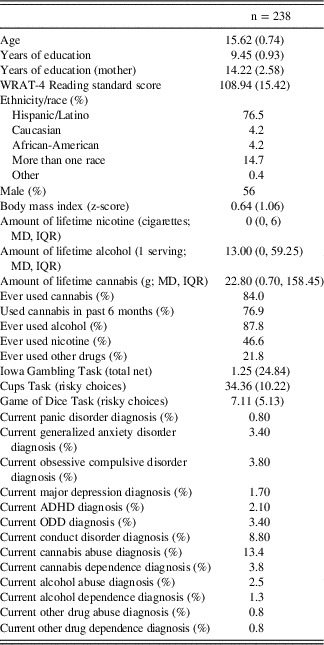
Most participants were Hispanic/Latino and reported cannabis as the most commonly used drug. At screening for the parent project, participants were excluded if they reported a mental health disorder diagnosis or frequent/recent drug use (i.e., used drugs other than cannabis more than 10 times, consumed more than 13 drinks per week on three or more occasions in their lifetime, had more than three occurrences of consuming 6 drinks per day for women and 7 drinks per day for men, or had evidence suggestive of dependence for alcohol or cannabis). However, substance use and mental health status of some participants did change over the course of the parent project, and participants were not excluded for emergence of these disorders over the course of the parent project. Substance use characteristics of the current study sample are presented in Table 1. Few met criteria for a current mental health disorder, and only four participants reported using drugs other than cannabis more than 20 times in their lifetime. Oral fluid testing for recent drug use revealed 11 participants had recently used cannabis, 3 participants had recently used cocaine, and 1 participant had recently used amphetamines.
Participant characteristics

Note. All values are means and standard deviations unless otherwise specified.
WRAT=Word Reading Achievement Test; MD=median; IQR=interquartile range; ADHD=attention deficit hyperactivity disorder; ODD=oppositional defiant disorder.
Procedures
All study procedures and protocols were approved by the Institutional Review Board at Florida International University, and this research was conducted in accordance with the Helsinki Declaration. Participant assent and parental consent were obtained for all participants. The participants in this study are part of a larger longitudinal study designed to assess how DM influences cannabis use trajectories and how neurocognition is affected by cannabis use. The study involves five measurement waves conducted every 6 months over 2 years. BMI data collection commenced about 1 year after study onset; therefore, BMI data for the current sample was collected for the first time during the baseline visit for 134 participants and during the third measurement wave for 104 participants. All other data used in the analyses were collected at the same measurement wave as the participant’s BMI data.
Measures
Substance use
The Drug Use History Questionnaire (DUHQ) assesses lifetime frequency and quantity of 15 different drug classes (Gonzalez et al., Reference Gonzalez, Schuster, Mermelstein, Vassileva, Martin and Diviak2012; Rippeth et al., Reference Rippeth, Heaton, Carey, Marcotte, Moore, Gonzalez and Grant2004). Amount of cannabis use was calculated (in grams) using self-report of frequency and quantity of use across participants’ lifetime.
Decision-making
DM was measured via three computerized tasks: the Iowa Gambling Task (IGT), the Cups Task (CT), and the Game of Dice Task (GDT), all of which assess DM but vary on how explicitly risk is presented to participants.
The IGT assesses DM under conditions of ambiguous risk (Bechara, Reference Bechara2007; Bechara, Damasio, Damasio, & Anderson, Reference Bechara, Damasio, Damasio and Anderson1994). Participants are shown a computer display of four decks of cards and are told the goal in the game is to win as much money as possible. Participants are instructed that every time they choose a card they win some money, but sometimes also lose money and that some decks are worse than others. More choices from “good decks” yield a positive total score while more choices from “bad decks” yield a negative total by the end of the game. The IGT net score, that is, the choices from “good decks” minus choices from “bad decks,” was used as the measure of DM for this task.
The GDT assesses DM when the participant is given specific rules and probabilities for gains and losses throughout the task (Brand et al., Reference Brand, Fujiwara, Borsutzky, Kalbe, Kessler and Markowitsch2005). For each of 18 trials, participants predict the outcome of a dice roll by choosing options that vary in the probability of winning (e.g., one possible number vs. multiple numbers). Choices with higher probability of winning are accompanied by lesser rewards compared to those with lower probability of winning. The two lowest probability choices with the highest reward are considered risky choices. The total number of risky choices was the measure of DM used in our analyses.
The CT is different from the previously mentioned DM tasks in that it was specifically designed to assess DM in children and adolescents (Levin, Hart, Weller, & Harshman, 2007). Similar to the GDT, the CT measures DM under conditions of specific risk. The CT gives the participant a visual display of two, three, or five cups on both the left and right side of the screen. The participants are told to choose a cup from either side; choices from one side always yield a definite reward, whereas choices from the opposite side provide a chance for a greater reward or loss. There are 54 trials of either a “gain” or “loss.” Gain trials have two options: (1) definite gain of one quarter or (2) the chance to win multiple quarters or no quarters. The loss trials also have two options: (1) definite loss of one quarter or (2) a chance to lose multiple quarters or no quarters. The total number of risky choices (i.e., choosing side with chances to lose multiple quarters or chance to win multiple quarters) made during all of the trials was used as the measure of DM for this task.
Body mass index
Following standard anthropometric procedures, trained personnel measured adolescents’ height and weight (removing shoes and heavy outer clothing) in triplicate (using the median value) using a wall mounted stadiometer and a balance beam scale. BMI z-scores were calculated based on age/gender norms from the Centers for Disease Control (Kuczmarski et al., Reference Kuczmarski, Ogden, Guo, Grummer-Strawn, Flegal, Mei and Johnson2002). Percentiles based on age and gender were used to categorize participants into two clinically relevant categories: (1) overweight or obese (85th percentile and above) and (2) underweight or normal weight (less than 85th percentile). The BMI z-score and clinical classification variables were used as the outcome variables for this study.
Statistical Analysis
All analyses were conducted in SPSS 22.0 using linear or logistic regression. To identify potential covariates, correlations (either Spearman’s rho, Pearson, or point-biserial) were calculated for BMI z-score and several variables thought to potentially influence BMI, including nicotine and alcohol use, diagnosis of major depressive episode, race/ethnicity, education, and estimated IQ. None were significantly correlated with BMI z-score (p-values > .07), and were not included as covariates.
As previously noted, BMI data for the current study were collected at baseline for some participants or during the third measurement wave for others. Participants whose data came from their third measurement wave were exposed to the neurocognitive measures twice (during baseline and their visits). To control for any influence this may have had on our results, a dummy-coded variable was created to indicate whether a participant had completed the DM tasks once or twice and was included in all analyses as a covariate. All independent variables were mean-centered. Assumptions for multiple regression were evaluated (i.e., linearity, normality of residuals, constant variance of residuals, independence of residuals; Cohen, Cohen, West, & Aiken, Reference Cohen, Cohen, West and Aiken2013).
Although Q-Q plots suggested some evidence for minor heteroscedasticity, examination of the overall residuals distribution from each regression model showed approximately normal distributions. Data were examined for outliers, and no outliers were present. Bootstrapping was used to make more robust standard error estimates. Linear regressions were conducted with BMI z-score as the dependent variable, and logistic regressions were conducted with the clinical classification of weight as the outcome variable. Three linear regressions and logistic regressions were conducted (one for each DM task). Independent variables were amount of lifetime cannabis use, DM task performance, and their interaction.
RESULTS
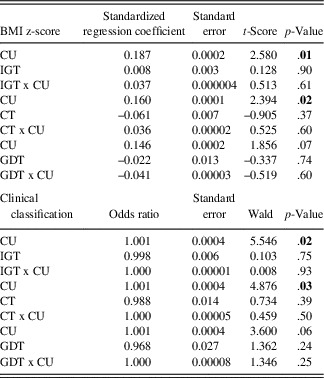
IGT performance was not correlated with either the performance on the CT (r=−0.10) or the GDT (r=0.01); however, performance on the CT and GDT were significantly correlated (r=0.23). Across all three DM tasks, no significant interaction effects were observed between DM performance and cannabis use on either BMI z-score or clinical classification (see Table 2 for all statistical results). Similarly, no significant main effects were observed for DM performance predicting BMI or clinical classification. In contrast, cannabis use was significantly associated with BMI z-score across most models, regardless of which DM task was included (β=0.19, β=0.16, β=0.15, respectively, when the IGT, CT, and GDT were included in the analysis); however, the model including the GDT was just shy of statistical significance (p=.07). Semipartial correlation coefficients across these models ranged from 0.12 (for the model including GDT) to 0.17 (for the model including the IGT).
Results of cannabis use, decision-making tasks, and the interaction of cannabis use and decision-making tasks predicting BMI z-score and clinical classifications of weight (n=238)

Note. Bold indicates significant p-Values.
CU=cannabis use; IGT=Iowa Gambling Task; CT=Cups Task; GDT=Game of Dice Task.
The same pattern emerged for clinical classification, with more cannabis use associated with a higher probability of being overweight/obese (odds ratio, 1.001, when all DM tasks were included in the analysis). A post hoc power analysis using G-Power 3.1 (Faul, Erdfelder, Buchner, & Lang, Reference Faul, Erdfelder, Buchner and Lang2009) indicated that our analyses were sufficiently powered to detect an interaction effect for a small effect size (d =.06).
DISCUSSION
The current study examined how amount of cannabis use was associated with BMI and weight status among adolescents, as well as whether differences in DM performance influenced this association. Consistent with our hypotheses, we found that more cannabis use was associated with a higher BMI and greater likelihood of being overweight/obese. This association could not be accounted for by the influence of alcohol use, nicotine use, parent education, depression, gender, race or ethnicity, as none of these were found to be associated with BMI in our sample. Contrary to expectations, DM performance had no significant impact on this association and did not account for unique variance in BMI or influence the probability of being classified as overweight/obese.
These findings, although consistent with known effects of cannabis on appetite and potential effects on motivation, differ from other cross-sectional studies examining associations between cannabis use and weight among adolescents (Lanza et al., Reference Lanza, Grella and Chung2014; Pasch et al., Reference Pasch, Velazquez, Cance, Moe and Lytle2012). These differences could potentially be explained by the relatively larger sample size (and increased power) of our study. Another potential explanation is that, compared to the aforementioned studies, our sample contained a greater number of adolescents who had tried cannabis at least once (84%) and used in the past year (76%) compared, for example, with Lanza and colleagues (2014) study, of which 32% of their sample reported using cannabis in the past year.
One longitudinal study reported an association between cannabis use (increasing and sporadic patterns of use) during adolescence with a greater likelihood of stable and increasing obesity patterns from adolescence to young adulthood. This study reported odds ratios of 1.6 (increasing cannabis use and increasing obesity), 0.2 (sporadic cannabis use and stable obesity), and 0.1 (sporadic cannabis use and increasing obesity; Huang et al., Reference Huang, Lanza and Anglin2013). The somewhat smaller effects we observed may be due to the cross-sectional design of our study; however, it is difficult to equate cross-sectional and longitudinal effects because they measure different things (i.e., relationships at a single time point vs. the relationship between one variable and change in the other variable).
The most surprising finding from our study is that DM abilities were not associated with BMI or weight status, nor did they influence the relationship between cannabis use and BMI, despite our use of three different measures of DM. We did find that the IGT was not associated with either the CT or GDT. Decision-making tasks that vary in whether risk is clearly specified or ambiguous may rely on different brain systems as demonstrated in fMRI studies conducted with the CT (Weller, Levin, Shiv, & Bechara, Reference Weller, Levin, Shiv and Bechara2007), GDT (Brand, Recknor, Grabenhorst, & Bechara, Reference Brand, Recknor, Grabenhorst and Bechara2007), and the IGT (Xue et al., Reference Xue, Lu, Levin, Weller, Li and Bechara2009).
Several prior studies have reported DM, mainly IGT, as a moderator of the associations between amount of recent cannabis use and problems from cannabis use (Gonzalez, Schuster, Mermelstein, & Diviak, Reference Gonzalez, Schuster, Mermelstein and Diviak2015), DSM-IV symptoms of cannabis use disorder (Gonzalez et al., Reference Gonzalez, Schuster, Mermelstein, Vassileva, Martin and Diviak2012), and risky sexual behaviors (Schuster, Crane, Mermelstein, & Gonzalez, Reference Schuster, Crane, Mermelstein and Gonzalez2012). Yet despite this, and evidence from others indicating a correlation between DM performance and weight among adolescents (Verdejo‐García et al., Reference Verdejo‐García, Pérez‐Expósito, Schmidt‐Río‐Valle, Fernández‐Serrano, Cruz, Pérez‐García and Marcos2010), we found no significant effects. The significantly larger sample size in our study (n=238) would have allowed us to detect small effects, yet this was not the case.
One notable difference between the current study and prior studies is our unique sample of participants. Our sample consisted of adolescents who were primarily Hispanic/Latino as well as cannabis users with a broad range of use. Prior studies from our group focused on young adults, the majority of which were non-Hispanic white. In addition, few participants in the current study met criteria for a mental health disorder. In contrast, Verdejo-García and colleagues (Reference Verdejo‐García, Pérez‐Expósito, Schmidt‐Río‐Valle, Fernández‐Serrano, Cruz, Pérez‐García and Marcos2010) included a sample of participants enrolled in a research-based treatment program for weight loss, which may indicate that they had greater problems with obesity compared to participants in the current study. The more severe nature of obesity among those adolescents may account for poorer DM performance observed among overweight adolescents compared to normal weight adolescents.
Our findings should be interpreted with some limitations in mind. Perhaps the biggest limitation of the current study is its reliance on a cross-sectional design. A longitudinal study that assesses how cannabis use, DM performance, and the interaction of these variables are associated with BMI over time will allow us to make causal inferences about how cannabis use influences BMI. We note that the one longitudinal study examining associations between adolescent cannabis use and BMI in young adulthood reported that greater amounts of adolescent cannabis use were associated with a higher BMI in young adulthood (Huang, Lanza, & Anglin, Reference Huang, Lanza and Anglin2013).
Another important consideration is that our sample consists predominantly of Hispanic/Latino (76%) participants; thus, our results may not generalize to other groups. It is worth noting that the Hispanic/Latino population has one of the highest rates of obesity in the United States (Hedley et al., Reference Hedley, Ogden, Johnson, Carroll, Curtin and Flegal2004). Although our findings cannot definitively establish causal associations between cannabis use and adolescent obesity, they suggest that, among adolescents, more cannabis use is associated with a higher BMI and greater likelihood of being classified as having an unhealthy weight. Thus, it follows that increases in cannabis use among teens may be accompanied with a higher incidence of unhealthy weight. Interventions for adolescent substance use should incorporate exercise components to reduce cannabis use and unhealthy weight as well as potentially improve cognition (Lisdahl, Gilbart, Wright, & Shollenbarger, Reference Lisdahl, Gilbart, Wright and Shollenbarger2013).
Acknowledgments
This work was supported by grants R01 DA031176 and R01 DA033156 (PI: Gonzalez) from the National Institute on Drug Abuse. The content is solely the responsibility of the authors and does not necessarily represent the official views of the National Institutes of Health. The authors have no other conflicts of interest to declare.