Since the ancient Greeks and their four types of “bile,” the balance between innate dispositions and environmental provisions in shaping individual pathways (the nature versus nurture debate) has preoccupied social scientists (Feldman, Reference Feldman2008). Recent approaches to this centuries-old debate attempt to address specific combinations of biology and environment that affect outcome (Belsky, Bakermans-Kranenburg, & van IJzendoorn, Reference Belsky, Bakermans-Kranenburg and van IJzendoorn2007; Boyce & Ellis, Reference Boyce and Ellis2005; Collins, Maccoby, Steinberg, Hetherington, & Bornstein, Reference Collins, Maccoby, Steinberg, Hetherington and Bornstein2000). Such approaches often begin with the dispositional end of the individual–environment continuum, particularly with the dimensions of negative reactivity and regulation conceptualized as central domains of infant temperament (Rothbart & Derryberry, Reference Rothbart and Derryberry1981; Rothbart, Sheese, Rueda, & Posner, Reference Rothbart, Sheese, Rueda and Posner2011). Overall, these models suggest that infant negative emotionality or reactivity provides a starting point for the individual–context exchange by charting the extent of parental effects, particularly on social–emotional and regulatory outcome (Belsky & Pluess, Reference Belsky and Pluess2009; Kiff, Lengua, & Zalewski, Reference Kiff, Lengua and Zalewski2011).Footnote 1 Support for these perspectives comes from longitudinal studies demonstrating that sensitive parenting carries a greater effect on the development of negatively reactive infants (Frenkel et al., Reference Frenkel, Fox, Pine, Walker, Degnan and Chronis-Tuscano2015; Jaekel, Pluess, Belsky, & Wolke, Reference Jaekel, Pluess, Belsky and Wolke2014; Kim & Kochanska, Reference Kim and Kochanska2013; Kim-Spoon, Cicchetti, & Rogosch, Reference Kim-Spoon, Cicchetti and Rogosch2012). Because negative reactivity has been repeatedly shown to predict psychopathology in later childhood (Burgess, Marshall, Rubin, & Fox, Reference Burgess, Marshall, Rubin and Fox2003; Clark, Watson, & Mineka, Reference Clark, Watson and Mineka1994; Degnan & Fox, Reference Degnan and Fox2007; Hane, Fox, Henderson, & Marshall, Reference Hane, Fox, Henderson and Marshall2009), specifying the magnitude of its effect on the way parenting defines outcome is of conceptual and clinical importance and should be examined in multiple experimental designs. To this end, the current study employs a microanalytic approach and tests the effects of mother–infant synchrony on infants’ ability to regulate increasing levels of induced stress within the immediate social context during an experimental paradigm as shaped by variability in infant negative reactivity.
Conceptual Models on the Interaction of Infant Negative Emotionality and Parenting
Several conceptual models address the effects of parenting on child outcomes in children of varying dispositions. The diathesis–stress model postulates that infants with greater negative reactivity; that is, lower thresholds, higher frequencies, and greater intensities of expressed negative affect are disproportionally affected by negative environmental influences, including insensitive or unavailable parenting (Williams et al., Reference Williams, Degnan, Perez-Edgar, Henderson, Rubin and Pine2009; Zuckerman, Reference Zuckerman1999). In comparison, the differential susceptibility frame (Belsky et al., Reference Belsky, Bakermans-Kranenburg and van IJzendoorn2007; Pluess & Belsky, Reference Pluess and Belsky2009), which in many aspects parallels the biological sensitivity to context model (Boyce & Ellis, Reference Boyce and Ellis2005), suggests that some infants are born with greater susceptibility to specific elements in their environment and are thus more affected by them, for better or for worse. Using the metaphor of “orchids” versus “dandelions” (Boyce & Ellis, Reference Boyce and Ellis2005) to describe parental effects on infants high versus low in negative reactivity, these models highlight the specific environmental component critical for the growth and thriving of highly reactive infants: a well-fitted parental investment that is responsive to moment-by-moment change in infant affective state and social readiness (Belsky & Pluess, Reference Belsky and Pluess2013). Consistent with this theoretical line, it can be hypothesized that parent–infant synchrony, the online coordination of parent and infant's affective behavior during social contact (Feldman, Reference Feldman2012), may carry a strong effect on highly reactive infants, particularly in the domain of regulatory functions (Feldman, Greenbaum, & Yirmiya, Reference Feldman, Greenbaum and Yirmiya1999; MacLean et al., Reference MacLean, Rynes, Aragón, Caprihan, Phillips and Lowe2014; Moore & Calkins, Reference Moore and Calkins2004).
While the two models (diathesis–stress and differential susceptibility) conceptualize negative reactivity and parenting as distinct and unrelated sources of influence, numerous studies describe correlations between the two already in infancy (Feldman, Greenbaum, Mayes, & Erlich, Reference Feldman, Greenbaum, Mayes and Erlich1997; Mertesacker, Bade, Haverkock, & Pauli-Pott, Reference Mertesacker, Bade, Haverkock and Pauli-Pott2004; Mills-Koonce et al., Reference Mills-Koonce, Gariépy, Propper, Sutton, Calkins and Moore2007; Seifer, Schiller, Sameroff, Resnick, & Riordan, Reference Seifer, Schiller, Sameroff, Resnick and Riordan1996; Skuban, Shaw, Gardner, Supplee, & Nichols, Reference Skuban, Shaw, Gardner, Supplee and Nichols2006). Conceptual frames, such as Sameroff's (Reference Sameroff2009, Reference Sameroff2010) transactional model, suggest that parenting and infant emotionality mutually influence each other since birth. The definition of temperament as a set of inborn traits that are sculpted by the environment to define personality (Kagan, Snidman, Kahn, & Towsley, Reference Kagan, Snidman, Kahn and Towsley2007) similarly suggests that while negative reactivity is a stable disposition, its degree and expression is modified by parenting. These links do not refute the differential impact of parenting on infants of different dispositions. For instance, although low but significant correlations were found between parent–infant synchrony and infant negative emotionality, synchrony had a greater impact on negatively reactive infants in predicting self-regulated socialization in the preschool years and empathy at 6 and 13 years (Feldman, Reference Feldman2007a; Feldman et al., Reference Feldman, Greenbaum and Yirmiya1999). As such, the goal of our study was to contribute to current conceptualization by assessing at microlevel detail the regulatory tactics infants high and low in negative reactivity employ when facing increasing levels of induced stress; whether the use of more or less adaptive strategies is moderated by experiences of synchrony; and whether synchrony differentially predicts physiological and behavioral regulation in infants of high or low negativity. This was examined without proposing complete independence between synchrony and negative emotionality, a condition rarely found in observational studies. In addition, we aimed to extend current thinking by postulating that the effects of synchrony on regulatory outcomes are not uniform for a particular child but may differ across domains. This notion has been proposed (Belsky et al., Reference Belsky, Bakermans-Kranenburg and van IJzendoorn2007) but is not typically directly tested. Developmental outcomes may vary along multiple dimensions, such as degree of difficulty, social focus, or level of observation (physiology or behavior), and those should be included when assessing the effects of parenting on children of varying dispositions.
To test these hypotheses, we examined the interactive effects of infant negative reactivity and parent–infant synchrony in a low-risk cohort within an experimental design that manipulated stress using variations on the well-known face-to-face still face (FTFSF) paradigm. We examined pathways to emotion regulation in typically developing infants as a platform to assess predictors of regulatory problems, because regulatory difficulties in infancy have repeatedly been shown to predict dysregulation in later childhood, including externalizing and internalizing problems, low self-restraint, peer problems, and defiant socialization (Crockenberg, Leerkes, & Bárrig Jó, Reference Crockenberg, Leerkes and Bárrig Jó2008; Feldman, Reference Feldman2009; Hill, Degnan, Calkins, & Keane, Reference Hill, Degnan, Calkins and Keane2006; Kochanska, Murray, & Coy, Reference Kochanska, Murray and Coy1997; Kochanska, Tjebkes, & Fortnan, Reference Kochanska, Tjebkes and Fortnan2008; Williams et al., Reference Williams, Degnan, Perez-Edgar, Henderson, Rubin and Pine2009). To our knowledge, this is the first study to examine predictions based on the aforementioned conceptual models in a random-assignment experimental design while integrating microlevel behavioral observations with physiological assessment of infant respiratory sinus arrhythmia (RSA).
Parent–Infant Synchrony, Infant RSA, and Regulatory Functions
The development of infants’ regulatory capacities occurs within the matrix of the parent–infant relationship (Harrist & Waugh, Reference Harrist and Waugh2002; Kopp, Reference Kopp1989; Reyna & Pickler, Reference Reyna and Pickler2009; Schore, Reference Schore2000). Our biobehavioral synchrony model (Feldman, Reference Feldman2007b, Reference Feldman2012, Reference Feldman2015) suggests that the parent's synchronous behavior provides an external regulatory framework for the infant's immature physiological and behavioral systems and supports the emergence of self-regulatory capacities. Perspectives on emotion regulation (ER) suggest that it is a multifactorial construct, including biological, behavioral, attentive, and cognitive processes and that both biological and behavioral aspects should be considered for a comprehensive model (Fox & Calkins, Reference Fox and Calkins2003). Longitudinal studies demonstrated that synchrony experienced in the first months of life carries long-term effects on children's self-regulation, attachment security, stress management, lower externalizing and internalizing symptoms, dialogical abilities with friends, and higher empathy across childhood and adolescence (Cerezo, Pons-Salvador, & Trenado, Reference Cerezo, Pons-Salvador and Trenado2008; Feldman, Reference Feldman2007a, Reference Feldman2008; Feldman & Eidelman, Reference Feldman and Eidelman2004; Feldman, Gordon, Influs, Gutbir, & Ebstein, Reference Feldman, Gordon, Influs, Gutbir and Ebstein2013; Jaffee, Caspi, Moffitt, Belsky, & Silva, Reference Jaffee, Caspi, Moffitt, Belsky and Silva2001; Kochanska, Philibert, & Barry, Reference Kochanska, Philibert and Barry2009).
Although synchrony is an experience constructed online from the inputs of both parent and child, in early infancy parents play a greater role in establishing synchrony and the synchrony experience moves from parental synchrony in the first months of life, when parents mainly follow the infant's pace and rhythms, to a more mutual form of synchrony toward the end of the first year (Feldman, Reference Feldman2007c). Mother–infant synchrony in the first months of life is associated with a host of maternal factors, including maternal depression (Apter-Levy, Feldman, Vakart, Ebstein, & Feldman, Reference Apter-Levy, Feldman, Vakart, Ebstein and Feldman2013; Field, Healy, Goldstein, & Guthertz, Reference Field, Healy, Goldstein and Guthertz1990; Murray, Fiori-Cowley, Hooper, & Cooper, Reference Murray, Fiori-Cowley, Hooper and Cooper1996), anxiety (Beebe et al., Reference Beebe, Steele, Jaffe, Buck, Chen and Cohen2011; Stein et al., Reference Stein, Craske, Lehtonen, Harvey, Savage-McGlynn and Davies2012), attachment representations (Grienenberger, Kelly, & Slade, Reference Grienenberger, Kelly and Slade2005; Madigan, Moran, & Pederson, Reference Madigan, Moran and Pederson2006), stress (Parfitt & Ayers, Reference Parfitt and Ayers2009; Zelkowitz, Papageorgiou, Bardin, & Wang, Reference Zelkowitz, Papageorgiou, Bardin and Wang2009), oxytocin (Feldman, Gordon, & Zagoory-Sharon, Reference Feldman, Gordon and Zagoory-Sharon2010), cortisol (Feldman, Singer, & Zagoory, Reference Feldman, Singer and Zagoory2010), and brain activations (Kim et al., Reference Kim, Feldman, Mayes, Eicher, Thompson and Leckman2011), and shows individual stability in repeated observations (Feldman et al., Reference Feldman, Gordon, Influs, Gutbir and Ebstein2013; Feldman & Greenbaum, Reference Feldman and Greenbaum1997). Mother–infant synchrony can thus be considered to index a specific and relatively stable feature of caregiving that bears long-term impact on the infant's social and regulatory development.
Infant RSA or vagal tone provides a brain stem mediated support system for the emergence of regulatory capacities (Calkins, Graziano, & Keane, Reference Calkins, Graziano and Keane2007; Geva & Feldman, Reference Geva and Feldman2008; Moore et al., Reference Moore, Hill-Soderlund, Propper, Calkins, Mills-Koonce and Cox2009; Porges, Reference Porges2007). RSA is considered an important physiological marker of ER in infancy (Porges, Reference Porges2003). Infants with higher baseline vagal tone, greater vagal brake (change in RSA from baseline to stress), and quicker recovery to baseline following challenge are thought to possess flexible and adaptive mechanisms to meet environmental challenges (Ham & Tronick, Reference Ham and Tronick2006; Hastings et al., Reference Hastings, Nuselovici, Utendale, Coutya, McShane and Sullivan2008; Moore et al., Reference Moore, Hill-Soderlund, Propper, Calkins, Mills-Koonce and Cox2009; Porges, Reference Porges2001, Reference Porges2007). In support, research has shown that infants with higher vagal tone are better able to regulate increasing levels of aversive stimuli in an experimental paradigm (Feldman, Reference Feldman2006), and exhibit more mature ER at 3 years (Hastings et al., Reference Hastings, Nuselovici, Utendale, Coutya, McShane and Sullivan2008), lower externalizing symptoms at 6 years (Doussard-Roosevelt, McClenny, & Porges, Reference Doussard-Roosevelt, McClenny and Porges2001), efficient self-regulatory skills at 5 years (Feldman, Reference Feldman2009), and better cognitive and social–emotional growth rates across the first 5 years of life (Feldman & Eidelman, Reference Feldman and Eidelman2009). Similarly, infants who displayed greater vagal withdrawal during the FTFSF showed greater recovery of play at reunion (Moore & Calkins, Reference Moore and Calkins2004) and lower externalizing and internalizing symptoms (Calkins et al., Reference Calkins, Graziano and Keane2007; Graziano & Derefinko, Reference Graziano and Derefinko2013; Hastings et al., Reference Hastings, Nuselovici, Utendale, Coutya, McShane and Sullivan2008). Because RSA and RSA change are thought to underpin regulatory capacities, and variations in RSA differentiate children at risk for behavioral problems, testing the interactive effects of infant negativity and parent–child synchrony in predicting vagal regulation may expand our understanding on the development of physiological support systems in the first months of life.
Several studies applied predictions of the diathesis–stress and differential susceptibility models in observational studies and found support for each. Jaekel et al. (Reference Jaekel, Pluess, Belsky and Wolke2014) tested effects of maternal sensitivity on pretem and full-term infants’ academic achievements and found support for the diathesis–stress model; among premature infants developmental catch-up was found only when mothers were highly sensitive. Kim and Kochanska (Reference Kim and Kochanska2013) found that highly negative infants showed lower regulatory skills when mutually responsive parenting was low, but higher regulation when responsivity was high, providing support for the differential susceptibility model. Negatively reactive infants with critical mothers had more externalizing symptoms, but those with less critical mothers had fewer symptoms (Poehlmanna et al., Reference Poehlmanna, Hanea, Burnsona, Malecka, Hamburgera and Shah2013). Denham et al. (Reference Denham, Workman, Cole, Weissbrod, Kendziora and Zahn-Waxler2000) tested longitudinal associations between various maternal styles at age 5 and externalizing behavior at age 9 and found evidence for both diathesis–stress and differential susceptibility. Overall, these studies emphasize that variability in child outcomes depends on specific combinations of child reactivity and maternal behavior. The inconsistency in findings suggests that these interactions may differ for specific dimensions of the regulation construct.
The Current Study
In light of the above, this study measured infants’ regulatory behavior in response to social stress by using three variations on the FTFSF paradigm that present infants with increasing levels of stress. The FTFSF paradigm, in which a parent interacts freely with the infant for 3 min, refrains from interactions for 2 min, and finally resumes normal play for 3 min, has been widely used to study infants’ regulatory capacities (Adamson & Frick, Reference Adamson and Frick2003; Mesman, van IJzendoorn, & Bakermans-Kranenburg, Reference Mesman, van IJzendoorn and Bakermans-Kranenburg2009). The FTFSF reliably elicits physiological stress response from 3- to 6-month-old infants, such as RSA change and cortisol increase (Feldman, Singer, et al., Reference Feldman, Singer and Zagoory2010; Moore et al., Reference Moore, Hill-Soderlund, Propper, Calkins, Mills-Koonce and Cox2009), as well as behavioral response, including decrease in positive affect, increase in distress, and more use of regulatory tactics (Cohn & Tronick, Reference Cohn and Tronick1983; Mesman et al., Reference Mesman, van IJzendoorn and Bakermans-Kranenburg2009; Moore, Cohn, & Campbell, Reference Moore, Cohn and Campbell2001). Infants (4–6 months old) were randomly assigned to one of three conditions: SF with touch (SF+T), typical SF (SF), and SF with arms’ restraint (SF+AR), and their microlevel regulatory behavior during the SF part of the procedure was coded. In addition, RSA, RSA change (vagal withdrawal), and RSA recovery were measured during the three parts of the paradigm. The SF+T has shown to induce milder physiological and behavioral stress response than the typical SF (Feldman, Singer, et al., Reference Feldman, Singer and Zagoory2010; Stack & Muir, Reference Stack and Muir1992) and the SF+AR elicits greatest distress compared to the typical SF (Provost & Gouin-Decarie, Reference Provost and Gouin-Decarie1979). Consistent with previous research (Mesman et al., Reference Mesman, van IJzendoorn and Bakermans-Kranenburg2009), three clusters of regulatory mechanisms infants employ to regulate stress during the FTFSF were measured: distress, disengagement, and social regulation. The first describes overt negative emotional response to the SF; the second addresses regulation of stress by withdrawing from the situation; and the third involves attempts to reduce distress by employing social signals to elicit response from the unresponsive mother. These mechanisms are thought to represent a continuum from less to more mature and adaptive response: from decompensation, to aversion, to displaying agency and utilizing social cues.
Infant negativity and mother–infant synchrony were measured during the free play part of the paradigm. Consistent with research noting effects of both negativity (Braungart-Rieker, Garwood, Powers, & Wang, Reference Braungart-Rieker, Garwood, Powers and Wang2014) and synchrony (Kaitz, Maytal, Devor, Bergman, & Mankuta, Reference Kaitz, Maytal, Devor, Bergman and Mankuta2010; Moore & Calkins, Reference Moore and Calkins2004) on regulatory behavior during the SF, we examined their independent and interactive effects on the three regulatory mechanisms and on autonomic reactivity and recovery using structural equation modeling (SEM), taking into account the level of induced stress. In light of a recent meta-analysis (Campbell & Ehlert, Reference Campbell and Ehlert2012), showing low correlations among behavioral, cognitive, and physiological markers of stress reactivity, we expected different effects for physiological and behavioral measures. In light of Denham et al. (Reference Denham, Workman, Cole, Weissbrod, Kendziora and Zahn-Waxler2000), we expected that the three regulatory behavioral mechanisms would be differentially linked to the interactions of infant negative emotionality and mother–child synchrony, but the specific patterns of correlations remained an open question. We postulated that functioning of the autonomic system, which is influenced by maternal proximity and adaptive behavior in humans and animals (Feldman, Rosenthal, & Eidelman, Reference Feldman, Rosenthal and Eidelman2014; Hofer, Reference Hofer1995), may be especially open to environmental influences, particularly the degree of RSA reactivity and recovery, and may show a for-better or for-worse effect.
Method
Participants
Participants included 122 mother–infant dyads. Infants were on average 5 months old (M = 20.32 weeks, SD = 5.7). The original sample included 146 dyads, but for 24 dyads data was incomplete (e.g., electrodes fell during experiment or infants could not complete trial), and these dyads were not included in the study. All families were of middle-class backgrounds and were of Israeli–Jewish ethnicity. All mothers completed at least high school education, and were married or cohabitating with the infant's father; parents did not report any physical or psychiatric illness; and parents were over 21 years old. Infants were all healthy, born at term in a singleton birth, and had no serious illness since birth. Mothers were on average 29.18 years old (SD = 4.6) and completed 15.85 (SD = 2.15) years of education.
Procedure
When infants were approximately 5 months old, mothers and infants arrived at the laboratory during the morning hours when the infant was fed and rested. Dyads were randomly assigned to one of three experimental conditions: SF+T, SF, or SF+AR. Upon arrival, dyads were acquainted with the lab, the experiment was explained to the mother, and mother signed an informed consent and completed several questionnaires. Following, mother and infant entered the experiment room, infant sat in an infant seat mounted on a table and mother sat facing him/her. Electrocardiograph (ECG) signals of mother and infant were simultaneously sampled during the interaction by a dual channel portable ECG monitor–IBI logger system (12 bit, 1000 samples/s/channel, 3992/6–IBI BioLog© System, UFI, Morro Bay, CA). The BioLog system was equipped with active signal-conditioning electrodes, attached to participants using three disposable Ag-AgCl skin surface electrode patches. Mothers were instructed to play freely with the infant for 3 min, maintain SF for 2 min in one of the three paradigms, and resume play for an additional 2 min. A tap on the window signaled the move from one part of the experiment to the next. Interactions were videotaped for later coding from a control room using two cameras placed on adjacent walls and a split-screen video mixer. The free-play episode was used to code infant negative reactivity and mother–infant synchrony. Mothers were instructed to press the ECG monitor before moving to the next episode, and following the visit, data were downloaded into a special computerized program. Consistent with previous studies, RSA during free play was used as the baseline to assess reactivity during the SF and recovery during reunion (Moore & Calkins, Reference Moore and Calkins2004).
During the SF+T, mothers were instructed to maintain SF but to touch their infants in whichever way they chose (Stack & Muir, Reference Stack and Muir1992). In the SF+AR group, mothers were instructed to hold the infant's arms against their body in addition to maintaining SF (Provost & Gouin-Decarie, Reference Provost and Gouin-Decarie1979). There were 40 dyads in the SF group (21 boys, 19 girls), 41 dyads in the SF+T group (21 boys, 20 girls), and 41 dyads in the SF+AR group (23 boys, 18 girls). No differences in gender, age, or family demographics were found between experiment groups.
Measures
Infant Characteristics Questionnaire
This well-validated questionnaire includes 19 items, each evaluated on a scale between 1 and 9. The items are divided into four factors: fussy–difficult, unpredictable, unadaptable, and dull (Bates, Freeland, & Lounsbury, Reference Bates, Freeland and Lounsbury1979). Of specific interest were the difficult and unadaptable constructs, which are linked to negative reactivity (Rothbart & Derryberry, Reference Rothbart and Derryberry1981).
Parenting Stress Index—Short form
This instrument includes 36 items scored on a 5-point scale that yield a total score and three subscales related to parental stress: parenting distress, parent–child dysfunctional interaction, and child difficulty (Abidin, Reference Abidin1990).
RSA
The vagal tone (Vna) index was computed for mother and child for each episode of the paradigm: free play, SF, and reunion. The Vna index measures the amplitude of RSA from the heart period (interbeat intervals in milliseconds) series by representing respiratory related heart period variability. Vna was quantified using Porges' (Reference Porges1985) MXEdit software. The software samples the heart period into a time series and utilizes a third-order 21-point moving polynomial filter and a band pass filter with a frequency band related to the spontaneous age appropriate respiratory cycle: between 0.24 and 1.04 Hz for infants and between 0.12 and 0.40 Hz for mothers. The Vna index is the natural logarithm of the variance of the detrended and filtered time series averaged over 15-s segments. The vagal break measure was computed by subtracting the Vna levels during SF stage from the Vna level during free play (Bazhenova, Plonskaia, & Porges, Reference Bazhenova, Plonskaia and Porges2001; Moore & Calkins, Reference Moore and Calkins2004).
Coding
The premanipulation free play episode was microcoded offline for mother and infant's behavior on a computerized system in 0.01-s level for four categories of behavior, each containing a set of mutually exclusive codes: gaze (to partner, to object, joint attention, or gaze aversion); affect (positive, neutral, medium, negative, or withdrawn); vocalizations (cry; fuss; yawn; positive vocalizations, e.g., cooing or babbling; or none); touch (affectionate touch, e.g., caressing, hugging, kissing, or loving pokes; functional/instrumental touch, e.g., wiping baby's mouth or fixing clothes; stimulatory touch, e.g., manipulating limbs, strong taps, or massage; or proprioceptive touch, e.g., moving infant to a sitting position). Interrater reliability, computed for 30 interactions (25%) averaged 94% (κ = 0.86, range = 0.80–0.98). Infant negative reactivity was computed as the sum proportions of negative affect coded in the premanipulation free-play episode. Consistent with previous research (Feldman & Eidelman, Reference Feldman and Eidelman2004, Reference Feldman and Eidelman2007; Feldman et al., Reference Feldman, Gordon and Zagoory-Sharon2010), synchrony was computed as conditional probabilities (infant in behavior x given parent in behavior y) as follows: gaze synchrony = infant looks at parent while parent looks at infant; affect synchrony = infant expresses positive affect while parent in positive affect; touch synchrony = mother touches infant affectionately while infant is gazing at mother; and vocal synchrony = infant in positive vocalization while mother in “motherese.” An overall synchrony construct was computed by calculating the mean percentage of the four conditional probabilities for each dyad.
Infant behavior during the SF episode of the paradigm was coded for gaze, affect, and vocalizations similar to the free-play episode. In addition, we coded autonomic response (breathing, wheezing, or yawning), motor response (kicking, arching, moving in chair, attempts to get out of chair, limb movement, or reaching), and self-soothing behavior (thumb sucking, pacifier, object manipulation, or body manipulation). Interrater reliability computed for 30 interactions (25%) averaged 91% (κ = 0.82, range = 0.75–0.96). Three composites were computed from the SF codes: distress (the sum proportions of negative affect, negative vocalizations, withdrawal behaviors, and autonomic stress); social regulation (the sum proportion of positive affect, gaze to mother's face, and positive vocalizations); and disengagement (the sum proportion of neutral affect, gaze shifting, and self-soothing behavior).
Results
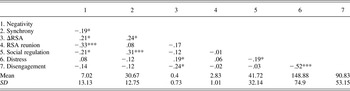
Prior to testing our main hypothesis, we present descriptive statistics and an intercorrelation matrix for study variables in Table 1. To provide validation for infant negative emotionality from sources outside the interactive context, we examined correlations between infant negativity with maternal report of infant temperament and stress. Infant negativity correlated with mother report of the infant's inadaptability (r = .21, p < .05) and the degree of dysfunction in their interaction (r = .19, p < .05). Mother–infant synchrony was unrelated to maternal report.
Descriptive statistics and correlations among study variables

Note: ΔRSA, Change in respiratory sinus arrhythmia.
*p < .05. **p < .01. ***p < .001.
In order to test the central study proposition (that infant negativity moderates the effects of mother–child synchrony on infant regulation), SEM was used. In the model, synchrony was the independent variable and the dependent variables were the child's physiological and behavioral regulation variables (social regulation, distress, and disengagement) and RSA at reunion (system's return to baseline following perturbation). Child negativity and procedure were included as moderators alongside their main effects. In addition, ΔRSA (the vagal break from baseline to the SF paradigm) was included as a mediator of the synchrony–RSA at reunion association. Thus, synchrony was hypothesized to predict ΔRSA, which in turn would predict RSA at reunion.
Prior to analysis, procedure was dummy coded into two orthogonal contrasts, which test the difference between SF+T and SF and the difference between SF+T and SF+AR. Two preliminary one-way analyses of variance were conducted to insure there were no initial differences in synchrony, F (2, 119) = 1.36, ns, and negative reactivity, F (2, 119) = 0.92, ns, between experimental groups. In addition, all the independent variables, mediator, and moderators were centered around their mean. The model was tested using AMOS19 software (Arbuckle, Reference Arbuckle2009). Model fit was assessed using the following goodness of fit indices (see Hu & Bentler, Reference Hu and Bentler1999): chi-square (Tabachnick & Fidell, Reference Tabachnick and Fidell2007), the normed fit index (NFI; Bentler & Bonnet, Reference Bentler and Bonnet1980), the comparative fit index (CFI; Rigdon, Reference Rigdon1996); and the root mean square error of approximation (RMSEA; Browne, Cudeck, Bollen, & Long, Reference Browne, Cudeck, Bollen and Long1993). A nonsignificant chi-square, NFI or CFI of ≥0.95, and an RMSEA of ≤0.07 (Hu & Bentler; Reference Hu and Bentler1999; Tabachnik & Fidell, Reference Tabachnick and Fidell2007) reflect a good fit between the model and the data.
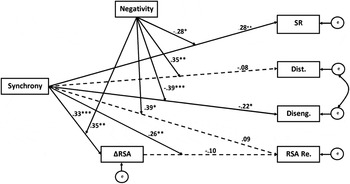
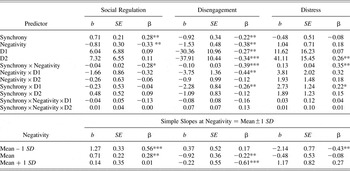
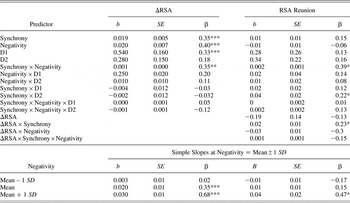
Results indicated an acceptable fit with χ2 (16) = 17.73, ns; NFI = 0.94; CFI = 0.99, and RMSEA = 0.03. The model with standardized path coefficients is presented in Figure 1 and the detailed regression analysis is presented in Table 2 for the behavior regulation measures and in Table 3 for the physiological measures. As shown, synchrony significantly predicted an increase in infant social-regulation behaviors and a decrease in infant disengagement behaviors. Synchrony was not significantly associated with infant's distress regulation and RSA at reunion. In addition, as shown in Table 2, negativity was significantly and negatively correlated with social regulation and disengagement, and as shown in Table 3, significantly and positively associated with ΔRSA. The first dummy variable had a significant negative correlation to disengagement (Table 2), indicating there were higher levels of disengagement in SF+T than in SF. It also had a significant positive correlation with ΔRSA (Table 3), indicating that there were higher levels of vagal withdrawal in SF than in SF+T. The second dummy variable had a significant positive correlation with distress (Table 2), indicating that there were higher levels of distress in SF+AR than in SF+T. It was also significantly and negatively associated with disengagement (Table 2): higher levels of disengagement were observed in SF+T than in SF+AR. Because there were no three-way interactions with the dummy variables, these were omitted from the SEM model.
Structural equation model testing the effects of synchrony, negativity, and their interaction on physiological and behavioral regulation during the still face paradigm. *p < .05, **p < .01, ***p < .001.

Predicting behavior regulatory mechanisms during the still face paradigm

Note: D1, SF versus SFT; D2, SF+AR versus SFT.
*p < .05. **p < .01. ***p < .001.
Predicting vagal withdrawal during the still face phase and vagal recovery at reunion

Note: ΔRSA, Change in respiratory sinus arrhythmia; D1, SF versus SFT; D2, SF+AR versus SFT.
*p < .05. **p < .01. ***p < .001.
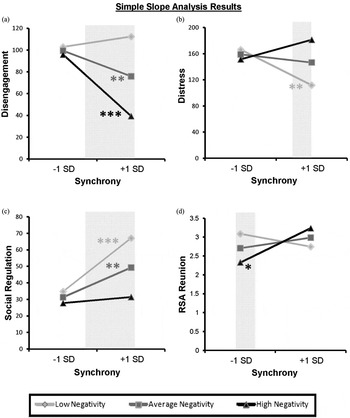
As hypothesized, infant negativity was found to moderate the effects of synchrony on infant behavioral and physiological regulation. A further simple slopes analysis (Aiken & West, Reference Aiken and West1991) provided information regarding the effects of synchrony on infant outcomes at three different levels of infant negativity: 1 SD below the mean, around the mean, and 1 SD above the mean (Figure 2). In addition, we calculated a regions of significance (RoS) test on the independent variable (synchrony) to assess whether the moderator (negative reactivity) and dependent variables (regulatory outcomes) are correlated both at the high and the low ends of the distribution of the independent variable, limited to ±2 SD from the mean of the independent variable (Roisman et al., Reference Roisman, Newman, Fraley, Haltigan, Groh and Haydon2012). In the following, results are presented for the behavioral regulation measures and then for physiological regulation. Simple slopes for synchrony at the different levels of negativity are presented at the bottom of Table 2.
Simple slopes analysis describing the effects of synchrony in predicting physiological and behavioral regulation for negativity levels at mean ±1 SD. Gray shaded area denotes regions where the two lines significantly differ. *p < .05, **p < .01, ***p < .001.

As seen, synchrony was found to have a significant positive effect on social regulation for children with average negativity or lower. However, for children with high levels of negativity, synchrony did not enhance social regulation (RoS > –0.45 SD from the mean). Regarding disengagement, synchrony reduced the frequency of disengagement behaviors for infants with average or high negativity but not for infants with low negativity (RoS > –0.5 SD from the mean). For distress, synchrony decreased this type of regulation only for infant with very low levels of negativity, those whose negativity was 1 SD below the mean or lower (RoS > 0.47 SD from the mean).
Results for the physiological regulation measures are presented in Table 3. As seen, for both RSA and ΔRSA, the association between synchrony and each of the physiological measures became stronger as infants negativity increased (ΔRSA: RoS > –0.67 SD from the mean; RSA: RoS < –0.58 SD from the mean). Moreover, results indicated that the main effect of ΔRSA on RSA at reunion was not significant; however, this path was moderated by synchrony. Simple slope analysis indicated that ΔRSA was inversely associated with RSA at reunion for those with low synchrony (b = –0.50, SE = 0.18, β = –0.36, p < .01) but not for those with average (b = –0.20, SE = 0.14, β = –0.15, ns) or high synchrony (b = 0.10, SE = 0.22, β = 0.07, ns).
Overall, because the effect of synchrony on ΔRSA was moderated by infant's negativity and the effect of ΔRSA on RSA at reunion was moderated by synchrony, we turned to test a moderated mediation effect. For this end, we followed the guidelines and employed the analytic methods outlined in Preacher and Hayes (Reference Preacher and Hayes2008). Accordingly, the significance of the moderated mediation effect was estimated by calculating 95% confidence intervals (CIs) of the indirect effects of synchrony on RSA at reunion through ΔRSA. This method uses 5,000 bootstrapped samples to estimate the bias corrected and accelerated confidence intervals. Results indicated that ΔRSA mediated the association between synchrony and RSA at reunion for those with high synchrony and average (95% CI = –0.009, –0.004) or high negativity (95% CI = –0.02, –0.008).
Discussion
Results of our study, the first to examine the interactive effects of infant negative reactivity and parenting on physiological and behavioral regulation in an experimental paradigm, present a complex picture that shows domain-specific effects. Overall, our findings call for further specificity in conceptualizing the effects of parenting on children of varying dispositions. The differential effects of synchrony on infants high and low in negative reactivity differed for each regulatory mechanism and across physiological and behavioral domains. Our study is also unique in addressing predictions from current theoretical models by utilizing careful microlevel observations that measure in second-by-second detail both the infant's regulatory repertoire and the mother–infant synchronous process. Thus, from a conceptual standpoint, our study may expand the discussion on the “influential child,” the infant's effect on his or her own development, by specifying mechanisms by which synchronous parenting impacts children of different dispositions at the level of the immediate social context. The results also lend support to our biobehavioral synchrony model (Feldman, Reference Feldman2007b, Reference Feldman2007c, 2012) by demonstrating that synchrony marks a unique process that impacts both biology and behavior, and that synchronous processes are dyad specific and are shaped by the personal attributes of each partner.
As to physiological regulation, our results show that only when both infant negative reactivity and mother–infant synchrony were high greater vagal withdrawal was observed. Higher vagal withdrawal during stress is thought to index a more mature and flexible autonomic system (Porges, Reference Porges2007) and has been associated with greater recovery from the SF as measured by both RSA and positive behavioral engagement at reunion (Moore & Calkins, Reference Moore and Calkins2004). Furthermore, Calkins et al. (2007) found that lower vagal withdrawal during the SF predicted more externalizing and internalizing behavior at 5 years. It thus appears that only infants with high negative reactivity were able to utilize synchronous experiences for developing a more flexible RSA system. However, the prediction of RSA recovery from the Synchrony × Negativity interaction showed that negatively reactive infants displayed poor vagal recovery compared to their low negativity peers when synchrony was low, but similar levels of vagal recovery when synchrony was high. Finally, we found that vagal withdrawal mediated the Synchrony × Negativity effect on vagal recovery, but only among infants high in synchrony and high or average in negativity, the same group that showed higher vagal withdrawal. It thus appears that for this group, the higher flexibility of the autonomic system may be the mechanism that enabled these infants to display typical levels of vagal recovery after the stressor has been removed. In light of these findings, we suggest that the mechanism by which synchrony may bolster regulation in negatively reactive infants at the physiological level is by providing a patterned experience that contains frequent moves from relaxed (coordinated) to more stressful (uncoordinated) moments. Negatively reactive infants show augmented physiological response to stress as well as difficulty in recovering from it (Feldman et al., Reference Feldman, Gordon and Zagoory-Sharon2010). Synchrony provides a tightly fitted framework where infants can learn via countless microlevel events to “repair” stressful moments (Tronick, Reference Tronick2007) within the predictable frame of maternal attunement. Animal studies emphasize the critical role of maternal undisrupted presence to the pup's autonomic maturation (Hofer, Reference Hofer1995), and our research shows that providing skin to skin contact to premature neonates, who show high negative reactivity, predicted higher vagal tone and greater vagal withdrawal at 10 years (Feldman et al., Reference Feldman, Rosenthal and Eidelman2014). Thus, synchronous parenting may be the component of maternal caregiving that enables highly reactive infants to develop an adaptive physiological response to stress despite initial regulatory difficulties.
With regard to the behavioral measures, each of the three regulatory mechanisms was shaped by a unique interaction of infant and parenting factors. For social regulation, the most adaptive and proactive mechanism that involves using social cues to reengage the unresponsive mother as a means of self-regulation, we found that highly negative infants did not benefit from high levels of synchrony. These infants were unable to use social behaviors to regulate stress, and social regulation was low in such children as compared to nonreactive children regardless of whether synchrony was low or high. These findings indicate that infants who are born with a disadvantage may be less able to profit from the beneficial elements in their environment. Possibly, using a proactive social mechanism to manage stress when internal regulation is low requires more resources than these children can master at this age, regardless of parenting. The results also highlight the fact that vulnerability cannot always be repaired by positive parenting. Developmental timing is also notable. Children were seen at 4–6 months, a period when infants are first learning to navigate social interactions and use social cues to regulate stress. Because infants were only assessed once, it is possible that ongoing parental synchrony may enable highly reactive infants to internalize social mechanisms for regulating stress at later stages.
As to distress, the most immature behavioral response, results show a different picture. In contrast to social regulation, for which infants with medium-level negativity were able to benefit from high parental synchrony, distress was only reduced among highly regulated and calm children and only when synchrony was high. While much more data in longitudinal and experimental designs are required to replicate this finding, reasons may be speculated. From an evolutionary perspective, overt distress signals, such as crying, whining, or fussing, are powerful mechanisms neonates are equipped with to maintain caregiver proximity, catch attention, and increase survival (Bowlby, Reference Bowlby1969). We tested infants at 4–6 months, the first period when communication through cry signals gives way to communication via social signals. Infants were faced with an unresponsive mother, and although likely familiar with moments of maternal unavailability, this may be their first experience of the mother in a face-to-face position when she is fully directed to them but yet unresponsive. In such a novel stressful context, infants may resort to earlier and familiar mechanisms of catching attention–distress signals. To overcome such a natural evolutionarily based tendency in a setting that activates the neurobiology of survival may require well-developed inhibitory mechanisms, which may be acquired at this age only by highly regulated infants who received high levels of synchrony.
Disengagement, the use of withdrawal tactics to regulate social stress, showed yet a different pattern. Highly negative infants experiencing high mother–infant synchrony exhibited the least disengagement of all groups. This is consistent with Tarabulsy et al. (Reference Tarabulsy, Provost, Deslandes, St.-Laurent, Moss and Lemelin2003), who showed that among high-risk dyads, when mother sensitivity was high, infants showed less disengagement. Gaze aversion and attention manipulation are the first regulatory mechanisms that allow neonates to control exposure to outside stressors, and these behaviors are associated with less distress and negative affect (Rothbart, Ziaie, & O'Boyle, Reference Rothbart, Ziaie and O'Boyle1992). Similarly, attention manipulation during the FTFSF in 2- to 3-year-olds was predicted by higher maternal sensitivity (Feldman, Dollberg, & Nadam, Reference Feldman, Dollberg and Nadam2011). It is thus possible that disengagement behavior may be underlaid by different neurobiological processes in infants high versus low in negative reactivity. Koulomzin, Beebe, Anderson, and Jaffe (Reference Koulomzin, Beebe, Anderson and Jaffe2002) found that 4-month-olds who developed avoidant attachment at 1 year tended to look less at their mothers and spent more time in neutral facial expression compared to infants who were later classified as securely attached. In these infants, such behaviors (the same as those included in our disengagement construct) were predictive of avoidant attachment and did not index successful regulation. High negative reactivity is considered a risk factor for avoidant attachment in adulthood, because avoidance may function as a defense mechanism against the high stress invoked by interpersonal intimacy (Mikulincer, Shaver, & Pereg, Reference Mikulincer, Shaver and Pereg2003). Possibly, among negatively reactive infants who may be more frustrated by maternal unavailability, maternal synchrony helped reduce the natural tendency to disengage, whereas among low-reactivity infants disengagement can be used in a more conflict-free manner. It is also possible that because reactive infants depend more heavily on their mothers’ response, synchronous experiences help these children to maintain focus on the unresponsive mother in the hope of rapid reengagement rather than giving up and withdrawing as a result of low frustration tolerance.
We found no modulation by the type of procedure on the Synchrony × Negativity interaction. Thus, the interactions between infant negativity and mother–infant synchrony were of similar magnitude regardless of the induced level of distress (SF+T, SF, or SF+AR), even though infants expressed greater distress as the level of induced stress increased. However, there were interaction effects of procedure, indicating that the correlations between synchrony and several regulatory outcomes (distress, disengagement, and RSA recovery) were modulated by the amount of induced stress. Nevertheless, these findings suggest that the internalization of synchronous parenting in infants of varying dispositions remained stable across the three levels of stress, suggesting that, at least in a microlevel social experiment, infant dispositions and maternal synchrony are the stronger predictors.
Overall, our microlevel behavioral and physiological data and the experimental design may contribute to current conceptualizations by specifying two pathways by which synchrony can enhance regulatory functions in infants of high and low reactivity. Among low reactive infants, the experience of synchrony may help children employ a wide array of social behaviors as a mechanism for handling stress by expending their social repertoire, teaching them to deal with the frustrations of momentary interactive failures via increasingly mature social engagement cues, and gradually moving toward mutual forms of interpersonal synchrony. Such experiences, if repeated across development, can help children utilize a social approach orientation and appropriately matched behavior during interpersonal encounters and feel efficacious in resolving the stresses inherent in human social relationships, both intimate and casual.
For highly reactive infants, building a social repertoire is not sufficient, because mothers need to first help infants handle their heighted response to stressful social moments. As seen, synchronous mothers accomplish this goal in two ways. First, synchronous parenting helps consolidate the infant's autonomic support system as the basis for emotion regulation, where the infant's high vagal withdrawal is used for “tuning the pendulum” for a flexible return to normative functioning following the termination of stress. Second, synchronous mothers can assist reactive infants to reduce their natural tendency to disengage from social stress, possibly as a platform for a step-by-step acquisition of social regulatory behaviors. Much further longitudinal research involving careful behavioral observations is required to test the trajectories of these two pathways over development in order to more fully understand how negatively reactive infants utilize fitted parenting to acquire regulatory milestones.
Future directions for translating research on the influential child into preventive interventions
Understanding how infants shape their own development by setting forth unique trajectories of infant–context interactions is an area that requires much further theory and research. Translational implications of such a framework involve teaching parents facing childrearing difficulties that children require different types of parenting for growth and thriving, that parental styles suited for one child are not necessarily fitted for another, and that similar parental behavior may carry different meaning and have distinct effects on each child.
Our results have several specific translational implications. Results regarding the greater impact of parent–infant synchrony on the physiological and behavioral regulation of highly reactive infants may be applied to a host of conditions associated with infant regulatory difficulties, including premature birth; intrauterine growth retardation; intrauterine exposure to stress, drugs, or alcohol; postpartum depression; unpredictable environments due to war, abuse, or poverty; and father absence. Mothers need to learn that reactive infants are highly aroused by social stress and must be helped to teach infants how to remain “tuned in” and reduce disengagement as the basis for a very gradual introduction of social-regulatory stress-reducing tactics. Mothers must also learn that synchrony provides essential nutrients for the child's physiological maturation and that the synchrony experience prepares the child's physiological systems to better meet the world and its stresses. Finally, in light of the low vagal recovery found among infants high in negative reactivity to less synchronous mothers, it is important to focus interventions on readjustment following moments of dyadic stress, reestablishing connections, and restabilizing the child's physiology in order to foster secure attachment and coping mechanisms (Holochwost, Gariépy, Propper, Mills-Koonce, & Moore, Reference Holochwost, Gariépy, Propper, Mills-Koonce and Moore2014). We recently developed an 8-week intervention for mothers suffering from postpartum depression that focuses on enhancing synchrony by using video feedback, gently instructing mothers how to achieve synchrony, and pointing out moments of “failures” when infants made social bids and mothers did not respond. Preliminary results suggest that such synchrony-focused intervention improves both mother–infant synchrony and the infant's regulatory functions as expressed in behavioral and physiological regulation.
Finally, the limitations of the study should be considered in the interpretation of the findings. First, negative reactivity and mother–infant synchrony were coded from the same interactive context. Although the correlations with mother-reported infant difficulty and stressed relationship support the infant negativity construct, this is a study limitation, and future research should define infant negative reactivity on the basis of independent observations. Second, because we observed infants only once, the study highlights a microsetting of stress and resolution within the immediate social context, and infants should be followed longitudinally to examine long-term predictions from their ability to regulate stress during the SF paradigm. Third, our study involved a low-risk cohort, and research in high-risk groups is required before findings can be generalized. Fourth, we measured only one biomarker of regulation (RSA) and other genetic, hormonal, and brain markers should be further tested. Yet, social processes observed in microlevel detail can yield rich and informative insights, particularly in infancy when communication is solely nonverbal. Applying such insights to create synchrony-focused interventions that can help highly reactive infants master rudimentary regulatory abilities may help prevent early regulatory difficulties from escalating into regulatory disorders, social maladjustment, or dysfunctional parent–child relationships.