Infection with respiratory syncytial virus is the commonest cause of infections of the lower respiratory tract in children under the age of 2 years.Reference Simoes1 Certain groups of children, such as those with bronchopulmonary dysplasia or haemodynamically-significant congenital cardiac disease, are at increased risk of serious morbidity and mortality.Reference MacDonald, Hall, Suffin, Alexson, Harris and Manning2
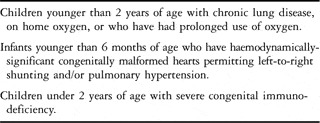
Palivizumab, a genetically-engineered humanized monoclonal antibody, which is active against respiratory syncytial virus, has been demonstrated to be effective in reducing hospitalization amongst patients at high risk of serious infections of the lower respiratory tract due to the respiratory syncytial virus.3 Cost-effectiveness models suggest that palivizumab does not represent good value when used in all children who meet the criterions within the product license,Reference Simpson and Burls4, Reference Reeve, Whitehall and Buettner5 and attempts have been made to define which groups most benefit from its administration.6, Reference Tulloh, Marsh and Blackburn7 Recently revised recommendations from the Joint Committee on Vaccination and Immunisation of the United Kingdom Department of Health are shown in Table 1.8 They predict that this would result in approximately 0.3% of births, or 2000 children, requiring palivizumab.
Populations recommended to receive palivizumab by the Joint Committee on Vaccination and Immunisation.8

The Royal Hospital for Sick Children is a tertiary hospital for children serving Glasgow and its surrounding areas. It is the national referral centre for paediatric cardiology and paediatric cardiac surgery for Scotland, and provides the only paediatric intensive care unit in the region. A dedicated palivizumab out-patient immunisation clinic has been running since 1999 in an attempt to coordinate prescribing and reduce cost.Reference Wills, Simpson and Coutts9 Patients referred for palivizumab immunisation were selected following referral mostly from neonatologists or cardiologists. Cardiologic referrals were based primarily on recommendations published in this journal.Reference Tulloh, Marsh and Blackburn7 Our primary aim was to examine the change in prescribing patterns of palivizumab in the Glasgow area since 1999, and to compare recent data with the recommendations made in 2005 by the Joint Committee on Vaccination and Immunisation. Our secondary aim was to examine the admission rate to paediatric intensive care unit with proven infection by the respiratory syncytial virus in children receiving palivizumab. In-patient hospitalization due to infection with the respiratory syncytial virus outwith the intensive care environment was not examined.
Methods
A policy of centralised prescribing for palivizumab has occurred in what is currently Greater Glasgow and Clyde National Health Service area since 1999. All children receiving palivizumab at the outpatient respiratory syncytial virus prophylaxis clinic, Royal Hospital for Sick Children, Yorkhill, Glasgow, were included. Prescribing data was obtained from the drug prescribing chart of each patient. The first dose of palivizumab was delayed until the onset of the season for infection by the respiratory syncytial virus. Patients were immunised in cohorts to maximise the use of sharing vials. Children referred following onset of the immunisation programme were given an appointment in the next scheduled cohort, or placed in a new cohort. Second dosing was approximately 3 weeks following the first dose, and thereafter 4 weekly until the season was complete. Children receiving palivizumab were categorised into one of three categories:
• Ex-preterm/chronic lung disease
• Congenital cardiac disease
• Other.
The last group included children with multiple congenital abnormalities, congenital diaphragmatic hernia, and severe congenital immunodeficiency. Admissions to paediatric intensive care with proven infection by the respiratory syncytial virus were compared to children given palivizumab. Prescribing data for the year 2005 and 2006, prior to publication of the revised recommendations, was compared to the recent recommendations of the Joint Committee on Vaccination and Immunisation.8
A chi-squared test for trend was used to investigate the total number of prescriptions for palivizumab during the period of study. Possible changes in population demographics were also examined during this period from data provided by Scottish Health Statistics (Information Services Division [ISD] Scotland), and the Scottish Perinatal and Infant Mortality and Morbidity Report of 2006.10, 11 These included analysis of birth rate in Scotland and the Greater Glasgow and Clyde National Health Service area, the number of live children born weighing less than 1500 grams in Greater Glasgow and Clyde, and the national incidence of newly diagnosed congenital cardiac disease. Population demographics were analysed using chi-squared goodness of fit tests to determine if the rates were uniform. A significance level of 5% was used for all tests.
Results
Number of prescriptions and population demographics
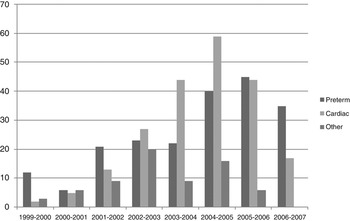
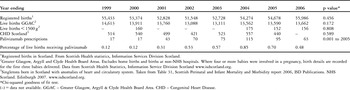
There was a significant increasing linear trend in the annual number of prescriptions of palivizumab since its introduction from 1999 to the season 2004 through 2005, 17 versus 115, chi-squared trend p < 0.001, Figure 1, with an increase in the percentage of live births receiving palivizumab from 0.12% to 0.85%. During this period, there was no increase in the total number of live births in the Greater Glasgow and Clyde area or Scotland as a whole. In addition there is no evidence that the rate of birth of infants weighing less than 1500 grams in Greater Glasgow and Clyde has increased, nor has the number of new diagnoses of children with congenitally malformed hearts in Scotland (Table 2).10, 11 It is noted, however, that the specific cardiac diagnoses each year were not analysed. The rise in prescriptions occurred across all categories of patient, but particularly so amongst patients with congenitally malformed hearts.
Annual number of prescriptions of palivizumab according to the category of prescription.

Demographics of populations and prescriptions of Palivizumab from 1999 through 2006.

1Registered births in Scotland. From Scottish Health statistics, Information Services Division Scotland.
2Greater Glasgow, Argyll and Clyde Health Board Areas. Excludes home births and births at non-NHS hospitals. Where four or more babies were involved in a pregnancy, birth details are recorded for the first three babies delivered. Data from Scottish Health Statistics, Information Service Division Scotland www.isdscotland.org.
3Singletons born in Scotland with anomalies of heart and circulatory system. Taken from Table 31, Scottish Perinatal and Infant Mortality and Morbidity report 2006, ISD Publications. NHS Scotland. Edinburgh 2007. www.isdscotland.org.
*Chi-squared goodness of fit test.
(–)=data not available. GGAC – Greater Glasgow, Argyll & Clyde Health Board Area. CHD – Congenital Heart Disease.
Following publication of the revised recommendation of the Joint Committee on Vaccination and Immunisation, the number of prescriptions of palivizumab fell across all categories, from 95 in 2005/6 to 63 in 2006/7, but particularly amongst the patients with congenitally malformed hearts, from 44 in 2005/6 to 17 in 2006/7.
Pattern of prescribing Versus the recommendations of the Joint Committee on Vaccination and Immunisation
Data from the season 2005–2006 was analysed relative to the recommendations of 2005. Of the 95 total prescriptions, 44 occurred in children with congenitally malformed hearts. Of these patients, 26 were less than 6 months old, and 12 had haemodynamically significant left-to-right shunts. Of the group of 44, 32 had some other cardiac diagnosis, including tetralogy of Fallot, pulmonary atresia, tricuspid atresia, transposition, and double outlet right ventricle. Only 9 of the group were both less than 6 months old and had haemodynamically-significant left-to-right shunts. This means that 35 of the 44 (80%) receiving palivizumab because of congenital cardiac disease were outwith the revised recommendations of the Joint Committee.
In the season 2005/6, 51 of 95 patients received palivizumab for non-cardiac indications. Of these, 45 were eligible on the basis of being less than 2 years old with chronic lung disease or requiring oxygen at home, or prolonged use of oxygen. Another was eligible on the basis of being aged less than 2 years and having severe congenital immunodeficiency. This left 5 patients who did not fulfil the criterions of the Joint Committee, 1 receiving home oxygen but older than 2 years, 1 with severe congenital immunodeficiency older than 2 years, and 3 with multiple severe gastrointestinal congenital abnormalities, all the last group being less than 2 years old but without dependency on oxygen.
Had the recommendations been fully implemented, then the total number of patients receiving palivizumab in the 2005/6 season would have been 55. This represents approximately 0.41% of the total live births.
Admissions to paediatric intensive care
No patients who received palivizumab required admission to paediatric intensive care with proven infection by the respiratory syncytial virus over the period of 8 years.
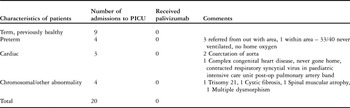
Following the publication of the revised recommendation of the Joint Committee, there was an increase in the total number of patients requiring admission to paediatric intensive care with proven infection by the respiratory syncytial virus (Fig. 2). This rise was predominantly in infants who would not have received palivizumab in previous years, accounting for 9 of 20 patients (Table 3). It is possible that 2 patients with coarctation of the aorta would have received palivizumab in previous years, and 4 patients born prior to term would have received palivizumab under the original IMpact-RSV trial. This suggests that, excluding the 9 infants born at term, 6 of 11 patients who were admitted to the paediatric intensive care unit with infection by the respiratory syncytial virus may previously have been immunised.
Number of admissions to paediatric intensive care due to infection with the respiratory syncytial virus relative to the seasons for infection.

Characteristics of patients admitted to paediatric intensive care with respiratory syncytial virus infection following implementation of the recommendations of the Joint Committee on Vaccination and Immunisation.

Discussion
Our data reveals that, since the introduction of palivizumab in the Glasgow area, there has been a change in patterns of prescribing, with an initial rise followed by a marked reduction. The change in prescribing has occurred throughout all categories of patients, but is particularly significant in children with congenitally malformed hearts.
Given that the population demographics in Glasgow, and Scotland as a whole, have not changed significantly over this period, it would appear that the increase in prescribing may have reflected an increasing awareness of the availability of palivizumab through the presence of published recommendations,Reference Tulloh, Marsh and Blackburn7 a dedicated clinic, and an increased confidence in its clinical effectiveness and safety, particularly given that no patient receiving palivizumab required admission to the paediatric intensive care secondary to infection by the respiratory syncytial virus.
The current recommendations of the Joint Committee on Vaccination and Immunisation predict that 0.3% of liveborns would be eligible to receive palivizumab. Our study reveals that current patterns for prescribing in the Glasgow area are higher than this. In the main, this is because of prescribing outwith the recommendations. When prescribing is corrected to be within the guidelines, the prescribing rate of 0.4% is similar to the predictions made by the Joint Committee. The rate of prescribing outwith the current recommendations may have reflected a lack of promotion of the recommendations compared to awareness of previous material,6, Reference Tulloh, Marsh and Blackburn7 and a familiarity of, and ease of access to, a dedicated clinic for immunisation.
In the original IMpact-RSV study, 1.3% of those vaccinated with palivizumab had admissions to paediatric intensive care associated with infection by the virus, compared to 3% of those given placebo.3 In our cohorts, there were no admissions to paediatric intensive care because of infection with the virus. It is possible that patients may have been admitted to other paediatric intensive care units, and thus escaped capture, but since ours is the only paediatric intensive care unit in the region, and we are also the national centre for treatment of children with congenitally malformed hearts, this is unlikely. Whilst this represents a success of the programme of immunisation, given the small total number of patients receiving palivizumab, and the predicted low rates of admissions to paediatric intensive care because of infection with the respiratory syncytial virus, further interpretation of this data is difficult. We did not study hospitalisations not requiring intensive care. It is not possible, therefore, to assess the impact of prescriptions of palivizumab on infection by the respiratory syncytial virus outwith the experience of our unit providing intensive care.
When the rates for prescription of palivizumab fell in 2006/7, there was an increase in admissions to paediatric intensive care due to infection with the respiratory syncytial virus. Most of these patients would not be considered high risk, and none of these patients were immunised. Of these patients, however, 6, including 2 with coarctation of the aorta and 4 with prematurity, would possibly have received palivizumab if more liberal policies for prescription had been followed, and their admissions thus were potentially avoidable. This would suggest that a more restrictive policy for prescription may exclude a small number of children at risk of serious infection by the respiratory syncytial virus infection. We note that, whilst the recommendations of the Joint Committee on Vaccination and Immunisation are based on current expert review, the specific scientific data supporting the recommendations is not detailed. Hence, a more thorough exploration of these recommendations is difficult.
In conclusion we have shown that the pattern for prescribing palivizumab has changed significantly over the past 8 years, with an initial enthusiasm for palivizumab reflected in a large increase in numbers receiving the drug. Emphasis on the subsequent recommendations made by a Joint Committee on Vaccination and Immunisation has resulted in a subsequent fall in prescriptions. This may be accompanied by an increased risk of some children not being immunized who would have benefited from palivizumab. Our data validates the efficacy of palivizumab preventing admissions to the paediatric intensive care unit because of infection with the respiratory syncytial virus.
Acknowledgments
We acknowledge the assistance of the staff of Ward 1C At the Royal Hospital for Sick Children, Yorkhill, Glasgow, and Drs Trevor Richens and Judith Simpson for their review of the manuscript. We thank Etta Shanks and Anne Stott, Information Services Division Scotland, for assistance with population demographics, Lorraine Leask, Department of Cardiology, Yorkhill for data regarding patients with congenitally malformed hearts, Pamela Joannidis, Infection Control, Yorkhill for data regarding admissions to intensive care admissions, and Alastair Irwin, Department of Medical Illustration, Yorkhill, for assistance with the figures. Statistical advice was provided by Dr David Young, Department of Statistics, Strathclyde University