Implications
Tail biting in growing pigs is a serious welfare and economic problem, and there is pressure to avoid tail docking. For the first time relying only on studies where tail damage was recorded, we review the evidence on controlling tail biting in pigs that are not tail docked. Adequate feeder space and manipulable substrate provision are important, but more work is needed on the type and quantity of substrate needed. Vigilance for behavioural signs which occur before the first damaging biting would enable rapid detection and prevention/early response to outbreaks. Genetic selection could play a role in reducing tail biting.
Introduction
Tail biting in domestic pigs occurs when pigs bite and chew the tails of pen-mates. It is a considerable animal welfare (Munsterhjelm et al., Reference Munsterhjelm, Brunberg, Heinonen, Keeling and Valros2013) and economic problem, causing painful injuries which are a site for further infection (Sihvo et al., Reference Sihvo, Simola, Munsterhjelm and Syrja2012), resulting in carcass losses for producers (Valros et al., Reference Valros, Ahlstrom, Rintala, Hakkinen and Saloniemi2004; Kritas and Morrison, Reference Kritas and Morrison2007) and reducing weight gain (Wallgren and Lindahl, Reference Wallgren and Lindahl1996; Sinisalo et al., Reference Sinisalo, Niemi, Heinonen and Valros2012). Several risk factors have been proposed, suggesting multi-factorial causation (Schrøder-Petersen and Simonsen, Reference Schrøder-Petersen and Simonsen2001; EFSA, 2007) and three different aetiologies have been proposed (Taylor et al., Reference Taylor, Main, Mendl and Edwards2010). Removal of part of the tail (tail docking) a few days after birth usually reduces the likelihood and severity of tail biting (Sutherland and Tucker, Reference Sutherland and Tucker2011). Where tail docking is banned, tail biting incidence usually increases, even when the housing environment and management are improved (D’Eath et al., Reference D’Eath, Niemi, Ahmadi, Arnott, Turner, Baxter, Rutherford, Jensen, Lahrmann, Busch, Jensen, Lawrence and Sandøe2014).
However, even though tail docking reduces tail biting, it does not eliminate it and has significant drawbacks: it is an acutely painful mutilation, and it may ‘mask’ the real underlying problems in housing and management that result in tail biting (Sutherland and Tucker, Reference Sutherland and Tucker2011). For these reasons, the EU Council Directive (2001/93/EC amending Directive 91/630/EEC, The Council of The European Union, 2001b) came into force from January 2003 banning the ‘routine’ tail docking of pigs, unless ‘there is evidence that injuries… to other pigs’ ears or tails have occurred’ and insisting that before resorting to tail docking ‘other measures shall be taken to prevent tail biting…taking into account environment and stocking densities’. It goes on to state that ‘…pigs must have permanent access to a sufficient quantity of material to enable proper investigation and manipulation activities, such as straw, hay, wood, sawdust, mushroom compost, peat or a mixture of such, which does not compromise the health of the animals’. Despite this clear legal signal, tail docking continues for 95% or more of pigs in European pig producing countries such as Germany, Denmark, Belgium, France, Ireland, the Netherlands and Spain, and for over 80% in the United Kingdom (EFSA, 2007; Harley et al., Reference Harley, More, O’Connell, Hanlon, Teixeira and Boyle2012).
Perhaps in response to this gap between policy and reality, the European Commission (Directorate-General for Health and Consumers, DG Sanco; Bergersen, Reference Bergersen2013) is currently engaging in a process to agree and clarify the guidance to farmers associated with the mentioned Directive and its later versions (the latest being Reference Day, De Weerd and Edwards2008/120/EC on the protection of pigs). Some countries already go further than the EU directives in restricting tail docking (Mul et al., Reference Mul, Vermeij, Hindle and Spoolder2010). In Denmark, no more than half of the tail may be docked, and in the Netherlands, a voluntary agreement exists between farmers and government to phase out tail docking entirely by 2023 (Spoolder et al., Reference Spoolder, Bracke, Mueller-Graf and Edwards2011). A few countries already have either a complete ban on tail docking (Sweden, Finland, Switzerland; EFSA, 2007; Swiss Federal Council, 2008) or a ban on docking without anaesthesia (Norway; EFSA, 2007) so that tail docking is rare. At the same time animal welfare protection organisations in many European countries focus on tail docking as a sign of welfare problems in intensive pig production; and in some countries political pressure is building up in favour of an effective ban on tail docking.
In another article, we consider the decisions facing farmers under current EU rules as to whether to tail dock, and the economic, legal and pig welfare consequences of this decision (D'Eath et al., Reference D’Eath, Niemi, Ahmadi, Arnott, Turner, Baxter, Rutherford, Jensen, Lahrmann, Busch, Jensen, Lawrence and Sandøe2014). In the present article, we ask how farmers can become better at controlling tail biting without the use of tail docking. Our review focuses on changes that would be possible in existing systems, rather than considering radical system re-design (De Greef et al., Reference De Greef, Vermeer, Houwers and Bos2011). Various knowledge gaps are identified and promising areas for future innovation are proposed. We begin by introducing the nature of tail biting, and then review risk factors relating to the pigs’ environment. For the first time, we rely only on studies which reported effects on tail injuries, rather than those which describe pigs’ non-injurious interactions with tails (tail in mouth). The relationships between these risk factors and the underlying process(es) that govern the expression of tail biting are poorly understood, and we present a new illustration of the diversity of hypotheses. A novel illustrated meta-analysis quantifies the effectiveness of enrichment on tail biting in undocked pigs, and the practical experiences of countries and production systems in which tail docking is banned are considered. The next section of the review then focuses on risk factors that relate to characteristics of the pigs themselves, including the possibility of genetic selection to reduce tail biting. Finally we consider the prospects for early detection of tail biting outbreaks, possibly by automated means, which could facilitate targeted prevention measures. Farmers react to tail biting in various ways but little is known about the efficacy of these measures in preventing the further escalation of an outbreak.
Tail biting: why it remains an intractable problem
Tail biting occurs in outbreaks
Damaging tail biting occurs in a sporadic way, in unpredictable ‘outbreaks’, rather like an infectious disease (Blackshaw, Reference Blackshaw1981). For example, in one study using abattoir data, ‘high incidence farms’ were identified at one point in time, but when a similar ‘high incidence’ list was made a few months later, most of the farms were different – although there were a few farms with a persistent problem (Busch et al., Reference Busch, Wachmann, Nielsen and Petersen2004). In general, while some of the risk factors that affect the overall incidence of tail biting are known, for any given outbreak, the specific triggering factor(s) are usually difficulty to identify. Sometimes a change (weather, season, food, or disease outbreak) can be identified, but often no obvious change has occurred, and the cause may be down to variability in individual pigs’ threshold of response to risk factors.
Tail biting can spread quickly within the group
Tail biting begins with one pig in the pen starting to bite. Tail damage can increase rapidly, with one study reporting that progress from bite marks to a clearly visible tail wound took on average 7 days (Zonderland et al., Reference Zonderland, Kemp, Bracke, den Hartog and Spoolder2010b), although practical experience suggests that it can occur even more quickly. Over time, biting pigs may continue or escalate their biting of existing victims, but also begin biting other pigs in the group (Niemi et al., Reference Niemi, Sinisalo, Valros and Heinonen2011). Additionally, other pigs in an affected pen begin tail biting too, perhaps because they copy the behaviour (social facilitation; Blackshaw, Reference Blackshaw1981) or the bitten tails might stimulate investigation and biting (stimulus enhancement; Fraser, Reference Fraser1987a). Although never formally studied, there appears to be considerable variation in the rate at which a pig increases its tail biting behaviour, and in the rate of spread to new biters. In one study, a batch of pigs already showing tail biting, moved to an environment with considerable space and access to rooting substrates, subsequently showed healing and improvement over time (De Greef et al., Reference De Greef, Vermeer, Houwers and Bos2011), suggesting that escalation is not inevitable.
Scientific investigation of tail biting is difficult
Tail biting is challenging to study. Its apparently sudden, unpredictable appearance and rapid spread can make it hard to investigate the events immediately before and after an outbreak begins. Its sporadic occurrence also means that a number of experimental studies have failed to observe any damaging tail biting at all. Such studies often report the effects of experimental treatments on tail investigation behaviour (‘tail in mouth’ Petersen et al., Reference Petersen, Simonsen and Lawson1995; Schroder-Petersen et al., Reference Schroder-Petersen, Heiskanen and Ersboll2004), which is at best an indirect indicator of tail biting, because ‘tail in mouth’ behaviour may or may not be a precursor to damaging tail biting (EFSA, 2007). Other studies include all pig-directed oral behaviours including ear and flank biting, and sometimes belly nosing, together in a single category (e.g. Jensen et al., Reference Jensen, Studnitz and Pedersen2010; Zwicker et al., Reference Zwicker, Gygax, Wechsler and Weber2013). This lack of precision makes interpretation difficult if the focus is on tail biting alone (Taylor et al., Reference Taylor, Main, Mendl and Edwards2010). In order to avoid these problems with indirect or imprecise indicators, this review focuses on studies where tail damage (with evidence of partial tail loss or of injury severe enough that blood was drawn) was the end point.
The sporadic occurrence of tail biting, and difficulties with experimental studies mean that multi-farm epidemiological studies (Moinard et al., Reference Moinard, Mendl, Nicol and Green2003; Goossens et al., Reference Goossens, Sobry, Odberg, Tuyttens, Maes, De Smet, Nevens, Opsomer, Lommelen and Geers2008) or abattoir data (Valros et al., Reference Valros, Ahlstrom, Rintala, Hakkinen and Saloniemi2004; Harley et al., Reference Harley, More, O’Connell, Hanlon, Teixeira and Boyle2012), sometimes combined with farm surveys (Hunter et al., Reference Hunter, Jones, Guise, Penny and Hoste2001), are often used to study tail biting. These usually record tail damage, and can find risk factors associated with it, but unlike experiments, are unable to determine cause and effect, so must be interpreted with caution. We begin by looking at risk factors in the pigs’ environment, and then explore risk factors intrinsic to the pig. Some of these risk factors and causes of tail biting may also affect the related problems of ear- and flank biting (Brunberg et al., Reference Brunberg, Wallenbeck and Keeling2011), but this is beyond the scope of this paper.
Risk factors for tail biting in the pigs’ environment and how to manage them
Tail biting does not have a single cause. It is a multi-factorial problem, and a variety of risk factors have been identified which are associated with it. Various efforts have been made to review all the currently known risk factors to weight their importance in order to influence policy makers (Bracke et al., Reference Bracke, Zonderland, Lenskens, Schouten, Vermeer, Spoolder, Hendriks and Hopster2006; EFSA, 2007; Spoolder et al., Reference Spoolder, Bracke, Mueller-Graf and Edwards2011) and to provide practical advice to farmers (Bracke et al., Reference Bracke, Hulsegge, Keeling and Blokhuis2004; Jensen et al., Reference Jensen, Riis, Maribo, Vernersen and Busch2004; Taylor et al., Reference Taylor, Parker, Mendl, Edwards and Main2012).
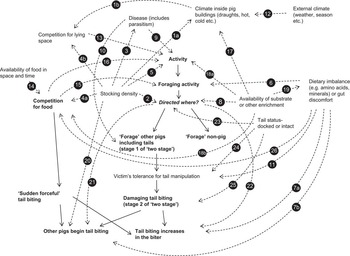
Taylor et al. (Reference Taylor, Main, Mendl and Edwards2010) in a recent review made a convincing case that there were at least two and possibly three different types of tail biting: two-stage, sudden-forceful and obsessive. ‘Two stage’ tail biting results from re-directed foraging due to a lack of suitable substrates. There is a progression from investigation and gentle manipulation of tails (stage 1) to damaging biting (stage 2). The second type, ‘sudden forceful’ tail biting is an aggressive behaviour (Van Putten, Reference Van Putten1969; Moinard et al., Reference Moinard, Mendl, Nicol and Green2003) apparently resulting from frustration over a lack of access to food, water or lying space. Pigs approaching a fully occupied resource such as a feeder may resort to biting at tails as the most readily available target for aggression. For example, in a recent study, 60% of the tail biting by pigs, which had limited feeder access (Palander et al., Reference Palander, Heinonen, Simpura, Edwards and Valros2013), occurred within 1 m of the feeder (A. Valros, personal communication). The third type, ‘obsessive tail biting’ is characterised by certain individual pigs which appear to be fixated on tails and go from one tail to another, inflicting damaging bites (Beattie et al., Reference Beattie, Breuer, O’Connell, Sneddon, Mercer, Rance, Sutcliffe and Edwards2005; Van de Weerd et al., Reference Van de Weerd, Docking, Day and Edwards2005). Here, we consider ‘obsessive’ biters to be individuals which are more likely than other pigs either to begin or to continue tail biting through the mechanisms explained above (and illustrated in Figure 1) for two-stage or sudden forceful tail biting.
Postulated relationships between the underlying processes of tail biting (text in bold, connected in order by solid arrows) and various known or suspected risk factors (text in plain type) connected with dashed numbered arrows to show how some of the risk factors might influence each other or the underlying process of tail biting. Some proposed risk factors for which the evidence is currently weak (e.g. disease and parasitism, draughts) are included where a plausible hypothesis exists. The meaning of the numbered arrows is explained in Supplementary Material S1.

The mechanism of action of each possible risk factor on the underlying processes controlling the expression of tail biting is in many cases unknown. Figure 1 illustrates many of the possible connections between proposed environmental risk factors and the underlying processes of ‘two stage’ and ‘sudden-forceful’ tail biting (Taylor et al., Reference Taylor, Main, Mendl and Edwards2010). The nature of each possible connection is described in Supplementary Material S1. Evidence for the effect of risk factors on damaging tail biting is discussed further below.
Availability of manipulable materials
Manipulable materials which are attractive to pigs as measured by their motivation to access them (Holm et al., Reference Holm, Jensen, Pedersen and Ladewig2008; Jensen et al., Reference Jensen, Studnitz, Halekoh, Pedersen and Jorgensen2008) or by the time pigs spend interacting with them over a sustained period have the characteristics ‘ingestible’, ‘odorous’, ‘chewable’, ‘deformable’ and ‘destructible’ (Van de Weerd et al., Reference Van de Weerd, Docking, Day, Avery and Edwards2003; Studnitz et al., Reference Studnitz, Jensen and Pedersen2007; Van de Weerd and Day, Reference Van de Weerd and Day2009). The opportunity to perform investigation and manipulation behaviours are in themselves important for pig welfare (Studnitz et al., Reference Studnitz, Jensen and Pedersen2007; Van de Weerd and Day, Reference Van de Weerd and Day2009), but here we focus on whether manipulable materials can reduce damaging tail biting apparently by providing an alternative outlet for investigatory behaviour.
Difficulties with the provision of loose manipulable materials on the floor
Systems making use of full or part-slatted floors, enabling automatic collection of pig faeces and urine (slurry) are common in indoor pig production. In comparison with straw-bedded systems, the labour (cleaning and waste handling) and input costs (e.g. of straw, peat and other substrates) are lower (Bornett et al., Reference Bornett, Guy and Cain2003), some environmental impacts may be lower (Stern et al., Reference Stern, Sonesson, Gunnarsson, Öborn, Kumm and Nybrant2005), and liquid slurry is more valuable as a fertiliser than solid manure (Sanchez and Gonzalez, Reference Sanchez and Gonzalez2005). The requirement to provide manipulable materials to occupy pigs, presents a difficulty for farmers with systems which rely on slatted-floors and liquid slurry handling (via pumps). Materials such as long (unchopped) straw do not easily pass through slats leading to pen fouling. Additionally, too much straw can separate from the liquid slurry and build up in the slurry pit, or if it does flow, it can block parts of slurry-handling systems, such as holes, pipes or vacuum-based slurry pumps (Tuyttens, Reference Tuyttens2005; Day et al., Reference Day, De Weerd and Edwards2008). Ways to reduce the problem of straw blockage may include use of chopped straw, in combination with engineering solutions, such as larger diameter pipes (Evira, 2013), slurry pumps fitted with chopper blades, the use of smaller, faster flowing slurry systems (PRC, 2011), or progressive cavity pumps which are suitable for viscous liquids. Depending on the quantity and type of substrate, these measures may not be 100% effective but are more likely to be successful if considered at the building design stage.
Non-destructible materials such as metal chains, or rubber or hard plastic objects have been tried. Although pigs may initially interact with these due to their novelty, interest in them usually declines rapidly over a few days (Van de Weerd et al., Reference Van de Weerd, Docking, Day, Avery and Edwards2003; Van de Perre et al., Reference Van de Perre, Driessen, Van Thielen, Verbeke and Geers2011). Even a repeating cycle of different objects may not be enough, as re-introduction of the same object after an interval of several weeks is usually not as effective at sustaining interest as a novel object would be (Van de Perre et al., Reference Van de Perre, Driessen, Van Thielen, Verbeke and Geers2011). The European Commission have made it clear that chains and other non-destructible materials are not sufficient to comply with the EU Council directive (EC, 2009). Gradually destructible materials, which take days or weeks to be chewed through such as wooden poles (often mounted vertically in a tube at the side of the pen, or suspended from a chain) are popular with farmers in some countries as they require less regular replenishment than other more readily destructible substrates and appear to comply with the EU Council directive (2001/93/EC) which lists wood as a suitable material. Wooden poles were found to be an effective enrichment for reducing tail damage in a recent unpublished Finnish study using freshly felled tree trunks 5 to 10 cm in diameter suspended on chains horizontally below snout level (Telkänranta et al., Reference Telkänranta, Bracke and Valros2014a). However, since some of the features required to make a material attractive to pigs are lacking (ingestible, odorous) or weak (chewable, deformable, destructible) in hard wood poles, the need to use soft, fresh woods which do have these features could be important.
In the face of these difficulties, an important question is whether it is possible to provide sufficient manipulable materials to pigs within existing intensive housing systems in order to reduce tail biting to a level which is acceptably low from a management, production and welfare perspective without the need to tail dock (D’Eath et al., Reference D’Eath, Niemi, Ahmadi, Arnott, Turner, Baxter, Rutherford, Jensen, Lahrmann, Busch, Jensen, Lawrence and Sandøe2014).
Alternative ways of providing manipulable materials
In part-slatted floored pens, it is possible to provide loose material such as chopped straw, peat or sawdust, which in small quantities may be used with slurry pumps (Munsterhjelm et al., Reference Munsterhjelm, Peltoniemi, Heinonen, Halli, Karhapaa and Valros2009). Substrate can be provided on the solid floor, while pigs defecate and urinate in the slatted part. To limit the passage of substrate from the solid to the slatted part of the floor, pen designs incorporating barriers (e.g. 50 mm high wooden strip, Zwicker et al., Reference Zwicker, Gygax, Wechsler and Weber2013) or where the slatted area is raised (BPEX, 2010) may be used. Practical experience suggests that such designs are usually not entirely successful, especially in high temperatures where pigs may choose to defecate in the lying area, wallowing in the wet faeces to keep cool, and at higher stocking densities where functional separation of lying and dunging areas becomes more difficult to achieve, particularly in older pigs (Jensen et al., Reference Jensen, Kold Nielsen, Vinther and D‘Eath2012).
Faecal contamination of manipulable substrates is a common problem which reduces their attractiveness to pigs (Scott et al., Reference Scott, Taylor, Gill and Edwards2009), and this contamination can be reduced by hanging objects in the pen. Hanging of substrates limits the form of interaction, for example chewing may be possible but not rooting (Day et al., Reference Day, De Weerd and Edwards2008). This might be important, or different forms of investigatory behaviour may substitute for one another in preventing tail biting, as long as the pigs are occupied. Hanging objects thus may have potential: in a meta-analysis of the time spent by pigs interacting with enrichment, properties promoting this interaction included enrichments which were suspended and/or deformable (Averós et al., Reference Averós, Brossard, Dourmad, De Greef, Edge, Edwards and Meunier-Salaün2010). For example pigs show sustained interest in interacting with destructible ropes (Trickett et al., Reference Trickett, Guy and Edwards2009), or hanging objects with an edible component (Van de Weerd et al., Reference Van de Weerd, Docking, Day, Avery and Edwards2003), and ‘flavoured rope’ devices for pigs are being sold commercially in Finland. However, the effects of these forms of enrichment on tail biting have not been investigated.
Another approach is to deliver loose manipulable materials by means of an elevated rack, so that pigs can gradually obtain the material for themselves over a period (Beattie et al., Reference Beattie, Sneddon, Walker and Weatherup2001; Van de Weerd et al., Reference Van de Weerd, Docking, Day, Breuer and Edwards2006; Zwicker et al., Reference Zwicker, Gygax, Wechsler and Weber2012 and Reference Zwicker, Gygax, Wechsler and Weber2013). This has the potential advantage of ‘double’ interaction (in the rack, and beneath it: on the floor, or in a box or feeder; Zwicker et al., Reference Zwicker, Gygax, Wechsler and Weber2012) which might mean less material can be used for the same total amount of interest from the pigs. A related approach is to use a low-level rooting box which can contain loose materials and keeps them separate from slats (Van de Weerd et al., Reference Van de Weerd, Docking, Day, Avery and Edwards2003; De Greef et al., Reference De Greef, Vermeer, Houwers and Bos2011).
Quantifying the effects of different enrichment methods on tail damage
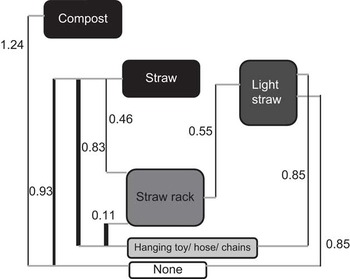
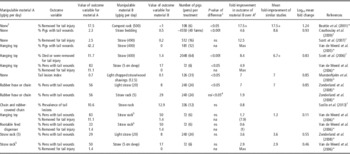
Studies published in refereed journals which compare the effect of different types and quantities of manipulable substrates on tail damage are summarised in Table 1. Most of the studies had pigs with intact tails, but some were docked, as indicated in the table legend. The studies all focus on grower-finisher pigs, except for Zonderland et al. (Reference Zonderland, Wolthuis-Fillerup, Van Reenen, Bracke, Kemp, den Hartog and Spoolder2008) which used weaners. Different indices of tail damage were used by different authors: most studies report either the percentage of pigs removed from the study with severe tail injury, or the percentage of pigs or of pens having tail wounds. One study (Munsterhjelm et al., Reference Munsterhjelm, Peltoniemi, Heinonen, Halli, Karhapaa and Valros2009) used a tail lesion index (scoring from 0 to 2). To compare studies that used different measures, we calculated the fold-change in tail damage for each pair of treatments in these studies (i.e. the reduction in tail injury following the provision of one type of manipulable substrate compared with another). Where one of a pair of substrates had zero damage, it was not possible to calculate a fold-change, so ‘max’ was reported in Table 1, and this value did not contribute to the mean fold change, probably resulting in an underestimate of the effect size. Most studies compared deep straw with either no enrichment, or with minimal enrichment with chains or hanging toys, considered to represent commercial practice. In Figure 2, the information from the studies in Table 1 is summarised graphically, giving a quantification of the relative value of different materials as it is drawn to scale using the mean log ‘fold’ difference between observed levels of biting damage as the distance between the materials. A log scale was used so that ‘fold’ differences could be added together on the same scale and shown relative to each other in a single diagram (since e.g. log 2+log 3=log 6).
Enrichment materials’ relative effect at reducing tail biting based on Log10 fold reductions in tail damage, using studies from Table 1. Line thickness indicates the number of studies used; thinnest lines=1 study, intermediate lines=2 studies, thickest lines=3 or more studies. Shading of the box indicates the amount of material that is used up. Compost and Straw (shown in black), at least 500 g/pig per day, light straw (in dark grey, 12.5 to 20 g/pig per day), straw rack (5 g/pig per day). None and Straw used as reference, as these are the most common materials used across studies. This means that none and straw each have only one horizontal line. Light straw and Straw rack have multiple lines, which show the range of positions they could occupy relative to other substrates based on a number of studies.

Summary of comparative manipulable material studies in which tail injuries were reported for growing pigs

An asterix (*) by the reference indicates that pigs had intact (undocked) tails, a dagger (†) indicates they were tail docked, and a double dagger (‡) indicates that half the pigs were docked in a 2×2 experimental design. All of the studies were controlled experiments with the exception of Courboulay et al. (Reference Courboulay, Eugene and Delarue2009) which scored tails in part- or fully slatted and straw systems in an on-farm observational study of 82 farms. Fold-improvement is a result of the tail biting value for the first manipulable material divided by the value for the second. Where two similar materials are named, the average was taken.
1 P-values are reported where these are available in the source paper; ns means that the difference was not significant, but numerical values have still been used to contribute to estimate the mean fold-change; na means that the P-value is not available as it was not reported in the source paper.
2 ‘Max’ indicates that the improvement was such that tail biting reduced to zero in the second treatment, and this information was not used for the calculation of average fold improvement. Values in parentheses in this column were not used for calculation of the ‘Mean fold improvement’ – where two different outcome variables were reported for the same study, one of them had to be chosen for use with other studies – the most comparable outcome variables were used where possible.
3 For the Beattie et al. (Reference Beattie, Sneddon, Walker and Weatherup2001) study, ‘None’ includes the average of pens with nothing and pens with the non-manipulable empty overhead racks.
4 In this study, straw rack and metal chain had significantly different % tail wounds, but straw rack and rubber hose did not. Metal chain and rubber hose had very similar levels of tail wounds so were combined for simplicity.
5 The straw rack was described as a metal tube with a chain mail base which was filled with long straw (and with a tray on the floor underneath) but the quantity provided/used was not reported.
In terms of manipulable substrate treatments that are compatible with fully or part-slatted floors, straw racks and light straw (⩽20 g/pig per day) are probably the most promising treatments for which data are available. Provision of straw in racks reduces tail damage compared with a rubber hose, chain or hanging toy, with two studies finding a small but consistent reduction in the percentage of pens with tail wounds (fold-improvement of 1.9 or 1.7, Van de Weerd et al., Reference Van de Weerd, Docking, Day, Breuer and Edwards2006; Zonderland et al., Reference Zonderland, Wolthuis-Fillerup, Van Reenen, Bracke, Kemp, den Hartog and Spoolder2008). In one study, the straw rack affected minor tail injuries, but was more effective at reducing severe tail damage (Van de Weerd et al., Reference Van de Weerd, Docking, Day, Breuer and Edwards2006), which suggests that the straw rack might have reduced the rate of escalation of biting.
Light straw (10 g twice a day per pig, Zonderland et al., Reference Zonderland, Wolthuis-Fillerup, Van Reenen, Bracke, Kemp, den Hartog and Spoolder2008), or light chopped straw and wood shavings (12.5 g a day per pig, Munsterhjelm et al., Reference Munsterhjelm, Peltoniemi, Heinonen, Halli, Karhapaa and Valros2009) were both highly effective at reducing tail damage compared with minimally enriched treatments in two studies, with fold-differences almost as high as for deep straw studies (see Figure 2). Unfortunately, neither of these studies included plentiful loose material as a positive control. In a producer survey combined with an abattoir study, Hunter et al. (Reference Hunter, Jones, Guise, Penny and Hoste2001) found that ‘light straw’ use reduced tail biting damage risk compared with no straw. Despite these positive findings, chopped straw may not be as attractive to pigs as long straw: A behaviour study comparing chopped with long straw (each 400 g/pig per day) suggested that chopped straw offers fewer possibilities for interaction and observed tail biting behaviour increased (Day et al., Reference Day, De Weerd and Edwards2008). However, this study included non-injurious chewing and biting, and tail damage was not reported. In contrast, a Danish study suggested that chopped and long straw (each at 100 g/pig per day) occupied pigs for a similar amount of time (Lahrmann and Steinmetz, Reference Lahrmann and Steinmetz2011).
Our comparative survey has identified a number of data gaps: only two studies included comparisons of more than one pair of treatments, allowing the substrates to be placed into an overall ranking (Van de Weerd et al., Reference Van de Weerd, Docking, Day, Breuer and Edwards2006; Zonderland et al., Reference Zonderland, Wolthuis-Fillerup, Van Reenen, Bracke, Kemp, den Hartog and Spoolder2008), and there was a paucity of studies investigating how different quantities of straw or other materials affect tail damage. Time spent exploring and manipulating straw rather than other pigs increases with straw quantity until above 300 g/pig per day (Olsson, Reference Olsson2011) or at around 500 g/pig per day (Pedersen et al., Reference Pedersen, Herskin and Forkman2013). However, tail biting occurred at very low levels in these studies, even in treatments with only 20 g/pig per day (undocked pigs, Olsson, Reference Olsson2011) or 10 g/pig per day (docked pigs, Pedersen et al., Reference Pedersen, Herskin and Forkman2013). Also, no studies have compared hanging toys with no enrichment, and none have looked at the effect of hanging destructible enrichments such as ropes on tail damage, except for one recent report in suckling piglets (Telkänranta et al., Reference Telkänranta, Swan, Hirvonen and Valros2014b), so there is considerable scope for further research.
Manipulable materials as fuel for anaerobic digesters (AD)
Materials which act as foraging enrichment for pigs could double as fuel for AD. This idea is being tested in the ‘Starplus’ system at Wageningen (Verdoes, Reference Verdoes2014). ADs enable farmers to deal with farm wastes, producing energy (methane) and digestates which can be used as fertiliser. Pig slurry provides micronutrients and trace elements needed for bacterial growth, but its energy content is low, so (non-wood) biological materials are added, some which could provide rooting/foraging (and eating) opportunities for pigs: chopped grass, maize or grass silage, sugar beet and kitchen waste (if concerns over biosecurity could be addressed). For example, pigs prefer chopped straw mixed with Maize silage over straw (Jensen and Pedersen, Reference Jensen and Pedersen2007; Jensen et al., Reference Jensen, Studnitz and Pedersen2010) possibly because it may include edible components. Many questions remain, however: materials must be compatible with floor slats/slurry systems, a method to deliver substrate to the pens is required, fungal growth in wet fermenting materials can be a problem (T. Jensen, personal communication), and there are hygiene issues if pigs are eating material from the floor. Finally, fuel source costs, energy prices and government policies affect the economic feasibility of AD.
Social factors: space allowance (stocking density), group size, mixing
At space allowances lower than those currently recommended in the EU, reduced space allowance increased tail damage in one experiment (Krider et al., Reference Krider, Albright, Plumlee, Conrad, Sinclair, Underwood, Jones and Harrington1975). At space allowances closer to or within the recommended range, one multi-farm study found an association between reduced space allowance and tail injuries (Goossens et al., Reference Goossens, Sobry, Odberg, Tuyttens, Maes, De Smet, Nevens, Opsomer, Lommelen and Geers2008) but another similar study did not (Smulders et al., Reference Smulders, Hautekiet, Verbeke and Geerst2008), and no effect was found in an experimental study (Street and Gonyou, Reference Street and Gonyou2008). Group size (Schmolke et al., Reference Schmolke, Li and Gonyou2003; Smulders et al., Reference Smulders, Hautekiet, Verbeke and Geerst2008; Street and Gonyou, Reference Street and Gonyou2008) and mixing of groups (Smulders et al., Reference Smulders, Hautekiet, Verbeke and Geerst2008; Zonderland et al., Reference Zonderland, Wolthuis-Fillerup, Van Reenen, Bracke, Kemp, den Hartog and Spoolder2008) had no effect in studies where tail damage was reported.
Feeding: feeder space, feed restriction, feed type, nutrients, minerals
Restricted feeder space increased tail biting in one experimental study (damaged tails, Hansen et al., Reference Hansen, Hagelsø and Madsen1982) and is a risk factor in epidemiological studies (Hunter et al., Reference Hunter, Jones, Guise, Penny and Hoste2001; Moinard et al., Reference Moinard, Mendl, Nicol and Green2003). Other experimental studies, in which low levels of tail biting occurred, found no effect of feeder space (Georgsson and Svendsen, Reference Georgsson and Svendsen2001 and Reference Georgsson and Svendsen2002). The form and presentation of feed may be important: pigs fed pelleted diets showed higher levels of tail injury than meal or liquid fed pigs in one study (Hunter et al., Reference Hunter, Jones, Guise, Penny and Hoste2001) while Temple et al. (Reference Temple, Courboulay, Velarde, Dalmau and Manteca2012) found liquid feed in a trough increased tail injury compared with wet feed in a hopper.
Nutritional qualities of the diet: protein, specific amino acids, minerals or high energy density have all been suggested to affect tail biting (Edwards, Reference Edwards2011), but there is little direct evidence of nutritional manipulations affecting tail damage. Experiments using ‘model’ tails suggest that attraction to blood may be increased if the diet is nutritionally inadequate in terms of protein (Fraser et al., Reference Fraser, Bernon and Ball1991) or minerals (Fraser, Reference Fraser1987b).Tail biting pigs were more attracted to cords soaked with pig blood than their non-biting pen mates (McIntyre and Edwards, Reference McIntyre and Edwards2002b) and this preference can be reduced by the addition of the amino acid tryptophan to their diets (McIntyre and Edwards, Reference McIntyre and Edwards2002a). Differences in serotonin metabolism in the prefrontal cortex and an altered pattern of tryptophan uptake have been reported in tail biting pigs in contrast to bitten and unaffected group-mates or unaffected pigs from another group (Valros et al., Reference Valros, Palander, Heinonen, Brunberg, Keeling and Piepponen2013). Additional salt in the diet or on the floor of the pen can increase foraging and drinking behaviour (Brooks, Reference Brooks2005), which may reduce biting, but it is not clear whether this was effectively a foraging enrichment or addressing a nutritional deficiency. Jaeger et al. (Reference Jaeger2013) proposed a novel causal pathway for tail biting: high energy density diets for weaner pigs (as well as exposure to various pathogens) result in a build-up of endotoxins which cause ear or tail necrosis, which then attracts biting. If the necrotic tissue is itchy, this could increase the tolerance of tail investigation and biting in victim pigs.
Climate: temperature, draughts, seasonal effects
Either low (Temple et al., Reference Temple, Courboulay, Velarde, Dalmau and Manteca2012), or both low and high temperatures (Geers et al., Reference Geers, Dellaert, Goedseels, Hoogerbrugge, Vranken, Maes and Berckmans1989) have been identified by epidemiological studies as risk factors for tail damage, and providing access to a water misting system can reduce tail injury in hot climates (Courboulay et al., Reference Courboulay, Souffran, Guingand, Massabie and Dubois2008). Seasonal effects on tail damage have been identified (Schrøder-Petersen and Simonsen, Reference Schrøder-Petersen and Simonsen2001, Busch, personal communication), the exact nature of which varies between different studies. It seems plausible that rapid changes in temperature (either up or down), an increase in draughts at certain times of year (known to affect activity, Scheepens et al., Reference Scheepens, Hessing, Laarakker, Schouten and Tielen1991), or heat stress are likely to be the underlying cause of seasonal effects (Figure 1), as there is a limit to the capacity of ventilation/heating/cooling systems in most pig buildings.
Disease, including parasitism
Disease has been proposed to be a risk factor (Edwards, Reference Edwards2011). Levels of tail damage are higher in herds with higher levels of respiratory illness (Elst et al., Reference Elst, Vaessen, Vos, Binnendijk, Huime and Backus1988 cited by Moinard et al., Reference Moinard, Mendl, Nicol and Green2003; Edwards, Reference Edwards2011), and in a study where health records from individual pigs were examined, leg disorders and tail damage were highly correlated (Niemi et al., Reference Niemi, Sinisalo, Valros and Heinonen2012). Caution is required with the interpretation of epidemiological data, as disease may result from infections that follow tail biting (Moinard et al., Reference Moinard, Mendl, Nicol and Green2003; Kritas and Morrison, Reference Kritas and Morrison2007), or poor health status may be an indirect indicator of less technically efficient farms.
Controlled studies in which measures to improve health result in a reduction in tail damage provide better evidence. Currently there is only an anecdotal report of tail biting being reduced following anthelminthic treatment (Barnikol, Reference Barnikol1978) and an as-yet unpublished study concerning PCV2 vaccination (Parker et al. in preparation, cited by Edwards, Reference Edwards2011). So at this stage, the evidence for disease as a cause of tail biting is weak.
The experience of countries and assurance schemes where tail docking is banned
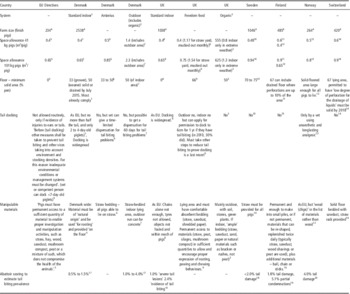
Pig producers in some countries and assurance schemes have already had to adapt their systems to cope with greater restrictions on tail docking, and the changes they have made are instructive. The tail docking and housing system rules for grower-finisher pigs applied by selected non-docking European countries and selected assurance schemes are summarised in Table 2, with some systems which permit tail docking included for comparison.
Comparison of minimum standards for housing grower-finisher pigs across countries and selected assurance schemes (from the UK and Denmark) that restrict or completely ban tail docking, with housing standards where docking is widespread (EU, Denmark and UK standard indoor housing)

1 Ban on fully slatted floors applies from July 2000 for new buildings, and for all housing by July 2015. Drained floor defined as maximum 10% openings (Danish Government, 2000, 2003a and 2003b; DVFA, 2013).
2 Outdoor access (can be concrete): 0.6 m2/pig at 40 kg and 1.0 m2/pig at 100 kg.
3 Soil Association (2012), outdoor-based system, giving permanent access to soil and growing plant foods. Must provide summer wallows and/or shade. Rotational grazing required. Indoors only under exceptional circumstances and must have outside run allowing rooting and dunging.
4 Farm sizes were calculated from Eurostat (2013) figures for 2010 for ‘other pigs’ which includes grower/finisher pigs (available only at country level). Low EU average is due to the inclusion of many member states which do not have a major pig industry.
6 Antonius: Danish Crown (2007).
8 Defra (2003), BPEX (2010) 1% figure from Northern Ireland and Republic of Ireland (Harley et al., Reference Harley, More, O’Connell, Hanlon, Teixeira and Boyle2012), 2.4% for six abattoirs in England (Hunter et al., Reference Hunter, Jones, Guise, Penny and Hoste2001).
9 RSPCA (2012) and Kate Parkes (RSPCA, personal communication).
10 Jordbruksverket (2010), Mul et al. (Reference Mul, Vermeij, Hindle and Spoolder2010), SLU and LRF (2009).
11 Council of State (2012). The regulations came into effect in the first of January 2013. If a facility was already operating at that time, the space allowance regulations come into effect on the first of January 2018, and the minimum solid floor area on the first of January 2028, or both come into effect upon renovation if that is sooner.
12 MAF (1997). Applies to all facilities until the 31 December 2012 and to old facilities not renovated before 2018.
13 LMD (2003).
14 Swiss Federal Council (2008), Wechsler (Reference Wechsler2013), CIWF (2009).
15 Tail docking prohibited since January 2003 (Council of State, 2002).
16 Evira (2013).
17 Taken from figure j, p. 86 in Forkman et al. (Reference Forkman, Olsen, Nørgaard, Laursen, Pedersen, Holm, Viekilde and Søndergaard2010) 2008–2010 figures from one abattoir so are directly comparable between systems.
18 Holmgren and Lundeheim (Reference Holmgren and Lundeheim2004), Keeling et al. (Reference Keeling, Wallenbeck, Larsen and Holmgren2012).
19 Partanen et al. (Reference Partanen, Niemi, Voutila and Jukola2012).
20 Fjetland and Kjastad (Reference Fjetland and Kjastad2002).
The ‘tail docking restricted or banned’ farms have a number of features in common, many of which may reduce tail biting risk. The space allowance is usually more generous, with up to 50% more space per pig being provided. Fully slatted pens are not allowed, enabling manipulable materials to be provided on the solid-floored part of the pen (although part slatted, part drained floors are permitted in Finland). Compared with the EU minimum provision, there are more specific rules on the quantity of materials, usually by specifying the frequency of replenishment, or the behaviour that pigs must be able to perform: in Finland pigs must be able to make small piles of material, Freedom Food requires sufficient quantities of material for rooting, pawing and chewing behaviour. The type of material provided is often also restricted, for example Sweden and the Danish assurance scheme Antonius require straw, and Norway repeats the EU list, but stipulates wood chips rather than ‘wood’ which rules out the use of wooden posts.
The smaller scale of farms in Finland, Norway and Switzerland, compared with the United Kingdom and Denmark (Table 2) might enable a greater supervision of the animals (assuming more staff per pig), making detection and prevention of tail biting easier, and smaller farms often have lower disease risk (Goldberg et al., Reference Goldberg, Weigel, Hahn and Scherba2000). For example, Finland is free from Porcine Reproductive and Respiratory disease, and mycoplasma and Salmonella are at low levels, although a lower density of farms and fewer pig movements including imports may also be important here.
Tail docking is not completely outlawed in all of the assurance schemes in Table 2. The assurance schemes Antonius, Outdoor (including Organic) in Denmark and Freedom Food allow farmers to apply for a dispensation to use tail docking for a limited time if a tail biting outbreak occurs. For example, Freedom Food farmers must annually seek written permission to dock, and if tail biting in the previous year was low, they are encouraged to trial a cessation of docking for some pigs, with the aim of stopping docking altogether. At each application, farmers must document the other measures they have taken to prevent tail biting and quantify their success. The standards give a detailed list of a number of environmental improvements that should be tried including providing straw and increasing feeder space. In 2010, 30% of Freedom Food breeding farms supplying indoor wean to finish herds requested permission to dock (Kate Parkes RSPCA, personal communication). This suggests that the majority of scheme members are managing to rear intact-tailed pigs, while those with tail biting problems are allowed to use tail docking to protect the welfare of potential victim pigs.
Finally, Table 2 gives figures on tail biting prevalence in the different countries and schemes, estimated from abattoirs. It is very difficult to compare the figures, since they are not collected in a standardised way, for example pigs with missing tails are usually not counted as injured (EFSA, 2007; Keeling et al., Reference Keeling, Wallenbeck, Larsen and Holmgren2012). It is also difficult to compare between docked and undocked pigs; if the number of lesions are counted, long tails provide a greater area for biting than docked or part-docked tails (Webster and Day, Reference Webster and Day1998). To avoid this problem, it might be best to use data on partial carcass condemnations (PCC), which can be used as indicators of the most severe cases of tail biting (Valros et al., Reference Valros, Ahlstrom, Rintala, Hakkinen and Saloniemi2004; Kritas and Morrison, Reference Kritas and Morrison2007), but these are not always available. Occasionally, different housing systems are assessed in the same way during the same period at one abattoir. Data from a Danish study (Forkman et al., Reference Forkman, Olsen, Nørgaard, Laursen, Pedersen, Holm, Viekilde and Søndergaard2010) show that tail biting damage at slaughter was higher in intact-tailed pigs in organic (or outdoor) systems (range 1.0% to 4.0%), in comparison to docked pigs in conventional indoor housing (range 0.5% to 1.5%; Table 2). These data suggest that tail docking is more effective at reducing tail biting than the combined effect of various improvements to the environment (as reported by Hunter et al., Reference Hunter, Jones, Guise, Penny and Hoste2001). It also highlights how challenging it is for producers to rear intact-tailed pigs, even in improved environments. However, it would be better to have data comparing countries and systems which used a standard scoring method and included PCC.
Risk factors for tail biting which are characteristics of the pig and how to manage them
Characteristics of the pigs themselves can affect their propensity to tail bite or to be bitten. This could involve any step of the tail biting process (Figure 1). To take the ‘two-stage’ form of tail biting for example pigs could vary in: (i) how much they perform exploratory behaviour (e.g. Zonderland et al., Reference Zonderland, Schepers, Bracke, den Hartog, Kemp and Spoolder2011), (ii) whether they explore tails rather than other things, (iii) whether tail manipulation becomes biting, (iv) whether one bite becomes many, and (v) in the likelihood of learning tail biting from a pen mate. Also, differences between pigs in their propensity to tail bite or be bitten could occur due to a greater sensitivity to any environmental risk factor (Figure 1).
Characteristics of victim pigs: sex and breed
Certain pigs may be more likely to become victims of tail biting. In several studies, castrated males were more likely to be the victims of tail biting than females (Kritas and Morrison, Reference Kritas and Morrison2004 and Reference Kritas and Morrison2007; tail damage, Wallgren and Lindahl, Reference Wallgren and Lindahl1996), with the risk to males rising with the proportion of females in the pen (Kritas and Morrison, Reference Kritas and Morrison2004). Tail biting was higher in pigs grouped by sex (intact males and females) in one abattoir study (Hunter et al., Reference Hunter, Jones, Guise, Penny and Hoste2001), but no relationship was found in an on-farm study of castrates and females (Steinmetz and Pedersen, Reference Steinmetz and Pedersen2009). All-female pens have been reported as having more (Zonderland et al., Reference Zonderland, Bracke, den Hartog, Kemp and Spoolder2010a) tail damage than pens of entire males. In another study, all female pens had less (Steinmetz and Pedersen, Reference Steinmetz and Pedersen2009) tail damage than pens of all-castrated males. It is not clear what causes these different findings in relation to sex.
Breed may affect the likelihood of being bitten. In a Swedish pedigree population of male pigs with low levels of tail biting, bitten pigs were: Yorkshire (3.5%), Landrace (1.8%) and Hampshire (0.1%, Westin, Reference Westin2003). However this was based on small numbers (63 victims out of 3049) in mixed breed groups which were not composed in a systematic way. Thus the evidence for breed differences in the risk of being bitten is weak.
Characteristics of tail biters: growth retardation, early experience, breed
It has been suggested that tail biters are often the smaller pigs in a group (Sambraus, Reference Sambraus1985) which is in agreement with data from some studies (Zonderland et al., Reference Zonderland, Schepers, Bracke, den Hartog, Kemp and Spoolder2011) although others have found that tail biters were no more likely to be smaller than average (Breuer et al., Reference Breuer, Sutcliffe, Mercer, Rance, O’Connell, Sneddon and Edwards2005). Once tail biting begins, certain individual pigs show much higher levels of biting than others (Beattie et al., Reference Beattie, Breuer, O’Connell, Sneddon, Mercer, Rance, Sutcliffe and Edwards2005; Van de Weerd et al., Reference Van de Weerd, Docking, Day and Edwards2005), and have been characterised as ‘fanatical’ or ‘obsessive’ biters (Taylor et al., Reference Taylor, Main, Mendl and Edwards2010). In one study with small numbers of ‘obsessive’ biters, these pigs were smaller than average (Van de Weerd et al., Reference Van de Weerd, Docking, Day and Edwards2005). Beattie et al. (Reference Beattie, Breuer, O’Connell, Sneddon, Mercer, Rance, Sutcliffe and Edwards2005) found that ‘tail in mouth’ behaviour was higher in pigs which grew poorly in the first 3 weeks after weaning. Although poorly supported by evidence from studies which include tail damage, it remains a popular theory with farmers, that smaller pigs in a pen begin biting perhaps because they resort to this biting as an aggressive tactic when excluded from food (Schrøder-Petersen and Simonsen, Reference Schrøder-Petersen and Simonsen2001) and/or because of a problem with nutrition or metabolism (Edwards, Reference Edwards2006; EFSA, 2007).
EFSA (2007) concluded that the rearing environment is not as important as the current environment for tail biting risk. Where pigs receive manipulable materials during the grower stage, past housing experience makes little difference to tail manipulation behaviours (Day et al., Reference Day, Burfoot, Docking, Whittaker, Spoolder and Edwards2002; no tail damage reported, Simonsen, Reference Simonsen1995; Statham et al., Reference Statham, Green and Mendl2011). However, a greater risk of tail lesions caused by tail biting occurs in pigs which have experienced manipulable materials in the farrowing pen early in life, but which are then absent during later stages (Ruiterkamp, Reference Ruiterkamp1985; Munsterhjelm et al., Reference Munsterhjelm, Peltoniemi, Heinonen, Halli, Karhapaa and Valros2009). In contrast to the small effects seen in experimental studies, epidemiological studies have found associations between early life factors and tail biting. These factors include slatted floors (Smulders et al., Reference Smulders, Hautekiet, Verbeke and Geerst2008) or absence of substrates (Moinard et al., Reference Moinard, Mendl, Nicol and Green2003) in the farrowing pen, and limited feeder space or high temperatures in the nursery (Smulders et al., Reference Smulders, Hautekiet, Verbeke and Geerst2008). Epidemiological studies of course do not prove a causal link and further research is required.
As well as breed differences in the propensity to become victims of tail biting (described above), some have reported breed differences in the propensity to perform tail biting. In the Swedish pedigree population with mixed breed pens of male pigs described earlier, the biters were: Landrace (1.7%), Yorkshire (0.64%) and Hampshires (0.1%), but only 27 biters out of 3049 animals were observed (Westin, Reference Westin2003). In a UK study, there was no effect of breed on tail biting, although there were breed differences in ear biting (Duroc>Large White>Landrace; Breuer et al., Reference Breuer, Sutcliffe, Mercer, Rance, Beattie, Sneddon and Edwards2003). Two other studies reported finding no breed differences in the performance of tail biting (Lund and Simonsen, Reference Lund and Simonsen2000; Guy et al., Reference Guy, Rowlinson, Chadwick and Ellis2002). Thus, as with breed differences in being tail bitten, breed differences in biting might occur, but the evidence is fairly weak.
Genetics of tail biting: biters, victims and unaffected pigs
A single published quantitative genetic study exists which found that biting other pigs’ tails was a heritable trait (Breuer et al., Reference Breuer, Sutcliffe, Mercer, Rance, O’Connell, Sneddon and Edwards2005), at least in Landrace (but not in Large White) pigs. Heritability was low at 0.05±0.02, although tail biters were rare (295 tail biters in a population of 9018 pigs) and tail biting was treated as a binary trait, which reduces the power of genetic analysis.
Commercial pig breeding mainly focuses on economically important traits of lean growth rate, food conversion and reproductive traits such as litter size. Some pig breeding companies are considering broadening their breeding goals, and traits relating to behaviour and welfare issues such as tail biting are of interest (Merks et al., Reference Merks, Mathur and Knol2012; Canario et al., Reference Canario, Mignon-Grasteau, Dupont-Nivet and Phocas2013). The inclusion of additional traits in a breeding index inevitably leads to a reduced rate of genetic progress in other traits (Falconer and Mackay, Reference Falconer and Mackay1996). However, breeding companies normally use economic weightings in breeding indices, and the considerable costs of tail biting could make it economically optimal to include a trait linked to lowered levels of tail biting in a multi-trait index (Lawrence et al., Reference Lawrence, Conington and Simm2004).
A number of other factors stand in the way of conventional genetic selection against tail biting (see discussion in Turner, Reference Turner2011). The positive genetic correlation relationship between tail biting and lean tissue growth rate found by Breuer et al. (Reference Breuer, Sutcliffe, Mercer, Rance, O’Connell, Sneddon and Edwards2005) could slow genetic progress if found in other populations. Phenotyping is also a challenge: identification of ‘biting’ pigs is considerably more difficult than identification of victims. Direct observation of biting may be the most accurate method, but is time consuming, especially since tail biting, as described above, often occurs in sporadic, unpredictable outbreaks. Also, it may be important to identify the individual pig which starts the outbreak (first biter), as once bloody tails appear in the pen, other pigs are more likely to begin biting. Because of these difficulties, there would be enormous value in identification of a proxy trait, associated with tail biting. Unfortunately, tests based on artificial tails have proved largely disappointing in terms of their predictive value for real tail biting (Breuer et al., Reference Breuer, Sutcliffe, Mercer, Rance, Beattie, Sneddon and Edwards2003; Beattie et al., Reference Beattie, Breuer, O’Connell, Sneddon, Mercer, Rance, Sutcliffe and Edwards2005; Statham, Reference Statham2008), although in one study the time spent manipulating an enrichment device before tail biting began was higher in biters than victims (Zonderland et al., Reference Zonderland, Schepers, Bracke, den Hartog, Kemp and Spoolder2011). Automated detection of tail biting might be possible using similar methods to those proposed for detection of early-warning signs (see next section).
There is some prospect of identifying molecular genetic markers of pigs at lower risk of tail biting, an approach which reduces the amount of phenotyping required. Single nucleotide polymorphism markers of biting and victim pigs (in contrast to non-biting controls from the same pen) have been identified (Wilson et al., Reference Wilson, Zanella, Ventura, Johansen, Framstad, Janczak, Zanella and Neibergs2012). Brain gene expression studies also suggest that biters and victims have more in common than unaffected pigs from the same group (Brunberg et al., Reference Brunberg, Jensen, Isaksson and Keeling2013a) or a different group (Brunberg et al., Reference Brunberg, Jensen, Isaksson and Keeling2013b). These authors suggest that unaffected pigs may show a ‘tail biting resistant’ phenotype. If confirmed in other populations, this idea suggests that selection against both biters and victims and for unaffected pigs might be possible.
Another approach which side-steps the problem of phenotyping tail biters is to use ‘associative genetic effects’ (Turner, Reference Turner2011; Camerlink et al., Reference Camerlink, Bijma, Kemp and Bolhuis2012). Quantitative genetic models for pig growth can be modified allowing pigs to have heritable influences on the growth of their pen-mates (Bijma et al., Reference Bijma, Muir and van Arendonk2007a and Reference Bijma, Muir, Ellen, Wolf and van Arendonk2007b; Rodenburg et al., Reference Rodenburg, Bijma, Ellen, Bergsma, de Vries, Bolhuis, Kemp and van Arendonk2010). Depending on the context, these ‘social breeding values’ might reflect differences in positive social behaviours such as social nosing (Camerlink et al., Reference Camerlink, Bijma, Kemp and Bolhuis2012) or in negative behaviours such as aggression, food competition, disease transmission and ear, flank or tail biting. To have a more direct effect on tail biting, modelling of associative genetic effects could be used in combination with phenotyping for tail damage. With sufficient representation of different sires across pens, pigs with a high genetic propensity to cause tail damage to pen mates could be identified, without the need to observe biting behaviour.
Selection to reduce tail biting behaviour could raise ethical concerns, particularly concerning ‘naturalness’ (D’Eath et al., Reference D’Eath, Conington, Lawrence, Olsson and Sandøe2010). Because ‘two-stage’ tail biting results from frustrated foraging behaviour, we could speculate that selection for lower tail biting might also reduce foraging. Also, selecting animals to function well in poor environments, rather than improving the animals’ environment to satisfy their needs might seem distasteful to some, and could lead to a decline in housing standards (Kanis et al., Reference Kanis, van den Belt, Groen, Schakel and De Greef2004). However, given that pigs are already undergoing constant genetic change to alter production traits, alongside improvements to the housing environment we should perhaps consider whether genetic selection to reduce tail biting could be part of a solution which makes an end to tail docking possible (D’Eath et al., Reference D’Eath, Niemi, Ahmadi, Arnott, Turner, Baxter, Rutherford, Jensen, Lahrmann, Busch, Jensen, Lawrence and Sandøe2014).
Although this is speculative, breeding to reduce tail length might be possible as tail length is heritable in various mammalian species (rodents, Barnett, Reference Barnett1965; cats, Howell and Siegel, Reference Howell and Siegel1966; sheep, Branford Oltenacu and Boylan, Reference Branford Oltenacu and Boylan1974), and naturally short-tailed pigs might be less prone to becoming victims of tail biting. There are probably difficulties though as tail length is likely to be genetically correlated with back length (a desired trait in bacon pigs) and tail-less mutations may have undesirable side-effects such as those seen in Manx cats (Howell and Siegel, Reference Howell and Siegel1966). Even if breeding to reduce tail length were successful, other concerns remain. The curly tail could be seen by consumers as an essential pig characteristic (although it is absent in wild pig species) and may have a function in communication (Kiley-Worthington, Reference Kiley-Worthington1976). Finally, breeding rather than docking to shorten tails still side steps the problem that pigs need an outlet for their foraging behaviour.
Early detection and targeted prevention
An alternative approach to the problem of tail biting is to detect outbreaks before or as soon as they begin, and to carry out targeted intervention (such as those discussed in the next section) to ameliorate or even prevent an outbreak (FAWC, 2011). Regardless of the system, if pig producers could identify certain ‘at risk’ individuals, groups, or batches, and target them for preventive intervention, this would be cheaper and more practical compared with making changes for every pig.
Early detection of tail biting might be possible by identifying changes in pig behaviour that precede an outbreak. Four main types of early warning sign have been described, which appear in the days or weeks before an outbreak begins (first bloody tails): (1) General activity (restlessness) increases (Statham et al., Reference Statham, Green, Bichard and Mendl2009; Zonderland et al., Reference Zonderland, Schepers, Bracke, den Hartog, Kemp and Spoolder2011), particularly in biters (Svendsen et al., Reference Svendsen, Olsson and Botermans2006). (2) Non-damaging ‘tail in mouth’ behaviour increases (Fraser, Reference Fraser1987a; Feddes and Fraser, Reference Feddes and Fraser1994; Schrøder-Petersen and Simonsen, Reference Schrøder-Petersen and Simonsen2001). (3) Tails are held down or ‘tucked under (Statham et al., Reference Statham, Green, Bichard and Mendl2009; Zonderland et al., Reference Zonderland, van Riel, Bracke, Kemp, den Hartog and Spoolder2009 and Reference Zonderland2010). (4) Feeding patterns might change. In one study, feeder visits tended (P<0.1) to be lower in groups which went on to tail bite 6 to 9 weeks pre-outbreak, and tended (P<0.1) to increase during weeks 2 to 5 pre-outbreak in pigs which would become tail biting victims (Wallenbeck and Keeling, Reference Wallenbeck and Keeling2013). More research on feeding patterns is needed.
Increased observation of pigs by staff might identify these early warning signs, but staff time has a cost, so automatic detection (precision livestock farming) would be attractive (reviewed by Rushen et al., Reference Rushen, Chapinal and de Passille2012). The detection of specific behaviours such as tail posture and tail in mouth behaviour may be possible (Sonoda et al., Reference Sonoda, Fels, Oczak, Vranken, Ismayilova, Guarino, Viazzi, Bahr, Berckmans and Hartung2013), but increases in activity (and perhaps feeding patterns) are perhaps the easiest of the ‘early warning signs’ to detect automatically (Costa et al., Reference Costa, Ismayilova, Borgonovo, Leroy, Berckmans and Guarino2013). One promising approach is ‘optical flow’, which estimates animal activity by quantifying overall pixel changes from moment to moment in a video image. ‘Optical flow’ has been used to detect the reduced activity of lame broiler chickens (Dawkins et al., Reference Dawkins, Lee, Waitt and Roberts2009), and the disturbance of behaviour in laying hen flocks when feather pecking is occurring (Lee et al., Reference Lee, Roberts, Drake and Dawkins2011).
The use of on-board animal devices (such as electronic ID ear tags), combined with detectors in the pen to record pig location also has potential to detect changes in activity (or feeding patterns). Currently, the infrastructure and consumable costs associated with either video or electronic ID approaches to monitoring pig behaviour may be prohibitive. But with falling costs and various other benefits of electronic ID (easier record keeping for medicines and at weighing, or even for detecting when a pig has not visited the feeder in a long while) and video (estimation of pig size average and variability) the use of these technologies could become more widespread in future. Detection of changes in pig vocalisations is also a plausible approach (Manteuffel et al., Reference Manteuffel, Puppe and Schon2004) but would require considerable further research and validation.
Reacting to outbreaks
Once a tail biting outbreak occurs, pig producers react in various ways (Arey, Reference Arey1991). Hunter et al. (Reference Hunter, Jones, Guise, Penny and Hoste2001) surveyed British pig producers and found that 67% removed the bitten pig(s), 51% added enrichment objects, 25% applied sprays or tar to injured tails, 16% added straw, 6% reduced stocking density and 6% gave antibiotics. In one study, moving pigs that were already biting to pens with substrates and more space resulted in reduced biting behaviour (De Greef et al., Reference De Greef, Vermeer, Houwers and Bos2011), and Edwards (Reference Edwards2011) has suggested that the effectiveness of salt or other nutritional supplements should be investigated. There is considerable scope for more research in this area: only one scientific study of the effectiveness of interventions has been reported. Zonderland et al. (Reference Zonderland, Wolthuis-Fillerup, Van Reenen, Bracke, Kemp, den Hartog and Spoolder2008) compared the interventions of removing the biter or adding straw as soon as tail damage was detected and found them to be equally effective (the ‘no intervention’ control was considered unethical).
Where pigs are removed from a tail biting group, bitten pigs are easier to identify (Hunter et al., Reference Hunter, Jones, Guise, Penny and Hoste2001), but removing tail biters might have a greater impact. Since biting spreads rapidly to other pigs, the time window is small for removing the first biter. Even if biters are removed, leaving bitten pigs in the pen might encourage new biters (because they are attracted to the bloody or scabbed tails), so it has been suggested that removal of both biters and bitten pigs might be optimal (Zonderland et al., Reference Zonderland, Wolthuis-Fillerup, Van Reenen, Bracke, Kemp, den Hartog and Spoolder2008; Boyle and Lemos Teixeira, Reference Boyle and Lemos Teixeira2010).
The other difficulty with removing pigs is the question of how to manage the pigs that are removed (Boyle and Lemos Teixeira, Reference Boyle and Lemos Teixeira2010). In an outbreak where multiple pigs are removed, the farmer may be constrained by space to group house them. They must also decide whether to use a lower stocking density and/or substrates or other forms of enrichment for those removed pigs. There is obviously a concern that removing biters and putting them into new groups could result in further tail biting, although anecdotally, Zonderland et al. (Reference Zonderland, Wolthuis-Fillerup, Van Reenen, Bracke, Kemp, den Hartog and Spoolder2008) reported that they did not experience this problem. Removing pigs to different groups and/or returning them needs to be carefully managed as it can result in social aggression including fighting and bullying (Marchant-Forde and Marchant-Forde, Reference Marchant-Forde and Marchant-Forde2005).
Another intervention worthy of further research is the application of aversive substances to tails. Bracke (Reference Bracke2009) found that when pigs were offered untreated ropes, or ropes treated with Dippel’s oil or Stockholm tar to chew on, they avoided the treated ropes, suggesting that these treatments might be aversive when applied to tails. On the other hand, a concern over adding substances (including antibiotic sprays) to tails is that it might make them more novel, stimulating investigation and perhaps biting.
As suggested by Edwards (Reference Edwards2011), there is clearly an urgent need for systematic research into the effectiveness of different methods for reacting to outbreaks. This research should: (i) investigate the different methods separately or in combination and develop others, (ii) investigate the quantity/frequency of enrichment that is necessary to reduce tail biting (iii) investigate the optimal timing of interventions (there may be a point after which certain methods cease to be effective), (iv) investigate whether it is most effective and efficient to target individuals, pens, or a whole room of pigs.
Conclusions
The risk factors affecting tail damage caused by tail biting were reviewed. A number of risk factors that have been proposed and reviewed elsewhere (Schrøder-Petersen and Simonsen, Reference Schrøder-Petersen and Simonsen2001; EFSA, 2007) are not currently well supported by experimental studies where damaging tail biting was the end point. These include group size, nutrition, disease incidence and pig breed. Surprisingly, the evidence for an effect of stocking density was also quite weak. Epidemiological evidence alone suggests that temperature and season might be important. The evidence was strongest for the provision of manipulable substrates, and an effect of feeder space was also found.
Housing systems using slatted floors and liquid slurry handling are in widespread use due to their economic advantages, but limit the amount of loose manipulable substrates that can be used. A crucial question for this review was whether, at commercial stocking densities, in part solid-, part slatted-floored pens, small quantities of straw or similar manipulable substrate (perhaps delivered via a rack), can reduce tail biting to the point where tail docking is no longer necessary. Very few studies have looked at this, but the few that have were promising. Damaging tail biting was greatly reduced in two studies with undocked pigs using light straw (10 g twice a day per pig, Zonderland et al., Reference Zonderland, Wolthuis-Fillerup, Van Reenen, Bracke, Kemp, den Hartog and Spoolder2008) or light chopped straw and wood shavings (12.5 g a day per pig, Munsterhjelm et al., Reference Munsterhjelm, Peltoniemi, Heinonen, Halli, Karhapaa and Valros2009), and the experience of Finland which uses small quantities of enrichment material is also positive. Further studies investigating the effect of quantity and type of enrichment material on tail biting risk are necessary, and such studies are especially valuable if treatments are compared to a negative control of very little enrichment and a positive control of a plentiful loose material. In particular, further studies of destructible hanging materials such as ropes and destructible fresh wood would be useful. As well as controlled scientific studies, investigations into the experiences of producers in assurance schemes which are working to phase out tail docking would also be worthwhile. As a way of reducing the cost of using enrichment materials, the possibility of using materials which could combine with pig slurry as fuel for AD is interesting but faces a number of technical hurdles.
The mechanisms by which the various proposed environmental risk factors might affect the underlying process(es) of tail biting are largely unknown. Possible mechanisms are shown in Figure 1, but much of this is speculative (see Supplementary Material S1) and there is considerable scope for further research into whether and how these risk factors might cause or affect tail biting. Alongside optimising the environment, it may be possible to use genetic selection to reduce tail biting. The challenge of phenotyping by identifying biters (Breuer et al., Reference Breuer, Sutcliffe, Mercer, Rance, O’Connell, Sneddon and Edwards2005) and especially the ‘first biter’ could potentially be made easier (using automatic detection or proxy measures), made into a smaller task (by identification of genetic markers) or side-stepped altogether (by the use of ‘associative genetic effects’ for growth, or possibly, for tail lesions). The possibility that a ‘tail biting resistant’ phenotype might exist is interesting (Brunberg et al., Reference Brunberg, Jensen, Isaksson and Keeling2013b), but identifying these pigs would still be challenging; they are the pigs in an affected pen which are neither biters nor victims.
Another potential area for innovation is the use of precision livestock farming methods to automatically detect the early warning signs of a tail biting outbreak at the pre-damaging stage. Various behavioural signs have been identified, including tail position, ‘tail in mouth’ behaviour, and increased activity, some of which might be detectable by automatic methods based on electronic tags (see http://pigit.ku.dk and www.pigwise.eu) or on video (Sonoda et al., Reference Sonoda, Fels, Oczak, Vranken, Ismayilova, Guarino, Viazzi, Bahr, Berckmans and Hartung2013). If farmers could identify when and where an outbreak of tail biting was about to begin, they could target preventative measures, which would be more economic in terms of time and materials than making changes for all pigs. A final potential area for innovation is to test the efficacy of measures to stop tail biting once it begins (or just before it begins), which has been the subject of only one scientific study (Zonderland et al., Reference Zonderland, Wolthuis-Fillerup, Van Reenen, Bracke, Kemp, den Hartog and Spoolder2008).
Spoolder et al. (Reference Spoolder, Bracke, Mueller-Graf and Edwards2011) suggested that ‘an intact curly tail’ can be regarded as the single most important welfare indicator in finishing pigs, since to achieve this requires a high standard of housing and management over a pig’s lifetime, so it serves as an ‘iceberg indicator’ of welfare (FAWC, 2009) and demonstrates respect for the ‘animal integrity’ of the pig. Within a system type, it also indicates good management to prevent (or quickly deal with) tail biting. A current difficulty is that alternative systems with intact-tailed pigs usually suffer from higher levels of tail biting than conventional systems that tail dock (Hunter et al., Reference Hunter, Jones, Guise, Penny and Hoste2001; Table 2). This means there is an ethical question as to how we should weigh a welfare impact on many (all pigs being docked as a precaution) with a worse welfare impact for a few (victims of tail biting) (D’Eath et al., Reference D’Eath, Niemi, Ahmadi, Arnott, Turner, Baxter, Rutherford, Jensen, Lahrmann, Busch, Jensen, Lawrence and Sandøe2014). Would we consider that a ban on tail docking had led to improved welfare if it increased tail damage at slaughter from 1% of pigs to 4% of pigs? The threshold for what constitutes an ‘acceptably low level’ of tail biting must be decided in a wider ethical debate which considers the pigs’ perspective. The experience of countries with complete bans on tail docking is that farmers do learn to reduce tail biting in other ways, although the resulting economic costs of this adaptation may reduce competitiveness and participation in export markets.
In most EU countries where docking is permitted, the letter of the EU Directive (2001/93/EC) that requires provision of manipulable materials is being followed, although the pressure group Compassion in World Farming found that on the farms they visited in a number of EU countries it was not (CIWF, 2008). However, the Directive states that docking should be used as a last resort only when there is evidence of a tail biting problem and other environmental measures have been tried, and this is only being enacted in reality by a minority of producers, for example some assurance schemes (e.g. Danish Antonius and Organic, UK Freedom Food). This approach seems a logical middle road (which appears to be the ‘spirit’ of the EU directive), allowing the majority of pigs in these schemes to benefit by avoiding docking and having their behavioural needs met, while still allowing docking to protect the welfare of potential tail biting victims on farms with a problem. However, it would be more difficult to enforce than a complete ban on tail docking. Thus it would require considerably more detail in terms of the measures producers should take before resorting to tail docking, and these measures would most likely involve substantial changes from current practice, imposing considerable costs on producers.
Acknowledgements
Funding from the Danish Pig Research Centre (Danish Agriculture & Food Council) supported this review. This funding is mainly from pig industry sources, and three of the authors of the paper also work for this organisation, resulting in a potential or perceived conflict of interest. However, the contract for this research with the independent academic partners (SRUC and University of Copenhagen) explicitly endorses that the work is at 'arms length' from commercial interests, and the first and senior author have led the process, and are satisfied that the result is an independent review of the available evidence. SRUC receives additional funding from the Rural and Environment Science and Analytical Services (RESAS) Division of the Scottish Government. Bouda Ahmadi, Emma Baxter, Sarah Ison, Karsten Klint Jensen and Kenny Rutherford contributed to valuable discussions and provided comments on drafts. Roland Weber, Linda Keeling, Kate Parkes and Lene Juul Pedersen also provided valuable information.