A congenital (as opposed to acquired) cardiopathy results from an embryologic malformation. By definition, the patient is affected from birth. An estimated 8 of 1000 births present with congenital cardiac disease,Reference Warnes, Liberthson and Danielson1–Reference Srinathan, Bonser, Sethia, Thorne, Brawn and Barron3 an incidence that appears to be stable across time with little influence from geographic factors. Infant mortality in these patients has fallen in four decades from 80%Reference Somerville6 to less than 10%,Reference Warnes, Liberthson and Danielson1, Reference Srinathan, Bonser, Sethia, Thorne, Brawn and Barron3, Reference Warnes7 because of the development of the technology required for early diagnosis and improvement in their therapeutic management.Reference Bhat and Sahn4, Reference Marelli, Mackie, Ionescu-Ittu, Rahme and Pilote5 Nevertheless, half of the infant mortality cases of any cause are related to a cardiac malformation.
Surgery for congenital cardiac disease has improved considerably over the last 40 years with a trend towards earlier and earlier treatment.Reference Gatzoulis, Hechter, Siu and Webb8 Multidisciplinary collaboration has yielded progressively improved survival and quality of life.Reference Bhat and Sahn4, Reference Gatzoulis, Hechter, Siu and Webb8 Since 1985, the adult patient population with congenital cardiac disease has steadily increased and today exceeds its paediatric counterpart,Reference Marelli, Mackie, Ionescu-Ittu, Rahme and Pilote5, Reference Webb9 at least in our countries. Unfortunately, the adjective “curative” for surgical treatment can be misleading as a number of patients require more than one operation.Reference Bhat and Sahn4, Reference Gatzoulis, Hechter, Siu and Webb8, Reference Dearani, Connolly, Martinez, Fontanet and Webb10
The therapeutic management of adult patients with congenital cardiac disease is a small subspecialty of cardiology and cardiac surgery.Reference Klcovansky, Sondergaard, Helvind and Andersen2–Reference Bhat and Sahn4, Reference Gatzoulis, Hechter, Siu and Webb8 These patients, designated as patients with grown-up congenital cardiac disease by J. Somerville,11 present with often-complex medical, psychosocial, professional, obstetrical, and surgical problems.Reference Dearani, Connolly, Martinez, Fontanet and Webb10–Reference Immer, Althaus, Berdat, Saner and Carrel13 They are frequently survivors of (sometimes multiple) operations in childhood but also of unaddressed anomalies discovered later.
Few data are available in the literature concerning the risk factors of morbidity and mortality related to surgical management of these patients. We retrospectively analysed our experience in this field during the last decade. The aim of this paper is to better describe these surgical patients and their perioperative evolution and to identify the related morbidity and mortality risk factors.
Methods
We retrospectively reviewed intrahospital data for all adult (older than age 16 years) patients undergoing surgical treatment for congenital cardiac disease between 1 January, 1998 and 31 December, 2007 in our centre. The initial diagnosis, the surgical indication, the operation performed, and the post-operative complications were identified according to the “Pediatric European Database Classification”.Reference Maruszewski, Lacour-Gayet, Monro, Keogh, Tobota and Kansy14, Reference Maruszewski and Tobota15 The operations were categorised as palliative or curative or as reoperations.Reference Stellin, Vida, Padalino and Rizzoli16 A palliative operation targets improving clinical tolerance or preventing complications related to the disease. A curative operation restores physiological circulation. A reoperation treats a complication occurring after a curative operation.
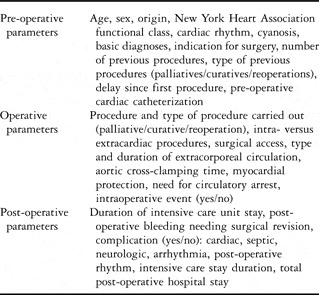
Cardiac rhythm evaluation was performed via an electrocardiogram. A post-operative intensive care unit stay exceeding 48 hours was considered an index of post-operative morbidity. We also sought to identify any link between factors identified pre-, intra-, and post-operatively and intrahospital post-operative mortality or the index of post-operative morbidity. Table 1 presents the factors considered. Data were collected retrospectively on the basis of each individual’s medical chart. A database was created, and all statistical analyses were carried out using STATA 8.0 software.
Main parameters considered.

Results
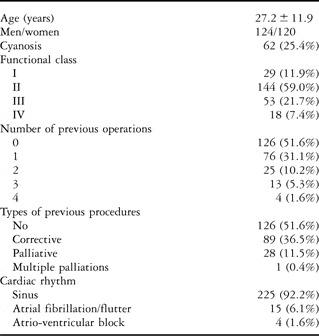
We included 244 consecutive adult patients in need of surgical treatment for congenital cardiac disease in the study. Their countries of origin were Algeria (n = 127), Belgium (n = 113), Tunisia (n = 3), and France (n = 1). Table 2 lists the population characteristics. For one of every two patients in this series, this was the first operation. Most operations were curative (66% of Algerians and 55% of Belgians), and reoperations were 29% and 44%, respectively, for these two groups.
Patient data.

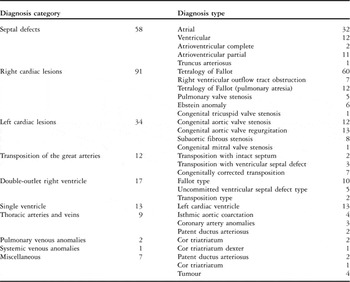
Table 3 lists the main primary cardiac diagnoses. Cardiac catheterisation was necessary to establish surgical indication in 23% of cases, and percentages were related to time (one-third until 2004 and one-tenth after 2004). An abnormal cardiac rhythm was present in 7.7% of patients preoperatively. Three patients benefited from a pre-operative atrial flutter ablation by catheterisation.
Main diagnostic.

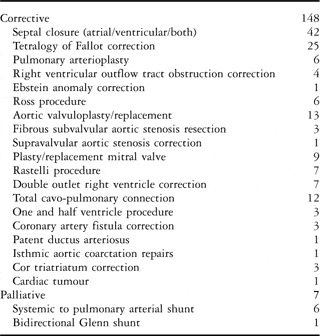
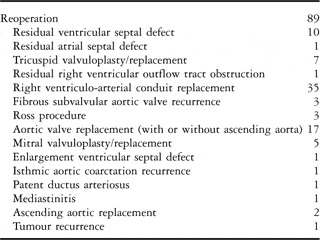
Table 4 lists the surgical indications and curative and palliative operations performed, and Table 5 lists information about the reoperations. Surgery was intracardiac in 232 cases and extracardiac in 12 cases. Three operations were supplemented by surgical ablation of atrial fibrillation. Chest entry was by sternotomy in 232 cases and lateral thoracotomy in 12 cases. Extracorporeal circulation was necessary in 234 cases, of which 35 were femoro-femoral. Surgery was performed under cardioplegic protection in 185 cases, on the beating heart in 53 cases, and with a fibrillating heart in two cases. The mean delay after a previous operation was 17 years.
Main surgical procedures: corrective and palliative.

Main surgical procedures: reoperation.

Intrahospital post-operative mortality was 4.9%. There were six patients who died from low cardiac output, two from arrhythmia, two from intraoperative mishap, one from intraoperative haemorrhage, and one from embolism. The mean duration of intensive care stay was 4 plus or minus 6.9 (standard deviation) days (median = 2). Low cardiac output was observed in 5.4% of cases, a neurologic event in 2.5%, and sepsis in 6.2%.
There were 13% of patients who presented with significant post-operative arrhythmia. The rate of surgical revision for bleeding was 4.5%; three cases of post-operative atrial flutter were treated by percutaneous ablation; one patient benefited from post-operative extra-corporeal membrane oxygenation support, and four patients needed pacemaker implantation for iatrogenic atrio-ventricular block (one present on admission). There were four patients who required immediate surgical revision (other than for bleeding): one fenestration of total cavo-pulmonary connection, one resuture of a dehiscent ventricular septal defect patch, and two revisions of a conduit from the subpulmonary ventricle to the pulmonary artery. All surviving patients were discharged home from the hospital. Cardiac rhythm was sinus in 221 patients, pacemaker stimulated in seven patients, and atrial fibrillation in four patients.
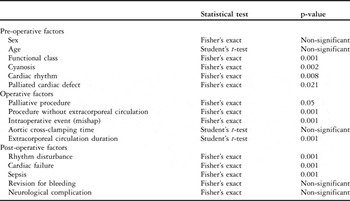
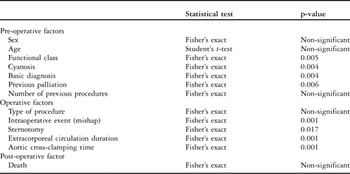
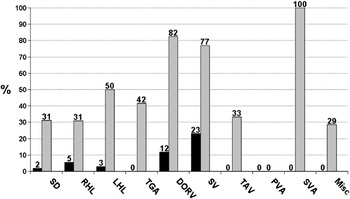
Observed mortality was compared with the risk factors listed in Table 1, and Table 6 gives the significant findings. In addition, the index of post-operative morbidity was compared with the factors listed in Table 1, and Table 7 shows the significant results from this analysis. There were 51 patients who had a prolonged stay in the intensive care unit for treatment of one or more complications). Figure 1 shows the relationship between prolonged intensive care unit stay (more than 48 hours) and observed mortality according to the diagnostic category. Univentricular hearts and double-outlet right ventricles were associated with the highest mortality and morbidity.
Mortality analysis.

Morbidity analysis.

Mortality and morbidity related to the main diagnosis. Results are expressed in percentage. Black column: observed mortality; grey column: morbidity (more than 2 days spent in the intensive care unit). SD: septal defects; RHL: right heart lesions; LHL: left heart lesions; TGA: transposition of the great arteries; DORV: double-outlet right ventricle; SV: single ventricle; TAV: thoracic arteries and veins; PVA: pulmonary venous anomalies; SVA: systemic venous return anomalies; Misc: miscellaneous.

Discussion
The diagnostic means (especially echography in the early 1980sReference Warnes, Liberthson and Danielson1) necessary to reach a diagnosis in congenital cardiac disease have become more accessible over the last three decades. With their availability in poor countries, the trend towards diagnosis of cardiopathies has increased strikingly. In 1985, two-thirds of patients with congenital cardiac disease were children in an industrialised country.Reference Marelli, Mackie, Ionescu-Ittu, Rahme and Pilote5 In subsequent years, the improved management of those patients has led to prolonged survival, increasing the number of adult patients with congenital cardiac disease.Reference Warnes, Liberthson and Danielson1, Reference Marelli, Mackie, Ionescu-Ittu, Rahme and Pilote5 Early this century, this observation concerned only adult patients under the age of 40 but is likely to extend to all adult age categories in the coming decades.Reference Marelli, Mackie, Ionescu-Ittu, Rahme and Pilote5
Our centre has always been oriented towards the management of these patients. Despite the possibility of paediatric cardiac surgeons not being at ease with the size of young adults and their pathology, often valvular and sometimes coronary, adult-focused surgeons can be limited by their lesser experience with the complexity and variety of congenital disease.Reference Karamlou, Diggs, Person, Ungerleider and Welke17 We believe that it is mandatory that a single surgical team offers these young patients expertise both in congenital surgery of the newborn child and in the acquired pathology of the adult. This multidisciplinary management involves cardiologists, surgeons, anaesthesiologists, intensive care therapists, and, more recently, radiologists.Reference Dearani, Connolly, Martinez, Fontanet and Webb10 Radiological advances have rendered the necessary workup of these pathologies less invasive.Reference Warnes, Liberthson and Danielson1 Before 2004, one-third of our patients needed invasive catheterisation for a complete pre-operative workup. Since 2004, with the routine implementation of multi-detector computed tomography (CT) scan and nuclear magnetic resonance, this frequency fell to one-tenth of our patients. Improvements in echocardiography also contributed to this trend.Reference Warnes, Liberthson and Danielson1 From least invasive to most invasive, echocardiography comes first, followed by nuclear magnetic resonance (when injection of the gadolinium contrast medium is necessary) and CT scan, exposing the patients to ionising radiation (plus or minus iodine contrast). In our experience, a CT scan renders better the precision of anatomical structures and their spatial relationship, whereas nuclear magnetic resonance allows evaluation of ventricular volumes, haemodynamic gradients, and regurgitated volumes.
The global mortality in this series was 4.9%, which agrees with the data in the literature.Reference Srinathan, Bonser, Sethia, Thorne, Brawn and Barron3, Reference Immer, Althaus, Berdat, Saner and Carrel13, Reference Stellin, Vida, Padalino and Rizzoli16, Reference Berdat, Immer, Pfammatter and Carrel18–Reference Dore, Glancy, Stone, Menashe and Somerville20 Patients whose main diagnosis was an atrial septal defect carried a different prognosis from the rest of our population. These patients are not symptomatic in childhood and are diagnosed later.Reference Webb9, Reference Stellin, Vida, Padalino and Rizzoli16, Reference Monro21 Of the 32 cases of atrial septal defect in this series, 30 were ostium secundum and two of the sinus venosus type. None of these patients died, and 28 stayed in the intensive care unit less than 48 hours. If the atrial septal defect cases are not included in the calculations, the mortality remains 5.7%, still in agreement with the literature.Reference Vida, Berggren and Brawn19, Reference Jacobs, Lacour-Gayet and Jacobs22–Reference Lacour-Gayet, Clarke and Jacobs24 The mortality of a curative operation performed in our adults did not differ from that of a reoperation. If only a palliative operation is possible, the observed mortality is significantly higher, whatever be the patient’s country of origin, both in this series and in the literature.Reference Stellin, Vida, Padalino and Rizzoli16 The lack of curative possibility reflects an advanced stage of the disease and usually the presence of a complication preventing the restoration of physiological circulation (generally increased pulmonary vascular resistance).
Among the risk factors identified in this study, the New York Heart Association functional class, cyanosis, and presence of arrhythmia have already been reported.Reference Vida, Berggren and Brawn19 A new finding here is the fact that a patient having undergone palliative surgery and reaching adulthood without curative treatment presents with an increased risk of morbidity and mortality. The majority of our patients were in functional class II, with only 7% in class IV. The surgical results are optimal for patients in classes I and II. Our results (and those in the literature) show that patients falling into class III, and more so class IV, have an increased risk of post-operative complications and mortality.Reference Vida, Berggren and Brawn19 In addition, an operation without extracorporeal circulation presents an increased risk for death (within the context of palliative surgery mainly done without extracorporeal circulation).
Almost half of our patients had not had a previous palliation or curative surgery. This common history is related to geographical origin, and economical and cultural constraints have been evoked to explain this phenomenon in emergent countries. However, our population, despite its mixed origins, was surprisingly homogeneous as far as pathologies and indicated surgery are concerned.
The vast majority of our patients were in normal sinus rhythm preoperatively. There were 15 patients (6.1%) in fibrillo-flutter, of whom three with flutter could be sinusalised by catheterisation before the operation. Certain series report an incidence of fibrillo-flutter up to 10%.Reference Walsh and Cecchin25 There were three other patients who had a post-operative catheterisation ablation of an atrial flutter, and still another three who had intraoperative ablation of an atrial fibrillation. The combination of catheterisation to ablate atrial flutter and surgery to suppress atrial fibrillation reduced the rate of persistent cardiac rhythm anomaly to 1.7% at discharge. The incidence of surgically induced atrio-ventricular block remained 2%Reference Walsh and Cecchin25; these cases necessitated the post-operative implantation of a sequential pacemaker. In this multidisciplinary approach, the whole team must be familiar with the management of complex electrophysiological problems.Reference Gatzoulis, Hechter, Siu and Webb8, Reference Dore, Glancy, Stone, Menashe and Somerville20, Reference Walsh and Cecchin25, Reference Williams and Webb26
Except for a few patients leaving the intensive care unit on post-operative day 1, the minimal duration of the intensive care stay was 48 hours. A longer stay was usually related to a post-operative complication, such as cardiac failure, sepsis, arrhythmia, or a neurological event. Among the risk factors for morbidity, we focused on those for mortality and diagnostic category and found that univentricular hearts and double-outlet right ventricles were at increased risk of a prolonged intensive care stay. The rate of revision for bleeding was 5%, despite the associated coagulopathies and abundant neovascularisation (25% of patients were cyanosed preoperatively). As previously described,Reference Vida, Berggren and Brawn19 we also observed an increased post-operative mortality in those cyanotic patients.
Conclusion
The surgical treatment of adults with congenital cardiac disease has evolved during recent decades to reach a low post-operative mortality. These patients, usually young, also present with a low rate of post-operative complications. The reasons for these good results include optimal timing of management and the growing experience of the teams collaborating in the diagnostic workup, surgical treatment, and post-operative care. In particular, recent breakthroughs in medical imaging technologies have allowed more precise diagnoses with less invasiveness. Surgery itself, however, remains more traditionally used in these complex, sometimes multi-operated patients. Interventional cardiology occupies more and more the field of atrial septal defect (secundum), certain ventricular septal defects, and the anticipated widening and valvation of the right ventricle to pulmonary artery conduits.Reference Rey27 Mini-invasive surgery addresses only the simplest cases (such as atrial septal defect secundum).
Acknowledgements
This study was supported by the Belgian Fund for Cardiac Surgery. We are indebted to Maria Franco, our database manager, for reviewing the statistics.