I. INTRODUCTION
Recently, electromagnetic (EM) waves have been used in various industrial applications, such as satellite broadcasting, local area network (LAN) systems, and mobile phones, so that the demand for the utilization of GHz range EM waves has drastically increased. However, electromagnetic interference (EMI) problems as well as the baneful influences on human bodies have been widely criticized,Reference Meng, Zhao, Xu, Zhan, Lei, Zhong and Liu1–Reference Ohkoshi, Kuroki, Sakurai, Matsumoto, Sato and Sasaki4 and microwave absorption materials have been used to attenuate those unwanted EM energies. Therefore, considerable attention has been devoted to the development of effective EM wave absorption materials that are cost-efficient, lightweight, and effective over a broad frequency range.Reference Chen, Gao, Wang, Zhu, Wang, Cao and Jin5–Reference Namai, Sakurai, Nakajima, Suemoto, Matsumoto, Goto, Sasaki and Ohkoshi8 EM wave absorption capability depends on the nature, shape, and size of an absorber.Reference Zhang, Dong, Huang, Liu, Wang, Zhu, Lv, Lei and Lee2,Reference Lee and Chen3 According to the EM energy conversion principle, the relative complex permittivity, relative complex permeability, and proper matching between the complex permittivity and permeability determine the reflection and attenuation characteristics of EM absorbers. Phthalocyanines (Pc) are a class of organic molecules with a macrocyclic core and different substituents.Reference Higuchi, Murayama, Itoh and Miyairi9 Pthalocyanines and their derivatives have attracted much interest in field-effect transistors,Reference Yasuda and Tsutsui10,Reference Schlebusch, Morenzin, Kessler and Eberhardt11 xerography,Reference Tang, Li, Song, Liu, Li, Xu, Liu, Hu and Zhu12 photoswitches,Reference Cao, Tu, Wang, Tian, Wang, Gu and Gan13 laser recording materials,Reference Yum, Jang, Baker, Grätzel, Cid, Torres and Nazeeruddin14 photovoltaic cell,Reference Troshin, Koeppe, Peregudov, Peregudova, Egginger, Lyubovskaya and Sariciftci15,Reference Agboola and Ozoemena16 and electrochemical sensors.Reference Bedioui, Griveau, Nyokong, Appleby, Caro, Gulppi, Ochoa and Zagal17,Reference Wang, Zhuang, Peng and Li18 Up to now, with the development of nanoscience and nanotechnology, considerable attention has been focused on nanosized metal phthalocyanines (MPcs) owing to their excellent optoelectronic and electronic properties.Reference Gao, Cheng, Zhou, Li, Xu, Du and Zhang19 For instance, phthalocyanines are extensively used in self-assembling processes to prepare monolayer and thin films,Reference Gao, Cheng, Zhou, Li, Xu, Du and Zhang19 organic vapor-phase deposition to prepare one-dimensional structure of MPcs,Reference Guo, Yoshimoto and Itaya20 electrochemical methods to prepare a two-dimensional self-organization of MPcs based on Au templates,Reference Wu, Wang, Lu, Bian, Jiang and Zhang21 and the solvent diffusion method to prepare MPc nanofibers and micro-tubes.Reference Zhao, Jia, Wei, Pu and Liu22 However, suffering from disadvantages of rigid equipments, the high temperature, special template, and limited amounts of single crystals, the further applications of MPc are greatly minimized. Other conventional methods such as reprecipitation are not suitable for the Pcs because of their poor solubility in normal organic solvents. On the other hand, as a direct, mild, and simple method, the hydrothermal technique, which has been considered as one of the promising new routes due to its low growth temperature, potential for scaled-up fabrication, and many parameters that allow control of the final size and morphology of the materials, was widely used in the preparation of inorganic frameworksReference Meng, Zhao, Zhan, Lei, Zhong and Liu23 and the synthesis of inorganic–organic hybrid materials.Reference Meng, Zhao, Zhan, Lei, Zhong and Liu24 Inspired by the hydrothermal synthesis, we have developed ethylene glycol solvothermal synthetic route to obtain hyperbranched CuPc nanomaterials.
To the best of our knowledge, there are no reports on the synthesis of highly dispersed spherical hyperbranched CuPc aggregates. Herein, we firstly reported the synthesis of highly dispersed spherical CuPc aggregates with a diameter of ∼500 nm and showed excellent broadband microwave absorption properties in the frequency of 2–18 GHz. Over an absorber of 5 mm thickness, an absorption bandwidth of 12 GHz corresponding to reflection loss (RL) below −10 dB can be obtained. And high value of microwave reflection about −50 dB at the frequency of 16.5 GHz also suggested that the hyperbranched spherical CuPc can be used as promising microwave absorbing materials. We also compared the microwave properties of the two kinds of hyperbranched CuPc obtained from different synthesis routes to prove the construction of micro- and nanostructures with a well-defined shape and size plays a key role in improving properties of electronic and optoelectronic functional materials.
II. EXPERIMENTAL
A. Materials
1,2-dihydroxybenzene, 4-nitrophthalonitrile, potassium carbonate, dimethyl sulfoxide (DMSO), copper (I) chloride, and ethylene glycol (EG) were all regent grade and were used as received unless otherwise stated.
B. Preparation of monomer 1,2-bis(3,4-dicyanophenoxy)benzene
The monomer 1,2-bis(3,4-dicyanophenoxy)benzene was synthesized according to the Ref. Reference Wei, Zhao, Zhan, Meng, Yang, Xu and Liu25 with minor modification. To a flask, 22 g of 1,2-dihydroxybenzene and 72 g of 4-nitrophthalonitrile were dissolved in 500 mL of DMSO. Then 120 g of K2CO3 was added into the flask and stirred at room temperature for 48 h. Then the reaction mixture was poured into the water. The crude product was collected by filtration, washed with water, and dried in air. The pure product was obtained by recrystallization using methanol. The white-yellow powdery product was dried at 80 °C overnight, affording 1,2-bis(3,4-dicyanophenoxy)benzene.
C. Preparation of the spherical hyperbranched copper phthalocyanine (CuPc)
In a typical preparation, under vigorous stirring, 4.24 g of 1,2-bis(3,4-dicyanophenoxy)benzene and 0.36 g of CuCl were added into 200 mL of EG; the mixture looked white-yellow and turbid; then the mixture was heated to 160 °C within 1 h; the mixture became clear and the color changed from white-yellow to green, which showed that 1,2-bis(3,4-dicyanophenoxy) benzene reacted with the CuCl; then, it was sealed in a Teflon-lined stainless-steel autoclave and maintained at 160 °C for 24 h; the green mixture was cooled to room temperature quickly. The obtained dark green precipitates were washed with distilled water and ethanol separately, and then dried at 60 °C overnight. The pure product was obtained by recrystallization using methanol and named SHCuPc. Normal hyperbranched CuPc were also prepared according to Ref. Reference Guo, Yan, Kwon, Hayakawa, Kakimoto and Goodson26, and the product was named HCuPc.
D. Characterization
UV-vis spectroscopy was recorded on a Shimadzu UV-2450 spectrophotometer. Fourier transform infrared (FTIR) spectra were recorded with a Shimadzu FTIR8400S FTIR spectrometer using KBr pellets between 4000 and 400 cm−1 in air. Differential scanning calorimetric (DSC) analysis was performed by TA Instruments Modulated DSC-Q100 at a heating rate of 10 °C/min and a nitrogen flow rate of 50 mL/min. For the scanning electron microscope (SEM), the JEM 7600F system has been used. X-ray diffraction (XRD) was recorded on Rigaku RINT 2400 with Cu Kα radiation. The sample used for EM measurements were prepared by homogeneously mixing with wax in a mass ratio of 3:1. The complex permeability μ (μ′ = μ − jμ″) and permittivity ε (ε = ε′ − jε″) were measured using a vector network analyzer (Agilent 8720 ET) at 1.0–18 GHz.
III. RESULTS AND DISCUSSION
A. UV-vis absorption spectrum
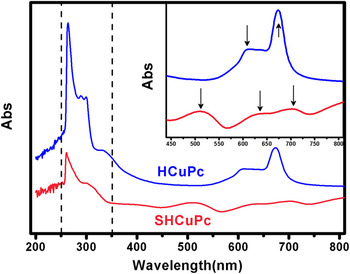
Typical UV-vis spectra of phthalocyanine feature two distinct absorption bands, namely Q-band and B-band. The Q-band corresponds to the π–π* transition of the monomer from the HOMO to the LUMO of the Pc 2-ring.Reference Snow and Jarvis27 The B-band belongs to the typical adsorption of MPc arising from the deeper levels to LUMO transition.Reference Chen, Zhong, Zhang, Li, Niu, Bin and Zhang28 As expected, aggregation is a common phenomenon for phthalocyanine compounds, which can be reflected from the shapes of their Q bands: monomer absorption (∼665 nm) and aggregate absorption (∼625 nm).Reference Zhan, Yang, Meng, Wei, Zhao and Liu29–Reference Luo, Gao, Cheng, Sun, Du, Xu and Wang32 Here, the aggregations tendency of the SHCuPc and normal HCuPc were significantly different from their synthesis method (Fig. 1). The dilute solution of the normal HCuPc showed a strong sharp peak at 650–700 nm, which was attributed to the copper Pc moiety; the shoulder peak appeared around 600–650 nm implied lower aggregate tendency. For the SHCuPc from the solvothermal synthetic route, the Q-band broadened and blue-shifted, and a new broad peak appeared at 500–550 nm, which aroused from interface aggregation of the Pc. The soret band at 250–350 nm corresponds to a metal-to-ligand charge transfer transition and is unaffected by aggregates, the shape of the split soret band of the SHCuPc showed less sharper and more broader compared with the normal HCuPc, indicating that highly ordered stacking form into spherical morphology happened during the solvothermal process.
UV-vis absorption spectrum of the synthesized SHCuPc and HCuPc in DMAc. (The concentration of the SHCuPc and HCuPc in DMAc was both 5 mg/L.)

B. FTIR spectrum
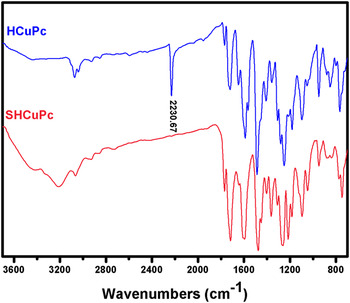
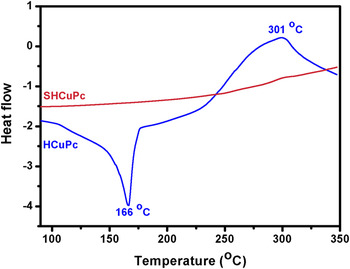
The FTIR spectrum of the SHCuPc was shown in Fig. 2, with absorption peaks at 1595, 1363, 1183, 948, 877, and 747 cm−1, which were assigned to the phthalocyanine skeletal vibration. Absorption peaks observed around 1476, 1095, and 675 cm−1 were assigned to the aromatic phenyl ring, C–N stretch vibrations, C–H in-plane bending vibrations, and C–H out-of-plane bending vibrations, respectively. No peak at 2230 cm−1 was observed.Reference Gao, Cheng, Zhou, Li, Xu, Du and Zhang19 But for the IR spectrum of the HCuPc, the characteristic absorption at 2230 cm−1 associating with the typical stretch vibrations of the C≡N in 1,2-bis(3,4-dicyanophenoxy)benzene showed that the reaction between the monomer and CuCl was not complete. This is also proved by the thermal analysis. From the DSC curves (Fig. 3), no obvious melt point appeared in the curve of the SHCuPc, otherwise, for the DSC curve of HCuPc, a melt point at 166 °C gave the evidence of 1,2-bis(3,4-dicyanophenoxy)benzene still existing, the other obvious exothermic peak at 301 °C, which was caused by the thermal cross-linking reaction of phthalonitrile, also confirmed the unreacted 1,2-bis(3,4-dicyanophenoxy)benzene. So from the FTIR and DSC data, it could reveal that, under certain temperature and pressure, the CN function group on the monomer 1,2-bis(3,4-dicyanophenoxy)benzene could react with CuCl more efficiently and completely via the ethylene glycol solvothermal synthetic route.
FTIR spectrum of SHCuPc and HCuPc.

DSC curves of the SHCuPc and HCuPc.

C. Morphology and structure of the hyperbranched CuPc microspheres
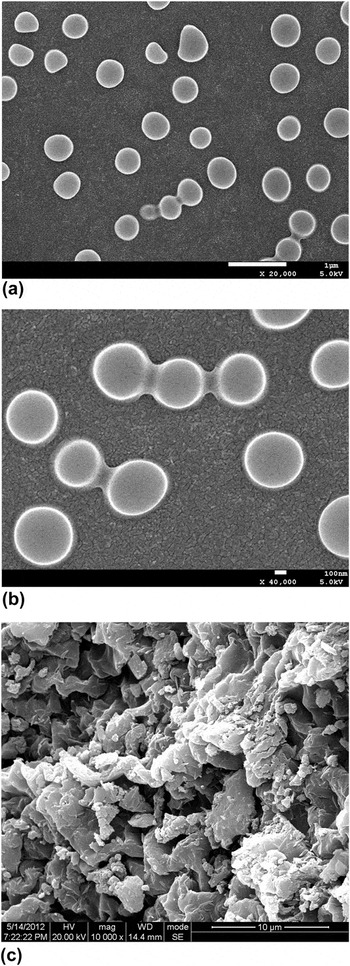
The morphologies of the as-synthesized hyperbranched CuPc microspheres under solvothermal treatment at 160 °C for 24 h were examined by SEM. Figure 4(a) was a low-magnification SEM image of the as-prepared product, from which numerous uniformly sized spheres with an average diameter of 500 nm could be clearly observed. These spheres were highly dispersed; moreover, no other morphologies could be detected, indicating a high yield of the product with the spherical morphology. The high-magnification SEM images of the individual spheres were also shown in Fig. 4(b), and little adhesion between the spheres was observed. This adhesion might happen during the cooperation of oriented aggregation and Ostwald ripening. Although oriented aggregation and Ostwald ripening were usually considered as two independent and competitive mechanisms, in this work, we assumed that the phthalocyanine macrocycle was rigid, the placement of rigid H-bonding moieties and their relative orientation allowed the design of a variety of specific architectures. Intramolecular H-bonding of the backbone helped to pre-organize the H-type aggregates in the macromolecules, and the H-bonding between the solvent EG and phthalocyanine helped to produce the spherical morphology. For the sample HCuPc, from Ref. Reference Guo, Yan, Kwon, Hayakawa, Kakimoto and Goodson26, without the solvothermal treatment, amorphous morphology shown in Fig. 4(c), the different morphologies of the SHCuPc and HCuPc lead to the different EM properties and discussed later.
(a) Low-magnification SEM image of the SHCuPC. (b) High-magnification SEM image of the SHCuPc. (c) Low-magnification SEM image of the HCuPC.

D. XRD analysis
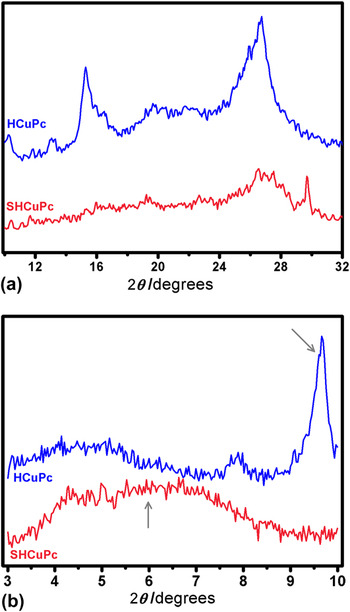
It is well-known that CuPc molecules have a planar structure and stack easily to form molecular columns. The internal structures of self-organized SHCuPc and HCuPc were further investigated by the XRD technique. As can be seen from Fig. 5, for the normal HCuPc, a diffraction peak at 2θ = 9.5° was obtained and its d spacing was d = 0.923 nm, which corresponds to the β (001) plane,Reference Fox, Katz, Elshocht, Verbiest, Kauranen, Persoons, Thongpanchang, Krauss and Brus33,Reference Debe and Kan34 indicating that the b-axis of the CuPc molecules stacking structures. On the other hand, the diffraction peaks at 15.34 and 27.16 were also obtained. Their d spacings were d = 0.6669 and 0.4510, respectively. This indicates that the b-axis of the CuPc molecules was stacked in one-dimensional columnar aggregates. Compared with the HCuPc, SHCuPc showed an amorphous crystal structure, a highly dispersed peak at 2θ = 6.5° was obtained, and other diffraction peaks at 19.239, 26.538, 26.867, and 29.698 were obtained. Their d spacings were d = 0.6669, 0.5794, 0.4510, and 0.3331, respectively. It is understandable that van der Waals forces dominate the interaction between the molecules themselves. To minimize the intra-layer van der Waals potential, the CuPc molecules favor a close-packed configuration in the horizontal direction.Reference Guo, Yoshimoto and Itaya20,Reference Zhao, Jia, Wei, Pu and Liu22 At the same time, the face-to-face stacking of the molecules leads to the formation of molecular columns and the unaltered molecular orientation parallel to special morphology during growth.
(a) XRD patterns of the SHCuPc and HCuPc and (b) small angle XRD patterns of the SHCuPc and HCuPc.

E. Microwave EM and microwave absorbing properties
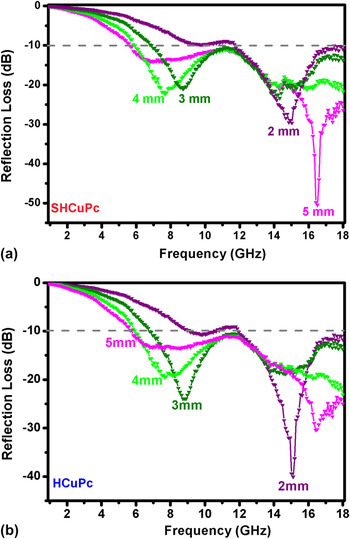
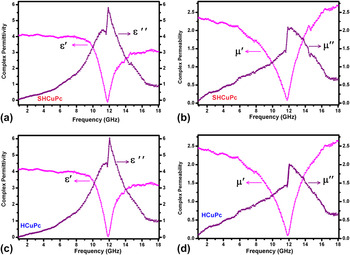
The microwave EM properties and microwave absorption behavior of SHCuPc/paraffin composites and HCuPc/paraffin composites were investigated in a frequency range of 2–18 GHz (Figs. 6 and 7). As can be seen from the EM data, two kinds of the CuPc from different synthetic methods gave similar peak forms not only for permittivity but also for permeability. Figure 7 shows the real part (ε′) and imaginary part (ε″) of the relative complex permittivity of the SHCuPc and HCuPc wax composites, where the ε′ values of the two samples retained an approximate constant of about 4.0 over 1–10 GHz and exhibited an abrupt decrease point at 12 GHz. Interestingly, the ε″ values of the two samples also achieved the max values at the frequency of 12 GHz. As the real and imaginary parts of the relative complex permittivity represent the energy storage ability and loss ability, respectively, ε′ and ε″ of both SHCuPc and HCuPc showed a sharp fluctuation throughout the whole frequency range, indicating that the two kinds of copper phthalocyanine possessed good dielectric loss. As for the permeability properties of two kinds of the copper phthalocyanine, the real part μ′ values of the samples exhibited an abrupt decrease from 2.5 to 0.0 at the frequency of 12 GHz, at the same time, the imaginary part μ″ values achieved the max values about 2.0. Figure 6 revealed that both ε′ and μ′ of two kinds of the samples exhibited frequency dispersion effect, which means dielectric loss and magnetic loss occurred simultaneously for the two samples, in favor of the EM wave absorption. It is interesting to find that broad peaks centered at 12 GHz are present in two samples in Fig. 6, indicating the occurrence of natural resonance in the prepared copper phthalocyanine from two synthetic methods.
(a) RL of SHCuPc/wax composites and (b) HCuPc/wax composites in the frequency range of 1–18 GHz.

(a) Permittivity spectra of the SHCuPc/wax composites; (b) permeability spectra of SHCuPc/wax composites; (c) permittivity spectra of the HCuPc/wax composites; (d) permeability spectra of SHCuPc/wax composites in the frequency range of 1–18 GHz.

According to the measured data of permittivity and permeability, the RL usually can be evaluated by the following equation:
 $${\rm{RL}} = 20\log |(Z_{{\rm{in}}} - Z_0 )/(Z_{{\rm{in}}} + Z_0 )\quad ,$$
where Z 0 is the impedance of free space and Z in is the input characteristic impedance, which can be expressed as
 $$Z_{{\rm{in}}} = Z_0 \sqrt {({\rm{\mu }}_r /{\rm{\varepsilon }}_r )} \tanh \left\{ {(2{\rm{\pi }}ft/c)\sqrt {{\rm{\mu }}_r } {\rm{\varepsilon }}_r } \right\}\quad ,$$
where c is the velocity of light and t is the thickness of an absorber. In this letter, the t values are in millimeter units. μr and εr are the measured relative complex permeability and permittivity, respectively. For microwave absorbing application 33, when the RL is less than −20 dB, we can say that Z in and Z 0 are matched. When the impedances are matched, the frequency and the absorber thickness are termed as “matching frequency” (f m) and “matching thickness” (t m), respectively. It can be seen that the two samples exhibited good ability of microwave absorption. For SHCuPc sample, with a matching thickness t m = 5 mm, the maximum RL Rmax is approximately −50 dB at 16.5 GHz. At t m = 5 mm, the bandwidth corresponding to RL below −10 dB (i.e., over 90% microwave absorption) is higher than 12 GHz. Otherwise, for HCuPc sample, with a matching thickness t m = 2 mm, the maximum RL Rmax is approximately −40 dB at 14.9 GHz. At t m = 2 mm, the bandwidth corresponding to RL below −10 dB is about 9 GHz. Both kinds of copper phthalocyanine showed excellent wideband microwave absorption properties, but the matching frequency and matching thickness are different; we assumed this difference to the morphology and aggregation properties of the samples.
Beside the dielectric loss or the magnetic loss, the EM wave can be absorbed via a so-called “geometrical effect,” which means that when the thickness of the absorber (t) satisfies the equation t = nλm/4 (n = 1, 3, 5…), the incident and reflected waves in the absorber are out of phase 180°. As a result, the reflected waves in the air-absorber interface are totally canceled. In the above equation, λm = λo/(|μr||εr|)1/2 is the wave length in the absorber at some specific frequency, |μr| and |εr| are the moduli of μr and εr, respectively, and λo is the wave length in the free space (λo = c/f). Such a geometrical effect has also been reported by Yusoff et al.Reference Lippel, Wilson, Miller, Wöll and Chiang35,Reference Yusoff, Abdullah, Ahmad, Jusoh, Mansor and Hamid36 According to the EM wave theory, when an EM wave is incident on an absorber, Z 1 should be equal to Z 0 for zero reflection, where Z 1 is the impedance in the absorber and Z 0 is the impedance of free space. Z has a general expression as (i = 0 and 1 for the free space and the absorber, respectively). In the free space, both the relative permeability μr0 and the relative permittivity εr0 are equal to 1. Therefore, for zero reflection, the relative permeability and relative permittivity in the absorber should satisfy the relationship μr1 = εr1. However, for copper phthalocyanine obtained from the two synthetic methods, the permittivity is much larger than the permeability. The impedance matching condition μr1 = εr1 cannot be satisfied. Therefore, we think that the observed microwave absorbing performance is not only from dielectric loss and magnetic loss but also from geometrical effect.Reference Ma, Cao, Liu and Wang37 For the normal HCuPc, at f m = 14.94 GHz, the εr1 = 3.298 − j2.336 and μr1 = 1.218 − j0.708, substituting these values into the equation t = λm/4, we obtain t = 2.1 mm, which is exactly equal to the matching thickness t m found based on Fig. 7. So the above calculations justify our hypothesis that the excellent microwave absorbing properties observed at f = 14.94 GHz is due to the geometric effect. Considering that HCuPc are uniformly distributed in the composites as the absorbent, there are more chances to satisfy this equation. But for the SHCuPc, at f m = 16.42 GHz, εr1 = 3.08 − j1.058 and μr1 = 2.571 − j0.772, substituting these values into the equation t = λm/4, we obtain t = 1.5 mm, however, for the SHCuPc, the impedance matching condition (μr1 = εr1) cannot be satisfied. Therefore, the RL showed in Fig. 6 might be attributed to the synergistic effects derived from the interaction between the natural resonance and special spherical morphology. Compared to the EM properties of the copper phthalocyanine from two synthetic methods, we believe that the EM property would be significantly influenced by the detailed morphology of the prepared samples.
IV. CONCLUSIONS
In summary, we first obtained the adjacent-type hyperbranched copper phthalocyanine (CuPc) with uniform spherical morphology by the ethylene glycol solvothermal synthetic route. The highly dispersed spherical CuPc aggregates with a diameter of ∼500 nm. Due to its good symmetrical structure and unique morphology, the hyperbranched spherical CuPc showed excellent broadband microwave absorption behaviors in the frequency of 2–18 GHz. Over an absorber of 5 mm thickness, an absorption bandwidth of 12 GHz corresponding to RL below −10 dB can be obtained. The high value of microwave reflection about −50 dB at the frequency of 16.5 GHz also suggested that the spherical microstructure is important in enhancing microwave absorbing ability and widening its application in industry, commerce, and military affairs.
ACKNOWLEDGMENTS
This work was financially supported by the Fundamental Research Funds for the Central Universities (Grant No. 103.1.2.E022050205), Major Science and Technology Project in Sichuan Province (Grant No. 2010 FZ 0117), "863″ National Major Program of High Technology of China (Grant No. 2012AA03A212), and National Natural Science Foundation (Grant No. 51173021).