Introduction
Hookworm is one of the most common parasitic nematodes, known to infect a wide range of host species (Bowman et al., Reference Bowman, Hendrix, Lindsay and Barr2002). Among common hookworms, Ancylostoma caninum and A. tubaeforme are species-specific for dogs and cats, respectively, while A. braziliense, A. ceylanicum and Uncinaria stenocephala affect both (Prociv, Reference Prociv, Palmer, Soulsby and Simpson1998; Anderson, Reference Anderson2000). The most serious effect of hookworm infection is blood loss leading to anaemia, in addition to protein loss, especially in puppies (Georgi & Georgi, Reference Georgi, Georgi, Georgi and Georgi1989; Traub et al., Reference Traub, Inpankaew, Sutthikornchai, Sukthana and Thompson2008). However, most canine hookworm species may also infect humans and cause zoonotic diseases (Landmann & Prociv, Reference Landmann and Prociv2003). Ancylostoma caninum has been associated with eosinophilic enteritis (EE) and suggested as a possible cause of diffuse unilateral subacute neuroretinitis in humans (Bowman et al., Reference Bowman, Montgomery, Zajac, Eberhard and Kazacos2010), A. ceylanicum can infect humans in both natural and experimental situations and produce patent infections, while A. braziliense is the most frequently implicated aetiological agent in human cutaneous larva migrans (CLM) (Chaudhry & Longworth, Reference Chaudhry and Longworth1989; Malgor et al., Reference Malgor, Oku, Gallardo and Yarzábal1996; Traub et al., Reference Traub, Inpankaew, Sutthikornchai, Sukthana and Thompson2008). Recently, epidemiological and genetic data have supported the transmission of A. ceylanicum among human and domestic animals such as dogs (Ngui et al., Reference Ngui, Lim, Traub, Mahmud and Mistam2012), and an outbreak of 150 EE cases was reported between 1988 and 1992 in Australia (Loukas et al., Reference Loukas, Croese, Opdebeeck and Prociv1992; Croese et al., Reference Croese, Loukas, Opdebeeck and Prociv1994; Landmann & Prociv, Reference Landmann and Prociv2003). Consequently, since hookworm infection is considered to be a great public health problem and produces serious disease in humans, it is very important to figure out hookworm infection in dogs.
Despite the global importance of canine hookworms, epidemiological reports in mainland China are still limited, especially as A. ceylanicum was first reported in 1965 (Zhuang & Jin, Reference Zhuang and Jin1982). Hookworms were widely reported in other Asian countries, such as India, Thailand, Malaysia, Borneo, Indonesia (Bowman et al., Reference Bowman, Montgomery, Zajac, Eberhard and Kazacos2010), while the latest case of A. ceylanicum infection in humans was reported in Taiwan (Hsu & Lin, Reference Hsu and Lin2012) and not far from Guangzhou city. Thus, this study aimed to investigate the prevalence and molecular characterization of hookworm species in stray and shelter dogs in Guangzhou city.
Materials and methods
Collection and examination of faecal samples
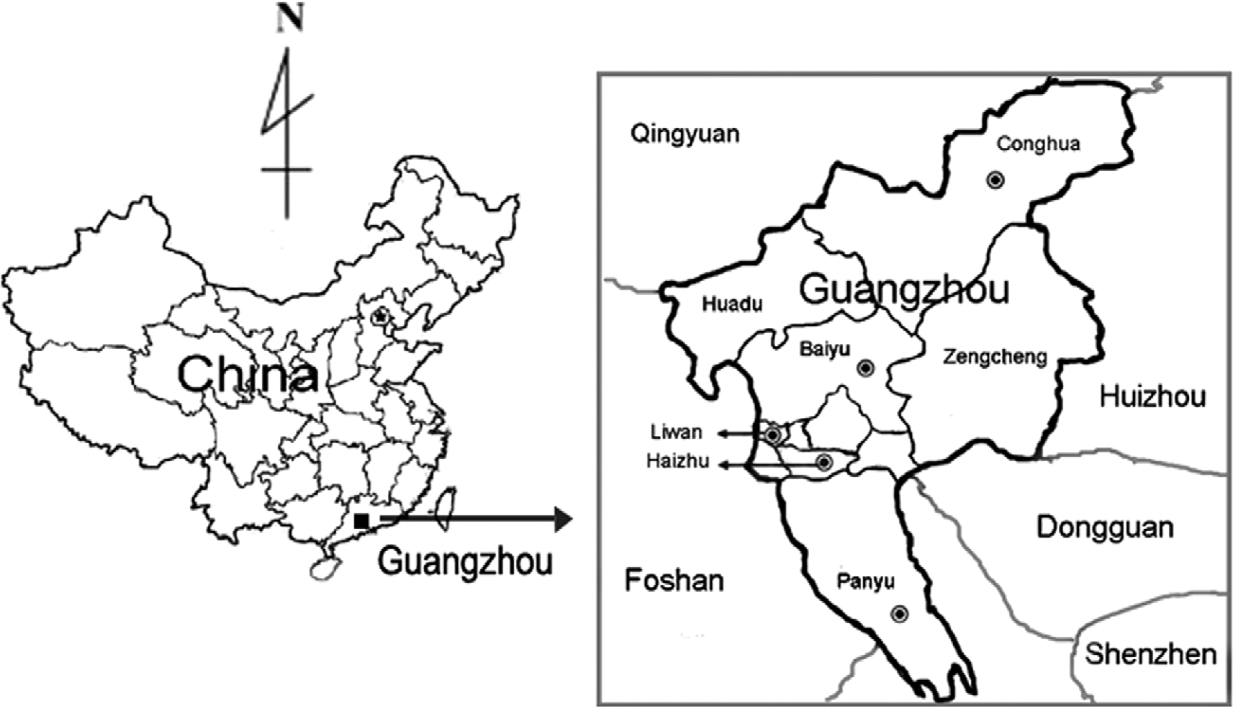
This study was conducted from March 2011 to July 2012 in Guangzhou city, southern China, which is located in the central part of Guangdong Province (22°45′–23°05′N; 113°14′–113°34′E). Guangzhou city covers an area of about 8000 km2 divided into ten geographical districts with an estimated population of approximately 12 million. This city contains a large number of stray and sheltered dogs, in five humane shelters (fig. 1). Shelters have different management conditions, but all shelters were cleaned twice daily and thus faecal samples were collected within 12 h of defecation. Stray dogs were captured and observed for 4–7 days before being housed in the nearest humane shelter. However, the early history of these dogs was unknown, except for geographical region, breed and gender.
The location of the five humane shelters in Guangzhou city, South China.

A total of 254 dogs (135 stray dogs and 119 real shelter dogs) were captured in five humane shelters, including Conghua (106), Baiyun (58), Liwan (40), Haizhu (28) and Panyu (22). Fresh faecal samples from each dog were transported back to the Parasitology and Parasitic Diseases Laboratory, College of Veterinary Medicine, South China Agricultural University (SCAU) on the same day of collection, preserved in 2.5% potassium dichromate and kept at 4°C for microscopic examination. Data on geographical region, dog breed and gender were recorded and written clearly on sample bags.
Faecal samples were processed and examined for the presence of the hookworm eggs. Microscopic examination of stool samples was undertaken using saturated sodium chloride and glucose flotation as described previously (Henriksen & Christensen, Reference Henriksen and Christensen1992). Positive faecal samples were further characterized by molecular procedures.
Molecular analysis
DNA was extracted directly from faecal samples using a commercial DNA extraction kit (QIAamp DNA Stool Mini Kit, QIAgen, Hilden, Germany) according to the manufacturer's instructions. However, samples were pretreated with five cycles of heating at 100°C for 5 min, immediately followed by freezing at − 80°C for 5 min. A negative control (water) was used in each extraction group. DNAs were then stored at − 20°C.
Internal transcribed spacer (ITS) sequences of A. caninum (AM850106, DQ438071, EU159416), A. braziliense (DQ359149, DQ438056, JQ812692), A. ceylanicum (DQ381541, DQ780009, DQ831519) and U. stenocephala (AF194145, HQ262053, HQ262054) were aligned by Clustal X (Thompson et al., Reference Thompson, Gibson, Plewniak, Jeanmougin and Higgins1997). A pair of primers – AF (5′-CTTTGTCGGGAAGGTTGG-3′) and AR (5′-TTCACCACTCTAAGCGTCT-3′) – were designed from the conserved region of ITS sequences of four different hookworms by Primer Premier 5.0 to amplify the 404 bp region of A. caninum, the 408 bp region of A. braziliense, the 404 bp region of A. ceylanicum and the 406 bp region of U. stenocephala, which contain ITS1 and 5.8S rRNA sequences. The specificity of the primers was confirmed by polymerase chain reaction (PCR) using chromosomal DNA extracted from Toxocara canis, Giardia lambia, Cryptosporidium canis, Isospora canis and Dipylidium caninum.
Each test batch contained a positive control and negative control (water). Positive-control DNA was extracted from A. caninum or A. ceylanicum preserved in our laboratory. Each PCR was performed in 25 μl containing 2 μl of the DNA sample, 0.2 μl of Taq polymerase (TaKaRa, Dalian, China), 2.5 μl of 10 × Taq buffer (TaKaRa), 2 μl of deoxynucleoside triphosphate (dNTP, TaKaRa) mixture, 0.5 μl of each primer (AF/AR, 50 mm) and 17.3 μl of distilled water. PCR cycling parameters were as follows: 1 cycle of 96°C for 5 min; followed by 35 cycles of 96°C for 30 s, 60°C for 30 s and 72°C for 50 s; and 1 cycle of 72°C for 7 min.
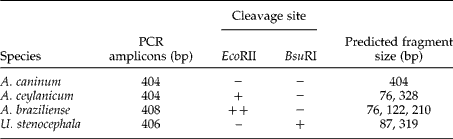
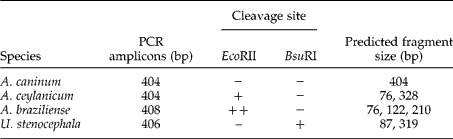
Restriction fragment length polymorphism (RFLP) analysis was performed by digesting 7 μl of PCR product with 2 units of EcoRII (TaKaRa) in a total volume of 20 μl for 3 h at 37°C to distinguish between A. ceylanicum and A. braziliense, and with 2 units of BsuRI (TaKaRa) under the same conditions to distinguish between U. stenocephala and other hookworms. The theoretical cutting patterns of four different hookworm fragments treated by the two restriction enzymes are shown in table 1. PCR products and restriction fragments were analysed after electrophoresis in 2% and 3% agarose gels, stained with 0.2 μg/ml of ethidium bromide and visualized on a UV transilluminator.
Predictive restriction loci in Ancylostoma caninum, A. ceylanicum, A. braziliense and Uncinaria stenocephala by endonuclease EcoRII and BsuRI at ITS1 and 5.8S loci; + indicates one digestive site and ++ two sites.
Positive amplicoms were purified and sent to Beijing Augct Co., Ltd. for sequencing using the ABI 3730 automated DNA sequencer (BigDye Terminator Chemistry, Oyster Bay, New York, USA). Nucleotide sequences were deposited in the GenBank database under accession numbers JX840456–JX840463. Obtained sequences were aligned with 25 ITS reference sequences using Clustal X programs (Thompson et al., Reference Thompson, Gibson, Plewniak, Jeanmougin and Higgins1997). A phylogenetic tree was constructed using MEGA version 5.1 (Molecular Evolutionary Genetics Analysis software, Arizona State University, Tempe, Arizona, USA). Bootstrap analyses were conducted using 1000 replicates to assess the reliability of inferred tree topologies. Neighbour-joining algorithms were conducted using the Kimura 2 parameter distance analysis.
Data analysis
Data were analysed using SPSS programmed for Windows version 11.5 (SPSS Inc., Chicago, Illinois, USA). The chi-square test was used to investigate the association between variables with significant differences expressed as P < 0.05.
Results
Up to 75 of 254 (29.53%) faecal samples were positive for hookworm infection. Dogs from the suburban area of Conghua had a higher prevalence of 45.28% than dogs from each urban area (Baiyun, 18.97%; Liwan, 15%; Haizhu, 21.43%; and Panyu, 18.18%) (P < 0.01). The prevalence of hookworm infection was significantly higher in stray dogs (Conghua, 63.79%; Baiyun, 24.24%; Liwan, 22.22%; Haizhu, 25.00%; and Panyu, 30.00%) than that in shelter dogs (Conghua, 22.92; Baiyun, 12.00%; Liwan, 9.09%; Haizhu, 16.67%; and Panyu, 8.33%) (P < 0.01).
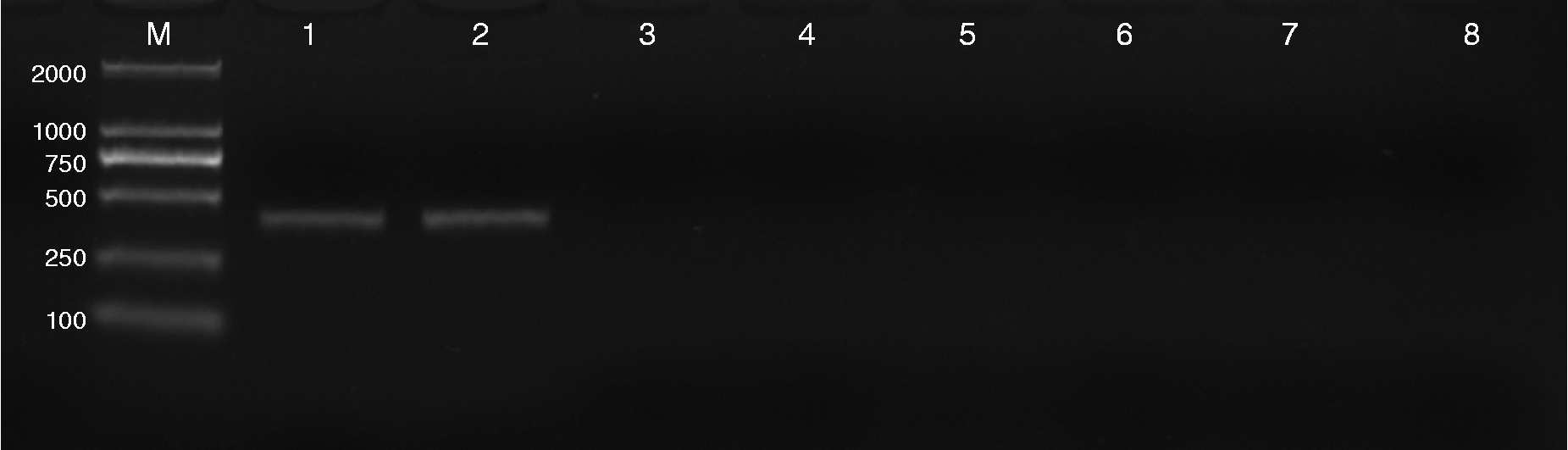
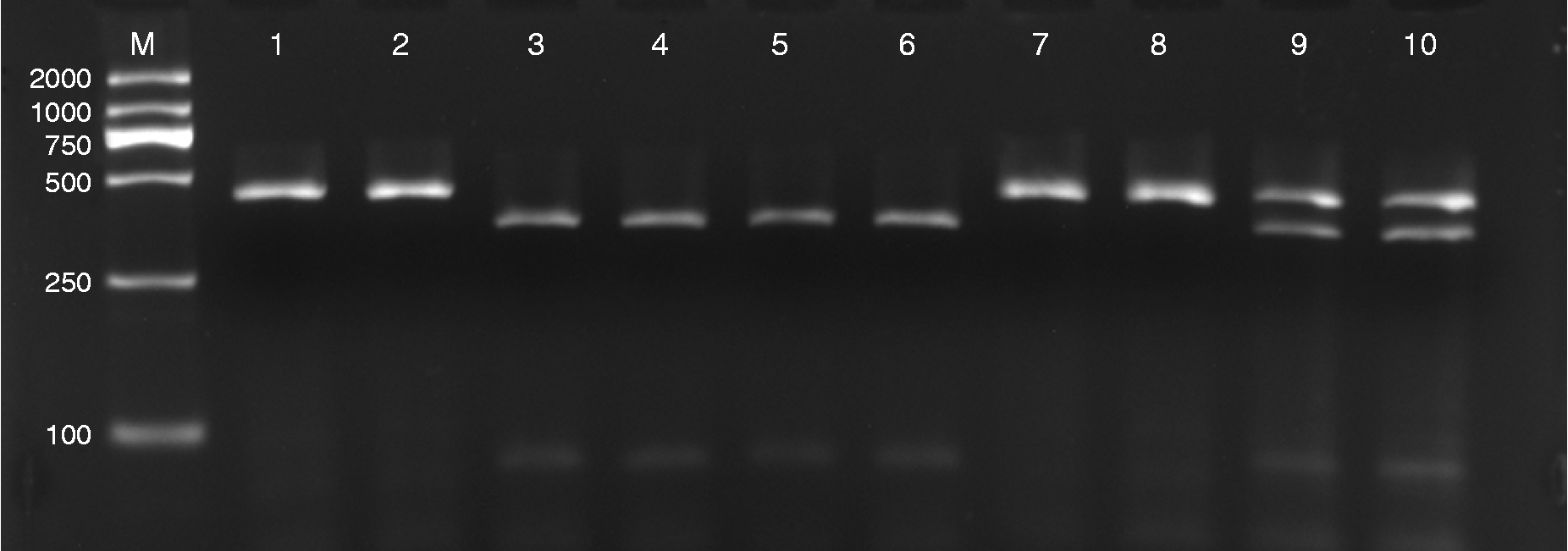
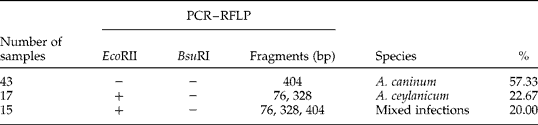
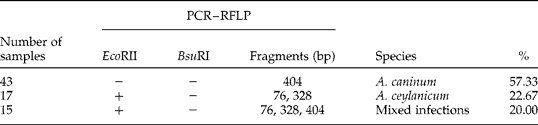
The AF and AR primers were able to detect specifically A. caninum and A. ceylanicum, providing PCR products with the expected size of 404 bp (fig. 2). No amplification was obtained for all the other species tested. Seventy-five microscopically positive samples were amplified successfully by PCR and all amplification products were digested with EcoRII and BsuRI. Up to 32 amplification products were digested successfully by EcoRII in the PCR-RFLP pattern (fig. 3); no amplicon was digested by BsuRI. The PCR-RFLP analysis showed that 43 microscopically positive samples belonged to A. caninum, 17 samples belonged to A. ceylanicum, and the remaining 15 samples were mixed infections with A. caninum and A. ceylanicum (table 2).
PCR amplification with specific primers of two hookworm reference isolates and five parasite species occurring in dogs. Lanes: M, DL 2000 DNA marker; 1, A. caninum reference isolate; 2, A. ceylanicum reference isolate; 3, Toxocara canis; 4, Giardia lambia; 5, Cryptosporidium canis; 6, Isospora canis; 7, Dipylidium caninum; 8, negative control.
PCR products of two hookworm isolates digested with endonuclease EcoRII and DNA fragments visualized on a 3% agarose gel. Lanes: M, DL 2000 DNA marker; 1, A. caninum reference isolate; 3, A. ceylanicum reference isolate; 2, 4–10, microscopically positive samples.
Species identification and prevalence (%) of Ancylostoma caninum and A. ceylanicum and mixed infections of these species in 75 positive samples from Guangzhou city by PCR–RFLP analysis using endonuclease EcoRII and BsuRI.
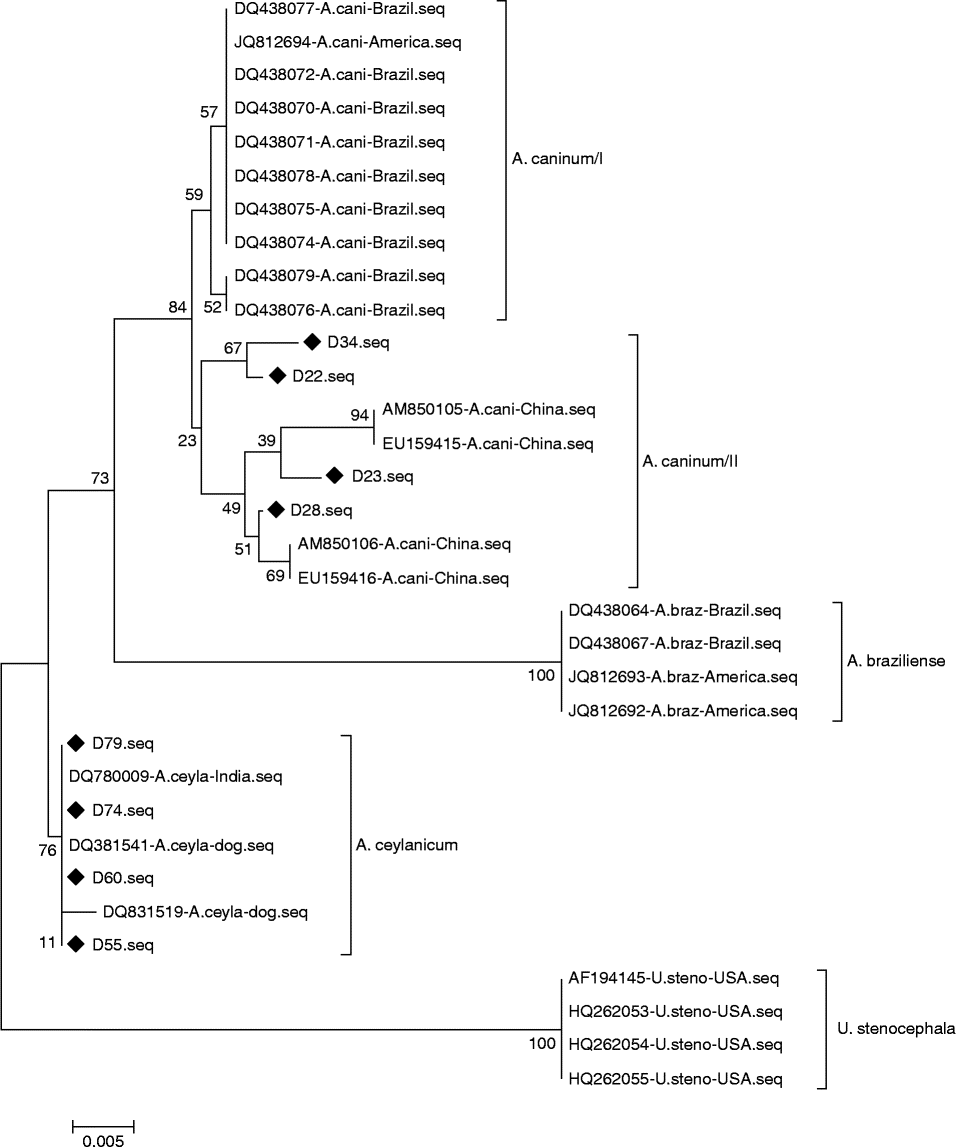
To further explore the genetic characterization of these samples, and to ensure that the PCR-RFLP analysis was accurate, eight samples were chosen randomly and sequenced, including four A. caninum-positive samples (D22, D23, D28 and D34) and four A. ceylanicum-positive samples (D55, D60, D74 and D79). The phylogenetic tree was obtained with the neighbour-joining analysis of ITS sequences of four hookworm species (A. caninum, A. ceylanicum, A. braziliense and U. stenocephala) (fig. 4). They were classified into different clusters. Among them, A. caninum was grouped in two clusters, with A. caninum isolates (D22, D23, D28 and D34) and other A. caninum isolated in China belonging to group II. These were clearly different from group I, where A. caninum was isolated from the USA and Brazil. Isolates of A. ceylanicum from positive samples D55, D60, D74 and D79 were grouped with a cluster of A. ceylanicum reference sequences. The results of the phylogenetic analysis were consistent with those of the PCR-RFLP analysis.
Phylogenetic tree of the hookworm isolates based on sequences of the ITS gene with neighbour-joining algorithm using the Kimura parameter; accession numbers for the reference sequences are in GenBank; ♦ symbols represent isolates from Guangzhou in the present study.
Discussion
Canine hookworm infection is endemic in South-East Asian countries with a prevalence ranging from 70% to 100%, with zoonotic transmission representing a potentially significant public health concern (Mahdy et al., Reference Mahdy, Lim, Ngui, Fatimah, Choy, Yap, Al-Mekhlafi, Ibrahim and Surin2012). However, there are few available data on the prevalence of canine hookworms in China. Thus, the present study provides the first assessment of canine hookworm occurrence, including A. caninum, A. ceylanicum, A. braziliense and U. stenocephala, in stray and sheltered dogs in Guangzhou city, Guangdong Province, subtropical southern China.
Ancylostoma caninum and A. ceylanicum were detected in the present study. Ancylostoma caninum is the most widespread species of hookworm, while A. ceylanicum is supposed as an endemic parasite in South-East Asia. Ancylostoma ceylanicum has been reported mostly in Asia, including India (Chowdhury & Schad, Reference Chowdhury and Schad1972), Thailand (Setasuban et al., Reference Setasuban, Vajrasthira and Muennoo1976; Traub et al., Reference Traub, Robertson, Irwin, Mencke and Thompson2004), Laos (Scholz et al., Reference Scholz, Uhlírová and Ditrich2003; Sato et al., Reference Sato, Sanguankiat, Yoonuan, Pongvongsa, Keomoungkhoun, Phimmayoi, Boupa, Moji and Waikagul2010), Malaysia (Ngui et al., Reference Ngui, Ishak, Chuen, Mahmud and Lim2011), Indonesia (Lie & Tan, Reference Lie and Tan1959; Margono et al., Reference Margono, Koesharjono and Kosin1979), Borneo (Choo et al., Reference Choo, Pang and Prociv2000), Philippines (Velasquez & Cabrera, Reference Velasquez and Cabrera1968) and Taiwan (Yoshida et al., Reference Yoshida, Okamoto and Chiu1968). There is a significant geographic gap in our knowledge of the prevalence of A. ceylanicum in Asia, except for a few reports from mainland China. The present high prevalence values of A. ceylanicum confirm that this species is clearly established in Asia.
To date, there remains scarce and unspecific data about hookworm occurrence in China. In this survey, the overall prevalence of canine hookworm was 29.53% in Guangzhou (south China). The prevalence of A. ceylanicum (95.24%) in south-west China (Guizhou Province) (Zhuang & Jin, Reference Zhuang and Jin1982), and the prevalence of A. caninum (66.3%) in north China (Heilongjiang Province) (Wang et al., Reference Wang, Qiu, Zhao, Xu, Yu and Zhu2006), were higher than the prevalence in south China (Guangzhou city). These differences in prevalence would be due to the geographical distribution and development of the city, where an increasing number of dogs are being raised and maintained in Chinese society, coinciding with changes in life style and living standards in China. As is the case elsewhere, infection with hookworms remains a severe problem for dog health and poses public health concerns in China (Wang et al., Reference Wang, Qiu, Zhao, Xu, Yu and Zhu2006). Guangzhou city has the lowest occurrence of hookworms compared with a prevalence of 48% (Mahdy et al., Reference Mahdy, Lim, Ngui, Fatimah, Choy, Yap, Al-Mekhlafi, Ibrahim and Surin2012) and 71.1% (Ngui et al., Reference Ngui, Lim, Traub, Mahmud and Mistam2012) in Malaysia, 98% in India (Traub et al., Reference Traub, Robertson, Irwin, Mencke and Thompson2004), 58% in Thailand (Traub et al., Reference Traub, Inpankaew, Sutthikornchai, Sukthana and Thompson2008) and nearly 100% in Laos (Thompson & Conlan, Reference Thompson and Conlan2011).
In the present study, the prevalence of infection was significantly higher in suburban and stray dogs compared with urban and shelter dogs. This finding is basically in agreement with Mahdy et al. (Reference Mahdy, Lim, Ngui, Fatimah, Choy, Yap, Al-Mekhlafi, Ibrahim and Surin2012), who reported that rural stray dogs had the highest prevalence (71.4%), followed by urban stray dogs (48%) and, lastly, dogs in shelters (28.7%). The high prevalence of hookworms observed in our study demonstrates the poor level of environmental hygiene, degree of environmental contamination with infective stages, and favourable climatic conditions for the survival of infective stages outside the host. Nevertheless, it is noteworthy that dog owners lack knowledge and understanding of the role of dogs in disease transmission and required veterinary care.
A rapid PCR–RFLP method was developed in the present study using an appropriate restriction endonuclease for PCR–RFLP to differentiate species of hookworms on the conserved region of the ITS locus by Primer Premier 5.0. The characteristics of such a method are straightforward and rapid, where only one pair of primers and two restriction enzymes are required to differentiate four common canine hookworm species (A. braziliense, A. caninum, A. ceylanicum, U. stenocephala). The PCR–RFLP method used by Traub et al. (Reference Traub, Robertson, Irwin, Mencke and Thompson2004) can only differentiate A. caninum and A. braziliense, and Silva et al. (Reference Silva, Miranda, Santos and Rabelo2006) discriminated three species of canine hookworm (A. braziliense, A. caninum, A. ceylanicum), while Palmer et al. (Reference Palmer, Traub, Robertson, Hobbs, Elliot, While, Rees and Thompson2007) discriminated A. caninum, A. ceylanicum, U. stenocephala and A. tubaeforme. In this study, 75 canine hookworm positive DNA samples were successfully identified by developed PCR–RFLP method, and results were further confirmed by sequence analysis. It is a convenient method for canine hookworm epidemiological investigations; however, it still needs further evaluation because of the absence of A. braziliense and U. stenocephala in the present study.
In addition, the phylogenetic analysis based on ITS1 and 5.8S rRNA sequences revealed that A. caninum isolated in China is obviously different from A. caninum isolated in the USA and Brazil. The phylogenetic tree is largely divided into four clusters: the largest cluster (A. caninum) contains two groups, with isolates from the USA and Brazil in group I and those from China in group II. Because available data about A. caninum ITS sequences are still limited, especially from countries around China, the difference between A. caninum isolates from China and other Asian countries is still unclear. However, it has been shown that A. caninum can be clustered into different groups, although further studies are required to compare other loci of DNA between A. caninum isolates from different countries.
Acknowledgements
We would like to thank Xu-hui Lin and the personnel of the humane shelters for helping us to collect all the samples.
Financial support
This work was funded by the National Natural Science Foundation of China (grant no. 30972179, 31272551).
Conflict of interest
None.