Introduction
In the absence of a cure, the prevention of new HIV infections remains the most feasible and sustainable means of combating its further spread, especially in the resource-constrained settings of developing countries where HIV prevalence rates are relatively high. Among the proven effective HIV preventative strategies is the correct and consistent use of condoms (Weller & Davis-Beaty, Reference Weller and Davis-Beaty2002; UNAIDS, 2004; Myer, Reference Myer2010). Condom use in sexual intercourse has long been identified as an effective means of reducing the transmission of sexually transmitted infections (STIs), including HIV (UNAIDS, 1998). Correct and consistent use of condoms is thus being advocated as an effective HIV protective strategy, alongside abstinence and fidelity (the ABC strategy). Although condoms were used for decades prior to the advent of HIV in the early 1980s, their use among numerous at-risk population sub-groups, including university students, has remained unsatisfactorily low and inconsistent (Mashegoane et al., Reference Mashegoane, Moalusi, Ngoepe and Peltzer2004; Njikam nee Savage, Reference Njikam nee Savage2005; Heeren et al., Reference Heeren, Jemmott, Mandeya and Tyler2007; Sabone et al., Reference Sabone, Ntsayagae, Brown, Seboni, Mogobe and Sebego2007; Ntata et al., Reference Ntata, Muula, Siziya and Kayambazinthu2008; Omungo, Reference Omungo2008). Whilst various factors contribute to low condom use, the controversy that surrounded educating youths about condoms at the onset of the HIV epidemic, and the subsequent myths that surrounded condoms, are worth noting, especially in Africa. In the early years of HIV, some political and religious leaders felt that educating young people on condoms would encourage them to experiment with sex early (Marindo et al., Reference Marindo, Pearson and Casterline2003; UNAIDS, 2004; Central Statistical Office & Macro International Inc, 2007; Muula, Reference Muula2010). The fading away of the controversy and condom myths, coupled with extensive promotion of their use, has led to improvement in condom usage among various at-risk groups, such as commercial sex workers.
A growing number of studies document improving trends in condom usage among young people, including university students, although it is largely inconsistent (Maharaj & Cleland, Reference Maharaj and Cleland2008). This is often attributed to increased awareness of their dual protection benefits against the risks of STIs and pregnancy (Maharaj, Reference Maharaj2003; Peltzer, Reference Peltzer2005; Maharaj & Cleland, Reference Maharaj and Cleland2008). Although the majority of students admit to the efficacy of condoms in reducing the risk of HIV infection, empirical evidence suggests that their use remains very low or elusive among the university student community (Singh et al., Reference Singh, Fong and Ratnam1992; Maswanya et al., Reference Maswanya, Moji, Horiguchi, Nagata, Aoyagi and Honda1999; Mashegoane et al., Reference Mashegoane, Moalusi, Ngoepe and Peltzer2004; Njikam nee Savage, Reference Njikam nee Savage2005; Sabone et al., Reference Sabone, Ntsayagae, Brown, Seboni, Mogobe and Sebego2007; Nshindano & Maharaj, Reference Nshindano and Maharaj2008; Ntata et al., Reference Ntata, Muula, Siziya and Kayambazinthu2008; Omungo, Reference Omungo2008; Rahamfey et al., Reference Rahamfey, Rivard, Ravaoarinoro, Ranaivoharisoa, Rasamindrakotroka and Morisset2008; Browne et al., Reference Browne, Clubb, Wang and Wagner2009). The prevalence of pregnancy and STIs in many campuses is testimony to this fact. Studies show that the percentage of students reporting condom use in their last sexual encounter varies greatly from one university to another. For instance, it has been reported to be 35% among Singaporean university students (Singh et al., Reference Singh, Fong and Ratnam1992), 46% in Cameroon (Maswanya et al., Reference Maswanya, Moji, Horiguchi, Nagata, Aoyagi and Honda1999), 61% in the USA (Flannery & Ellingson, Reference Flannery and Ellingson2003; Brown & Vanable, Reference Brown and Vanable2007), 52.6% in Malawi (Ntata et al., Reference Ntata, Muula, Siziya and Kayambazinthu2008) and 75% in South Africa (Peltzer, Reference Peltzer2005). Despite the widespread promotion of condoms, many countries are still far from reaching universal usage.
This paper explores the level of condom use and factors that surround their use among university students in Zimbabwe (one state-owned and one private university), with the intention of revealing the interaction between condom use and the environment that intimately impinges upon an individual. It was motivated by the increased risk to HIV that most university students are exposed to. With the majority of university students aged between 18 and 24 years, they are likely to be sexually active, more prone to experimentation, desire to experience unprotected sexual intercourse and to have multiple sexual partners (Peltzer et al., Reference Peltzer, Nzewi and Mohan2004). On the other hand, going to university lengthens the period between puberty and marriage, creating an expanded adolescence and increasing the likelihood of premarital sexual relationships and the risk of pregnancy and STIs, especially HIV (Abdool Karim, Reference Abdool Karim, Abdool Karim and Abdool Karim2010). Sabone et al. (Reference Sabone, Ntsayagae, Brown, Seboni, Mogobe and Sebego2007) noted that the challenges of transition into adulthood, peer pressure and the stress of academic work, coupled with lack of entertainment at universities, frequently push students to engage in risky sexual activities, thereby increasing their chances of contracting HIV infections. In addition, female students' financial insecurity, which is common in most developing countries, often lures them to older men and other risky sexual behaviours (Njikam nee Savage, Reference Njikam nee Savage2005). The other source of HIV risk among university students is their high level of mobility, which allows them to interact sexually with other groups who may have higher (or lower) HIV prevalence, thus increasing their vulnerability (Madise et al., Reference Madise, Zulu and Ciera2007). It is against this background that this paper seeks to profile the condom usage patterns among university students in Zimbabwe, in a bid to inform campus HIV/AIDS programmers on areas that need attention in order to reduce the spread of HIV among students at tertiary institutions in the country.
Condom use has been a subject of considerable research in Zimbabwe, but most studies have largely been qualitative and directed towards groups other than university students. Data on condom use among students in Zimbabwe are very limited, especially on its determinants. Identifying the level of condom use and its predictors is crucial for the development of appropriate programmes to increase or sustain their current usage. This may go a long way in preventing new infections among young people.
Methods
Settings and data
The Republic of Zimbabwe is a landlocked southern African nation sharing borders with South Africa to the south, Botswana to the west, Zambia to the north and Mozambique to the east. The national census estimated the country's population at 11.632 million, of which approximately 55% are believed to be aged below 15 years, and 52% of the population being females (Central Statistical Office, 2004). The majority of people in Zimbabwe (70%) live in rural areas and are often poor. As with other southern African countries, Zimbabwe is battling to combat one of the most severe HIV epidemics in the world. With the first case of HIV/AIDS reported in 1985 (Whiteside, Reference Whiteside1996; GOZ, 1999; Meursing & Sibindi, Reference Meursing and Sibindi2000), the epidemic subsequently spread rapidly throughout the country, and is now believed to be generalized throughout the country's population. HIV prevalence rates of above 40% have been reported in some towns and growth points in the country (ZMHCW, 1994; Pettifor et al., Reference Pettifor, Straten, Dunbar, Shobiski and Padian2004). At the onset of the epidemic HIV prevalence rates were lower in rural than in urban areas but are now fairly similar, with the 2005–2006 Demographic and Health Survey (DHS) estimating the prevalence rates at 19% and 18%, respectively for urban and rural areas (Central Statistical Office & Macro International Inc, 2007).
The data for this study were from a large study designed to investigate the determinants of risky sexual behaviours among university students in Zimbabwe carried out between April and December 2010. Two universities, one state-owned and one privately owned, were purposively selected for study. In order to maintain anonymity and comply with the recommendations of the Ethical Committee of the private university chosen, the names of the two universities will be withheld. The two universities are hereafter referred to as the ‘state university’ and the ‘private university’. Since the two universities had various modes of enrolment, only full-time students studying undergraduate bachelors degrees for a minimum of 3 years were considered for the present study. This means that only students on conventional degree programmes (day classes) and those on parallel degree programmes (evening classes) were eligible for inclusion in the study, thus excluding those studying on a part-time basis, such as those studying through block release (visiting school programmes), those studying towards diplomas and those doing their postgraduate degrees or course, since they do not spend much of their time at the university and are also often older, and thus do not fit into the age group of interest, which is 15–24 years. Stratified random sampling was utilized, where students at each university were stratified using their faculties of study and random samples then taken from each faculty. In order to synchronize the faculties found at the two universities, faculties were divided into five strata as follows: Stratum 1 (Commerce or Business), Stratum 2 (Education & Social Sciences), Stratum 3 (Arts & Law), Stratum 4 (Agriculture & Natural Resources Management) and Stratum 5 (Engineering, Science & Technology). A list (or register) of the registered students in each university was sought and students were then put into the respective strata. Simple random sampling was then used to pick respondents from each stratum, in proportion to the total number of students in their respective strata, using computer-generated random numbers.
Data were collected with a survey approach. The targeted sample size was 890 students drawn from the two universities. The choice of the sample size was informed by guidelines of choosing a sample, which state that for any population size around 1500, 20% should be sampled, whereas for any population greater than 5000, a sample of 400 would be adequate to draw representative conclusions about population parameters (Gay et al., Reference Gay, Mills and Airasian2006). Since the university student population for the state university was 10,231 a sample size of 400 students would have sufficed to produce a representative sample. However, taking into account the inevitable response rate of about 70% often associated with self-administered questionnaires (the main research instrument used to collect data), a sample of 600 students was taken in order to reduce the bias that may be brought about by non-response. More students were selected at first, so that in the case of a lower response rate, the final sample size would at least be 400 students for the state-owned university. As for the private university, with a student enrolment estimated at 1482, a sample size of 290 students was taken as this was deemed sufficient to avoid any bias. This was about 20% of students in this university and was thought to produce a representative sample. A self-administered questionnaire was chosen as the most appropriate means of collecting data for this study because of the sensitive nature of the questions asked, where honest responses and participation is low when questions are asked face-to-face. The validly completed questionnaires totalled 753 (547 from the state university and 206 from the private university respondents), yielding an overall response rate of 89.1% (96% for the state university and 74.9% among the private university respondents). Only 345 respondents (45.8%) had initiated sex. For the purpose of this paper, all analyses were confined to the 345 sexually active respondents.
Data analysis
The main outcome variables were: (1) ever used a condom, (2) condom use at last sex, (3) consistent condom use with regular and casual sexual partners and (4) condom use intentions. ‘Ever used a condom’ was assessed by asking respondents, ‘Have you ever used a condom in any of your sexual encounters?’; this question had ‘yes’ and ‘no’ as answer options, and was meant to assess popularity of condoms in sexual encounters. ‘Condom use at last sex’ was ascertained by the question, ‘Did you or your sexual partner use a condom during the last time you had sex?’ Similarly, the answer options to this question were ‘yes’ and ‘no’. ‘Consistent condom use’ was assessed in both the regular and casual sexual encounters. In the questionnaire provided to respondents, a regular (or steady) partner was defined as someone who is a spouse, lover or anyone else whom the respondent felt committed to or had a special relationship with. On the other hand, a casual partner is someone whom a respondent felt uncommitted to, such as in a ‘one night stand’ or in the ‘no strings attached’ types of relationship. The two questions asked were, ‘How often do you use a condom with your regular (or steady) sexual partner?’ and ‘How often do you use a condom with your casual (or non-regular) sexual partner?’ These questions were only asked of those who had acknowledged having had sex with regular or casual partners. The answer options to these questions were: every time (always), almost every time, sometimes and never. Those who always used condoms with either regular or casual partners were taken to be consistent condom users in those categories. The last outcome variable, ‘condom use intention’, was assessed through the question, ‘Do you intend to use a condom at your next sexual encounter?’, also with the ‘yes’ and ‘no’ answer options.
The socio-demographics used to analyse the measures of condom use discussed above were age, marital status, level of religiosity, condom use at first sex, abuse at first sex, personal HIV risk perception, place of study, alcohol consumption, having multiple partnerships and childhood place of residence. The level of religiosity was calculated from a set of questions indicating the frequency of respondents’ engagement in six key religious activities. For each religious activity, the Likert scale had the following answer options: 1=not at all, 2=rarely, 3=sometimes, 4=often and 5=always. The level of religiosity was then found by adding respondents’ scores for the six questions and then dividing by 30, the highest possible score for the highly religious individual, and multiplying by 100 to express it as a percentage. Religiosity scores were then categorized as follows: low=0–49%, medium=50–79% and high=80–100%. On the other hand, personal HIV risk perception was ascertained by asking respondents how they rated their chances of contracting HIV infections, with ‘low’ and ‘high’ as answer options. Alcohol consumption was assessed by the question, ‘Do you drink alcohol?’ The answer options to this question were ‘yes’ and ‘no’.
After checking for completeness and consistency, the data were analysed using STATA software (version 11.0). Data were aggregated according to sex, and at some instances according to place of study, in the final analysis.
Results
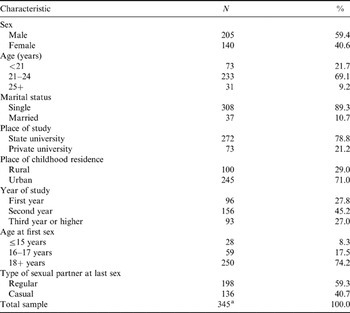
Table 1 summarizes the characteristics of the 345 sexually active students in the sub-sample. Almost 60% of these were males. The majority (69.1%) were in the 21–24 age group, with just 9.2% aged 25 years and above. The mean age of the sub-sample was 21.99 years (SD=2.04). Only 10.7% of the sexually active respondents were married, with the vast majority (almost 90%) being single. In line with the student populations in the sampled universities, 78.8% of the respondents came from the state university. Most students had spent their first 15 years in urban settings (71%) and were in their second year of study (45.2%). About three-quarters of the respondents had their coital sexual intercourse at the age of 18 or above. Only 8.3% of the respondents initiated sexual activity before the age of 15. The median age at first sex was 19 years, and this was uniform across universities, but it was 18 for females and 20 for males. All respondents were aware of condoms and knew where to get them.
Distribution of sexually active respondents by selected demographic characteristics, Zimbabwe, 2010

a In cases where the categories do not add up to the total sample, the difference represents the missing data.
Ever use of condoms
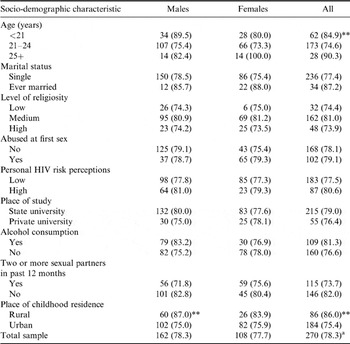
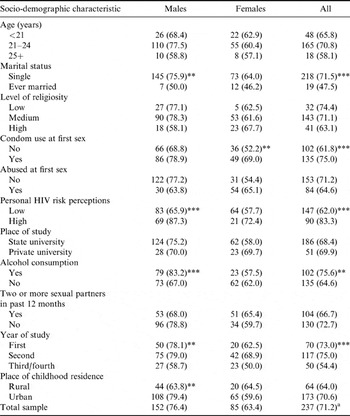
It was found that 78.3% of the sexually active respondents had used a condom at least once in their previous sexual encounters. The rates of ever use of condoms were not significantly different for the state and private universities, at 79% and 76.4%, respectively (χ 2=0.46; p=0.50). Furthermore, male and female respondents had fairly similar rates of ever using condoms, at 78.6% and 77.7%, respectively. Table 2 shows the frequency and percentages of respondents who have used condoms before by selected socio-demographic characteristics. It is apparent that a higher percentage of male respondents aged under 21 years (89.5%) had used a condom before as compared with female respondents (80%) in the same age group. Also, a greater proportion of respondents with a rural background reported having used a condom before as compared with their urban counterparts. This distribution was uniform across sex and was statistically significant. Across all the other socio-demographics, ever using a condom did not vary significantly by sex.
Respondents who had ever used condoms by selected demographic characteristics, Zimbabwe, 2010

Figures in parentheses are percentages, whilst those outside are the frequencies.
a In cases where the categories do not add up to the total sample, the difference represents the missing data.
**p<0.05; ***p<0.01.
Condom use at last sex with any sexual partner
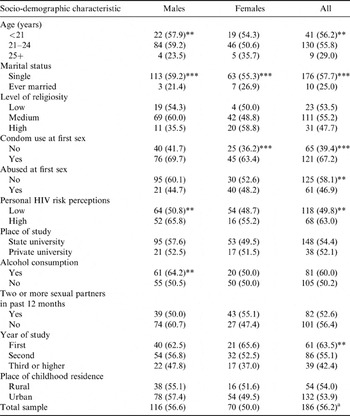
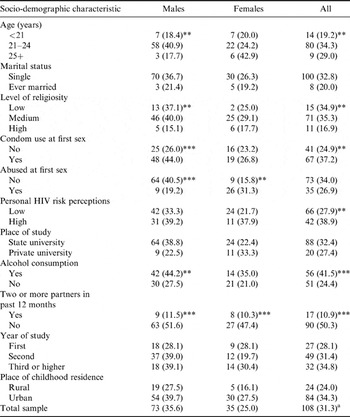
Table 3 shows frequencies and percentages of respondents who used condoms at their last sex by selected socio-demographic variables. The overall usage of condoms at last sexual intercourse was found to be 56.2%. However, further analysis of these results by marital status revealed that 57.7% of the single respondents had used a condom in their last sexual encounters. This was in sharp contrast to only 25% of the married students who had used a condom at their last sex, although they were very few in the sample. Across place of study, 54.4% of state university respondents had used condoms at their last sexual encounters as compared with 52.1% for the private university respondents, but the difference was not statistically significant (χ 2=0.44; p=0.51). Furthermore, condom use at last sex among male respondents was 56.6%, whilst it was 50.0% among female respondents. This difference was not statistically significant (χ 2=1.45; p=0.28), meaning that condom use at last sex was similar across sex and place of study. A higher proportion of younger respondents (those aged under 21 and 21–25 years) used condoms at last sex than the older respondents (those aged 25–32 years), and the differences were significant for male respondents and the total sample. Other statistically different distributions were observed between condom use at last sex and the following variables: condom use at first sex, abuse at first sex, personal HIV risk perceptions and alcohol consumption. A smaller proportion of respondents with low personal HIV risk perception, those who did not use condoms at first sex and those who do not drink alcohol had used condoms at their last sex.
Percentage of respondents who used condoms at their last sex by selected socio-demographic characteristics, Zimbabwe, 2010

Figures in parentheses are the percentages, whilst those outside are the frequencies.
a In cases where the categories do not add up to the total sample, the difference represents the missing data.
**p<0.05; ***p<0.01.
Consistent condom use with a regular and casual partners
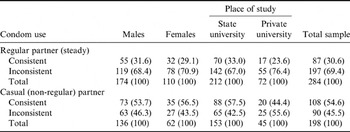
Table 4 shows condom use by type of sexual partner (regular versus casual). Only 30.6% of the respondents always used condoms with their regular partners (consistent condom users). In other words, 69.3% of the respondents either did not use condoms at all (14.4%), or used them inconsistently (54.9%) with their regular partners. When analysed by marital status, 32.8% of the single respondents, as compared with 16.1% of the married respondents, used condoms every time with their regular partners. Consistent condom use with a regular sexual partner was fairly similar for the two universities, at 33% and 23.6%, respectively, for the state and private universities (χ 2=4.47; p=0.22). Furthermore, male respondents were more consistent condom users than their female counterparts (31.6% versus 29.1%), yet these differences were also not statistically different (χ 2=4.82; p=0.19).
Condom use of respondents by type of sexual partner, Zimbabwe, 2010

Figures in parentheses are the percentages, whilst those outside are the frequencies.
Consistent condom use with a casual partner was slightly higher (54.6%) than that with regular sexual partners (30.6%). State university respondents used condoms more consistently with their casual partners than their private university counterparts. Those who always used condoms with casual partners comprised 57.5% of respondents at the state university, whereas they only constituted 44.4% of the private university respondents. Rates of consistent condom use with a casual partner were very similar for male and female respondents, at 56.5% and 53.7%, respectively (χ 2=6.06; p=0.11), and by place of study (χ 2=6.33; p=0.10).
Table 5 shows the frequencies and percentages of respondents who consistently used condoms with casual partners by selected socio-demographic variables. A larger percentage of respondents who had used a condom at their sexual debut used condoms more consistently with casual sexual partners than their counterparts who did not use condoms at first sex. Another noteworthy observation was that a very small proportion of respondents who had been abused or coerced at first sex, and those who do not drink alcohol, had used condoms consistently with casual partners.
Consistent condom users with casual partners by selected demographic characteristics, Zimbabwe, 2010

Figures in parentheses are percentages, whilst those outside are the frequencies.
a In cases where the categories do not add up to the total sample, the difference represents the missing data.
**p<0.05; ***p<0.01.
Condom use intentions at next sex
Those who intended to use condoms at their next sexual encounters were 70.2% of the sexually active respondents. After adjusting for marital status, close to three-quarters of the single respondents (74.4%) intended to use condoms at their next sexual encounters. A quarter of the single respondents were either not sure or did not intend to use condoms in the future. Intentions to use condoms were very low among the married respondents, with only 43.2% of them intending to use condoms in their next sexual encounters. Slightly more single sexually active respondents from the state university (75.2%) had intentions to use condoms at their next sexual acts than their counterparts at the private university (71.4%). However, the difference was not statistically significant (χ 2=1.21; p=0.55). Also striking was that more male respondents (78.4%) intended to use condoms at their next sexual encounters than female respondents (67.6%), and this difference was statistically significant (χ 2=6.69; p=0.05). In all categories, the intentions to use a condom at next sexual intercourse by the married respondents were quite low, at often less than 50% of respondents intending to use condoms at their next sexual encounters.
Table 6 shows the frequencies and percentages of respondents' intentions to use condoms at their forthcoming sexual encounters. Larger percentages of single respondents, those who had used condoms at first sex, those with high personal HIV risk perceptions, those who drink alcohol, those who had their last sex with a casual partner and those who lived in urban areas during their childhood intended to use condoms at their next sexual encounters, and these differences were statistically significant.
Condom use intentions of respondents by selected socio-demographic characteristics, Zimbabwe, 2010

Figures in parentheses are percentages, whilst those outside are the frequencies.
a In cases where the categories do not add up to the total sample, the difference represents the missing data.
**p<0.05; ***p<0.01.
Discussion
This article explores the level of condom use, and the factors associated with their use or non-use, among students at two universities in Zimbabwe (one state owned and one privately owned). All respondents reported that they were aware of condoms and where to get them. This was expected, given that the HIV/AIDS epidemic has been around for more than 25 years now, and most of the current university students were born in the midst of the epidemic and at a time when government and non-governmental organizations (NGOs) were implementing awareness programmes on HIV, especially the ABC message of prevention.
More than three-quarters of the respondents revealed that they had used condoms before. Also, the majority believed in the efficacy of condoms, to prevent unwanted pregnancies or STIs, including HIV. Increasing condom use patterns have been reported in other studies in similar populations (Peltzer, Reference Peltzer2005; Maharaj & Cleland, Reference Maharaj and Cleland2008). Surprisingly, a larger proportion of respondents who spent most of their childhood in rural areas reported having used condoms before than their counterparts who spent their childhood in urban areas. It had been expected that a greater percentage of respondents with an urban background would have used condoms before, since information about condoms is more readily available in urban than rural areas. This finding may be explained by the fact that knowledge about HIV/AIDS and its prevention in Zimbabwe has spread across the country and is almost universal. In other words, unlike in the early years of the HIV epidemic, when the disease was mostly confined to urban areas, it has now spread to rural areas and HIV/AIDS programme workers have responded by taking the preventative message to these areas.
This study found that condom use at last sexual intercourse among Zimbabwe university students was on average 56.2%. This is a cause for concern given that most of the sexual activities that students engage in occur outside steady relationships and, moreover, in a potentially risky sexual environment. However, these finding are comparable to those of other studies on condom use among university students, which have found condom usage rates at last sex ranging between 40% and 60% (Abdullah et al., Reference Abdullah, Fielding and Hedley2003; Flannery & Ellingson, Reference Flannery and Ellingson2003; Hendriksen et al., Reference Hendriksen, Pettifor, Lee, Coates and Rees2007; Ntata et al., Reference Ntata, Muula, Siziya and Kayambazinthu2008; Ma et al., Reference Ma, Ono-Kihara, Cong, Pan, Xu and Zamani2009). However, other studies, such as that of Peltzer (Reference Peltzer2005), document condom usage rates as high as 75%, with some recent studies suggesting rising trends in condom use among college students and other young people (Gouws et al., Reference Gouws, Stanecki, Lyerla and Ghys2008; Shisana et al., Reference Shisana, Rehle, Simbayi, Zuma, Jooste and Pillay-van-Wyk2009; UNAIDS, 2010).
As expected, condom use at last sex was found to vary according to marital status, with single students being significantly more likely to report having used condoms at their last sex than their married counterparts (57.7% versus 25%). This trend was clearly observable across sex and place of study. These findings are in line with previous research findings by various authors who noted that condoms are the method of choice among the single sexually active, whilst the pill is preferred by the married or those in stable relationships (Adetunji, Reference Adetunji2000; Prata et al., Reference Prata, Vahidnia and Fraser2005). The other factors explaining variations in condom use at last sex were abuse at first sex, personal HIV risk perception and the consumption of alcohol. A number of studies have also documented the importance of these factors in predicting various measures of condom use (Hendriksen et al., Reference Hendriksen, Pettifor, Lee, Coates and Rees2007; Maharaj & Munthree, Reference Maharaj and Munthree2007; Ma et al., Reference Ma, Ono-Kihara, Cong, Pan, Xu and Zamani2009). In fact, the results reveal that those who did not use condoms at first sex, those who were abused at first sex and those with low personal HIV risk perception reported significantly lower condom use at last sex than their alternative counterparts. Is worth noting that a slightly larger proportion of respondents who consume alcohol had used condoms at last sex than those who had not (64.2% versus 50.5%). This is contrary to the belief that those who consume alcohol are likely to lead riskier sex lives, engaging in unprotected sex under the influence of alcohol (Cooper, Reference Cooper2002; Mashegoane et al., Reference Mashegoane, Moalusi, Ngoepe and Peltzer2004; Brown & Vanable, Reference Brown and Vanable2007; Sabone et al., Reference Sabone, Ntsayagae, Brown, Seboni, Mogobe and Sebego2007; Gilbert, Reference Gilbert2008). These findings may underscore the success of HIV prevention programmes targeting high-HIV-risk places such as beer halls and bars, especially in the form of providing free condoms.
Consistent condom use was low at 30.6% and 54.6%, respectively, for regular and casual sexual relationships. Consistent condom use with casual partners was almost double that for regular sexual partners. These findings reinforce the known fact that consistent condom use is usually low and more prevalent in casual as opposed to regular relationships (Adetunji, Reference Adetunji2000; Njikam nee Savage, Reference Njikam nee Savage2005; Prata et al., Reference Prata, Vahidnia and Fraser2005; Rahamfey et al., Reference Rahamfey, Rivard, Ravaoarinoro, Ranaivoharisoa, Rasamindrakotroka and Morisset2008). As reported in other population sub-groups, these findings clearly illustrate that students underestimate the HIV risk from regular relationships. However, this nexus requires attention given the HIV risks posed by steady or regular sexual relationships, especially in settings with generalized HIV epidemics. The results are very comparable to those of other studies conducted on similar populations (Abdullah et al., Reference Abdullah, Fielding and Hedley2003; Peltzer, Reference Peltzer2005; White et al., Reference White, Kristensen, Coulibaly, Sarro, Chamot and Tounkara2009). It was worrying that a smaller percentage of respondents who had two or more sexual partners in the past 12 months had used condoms consistently with casual partners than those with fewer than two sexual partners. This is a major cause for concern given that the chances of acquiring HIV increase with increase in number of sexual partners (Slaymaker, Reference Slaymaker2004).
Condom use intentions were found to be high among study respondents, with almost three-quarters of them indicating that they intend to use condoms at their next sexual encounters. This also brings to the fore the fact that Zimbabwean university students are aware of the reproductive risks posed by unprotected sex and also believe in the efficacy of condoms in reducing this risk. However, condom use intentions have been reported to be very low in other studies (Singh et al., Reference Singh, Fong and Ratnam1992; Mattila et al., Reference Mattila, Apostolopoulous, Sonmez, Yu and Sasidharan2001; Mashegoane et al., Reference Mashegoane, Moalusi, Ngoepe and Peltzer2004; Ntata et al., Reference Ntata, Muula, Siziya and Kayambazinthu2008). They were found to be significantly high among males, the single, those who used condoms at first sex, those with high personal HIV risk perceptions, those who consume alcohol and those with casual sexual partners. The same factors have been found to be important predictors of a variety of condom use measures (Hendriksen et al., Reference Hendriksen, Pettifor, Lee, Coates and Rees2007; Maharaj & Munthree, Reference Maharaj and Munthree2007; Ma et al., Reference Ma, Ono-Kihara, Cong, Pan, Xu and Zamani2009).
However, the results of this study should be interpreted with caution. Just like other sexual behaviour studies, it focuses on sensitive personal behaviour, which may be under- or over-reported by respondents in an attempt to present a socially desirable picture. This has been found to be common in many sexual behaviour studies, especially among women and girls (Fenton et al., Reference Fenton, Johnson, McManus and Erens2001; Gregson et al., Reference Gregson, Nyamukapa, Garnett, Mason, Zhuwau and Carael2002; Mahomva et al., Reference Mahomva, Greby, Dube, Mugurungi, Hargrove and Rosen2006). To counteract this limitation, respondents were asked to complete questionnaires on their own (self-administered), in order to encourage honest responses. Self-administered questionnaires have been shown to elicit higher rates of sensitive behaviours than face-to-face interviews (Fenton et al., Reference Fenton, Johnson, McManus and Erens2001).
Conclusions
In conclusion, it appears that the broader environmental conditions only have limited influence on the use of condoms by university students. Instead, the differences in the places of study and personal factors appear to exert the greatest influence. Promotional messages for condom use should, therefore, target individual factors, such as cognition and feelings and those related to interpersonal relationships such as peer pressure and the quality of health services, which expose students to the risks of STIs, yet may result in the failure to use condoms. The promotional messages should also dispel the assertion that condoms reduce sexual pleasure. Awareness campaigns should continue and ‘creeping fatigue’ should be avoided. University campus condom use programmes should target students in regular or steady relationships, as these often disregard the use of condoms, and are therefore at increased risk of acquiring STIs, including HIV.
Given the importance of condom use at first sex and high personal HIV risk perception in explaining various measures of condom use, promotional programmes should endeavour to encourage those who have not yet initiated sexual intercourse to use condoms. Furthermore, the high condom use intentions exhibited by respondents should be capitalized on and converted into actual condom use by making sure that condoms are always readily available and that the myths associated with them are dispelled.
Acknowledgment
This research was supported by a University of KwaZulu-Natal Health Economics HIV/AIDS Research Division (HEARD) PhD scholarship.