Implications
We have reported earlier that the type of stunning and packaging can affect suckling lamb meat. Considering the different physiological responses upon stunning lambs of different ages (weights), there is a need to evaluate the best stunning system for light lamb. Effects of these factors on the ageing process of light lamb meat, the favourite by consumer, are unknown. Although the current slaughterhouses have valid stunning systems to stun sheep (electrical methods), sometimes its use is not so adequate and finally the operator gives the method up. For this reason, we consider it to be important to develop new stunning procedures (gas system) for sheep, as already developed for others species such as pigs or poultries. Additionally, it is necessary to know the meat quality on each type of stunning when meat is packed in different types of modified atmospheres.
Introduction
‘Manchego Lamb’ is a highly valued product in Spain. Exclusively raised in the La Mancha region, its own official label (approved by the Regulatory Council of Manchego Lamb Protected Geographical Indication (PGI) on 7 July 1995) guarantees its high-quality product, in addition to ensuring its sensorial and organoleptic attributes (Vergara and Gallego, Reference Vergara and Gallego2001). Light lambs are intensively fed initially with milk (until 12 kg slaughter weight) and later with cereal and concentrate, ad libitum, until the slaughter at 22 to 28 kg weight (70 days after birth). Meat acquires a pale pink colour, great tenderness and juiciness, and a slight intramuscular fat infiltration that promotes a very typical pleasant flavour (PGI Manchego Lamb, 1995).
On the other hand, numerous ante- and post-mortem factors are widely described as affecting lamb meat quality characteristics, with pre-slaughter conditions (type of stunning) and the preservation systems being especially relevant for red meats (Sañudo et al., Reference Sañudo, Sánchez and Alfonso1998).
In accordance with European law for the protection of animals at killing time (EU Council Directive 93/119/EC, 1993), electrical stunning is one of the most common procedures to ensure that sheep are unconscious and insensitive at slaughter time. A new Spanish requirement (Spanish Animal Welfare Act, 32/2007) forces more inspections in the slaughterhouses and important sanctions if these procedures are not executed. Several disadvantages have been observed in carcasses from animals stunned by electrical methods (e.g. haemorrhages, blood splashes, bone fractures), which have caused the replacement of these systems for the gas practice (CO2 gas), especially in species such as pig (Channon et al., Reference Channon, Payne and Warner2002) or poultry (Gregory, Reference Gregory2005). With regard to initial meat quality of Manchego Spanish breed light lamb, earlier researches found some changes because of the type of stunning, such as lower drip losses (DL) and colour variations (Linares et al., Reference Linares, Bórnez and Vergara2007a) or minor initial rancidity levels (Linares et al., Reference Linares, Berruga, Bórnez and Vergara2007b) with gas stunning systems, in comparison with the electrical method.
On the other hand, packing that preserves quality during storage is critical to meat retailing. Modified atmosphere (MA) packaging rich in oxygen (70% to 80% O2 + 20% to 30% CO2) is the most habitual packing system used in the case-ready industry (Jakobsen and Bertelsen, Reference Jakobsen and Bertelsen2000). However, these conditions promote some negative effects on lamb meat, such as the development of oxidative routes and surface discolouration processes (Berruga et al., Reference Berruga, Vergara and Gallego2005). A novel combination with a low carbon monoxide concentration (CO) is proposed as an alternative in order to maintain an attractive red colour and freshness (Krause et al., Reference Krause, Sebranek, Rust and Honeyman2003).
In earlier research on suckling lambs (Linares et al., Reference Linares, Bórnez and Vergara2008) a new gas mixture with a low carbon monoxide level was used in MA packing conditions to pack meat from animals stunned by two different ways (electrically v. gas). Conclusions from that study showed that both CO2 gas stunning system, and also less than 1% of CO applied to the gas mixture (concretely 0.7%) could be valid alternatives to improve meat quality on Manchego suckling lambs. However, it is not known how the different stunning systems can influence light lamb meat packed under various MA packing systems, a factor which is important, as this product (Manchego Lamb) is still the preferred choice of the habitual lamb consumer (Bernabeu and Tendero, Reference Bernabeu and Tendero2005).
Therefore, the aim of this study was to evaluate the effect of three different types of MAs (MA-A: rich in O2; MA-B: low CO; MA-C: no O2/high CO2) on light lamb meat quality from two different types of stunning systems (electrical v. gas) at 7, 14 and 21 days post packing.
Material and methods
The research protocol used in this work was approved by the Animal Ethics Committee of the University of Castilla-La Mancha, according to guidelines regarding the protection of animals used in research and for scientific purposes (Directive 2003/65/EC, 2003).
Animals
Male light lambs (n = 20) of the Manchega Spanish breed, from the flock of the Experimental farm of Castilla-La Mancha University, were slaughtered at a weight of 25.1 ± 0.1 kg (70 days old). Animals were distributed into two groups (n = 10 each) according to the type of stunning:
• Electrically stunned lambs (ESL): electrodes applied on both sides of the head, behind the ears at 110 V, 50 Hz for 5 s (Electronarcosis Panel, MAC-01, Bernard, S.L.);
• Gas-stunned lambs (GSL): two groups of five lambs in the box, each time, exposed to 90% CO2 for 90 s at the bottom of the well (G. Van Wijnsberghe & Co n.v., Veurne, Belgium).
Immediately after stunning, lambs were slaughtered using standard commercial procedures. Carcasses were chilled at 4°C in a conventional chiller. The longissimus dorsi (LD) muscle from both sides was removed (at 24 h post mortem) from 7th to 11th vertebra in both sides of each chilled carcass.
Sampling and measurements
Ten samples were analysed per atmosphere type and per sampling time (at 7, 14 and 21 days of storage at 2°C). Samples were placed in clear rigid trays (PSEVOH-PE; Linpac Plastic, West Yorkshire, UK), with an oxygen permeability rate of 3.2 cm3/m2 per day at 1 atm and 23°C, and covered by a film (OPP-PE-EVOH PE) with transmission rates of 1 cm3/m2 per day for oxygen (23°C; 50% relative humidity (RH)); 5.5 cm3/m2 per day for CO2 (23°C; 0% RH) and 2.2 g/m2 per day for H2O (25°C; 90% RH). The samples were preserved in MA conditions under three different gas mixtures: MA-A (30% CO2 + 70% O2); MA-B (30% CO2 + 69.3% N2 + 0.7% CO) and MA-C (40% CO2 + 60% N2), by using an ULMA Packaging machine, model Smart 500. Gas composition was checked at all storage times using a PBI Dansensor CheckMate (Denmark) gas analyser. Samples from each lamb were used in all three MAs and at all sampling times.
After opening the packs, the following parameters were measured:
• pH values were determined using Crison 507 equipment, with a penetrating electrode at different analysis times.
• Water-holding capacity (WHC) was evaluated as the percentage of free water (Grau and Ham, Reference Grau and Ham1953).
• Drip losses (DL), expressed as a percentage of the initial portion weight, were analysed (Vergara et al., Reference Vergara, Gallego, García and Landete-Castillejos2003).
• Colour measurements (L*, a*, b* coordinates) were taken immediately after the packs were opened and the measurements were taken on the surface of the LD using a Minolta CR400 colorimeter. The average of three measurements for lightness (L*), redness (a*) and yellowness (b*) were determined, and Chroma was calculated as C* = (a2 + b2)1/2 and Hue as H° = (arctg b*/a*)* 57.32.
• Shear force (SF) was measured using a TA.XT2 texture analyser (England) equipped with a Warner–Bratzler device. Each meat sample was individually placed in a polyethylene bag in a water bath at 70°C for 15 min. Samples cooked and then dried with filter paper were cut into three replicates with 1 cm2 cross-section and 2 to 3 cm length, and SF was determined.
Statistical analysis
Data were analysed using a General Linear Model (GLM) to determine the effect of stunning and atmosphere types on meat-quality parameters. A Tukey’s test was carried out to check the differences between pairs of groups (type of stunning–type of MA). An analysis of variance was carried out to determine the effect of the storage time (7, 14 and 21 days post packaging) in each stunning-MA group. Significant differences were considered at P < 0.05. Data analysis was performed by using the SPSS version 11.0 statistical package.
Results
pH values
Type of stunning affected pH (P < 0.001) for all maturation times analysed (Table 1), and higher values were observed in meat from GSL in comparison to the electrical stunning system. In general, the type of MA did not affect the pH in any of the stunning groups. Furthermore, in the ESL group, pH value decreased throughout storage time in the MA-A and MA-C samples (P < 0.01 and P < 0.001, respectively). Although, a high stability of pH values was found in the GSL group without significant differences with the storage time in any MA packing system.
pH values (mean ± s.e.) in MA-packed meat of light lamb of Manchega Spanish breed stunning by two different types of stunning methods (electrical v. gas)

MA = modified atmosphere.
1MA-A = Type A (30% CO2 + 70% O2); MA-B = Type B (30% CO2 + 0.7% CO + 69.3% N2); MA-C = Type C (40% CO2 + 60% N2).
**Significance level at 0.01; ***at 0.001; ns = non-significant.
a,bValues in the same row with different superscripts are significantly different (P < 0.05) for the different types of MAs (A, B and C) at the same time post-packing and the same type of stunning.
x,yValues in the same column with different superscripts are significantly different (P < 0.05) for the different times post-packing (7, 14 and 21 days) at the same type of stunning and MA.
w,rValues in the same row with different superscripts are significantly different (P < 0.05) for the different type of stunning (electrical and gas) at the same time post-packing and MA.
Water losses (water-holding capacity and drip losses)
In general, WHC was lower (more water expelled) in meat from GSL than in ESL (Table 2) at 7 and 21 days post mortem (P < 0.01, P < 0.001, respectively). In the ESL, slight differences were observed at 21 days post packing (P < 0.05) for the different MAs; the MA-B samples reached the greatest WHC (15.60%; therefore less water expelled) in relation to the MA-A, which raised the poorest WHC and subsequently more water released (21.91%). However, there were no significant differences among the types of MAs with regard to this parameter in the GSL. Differences because of the storage time were observed only in meat from the ESL in all MA types (P < 0.001 for MA-A, MA-B; P < 0.01 for MA-C, respectively), and expelled water increased in this group only, until 2 weeks post packing.
Water holding capacity (as % of free water) (mean ± s.e.) values in MA-packed meat of light lamb of Manchega Spanish breed stunning by two different types of stunning methods (electrical v. gas)

MA = modified atmosphere.
1MA-A = Type A (30% CO2 + 70% O2); MA-B = Type B (30% CO2 + 0.7% CO + 69.3% N2); MA-C = Type C (40% CO2 + 60% N2).
*Significance level at 0.05; **at 0.01; ***at 0.001; ns = non-significant.
a,bValues in the same row with different superscripts are significantly different (P < 0.05) for the different types of MAs (A, B and C) at the same time post-packing and the same type of stunning.
x,yValues in the same column with different superscripts are significantly different (P < 0.05) for the different times post-packing (7, 14 and 21 days) at the same type of stunning and MA.
w,rValues in the same row with different superscripts are significantly different (P < 0.05) for the different type of stunning (electrical and gas) at the same time post-packing and MA.
At 21 days post packing, DL varied (P < 0.05; Table 3) with the type of stunning; Tukey’s test showed differences only in samples packed in MA-A type, with higher DL in GSL group (4.42) than in ESL (2.95). In general, the type of MA had no effect on this parameter, a fact which contradicts our earlier results on suckling lambs (Linares et al., Reference Linares, Bórnez and Vergara2008). In addition, DL increased with the maturation time in both groups of stunning (ESL, GSL) (Vergara et al., Reference Vergara, Gallego, García and Landete-Castillejos2003; Linares et al., Reference Linares, Bórnez and Vergara2008).
Drip losses (as % of initial portion weight) (mean ± s.e.) values in MA-packed meat of light lamb of Manchega Spanish breed stunning by two different types of stunning methods (electrical v. gas)

MA = modified atmosphere.
1MA-A = Type A (30% CO2 + 70% O2); MA-B = Type B (30% CO2 + 0.7% CO + 69.3% N2); MA-C = Type C (40% CO2 + 60% N2).
*Significance level at 0.05; **at 0.01; ***at 0.001; ns = non-significant.
a,bValues in the same row with different superscripts are significantly different (P < 0.05) for the different types of MAs (A, B and C) at the same time post-packing and the same type of stunning.
x,yValues in the same column with different superscripts are significantly different (P < 0.05) for the different times post-packing (7, 14 and 21 days) at the same type of stunning and MA.
w,rValues in the same row with different superscripts are significantly different (P < 0.05) for the different type of stunning (electrical and gas) at the same time post-packing and MA.
Colour values (L*, a*, b*, C* and H° coordinates)
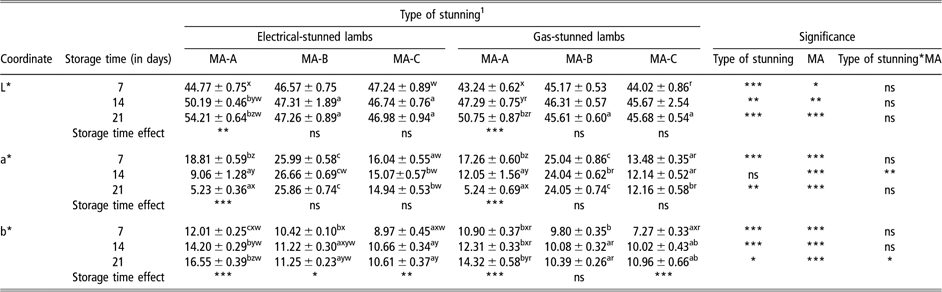
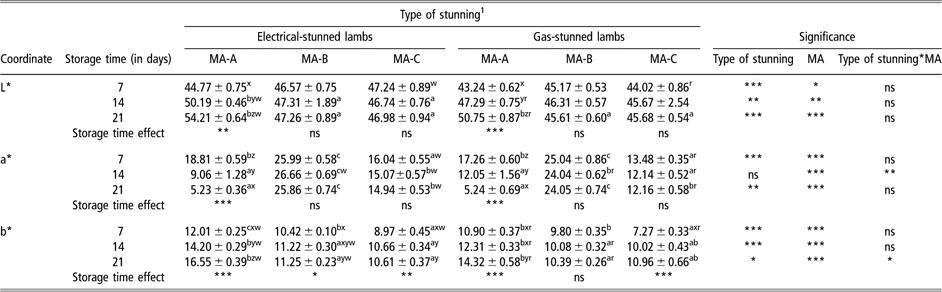
In general, CIELAB (Commission Internationale d'Eclairage L*, a*, b*) colour coordinates (Table 4) reached higher values (P < 0.05) in ESL than in the GSL group. Also, redder (higher a*) and yellower (higher b*) values were described in meat from ESL.
Values of colour coordinates (LFootnote *, aFootnote *, bFootnote *) (mean ± s.e.) in MA-packed meat of light lamb of Manchega Spanish breed stunning by two different types of stunning methods (electrical v. gas)
MA = modified atmosphere.
1 MA-A = Type A (30% CO2 + 70% O2); MA-B = Type B (30% CO2 + 0.7% CO + 69.3% N2); MA-C = Type C (40% CO2 + 60% N2).
* Significance level at 0.05; **at 0.01; ***at 0.001; ns = non-significant.
a,b Values in the same row with different superscripts are significantly different (P < 0.05) for the different types of MAs (A, B and C) at the same time post-packing and the same type of stunning.
x,y Values in the same column with different superscripts are significantly different (P < 0.05) for the different times post-packing (7, 14 and 21 days) at the same type of stunning and MA.
w,r Values in the same row with different superscripts are significantly different (P < 0.05) for the different type of stunning (electrical and gas) at the same time post-packing and MA.
The type of MA packing had an effect on colour coordinates owing to the fact that in both groups (ESL, GSL), L* and b* values were in general higher in MA-A (high oxygen level) whilst the higher a* value was observed in MA-B.
Storage time affected coordinate values (L*, a*, b*) since MA-A showed the poorest colour stability with important significant differences due to maturation time (Sorheim et al., Reference Sorheim, Kropf, Hunt, Karwoski and Warren1996). In both stunning treatments (ESL, GSL), in MA-A, L* and b* increased (P < 0.01, P < 0.001, respectively) from 7 to 21 days post packing. However, MA-B and MA-C were more stable during the storage time and, in general, no significant differences were found.
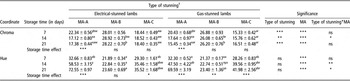
On the other hand, C* and H° angle (Table 5) were also influenced by both the pigment content and the myoglobin form (Lindahl et al., Reference Lindahl, Lundström and Tornberg2001). The type of stunning affected the C* coordinate because in all types of gas mixtures, C* was higher (P < 0.001) in the ESL than in the GSL group. Also, in both stunning groups, MA-B scored the highest C* values (P < 0.001). Only the MA-A (rich in oxygen) showed significant variations on C* with time (P < 0.001 in both treatments).
Chroma and Hue values (mean ± s.e.) in MA-packed meat of light lamb of Manchega Spanish breed stunning by two different types of stunning methods (electrical v. gas)

MA = modified atmosphere.
1MA-A = Type A (30% CO2 + 70% O2); MA-B = Type B (30% CO2 + 0.7% CO + 69.3% N2); MA-C = Type C (40% CO2 + 60% N2).
*Significance level at 0.05; **at 0.01; ***at 0.001; ns = non-significant.
a,bValues in the same row with different superscripts are significantly different (P < 0.05) for the different types of MAs (A, B and C) at the same time post-packing and the same type of stunning.
x,yValues in the same column with different superscripts are significantly different (P < 0.05) for the different times post-packing (7, 14 and 21 days) at the same type of stunning and MA.
w,rValues in the same row with different superscripts are significantly different (P < 0.05) for the different type of stunning (electrical and gas) at the same time post-packing and MA.
In general, the type of stunning did not alter H° angle. However, we observed that MA-A reached the highest values in H° ratio with 72.55 and 69.60 for ESL and GSL groups, respectively, after 21 days post packing (P < 0.001). Storage time affected H° angle in all the MAs and a great instability was also observed.
Tenderness (Warner–Bratzler shear force)
The GLM procedure showed that the type of stunning affected (P < 0.05) tenderness values at all analysed times (Table 6). In general, higher Warner–Bratzler shear force (WBSF) values were found in meat from GSL than in those from ESL. Slightly different results were described in an earlier paper (Linares et al., Reference Linares, Bórnez and Vergara2008), where suckling lamb meat from GSL was more tender than meat from ESL. On the other hand, significantly higher shear force values (less tenderness) were observed in MA-A at 14 and 21 days post packing in ESL (38.31 and 29.8 N/cm2; P < 0.001 for both) and only at 21 days post packing in GSL (36.75 N/cm2; P < 0.001). Ageing affected meat tenderness in all treatments, decreasing shear force value with the storage time (Vergara and Gallego, Reference Vergara and Gallego2001; Martinez-Cerezo et al., Reference Martinez-Cerezo, Sañudo, Panea, Medel, Delfa, Sierra, Beltrán, Cerero and Olleta2005).
Warner–Braztler Shear force (N/cm2) values (mean ± s.e.) in MA-packed meat of light lamb of Manchega Spanish breed stunning by two different types of stunning methods (electrical v. gas)

MA = modified atmosphere.
1MA-A = Type A (30% CO2 + 70% O2); MA-B = Type B (30% CO2 + 0.7% CO + 69.3% N2); MA-C = Type C (40% CO2 + 60% N2).
*Significance level at 0.05; **at 0.01; ***at 0.001; ns = non-significant.
a,bValues in the same row with different superscripts are significantly different (P < 0.05) for the different types of MAs (A, B and C) at the same time post-packing and the same type of stunning.
x,yValues in the same column with different superscripts are significantly different (P < 0.05) for the different times post-packing (7, 14 and 21 days) at the same type of stunning and MA.
Discussion
The CO2 gas is known to promote an important glycogenolytic effect on tissues with a subsequent minor lactic acid production, which results in higher pH values for the GSL meat, as observed by Rosenvold et al. (Reference Rosenvold, Petersen, Lwerke, Jensen, Therkildsen, Karlsson, Moller and Andersen2001). In addition, other authors (Channon et al., Reference Channon, Payne and Warner2000) reported higher pH values in meat from animals (pigs) subjected to CO2 gas methods in comparison to electrical systems; although in this case the results were attributed to the pre-slaughter handling and the genotype of animals more than to the stunning system. A later study, also in pigs (Channon et al., Reference Channon, Payne and Warner2002), found no significant differences for pH values among stunning treatments, although on refrigerated meat. The results of the present study markedly contrast with an earlier paper on suckling lamb (Linares et al., Reference Linares, Bórnez and Vergara2008), which showed that the type of stunning had no effect on pH. This fact suggests an intense effect of slaughter weight on meat pH in Manchego Spanish breed, as others authors have earlier described in lamb (Sañudo et al., Reference Sañudo, Sánchez and Alfonso1998). Regarding the effect of storage time, our results are similar to those found in deer meat from electrically stimulated carcasses (Wiklund et al., Reference Wiklund, Stevenson-Barry, Duncan and Littlejohn2001). However, certain authors (Sekar et al., Reference Sekar, Dushyanthan, Radhakrishnan and Narendra Babu2006) reported an increase in pH values from 7 to 21 days post packing (in buffalo meat), which is in agreement with researches done on lamb (Moore and Gill, Reference Moore and Gill1987; Linares et al., Reference Linares, Bórnez and Vergara2008) or rabbit meat (Vergara et al., Reference Vergara, Berruga and Linares2005).
On the other hand, the higher water releases (higher WHC values) from the gas-stunned group coincides with results found in suckling lambs (Linares et al., Reference Linares, Bórnez and Vergara2008), which have been associated with a greater meat juiciness (Vergara and Gallego, Reference Vergara and Gallego2000). In the electrically stunned group, meat samples packed under MA-A type released more water because of the high oxygen level added in this gas mixture (70%), in comparison to the others two packing systems (Type B and C) (Linares et al., Reference Linares, Bórnez and Vergara2008). Also, in this same treatment group (ESL), expelled water increased until 2 weeks post packing, possibly related to the faster ageing for this stunning method (Vergara and Gallego, Reference Vergara and Gallego2000).
Regarding DL, as already explained, the CO2 gas stunning system promotes a decrease in the glycogen level, which could be related to greater DL (Stoier et al., Reference Stoier, Aaslyng, Olsen and Henckel2001). Results concerning the effect of CO2 gas on DL in tissues are not clear, but the present study concludes that as a consequence of the CO2 gas inhalation, higher DL values (with significant differences at 21 days post-ageing) are found; as described earlier in other studies on chilled storage meat in atmospheres containing CO2 (Doherty et al., Reference Doherty, Sheridan, Allen, McDowell and Blair1996; Sorheim et al., Reference Sorheim, Kropf, Hunt, Karwoski and Warren1996). Some authors (Schafer et al., Reference Schafer, Roselvold, Purslow, Andersen and Henckel2002) consider the effect of the pH variation as responsible for drip formation because intense differences on its evolution were observed in the present study for the light lamb group. These differences were not described in the earlier report on suckling lamb meat (Linares et al., Reference Linares, Bórnez and Vergara2008). Also, Lambertini et al. (Reference Lambertini, Vignola, Badiani, Zaghini and Formigoni2006) (in rabbit) pointed out that water losses increase as pH decreases. However, we have found the highest water losses in GSL (lower WHC (more water expelled) and higher DL), although the highest pH values were observed.
According to Roça et al. (Reference Roça, Padovani, Filipi, Schwach, Uemi, Shinkai and Biondi2001), the type of stunning changes the total pigment content in muscles; this could explain the higher a* and b* values found in meat from the ESL, as described earlier in refrigerated light lamb meat (Linares et al., Reference Linares, Bórnez and Vergara2007a). Also, paler meat (higher L*), because of the intense fall in pH by effect of the electrical current flow and the subsequent protein denaturation, was described in the electrically stunned group, in agreement with Lindahl et al. (Reference Lindahl, Lundström and Tornberg2001). In addition, the MA-B (a low CO%) promotes a more intense red colour of meat due to the more stable carboxymyoglobin pigment formation (Jayasingh et al., Reference Jayasingh, Cornforth, Carpenter and Whittier2001). However, in MA-A, intense variations on colour coordinates were observed along time, mainly related with the high oxygen concentrations (Gill, Reference Gill1990). The enhanced pigment stability after CO binding and the carboxymyoglobin formation were also implied in the highest C* values in both stunning groups (Lindahl et al., Reference Lindahl, Lundström and Tornberg2001). A study on frog meat (Ramos et al., Reference Ramos, Gomide, Fontes, Ramos and Peternelli2005) described a negative correlation among both coordinates (L* and C* values), but we observed the same evolution range in both values. Storage time showed an intense variation of C* in MA-A in both treatment groups; this could be related to a greater instability of the oxymyoglobin with regard to the other pigments conformed (Gill, Reference Gill1990; Viana et al., Reference Viana, Gomide and Vanetti2005). Although no significant differences were found in the H° value with regard to the type of stunning, according to Jayasingh et al., Reference Jayasingh, Cornforth, Carpenter and Whittier2001, larger Hue angle was associated to less red colour, which is in agreement with our results. Intense discolouration due to the high oxygen concentrations is related to the greater H° values in MA-A.
Finally, regarding the shear force values, we observed differences on its evolution in light lamb meat as compared to an earlier research in suckling lambs (Linares et al., Reference Linares, Bórnez and Vergara2008). Therefore, we can conclude that there exists an important effect of the slaughter weight on meat tenderness in ovine species, as reported by Martinez-Cerezo et al. (Reference Martinez-Cerezo, Sañudo, Panea, Medel, Delfa, Sierra, Beltrán, Cerero and Olleta2005). Contrarily, other studies on pork (Roça et al., Reference Roça, Padovani, Filipi, Schwach, Uemi, Shinkai and Biondi2001) did not find significant differences in WBSF values for either treatment (electrical v. gas). Furthermore, the presence of high oxygen levels in the packaging atmosphere reduces meat tenderness, which has been observed earlier in pork by Lund et al. (Reference Lund, Lametsch, Marchen, Jensen and Skibsted2007).
On the whole, the type of stunning affected pH values, water losses and colour values on light lamb meat of the Spanish Manchego breed. Meat from the GSL group scored the highest pH values, which decreased with time. Water losses (WHC and DL) were in general, also the highest in GSL, which could be related to greater meat juiciness. In addition, some variations were found in both stunning groups regarding colour coordinates (CIELAB), and as a consequence, lower colour saturation was described in the GSL group. Colour evolution and meat tenderness were improved under the atmosphere with a low CO level as compared to the other two types of packaging systems (MA-A, MA-C).
In conclusion, light lamb meat quality of Manchego Spanish breed packed under MA can be affected by the stunning treatments.
In comparison with an earlier research in Manchego breed suckling lamb (Linares et al., Reference Linares, Bórnez and Vergara2008), the pH values, lightness and tenderness varied by effect of the age/slaughter weight. Some age-dependent physiological metabolites could influence the meat quality evolution (Bórnez et al., Reference Bórnez, Linares and Vergara2009).
The 0.7% CO gas concentration also seems to be a good packaging possibility in the case of this red meat; specifically, light lamb.
Acknowledgements
The authors would like to thank the slaughter-men at the Municipal Abattoir in Albacete (Spain) for their valuable help, and K. Walsh for assistance with the preparation of the manuscript in English. This work was made possible through financial help from the Council of Education of the Junta of Castilla-La Mancha region (PREG07-016).