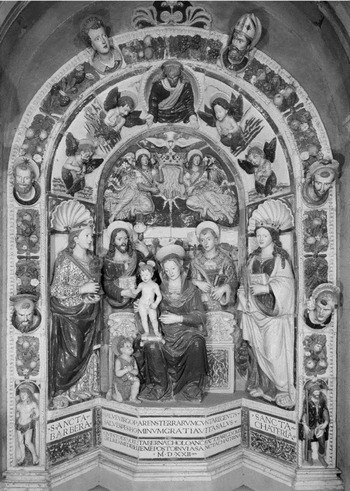
At the junction where Florence's busy San Lorenzo Market meets the hectic via Nazionale stands an enormous tabernacle of the Virgin and saints (Figures 1 and 2). Passers-by rarely stop to look at it, and it has mostly been ignored by historians. Yet on several counts it is a remarkable object. When it was put up, in 1522, it was (and still is) one of the biggest street tabernacles in Florence, a commanding presence in the neighbourhood and beyond. It is also one of the few surviving landmarks left by the city's potenze, informal brigades of lower-class men who divided Florence up into festive ‘kingdoms’ or ‘states’ between the late fifteenth and early seventeenth centuries. As the inscription on the base of the platform supporting the Madonna announces: ‘The men of the kingdom of Biliemme had this pious tabernacle made and placed in via Santa Caterina, 1522.’
Giovanni della Robbia (attr.), tabernacle of the Biliemme, via Nazionale, Florence. Known as the tabernacolo delle fonticine.

Tabernacle of the Biliemme. Photo: Scala.

These two facts alone make a good case for taking a close look at the Biliemme tabernacle, to see what it might tell us about locating communities in the Renaissance city – or rather about how specific groups located themselves, how in effect they sought to create community. With the men of the Biliemme we in fact are confronted with several overlapping kinds of solidarity. To take an active part in a potenza meant to identify oneself as a man belonging to a neighbourhood, to an artisan and labourer class, and quite often to a particular occupation. All these factors were in play in the case of the Biliemme, which mainly consisted of weavers in the Florentine textile industry. What makes the Biliemme especially interesting, however, is that it was also essentially a migrants’ brigade. While the economic and demographic impact of immigration, much of it in Florence related to the city's huge textile business, is reasonably well known, our understanding of what it meant for an artisan migrant to negotiate life in an alien city remains a work in progress.Footnote 1 The Biliemme – by and large a German potenza in the early 1500s, and later one dominated by weavers who had come to Florence from elsewhere in Italy – therefore presents an opportunity to contribute to the discussion about migrant workers in the civic worlds of early modern Italy, to examine the social and cultural forces that shaped their horizons. Indeed, as we will see, the brigade's tabernacle makes such issues inescapable.
Politics and the potenze
By the time the Biliemme put up its tabernacle in the early 1520s there were already as many as 30 potenze brigades in Florence, with the number continuing to grow over the rest of the century.Footnote 2 To be necessarily schematic here, the rise of these worker kingdoms spoke to a new aristocratizing ethos that gripped Florentine elites towards 1500, one that militated, ultimately among republicans of all stripes, to produce the more insistent exclusion from formal civic life of those who were becoming consistently referred to as the plebe. An attendant discourse on hierarchy and authority – one that carried through into the duchy after 1532 as the plebe became a perfect Other for republican aristocrats now busily fashioning themselves as a nobility – insistently characterized work as vile and workers as bereft of honour or any public role. In this context, these non-citizens took up a language of statehood (potenza means power, in the sense of a state) in order to carve out a representational space for themselves in the civic sphere. They marked out territories around the shops and workshops of the city centre and elsewhere, or in the predominantly lower-class neighbourhoods of the outskirts in which they mainly lived. Most of the high-profile potenze were associations based on the various branches of textile production – and in the case of weavers, who usually operated their looms at home, ties of craft and residential neighbourhood coalesced. The Biliemme, in the north of the large parish of San Lorenzo, around the church of San Barnaba, was one of the two most prominent brigades that were mainly comprised of wool weavers; the other was located on the south side of the Arno in the area known as the Camaldoli, from which it took its name.Footnote 3
In common with much carnivalesque ritual in early modern Europe, an inversion of ‘rich’ and ‘poor’ saw Florence's artisan kings extract tribute from their employers or the wealthy residents in their states – their ‘subjects’ – and at the same time extract public acknowledgement for the role of workers and work. These kinds of festive transactions took place under the sign of civic peace, and they were mediated, and at times amplified and even initiated, by the authorities. Above all the potenze were patronized by the Medici, who clearly saw in this festive dialectic a means of reaching out for lower-class support in their quest for supremacy. It is no coincidence that the Biliemme tabernacle went up in 1522, the date emphatically proclaimed on its base. In the summer of 1522, Cardinal Giulio de’ Medici crushed a conspiracy to assassinate him and re-establish a broadly based republican regime. Shortly afterwards, during that year's feast of St John the Baptist, the city's patron saint, Giulio, made a point of parading Medici ties with the potenze, going as far as to watch the start of the annual Palio horse race from the home of the emperor of all the potenze kings.Footnote 4 It was in the politically charged aftermath of these events, which saw the reversal of Giulio's policy of conciliation towards his opponents, that the men of the Biliemme seized the opportunity – no doubt with the blessing of the Medici cardinal – to lay concrete, permanent claim to a slice of the parish of San Lorenzo, thrusting their kingdom beyond the theatre of the festa and thus beyond one of the conventions of the carnival genre, which was to place temporal limits around the imaginary states of artisans and labourers.
Neighbourhood madonna, German saints
If that very briefly is the wider panorama, and offers a taste of the dialogue of power within which artisans asserted themselves as potenze, it does not sufficiently explain the Biliemme's uniquely monumental expression of kingdom. For that it is necessary to turn to the local politics of a neighbourhood that had a distinctly migrant texture.
The tabernacle may declare itself to be on via Santa Caterina, as today's via Nazionale was then called, but this part of the street was more commonly known as via Tedesca, the street of the Germans. Artisans from Cologne, Brabant, Flanders and Holland, known in Florence simply as Germans, were the most significant migratory groups to arrive in Florence in the fifteenth century, clustering here and in the Camaldoli on the other side of the river. These artisans, while of many trades, dominated wool weaving in Florence in the middle decades of the Quattrocento. The Biliemme tabernacle reveals itself to be intimately linked to the German community in San Lorenzo through the presence on either side of the Virgin of St Barbara and St Catherine of Alexandria, full-length figures with their names loudly inscribed beneath them. St Catherine was the patron saint of two confraternal brotherhoods founded by Germans in the fifteenth century. One of these confraternities, also dedicated to the Virgin, had met nearby in the church of San Lorenzo. St Barbara, meanwhile, was the patron of the principal German confraternity in the city, its chapel in the church of the Annunziata in the same quarter.Footnote 5
In the first instance, what seems to have galvanized the German community to put up the tabernacle was the plague, which had been threatening since the summer of 1522, was rampant in Rome and Milan and had struck the countryside around Florence by August. When it hit the city in November, its entry was widely blamed on a lone German on his way home from Rome. This man headed, as chroniclers told it, to his house in the ‘[via] Marmeruchole of these Germans’, just off via Santa Caterina, where he got sick and later died. From there plague spread mainly ‘around San Barnaba among the Germans’, killing around 40 people. The reaction of the authorities was briefly to quarantine several streets in the area, which not only isolated the German community but stigmatized it, whatever the precise truth of the plague's origins.Footnote 6
The Biliemme tabernacle can be seen as a response to the trauma of these events, something strongly suggested by the two small standing saints at the base of the frame, the typical plague saints Sebastian and Roch. Organizing the erection of the tabernacle was an act of contrition. ‘Hail the Virgin, the ruling mother of the earth. Hail the hope, grace, life, salvation of man’, say the words immediately above the inscription attesting to the fact the tabernacle was built by the men of the Biliemme. The Madonna was a powerful peacemaker, an intercessor with God who could help expiate the sin that had brought the plague upon the Germans, as well as ward against future ravages. In fact plague continued to take lives in the city after the first bout in November of 1522, returning in force towards the end of the Florentine year, the following March, and striking hardest in the ‘impoverished places’ of the outskirts.Footnote 7
Yet why appeal to the Virgin as ‘the men of the realm of Biliemme’? One reason perhaps was that potenze kingdoms were rooted in an idea of urban territory and that plague was understood to be a disease transmitted through the air, spreading in this way between neighbours and infiltrating whole districts. However, there were arguably more compelling motives. The kingdom was a vehicle through which these men could take their migrant solidarities and insert them into wider communities. To begin with, the neighbourhood-community that the realm of the Biliemme looked to give shape to was hardly uniformly German. Moreover, to act as the Biliemme was to claim membership of a citywide artisan class and participate in an established civic subculture: no matter where they were from, when men gathered as a potenza they became more Florentine. Thus, in the wake of the plague crisis of 1522, Germans, perhaps with Medici financial contributions, raised a considerable sum of money and commissioned the well-known artist Giovanni della Robbia – also a subject of the kingdom, his workshop a few steps away – to make an extraordinary tabernacle that might define and unify the neighbourhood, bringing it under the Virgin's intercessory canopy and forcefully asserting it within the jostling, competitive world of potenze states.Footnote 8 At the same time, they looked to incorporate, or reincorporate, themselves into that wider artisan subculture, and ultimately into the civic tapestry of Florence. In the tabernacle, the German saints Barbara and Catherine are visually dominant, yet their position is also deferential, not only in respect to the Madonna but to the entire inner group, which includes both St Lawrence, the saint of the parish, and St John the Baptist, the spiritual advocate of the city.Footnote 9 Essentially the Madonna of the Biliemme was enjoined not only to intercede with God, but to make peace between men. Indeed, one of the inspirations for the potenza's own Virgin was almost certainly the region's most potent Marian peacemaking icon, the Madonna of Impruneta, whom Cardinal Giulio had processed through Florence immediately after the failed plot against him and whose shrine was in fact a popular destination for the potenze when they made trips into the countryside.Footnote 10
Inheriting the kingdom – the new Italians
The tabernacle on via Nazionale is the only known source for the early history of the Biliemme – and it is tempting to imagine, though it seems unlikely, that this potenza was first forged amidst the turmoil of 1522. In any event, what we can be certain about is that by the time the men of the brigade put up their monument, the kingdom was undergoing a transformation.
Even before the start of the sixteenth century, few new German-speaking artisans were arriving in Florence, and Germans had fallen from being more than half of all wool weavers in the city to one quarter and probably considerably less.Footnote 11 In 1502, one of the two German confraternities dedicated to St Catherine, the one north of the river in San Lorenzo and consisting primarily of cobblers, moved to amalgamate with a confraternity that described its members as the ‘Italian shoemakers of Florence’, a process that was complete by 1514. This new occupational brotherhood maintained several of the ‘old regulations of the company of the Germans’, including masses for the feast days of the Virgin and St Catherine, and it made a certain ‘Maestro Leonardo, the German’ an office-holder for life, but its new statutes were in Italian rather than Flemish and the confraternity chose new saints to be their principal heavenly advocates. Later, in the 1550s, the second brotherhood of St Catherine, this one south of the Arno in the Camaldoli, was absorbed into a local confraternity of Italian wool weavers, which took over the Germans’ chapel in the church of the Carmine. The Carmelite friars explained that the Germans were ‘extinct, or had left’.Footnote 12
However, the story of immigration into these neighbourhoods, and the story of the Biliemme, does not end there. Germans were being displaced or replaced not only by Florentines but by new migrants. By the end of the fifteenth century about 20 per cent of wool weavers were from small centres in Tuscany and other Italian towns, compared to almost zero previously. In the mid-sixteenth century that percentage would have risen steeply, a stream of textile migrants settling in the city as the wool industry entered a boom period in the 1550s and 1560s.Footnote 13
In short, 35 or so years after the Biliemme put up their tabernacle this was a district of a somewhat different stamp – still one with a major clustering of wool weavers and a significant migrant population, but now overwhelmingly Italian. As seems true for the earlier incarnation of the potenza, migrants were again near the centre of things. In 1577 – a year of extraordinary festivities to mark the birth of an heir to Duke Francesco de’ Medici – the king of the Biliemme, the wool weaver Filippo di Orlando, was from Marradi near the border of Tuscany and the Romagna. In 1610 – at festivities for the birth of an heir to Cosimo II – the king was from the Rigo River area in the south of Tuscany, while his flagbearer was from Perugia.Footnote 14 From the other side of the river – where the same transformations were taking place – there survives a list of 146 men whom the king of Camaldoli in 1559 counted as his adherents. Fifty-five of these men, almost 40 per cent, described themselves as having a place of origin other than Florence. Outside ducal Tuscany, there were those from Venice, Vicenza, Parma and Bologna, with Lucca, Ferrara and Genoa standing out.Footnote 15 Within the ducal state, there were men from Montopoli and Mulazzo in the west to Santa Sofia and Modigliana in the east. In 1577, the king of the Camaldoli, Francesco di Bernardo, was from Montopoli, about half way along the Arno valley towards Pisa, while his viceroy was from Ferrara, the two places most frequently nominated in the brigade's list of 1559.Footnote 16
If the old Biliemme had allowed a specific migrant group to reach out to form broader ties of occupation and class, the later potenza was a mechanism that arguably helped a very disparate body of newcomers to build these kinds of ties in the first place. We gain some insight into the dynamics of this in 1576, when 228 wool weavers from the Biliemme area and 265 of their counterparts in the Camaldoli moved to establish a new occupational confraternity. This brotherhood – which like other citywide trade corporations aimed to set up dowries and aid for sick and old artisans – would never have been founded if it had not been for the economic problems caused by the recent banking crisis in Florence. Why? Because, the weavers explained in their statutes, ‘What a difficult thing it is for so many persons from different towns and nations, and mostly coarse people, as there has always been, and are, in our trade, to come together in communal concord in one council and with one will.’Footnote 17 That clearly articulated a general truth for these men, but what is equally interesting here is how difficult it was to bring weavers together from either side of the Arno: the confraternity was founded only after two separate neighbourhood ballots, and the brotherhood later revealed that it had bought a meeting hall in a neutral part of the city because ‘our membership is divided into two parts . . . and one part did not want to go to the Camaldoli and the other did not want to come to San Bernaba’.Footnote 18 In other words, a powerful sense of place, of a new urban homeland, which the Biliemme and Camaldoli kingdoms had helped to foster and which in part functioned to create ties between artisan migrants and between them and their other neighbours, ironically militated against wider unities. At the same time this did not prove an insuperable obstacle, and the men who overcame it were also at the heart of each potenza: one of the new confraternity's six founding brothers appears a year later, in 1577, as the Camadoli's Ferrarese viceroy, while the man who wrote the bulk of the statutes was secretary to the Biliemme monarch.Footnote 19 Again, to act as a potenza was not only to define a community of workers but to identify that community as belonging to a citywide artisan class, whose festive culture involved warlike competition between states but also diplomacy, alliance and the transaction of peace. During the festivities of 1577, Camaldoli king Francesco di Bernardo from Montopoli recorded that, along with his ‘soldiers and other people of the king’, he processed across the Arno to feast with Biliemme king Filippo di Orlando from Marradi, after which ‘his colleague’ Filippo walked him home.Footnote 20
As for the Biliemme itself, it had also become deeply enmeshed with a local devotional confraternity that called itself the Company of the Assumption in via Tedesca. An account book dating from 1600 reveals that Filippo di Orlando was a brother, as were at least four of the central figures in the potenza of 1610, including its Perugian flagbearer.Footnote 21 In the confraternity's surviving statues, written in 1575, the brothers began by remembering, though with no details, that the Company of the Assumption had been founded by wool weavers back in 1522.Footnote 22 This may have been the case – a new formal corporation may have emerged out of the same impulses that drew men together as the Biliemme potenza. Yet whether this declaration of origins was entirely accurate or not, in making it these Italians – who drank in the nearby Cella di Ciardo tavern that served as the hub of their kingdom, and who met as confraternal brothers on the street of the tabernacle – suggest how the giant Madonna put up by Germans 50 years earlier, the date of 1522 inscribed beneath her feet, had itself became a point of reference for a neighbourhood in flux, an object around which artisan migrants created and recreated community.
Conclusion
By way of conclusion, it is useful to pan out and re-emphasize the wider social dynamic within which the Biliemme potenza coalesced. By the mid-sixteenth century the Biliemme had built its name, no doubt with considerable help from its tabernacle, into the map of Florence, becoming a word commonly used to indicate the ‘via Porciaia [via Sant'Antonino] and the streets above San Barnaba towards the Fortress’, as one chronicler described the kingdom's territory.Footnote 23 But for citizens Biliemme was also very often a pejorative term, freighted with a mixture of pity, anxiety and revulsion, a shorthand (as ‘Camaldoli’ had long been) for the urban hinterlands of the impoverished and excluded, especially those of the textile industry. At times, even other artisans, such as the Santo Spirito tailor Bastiano Arditi, a plebeian himself in the eyes of most citizens, sought to dissociate themselves from these neighbourhoods: the outskirts, Arditi said in the mid-1570s, were ‘where the plebe live, such as Biliemme, Camaldoli and similar places’.Footnote 24
Such prejudice was a fact of city life, and for those who came from outside of Florence it took on a second dimension. When the brothers of the confraternity that had joined the wool weavers of the Biliemme and Camaldoli in 1576 wanted to extend their oratory at the turn of the seventeenth century, their next door neighbour, the friars of the hospital of San Paolo, protested the plan by linking class and migrancy in a single breath. The hospital's governors told Duke Ferdinando I de’ Medici that the confraternity comprised ‘every sort of manual type, and mostly foreigners’, and thus ‘of erratic temper, given to arguing among themselves, and also to habits of little civility’. The duke's father, Cosimo I, they claimed, ‘did not want these kind of people to set up big companies’.Footnote 25 Some decades later, a court secretary, in reference to the potenze, remarked,
We call Biliemme those outlying districts of the city of Florence where this sort of people live. And though born and raised in Florence, they are different from the other Florentines in their customs and speech. In short, they are a people unto themselves, whom we call the Greasy Ones, or Biliemme, which also signifies the most vile plebe.Footnote 26
Here, the idea of foreign-ness, no doubt informed by the long history of immigration, had become a metaphor for the outsider status, for the otherness, of all plebeian men. If artisan kingdoms in general were, in part, forged by these kinds of social and rhetorical pressures, arguably the double load bearing down on migrants provided them with a compelling motive to form horizontal ties in the neighbourhood and beyond, as well as seek a powerful and mediating patron – in short, to embrace the carnivalesque subculture of the potenze and project themselves into the Florentine civic conversation.