Background
Anxiety disorders are among the most prevalent mental health disorders in the United States. About 18% of the US population will suffer from an anxiety disorder each year and almost 29% will experience an anxiety disorder at some point in their lives (Kessler et al. Reference Kessler, Berglund, Demler, Jin, Merikangas and Walters2005 a). Prior studies of patients with specific anxiety disorders show that they have large decrements in functioning and well-being and increases in disability compared with those without anxiety disorders (Blazer et al. Reference Blazer, Hughes, George, Swartz, Boyer, Robins and Regier1991; Massion et al. Reference Massion, Warshaw and Keller1993; Schneier et al. Reference Schneier, Heckelman, Garfinkel, Campeas, Fallon, Gitow, Street, Del Bene and Liebowitz1994; Katon et al. Reference Katon, Hollifield, Chapman, Mannuzza, Ballenger and Fyer1995; Sherbourne et al. Reference Sherbourne, Wells and Judd1996; Hollifield et al. Reference Hollifield, Katon, Skipper, Chapman, Ballenger, Mannuzza and Fyer1997; Schonfeld et al. Reference Schonfeld, Verboncoeur, Fifer, Lipschutz, Lubeck and Buesching1997; Zatzick et al. Reference Zatzick, Marmar, Weiss, Browner, Metzler, Golding, Stewart, Schlenger and Wells1997; Malik et al. Reference Malik, Connor, Sutherland, Smith, Davison and Davidson1999). These disabilities manifest themselves in the absence of desire to perform activities, interference in level of performance, and avoidance of activities. While the negative impact of anxiety is fairly well established relative to that in persons without anxiety, few studies have compared differences in functioning and disability between the anxiety disorders themselves. In addition, while individuals with more than one anxiety diagnosis appear to have increased symptom severity (Kessler et al. Reference Kessler, Chiu, Demler and Walters2005 b), less is known about whether or not co-morbidity affects levels of functioning and disability (Norberg et al. Reference Norbeg, Diefenbach and Tolin2008), although some studies have found lower levels of quality of life in anxiety patients with co-morbid depression compared with those with anxiety alone (Stein & Kean, Reference Stein and Kean2000; Lochner et al. Reference Lochner, Mogotsi, du Toit, Kaminer, Niehaus and Stein2003). A recent meta-analysis found that, compared with control samples, no particular anxiety disorder diagnosis was associated with significantly poorer overall quality of life than was any other anxiety disorder diagnosis (Olatunji et al. Reference Olatunji, Cisler and Tolin2007). However, there was difficulty in comparing across studies due to the use of different clinical settings, small sample sizes for many of the specific anxiety disorders, and different measures of quality of life assessed.
This paper uses a large sample of primary care patients diagnosed with one or more of four common anxiety disorders [generalized anxiety disorder (GAD), panic disorder (PD), social anxiety disorder (SAD) and post-traumatic stress disorder (PTSD)] to address these issues. Specifically, we estimate whether the relative impact of anxiety on functioning and disability is due to the principal anxiety disorder or to the co-occurrence with other anxiety disorders. In addition, we estimate the relative contribution to reduced functioning and increased disability of different combinations of anxiety disorders, controlling for the presence of co-morbid depression. We control for co-morbid depression since it is one of the most burdensome disorders worldwide (Murray & Lopez, Reference Murray and Lopez1996). Less is known about the comparative impact of the anxiety disorders themselves.
Method
Sample
Subjects include 1004 primary care patients with PD, SAD, GAD or PTSD enrolled between June 2006 and April 2008 in the Coordinated Anxiety Learning and Management (CALM) study. CALM is the largest randomized trial of collaborative care for anxiety disorders conducted to date (for details about the study, see Sullivan et al. Reference Sullivan, Craske, Sherbourne, Edlund, Rose, Golinelli, Chavira, Bystritsky, Stein and Roy-Byrne2007). It is a flexible delivery model for primary care anxiety treatment that simultaneously targets any of these four common anxiety disorders in primary care; provides strategies to enhance patient engagement in treatment, including allowing choice of either cognitive behavioural therapy (CBT), medication, or both; and provides the option for additional treatment over the course of 1 year in 3-month ‘steps’. It utilizes a web-based outcomes system to optimize treatment decisions and a computer-assisted program to allow CBT-inexperienced care managers to optimize delivery of CBT. Medication is prescribed by primary care physicians, with care manager assistance in promoting adherence, dose optimization, and medication switches/augmentation.
Patient recruitment was coordinated at four sites: University of Washington at Seattle, University of California at San Diego and Los Angeles, and the University of Arkansas at Little Rock, Arkansas. Each of the four sites selected clinics in their geographic area to participate. Candidate clinics were evaluated and 17 were purposively selected based on a number of considerations, including provider interest, space availability, size and diversity of the patient population, and insurance mix (public and private).
A ‘facilitated referral’ approach used multiple strategies to recruit subjects. Primary care providers and clinic nursing staff directly referred potential subjects, and sites actively publicized the study within each clinic, allowing for self-referral. In addition, at some sites, a simple five-question anxiety screener (Means-Christensen et al. Reference Means-Christensen, Sherbourne, Roy-Byrne, Craske and Stein2006) was used to identify patients who had potential anxiety disorders.
Referred subjects met with a study clinical anxiety specialist to determine eligibility for CALM. An eligible subject had to be a patient at one of the participating clinics, be aged at least 18 years old, DSM-IV criteria for GAD, PD, SAD or PTSD [based on the Mini International Neuropsychiatric Interview (MINI; Lecrubier et al. Reference Lecrubier, Sheehan, Weiller, Amorim, Bonora, Sheehan, Janavs and Dunbar1997) administered by a nurse or social worker after formal training and diagnostic reliability testing], score at least 8 (moderate but clinically significant anxiety symptoms on a scale ranging from 0 to 20) on the Overall Anxiety Severity and Impairment Scale (OASIS) (Campbell-Sills et al. Reference Campbell-Sills, Norman, Craske, Sullivan, Lang, Chavira, Sherbourne, Roy-Byrne and Stein2009), be willing to participate in CALM, and be able to provide written, informed consent. The MINI has been shown to have high inter-rater and test–retest reliability and good concordance with the Structured Clinical Interview for DSM Disorders (SCID) and Composite International Diagnostic Interview (CIDI) (Lecrubier et al. Reference Lecrubier, Sheehan, Weiller, Amorim, Bonora, Sheehan, Janavs and Dunbar1997; Sheehan et al. Reference Sheehan, Lecrubier, Sheehan, Amorim, Janavs and Weiller1998). Exclusion criteria were minimal and were intended to exclude persons who would not likely benefit from the intervention or for whom the intervention could be risky. They included serious alcohol or drug use (specifically, alcohol or marijuana dependence or any other drug abuse or dependence, including methadone – 4% were excluded for this reason), unstable medical conditions, marked cognitive impairment, active suicidal intent or plan, psychosis, or bipolar I disorder. Subjects already receiving ongoing CBT were excluded. Finally, persons without routine access to a telephone, or who could not speak English or Spanish were excluded.
Of 1620 patients referred and interviewed for eligibility, 1062 were eligible and 1036 consented for the study. Data for the analyses in this paper are from the 1004 subjects who completed a baseline telephone questionnaire conducted by a centralized data collection facility at the RAND Corporation in Santa Monica, CA.
Measures
To measure functioning and disability status, we used five widely used self-report measures. Mental and physical health-related quality of life was measured using the global physical (PCS12) and mental (MCS12) health scales of the short-form 12-item Health Survey (SF-12) (Ware et al. Reference Ware, Kosinski, Turner-Bowker and Gandek2002). The SF-12 summary scores have internal consistency reliability estimates of 0.89 and 0.86, exceeding the minimum standard for group-level comparisons and have demonstrated good validity for discriminating between groups differing in physical or mental health status (Ware et al. Reference Ware, Kosinski, Turner-Bowker and Gandek2002). Norm-based scoring is used to achieve a mean of 50 (s.d.=10) in the general US population for each measure. The three-item Sheehan Disability Index was used to measure the extent to which work/school, social life and home life or family responsibilities were impaired by the patient's symptoms (Sheehan, Reference Sheehan1983). The internal consistency of the measure has been shown to be high (0.83) in primary care patients and it has been shown to be a sensitive tool for identifying primary care patients with mental health-related functional impairment (Leon et al. Reference Leon, Olfson, Portera, Farber and Sheehan1997). A more direct activity limitation measure was the Centers for Disease Control and Prevention Healthy Days measure (HD3-Day), a single-item estimate of restricted activity days or days (in the past 30 days) in which poor physical or mental health kept the subject from doing usual activities (Centers for Disease Control and Prevention, 2000). A number of studies have demonstrated the construct and known-groups validity of this measure in various populations (Moriarty et al. Reference Moriarty, Zack and Kobau2003). Finally, the five-item EuroQol preference-based measure that evaluates health-related quality of life in the areas of mobility, self-care, usual activities, pain/discomfort and anxiety/depression (EQ-5D; Rabin & de Charro, Reference Rabin and de Charro2001) was used to describe the patient's health status and preference for that health state on a scale of 0 to 1. A high score on this measure indicates greater preference for one's own current health state across the domains of physical, mental and social functioning. A wide range of studies has reported on the reliability and validity of the EQ-5D in countries around the world (Brooks et al. Reference Brooks, Rabin and de Charro2003). While the five measures are moderately correlated in our sample (e.g. the highest correlation is −0.64 between MCS12 and the Sheehan Disability Index), each provides unique information. MCS12 and PCS12 indicate more subjective reports of functioning or well-being, while the Sheehan Disability Index and HD3-Day measures (correlation=0.54) indicate disability more directly.
To test whether the effect of having one or more anxiety disorders was due to increased avoidance behavior or frequency/severity of anxiety, we included three OASIS items in our analyses: How often did you avoid situations, places, objects, or activities because of anxiety or fear? (avoidance item); How often have you felt anxiety? (frequency item); How intense or severe was your anxiety? (severity item) (Campbell-Sills et al. Reference Campbell-Sills, Norman, Craske, Sullivan, Lang, Chavira, Sherbourne, Roy-Byrne and Stein2009). All multivariate analyses controlled for demographics (age, gender, education, ethnicity), number of self-report chronic medical conditions (asthma, high blood sugar or diabetes, hypertension or high blood pressure, arthritis or rheumatism, cancer, neurological condition, stroke or major paralysis, heart attack, back problems, stomach ulcer, chronic inflamed bowel, thyroid disease, kidney failure, migraine headaches, trouble seeing even with glasses, chronic lung disease, a physical disability), co-morbid depression, and study site.
Statistical approach
Linear multivariate regression models were run to evaluate whether levels of functioning and disability were significantly different in subjects with one or more anxiety disorders (e.g. subjects with one, two or three or more disorders), controlling for demographics, number of chronic medical conditions, co-morbid depression, and study site. To examine whether avoidance or increased frequency and severity of anxiety explained these results, we conducted additional analyses adding the avoidance item singly to the multivariate regression models and then repeated the analyses with all three OASIS items in the model simultaneously. Similarly, linear multivariate regression models were run to evaluate the unique effect of PD, SAD and PTSD, entered simultaneously, compared with GAD also controlling for the other covariates. GAD was selected as the comparator because it was the most frequent anxiety disorder. Evidence of an independent burden of disability for each anxiety disorder, after adjusting for other disorders simultaneously, provides additional support for increased burden due to co-morbidity. To determine the relative contribution to reduced functioning and well-being of different combinations of anxiety disorders, regression models were subset to patients with one anxiety disorder only; two disorders; and three disorders. Indicators for type of disorder or combinations of disorders were included as independent variables in the relevant subset models, again controlling for covariates described above. Results are standardized predictions generated from parameter estimates in each regression model.
Results
The baseline sample of 1004 subjects was 71% female, 20% Hispanic, 12% black, 57% white, and 12% other ethnicity. A proportion of 22% of the sample had not completed high school. The mean age was 43 years. Of the sample, 42% had one anxiety disorder only; 38% had two; 16% had three; and 3% had all four anxiety disorders. On average, the baseline sample reported 2.3 (out of 17) co-morbid chronic medical conditions. A proportion of 63% were currently taking a prescribed psychotropic medication.
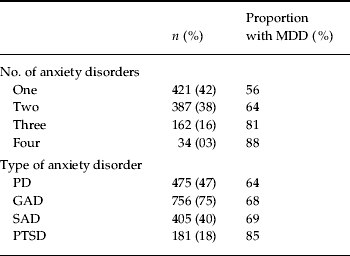
Table 1 describes the sample in terms of associated co-morbid depression. As number of anxiety disorders increased, so did the percentage with co-morbid depression. For example, 56% of those patients with only one anxiety disorder had co-morbid depression compared with 88% of those patients with four anxiety disorders. Co-morbid depression varied from 64% in subjects with PD to 85% in subjects with PTSD (with or without another anxiety disorder).
Co-morbid depression by number and type of anxiety disorder

MDD, Major depressive disorder; PD, panic disorder; GAD, generalized anxiety disorder; SAD, social anxiety disorder; PTSD, post-traumatic stress disorder.
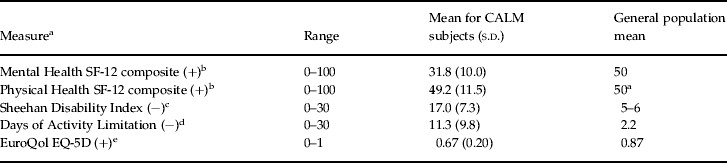
Table 2 shows baseline levels of functioning and well-being for all CALM subjects combined. For comparison purposes, the last column indicates general population means based on published literature. On all but physical health, CALM subjects showed reduced levels of functioning and well-being and/or increased levels of disability from those normally found in general populations.
Baseline levels of functioning and well-being for CALM subjects (n=1004)

CALM, Coordinated Anxiety Learning and Management; s.d., standard deviation; SF, short-form.
a The − or + indicates the direction of good health.
b The Mental and Physical Health composite scores reflect norm-based scoring where the mean of the general population is 50 with a standard deviation of 10.
c Primary care population norms (Leon et al. Reference Leon, Olfson, Portera, Farber and Sheehan1997; Olfson et al. Reference Olfson, Fireman, Weissman, Leon, Sheehan, Kathol, Hoven and Farber1997).
d 2008 Nationwide mean days of activity limitation (confidence interval 2.1–2.3) are available on the Centers for Disease Control and Prevention (2009) website.
e US general population mean (Luo et al. Reference Luo, Johnson, Shaw, Feeney and Coons2005).
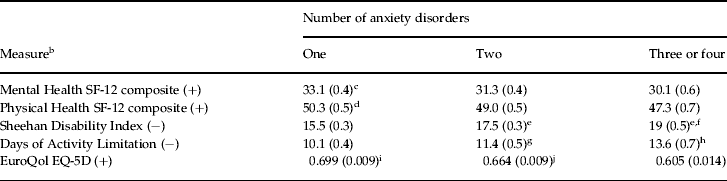
Table 3 shows baseline levels of functioning and well-being by number of co-morbid anxiety disorders. Functioning and preferences for health states decrease while activity limitations and disability increase as number of anxiety co-morbidities increase. Almost all comparisons are significantly different from one another except that patients with between two and four anxiety disorders have similarly low levels of mental well-being, and patients with one or two anxiety disorders have similarly high levels of physical functioning.
Functioning and well-being levels by number of anxiety disordersFootnote a

SF, Short-form.
Values are given as mean (standard error).
a Analyses controlled for age, gender, education, ethnicity, number of self-report chronic medical conditions, co-morbid depression and study site.
b The − or + indicates the direction of good health.
c Significantly higher than subjects with two (p=0.004) or three or four (p=0.002) anxiety disorders.
d Significantly higher than subjects with three or four (p=0.001) anxiety disorders.
e Significantly higher than subjects with one (p=0.00001) anxiety disorder.
f Significantly higher than subjects with two (p=0.0103) anxiety disorders.
g Significantly higher than subjects with one (p=0.0428) anxiety disorder.
h Significantly higher than subjects with one (p<0.0000) or two (p=0.0084) anxiety disorders.
i Significantly higher than subjects with two (p=0.007) or three or four (p=0.0000) anxiety disorders.
j Significantly higher than subjects with three or four (p=0.003) anxiety disorders.
The number of co-morbid anxiety disorders correlated 0.13 with the OASIS frequency item, 0.19 with the OASIS severity item, and 0.24 with the OASIS avoidance item. When the OASIS avoidance item was included in the models, nine out of the 12 significant comparisons shown in Table 3 remained significant. The differences between patients with two anxiety disorders and those with three or four disorders were reduced for the two disability measures (Sheehan Disability Index and HD3-Day), while the difference between patients with one disorder only and those with two disorders was also reduced for the HD3-Day disability measure. When the OASIS frequency and severity items were included along with avoidance, two more comparisons became non-significant: the difference between patients with one and two disorders on the EQ-5D and the difference between patients with one and three or four disorders on the MCS12.
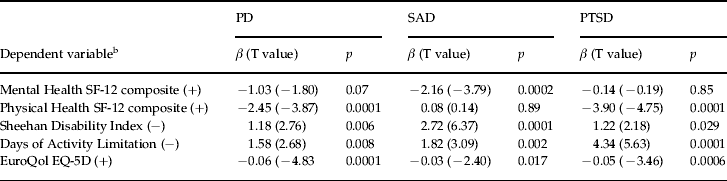
Table 4 shows parameter estimates from regression models where PD, SAD and PTSD were entered simultaneously with GAD, the most prevalent disorder, as the comparator. Patients with SAD had significantly lower mental functioning relative to GAD, controlling for the other anxiety disorders, depression, chronic medical conditions and demographics. Patients with either PD or PTSD had significantly lower physical functioning relative to GAD. Disability was significantly less in GAD compared with each of the other anxiety disorders, while preference for current health state was significantly higher/better in GAD compared with each of the other anxiety disorders.
Unique effect of each anxiety disorder relative to GADFootnote a

GAD, Generalized anxiety disorder; PD, panic disorder; SAD, social anxiety disorder; PTSD, post-traumatic stress disorder; SF, short-form.
a Analyses controlled for age, gender, education, ethnicity, number of self-report chronic medical conditions, co-morbid depression and study site.
b The − or + indicates the direction of good health.
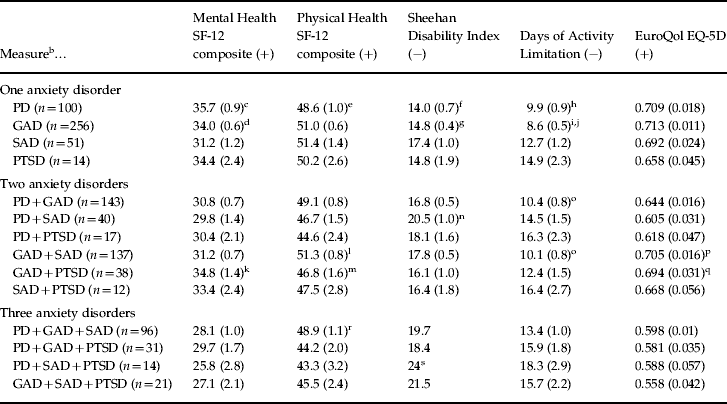
Table 5 shows baseline levels of functioning and well-being among patients with only one anxiety disorder, with two disorders or with three disorders. There were few large differences among these patients. Among patients with only one disorder, those with PD reported the highest level of mental well-being but the lowest level of physical functioning. Patients with SAD had the highest disability levels and, along with patients with PTSD, the most days of activity limitation due to health.
Functioning and well-being levels in patients with one, two or three anxiety disordersFootnote a

SF, Short-form; PD, panic disorder; GAD, generalized anxiety disorder; SAD, social anxiety disorder; PTSD, post-traumatic stress disorder.
Values are given as mean (standard error).
a Analyses controlled for age, gender, education, ethnicity, number of self-report chronic medical conditions, co-morbid depression and study site.
b The − or + indicates the direction of good health.
c Significantly different (p=0.0035) from SAD.
d Significantly different (p=0.0481) from SAD.
e Significantly different (p=0.0483) from GAD.
f Significantly different (p=0.006) from SAD.
g Significantly different (p=0.0203) from SAD.
h Significantly different (p=0.0419) from PTSD.
i Significantly different (p=0.0068) from PTSD.
j Significantly different (p=0.0027) from SAD .
k Significantly higher at p<0.05 than all other combinations except for SAD+PTSD and PD+PTSD.
l Significantly higher than PD+SAD (p=0.009) and PD+PTSD (p=0.008).
m Significantly lower than GAD+SAD (p=0.012).
n Significantly higher at p<0.05 than all combinations except for PD+PTSD.
o Significantly lower than PD+SAD (p=0.011), PD+PTSD (p=0.013), and SAD+PTSD (p=0.025).
p Significantly higher than PD+GAD (p=0.008) and PD+SAD (p=0.004).
q Significantly higher than PD+SAD (p=0.042).
r Significantly higher than PD+GAD+PTSD (p=0.0433).
s Significantly higher than PD+GAD+SAD (p=0.0347) and PD+GAD+PTSD (p=0.0143).
Among patients with two anxiety disorders, those with PD co-morbid with SAD appeared worse off on three out of five measures, although not all comparisons were statistically significantly different from one another. GAD combined with one other co-morbid anxiety diagnosis appeared to be the least limiting combination.
Finally, among patients with three anxiety disorders, in almost all comparisons, the groups appeared equally low in levels of functioning and well-being. The combinations with GAD appeared least limiting, although not significantly so except for the Sheehan Disability Index.
Discussion
All measures of functioning and disability, except for physical functioning, showed substantial impairment in the overall sample compared with general population norms. This finding is consistent with that of many other studies that have shown increased disability and poor mental health outcomes in persons with anxiety, relative to non-anxious controls (Markowitz et al. Reference Markowitz, Weissman, Ouellette, Lish and Klerman1989; Noyes, Reference Noyes1990; Klerman et al. Reference Klerman, Weissman, Ouellette, Johnson and Greenwald1991; Fifer et al. Reference Fifer, Mathias, Patrick, Mazonson, Lubeck and Buesching1994). It is also consistent with our prior work on a different primary care sample which showed less impact of anxiety disorders on physical health functioning than on mental health functioning (Stein et al. Reference Stein, Roy-Byrne, Craske, Bystritsky, Sullivan, Pyne, Katon and Sherbourne2005).
In this primary care sample of patients with anxiety disorders, co-morbidity was high, with 58% of the sample diagnosed with more than one anxiety disorder. Co-morbid depression was also high. It was highest in patients with PTSD and increased substantially to almost 88% as the number of co-morbid anxiety disorders increased. Such high co-morbidity is common in primary care patients (Kroenke et al. Reference Kroenke, Spitzer, Williams, Monahan and Lowe2007) and, based on primary care provider feedback about the desirability of coordinating care for all anxiety disorders, was one of the reasons the CALM intervention was designed to address multiple disorders simultaneously.
The burden of disability is clearly greater as the number of anxiety co-morbidities increases. This was reflected in the linear relationship (especially in increased levels of disability and the decreasing health-related quality of life as measured by the EQ-5D) as one moves from having one disorder alone to having multiple disorders. Several other studies have confirmed the dose–response relationship between number of co-morbidities and disability (Andrews et al. Reference Andrews, Slade and Issakidis2002; Kroenke et al. Reference Kroenke, Spitzer, Williams, Monahan and Lowe2007). The question remains as to why increased co-morbidity leads to increased disability and poorer functioning. It may be that the number of co-morbidities is merely a marker for severity. Alternatively, as the number of co-morbid anxiety disorders increases, avoidance behavior is likely to increase. In this study, the number of co-morbid anxiety disorders correlated significantly with the OASIS avoidance item. When the avoidance item was added to the multivariate analyses, three out of 12 comparisons were mediated (i.e. differences were reduced) by the addition of the item, suggesting that avoidance partially explains the relationship between number of co-morbid disorders and poor outcomes. Perhaps not surprisingly, the outcomes affected were disability outcomes, including days kept from doing usual activities (as measured by the HD3-Day) and disruption in specific areas of work, social life and family responsibilities (as measured by the Sheehan Disability Index). When frequency and severity of anxiety were added to the multivariate analyses, two more generic health-related quality of life outcomes were affected: mental health functioning and the integrative preference-based EQ-5D measure. Despite these reductions in differences, the burden of disability remained greater as the number of anxiety disorders increased for the majority of analyses. Thus, neither frequency, nor severity of anxiety, nor extent of avoidance completely explains the observed relationships. Other factors, such as third variable correlates of co-morbidity (e.g. socio-economic status, interpersonal dysfunction) may play a role and need to be examined in future research.
Even when controlling for all anxiety disorders simultaneously, we found significant unique effects of each anxiety disorder relative to GAD alone, again confirming that disability increases with added disorders. While GAD itself is also impairing, these results suggest that it is the least impairing of the four disorders measured in this study. There may be several reasons for this finding. It may be due to a lower diagnostic threshold for GAD because it does not include behavioral interference or avoidance. However, recent results from an Australian general population sample found that diagnostic thresholds for social phobia and obsessive–compulsive disorder were less stringent than for GAD (Andrews et al. Reference Andrews, Sunderland and Kemp2010). This raises the possibility that there might be a bias in the kinds of patients that primary care providers refer for anxiety treatment. Providers may be more attuned to GAD (which was the most prevalent anxiety disorder in this study) and hence refer people with GAD who are, on average, less ill than are those primary care patients with the other anxiety disorders. In order to be identified and therefore referred to the CALM study, patients with PD, SAD or PTSD may have been more ill than patients with GAD.
We found interesting trends when subsetting the sample according to number of anxiety disorders. In general, in contrast to studies of depression-related functioning (Wells et al. Reference Wells, Sturm, Sherbourne and Meredith1996), physical functioning did not appear to be affected greatly by the presence of anxiety, although levels were reduced in patients with PD alone and in some combinations of co-morbidities which included PD. The effect sizes as seen in Table 5 were not large, however, with physical functioning levels in those with PD (with and without other co-morbidities) from one-fourth to one-half a standard deviation below the general population norm of 50. It may be that the often co-morbid agoraphobia associated with PD affects mobility and therefore contributes to the decreased physical functioning in patients with PD. In addition, decreased physical functioning in PD patients may be a consequence of avoidance of physical sensations.
Patients with SAD alone were severely restricted in work/social/home activities and spent more days limited in activities, as did those with PTSD. The combination of social anxiety and PD appeared particularly debilitating and patients with both conditions had the lowest rating of their overall health-related quality of life, as measured by the EQ-5D. These findings for SAD reinforce the seriousness of this condition in which fear of negative evaluation by others causes such individuals to avoid situations in which scrutiny will take place, whether in the work force, socially or at home (Stein & Stein, Reference Stein and Stein2008). Given that SAD is the third most prevalent psychiatric disorder (after depression and alcohol abuse) in the community (Kessler et al. Reference Kessler, McGonagle, Zhao, Nelson, Hughes, Eshleman, Wittchen and Kendler1994; Magee et al. Reference Magee, Eaton, Wittchen, McGonagle and Kessler1996) and is associated with extreme disability (Kessler, Reference Kessler2003) and substantial unmet need for care (Roy-Byrne & Stein, Reference Roy-Byrne and Stein2005), awareness of the seriousness of this disorder should be promoted. Further screening and outreach programs may be needed to identify these patients and facilitate their access to treatment (Roy-Byrne & Stein, Reference Roy-Byrne and Stein2005).
Our results are limited by the fact that the sample was for the most part referred to the study by primary care physicians and thus, because they had been detected by their physician, may represent a more seriously ill population than that found if screened in the primary care population. However, the inferences on relative impact and dose–response relationship between number of co-morbidities and disability should be valid. Our results are also limited by the relatively small sample with PTSD which may have made it difficult to detect significant differences between this group and patients with other anxiety disorders. However, patients with PTSD were significantly worse off on four of our five functioning and disability measures than patients with GAD and they did have the highest levels of activity limitation both when considered alone and in combination with other disorders, underscoring the seriousness of this disorder also. Finally, because of the number of tests conducted, some of the observed significant results in Table 5 might be due to chance. It is possible that other indices of psychopathology such as the presence of axis II disorder(s) might also explain some of the disability attributable to anxiety disorders. This is an area worthy of additional research.
Results from this study are relevant to the primary care clinicians who treat such patients. Clinicians should be aware of the substantial co-morbidity among the anxiety disorders and with depression and the fact that there is a greater burden on those with multiple disorders. The literature is, at present, unclear as to whether or not the presence of multiple disorders requires a different therapeutic approach that broadly tackles the co-morbid conditions. There is, however, some literature suggesting that treating one disorder with CBT can have a very positive effect on surrounding co-morbidities (e.g. Tsao et al. Reference Tsao, Mystkowski, Zucker and Craske2005; Craske et al. Reference Craske, Farchione, Allen, Barrios, Stoyanova and Rose2007). Results from our CALM study may help resolve this controversy.
In conclusion, patients with anxiety disorders seen by primary care clinicians have serious disability and low functioning even after adjusting for co-morbid depression (and number of chronic medical conditions). Clinicians should be vigilant for multiple anxiety disorders and co-morbid depression in patients suspected to have any of these four anxiety disorders. In addition, clinicians should be more attuned to patients with SAD and recognize the seriousness of this condition. Effective treatments are available for all of these anxiety disorders and effective methods of identifying and treating them need to be incorporated into standard care practices.
Acknowledgements
This work was supported by the following National Institute of Mental Health (NIMH) grants: U01 MH070018 to C.S.; 5 U01 MH058915 to M.G.C.; U01 MH057835 and K24MH64122 to M.B.S.; U01 MH057858 and K24MH065324 to P.R.-B.; U01-MH070022 to G.S.
Declaration of Interest
P.R.-B. reports receiving research grant support from the National Institutes of Health; having served as a paid member of advisory boards for Jazz Pharmaceuticals and Solvay Pharmaceuticals (one meeting for each); having received honoraria for CME-sponsored speaking from the American Psychiatric Association, Anxiety Disorders Association of America, CME LLC, CMP Media, Current Medical Directions, Imedex, Massachusetts General Hospital Academy, and PRIMEDIA Healthcare; and serving as Editor-in-Chief for Journal Watch Psychiatry (Massachusetts Medical Society) and Depression and Anxiety (Wiley-Liss Inc.). P.R.-B. has also served as an expert witness on multiple legal cases related to anxiety, none involving pharmaceutical companies or specific psychopharmacology issues. A.B. has served as a paid consultant for Jazz Pharmaceuticals. M.B.S. reports receiving or having received research support from the US Department of Defense, Eli Lilly and Company, GlaxoSmithKline, Hoffmann-La Roche, National Institutes of Health, and the US Veterans Affairs Research Program. M.B.S. is currently or has been a paid consultant for AstraZeneca, Avera Pharmaceuticals, BrainCells Inc., Bristol–Myers Squibb, Comprehensive NeuroScience, Eli Lilly and Company, Forest Laboratories, GlaxoSmithKline, Hoffmann-La Roche Pharmaceuticals, Jazz Pharmaceuticals, Johnson & Johnson, Mindsite, Pfizer, Sepracor, and Transcept Pharmaceuticals Inc.