Introduction
The family Microphallidae Ward, Reference Ward1901 indicates a large assemblage of small-sized (usually < 1 mm) digenean taxa representing more than 160 species under 28 genera arranged in ten subfamilies. They are characteristically found in the intestine of all groups of vertebrates, mainly Charadriiformes birds (Martorelli et al., Reference Martorelli, Fredensborg, Mouritsen and Poulin2004) and among mammals, especially rodents (reviewed by Deblock, Reference Deblock1971, Reference Deblock, Bray, Gibson and Jones2008). Of these taxa, only Spelotrema brevicaeca is reported to infect humans (Fried et al., Reference Fried, Graczyk and Tamang2004). Infective metacercarial stages of microphallid flukes commonly occur in Crustacea (Heard & Overstreet, Reference Heard and Overstreet1983; Pung et al., Reference Pung, Khan, Vives and Walker2002), intermediate hosts in which they undergo extensive organogenesis (Caveny & Etges, Reference Caveny and Etges1971). Many workers have made significant contributions to the study of microphallid life cycles (Cable & Hunninen, Reference Cable and Hunninen1940; Stunkard, Reference Stunkard1957, Reference Stunkard1958; James, Reference James1968; Deblock, Reference Deblock, Bray, Gibson and Jones2008).
Like most digenean trematodes, microphallid taxa encompass several species/genera with little morphological differentiation. Thus morphological criteria alone are not sufficient to resolve taxonomic issues (Tkach et al., Reference Tkach, Littlewood, Olson, Kinsella and Swiderski2003). In recent years, molecular data generated through polymerase chain reaction (PCR)-based DNA sequencing techniques have been successfully analysed and employed to resolve existing systematic controversies related to various helminth parasites (Hust et al., Reference Hust, Frydenberg, Sauriau, Gall, Mouritsen and Jensen2004). Genetic markers, particularly the internal transcribed spacer (ITS) regions in nuclear ribosomal DNA (ITS1, ITS2), lsr regions and mitochondrial genes (e.g. cytochrome c oxidase 1) have been successfully utilized for species identification and for establishing phylogenetic inter-relationships of several digenean taxa (Bray et al., Reference Bray, Waeschenbach, Cribb, Weedall, Dyal and Littlewood2009). Significant information on the molecular characterization of microphallid digeneans has become available in recent years (Tkach et al., Reference Tkach, Pawlowski and Mariaux2000, Reference Tkach, Littlewood, Olson, Kinsella and Swiderski2003).
During an exploratory survey in north-east India of edible Crustacea, the vectors of potential trematode-borne helminthozoonoses (particularly paragonimiasis), some crab species were found to harbour metacercariae. In certain foci of infection in the region, the metacercarial stage recovered was identified as belonging to the genus Paragonimus (Singh, Reference Singh2002, Reference Singh2003; Narain et al., Reference Narain, Devi and Mahanta2003; Tandon et al., Reference Tandon, Prasad, Chatterjee and Bhutia2007). In other locales, namely the West Garo Hills District in the State of Meghalaya and Nagaon in Assam, the infected crabs harboured a microphallid metacercaria. Therefore, in the present study we aimed to identify this metacercaria and describe the species implicated in infection.
Materials and methods
Collection and examination of crabs for metacercariae
The edible crab, Barytelphusa lugubris mansoniana (Henderson) is found to be dominantly prevalent in the State of Meghalaya, whereas in Assam, in addition to this species, Lobotelphusa fungosa and Sartoriana spinigera also abound. Of these three crab species surveyed, only Barytelphusa crabs were found to be infected with metacercariae. The prevalence of infection was 91.05% and the intensity was high in crabs collected from Meghalaya; up to 285 metacercariae were recovered from a single crab. In Assam, however, the rate and intensity of infection were rather low (15.70%, with a maximum of 23 metacercariae recovered from one host).
To screen them for probable infection, the crabs were digested singly in artificial digestive juice at 37–45°C for 5–10 h, as described by Tandon et al. (Reference Tandon, Prasad, Chatterjee and Bhutia2007). The tissue digest was screened under a stereoscopic microscope. Metacercarial cysts were recognized by their prominent external two-layered, thick wall and rounded or oval shape. As the cyst was semi-transparent, the parasite could be seen inside and recovered manually by pricking the cyst wall with a fine needle.
Excysted metacercariae were flattened and fixed in 70% alcohol and processed for whole mount preparation following a standard procedure and using borax carmine and Mayer's carmellum stains. Serial sagittal sections of the fresh material were also cut at a thickness of 8–10 μm, using a Leica CM 1850 cryotome. Observations and measurements were made by using the Leica DM 1000 image analysis system (Leica Microsystems, Wetzlar, Germany) and a Leitz Ortholux II microscope (GmbH, Wetzlar, Germany).
Scanning electron microscopy (SEM)
Metacercariae were fixed in 2.5% glutaraldehyde in 0.1 m sodium cacodylate buffer for 6 h at 4°C, washed in phosphate-buffered saline and dehydrated with ascending grades of acetone to pure dried acetone. Specimens were then treated with tetramethylsilane in lieu of critical point drying following Roy & Tandon (Reference Roy and Tandon1991). Gold-coated specimens were observed using a LEO 435 VP scanning electron microscope (Zeiss, Oberkochen, Germany) at electron-accelerating voltages ranging between 10 and 20 kV.
DNA extraction, PCR amplification and sequencing
Genomic DNA was extracted from fresh as well as alcohol-preserved excysted specimens, following the phenol–chloroform method (Sambrook et al., Reference Sambrook, Fritsch and Maniatis1989). For the purpose of extraction, metacercariae recovered from one single host were pooled together. Approximately 20 metacercariae were taken for a single isolation. Metacercariae were ground and immersed in digestion buffer containing 1% sodium dodecyl sulphate (SDS) and 20 mg proteinase K at 37°C overnight and processed further.
For amplification of ribosomal ITS (1 and 2), we used the primer sets based on conserved sequences of the 18S, 5.8S and 28S genes of Schistosoma species that are considered universal for trematode species (Bowles et al., Reference Bowles, Blair and McManus1995) with minor modifications as per Tandon et al. (Reference Tandon, Prasad, Chatterjee and Bhutia2007). For lsr, procedures as described by Tkach et al. (Reference Tkach, Littlewood, Olson, Kinsella and Swiderski2003) were followed. The annealing temperature was fixed at 55°C and the known size fragments of ΦX174 DNA/HaeIII digest in agarose gel were used as markers. For DNA sequencing, the PCR products were purified using Genei PureTM Quick PCR Purification Kit (Bangalore, Karnataka, India), according to the manufacturer's instructions, and sequenced in both directions using PCR primers on an automated sequencer.
Molecular phylogenetic analysis
A BLAST (http://www.ncbi.nlm.nih.gov/blast) search of the DNA sequences was performed and the best hits were selected. Appropriate homologues based on the previous microphallid literature and BLAST identifiable hits were aligned using Clustal X with default parameters (Jeanmougin et al., 1998), and the alignments were refined manually. Phylogenetic models using neighbour joining (NJ) and maximum parsimony (MP) analyses were carried out in MEGA version 5.0 software (Tamura et al., Reference Tamura, Nei and Kumar2004, Reference Tamura, Peterson, Peterson, Stecher, Nei and Kumar2011). Phylogenetic analysis was performed using Kimura-2-parameter (for NJ), and complete-deletion for all trees. Bootstrapping was performed with 1000 replicates. The maximum composite likelihood (MCL) method was employed for estimating evolutionary distances between all pairs of sequences simultaneously, incorporating rate variation among sites and substitution pattern heterogeneities among lineages.
Results
The collection comprised a large number of metacercarial cysts (1–285) recovered from the infected crabs. The cyst is elliptical in shape and has a prominent thick wall composed of two layers, the outer layer being thick but transparent. The excysted metacercaria is described below.
Morphology of metacercariae
From an examination of ten excysted specimens, they were classified as: Family Microphallidae Ward, Reference Ward1901; Subfamily Microphallinae Ward, Reference Ward1901; Genus Microphallus Ward, Reference Ward1901; Microphallus indicus Mukherjee & Ghosh, Reference Mukherjee and Ghosh1967.
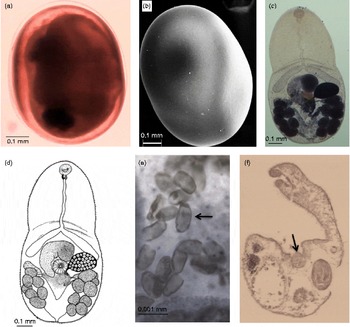
Description (fig. 1a–f). Most of the adult characters prominent; body pyriform in shape, minute in size (0.94–1.17 mm in length, 0.59–0.71 mm in maximum width). Oral sucker subterminal; ventral sucker single, well developed, post-equatorial in position. Prepharynx conspicuous; pharynx small, short, muscular; oesophagus long, bifurcating in mid body region; intestinal caeca short, pretesticular, preacetabular. Testes symmetrical, located one on either side of ventral sucker; cirrus (phallus) pouch present, curved in shape; cirrus well developed, conical, occupying entire genital atrium. Genital atrium opening near ventral sucker. Ovary located on right side of ventral sucker or slightly overlapping right testis, oviduct emerging from mid posterior part of ovary; uterus forming ascending and descending loops between testes and excretory vesicle, containing numerous eggs. Vitelleria commencing from level of testes, extending up to excretory vesicle; vitelline glandular cells arranged in two groups – one with eight lobes on right, the other with seven on left. Excretory vesicle ‘V’ shaped, excretory pore terminal.
Metacercariae of Microphallus indicus to show the larvae: (a) and (b) encysted, (c) excysted, (d) flattened and ventral view, (e) eggs in utero and (f) median sagittal section with a single ventral sucker. (See online at at http://journals.cambridge.org/jhl for a colour version of this figure.)

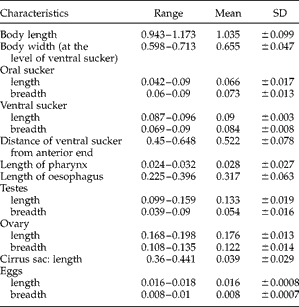
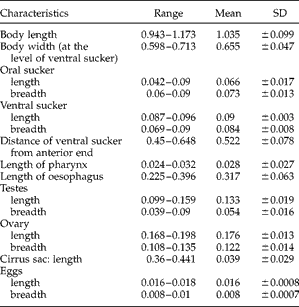
Morphometric measurements (in mm) of the body and its organs are provided in table 1. Voucher specimens of 70% alcohol fixed, stained and mounted metacercariae are deposited [vide catalogue no. NEHU/Z–MC(cr)1] in the helminth collections of the Department of Zoology, North-Eastern Hill University (NEHU), Shillong, India.
Morphometric measurements (in mm) of Microphallus indicus excysted metacercariae.
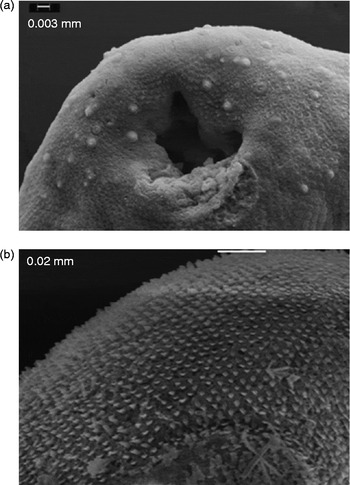
SEM observations (fig. 2a and b) revealed the fine surface topography of the fluke. The metacercarial cyst has a smooth surface. The excysted metacercaria is oval in shape and the entire body surface is covered with numerous spines; papillae abound in the circum-oral sucker region, where they appear to be randomly scattered and without showing any pattern.
Metacercaria of Microphallus indicus to show (a) oral sucker with papillae and (b) tegument with spines.

Molecular characterization
Using the mentioned primers, the selected rDNA regions could be successfully amplified. Sequences were deposited in GenBank with accession numbers FJ966109 (lsr), FJ966110 (ITS1) and FJ966111 (ITS2). The amplicon sizes of lsr, ITS1 and ITS2 were 1113, 873 and 473 bases, respectively. Phylogenetic trees were obtained by comparing the lsr and ITS1 DNA sequences of the queried parasite and other available sequences for other related trematodes, including microphallid species. Trees based on ITS2 sequences could not be constructed since these sequences for other related species of the microphallid group are not yet available in the public domain.
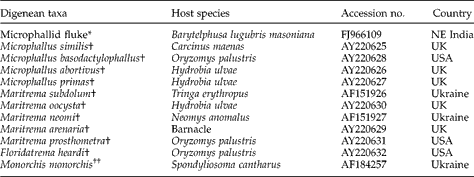
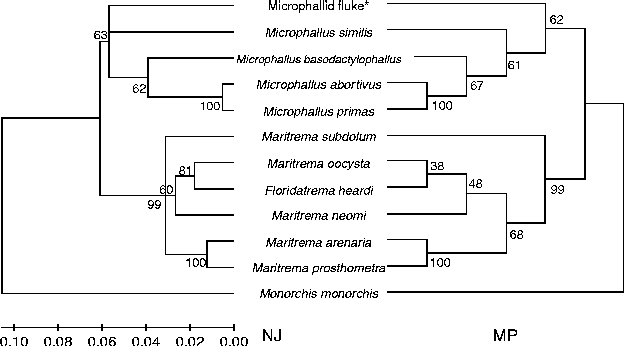
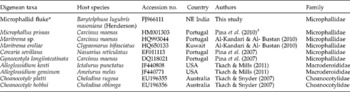
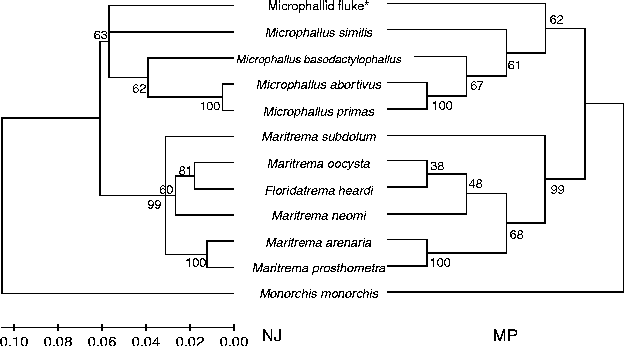
The BLAST results showed that the queried lsr DNA sequences are more similar to sequences of microphallid species. The analysis involved 12 nucleotide sequences (table 2). Monorchis monorchis was considered as an outgroup. The E-value was found to be zero up to the 100th sequence of BLAST search and the query coverage, 95% and above. The evolutionary history, inferred using the NJ method, showed an optimal tree with the sum of branch length = 1.39081292 (fig. 3), which was drawn to scale, with branch lengths in the same units as those of the evolutionary distances used to infer the phylogenetic tree. The MP method gave the most parsimonious tree, with length = 552 (fig. 3), the consistency index 0.661856, the retention index 0.658333 and the composite index 0.462742 for all sites and 0.435722 for parsimony-informative sites.
Digenean taxa used for molecular comparison of lsr DNA sequences along with their hosts, country and GenBank accession number for corresponding sequences (*queried sequence).
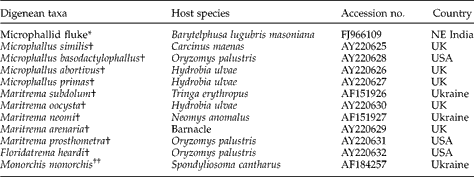
† Family Microphallidae (Tkach et al., Reference Tkach, Littlewood, Olson, Kinsella and Swiderski2003).
†† Family Monorchiidae (Tkach et al., Reference Tkach, Pawlowski and Mariaux2000).
Neighbour-joining (NJ) and maximum parsimony (MP) trees with significant bootstrap values for lsr sequences (*queried sequence).
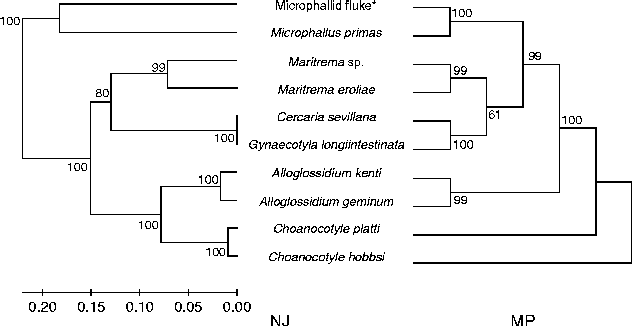
In the analysis of ITS1 sequences, Alloglossidium kenti, A. geminum, Choanocotyle platti and C. hobbsi were considered as outgroups that involved ten nucleotide sequences (table 3). The evolutionary history, inferred using the NJ method, showed an optimal tree with the sum of branch length = 1.07917338 (fig. 4).
Digenean taxa used for molecular comparison of ITS1 DNA sequences along with their hosts, country and GenBank accession number for corresponding sequences (*queried sequence).

† Not published, as per GenBank record.
Neighbour-joining (NJ) and maximum parsimony (MP) trees with significant bootstrap values for ITS1 sequences (*queried sequence).
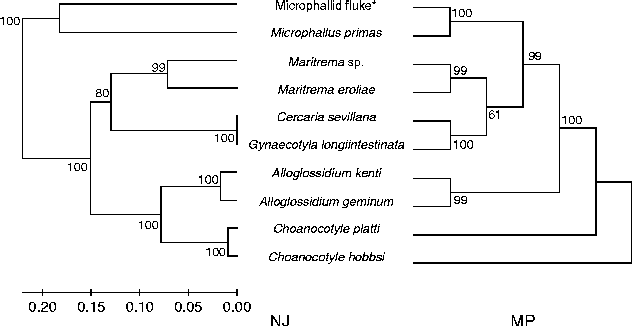
In most topologies, NJ and MP phylogenetic techniques recapitulated major groupings of microphallids. All these methods produced a single supportive congruent topology (topologies in which major branch points in identical relative positions are considered congruent). There were two monophyletic groups with robust bootstrap values. The microphallid fluke grouped with Microphallus primas and the rest of the taxa formed a single cluster.
Discussion
Traditional diagnostic techniques based on morphological differences found in adult specimens have been widely used for platyhelminth characterization, but are now aided by molecular techniques to help resolve taxonomic issues associated with describing new species or strains on the basis of phenotypic characteristics (Thompson et al., Reference Thompson, Zarlenga, La-Rosa, Pozio, Rosenthal, Bandi, Mortarino, Casiraghi, Genchi, Gasser, Hu, Chilton, Matthews and Hodgkinson2004). In the present study, we tried to identify the microphallid form by both morphological and molecular taxonomic approaches.
The present form was found to belong to the family Microphallidae Ward (syn. Maritrematidae Nicoll, 1907) based on the following characteristics: spiny body surface, ventral sucker at the middle third of the body, prepharynx distinct, pharynx well developed, oesophagus moderately long, caeca short (may or may not reach the level of testes), testes symmetrical and equatorial or at the posterior half of the body, cirrus pouch more or less curved, ovary submedian and lateral to the ventral sucker, uterine coils confined to hind body, eggs small and excretory vesicle ‘V’ shaped. After considering all the characters, the trematode form described here comes under the subfamily Microphallinae and tribe Microphallini, following the classification of Yamaguti (Reference Yamaguti1971) and Deblock (Reference Deblock, Bray, Gibson and Jones2008). As is evident from the detailed morphological features enumerated above, the present form comes close to the genus Microphallus in several diagnostic characters. In SEM observations the metacercarial cyst presently studied revealed a smooth surface contour, whereas the excysted juvenile fluke had a spiny tegument and numerous papillae in the region surrounding the oral sucker. Surface fine topography of encysted and newly excysted metacercariae has been described with respect to Microphallus abortivus and Cercaria sevillana etc., in which a spiny tegument and circum-oral sensory papillae are the features of common occurrence (Saville & Irwin, Reference Saville and Irwin1991; Pina et al., Reference Pina, Russell-Pinto and Rodrigues2007).
There are only a few reports on the occurrence of Microphallidae flukes from vertebrates in India. So far only a few microphallid taxa have been described, including Levinseniella indica, Basantisia ramai and Pseudospeloterma indicum from birds (Lal, Reference Lal1936; Pande, Reference Pande1938; Murhar, Reference Murhar1960; Bharadwaj, Reference Bharadwaj1962); Mehraformes jabalpurensis and Microphallus indicus from reptiles (Bharadwaj, Reference Bharadwaj1963; Mukherjee & Ghosh, Reference Mukherjee and Ghosh1967); Megalatriotrema hispidum from the common frog (Rao, Reference Rao1969); and Spelotrema narii from the intestine of jackals (Rao, Reference Rao1965). In addition to these, microphallid metacercarial stages have also been reported from sand crabs and brackish-water prawns near the south-eastern coast of the Indian subcontinent (Anantaraman & Subramoniam, Reference Anantaraman and Subramoniam1976; Jayasree et al., Reference Jayasree, Janakiram and Madhavi2001). A comparison of morphological features of various microphallid species described so far from crustacean hosts in India reveals a close similarity to the present metacercarial stage, with Microphallus indicus Mukherjee & Ghosh, Reference Mukherjee and Ghosh1967, originally described from a reptilian host.
Microphallid species are known for rapidly attaining sexual maturity (Ching, Reference Ching1963); the metacercarial stage and the adult form are quite similar morphologically. The present metacercarial form was recovered from a freshwater habitat. In phylogenetic analysis, its lsr sequences showed very close resemblance with the genus Microphallus, although with ITS1 sequences, maximum similarity was recorded with C. sevillana and Gynaecotyla longiintestinata (both under the family Microphallidae). In view of the evident similarity in morphological topology, supplemented by molecular data, it may be concluded that the metacercarial form studied herein represents Microphallus indicus Mukherjee & Ghosh, Reference Mukherjee and Ghosh1967.
Acknowledgements
This study was carried out under the Department of Biotechnology (Government of India (GOI))-sanctioned project to V.T. and A.C. (Sanction No. BT/PR5016/AAQ/01/200/2004) and partly supported by AICOPTAX project (funded by Ministry of Environment and Forests, GOI) to V.T., the ‘Northeast Parasite Information and Analysis Centre’ project under the Department of Information Technology (Ministry of Communication and Information Technology, GOI) sanctioned to V.T. and D.K.B., UGC-DSA (University Grants Commission-Departmental Special Assistance Programme) in the Department of Zoology, and UPE-Biosciences programme in the School of Life Sciences at NEHU, Shillong. The award of Senior Research Fellowship by the Council of Scientific and Industrial Research (GOI), New Delhi to L.M.G. is gratefully acknowledged.