“Determine which clients to recommend for discharge in a disaster situation” 1 is a Registered Nurse Activity Statement on the National Council Licensing Exam Test Plan. Risk identification is taught with prelicensure nursing assessment and care planning. The activity statement raised the nursing education research question: could senior student nurses transfer their learning to a novel circumstance with a high degree of risk making decisions using patient assessments and determining resource needs? Transfer of learning (TOL) is a critical outcome of students’ nursing education.
Optimal TOL is the ability to use learning in novel circumstances. Reference Perkins, Salomon, Husen and Postlethwaite2 Hospital emergency response plans often include early discharge or transfer of patients to an alternative care site to reallocate current resources. Decisions made by the bedside nurse contribute to recommendations of patient dispositions. Reference Evans and Veenema3 Tabletop exercises provide classroom disaster-related opportunities where student nurses must critically think to problem-solve for operational plan needs. Reference Pattillo4,Reference Evans and Schwartz5
The principal investigator (PI) designed tabletop exercise Reference Evans and Schwartz5 mirrored the Registered Nurse activity statement. 1 The exercise was further developed into the original study Reference Evans, Baumberger-Henry and Schwartz6 using a descriptive quantitative approach. The disaster-scenario set the novel circumstance for student nurses to make decisions captured as instrument data to describe their TOL.
The measured TOL was for medical-surgical topics included in nursing curriculums and covered by senior-level: basic disaster knowledge, discharge and transfer planning, infection, bleeding, pain, and hyponatremia. The study had 2 aims. The first was to describe students’ TOL for basic disaster and medical-surgical knowledge and make recommendations for patient dispositions. The second aim was to describe students’ attitudes about their TOL during the tabletop exercise. This brief report presents the findings from the replicated study that was extended to 2 Mid-Atlantic universities.
Methods
The study used a classroom disaster-scenario tabletop exercise. The PI, a disaster nurse, and a tabletop exercise subject-matter-expert (SME) developed the 3 paper instruments for data collection, the 4 patient shift reports, and the exercise scenario. The scenario was based on the PI’s lived experience and a literature review validated the role of the professional nurse. Reference Evans and Veenema3 The setting was a medical-surgical unit in an acute care hospital where students assessed and made a discharge, transfer, or remain-in-place recommendation for their assigned inpatients. The scenario included the hospital operating within the standards of care, unaffected directly by the disaster, and disaster victims arriving for admission. Students were provided 1 Disaster Knowledge Test (DKT), 4 Tabletop Matrixes (MATRIX) with 4 patient shift reports, and 1 Tabletop Attitude Questionnaire (TAQ).
Students were in the role of the registered nurse during the exercise. The exercise begins with the students’ completing the DKT as their annual disaster competency assessment. Then the PI announced that a disaster had occurred 50 miles away. The hospital needed to open inpatient space, staff, and resources for a disaster victim surge arriving in the next 12-24 h. Students were charged to assess the 4 medical-surgical patients using the provided change of shift reports. Using the shift reports, students decided physical acuity, functional ability, and resource needs and then made their recommendation for the patient disposition. Options for recommendations included: remain-in-place, discharge home, transfer to an internal or external alternative care site, or transfer to critical care. Students also documented a patient’s readiness time for disposition. Students completed 1 MATRIX with their decisions for each patient. Table 1 includes key patient shift report facts.
Key patient facts, tabletop matrix category DIs (N = 129)

# Eliminated for missing 10% of responses.
Abbreviations: Dispo, disposition; Dx, diagnosis; F&E, fluid & electrolyte; GI, gastrointestinal; GU = genitourinary; HX, history; Na = sodium; POC = plan of care (patient had an established diagnosis and plan of care versus a patient not having an established diagnosis and plan of care as identified by the nurse); Rec, Recommendation; UTI, urinary tract infection.
The exercise ended after a verbal count of opened beds. Students then completed the TAQ. Data analysis identified aggregate sample TOL gaps that were remediated for the students at both universities. Time projections for the DKT was 22 min; Matrix, 10 min each; verbal count of opened beds, 3 min; and TAQ, 3 min.
Instruments
Medical-surgical and disaster nurse SMEs evaluated the DKT, MATRIX, and TAQ for Content Validity Index (CVI). Answer keys for the 4 patient MATRIXs and the DKT were evaluated for inter-rater agreement by the SMEs. The instruments were revised on their feedback. A pilot study estimated DKT and TAQ statistical reliability with Cronbach’s alpha.
The purpose of the MATRIX (CVI = .95), a criterion-referenced TOL performance measure, Reference Evans and Baumberger-Henry7 was to collect decisions for physical acuity, functional ability, and resource needs to then make a recommendation for patient disposition. Disaster nurse SME inter-rater reliability was 100% for disposition recommendations, and medical-surgical nurse SME inter-rater reliability was 95-98% across MATRIX categories on all 4 patients.
The organization of MATRIX checklists were improved before the replication study by separating skin, movement, nutrition, hygiene, and patient teaching under their respective categories: physical acuity, functional abilities, and resource needs (Table 1). The score range is now 0-30. Optimal TOL is a higher MATRIX total score.
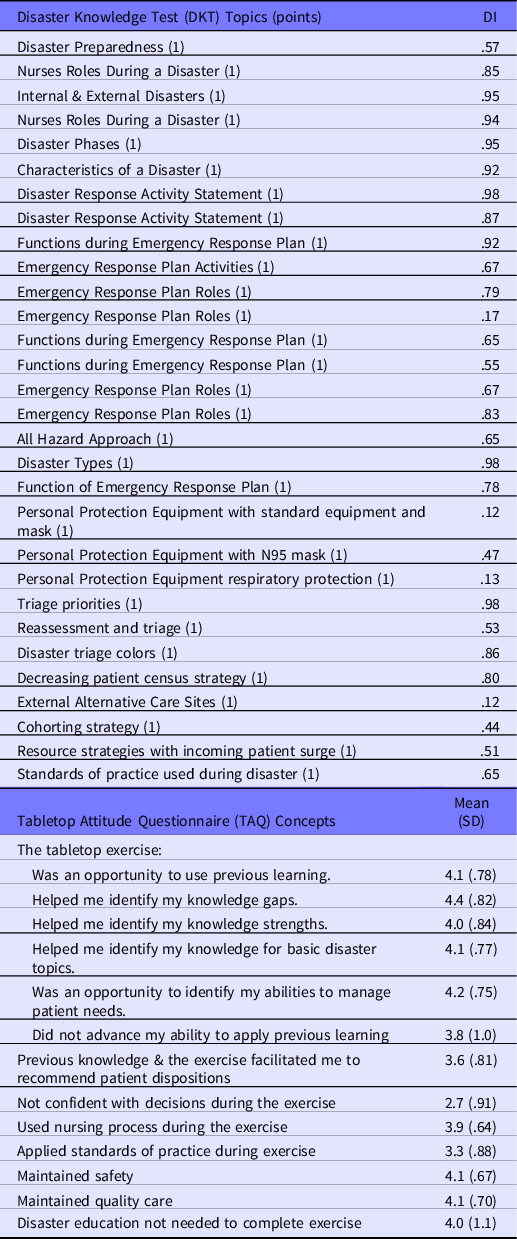
The purpose of the DKT (CVI = .96; r = .60) was to measure basic disaster education covered in nursing coursework using 30 multiple-choice items. The score range is 0-30. Inter-rater SME agreement was 90-100%. Table 2 shows item topics. Optimal TOL is a higher DKT total score.
Disaster Knowledge Test (N = 127) DIs & Tabletop Attitude (N = 109) Means (SD)

DKT eliminated instruments, n = 2. TAQ eliminated instruments, n = 20, SD = Standard Deviation.
The TAQ (CVI = .89, r = .76) purpose was to describe students’ attitudes using their TOL during a tabletop exercise. There are 13 Likert statements with 2 that are reverse scored. The item score range is 1-5; 5 strongly agree, 4 agree, 3 neither agree nor disagree, 2 disagree, and 1, strongly disagree. Table 2 shows attitude concepts, a more positive attitude for TOL during the tabletop exercise had a higher item score.
Sample
The courses selected at the 2 Mid-Atlantic universities for sample recruitment had 75-min-long classes; the minimum time needed to complete consent procedures and the study exercise with data collection. The aggregated convenience sample was recruited from senior student nurses who were enrolled in the senior-level medical-surgical or community courses at 1 university and in a senior elective at the other university. Recruitment occurred as a written notice in the course syllabi and a verbal announcement by the course coordinators after both university institutional review boards approved the study. Student nurses not enrolled in the specified senior-level courses were excluded. The 2-university aggregate sample (N = 129) included 112 females, 16 males, and 1 transgender person.
Statistics
Anonymous aggregate instrument data were hand entered into SPSS Version 23. 8 Analysis included descriptive statistics and difficulty index (DI). Descriptive statistics measured data averages, frequencies, and standard deviation. The proportion of responses answered correctly is DI. Reference Oermann and Gaberson9 Educators often use a DI of ≤ .49 to determine remediation needs. For this study, a DI ≤ .49 was the cut-score and described less-than-optimal TOL for DKT item and MATRIX category scores.
The study was designed with a power of .80 and alpha was set at .05. The effect was moderate at .50, with a minimum sample size of 65. A study instrument with more than 10% of responses missing was eliminated. If a DKT or MATRIX had less than 10% of responses missing, then a “0” marked the blank response; on the TAQ, the average mean replaced the missing response.
Results
Power and effect were achieved for the study with the sample of 129 participants. Instruments missing 10% of responses were removed from data analysis (Tables 1 and 2).
The completion of basic disaster education in nursing coursework was captured as demographic items. Basic disaster education (72.9%; n = 94), including personal protective equipment (PPE) (69%; n = 89), was covered in medical-surgical coursework and in other nursing coursework (21.7%; n = 28).
Table 2 provides DKT item DI results and TAQ item means. The DKT (N = 127) averaged 20.9 (SD = 3.2) of 30 points. The DI item range was .12 to .98. All PPE items had DIs ≤ .49, while triage, disaster types, and disaster response items were .98. The TAQ (N = 109) item mean range was 2.7 to 4.4. Student self-report confidence in decision-making was 2.7 (SD = .90), and the exercise helped identify knowledge gaps was 4.4 (SD = .82).
Table 1 lists the MATRIX infection, bleeding, pain, and hyponatremia total scores and respectively, each category DI. Of note, the MATRIX DI recommendations for patient dispositions described more optimal TOL for infection (n = 110) at .73 and bleeding (n = 117) at .50. Hyponatremia (n = 105) at .30 and pain (n = 110) at .28 were ≤ .49.
Discussion
Study data analysis provided DKT and MATRIX DI results that described students’ TOL during the disaster-scenario tabletop exercise. Likert statement TAQ item means described student attitudes for their TOL during the exercise. The DKT and MATRIX DIs were educationally more useful TOL descriptions than instrument total scores to identify specific student remediation needs. Mean TAQ item descriptions, though, were helpful for the assessment of students’ attitudes.
Perkins and Salomon Reference Perkins, Salomon, Husen and Postlethwaite2 wrote that there is ample research on educational experiences that hope to aid transfer but often fall short; moreover, the design of experiences for transfer is a critical first step. Education aspires for the TOL by teaching initial learning to include connections that a learner will be able to use in the future. First learning in the classroom is dramatically different from contexts of use. Reference Perkins, Salomon, Husen and Postlethwaite2
Basic disaster and medical-surgical education include initial knowledge that the learner transfers and uses in decision-making that matters to the people involved in the circumstance. The disaster-scenario tabletop exercise was a student opportunity to transfer learning to make decisions to keep the nurse and the patient safe. Critical first learning and then learner discovery for how to use and apply learning is how they gain insight to become a thinker and decision-maker. Novel circumstances with uncertainty, as is common with a disaster-scenario, can aid the student nurse to advance their thinking and decision-making for more complex problem-solving. The tabletop exercise is a strategy to bring that opportunity to the classroom.
Student attitudes were that the tabletop exercise was an opportunity to identify their knowledge gaps, ability to manage patient needs, and use the nursing process. The study supports that tabletop exercises can be a measurable novel circumstance and is a classroom nongraded assessment of students’ TOL and attitudes. Educators need strategies to provide novel circumstances to get at the optimal TOL and determine gaps to aid remediation that includes applying the nursing process. Using a (nursing) process to strategically think and consider assessed risks for physical acuity, functional ability, and resource needs is critical to planning and considering outcome decisions, such as the MATRIX recommendation for patient disposition.
Student TOL strengths were overall DKT knowledge and MATRIX physical and functional assessments. In contrast, data described gapped TOL that did not reduce risk. The low DIs for DKT PPE items and the MATRIX recommendations for patient dispositions with pain and hyponatremia described lower TOL, which could be the effect of a knowledge deficit or not using the nursing process as steps for thinking. Rationales for these lowest DI results include that students did not recognize how wearing PPE protects the provider, understanding the impact of a patient living alone with pain on self-care, or the correction needed for a patient with a sodium of 121 mEq/L. It is plausible that students may not have had enough novel experiences to transfer learning with situated thinking for problem-solving and making decisions. Likewise, nursing education must plan these student opportunities.
The 75-min class time was a key limitation. The study had an unintended time pressure likely caused by the study design with the consent procedures and exercise in the same class period. Many students had never experienced a tabletop exercise and asked many questions about how they worked in the classroom. The tight time design is one rationale for the low decision confidence and instrument elimination when missing more than 10% of responses. Future studies will plan for a longer time or reduce the patient assignment to 3. Additionally, focused student interviews could inform of other confidence or TOL factors.
In conclusion, student nurse decision-making during the disaster-scenario tabletop exercise approximated the Registered Nurse Activity Statement listed on the National Council Licensing Exam Test Plan. 1 Students could safely transfer their learning to most decisions during a novel circumstance with a high degree of risk. Descriptions of students’ TOL for basic disaster and medical-surgical topics, 4 recommendations for patient dispositions, and their attitudes were obtained from instrument data analysis. Remediation occurred for less-than-optimal TOL decisions (≤ .49). Disaster-scenario tabletop exercises, such as designed for this study, benefit student nurse development of essential core disaster nursing competencies. 10
Acknowledgments
We thank the Widener University School of Nursing Scholarship Community for feedback on this brief report.
Author contributions
C.A.E.: research need, literature review, instruments, scenario and patient reports development, study design, data collection, analysis, writing and editing the brief report. J.P.: data collection, revision, and editing of the brief report. L.O'K.: data collection, revision, and editing of the brief report. Other Contributions: Widener University School of Nursing Leadership Center for Nursing Education Research - SPSS Data Processing.
Funding
Eta Beta Chapter of Sigma Theta Tau International Honor Society of Nursing.
Conflict(s) of interest
We have no known conflict of interest to disclose.
Ethical standards
This study was approved by Widener University and Stockton University IRB 144-17.