Introduction
The digenetic trematodes are characterized by complex heteroxenous life cycles involving several developmental stages. Molluscs, being the first intermediate host in which parthenogenetic reproduction occurs, play a central role in the overall biology of digeneans. Examination of molluscs for larval digeneans is the keystone for determination of the parasite fauna in the region under study. However, it is impossible to link the larval stage to adult based solely on its morphological characters, while the experimental transmission of biological cycles is almost always a difficult task (Combes, Reference Combes2001). It is hardly surprising that numerous cercariae are described from different mollusc hosts, the sexual generation and taxonomic position of which remain unknown.
Cercariaeum crassum Wesenberg-Lund, 1934 is among the fairly common and widely distributed larval digeneans parasitizing the sphaeriid bivalve, Pisidium amnicum (Müller, 1774). Pisidium amnicum is a Palaearctic species and lives in a wide range of usually flowing habitats, where it sometimes reaches high densities; but it also inhabits lakes and large ponds (Kuiper et al., 1989; Piechocki, Reference Piechocki1989; Killeen et al., Reference Killeen, Aldridge and Oliver2004). Digeneans of the families Allocreadiidae and Gorgoderidae generally use Sphaeriidae bivalves as the first intermediate hosts in their life cycles (Mackie, Reference Mackie1976; Caira, Reference Caira1989; Caira & Bogea, Reference Caira, Bogea, Jones, Gibson and Bray2005; Campbell, Reference Campbell, Bray, Gibson and Jones2008). The systematic position of C. crassum has been obscured for many years. It was ascribed to Monorchidae or Lissorchiidae by different authors, and has previously been reported as Cercaria ( = Cercariaeum) crassa in the Ukraine (Zdun, Reference Zdun1961), Palaeorchis sp. in Russia (Zhokhov, Reference Zhokhov1991) and Palaeorchis crassus in Finland (Holopainen et al., Reference Holopainen, Lamberg, Valtonen and Rantanen1997; Rantanen et al., Reference Rantanen, Valtonen and Holopainen1998).
A recent comparative study of morphology and development of intramolluscan stages of C. crassum suggested its allocation to the family Allocreadiidae, but generic affiliation of the species remains unknown (Niewiadomska & Valtonen, Reference Niewiadomska and Valtonen2007). Adult allocreadiids are parasites in the digestive tract of freshwater fish species. Their ophthalmoxiphidiocercariae (cercariae with eye-spots and stylet in the oral sucker) develop in rediae in sphaeriid bivalves rather than in gastropods. The life cycle of C. crassum is unusual, including both ophthalmoxiphidiocercariae and cercariaeum (tailless cercariae) stages, sometimes developing in the same daughter redia; the second intermediate host is probably absent (Niewiadomska & Valtonen, Reference Niewiadomska and Valtonen2007). Therefore, the presence of a cercariaeum misleads investigators and C. crassum was mistakenly regarded as a developmental stage of Palaeorchis sp. or P. crassus (Lissorchiidae) (Zhokhov, Reference Zhokhov1991; Holopainen et al., Reference Holopainen, Lamberg, Valtonen and Rantanen1997; Rantanen et al., Reference Rantanen, Valtonen and Holopainen1998).
The application of DNA methods to studies on the systematics and life cycles of platyhelminth parasites has become widespread in recent years. Molecular markers based on the nuclear ribosomal DNA sequences were developed recently for some Holarctic allocreadiid species (Curran et al., Reference Curran, Tkach and Overstreet2006; Choudhury et al., Reference Choudhury, Rosas Valdez, Johnson, Hoffmann and Pérez-Ponce de León2007; Pérez-Ponce de León et al., Reference Pérez-Ponce de León, Choudhury, Rosas-Valdez and Mejía-Madrid2007; Petkevičiūtė et al., Reference Petkevičiūtė, Stunžėnas, Stanevičiūtė and Sokolov2010). In this study two regions of rDNA of C. crassum, internal transcribed spacer 2 (ITS2) and partial 28S, were sequenced and alignments used for comparative analysis. Nucleotide sequencing of the ITS2 is at present the most reliable molecular marker for allocreadiid species identification and differentiation, due to its high variability and short length (Curran et al., Reference Curran, Tkach and Overstreet2006; Petkevičiūtė et al., Reference Petkevičiūtė, Stunžėnas, Stanevičiūtė and Sokolov2010). The 28S gene is more stable and has been studied mainly to infer phylogeny of various helminth groups (Blair, Reference Blair, Maule and Marks2006), the beginning of the 28S gene has been more widely employed in allocreadiid studies and provides the most diverse reference database of molecular characters.
Cytogenetic parameters provide fewer informative characters, but are nevertheless of undoubted taxonomic importance and provide investigative tools for definition and differentiation of biological species. Moreover, cytogenetic information can reveal inter- and intraspecific variation that may not be obvious at the morphological and molecular level, i.e. aneuploidy or polyploidy of some individuals or populations, presence of supernumerary chromosomes and different chromosomal rearrangements (White, Reference White1973; Camacho et al., Reference Camacho, Sharbel and Beukeboom2000).
In this study a combination of karyological and molecular characteristics was used.
Materials and methods
Collection of infected bivalves
Pisidium amnicum naturally infected with C. crassum was collected from the Rivers Ūla and Žeimena (54°07′45″ N, 24°27′47″ E and 55°10′18″ N, 25°59′11″ E, Lithuania) and Siilaisenpuro River (62°36′50″ N, 29°43′19″ E, eastern Finland). The latter is the same collection place from which material for morphology and development studies of C. crassum was obtained by Niewiadomska & Valtonen (Reference Niewiadomska and Valtonen2007). Morphological features of intramolluscan larval stages, redia, cercariaeum and cercaria, were examined; they were identical with the description of C. crassum presented by Niewiadomska & Valtonen (Reference Niewiadomska and Valtonen2007).
Karyological analysis of Cercariaeum crassum
For karyological analysis, living clams, shortly after collection, were incubated in 0.01% colchicine in well water for 3–4 h at room temperature. Tissues of dissected clams, containing parthenitae, were treated in distilled water for hypotony for 30–40 min and fixed with modified Carnoy's fixative (one part glacial acetic acid and three parts ethanol) with three changes, each of 20 min duration. Fixed material was stored at − 20°C. Slide preparations were made using an air-drying technique (Petkevičiūtė & Stanevičiūtė, Reference Petkevičiūtė and Stanevičiūtė1999). Preparations were stained for 30 min with 4% Giemsa solution made up in phosphate buffer, pH 6.8.
The chromosome preparations were examined with an Olympus BX51 microscope with an oil immersion objective and digital camera (3 megapixels). The best chromosome spreads were photographed, and karyotypes were constructed by arranging chromosomes in pairs on the basis of decreasing size and centromere position. The lengths of the short and long arms of chromosomes were measured in the ten best mitotic spreads out of 72 analysed cells chosen from parthenitae obtained from nine mollusc hosts. The relative length was expressed as 100 × absolute chromosome pair length (in μm) divided by the total length of the haploid complement. Centromeric index was calculated by dividing 100 × length of the short arm by the total chromosome length. Terminology relating to the centromere position follows that of Levan et al. (Reference Levan, Fredga and Sandberg1964).
DNA isolation, PCR amplification and DNA sequencing of Cercariaeum crassum
Total DNA was extracted from the tissues of the specimens prepared and used for cytogenetic studies. Parthenitae isolated from five infected molluscs from Lithuanian populations and three molluscs from the Finnish population were used for DNA analysis. In the previous research (Stunžėnas et al., Reference Stunžėnas, Cryan and Molloy2004) we found that a tissue sample preparation for karyological analysis using the colchicine treatment has no mutagenic or degradation effect on DNA sequences and this sample can be used for DNA sequencing via polymerase chain reaction (PCR). For the DNA extraction a very rapid method without any proteinase treatment and without any lysis buffer, only sterile Tris–borate–EDTA (TBE) buffer (this buffer is commonly used for DNA agarose electrophoresis), has been used. In the previous study this method allowed us to extract high-quality DNA from tissue of molluscs (Stunžėnas et al., Reference Stunžėnas, Petkevičiūtė and Stanevičiūtė2011) and trematodes (Petkevičiūtė et al., Reference Petkevičiūtė, Stunžėnas, Stanevičiūtė and Sokolov2010) for the amplification and sequencing of mitochondrial and nuclear DNA fragments. Before DNA extraction, several parthenitae, isolated from a single host, were placed in 500 μl of TBE buffer for 5 min to wash out the fixative. The tissue sample from the washing TBE buffer was placed in 50 μl of TBE buffer on a sterile microscope glass slide (76 × 26 mm), covered with another microscope slide and ground to homogenize the mass. The tissue homogenate was collected in a microtube and incubated at 95°C for 10 min in a thermocycler, placed on ice for 3 min then centrifuged at 12,000 g for 5 min in a refrigerated centrifuge. The temperature of the refrigerated centrifuge was maintained between 4 and 7°C. A 25 μl sample of the supernatant with total DNA was removed to a fresh tube and stored at − 20°C; this solution of total DNA (without DNA precipitation or dilution) was used directly for further PCR.
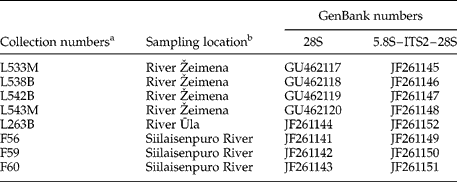
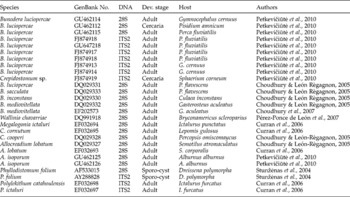
An entire nuclear 5.8S–ITS2–28S DNA sequence of ribosomal DNA (~460 bp: 5.8S ribosomal RNA gene, partial sequence; internal transcribed spacer 2, complete sequence; and 28S ribosomal RNA gene, partial sequence) was amplified using primers: 3S (5′–CGG TGG ATC ACT CGG CTC GTG–3′), forward direction; 28S (5′–CCT GGT TAG TTT CTT TTC CTC CGC–3′), reverse direction (Bowles et al., Reference Bowles, Blair and McManus1995). The 5′ end of the 28S rRNA gene sequence (~1230 bp), not overlapping with the previous sequence, was amplified using two primers: Digl2 (5′–AAG CAT ATC ACT AAG CGG–3′) forward direction; L0 (5′–GCT ATC CTG AG(AG) GAA ACT TCG–3′) reverse (Tkach et al., Reference Tkach, Grabda-Kazubska, Pawlowski and Swiderski1999). Additionally, two primers were used to check and cover flaws in the 28S rRNA gene sequences: Alloc28F (5′–ATG CGC GTT GCT CTT ATC AA–3′), forward direction; Alloc28R (5′–GTT TCA AGA CGG GTC AGG TG–3′), reverse direction (Petkevičiūtė et al., Reference Petkevičiūtė, Stunžėnas, Stanevičiūtė and Sokolov2010). DNA fragments were amplified via a standard PCR using Taq DNA polymerase (Fermentas Inc., Vilnius, Lithuania) in an Eppendorf Master Gradient thermal cycler under the following conditions: 36 cycles of 95°C, 30 s; 53°C, 1 min; 72°C, 2 min. All PCR reactions included negative controls to detect possible contamination. The PCR product was purified and sequenced in both directions at Macrogen Inc. (Seoul, Korea). Sequence confirmation was accomplished by comparing complementary DNA strands. Editing of the DNA sequences, contig assembly and the alignment of the consensus sequences were carried out using the software program Sequencher 4.7 (Gene Codes Corporation, Ann Arbor, Michigan, USA). The new sequences have been deposited to GenBank (table 1). Sequences of digenean species downloaded from GenBank and used in the phylogenetic analysis are presented in table 2. Phyllodistomum folium (Olfers, 1816), Polylekithum catahoulensis Curran, Tkach & Overstreet, 2006 and P. ictaluri (Pearse, 1924) were included as out-groups in this study. Polylekithum spp. has been classified within the Allocreadiidae, but recent molecular analyses have shown that they are not allocreadiids (Curran et al., Reference Curran, Tkach and Overstreet2006). Phyllodistomum folium is a species of the family Gorgoderidae, which exhibits a close association with allocreadiids in molecular phylogenies (Curran et al., Reference Curran, Tkach and Overstreet2006; Choudhury et al., Reference Choudhury, Rosas Valdez, Johnson, Hoffmann and Pérez-Ponce de León2007) and also uses bivalves as intermediate hosts.
Samples of Cercariaeum crassum specimens subjected to nuclear DNA sequencing of the 28S and 5.8S–ITS2–28S loci and GenBank accession numbers of the sequences.
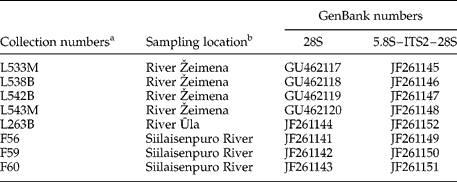
a Collection of P.B.Šivickis Laboratory of Parasitology, Institute of Ecology, Nature Research Centre, Vilnius, Lithuania.
b Rivers Žeimena and Ūla in Lithuania, Siilaisenpuro River in Findland.
Digenean species used in this study, their hosts, developmental stage and GenBank accession numbers for 28S and 5.8S–ITS2–28S sequences.

The ribosomal RNA sequence datasets were analysed and phylogenetic trees were obtained using MEGA version 4 (Tamura et al., Reference Tamura, Dudley, Nei and Kumar2007). The sequences were aligned with ClustalW (Thompson et al., Reference Thompson, Higgins and Gibson1994) with an open gap penalty of 15 and a gap extension penalty of 6.66. The genetic distances were calculated using Kimura's two-parameter model (Kimura, Reference Kimura1980) and the phylogenetic trees were constructed using the neighbour-joining method (Saitou & Nei, Reference Saitou and Nei1987). Also, phylogenetic trees under maximum parsimony (MP) criterion were constructed. The Close-Neighbor-Interchange (CNI) algorithm (Nei & Kumar, Reference Nei and Kumar2000) was used to find the MP tree.
Results
Karyotype structure of Cercariaeum crassum
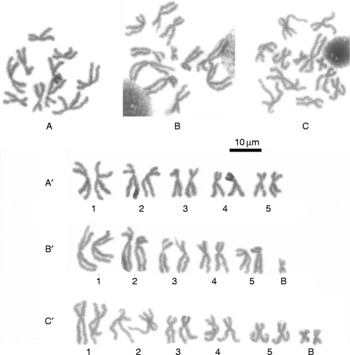
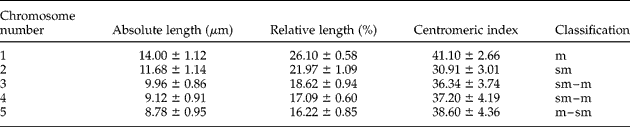
The mitotic spreads of chromosomes of C. crassum were obtained from nine infected specimens of P. amnicum, collected in Lithuanian rivers. The karyological analysis revealed inter-individual variation in the diploid chromosome numbers. Parthenitae isolated from six molluscs contained 10 chromosomes in their cells; two molluscs were infected with parthenitae possessing 11 chromosomes and one, 12 chromosomes. Representative karyotypes for C. crassum are shown in fig. 1. The prevailing chromosome complement with 2n = 10 is fairly symmetrical, composed of five pairs of large bi-armed elements. The mean total haploid complement length reached 53.5 μm. Table 3 gives the means ± SD of absolute length, relative length and centromeric indexes with the chromosome classification. According to the centromeric index values, chromosomes of pair 1 are metacentric, pair 2 is submetacentric, and remaining pairs 3, 4 and 5 are intermediate between the submeta- and metacentric type of structure.
Mitotic chromosomes of Cercariaeum crassum. A, A′, Mitotic metaphase and karyotype 2n = 10; B, B′, 2n = 10+1B; C, C′, 2n = 10+2B.

Measurements (means±SD) and classification of chromosomes of Cercariaeum crassum.
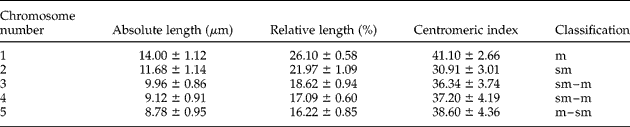
m, metacentric; sm, submetacentric chromosomes.
Supernumerary (B) chromosomes were detected in karyotypes containing more than ten structural elements. B chromosomes were metacentric (mean centromeric index value 42.6), mitotically stable and readily identifiable, because they were significantly smaller than any of the basic (A) chromosomes (fig. 1). Their mean absolute length reached 4.4 μm.
Sequence analysis and molecular phylogeny of Cercariaeum crassum
Sequences from two different regions of nuclear ribosomal DNA were used for phylogenetic analyses: the 5.8S–ITS2–28S (452 bp) and the 5′ end of the 28S gene (1212 bp), which does not overlap with the previous sequence. All corresponding sequences from both populations were identical. Complete nucleotide sequences are available in GenBank (table 1). BLAST searches performed on these sequences demonstrated the highest matches with sequences of digenean trematodes of the family Allocreadiidae.
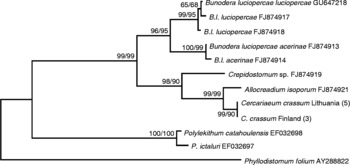
An alignment of the 5.8S–ITS2–28S sequences of allocreadiids (without outgroups) comprises 54 variable (12.83% of 421 bp) and 44 (10.45%) parsimony informative sites. Neighbour-joining and maximum parsimony analyses of these sequences gave identical topology phylogenetic trees with two major clades within the allocreadiids (fig. 2). The first clade is formed by 5.8S–ITS2–28S rDNA sequences of Bunodera spp. The second clade comprises sequences of Crepidostomum sp., Allocreadium isoporum and C. crassum. The DNA sequence analyses of C. crassum showed no intrapopulation or interpopulation differences. Intraspecific point-mutations in the ITS2 rDNA were observed for allocreadiid species in previous studies (Petkevičiūtė et al., Reference Petkevičiūtė, Stunžėnas, Stanevičiūtė and Sokolov2010). Sequence analysis of the 5.8S–ITS2–28S rDNA clearly distinguished Crepidostomum sp. and C. crassum, where a difference as great as 5.11% (23 bp) at this rDNA locus (450 bp) was revealed. In the phylogenetic tree, C. crassum appeared closely related to A. isoporum, with differences at 12 (2.67%) sites.
Phylogenetic tree based on analysis of 452 sites of ribosomal DNA sequences (5.8S and 28S gene partial sequences and ITS2 complete sequence). The tree was constructed by the neighbour-joining method (bootstrap repeats = 10,000, complete deletion of gaps/missing data, distance method: Kimura 2-parameter). Bootstrap percentages refer to neighbour-joining/maximum parsimony analysis. The sampling place and number of Cercariaeum crassum used for the sequencing are indicated following species name. Accession numbers are indicated for sequences obtained from GenBank.

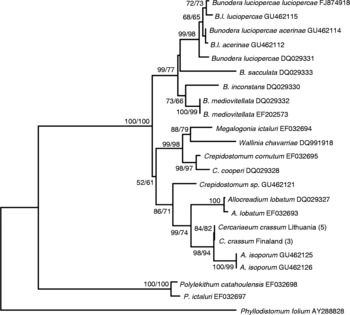
The rRNA gene sequences (1212 bp) localized at the 5′ end of the 28S rDNA gene of C. crassum are included in the phylogenetic analysis together with those sequences obtained from GenBank, which were not shorter than 812 bp. An alignment of the 28S rDNA dataset comprised 827 characters (including spaces), of which 113 bp (excluding the outgroup) and 197 bp (including the outgroup) are parsimony informative. Neighbour-joining and maximum parsimony phylogenetic trees, constructed using 28S rDNA gene sequences (fig. 3), have an identical topology. The separation of allocreadiids species in the 28S phylogenetic tree was identical to that of the previously discussed 5.8S–ITS2–28S phylogenetic tree. No differences in all obtained 28S sequences of C. crassum were found. In the 28S phylogenetic tree, C. crassum occurs in a single well-supported clade together with A. lobatum and A. isoporum. The 28S rDNA sequence difference between A. isoporum and C. crassum was low, occurring at 14 sites (1.16% of 1208 sites). More differences were detected between A. lobatum and C. crassum 28S rDNA sequences: 36 (2.9%) variable sites.
Phylogenetic tree based on analysis of 796 sites of the 5′ end of the 28S rRNA gene sequences. The tree was constructed by the neighbour-joining method (bootstrap repeats = 10,000, complete deletion of gaps/missing data, distance method: Kimura 2-parameter). Bootstrap percentages refer to neighbour-joining/maximum parsimony analysis. The sampling place and number of Cercariaeum crassum used for the sequencing are indicated following species name. Accession numbers are indicated for sequences obtained from GenBank.

Results from maximum parsimony and neighbour-joining analyses were identical in placing C. crassum into one clade with Allocreadium species: A. isoporum in the 5.8S–ITS2–28S phylogenetic tree (fig. 2) and A. lobatum and A. isoporum in the 28S sequence based phylogenetic tree (fig. 3).
Discussion
The karyological and molecular results of this study provide strong evidence that C. crassum is an allocreadiid species belonging to the genus Allocreadium Looss, 1900. Within this group much remains to be learned about species diversity, life cycles and evolutionary relationships (Caira & Bogea, Reference Caira, Bogea, Jones, Gibson and Bray2005).
In the molecular phylogenetics trees, according to our results, C. crassum is most closely related to the adult A. isoporum and Nearctic A. lobatum. However, the level of divergence in the C. crassum and Allocreadium spp. sequences revealed is consistent with the expected level of intrageneric variation.
In Finland A. isoporum and A. baueri Spaskij & Roitman, 1960 are known to occur (Niewiadomska & Valtonen, Reference Niewiadomska and Valtonen2007), while in Lithuania A. isoporum, A. transversale (Rudolphi, 1802) and single case of A. markewitschi (Koval, 1949) have been recorded in fish hosts (Rauckis, Reference Rauckis1988). The larval stages and life cycles of these species are unknown. Recent molecular analysis disclosed a significant difference between adult A. isoporum and cercaria known as cercaria of A. isoporum sensu Wiśniewski, 1958, and detected an unexpected match between the rDNA sequences of adult Bunodera luciopercae luciopercae (Müller, 1776) and larval ‘A. isoporum’ (Petkevičiūtė et al., Reference Petkevičiūtė, Stunžėnas, Stanevičiūtė and Sokolov2010). Despite the fairly good knowledge of helminths in European freshwater fish, C. crassum could represent a previously unknown species of the genus Allocreadium. There are numerous cases of the detection of cryptic species with narrow host specificity within well-known generalist parasites (see Combes, Reference Combes2001). Recent surveys based on morphology, random amplification of polymorphic DNA (RAPD) profiles, host specificity, karyology and DNA sequences (Sokolov et al., 2006; Petkevičiūtė & Stanevičiūtė, Reference Petkevičiūtė and Stanevičiūtė2008; Petkevičiūtė et al., Reference Petkevičiūtė, Stunžėnas, Stanevičiūtė and Sokolov2010) revealed the existence of a morphologically similar species complex within the allocreadiid B. luciopercae (Müller, 1776).
It is likely that C. crassum is a parasite of the clam-eating fish, since the emergence of cercariae from clams was never observed. Because of the identity of DNA sequences across different life-cycle stages within a species and their relative stability and reproducibility within a taxon, data on DNA sequences of additional Allocreadium spp. would provide an excellent opportunity to find the adult stage of C. crassum and to elucidate its life cycle.
The diploid chromosome numbers vary among studied digenean taxa, from 12 to 28 (Baršienė, Reference Baršienė1993); chromosome sets with 20 or 22 elements predominate. But 56 chromosomes were found in diploid sets of Clonorchis sinensis (Park et al., Reference Park, Im, Huh and Yong2000). Allocreadiid species possess comparatively large chromosomes, up to 13–14 μm, but low haploid numbers of six, seven or eight were recorded in most species (for a review see Petkevičiūtė & Stanevičiūtė, Reference Petkevičiūtė and Stanevičiūtė2008). The chromosome complement of C. crassum is unusual among digeneans due to the low number, 2n = 10. The karyotype is composed of large and exclusively bi-armed chromosomes. Such a karyotype presumably results from a decrease in chromosome number through centromere–centromere Robertsonian fusions that have affected mono-armed chromosomes leading to the formation of large metacentric elements. Comparative analysis of chromosomes of related trematode species indicated that the reduction of chromosome numbers resulted from centromeric fusion rather than elimination of chromosomes (Grossman et al., Reference Grossman, Short and Cain1981). Acrocentric mono-armed chromosomes prevail in the karyotypes of larval B. luciopercae, 2n = 14, and larval A. isoporum sensu Wiśniewski, 1959, 2n = 14 (Petkevičiūtė & Stanevičiūtė, Reference Petkevičiūtė and Stanevičiūtė2008). It is notable that the mean total length of haploid complements (TCL) of these two species does not exceed the TCL of C. crassum, despite different chromosome numbers.
The other peculiarity of the chromosome set of C. crassum is the presence of supernumerary chromosomes. The term B chromosomes covers a wide variety of accessory chromosomes, differing in size, shape and molecular composition (Vujošević & Blagojević, Reference Vujošević and Blagojević2004). Their only consistent feature is that they are not essential for survival of an individual and show non-Mendelian inheritance (Jones & Rees, 1982; Camacho et al., Reference Camacho, Sharbel and Beukeboom2000). Several hypotheses have been advanced to explain the intragenomic origin of B chromosomes in animals (Volobujev, Reference Volobujev1981; Camacho et al., Reference Camacho, Sharbel and Beukeboom2000). A mechanistically attractive model suggests that B chromosomes represent the small reciprocal products of Robertsonian translocations. B chromosomes occur in the Robertsonian-derived karyotypes of various rodents and other mammals (Patton, Reference Patton1977; Volobujev, Reference Volobujev1981; Borowik & Engstrom, Reference Borowik and Engstrom1993; Peppers et al., Reference Peppers, Wiggins and Baker1997). It is likely that B chromosomes of C. crassum could also be the by-products of Robertsonian fusions.
Parasitic flatworms have rarely been documented as carriers of supernumerary chromosomes. B chromosomes have been identified in selected natural populations of 11 digenean species belonging to six families (Špakulova & Casanova, Reference Špakulová and Casanova2004). More frequently they were mitotically stable and one or two existed in the cells of the carrier individual, although two species, Notocotylus sp. and Diplodiscus subclavatus, possessed up to ten B chromosomes differing in number from cell to cell and from individual to individual (Petkevičiūtė & Baršienė, Reference Petkevičiūtė and Baršienė1988; Petkevičiūtė et al., Reference Petkevičiūtė, Kiselienė and Stenko1989). However, B chromosomes were never found in species of the suborder Xiphidiata.
The results of this study showed that collection of different developmental stages of species and provision of exact collection localities, host identification reference, DNA sequences and karyotype characteristics of parasites will eventually provide the framework needed to piece together individual life cycles and clarify species variety and phylogeny in Allocreadiidae.
Acknowledgements
This research was funded by a grant (No. MIP-84/2010) from the Research Council of Lithuania. The authors also want to express their appreciation to Professor E. Tellervo Valtonen (University of Jyväskylä) for helping with the collection of sphaeriid bivalves in Finland. We also thank the Konnevesi Research Station of the University of Jyväskylä, Finland, for making laboratory and living facilities available.