Implications
Use of sexed genetic materials is a potentially efficient means of obtaining offspring of predetermined sex. Use of in vitro-produced embryos and technology controlling the sex of embryos has the potential to significantly change many aspects of animal production, such as allowing the breed of calf to be independent of the breed of cow and promoting enhanced rates of genetic gain. The use of sexed embryos offers an opportunity for the farmers to reduce calving difficulties and improve animal welfare. There will be considerable economic advantage to sexing embryo for cattle production if the technology is efficacious and costs of sexing are minimal.
Introduction
Reproductive management has received increased attention in recent years, as new technologies and programs have been developed to aid dairy managers in efficiently breeding cows and heifers. Efficient breeding of cows and heifers has become increasingly difficult, as fertility has decreased because of a correlated negative response with milk yield (MY; Olynk and Wolf, Reference Olynk and Wolf2008). Reproductive performance on the dairy farm affects profitability directly through the milk production per cow per day, number of replacements available, as well as voluntary and involuntary culling rates (Britt et al., Reference Britt, Scott, Armstrong and Whitacre1986; Olynk and Wolf, Reference Olynk and Wolf2007). In addition, breeding costs and costs associated with the veterinary care will affect the profitability of the dairy herd. Currently, many reproductive technologies are available for use on commercial dairy farms, with the costs and reproductive performance associated with these technologies varying considerably among farms. Reproductive management programs differ because of varying on-farm costs; housing and handling facilities; farm goals and values; and management styles (Olynk and Wolf, Reference Olynk and Wolf2007). Several survey-based studies in recent years have focused on dairy herd reproductive performance and management practices, providing a great deal of information. These overviews are useful for dairy producers, extension educators, researchers and related farm service industries because they provide current information regarding management practices that have been adopted and used on commercial dairy farms (Nebel and Jobst, Reference Nebel and Jobst1998; Caraviello et al., Reference Caraviello, Wiegel, Fricke, Wiltbank, Florent, Cook, Nordlund, Zwald and Rawson2006; Olynk and Wolf, Reference Olynk and Wolf2008).
Use of in vitro-produced embryos (IVP) and technology controlling the sex of embryos has the potential to significantly change many aspects of animal production, such as allowing the breed of calf to be independent of the breed of cow and promoting enhanced rates of genetic gain. To facilitate rapid adoption of the technology, studies are required in order to answer questions associated with the effects and possible benefits on production efficiency and cost (Tian et al., Reference Tian, McCall and McMillan1999). In addition, the value of investing in research and development of new technology is enhanced when the research is shown to take into account the needs of users (Yates et al., Reference Yates, Rehman and Chamberlain1996).
The majority of the studies on embryo technologies have focused on the aspects of genetic gain within the dairy herd. Their results have shown that IVP and embryo transfer (ET) technology can be of potential use both for increasing rates of genetic gain within a herd and for enabling a faster dissemination of superior genetics from nucleus breeding herds to commercial milk producers (Colleau, Reference Colleau1992; Imke et al., Reference Imke, De Boer and Van Arendonk1994; Yates et al., Reference Yates, Rehman and Chamberlain1996). The technology benefits for beef production were assessed by Herd et al. (Reference Herd, Bootle and Parfett1993) who showed that IVP and ET, in conjunction with the optimization of management practices, could improve increases in beef production efficiency by 1.8-fold when used in farming systems containing beef herds.
Reproductive technology on cattle has made significant strides over the past 50 years. This is a continuum that began with artificial insemination (AI). The utilization of AI was greatly enhanced with cryopreservation of semen and the ability to synchronize estrus by utilizing prostaglandins. The beef and dairy industry has focused on developing elite sires and selection through pregnancy testing. Genetic progress was further enhanced via ET technology. Non-surgical collection and transfer, cryopreservation of embryos, improved synchronization methods and ‘direct transfer’ embryos have improved efficiency, decreased costs and increased the utilization of ET by both beef and dairy producers. The continuum of reproductive technology continues with techniques such as in vitro fertilization, separated semen and nuclear transfer or cloning (Faber and Ferré, Reference Faber and Ferré2004).
The incidence of twin births is on average 4% to 5% in dairy herds and is strongly affected by age and parity of the dam (Silva del Río et al., Reference Silva del Río, Stewart, Rapnicki, Chang and Fricke2007). Increased frequency of twinning would increase the potential for obtaining more progeny from a genetically superior female, thereby allowing those females to play a larger role in a selection program (Cady and Van Vleck, Reference Cady and Van Vleck1978). The importance of this condition can be expressed along with the application of technologies controlling the sex of calves. In other words, the use of embryo technologies and sexed semen leads to significantly more female calves. This allows dairy producers to select among their herd's potential dams and produce dairy replacement heifers from only the genetically superior animals and promotes enhanced rates of genetic gains (De Vries et al., Reference De Vries, Overton, Fetrow, Leslie, Eicker and Rogers2008).
There is general agreement on the need to monitor herd performance, but it is not known how to do it effectively (Dohoo, Reference Dohoo1993). Stochastic dynamic simulation could be useful for measuring the performance of new technologies in dairy herds. Simulation can be used when exact analytic results are not obtainable (Allore et al., Reference Allore, Schruben, Erb and Oltenacu1998). This method allows for the inclusion of many sources of variation to obtain realistic results. Typically, herd measures are calculated from data collected during a fixed period (e.g. week or month) and compared with the previous period or standards (Reneau and Kinsel, Reference Reneau and Kinsel2001). The objective of using a dynamic model for this study was to mimic the biology and management of a herd of individual young stock and cows over time, with emphasis on reproduction management practices. The inclusion of stochastic functions generates variability in the performance of animals. This consequently results in realistic variability in herd performance. Each cow and heifer is described by a state variable. The states are characterized by actual milk production, weight and reproductive status. The state of the individual animal is updated and changed from month to month, and the production and input consumption of the herd are calculated. Briefly, dynamic programming is a mathematical technique that divides a multi-stage problem into a series of independently soluble single-stage problems to picture the multi-stage problem as developing a guideline for dairy cows of varying size and production over a certain planning horizon.
The principal objective of this study was to evaluate the net profit of milk production per cow for transferring two sexed embryos at different conception rates (CRs) and herd sizes and to compare with the net profit of milk production per cow for breeding cows and heifers with conventional semen at different herd sizes and with or without estrus synchronization in the dairy herds. The other objective of this study was to compare the genetic means of MY for breeding cows and heifers with conventional semen with genetic means for transferring two sexed embryos at different CRs and herd sizes in the dairy herds. The last objective of this study was to conduct a sensitivity analysis to evaluate the effect of varying in input and cost variables on the net profit of milk production per cow for transferring two sexed embryos at different CRs and herd sizes.
Material and methods
Model description
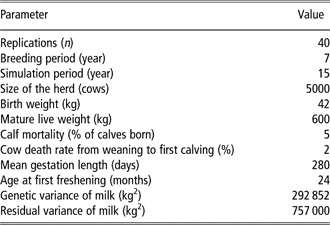
Dairy Herd Sim 1.0 simulation model (Honarvar et al., Reference Honarvar, Nejati Javaremi, Miraei Ashtiani and Dehghan Banadaky2010) written in Visual Basic version 6.0 was used with appropriate changes to this model for evaluating the objectives of this study. Therefore, a dynamic model that describes the biological, reproduction and genetic characteristics, as well as return and cost of dairy cows, was constructed to study the effect of several management and reproductive strategies on the genetics and economics of dairy herds. The population had overlapping generations. The basic characteristics of the animal component included pedigree, genetics, age at calving, number of services per conception, number of lactations and herd life. Other characteristics included time-oriented characteristics such as weight, age, physiological status, lactation stage, days open, pregnancy days, estrous cycle, service date and feed requirements. In the herds, the following animal groups were distinguished: young stock (<1 year old), pregnant and non-pregnant heifers (>1 year old), and several groups of lactating and dry cows. Default input parameters used in the model are given in Table 1. The feed intake and body weight (BW) functions are deterministic. The milk production functions are stochastic and depend on milk producing ability, age, lactation number, day in lactation and reproductive status. Input and output of animals from the herd were also estimated. The drawing of random numbers using relevant probability distributions triggers discrete events such as pregnancy and culling. The production and the changes within the herd are thus determined indirectly by simulation of production and change in state of the individual animals. The initial herd consists of a list of heifers in the herd described by their state variables. The reproductive process is viewed as a sequence of the events involving calving, estrus detection, service, conception and abortion or subsequent calving. Cows in the model move from one event to the next, depending on the outcome of previous events. When the model reaches the day on which a previously scheduled event occurs, the outcome of the event is determined, and the next event for that animal is scheduled. The maximum herd size in the model is set by the user. But two strategies have been used with regard to the size of dairy herds in this study: fixed size herds and expanding herds. The final size of expanding herds was assumed to be 10 000 cows (i.e. twice the initial size). Dairy expansion can relate to size, volume of production or total number of cows. If a dairy herd was expanding, then the lower the age at first calving, the faster is the rate of increase in the herd. On the other hand, in a stable herd, the age at first calving has no effect on the number of surplus animals available for sale each year. A greater age at first calving merely means that there are more heifers on the farm. A final consideration is that the older the heifer, the lower her fertility. Sex of the calf was determined by a U (0, 1) random variable. Bull calves make up 52% of all calves born (Ghavi Hossein-Zadeh et al., Reference Ghavi Hossein-Zadeh, Nejati-Javaremi, Miraei-Ashtiani and Kohram2008). If prior embryo sexing has been carried out, the probability is set to 0.9 for the favored sex (female sex; Seidel, Reference Seidel2003). Incidence of natural twinning is set at 1.10%, 3.20%, 4.22% and 4.50% of all calvings for first, second, third and fourth and later lactations, respectively (Ghavi Hossein-Zadeh et al., Reference Ghavi Hossein-Zadeh, Nejati-Javaremi, Miraei-Ashtiani and Kohram2009). It was assumed that freemartinism occurs in approximately 92% of heifers born as a result of heterosexual twin pregnancies (Buoen et al., Reference Buoen, Zhang, Wever and Ruth1992). The calving event triggers the determination of the calf data, and when the cow is in the estrous cycle schedules the first ovulation. Scheduling of the second and later ovulations depends on whether the cow became pregnant or not. The default probability of estrus detection (the estrus detection efficiency) is set at 0.50. But it was assumed that estrus detection efficiency was set at 0.9 (Tian et al., Reference Tian, McCall and McMillan1999) when the estrous cycles of the cows and heifers were synchronized in the herds. Cows are eligible to be served following a detected estrus after a voluntary waiting period of 45 days after calving. Cows that are open more than 400 days are not served, but kept in the herd until they are culled. Culling probabilities per each month of lactation were considered in the model, and more details of culling strategies are given in Honarvar et al. (Reference Honarvar, Nejati Javaremi, Miraei Ashtiani and Dehghan Banadaky2010). It is assumed that embryonic mortality before 42 days after service is included in the probability of conception. Abortion was defined as loss of the fetus between 42 and 260 days of gestation. The probability of abortion for each month of pregnancy was calculated from the current database of Holstein dairy cows in Iran. It was assumed that the odds ratio (OR) of abortion rate was 1.22 for single births v. twins (Ghavi Hossein-Zadeh et al., Reference Ghavi Hossein-Zadeh, Nejati-Javaremi, Miraei-Ashtiani and Kohram2008). Served cows that do not return to estrus are diagnosed for pregnancy at 42 days after service. Pregnant cows are dried off at 220 days of gestation, regardless of the pregnancy diagnosis result. Therefore, the dry period lasts for an average of 60 days. The average CRs investigated were 35%, 40%, 45%, 50% and 55% for embryos, but the average CR of the semen used in the AI program was assumed to be 40% (Tian et al., Reference Tian, McCall and McMillan1999). The CR of 40% permitted a comparison of the genetic trend of MY and profitability of using sexed or unsexed ET programs with AI. Stillbirth was defined as calf loss from day 260 until the end of normal gestation period, and the OR of stillbirth was assumed to be 7.58 for twin births v. singletons (Ghavi Hossein-Zadeh et al., Reference Ghavi Hossein-Zadeh, Nejati-Javaremi, Miraei-Ashtiani and Kohram2008). Wood's function (Wood, Reference Wood1967) was used to describe milk production. Parameters for functions for milk production were estimated from the test-day records obtained from the milk production records of dairy herds collected by the Animal Breeding Center of Iran using PROC NLIN in SAS (SAS Institute Inc., 2002). It was assumed that as lactation MY increased by 1 kg, open days increased by 0.22 days and the number of services per conception increased by 0.014 when lactation MY increased by 100 kg (Olds et al., Reference Olds, Cooper and Thrift1979). It was assumed that the odds of dystocia was 2.32 for twin births v. singletons, and that twin-calved cows had greater 305-day milk production than single-calved cows (Ghavi Hossein-Zadeh, Reference Ghavi Hossein-Zadeh2010a).
Default input parameter values used in the model

Records of milk production were generated by assuming an infinitesimal additive genetic model as yi = μ + ai + ei, where yi = phenotypic lactation milk record of the animal i; μ = population mean; ai = additive genetic effect of the animal i; and ei = random residual effect. The breeding value of animal i, ai, was generated by ai = zσa. If parents were unknown, where z is an independent random normal deviate and σa is the assumed additive genetic s.d., or was generated by ai = 0.5(ai (s ) + ai (d )) + M. If parents were known, where ai (s ) and ai (d ) are true breeding values of sire and dam of animal i and M is a deviation due to random Mendelian sampling, which was generated as  , where
 was the average inbreeding of the parents, and
 accounted for the reduction of genetic variation due to inbreeding. In addition, the residual effect, ei, was generated as ei = zσe, where σe was the assumed r.s.d. (Colleau, Reference Colleau1992).
BW of a cow is calculated as a function of age, lactation and pregnancy following Korver et al. (Reference Korver, Van Arendonk and Koops1985):
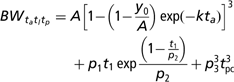
where  is the cow's BW (kg); ta is her age in days; tl is the number of days in lactation; tp is the number of days pregnant; A is mature live weight (kg); y 0 is birth weight (kg); k is a growth rate parameter and was assumed to be 0.003; p 1 is the maximum decrease of live weight during the lactation (kg); p 2 is the number of days during the lactation with the minimum live weight (kg); p 3 is a pregnancy parameter and was assumed to be 0.0187; t pc = tp−50 when tp−50 > 0, otherwise t pc = 0.
First service interval, conception interval and calving interval were calculated as the number of days between calving and first service, conception and previous calving, respectively. Pregnancy rate is a function of CR and estrus detection rate. Estrous cycle is one of the time-oriented reproductive characteristics for each open cow and heifer. Estrous cycles were assumed to be 18 to 24 days. CR, estrus detection rate and estrous cycle period were sampled from a random uniform distribution between 0 and 1. For AI and ET strategies, we assume that estrus in cows and heifers is synchronized. Synchronization can also reduce the time from the start of calving until mean calving day (Macmillan et al., Reference Macmillan, Henry, Taufa and Phillips1990), provided breeding begins on a fixed date, and may be significant when CR is low.
Theoretical annual genetic gain in a conventional AI population for MY was 150 kg/year (Colleau, Reference Colleau1992). However, the genetic trend of milk in the ET program was assumed to be 225 kg/year for sexed embryos (Jeon et al., Reference Jeon, Mao, Jensen and Ferris1990). It was indicated that breeding schemes using ET techniques promised a greater rate of genetic response than current AI programs. This conclusion was based on the argument that ET would lead to shortened generation intervals, more progeny from genetically superior females and higher intensity in selecting cows for replacements (Jeon et al., Reference Jeon, Mao, Jensen and Ferris1990). Genetic means for different strategies were compared using the GLM procedure of SAS (SAS Institute Inc., 2002).
Bio-economic evaluation
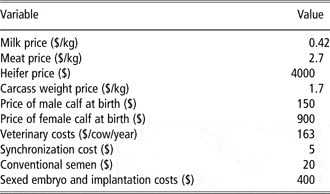
Summary statistics of some economic variables are shown in Table 2. Economic information was derived from different dairy farms in order to obtain realistic returns and costs as observed in Iran dairy industry. The 15 milk production classes were calculated as described by Van Arendonk (Reference Van Arendonk1985), with the lowest class equal to 70% of the average daily milk production and the highest class equal to 130%. Typically, annual veterinary costs per cow were estimated for an average first lactation cow and increased 5% for subsequent lactations. Groenendaal et al. (Reference Groenendaal, Galligan and Mulder2004) assign 33% of these costs to the first month, 11% to the second and third months and 5% to the later months of each lactation.
Economic variables for dairy herds in this study

At first, the present economic study started with the assumption that cows in the twin group had a naturally occurring twin pregnancy and therefore had no ET. Then it is assumed that the ET is performed in the dairy herd, using sexed embryos. In addition, only the effects of twinning were considered; however, causes and risk factors and direct influences of twin births on feed consumption and on diseases other than reproductive problems of the dam were all ignored. The additional income was completely based on the returns from the calves. The value of the calf was based on weight, sex, breed, mortality and the price per kilogram of BW. In this study, the birth weight of twin calves was assumed to be 8 kg lighter than for singles (Ghavi Hossein-Zadeh et al., Reference Ghavi Hossein-Zadeh, Nejati-Javaremi, Miraei-Ashtiani and Kohram2010).
The annual total income was determined by the following equation:

where R = annual total income, Nm = number of breeding cows, Pm = milk price, MY = milk yield, N mc = number of male calves, P mc = male calf price, N cc = number of culled cows, P cc = meat price, N sh = number of surplus heifers, P sh = heifer price and R mis = miscellaneous returns.
The annual total costs were divided into feed and non-feed costs and determined by the following equations:


where C = annual total cost; CF = feed costs; C NF = non-feed costs; CS = service or ET costs; CV = veterinary and health costs; CL = livestock supplies, building, real estate and equipment repairs, and C mis = miscellaneous costs.
Nutrients available to the animal are used for a variety of purposes, such as maintenance of body functions, pregnancy, lactation and growth. These diverse functions require considerable quantities of energy, so that in situations when the energy requirements of the animal's different functions are met, it is assumed that the non-energy requirements (protein, minerals and vitamins) are also met. Hence, differential herd feeding levels are expressed in terms of feed energy available per animal, or more precisely by the herd's ability to supply sufficient net energy (NE) to meet the requirements of the different body functions. Different equations adapted from National Research Council (2001) were used to compute dry matter intake, energy and protein requirements for maintenance, pregnancy, milk and growth per animal. To calculate feed costs, feed consumptions for different classes of animals were multiplied by the average feed costs. To calculate the service or ET costs, the actual number of inseminations or embryo transfers was multiplied by the service or ET costs.
The annual net profit of system (P) was finally determined as follows:

Where R = annual total income and C = annual total cost. Effects of a 20% variation in milk price, meat and heifer prices, feed and non-feed costs on net profit per cow were studied. In addition, this model can also be used to determine the breakeven point of the profitability (zero point of the net profit per cow) of sexed ET strategies for different input values. In such a sensitivity analysis, revenue and cost variables can be modified and used to predict the point at which twinning induced by sexed ET becomes favorable (Beerepoot et al., Reference Beerepoot, Dykhuzen, Nielen and Schukken1992).
Results
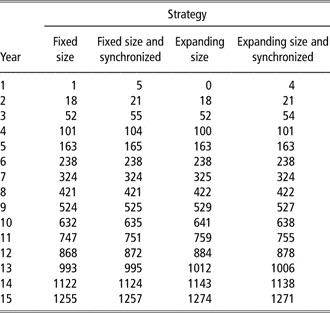
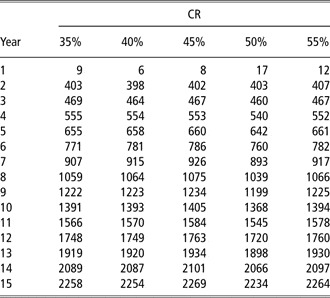
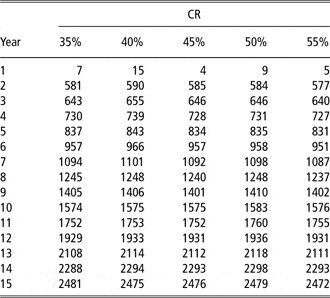
The genetic means of MY for different sizes of herds, with the application of conventional AI program with or without estrus synchronization, are given in Table 3. The results of this study indicated that the genetic means of AI population increased over the years (P < 0.01), because cows and heifers were bred to sires with milk genetic trends of 150 kg/year. The rate of genetic progress in the sexed ET strategies was significantly (P < 0.01) greater than the rate of progress in AI population with conventional semen (Tables 3 to 5). In addition, the genetic means of MY in the expanding herds were greater than the fixed size herds, using different embryo-based scenarios in the dairy herds (P < 0.01).
Genetic means of milk yield (kg) for breeding cows and heifers with conventional semen at different herd sizes and with or without estrus synchronization

Genetic means of milk yield (kg) for transferring two sexed embryos at different CRs in the fixed (synchronized and non-synchronized) herdsFootnote *

CR = Conception rate.
* The genetic means of milk yield for transferring two sexed embryos in synchronized and non-synchronized fixed herds were virtually identical.
Genetic means of milk yield (kg) for transferring two sexed embryos at different CRs in expanding (synchronized and non-synchronized) herdsFootnote *

CR = Conception rate.
* The genetic means of milk yield for transferring two sexed embryos in synchronized and non-synchronized expanding herds were virtually identical.
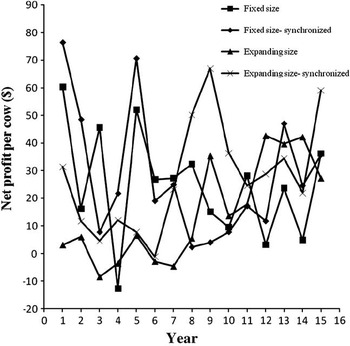
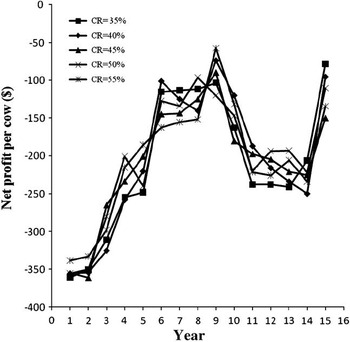
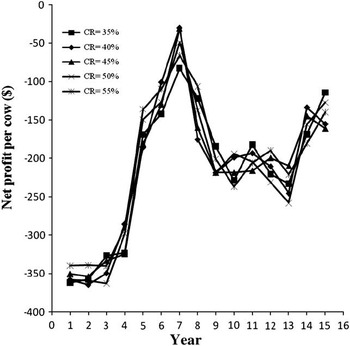
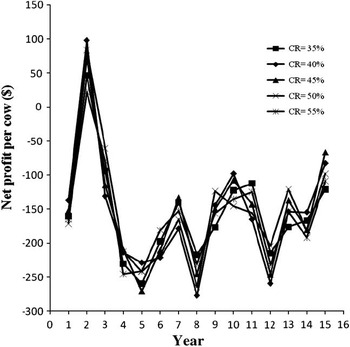
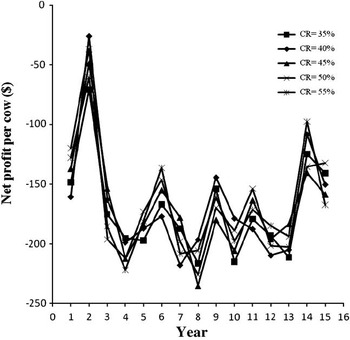
The net profit per cow for using the conventional AI system at different herd size and with or without estrus synchronization is shown in Figure 1. The net profit per cow for using sexed ET for induction of twinning at different herd sizes and with or without estrus synchronization is shown in Figures 2 to 5. In general, the net profit per cow for the AI strategies was positive at the end of the time horizon. The trend of net profit of using AI strategies with conventional semen over the time horizon was greater when the size of the herds was expanding (P < 0.01). However, the net profit of the embryo-based strategies was negative at the end of time horizon. Simultaneous use of estrous synchronization in AI programs resulted in more net profit than non-synchronized programs (on average from 4 to 13 $/year; P < 0.05). There were no restrictions on inbreeding in any of the strategies under study, thus allowing the best genetic material to be used each month. The net profit of applying sexed ET for induction of twinning was greater (P < 0.10) when the CRs of sexed embryo in the fixed and expanding dairy herds were 35% and 45% to 50%, respectively. The net profit of using sexed ET in the expanding herds was greater (P < 0.05) than that of fixed size herds (on average 47 $/cow per year). In general, there was a roughly consistent trend in net profit per cow for sexed ET strategies in the expanding herds over the years, but there was an increasing trend in net profit per cow for sexed ET strategies in the fixed herds over the years.
Net profit of milk production per cow ($) for breeding cows and heifers with conventional semen at different herd sizes and with or without estrus synchronization.

Net profit of milk production per cow ($) for transferring two sexed embryos at different conception rates (CRs) in the fixed herds.

Net profit of milk production per cow ($) for transferring two sexed embryos at different conception rates (CRs) in the synchronized fixed herds.

Net profit of milk production per cow ($) for transferring two sexed embryos at different conception rates (CRs) in the expanding herds.

Net profit of milk production per cow ($) for transferring two sexed embryos at different conception rates (CRs) in the synchronized expanding herds.

A key outcome is that most performance parameters, such as number of ET services, number of induced cows and number of surplus dairy heifers, are sensitive to CR differences between ET and AI. In general, the percentage of cows finally pregnant is lower where the CR is poorer. As expected, the total number of mating services or embryo transfers required increased as the CR decreased. Synchronized services had minimal effect on final pregnancy rate, in part because the submission rate was 90% for all scenarios. However, synchronization improved the mean calving date because the start of breeding coincided with the peak of the first synchrony. In practice, non-pregnant cows are the preferred candidates for culling. The total number of cows culled is constant in herds of fixed size and is determined by the number of cows surplus to the required number of lactating cows.
The results of this study revealed that the impact of IVP and ET technology for induction of twins in the dairy herd is not only on dairy production characteristics, but also on the beef production resulting from the production of surplus male calves and freemartins. Benefits are shown for estrous synchronization as a companion technology, which can overcome the effects of low CR on dairy herd productivity. In addition, the sex-controlled scenarios resulted in many more female calves than sex-uncontrolled scenarios (on average twice the number of female calves in sex-uncontrolled scenarios).
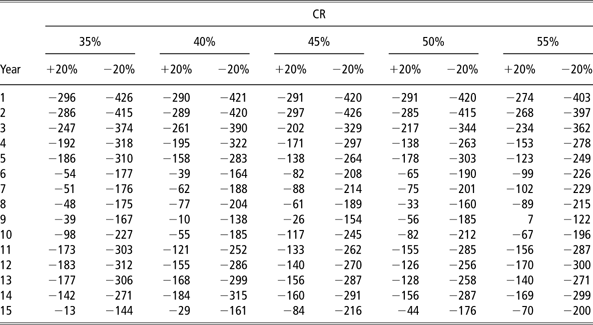
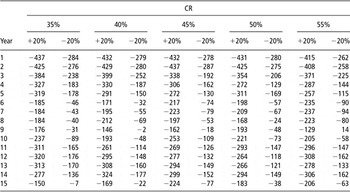
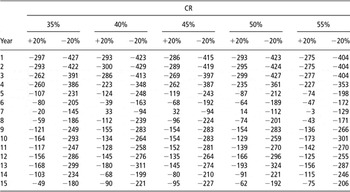
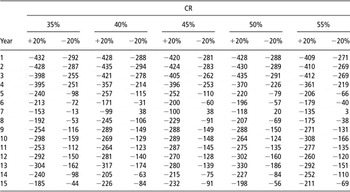
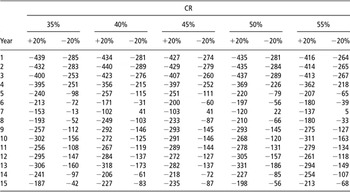
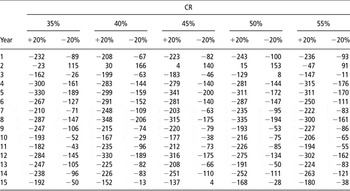
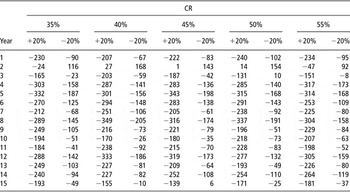
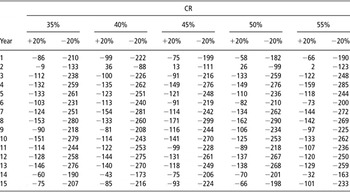
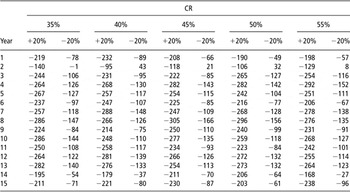
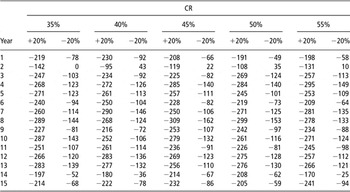
The results of sensitivity analysis of the model for transferring two sexed embryos at different CRs and herd sizes are shown in Tables 6 to 17. It is indicated that the income obtained from the milk sales and feed costs were the most important revenue and cost variables, respectively. A 20% increase or decrease in milk sales income and feed costs has a significant effect on the net profit of dairy herds. On the other hand, incomes obtained from the milk and heifer sales were the most important revenue variables, and feed and embryo costs were the most important cost variables in the embryo-based strategies. In addition, several analyses were conducted to calculate breakeven points, and the results indicated that twin births induced by sexed ET in the fixed size herds were profitable when the milk and heifer prices increased by 44% and 58%, respectively, and the costs related to the feed and embryo decreased by 41% and 53%, respectively. On the other hand, twin births induced by sexed ET in the expanding herds were profitable when the milk and heifer prices increased by 40% and 49%, respectively, and the costs related to the feed and embryo decreased by 38% and 50%, respectively.
Sensitivity analysis of net profit per cow ($) for transferring two sexed embryos at different CRs in the fixed herds when milk payment varied by ±20%
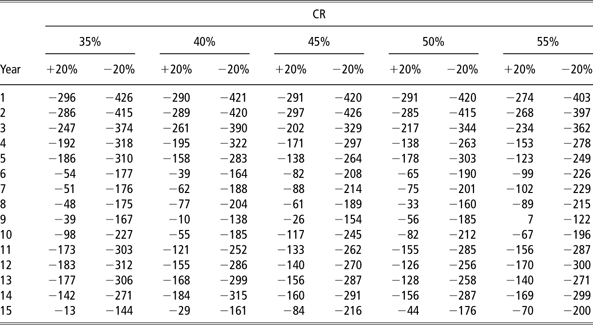
CR = Conception rate.
Sensitivity analysis of net profit per cow ($) for transferring two sexed embryos at different CRs in the fixed herds when feed costs varied by ±20%

CR = Conception rate.
Sensitivity analysis of net profit per cow ($) for transferring two sexed embryos at different CRs in the fixed herds when non-feed costs varied by ±20%

CR = Conception rate.
Sensitivity analysis of net profit per cow ($) for transferring two sexed embryos at different CRs in the synchronized fixed herds when milk payment varied by ±20%

CR = Conception rate.
Sensitivity analysis of net profit per cow ($) for transferring two sexed embryos at different CRs in the synchronized fixed herds when feed costs varied by ±20%

CR = Conception rate.
Sensitivity analysis of net profit per cow ($) for transferring two sexed embryos at different CRs in the synchronized fixed herds when non-feed costs varied by ±20%

CR = Conception rate.
Sensitivity analysis of net profit per cow ($) for transferring two sexed embryos at different CRs in the expanding herds when milk payment varied by ±20%

CR = Conception rate.
Sensitivity analysis of net profit per cow ($) for transferring two sexed embryos at different CRs in the expanding herds when feed costs varied by ±20%

CR = Conception rate.
Sensitivity analysis of net profit per cow ($) for transferring two sexed embryos at different CRs in the expanding herds when non-feed costs varied by ±20%

CR = Conception rate.
Sensitivity analysis of net profit per cow ($) for transferring two sexed embryos at different CRs in the synchronized expanding herds when milk payment varied by ±20%

CR = Conception rate.
Sensitivity analysis of net profit per cow ($) for transferring two sexed embryos at different CRs in the synchronized expanding herds when feed costs varied by ±20%

CR = Conception rate.
Sensitivity analysis of net profit per cow ($) for transferring two sexed embryos at different CRs in the synchronized expanding herds when non-feed costs varied by ±20%

CR = Conception rate.
Discussion
One special case of non-equilibrium application in this study is herd expansion. Increasing herd size by having more female calves is very attractive in many situations, and may become even more attractive because of the biosecurity issues in large herds (Seidel, Reference Seidel2003). The possible reason for the greater rate of genetic progress in expanding herds was because of the larger size of expanding herds than the size of static herds. Expanding herds probably experienced lower inbreeding rates than fixed size herds. Therefore, there were greater possibilities for the use of better genetic material and the better expression of the genetic potential of dairy cows for production traits in the expanding herds (Ghavi Hossein-Zadeh et al., Reference Ghavi Hossein-Zadeh, Nejati-Javaremi, Miraei-Ashtiani and Kohram2010). The greater trend of net profit per cow for AI strategies in expanding herds over the time horizon was because of the genetic trend of MY and the increase in milk production over the years. The reason for the negative net profit of embryo-based strategies at the end of time horizon was that the increase in the milk production and its related incomes cannot decrease the costs of sexed embryos and their transfers. The negative relationship between CR of embryo and the total number of embryo transfers was because a greater number of cows required re-serving in subsequent service periods when the CR was lower (Tian et al., Reference Tian, McCall and McMillan1999). The greater number of female calves produced in the sex-controlled scenarios allows the farmer to select animals with the best genetic potential as dairy replacement heifers; therefore, the rate of genetic gain increased in the dairy herd. The greater net profit in synchronized AI herds than that in non-synchronized herds indicated the positive effect of the improvement in reproductive management of dairy herd on the net profit and increase in the performance of dairy herds (Ghavi Hossein-Zadeh et al., Reference Ghavi Hossein-Zadeh, Nejati-Javaremi, Miraei-Ashtiani and Kohram2010).
The first of several attempts to model the potential benefits of using embryo-based technologies in commercial dairy herds in New Zealand was undertaken by WH Vivanco in 1997 (unpublished results). By assuming that the new technologies enabled the selection of replacement heifers from only the top 10% of cows in the milking herd, Vivanco determined that the breakeven cost of the technology was accomplished. A modeling study was conducted by BL Harris (unpublished results) to compare the current scheme for breeding heifer replacements using AI only, with those using embryo reproductive technologies. Three scenarios ranging from a ratio of one heifer produced per cow up to two heifers per cow were modeled (Smeaton and Vivanco, Reference Smeaton and Vivanco2001).
In a simulated case study analysis of several herds, Smeaton and Vivanco (Reference Smeaton and Vivanco2001) tested several scenarios using the new technologies as strategies for breeding replacement heifer calves. These strategies were compared with the status quo system using AI only. In this system, cows for mating are selected as they come on heat once the mating season has started, regardless of production worth or breeding value. Clearly in this system, most of the genetic gain of the herd is derived from the use of superior bulls provided by the breeding company. Similar to this study, scenarios modeled by Smeaton and Vivanco (Reference Smeaton and Vivanco2001) were based on the assumption that the reproductive technologies were available and reliable. In addition, most of the genetic gain in the embryo-based strategies of this study would be because of superior females compared with Smeaton and Vivanco's study. Tian et al. (Reference Tian, McCall and McMillan1999) compared a range of ET and IVP scenarios at different pregnancy rates with AI systems of mating. Consistent with the result of this study, conclusion of Tian et al. (Reference Tian, McCall and McMillan1999) was that profit opportunities for dairy farmers would be significant if beef IVP and ET costs were no more than AI costs, and if CRs for the IVP/ET technology were at least 50%. Beerepoot et al. (Reference Beerepoot, Dykhuzen, Nielen and Schukken1992) developed an economic model to determine the additional costs and returns of natural twin calvings in dairy cattle. They concluded that it is not profitable to select to increase the number of twins in dairy cattle, and that milk losses determined 59% of the total costs of natural twinning. Beerepoot et al. (Reference Beerepoot, Dykhuzen, Nielen and Schukken1992) studied the economics of natural twins in dairy cattle, but our study was related to artificial induction of twins using sexed ET in dairy cows. Yates et al. (Reference Yates, Rehman and Chamberlain1996) evaluated the potential effects of ET on milk production on commercial dairy herds over a 15-year period and applied a strategy of using either ET followed by two AI or (for animals already derived from ET in an earlier generation) three passes of AI. Typical CRs, herd structure, MY and culling rates are used to model such a strategy, and the average MY increases from 5551 l/year in year 1 to 6348 l/year in year 15. The rate of increase is faster in the earlier years at 51 l/year than in the final years 45 l/year as initially more animals are bred to ET than AI. Increasing the CRs to ET increases the MYs in the early stages, but by year 15 the benefits are minimal. Similar to the results of Yates et al. (Reference Yates, Rehman and Chamberlain1996), the genetic means of MY increased over the years for different strategies used in this study. However, increasing the CRs to ET did not have a significant effect on the genetic means of MY in this study.
Smeaton and Vivanco (Reference Smeaton and Vivanco2002) reported that where new technologies are used to produce beef animals at commodity prices, their use is likely to be mostly uneconomic. In addition, they assumed reproduction efficiency levels similar to natural mating, which are presently not attainable on a regular basis. They concluded that at commodity prices, the use of reproductive technologies appears likely to be uneconomic unless these returns rise to at least double the present levels. This applies even if the biological efficiencies of a small cow rearing a large calf can be captured successfully. Examples in which these opportunities may apply include the use of special recessive genetic characteristics, which are expressed only in animals homozygous for the gene. Other examples include instances where the technologies could play a role in rapidly propagating valuable new genes out to the industry or in some other situation where very tightly defined animal products are required, which cannot be easily produced on a large scale by natural mating. Smeaton et al. (Reference Smeaton, Harris, Xu and Vivanco2003) applied a modeling approach to study the factors affecting commercial application of embryo technologies in New Zealand. All of their models confirmed that at current levels of performance, embryo-based reproductive technologies are usually not profitable in New Zealand except in niche market situations where the returns from the resulting offspring are significantly greater than can be obtained from natural mating or AI reproduction systems. Jeon et al. (Reference Jeon, Mao, Jensen and Ferris1990) used stochastic modeling of multiple ovulation and ET (MOET) breeding schemes to study the genetic changes and genetic drift in small closed dairy cattle populations. They concluded that all MOET breeding schemes achieved larger genetic responses than the realized genetic gain from the AI progeny testing population. Ghavi Hossein-Zadeh (Reference Ghavi Hossein-Zadeh2010b) reported that MOET breeding schemes achieved larger genetic responses than the realized and theoretical genetic gains from the current AI progeny testing populations. In addition, Kosgey et al. (Reference Kosgey, Kahi and Van Arendonk2005) evaluated the closed adult nucleus MOET and conventional progeny testing breeding schemes for milk production in tropical crossbred cattle and concluded that there was substantial genetic gain with a relatively small number of animals in the MOET nucleus scheme compared with a conventional progeny testing scheme. In addition, Peixoto et al. (Reference Peixoto, Verneque, Teodoro, Penna and Martinez2006) reported that there was a positive genetic trend for MY in the MOET nucleus of Guzerat herds at low inbreeding coefficients because of the increased accuracy and estimated genetic merit; however, no changes in the average MY were observed.
If our objective is to increase the twinning rate in a dairy herd, it should be noted that development of excellent and practical management strategies to cope with some of the negative effects associated with twinning on dairies is critical. Management of twinning in a dairy operation begins with early identification of cows carrying twins because management intervention cannot occur unless cows carrying twins are accurately and efficiently identified (Fricke, Reference Fricke2001).
Conclusions
The genetic means of milk production for all of the embryo-based scenarios performed in this study were larger than those of the AI strategies. The net profit of using sexed ET in the expanding herds was greater than that of fixed size herds. High CRs for ET technology and the use of sex-controlled embryo systems, especially for induction of twin births, to produce dairy replacements will be critical elements of the system that produces a significant number of calves of the favored sex in the dairy herds. The greater number of female calves produced in the sex-controlled scenarios allows the farmer to select animals with the best genetic potential as dairy replacement heifers. The results of sensitivity analyses indicated that incomes obtained from the milk and heifer sales were the most important revenue variables, and feed and embryo costs were the most important cost variables in the embryo-based strategies. Therefore, the price of the embryos, especially sexed embryos, needs to be considerably lower than present to make the new embryo-based technologies cost-effective for dairy producers.
Acknowledgement
The authors thank two anonymous reviewers for their constructive comments on the earlier versions of this manuscript.