There can be no doubt that the most horrible topic connected with slavery is slave-hunting … the miseries arising from slavery and the slave-trade are here revealed in their most repulsive features. (Henry Barth Reference Barth1890: xiii, xvi)
INTRODUCTION
The history of slavery in Africa has until recently paid little attention to the societies described as decentralized, stateless or of intermediate complexity from which the vast majority of slaves were drawn. The absence of contemporary historical and ethnographic records has led to such groups being treated as reservoirs, ‘passive victims of the process’ (Klein Reference Klein2001: 49–50). This, Klein showed, citing ground-breaking West African case studies by Hawthorne (Reference Hawthorne2001) and Hubbell (Reference Hubbell2001), is far from the case. These contributions and further case studies, notably those presented in Diouf (Reference Diouf2003), confirm that, far from lacking agency, decentralized African societies responded to predation by states in a great variety of ways. While Klein's main interest lay elsewhere, his paper usefully catalogues the varied adaptations made by decentralized societies facing exploitation by slavers. These included movement and relocation, new types of settlement, the construction of physical defences, changes in religion, economy, agricultural practices, patterns of trade and exchange, involvement in slaving on their own account, the pawning and selling of kin, and submission and payment of tribute to slaving powers. The scope of his survey does not, however, extend to analyses of specific prey–predator interfaces. The interface concept summarizes the parties' interrelationships, emphasizing social identities and the types and natures of transactions between them. Those in the study area are shown to be both varied and sensitive to local conditions, and their definition assists understanding of accommodations between societies through time.
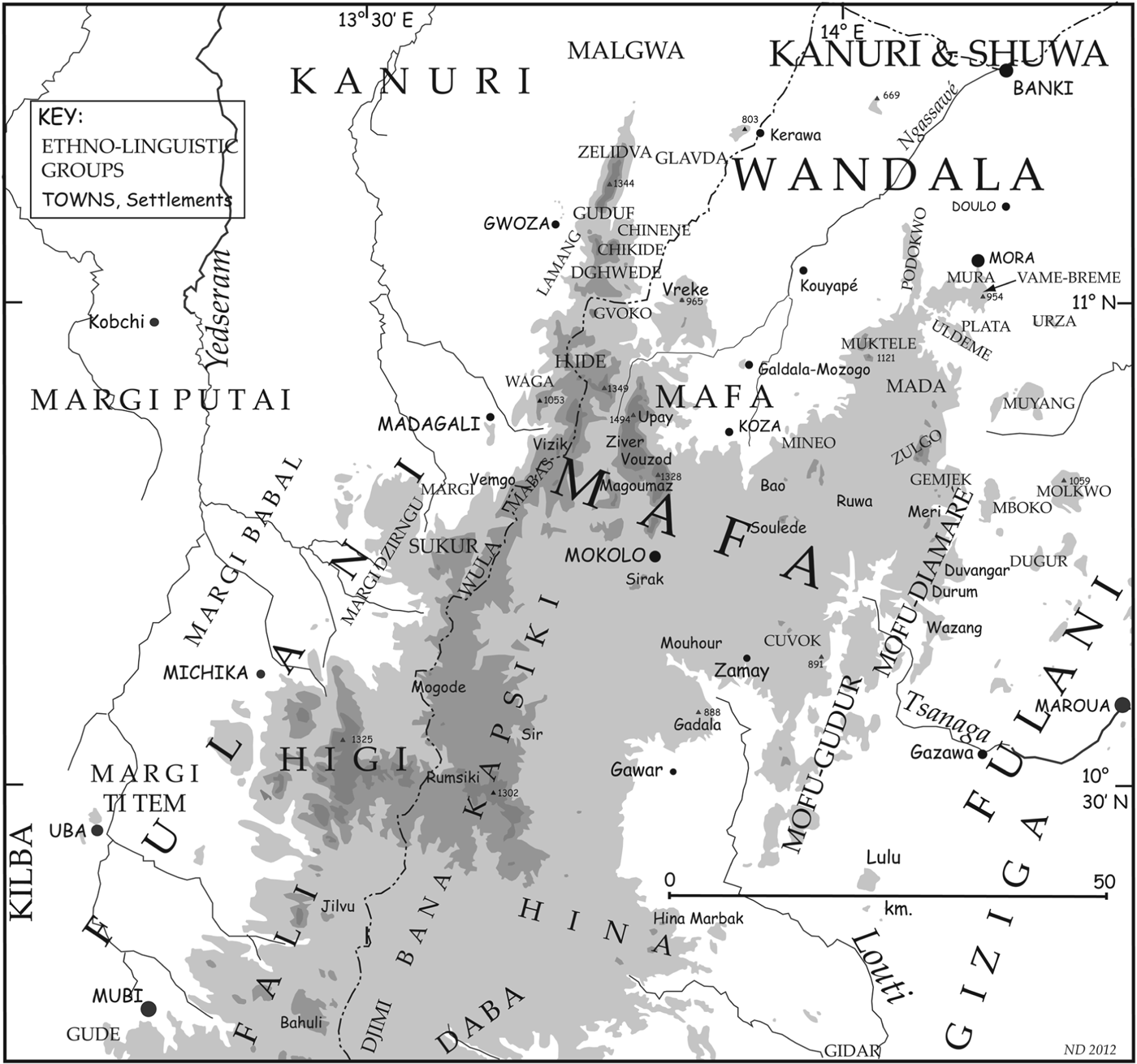
The many indigenous groups of the northern Mandara Mountains in the Extreme North Region of Cameroon and parts of Nigeria's Borno and Adamawa states invite such studies (Figure 1). Ethnographic observation here goes back to the first decade of the twentieth century (Strümpell Reference Strümpell1912; Reference Strümpell1922–23) and research to the 1930s (Lavergne Reference Lavergne1944). We also possess the diary of Hamman Yaji, the Fulani (Fulbe, Peul, etc.) chief (lamido) of Madagali, who was vigorously involved in slaving from before September 1912 to December 1920 (Vaughan and Kirk-Greene Reference Kirk-Greene, Vaughan and Kirk-Greene1995). These authors set Hamman Yaji and his actions in their regional and political settings, and Fisher (Reference Fisher2001) places them within the context of slavery in Muslim Black Africa. Van Beek (Reference van Beek2012) has also described Yaji's slaving and eventual downfall in its interstitial colonial context. My aim here is to compare Yaji's and two other, very different, forms of late slaving in this region, one little treated in syntheses of slavery in Africa (see, for example, Manning Reference Manning1990; Lovejoy Reference Lovejoy2012).Footnote 1
The northern Mandara Mountains and surrounding plains showing topographic features and selected ethno-linguistic groups, towns and settlements. The Nigeria–Cameroon border is indicated, as are contours at 2,000, 3,000 and 3,500 feet (610, 915 and 1,067 metres).

Throughout this paper I refer to the inhabitants of the mountains, piedmonts and the surrounding inselbergs and nearby plains as ‘montagnards’,Footnote 2 descendants of small populations speaking closely related Chadic (Afro-Asiatic) languages who occupied the region in the first and early second millennium AD. From perhaps AD 1200, settlement in the mountains began to increase (MacEachern Reference MacEachern and David2012: 52–5), and there is localized evidence of communities constructing impressive monumental sites in the fifteenth century (David Reference David2008). At this time, most groups are likely to have been organized into petty chiefdoms. They made their living, as did their descendants at the start of the colonial interlude in the early twentieth century, primarily by subsistence farming, small-scale animal husbandry, and crafts including iron smelting and smithing (Hallaire Reference Hallaire1991; Sterner Reference Sterner2003). Chiefdoms rarely attained 10,000 people and sometimes consisted of a single settlement. Despite political and linguistic fragmentation, montagnards maintained close relations with their neighbours. Groups in the highlands and those resident in the piedmont, around inselbergs and on the plains adjacent to the mountains drew from the same symbolic and cultural reservoir (David and Kramer Reference David and Kramer2001: 216–18).
Since 1984, I have directed the Mandara Archaeological Project in ethnoarchaeological, archaeological and ethnological research in and around the Mandara Mountains, working on both sides of the international border, and, together with Judith Sterner, from 1991 to 1996 and again in 2008 at Sukur, Adamawa State, Nigeria, a prime Hamman Yaji target.Footnote 3 Unreferenced statements made below regarding montagnards derive from my field notes. In addition, in the Gousda village complex (Müller-Kosack Reference Müller-Kosack2003) located in the hills next to the Koza-Mozogo plain, Godula Kosack (Reference Kosack1992) has recorded substantial oral accounts of slaving. Scott MacEachern (Reference MacEachern, Lane and MacDonald2011), who worked in the mountains south of Mora in the mid-1980s, also collected montagnard testimony on early twentieth-century enslavement and everyday life. These three sets of data allow for comparison of slaving practices and montagnard responses in the late nineteenth and early twentieth centuries in the Madagali region and in the sphere of influence of the Wandala (or Mandara) state.
Slaving in and around the Mandara Mountains from the SIXTEENTH century to 1902
Perhaps earlier than the sixteenth century (Haour Reference Haour, Lane and MacDonald2011) and well into the twentieth, the lives of the peoples of the Mandara Mountains and surrounding foothills and plains were lived in slavery's shadow. The Muslim states of the plains – Borno, south-west of Lake Chad; Wandala,Footnote 4 Borno's restive southern client; Bagirmi to the east; and, in the nineteenth and early twentieth centuries, the Fulani caliphate of Sokoto – were perennially hungry for the products of the montagnards. First and foremost the states wanted slaves and animal livestock and, from the mountains, also iron. Slaves were used for a variety of purposes (see Hopkins Reference Hopkins1973: 22–7, 79–86; Lovejoy and Hogendorn Reference Lovejoy and Hogendorn1993: 267–70; Lovejoy Reference Lovejoy2005: 231; Fisher Reference Fisher2001: passim). While adult males were often slaughtered in raids, some men and women were placed in agricultural slave settlements. Young males might be recruited into domestic or military service. Women and girls were incorporated into Muslim households as servants, concubines and mothers of children. The demand for slaves was never satisfied, especially as slaves did not replace themselves by reproduction (Lovejoy Reference Lovejoy2012: 7–8; Meillassoux Reference Meillassoux1991: 294–9).
Since at least the sixteenth century, the Wandala (Mandara) and Borno states, sometimes in concert, were engaged with the stateless societies of the plains and foothills and to some extent with those of the mountains. Bagirmi also made incursions into the area (Forkl Reference Forkl1983; Barkindo Reference Barkindo1989: 111–12, 148). However, we know little of the specifics of slaving in the period before the Fulani jihad reached the region in the first decade of the nineteenth century, and not much more until the twentieth.
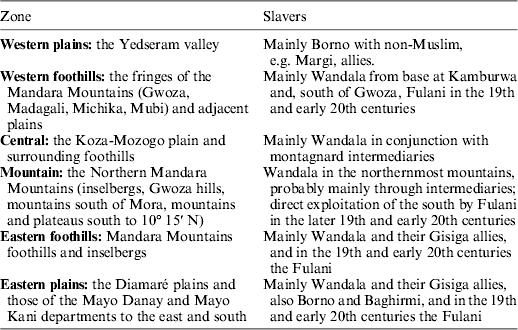
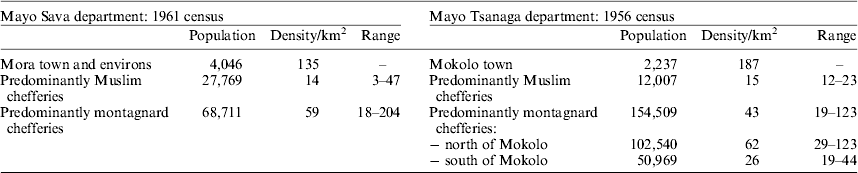
Table 1 sets out six geographic zones with contrasting topographies that constrained slave acquisition. Another important variable was the distribution of people across these landscapes. Historical demography of the Mandara region is in its infancy, and population numbers fluctuated widely in response to frequent natural disasters. Table 2 shows a marked mid-twentieth-century contrast between low-density, mainly Muslim populations in the lowlands and much higher-density montagnard populations located preferentially on the outer slopes of the mountains and on massifs and inselbergs. The highest densities occurred in the mountains south of Mora, in those around the Koza-Mozogo plain extending south to Mokolo, and in the Higi hills south-east of Michika. In the past, population densities were lower but showed similar patterns. In the mountains, the interior plateau of the eastern horn of the mountains and those south of Mokolo were sparsely occupied by montagnards, leaving room, especially in the latter area and before the nineteenth-century jihad, for Fulani pastoralists (Mohammadou Reference Mohammadou1988: 125, 257). The plains, now widely cleared, were largely forested into the early twentieth century, with settlements concentrated along watercourses. East of the area mapped in Figure 1, along the Logone river, densities of fifty to over a hundred persons per square kilometre were reached among the Musgu, Massa and, north of the Kébi river, the Tupuri. To the west, there were considerably fewer occupants on the plains of the smaller Yedseram river (Barth Reference Barth1965 [1857]: 102–27; Meek Reference Meek1931: 213–14).
Slaving zones in and around the northern Mandara Mountains in the sixteenth to twentieth centuries*
* The areas to the west and north were within the Borno sphere of exploitation.
Population numbers and densities by main towns, predominantly Muslim and predominantly Montagnard ‘chefferie’ (chieftaincy) administrative units in the departments of Mayo Sava and Mayo Tsanaga, Cameroon*
* Data extracted from Beauvilain (Reference Beauvilain1989: 590–1). Boutrais’ (Reference Boutrais1973: Carte Annexe 1) map of the human distribution in and around the northern Mandara Mountains gives a superb visual impression of population densities on both sides of the border.
The ability to muster a military or raiding party and to equip and maintain it in the field constitutes another set of constraining variables. In the sixteenth century, the small, nascent Wandala state established its capital beneath the Kerawa inselberg, where, with easy access to the Western and Central zones, ‘they could best supply some of the economic needs of Borno: namely foodstuffs, iron and slaves' (Barkindo Reference Barkindo1989: 98–9).Footnote 5 Around 1570, Idris Alauna, ruler of Borno, displeased with the Wandala, sent an expedition against Kerawa. This failed because the capital's inhabitants fled up into the inselberg. In the words of the contemporary chronicler Ibn Furtu, ‘the army of the Muslims was not able to attack them, or even come near them’, although a later siege brought the Wandala to heel (Lange Reference Lange1987: 77). At this time, and long afterwards, slavers from the plains, even while they possessed cavalry, were incapable of operating effectively in mountain terrain (lengthy sieges not being feasible), although they penetrated the broader river valleys and plateaus. Even in the second half of the nineteenth century, Shehu Omar of Borno, having burned Doulo, then the Wandala capital, was unable to defeat the Wandala, who had taken refuge in the mountains above Mora.
From Ibn Furtu we also learn that the ruler of the Margi, whose residence was at Kobchi, on the plains 44 kilometres west of Madagali, ‘used to follow our Sultan in all his expeditions’. When he demurred, Idris Alauna sent an expedition that pursued him south, perhaps beyond Michika (Lange Reference Lange1987: 76). The Margi ruler later submitted. Thus, even in the sixteenth century, states were in a position to dominate a considerable portion of the Western plains zone and to compel some non-Muslim societies to become their allies.
During the seventeenth century, the Wandala state extended north towards Dikwa, north-west to Bama, and in the Western foothills zone south beyond Gwoza. ‘Dominion was achieved not only by raids, but also through economic and cultural relations’, including trading with montagnards for iron (Barkindo Reference Barkindo1989: 108–9). Before the accession of Tlikse (Wandala ruler) Bukar Aji (reigned c.1715–37), many of the Margi, Gamergu and WulaFootnote 6 of the Western foothills and the Musgu of the Eastern plains ‘paid homage to the Tlikse-a-Wandala’ (Barkindo Reference Barkindo1989: 109), but we have no contemporary accounts of slaving. Barkindo's map of the Wandala state for this period (Barkindo Reference Barkindo1989: 142) shows it extending west of the Gwoza hills to Kamburwa (Kamburo-Disa), an important Wandala outpost, but nowhere more than 25 kilometres south of Doulo.
The earliest information on the Central zone comes from the list of rulers in the Wandala chronicles. Tlikse Abarafa ruled around 1700 (Forkl Reference Forkl, Barreteau and von Graffenried1993: 224) but was ‘dethroned’ and exiled to Mozogo, where he died (Vossart Reference Vossart1953: 37). Mozogo, at that time located beneath Galdala inselberg, was only 10 kilometres from the mountains and could hardly have survived without accommodation with the montagnards. It is likely that it was already a mixed Wandala–montagnard settlement, as is Mozogo today (Boutrais Reference Boutrais1973). The suggestion is that for a considerable period the Wandala operating in the Central zone benefited from the services of montagnard allies, and not merely renegades, in military and slaving enterprises. This was the case when, around 1890, a fortified Wandala settlement was founded by ten Wandala household heads at Kouyapé, 11 kilometres north of Galdala (by this time Wandala access to the Eastern slaving grounds was greatly reduced by Fulani conquests). Kouyapé served as a base of operations for slaving and for countering ‘the reprisals of the pagan montagnards’, which took the form of night attacks. Raids on the margins of the Koza-Mozogo plain took place weekly or fortnightly (although probably not during the main rains or for a while after them). Cavalry, together with footmen, worked the foot of the mountains and captured women, children and livestock while the men fled.Footnote 7 Despite its location off the trade routes, Kouyapé had the reputation of being a substantial slave market selling captives from the Mafa, Podokwo and Mouktele massifs, but the catch resulting from the kind of low-intensity raid described, which was unlikely to have exceeded a couple of dozen captives at a time, was swelled by slaves supplied by the montagnards themselves (see below).
While for much of the eighteenth century Wandala rule extended over most if not all of the Central zone, they probably controlled no more than the northern inselbergs and foothills of the Mountain zone. In 1800, the time of maximal expansion, Barkindo (Reference Barkindo1989: 170) shows the Wandala state extending east to Musgu country on the Logone river at Pouss and south almost to the river Kébi, with a south-western border running east of the river Louti. These boundaries include most of the Mandara highlands above 10 degrees 30 minutes north. However, ‘It is doubtful if Wandala, at any point of its history, ever attempted to carry a large scale expedition into the mountains’ (Barkindo Reference Barkindo1989: 112).Footnote 8 Juillerat (Reference Juillerat and Tardits1981: 207) found no evidence of Wandala raids into the mountainous territory of the Muktele, from whom, however, the Wandala extorted slaves, building materials and other goods and services.
Large-scale captures of slaves had to come from elsewhere. Under threat from Borno, Tlikse Bladi (reigned c.1755–73) agreed to send a payment of 1,000 slaves plus large numbers of camels, riyals and gowns. Although he may have reneged, he later paid tribute on a regular basis (Barkindo Reference Barkindo1989: 149). The acquisition of slaves in such numbers was facilitated by Bladi's delegation – a practice continued by his successors – of much of the slaving in the Eastern zones to the Giziga chief of Masfaye (Maroua), an enterprise so productive that it allowed for the establishment of slave agricultural settlements (Barkindo Reference Barkindo1989: 150). The emergence during Bladi's reign of a powerful Wandala cavalry mounted on cross-bred North African and heavy Dongolan horses with some admixture from tough local ponies (Barkindo Reference Barkindo1989: 151) also made possible the intensification of both warfare and slaving. Tlikse Bladi's successor, his son Bukar-a-Jama (reigned c.1773–1828), re-equipped Kamburwa with cavalry and increased raids in the Western foothills. Oral traditions of Wandala horsemen raiding in the Western zone as far south as Michika are likely to date to these and later times (Barkindo Reference Barkindo1989: 109; Madziga Reference Madziga1976: 67).
Wandala reached the zenith of its power after defeating the forces of Borno c.1781 (Barkindo Reference Barkindo1989: 152–3). Its cavalry raided south of Mubi, and in the Eastern zones the state achieved its maximal extension (Barkindo Reference Barkindo1989: 157). But this was not to last. The jihad initiated by Usman dan Fodio of Sokoto was carried into Wandala territory in 1806–13 by the Fulani under the leadership of Modibbo Adama, the future Emir of Adamawa. Madagali, a Margi village, was taken over by Ardo (leader) Hamman Njidda, who had received a jihadi flag from Adama. Shortly afterwards it was sacked by the Wandala, but, after further troubles, in about 1813 Adama led his army through the southern Mandara Mountains and the Eastern foothills north to Doulo, which he sacked. He then returned to his capital of Yola through the Western foothills, re-establishing Fulani rule from Madagali south (Kirk-Greene Reference Kirk-Greene1954; Strümpell Reference Strümpell1912: 64–5). Wandala's defeat led to a rapprochement with Borno and the marriage of one of the Tlikse's daughters to its ruler, the Sheik el Kanemi. Denham (Bovill Reference Bovill1966: 332), who in 1823 visited Mora, to which the Wandala capital had been moved, described the bride's wedding portion as the spoils of a joint slaving raid against the Musgu of the Eastern plains zone: ‘three thousand unfortunate wretches … dragged from their native wilds and sold to perpetual slavery: while, probably, double that number were sacrificed to obtain them.’ In 1851–52, Heinrich Barth (Reference Barth1965 [1857]: vol. 2, 337–424) participated in a comparable dry-season raiding expedition into Musgu country involving a Bornoan army of over 20,000 men, rather less than half of them cavalry, to which a Fulani troop attached itself. Their booty included about 10,000 cattle and no fewer than 3,000 slaves, many of them aged and decrepit women, obtained with immense collateral damage. While exceptionally large, this type of raid was typical of the Eastern plains zone (Forkl Reference Forkl1983: 376–80).
In the Western plains zone, population densities were lower and more of its societies under state domination. Extortion and lower-intensity raids would have been the preferred forms of exploitation there.
What of the Mountain zone? Droughts, local conflicts and increasing state pressure on surrounding areas all stimulated immigration into the highlands (Vincent Reference Vincent1991: 149–246).Footnote 9 Rising montagnard populations increased both competition for land and the attraction of the Mountain zone to slavers. A positive feedback loop ensued, with the need for labour to support intensive agriculture and for defence resulting in mounting population densities and inter-group tension. A multiplicity of languages and local religions that tied groups to spirits attached to particular places also inhibited political integration within the Mountain zone. Instead, there were shifting patterns of alliances and enmities, liable at any time to erupt into small-scale internecine warfare (Otterbein Reference Otterbein1968; van Beek Reference van Beek2012: 313). A united montagnard front against common enemies was an impossibility.
By 1833, the Fulani, having wrested control over most of the Eastern plains and Eastern foothills zone from the Wandala and their allies, established chiefdoms, three of which extended into the Mountain zone (Mohammadou Reference Mohammadou1988). Gazawa and Gawar developed from pre-jihad pastoralist occupations of mountain plateaus and valleys, during which Fulani had lived amongst montagnards. Gazawa claimed an extensive territory – primarily a slaving reserve – reaching into the Mountain zone almost to Mokolo (Mohammadou Reference Mohammadou1988: 130). It undertook slaving raids up the Tsanaga and its tributary valleys into Mofu-Gudur territory, resulting, it is argued by Sterner and David (Reference Sterner, David and Dawson2009: 16–34), in the flight of many Gudur into the mountains. Gawar chiefdom claimed a larger and partially overlapping territory that marched to the west with that of Michika lamidate in present-day Nigeria. According to Mohammadou (Reference Mohammadou1988: 258), its second chief, Alhadji Oumarou, conquered the peoples, mainly Kapsiki, who occupied the area, but this is an overstatement as Hamman Yaji's diary describes raiding into Gawar territory, sometimes in company with the Gawar chief. The third chiefdom operating in the Mountain zone had a different origin (Mohammadou Reference Mohammadou1988: 257–76). In about 1834, Ardo Gaw, a hunter of Mundang extraction and leader of a band comprising freed slaves and montagnards, carved himself the chiefdom of Zamay, which was soon recognized by the Adamawa emirate to which it paid tribute. Ardo Gaw and his successor allied themselves with neighbouring montagnards and harried the Mafa of the Mokolo region over many years in a manner that we infer resembled kidnapping and rustling rather than major raids. This is precisely the form of slaving reported by Vincent (Reference Vincent1991: 94–5) as being practised by Fulani against the Mofu-Diamaré of the Eastern foothills, where it was combined with extortion, here including numbers of iron hoes, under threat of raiding.
To summarize, before the arrival of the Germans in 1902, major slave raids were characteristic of the Eastern and, probably early on, the Western plains: these produced hundreds or thousands of slaves. While it is possible that comparable raids were once attempted in the foothills and Central zones, the movement of settlements into defensible locations must soon have led to a pattern of low-intensity surprise raids that, combined with extortion and the suborning of montagnards, produced a steady but limited flow of captives. Vincent's informants suggested that about twelve were captured a year from the relatively large Mofu-Diamaré chiefdom of Duvangar, although more were taken by the Wandala of Kouyapé. As time went by, the capture of slaves was frequently delegated to non-Muslim chiefs – in 1860 the Emir of Adamawa recognized the leaders of the montagnard Hina and Daba as tributary chiefs (Mohammadou Reference Mohammadou1988: 221) – or to adventurers such as Ardo Gaw. These extended the range of slaving into the Mountain zone, where any initial successes must have been rapidly countered by the movement of montagnards into positions that were defensible either by nature or by crude walls and thickets of thorny acacia (Seignobos Reference Seignobos and Pélissier1980). Thereafter, slaves could be directly acquired only by small-scale surprise attacks. While they stayed in their mountains, montagnards were relatively safe, at least from Fulani attack. Muskets were of little use in mountain warfare.Footnote 10 Then came the rifle.
Madagali, Hamman Yaji and the EuropeansFootnote 11
The Fulani lamidate of Madagali, ruled by Hamman Yaji from 1902 until he was deposed by the British in 1927 (Kirk-Greene Reference Kirk-Greene1958: 60; Reference Vaughan and Kirk-Greene1995), was a militarized outpost of the Adamawa emirate. Montagnards lived nearby, and contested borders with Borno and Wandala were not far distant. Yaji's raiding took place in the context of the encounter of Africans and European colonial powers, the latter here engaged from 1914 to 1916 in the First World War. Prior to the incursion of Europeans in 1902, Adamawa was a major supplier of slaves to the Fulani-Hausa emirates of the caliphate, and this continued with interruptions and changes in scale over the following two decades. Even before the war, the German administration in northern Kamerun lacked the manpower and will to rule effectively and to stamp out slavery (Weiss Reference Weiss2000; Midel Reference Midel1990). The Germans, and the French and British who succeeded them, practised similar forms of indirect rule whereby montagnard groups were assigned to Fulani rulers who were given responsibility for their pacification and taxation (Goodridge Reference Goodridge1994). The European powers were complicit in the slave trade. A German officer ordered Yaji ‘to get [labourers] from the pagans willingly and obediently, even though it might be by fighting them’. The French and Yaji's men raided together. Europeans produced and distributed the rifles and cartridges obsessively catalogued in Yaji's diary.
Weiss (Reference Weiss2000: 192–3) includes an excerpt of German Resident Schwartz's March 1911 report to his superiors after a tour of Adamawa:
The situation was unstable along the roads in the lamidates of Mugulbu, Mubi, Uba, Mitschiga, and Moda and in the areas of the neighboring non-Muslim societies. The lamido of Madagali was criticized by Schwartz for so severely raiding his non-Muslim neighbors that the whole border area of Madagali had become deserted. More generally, it was reported that ‘the pagans are stealing and robbing anywhere they can. The Fulani are doing, whenever possible, the same.’
Such, at least in the eyes of the colonial power, was the situation when Hamman Yaji began to dictate his diary, which he maintained from September 1912 until August 1927. This describes, inter alia, its author's raids on the montagnards, demonstrating in the process that depopulation of the Madagali border area was palpably untrue, as were most of the montagnard depredations reported by Fulani to their European masters (Midel Reference Midel1990: 318–28). The diary's editors, Vaughan and Kirk-Greene (Reference Vaughan and Kirk-Greene1995), focus on the broader historical context and the British view of the events that led to Yaji's eventual deposition, but neither they nor van Beek (Reference van Beek2012) have exhausted its informational potential.
As to the diary's evidential value: first, the original is lost and unfortunately only those entries relating to 1924–27, thus not including the raiding years, were translated in full.Footnote 12 Second, the points of contact with other chronicles are few, but where they can be checked, they are accurate. Hamman Yaji was as frustrated with the ongoing state of lawlessness as Resident Schwartz, though for very different reasons, and he resolved to put raiding on a commercially viable footing. The diary records his restructuring and management of this economic sector. Evidence that the raiding record is incomplete requires that we regard his statistics of slaves, cattle and livestock captured as minimum estimates (David Reference David2012b). On 6 September 1913, Resident Schwartz took action against Yaji for slaving. Weiss (Reference Weiss2000: 195) gives the following account:
Lamido Madagali Hamman Yaji and his people were accused by two neighboring non-Muslim villages of having raided them several times during 1913 and enslaved over 200 people. Schwartz summoned the Lamido Madagali and forced him to return the enslaved people. Both the Lamido Madagali and his courtiers asked Schwartz not to take any harsh measures against them, but if they were to be caught again, they would lose their positions and power. Surprisingly, Schwartz agreed to this plea, perhaps out of pragmatic considerations. All the rifles of the Lamido Madagali were confiscated, the modern ones destroyed, and only the muzzle-loaders were returned to him. [In a footnote] Of the 161 enslaved Mokolo people and 62 enslaved Sukur people, all but 22 Mokolo people had been returned by the middle of October. Only four of the enslaved were men, the rest were women and children.
Prior to his trial in September 1913, Yaji records five raids against Sukur resulting in twenty-five captives and two against Mokolo that produced fifty-four. The difference in numbers reported by Yaji and the larger figures given by Schwartz constitutes compelling evidence that Yaji had begun raiding well before September 1912. His trial and punishment are referred to (if at all) only indirectly in the diary: ‘In [August–September 1913 (the date is atypically imprecise)] … the Governor and the Oberleutnant departed and I took leave of them safely. He sent Kobawim and Rizku to Gaur [Gawar], and God be praised for that.’ His omissions are thus full of information: on his character, as confirmation that his raiding had begun before the diary was started, and also on a preference for females and boys. With these caveats, the diary can be considered an incomplete but factual account of his raiding.
From the beginning of the diary, Hamman Yaji is in contact with the German Resident in Garoua, for whom he collects taxes and to whom he supplies labourers and porters. In 1917, he begins to deal with the French station at Maroua. The French mark out boundaries and assign and reassign various montagnard settlements to and from him. On at least two occasions his men and the French raid together. In August 1920, he is informed by the French that his land has been assigned to the British part of the mandated territories. In December, although we are not told this directly, Yaji is notified by ‘the English judge with spectacles’, probably the District Officer, Captain Brackenbury, that he must desist from raiding (Kirk-Greene Reference Kirk-Greene1958: 84; but see Vaughan Reference Vaughan, Vaughan and Kirk-Greene1995: 15). Yaji records no raids of his own after this date.
Hamman Yaji's raids
Horses and rifles gave Yaji an insurmountable advantage over the montagnards, who had very few horses or ponies and no access to rifles. The rifles could kill over distances far greater than the tens of metres that poisoned arrows, spears or the odd musket could carry. Rifles and cartridges were scarce and expensive, but very few were required to establish a defensive perimeter around a raiding party. The raids, not described in any detail,Footnote 13 took the form of rapid strikes by troops of mounted Fulani accompanied by footmen, many either slaves or freedmen themselves, or montagnards who lived on the plains, often at the foot of their mountain of origin, under Yaji's protection and threat.
The third diary entry, dated 22 September 1912, describes an attack on Sukur in a taken-for-granted fashion. In 1913, the last raid is recorded in July. The judgment against him, and especially the confiscation of rifles, combined with a lack of mounts for his horsemen explain the interruption in raiding until well after the start of the First World War, by which time the German gaze was directed elsewhere. European demands for labour, lawsuits and Yaji's stomach troubles hindered the mounting of raids in the last half of 1915. From that time onwards, the raids continue at a rate of between fifteen and twenty-five a year until their abrupt cessation at the end of 1920.
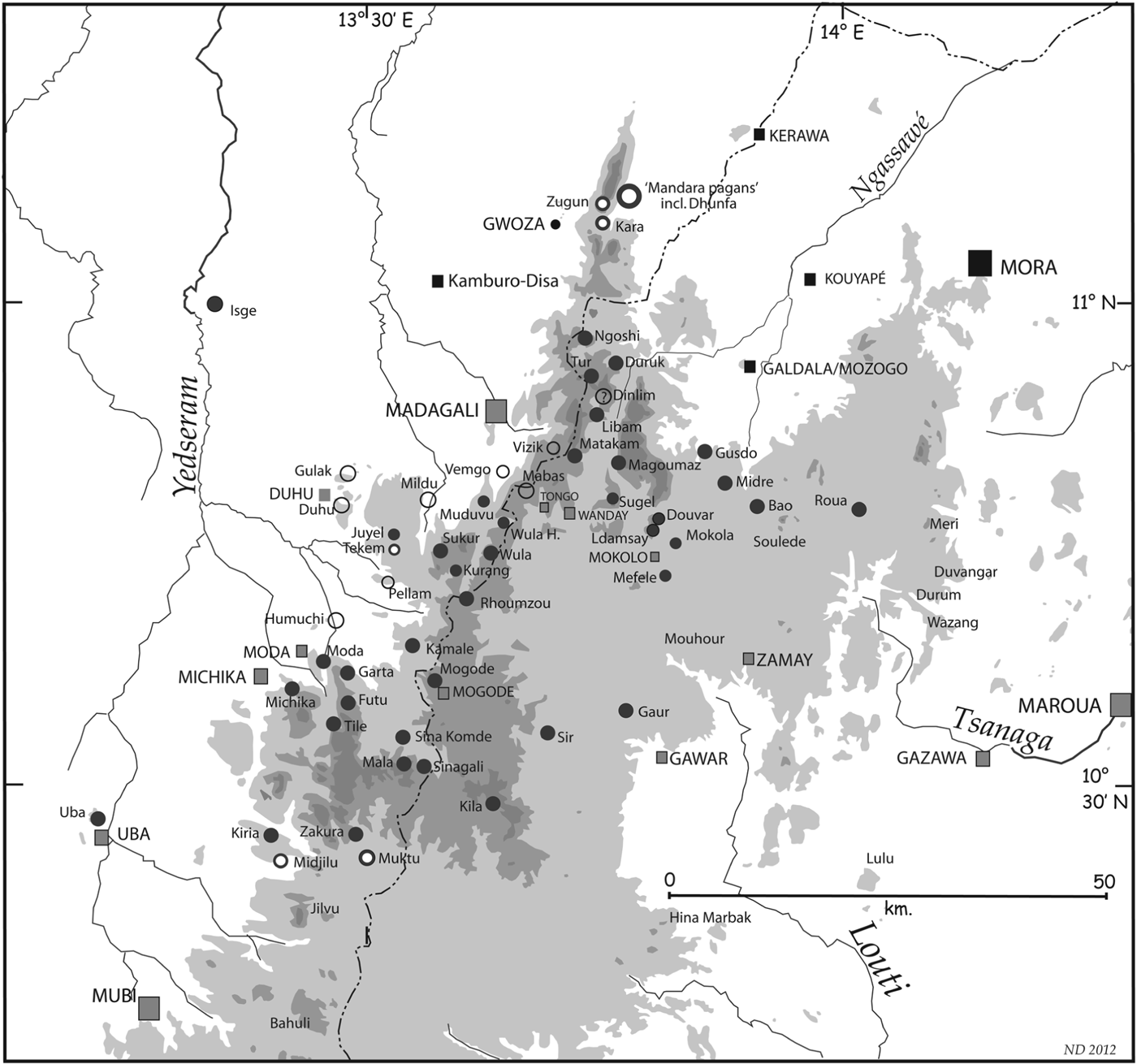
I have identified 118 raids on sixty-four raid destinations, of which thirty-eight can be located exactly and a further six approximately; one destination is unspecified. Nineteen names (some certainly of chiefs) associated with raids remain unidentified, although the general area may be apparent from the context. Figure 2 shows the range of Hamman Yaji's predations. Of the open circles representing montagnard settlements that were forcibly allied to Yaji, only two, Gulak and Mildu, were ever raided. With some exceptions, mostly in the early years, the multiplicity and dispersion of Yaji's targets and his variation of the month in which he raided any particular settlement or cluster ensured that montagnards were unable to predict those attacks. Over the nine raiding years covered by the diary, there is evidence of increasing professionalization of the enterprise, including reliance on named ‘chiefs of soldiers’. His ‘soldiers … [wore] a kind of khaki uniform, with red fezzes’ (Kirk-Greene Reference Kirk-Greene, Vaughan and Kirk-Greene1995: 35). He became able to mount raids in rapid succession, and, unlike other slavers, Yaji raided throughout the year.
Madagali's raiding sphere (1912–20). Larger filled circles represent raiding targets, ones with a white centre indicating approximate locations. Open circles indicate villages under Hamman Yaji's control. A selection of other montagnard settlements are indicated by smaller black circles. Fulani settlements are indicated by grey squares and Wandala settlements by black squares.
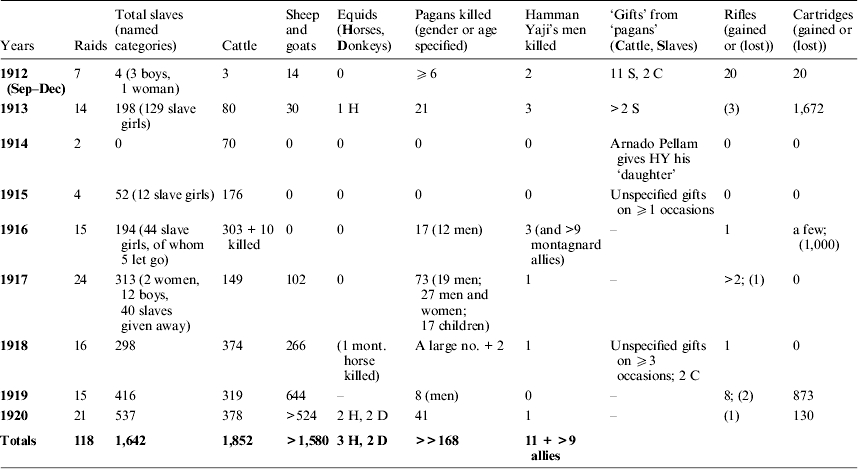
Hamman Yaji's raiding accounts show a healthy balance (Table 3). He is less than systematic in his categorization of human prey and after 1917 refers to his victims without specifying age and sex. Conversely, when the sex of montagnards killed is noted, they are male in every case but one. Cattle were highly desirable, sometimes being mentioned before slaves. Sheep and goats were largely ignored in the early days, perhaps being ceded to montagnard allies, but from 1917 onwards they were taken in ever increasing numbers, probably to feed Yaji's troops. The Fulani took other goods when they could lay hands on them, including gowns and fezzes, the presence of which indicates ongoing montagnard exchanges with the Muslim world.
Hamman Yaji's spoils from raiding, deaths in raids, gifts from pagans, and gains and losses of munitions, as recorded in his diary for the years 1912 to 1920
Rapidly increasing intensity of raiding from 1916 onwards occurred as the cessation of inter-European hostilities was followed by an administrative interregnum and increased availability of rifles. However, the scale of Yaji's operations became ever more apparent to the British, who, in 1916 – before taking over responsibility for the region – commented on the ‘orgy of oppression and confiscation’ in Madagali and Mubi, where slaves were being sold openly (Vaughan Reference Vaughan, Vaughan and Kirk-Greene1995: 14). And so, in December 1920, the District Officer prevailed upon Hamman Yaji to desist – while at the same time confirming his position as District Head with responsibility for collecting taxes. Yaji could appreciate the possibilities of another form of sustainable harvesting of the hills.
The fate of the enslaved
The diary is uninformative regarding the fate of the mostly female captives acquired by raiding. Of course, not all of them accrued to Hamman Yaji. When one of his commanders died in August 1916 on an expedition to Mokolo, he left forty slaves and ten horses.
During the raiding years, runaways are not mentioned at all and ransom only once; subsequently, however, there are several mentions of runawaysFootnote 14 (Fisher Reference Fisher2001: 158–63) and two of ransoms (see below). While we can be sure that slaves worked on Yaji's many farms, there is no general account of either slave prices or their disposition, although slaves are mentioned as:
• objects of diplomatic exchanges;
• sureties or currency;
• inducements for favours desired or received;
• reward for achievements or services rendered;
• ritual charity;
• a form of per diem;
• militia; and
• a variety of other functions, including the domestic: ‘… a female slave of mine, named Awwa, refused to cook me my food … This made me a little angry.’
Yaji dictated to his scribes a substantial and itemized, if incomplete, chronicle of his raiding, but he was unwilling to entrust to them either his strategies or the balance sheets of his diversified enterprises.
Montagnard responses in Madagali's raiding zone
Resistance to slaving takes many forms underdetermined by regional, environmental, socio-cultural and economic factors (Diouf Reference Diouf2003). Montagnard society, to which, despite inequalities and exceptions such as the Mafa of Gousda, slavery was generally foreign, was and remains kin-based and patriarchal (Vaughan Reference Vaughan, Miers and Kopytoff1977; Sterner Reference Sterner2003). Settlements, often densely peopled, were not nucleated. Compounds were set among their fields and agricultural terraces, some on rocky slopes and outcrops beyond the reach of cavalry. Although there was at least one night attack, it would seem that most raids, after a clandestine approach in the night often guided by a former member of the target community, came soon after dawn when men were often away from their compounds, in their fields or collecting fodder, and therefore unable to offer much in the way of organized resistance – although this did occur. Accounts of victims describe compounds being raided individually and their inhabitants enslaved or killed and livestock driven away.
Houses were sometimes set alight, perhaps to drive the inhabitants into the grip of the soldiers, but this did not happen often and appears punitive in intent. Only once did Hamman Yaji record killing women and children: ‘On [16 August 1917] … I sent Fadhl al Nar with his men to raid Sukur and they captured 80 slaves, of whom I gave away 40. We killed 27 men and women and 17 children.’ This was a political reprisal, Yaji having had hopes that an appeasement faction in Sukur would gain the upper hand. He must also have coveted Sukur's famous iron production and market (David and Sterner Reference David and Sterner1996; David Reference David and David2012a).
Montagnard options
Warfare and armed resistance
Montagnards were hopelessly outclassed by Hamman Yaji's militia. Although, especially in the early years, they were sometimes able to drive off raiders and inflict casualties, a small-scale attack on a pastoral Fulani hamlet, perhaps merely Kapsiki attempting to rustle cattle, is the only violent act perpetrated by montagnards on Fulani that Yaji dignifies by the term translated as ‘raid’. Rare other instances of attacks on Fulani or on montagnards under his protection were usually sanctioned quickly by raids on the perpetrators.
As to defensive measures, the dispersed nature of montagnard settlements precluded the fortification of villages. Besides thorny thicket defences, rough ramparts of rocks and earth were built across valleys or along crests, serving to hamper cavalry and to provide cover from behind which to shoot arrows. Montagnards had no system of watchers or sentries. Nor, as noted above, were they capable of achieving effective alliances against the Fulani (van Beek Reference van Beek and Fokkens1986: 150–1). Thus it was that Hamman Yaji could maintain a ‘house’ in Mokolo that served as a way station between Madagali and Maroua (van Santen Reference van Santen1993: 86–8; Lavergne Reference Lavergne1944: 18). Mokolo was overlooked by montagnard settlements that he repeatedly raided, but the small outpost was never attacked.
Flight
Once the alarm was raised, it was common practice for montagnards to seek refuge in their boulder-strewn hills, and sometimes, as at Sukur, in caves (cf. Cordell Reference Cordell and Diouf2003: 38–9). There, the cavalry could not follow them, although on occasion they were smoked out (van Santen Reference van Santen1993: 88). Judy Sterner and I have collected oral traditions regarding the flight of all or part of montagnard communities in the face of Fulani aggression. Thus the entire community of Sirak, just south of Mokolo, took refuge for a period of years with relatives on Mouhour massif. It was probably after the brutal raid on Sukur noted earlier that its non-appeasers scattered to live for a time in nearby communities, some of which were under Yaji's control.
Submission and alliance
Several of the plains villages in the vicinity of Madagali and Moda had submitted to the Fulani before Hamman Yaji's time (see Figure 2) and he brought several others located on the edge of the plains or around inselbergs under his control. These provided him with varying combinations of tribute, labour on his many farms and part-time militia. Of the highlanders, the people of Mabas and Vizik, located at the top of the steep scarp that overlooks Madagali and the former on a well-travelled route via Wanday and Mokolo to Maroua, were never raided. According to Mafa informants, the Mabas were allied with the Fulani and acted as their ‘jackals’, assisting in raids for what they could plunder in goats and chickens, and indeed anything that the Fulani did not reserve for themselves. Mabas may have been the only mountain community actively aligned with Madagali, although there is plenty of evidence that others, such as Sukur, were divided between resistance and appeasement.
Tribute, ransom and taxes
The diary for the period 1912 to 1920 describes instances of montagnard chiefs sending Hamman Yaji ‘gifts’, sometimes a form of tribute and sometimes in recognition of a position granted (Table 3). Gifts of something over a dozen slaves (all in 1912 and 1913) do not suggest that free montagnards within Yaji's reach were more than incidentally involved in slave capture, handling or trading.Footnote 15 In 1914, Yaji mentions one case of the ransoming of an unspecified number of women by ‘the pagans of Subalu’ (probably a chief). However, there are also montagnard oral traditions of people, including two rain chiefs, going to Madagali to ransom captives.
The diary for 1912 to 1920 tells us little about taxes. Yaji mentions by name only two non-Muslim settlements that paid tax: Isge on the plains and Bau near Mokolo, the latter's ‘tax’ having in fact been obtained by raiding. Tax collection was clearly profitable, especially when he taxed villages while hiding their existence from the British. Sukur was concealed in this manner until 1927, shortly before Yaji's arrest and deposition.
The Fulani–montagnard interface around Madagali
Hamman Yaji's high-intensity slave raiding into the Mountain zone was unique in the Mandara region. It stimulated most of the prey responses listed by Klein (Reference Klein2001) and generated an interface between the Fulani and raided montagnard communities that can be characterized as abrupt and shallow, in that there was an unambiguous distinction between the two identities and little or no transfer of ideas between them. Almost all contacts were characterized by violence or threat of violence. Those montagnard captives, mostly young and mostly female, who remained in Madagali were absorbed into Fulani society, although their slave origins were not quickly forgotten. Sukur traditions hold that the young militiamen who killed Chief Ndusheken, probably in April 1922, as he set off down the mountain to negotiate with Hamman Yaji, were themselves Sukur ‘by tribe’ who had been captured years earlier. No captives beyond the very few ransomed or freed by Yaji himself are known to have returned to their original homes.
Meanwhile, free montagnards and those living in communities owing tribute and service to Hamman Yaji maintained multifaceted contacts, with the free, in general, seeming to have held little resentment against those forced to serve him. (There are stories that during raids militiamen of montagnard origin would sometimes shout warnings as they approached a compound.) But such intra-montagnard interaction cannot be said to constitute mediation between predators and prey. And the iron trade, which was focused on Sukur and was the other major link between montagnards and state societies, remained obstinately out of Yaji's control (David Reference David and David2012a).
SLAVING IN THE WANDALA SPHERE OF INFLUENCE
The southern Central zone
A more insidious pattern of slave acquisition existed locally elsewhere. Kosack (Reference Kosack1992) provides transcripts of interviews with ten elderly Mafa informants of both sexes that, when read in the historical context sketched above, make it clear that in the Gousda village complex – and I suspect among all the montagnards living around the Koza-Mozogo plain – late nineteenth- and early twentieth-century Mafa society was pervaded by slaving.Footnote 16 All, save only nursing babies and pregnant women, were at risk of enslavement whether by force or by trickery. The fact that slave price was higher than bride price induced some fathers to sell their daughters. Orphans, persons with few kin, the lazy and troublemakers were at special risk. There were gangs on the lookout, ready to snatch individuals who wandered into the bush.Footnote 17 Men from villages such as Soulede that were located behind the Wandala slaving front would bring a relative or other victim and sell them to a Mafa dealer, who would then sell them on to a Mafa-run slave market, of which there were several in villages with easy access to the plains. The main Mafa slave dealers were important men. They included two chiefs, of Mudukwa and, to the north, Vreke, the latter having special powers over rain, fecundity and various natural disasters (Kosack Reference Kosack1992: 186). Wandala would visit market owners to pick up slaves – one source says daily – and leave goods with them on account. The son of one owner claims that his father sold forty to sixty slaves a week, ‘mostly young girls and women, but also youths, though only a few men’ (Kosack Reference Kosack1992: 192). Such numbers suggest that the importance of the Kouyapé slave market, operating during the period covered by these testimonies, was not exaggerated.
Meanwhile, direct pressure on the Mafa and their neighbours was maintained by mounted raiding parties operating along the edges of the mountains. Although an informant associates these with a famous slaver called ‘Hamajè’,Footnote 18 they were not Hamman Yaji's men, who are not known to have operated in this area, but Wandala from Kouyapé or Galdala-Mozogo. Their weapons included long spears and ‘bush knives’, but not, apparently, rifles. Thus fear combined with greed served to maintain a trade that was both regulated by force and custom and institutionalized, as is evident in the payment of taxes to Wandala by Mafa market owners. A third motivator requires mention. During the period covered by these interviews, the Mafa and their neighbours suffered major disasters brought about by, inter alia, drought, rinderpest, and locusts in 1890–93, 1903–06, 1910, 1912–13, 1922–23 and into the 1930s, well after Europeans had put a stop to most forms of slaving, but when montagnards were once again forced to pawn or sell their children (Beauvilain Reference Beauvilain1989: 116–36). Famine is frequently referenced in these Mafa accounts.
Mountains and Eastern foothills south of Mora
Only 40 kilometres separate Gousda from the mountains south of Mora, but in the late nineteenth and early twentieth centuries these areas were worlds apart. Immediately south of Mora, the Wandala ruler owned a village in the mountains. His army incorporated squads of montagnard archers. Further east and south in the Eastern foothills in the sub-region studied by MacEachern (Reference MacEachern, Lane and MacDonald2011),Footnote 19 the social landscape was sharply differentiated between the plain, formerly a no-go area for montagnards, and the mountain slopes where only a few Wandala iron workers could venture safely. Montagnards and Wandala lived cheek by jowl but nevertheless on either side of a social divide bridged by multifaceted economic and social forms of interaction; these included Wandala coercion of labour and low-intensity slaving. Montagnard involvement in slaving was minimal and won no respect; indeed, in one notorious nineteenth-century case where a territorial lineage, the Dibilikwer, was engaging in slaving, it was eliminated by coordinated montagnard and Wandala attacks. Perhaps on account of the more varied economic opportunities available to montagnards, even during the locust-induced famines of the 1930s there was no sale of children to Wandala.
MacEachern (Reference MacEachern, Lane and MacDonald2011: 106) describes circumstances under which ‘considerations of proximity over-ride the dichotomy of plains-dweller/Muslim/slave raider versus montagnard/non-Muslim/victim-of-raids'. Where montagnards and small Wandala communities lived only 2.5 to 7 kilometres apart, trading interests were emphasized; for example, iron and iron ore were exchanged for salt, fish and other goods. This did not preclude the kidnapping and enslavement of montagnards, although social links between the communities facilitated their ransoming. Even when Wandala living at greater distances conducted commercial slave raids from larger settlements such as Mora, negotiation for the return of captives remained a possibility. This had not been the case when, in earlier times, military expeditions, perhaps with Bornoan or Shuwa troops, had captured slaves and immediately removed them from the area. Geographical and social proximity made possible continuing relations between individuals and communities across the social divide, mitigating some of the effects of violence (MacEachern Reference MacEachern, Lane and MacDonald2011: 118). At the same time, in a constrained landscape such proximity also made violence more likely to occur between neighbours. ‘In 1700 and even 1800’, MacEachern considers that the ‘Wandala group [was] still in some ways in the process of differentiating from people who [were] at the same time “becoming montagnard”’ (personal communication, 2013). In the nineteenth century, montagnard society, albeit fragmented, becomes distinctively montagnard, and the Wandala Wandala. Thus, in the late nineteenth and early twentieth centuries the montagnard−Wandala interface in this sub-region may be characterized as abrupt, in that social identities remained distinct, but nonetheless permeated by economic and some social interactions.
Conclusion
Stephen Reyna's (Reference Reyna1990) study of the practice and role of warfare in Bagirmi conceives of this ‘archaic state’ as located at the centre of three concentric zones. The poor and uncertain environment of the homeland is incapable of supporting state institutions by production and trade. Maintenance of the state requires the use of organized violence, for exacting tribute from vassals in an intermediate zone and predation in an exterior zone composed largely of stateless peoples. This model, while possessing a certain truth, oversimplifies the fractal landscape of slavery and is of little help in identifying the variables influencing the forms that slaving took in and around the northern Mandara Mountains from the sixteenth to the twentieth centuries. Topography and military technology were critical factors, as was the ability to raise a force of a certain size and maintain it in the field. The nature and the frequency of prey–predator interaction, varying from military campaigns through raids and kidnappings to the sale of relatives, were conditioned by the spatial and social proximity of the societies involved, and conversely influenced the feedback that slaving exerted on the affected societies – in both directions. Prey–predator interfaces in the three sub-regions considered differed accordingly.
Thus Hamman Yaji's raids represent a brief episode of intensification and extension of raiding from plains and foothills into the Mountains, a zone that had become more attractive through time in terms of the resources, human and other, potentially available, but that required both horses and rifles for its effective exploitation. The Fulani/state−montagnard/stateless interface was clear-cut, permeable by means of violence, and with few agents mediating between the opposing groups. Montagnards, despite their internecine armed conflicts, were not (or only peripherally) involved in slave production for the areal market. Captives, if they remained in Madagali, were incorporated into Fulani society.
Comparable intensification did not occur in the Central zone, where Wandala–montagnard interaction went back to the sixteenth century. Instead, relatively small numbers of Wandala, while maintaining an active if low-key slave-raiding posture, came to involve montagnard elites in the slaving enterprise. The montagnard–Wandala interface was gradual and permeable, in that montagnard and Wandala identities became less distinct in the contact zone and interactions profoundly affected both Mafa and Wandala societies. Blurring of identities continues to the present. The interface was the context of trade and of the transfer of slaves from montagnard to Wandala custody, and also of the return of captured montagnards, whether by ransom or by the taking of hostages (Kosack Reference Kosack1992: 183). Montagnard society within the interface zone was as permeated by the practices and consequences of slaving as was Balanta society in Guinea-Bissau (Hawthorne Reference Hawthorne2001) or the American antebellum South. For the Wandala, the system was clearly beneficial as it transferred much of the risk involved in slaving from themselves to montagnard slave-handlers and dealers.
We have no statistics on enslavement in the Eastern foothills south of Mora but the impression from oral testimonies is that many fewer slaves were taken here than in the Central zone, despite comparable numbers of montagnards and proportionately more Wandala (MacEachern Reference MacEachern, Lane and MacDonald2011). The interface between montagnards and Wandala was here as unambiguous as it was in the Madagali region, but economic and social interaction was far more active and varied. Facilitated by markets, material items moved in both directions, most notably iron in various forms from mountain to plain. The Wandala relied on the montagnards for a certain amount of labour, more or less coerced. However, in the case of Bornoan, Fulani or, at the end of the nineteenth century, Mahdist attack, they also relied on safe refuge in the mountains. It was therefore to the Wandala advantage, while maintaining dominance over the montagnards, not to exceed a level of exploitation proven tolerable through time.Footnote 20 Thus Tlikses during the nineteenth century attempted to control ‘the profits of the slave trade and slave production’, including what the montagnards perceived as ‘the Sultan's wars’, the commercial slave raids directed from Mora against the montagnards to the south and south-west (MacEachern Reference MacEachern, Lane and MacDonald2011: 117). Even the attacks on the Dibilikwer coordinated between Afam and Plata montagnards and Wandala from Mora can be regarded from the Wandala perspective as conservation measures. Meanwhile, while montagnards resisted through arms and in other ways, exposure to natural disasters, competition for scarce resources and religion tied to localized spirits and emphasizing delimitation of the in-group ensured continuing montagnard fragmentation vis-à-vis their oppressors.
The varied montagnard responses to state aggression in the Mandara Mountains are paralleled elsewhere (Klein Reference Klein2001), but nowhere is so much variety played out over so small an area. Whereas across the Sahel and Sudan zones there was an almost universal and highly elastic demand for slaves, the nature and intensity of their extraction from native communities varied according to a wide range of natural, technological, social and cultural factors, summarized here under the rubric of the prey–predator interface. The three case studies presented amplify the voices of the previously unheard and provide fresh perspectives on slaving. Besides offering a relatively independent source of evidence for evaluating the constructions of historians, they open the way for research on the mutual accommodations to slaving that affected the societies and cultures of both prey and predators, and eventually on the role of captives in the transmission of cultural practices (Cameron Reference Cameron2011).
ACKNOWLEDGEMENTS
Field research for this paper was conducted from 1984 to 2008, supported by grants from the Canadian Social Science and Humanities Research Council and authorized by the Cameroonian and Nigerian authorities. I particularly thank the people of Sukur for their interest in Hamman Yaji, and the many field assistants to myself and to Judy Sterner, who herself contributed to this work in multiple ways. Gerhard Müller-Kosack gave generously of his knowledge of the peoples of the Mandara Mountains and brought German sources to my attention. I am grateful to Godula Kosack and Scott MacEachern for information on slaving in their areas of fieldwork and to Scott for his ideas on the history of Wandala–montagnard relationships and differentiation. Paul Lovejoy, Anne Stahl, James Vaughan and anonymous reviewers offered constructive comments on earlier drafts.