Introduction
Rhythmic play is an obvious and prominent aspect of the world's musical traditions. Immediately recognisable in its exterior and performative form in percussion and improvisatory based musics, it manifests itself much earlier and informally around the globe in the games of the playground, campfire and living room.Footnote 1 As a subset of musical play under the broader rubric of creative play, rhythmic play beginning in childhood promotes cooperation in groups through rehearsing the skills of social interaction, at the same time activating higher level mental processes through the nurturing of ‘exploratory competence’ (Cross and Morley Reference Cross, Morley, Malloch and Trevarthen2009, pp. 73–4; see also Bjørkvold Reference Bjørkvold1989; Pellegrini and Smith Reference Pellegrini and Smith1998). The source of everything from athletic achievements to scientific discoveries to engaging works of theatre and art, we are often at our best when at play (Turner Reference Turner1982; Donald Reference Donald1991, pp. 162–200).
Rhythmic play as the confluence of rhythm, motion and cognition appears early in human development. Almost from the time we are born we begin to engage with our caretakers and the outside world in a rhythmic dialogue that promotes emotional bonding, spatial awareness and pleasure in the act of play.Footnote 2 It has even been argued that synchronous movement and the ability to keep a steady pulse (the onset of entrainment) directly contributed to our transition from protohuman to human society and the development of the modern brain (Brown et al. Reference Brown, Merker, Wallin, Wallin, Merker and Brown2000, p. 12; Geissman Reference Geissman, Wallin, Merker and Brown2000, p. 119; Levitin Reference Levitin2009, p. 50). Evolutionary perspectives aside, rhythmic awareness and transformative skills begin to present themselves more formally in children outside the sphere of games in musical activity, both practically/socially – first instrument lessons, early ensemble and/or choir experiences – and aesthetically/socially through listening (typically to pop/rock, but also other musical genres). For many of us – amateur and specialist alike – these become lifelong pursuits.
In this paper I focus on the interior and more subtle, but just as ubiquitous, use of rhythmic play in composition. Firstly I address such play as embodying an attitude on the part of the performer-composer, an approach to music as pure structure in which one's skill and imagination can be tried out in sonic reality (Lerdahl and Jackendoff Reference Lerdahl and Jackendoff1996, p. 9). Here compositional play feeds into the aforementioned cognitive challenges leading to exploratory competence, as Leonard Meyer noted:
The relation of artistic creation to play must be mentioned. Many references are made in the literature of music to the playfulness of a particular passage or to the delight taken by musicians in play. It seems very probably that this too is a way of referring to the conquest of self-imposed difficulties. Karl Groos frequently emphasises that this is an essential feature of play; that, in his own words, ‘play leads up from what is easy to more difficult tasks, since only deliberate conquest can produce the feeling of pleasure in success’. (Meyer Reference Meyer1956, p. 70)
And while such rhythmic play is frequently discussed in the literature on classical music (and often marked as contributing to its special quality),Footnote 3 I will argue that it is also central to rock music and its practitioners.
A second and perhaps more notable aspect of compositional intent is when such play serves as an attempt on the part of the composer as a special kind of communication with his or her audience. In this capacity the musical work becomes an unspoken or hidden challenge to the listeners – the interior play projected outwards – as a kind of in-group or insider knowledge, the challenge resting on an audience's familiarity with the music as a shared body of expectations (Davies Reference Davies, Juslin and Sloboda2010, p. 24).Footnote 4 Listening thus becomes a window into the creative act, something that happens everywhere in the world when performer-composers take their audience's listening and cognitive abilities, their imagination, seriously:
The notion is similar to Bird's description of the West African Mande, whose performances are so dependent upon aesthetic tension, ‘the device by which the master jostles the expectancies of his audience, forcing them to participate in his act of creation’ (Bird Reference Bird1976, p. 91). Jostling expectancies, getting under the surface, reframing usual thought patterns, and evoking a dramatic response are all at the heart of Kaluli poetics, because composers force their audiences to participate in their creations by making them weep. (Feld Reference Feld1990, p. 132)
Rhythmic play through expectation is mostly keenly felt at the beginning of a rock song – its intro, where the ‘groove’ is established – at the nexus of metric understanding and entrainment. Knowing what a song's beat is, its metrical organisation, is of central importance to listeners in their understanding and enjoyment of a piece (Povel and Essens Reference Povel and Essens1985; Lull Reference Lull and Lull1992, p. 20; Temperley Reference Temperley2001, pp. 24, 205–6).Footnote 5 Entrainment, however, is not just about intellectual understanding; it represents more fully the reaching out for the emotional content of a song, its bodily feel as we move along both physically and emotionally (Clarke Reference Clarke2005, pp. 62–90). In so doing, rhythmic entrainment has the potential for changing one's personal consciousness, a sense of individual awareness within a collective communal experience (Becker Reference Becker, Juslin and Sloboda2010, p. 149; Juslin et al. Reference Juslin, Liljeström, Västfjäll, Lundqvist, Juslin and Sloboda2010, p. 626; London n.d.a, p. 10).
Two representative and contrasting examples of intros featuring rhythmic play are analysed in this paper. The bands from whose work I will sample – the Police and Radiohead – were chosen for a number of commonalities:
1. they were misunderstood at the beginning of their careers as to what kind of music they were creating, what roots they were drawing on, and in what direction their music would take them;
2. they had antagonistic relationships with the press due to initial mixed critical response, at the same time forging close links with an avid and loyal fan base;
3. unafraid of uncertainty as they looked to forge new sonic ground, they all ‘played’ with different genres, styles, rhythms and melodic/harmonic material; and
4. both groups would go on to create unique sound worlds – almost their own subgenres of rock – to later great critical and commercial acclaim.
(They also both happen to be British-based bands, though this is more of a coincidence and/or a reflection of my personal listening habits, rather than an exclusive marker of British rock [though see note 6].)
The first example is an examination of the intro to the Police's ‘Bring On the Night’ (1979) as an example of a ‘rhythmic fakeout’, where listeners cannot help but be misled as to where the beats land (at least temporarily). The second is an example of rhythmic ambiguity in the intro to Radiohead's ‘Pyramid Song’ (2001) such that the metre is unclear or even impossible to ascertain until midway through the composition. The burden for me as analyst will be to show not only a consistent pattern of play in these artists’ works in musical structural terms, but also in their expressed intent – through interviews, commentary and/or biographies when available – to employ this play as a strategy to communicate with their audiences via a form of insider knowledge, validating their attention and listening capabilities.
It is worth noting that both musical excerpts are clear examples of what the theorist Mark Spicer has called an ‘accumulative form’, the technique by which a groove is gradually built up from its constituent parts – a conscious choice to withhold structural elements – so that listeners are drawn into the compositional process in real time (playing upon, of course, a knowledgeable listener's expectations) (Spicer Reference Spicer2004, pp. 33, 61). His description of another Radiohead song's intro perfectly encapsulates the procedure and its effect:
Listening to an accumulative beginning is not unlike assembling the pieces of an aural jigsaw puzzle: only when all the layers of the groove are put together can we understand the complete picture. The Radiohead example exploits a procedure that is characteristic of many accumulative beginnings: here, the addition of each new component seems to be a deliberate attempt to surprise the listener – or, at the very least, to toy with the listener's expectations – so that when the groove ultimately does crystallise it sounds as if it has ‘emerged’ out of a state of rhythmic, metric, and/or tonal confusion. (Spicer Reference Spicer2004, p. 33)Footnote 6
It is the nature of this dynamic play between performer-composer and audience that I hope to reveal in the analysis that follows.
Rhythmic fakeout: ‘Bring On the Night’
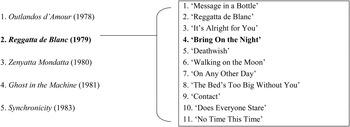
The brainchild of American-born Stewart Copeland (drums, percussion), the Police was formed in 1977 in London with a line-up that would eventually include British artists Sting/Gordon Sumner (bass, vocals) and Andy Summers (guitar). The coming together of three distinct musical personalities – punk (Copeland), progressive rock and classical (Summers) and jazz (Sting) – the group appeared toward the end of punk's brief but influential heyday. Their historical placement and initial preference for fast and aggressive numbers led early critics to write them off as simply one of many bands trying to break into the punk or New Wave scene. With the release of their first album in 1978, and continuing on through to their fifth and last release in 1983, however, a much richer and more complex picture emerged that defied any simple genre classifications (see Figure 1). Mark Spicer has mapped out what he calls a ‘Universe of Style’ for the Police, one in which reggae is the largest sphere or planet, surrounded by smaller spheres of punk, jazz, progressive rock, synth pop, music hall, blues, Baroque lament and ‘Villa-Lobos’ (Spicer Reference Spicer, Spicer and Covach2010, p. 126).Footnote 7 Such border crossings and difficult-to-pigeonhole music served as sources of frustration for early critics of the band, as did Sting's savvy and frequently intellectual approach to lyrics and formal structures.Footnote 8
Police full-length studio releases (with track listings for Reggatta de Blanc).

What first drew most fans to the music of the Police – and what the band would come to recognise as central to their unique sound – was the rhythmic space they carved out between rock/punk and reggae. It was a creative tension produced by the mixing or blending of two very different approaches to rhythmic construction, often within a single song, that had seldom been attempted before:
Punk is rhythmically explicit because it saturates the rhythmic texture with eight-beat timekeeping. Reggae, by contrast, is rhythmically implicit, because the most consistent rhythms are all afterbeats. The other rhythm lines, especially the bass, move freely, creating a rhythmic fabric of unparalleled lightness. (Campbell and Brody Reference Campbell and Brody1999, p. 335; emphasis in original)
‘Play’ and ‘space’ became common metaphors by band members in interviews and personal writings on their compositional strategy that straddled both of these poles:
For us it was the blending of rock and reggae and punk, and using the spaces that reggae provides to find a fresh approach to playing as a three-piece, rather than just banging out heavy power chords all night long. … (Summers, quoted in Goldsmith Reference Goldsmith and Sutcliffe2007, p. 90)
Very few of the new bands had the finesse to be able to play reggae, with its complex rhythmic counterpoint that seems to turn traditional pop drumming on its head. This, and the predominance of the bass in the music, allowed Stewart and me to explore subtle areas of interplay that were rarely touched on by less experienced outfits. To create a hybrid using the drag-race horsepower of rock n roll and welding it seamlessly to the rolling stock of reggae music would make for an interesting journey. … (Sting 2003, p. 284)Footnote 9
The idea of rhythmic (inter)play also featured prominently in early reviews of the Police's work (Cohen Reference Cohen1979, pp. 84, 86; Fricke Reference Fricke1980, p. 104).Footnote 10
The two most prominent aspects of reggae's move away from rock rhythm include the shifting over of the bass drum hits to beats 2 and 4, and an increased emphasis on the hi-hat part at the 16th-note level (often accentuating the off-beats). For Copeland in particular, it was the subtle manipulation of and unexpected emphases on the off-beats (syncopations) within the hi-hat line – either through dynamic stress or a stroke on the open hi-hat, and often in combination with various crash cymbals – that he drew from reggae and which he found so aesthetically pleasing; it was also what many other musicians would come to recognise as his personal imprint on rock drumming history (Starr Reference Starr2009, pp. 217–30).Footnote 11 Copeland was vocal about the pleasure he felt when engaged in such compositional-rhythmic play. In a 1981 interview with the British interviewer Jools Holland, he spoke about taking familiar rhythms and ‘turning them around’ a bit, ‘camouflaging’ them so that something of one's own personality, something new, might be expressed (The Police Reference Police2003).Footnote 12 In a much later interview with Modern Drummer magazine, Copeland added extra insight into his interest at the 16th-note level, co-crediting it to music he heard when growing up in Beirut:
Stewart: One thing that Arabic music does feature prominently is the 16th-note interest. In modern electronic music, the 16th note is not very interesting. It is metronomic. That was true even through pre-electronic pop music. People never thought about the hi-hat as providing anything other than steady 16th notes. … One factor is that for a long time it hadn't occurred to anyone else other than your humble servant to make use of various 16th-note interests.
MD: Do you mean as far as breaking up the 16th-note patterns on the hi-hat and splash cymbals?
Stewart: Yes, in terms of considering the inflections and doing interesting things with the accents. (Micallef Reference Micallef2006, p. 52)
Sting would similarly incorporate a reggae-influenced approach to his bass lines that would often include activity at the 16th-note subdivisional level (Spicer Reference Spicer, Spicer and Covach2010, p. 132), something that becomes apparent in the analysis that follows.
In perhaps the only full-length academic analysis of the musical style of the Police, Spicer noted that metric conflict and play was a common trait of most of their recorded output, regardless of the presence or absence of overt references to reggae melodic and rhythmic gestures. A characteristic manifestation of this approach was the shifting of the various instrumental lines in relation to each other by a quarter or eighth note – similar in manner to the bass drum shift or the accentuation of off-beats, respectively – so that the underlying beat or metre is often obscured: ‘It turns out that such rhythmic displacement is quite typical of the Police's unique appropriation of the reggae style and therefore a crucial defining feature of the band's idiolect’ (Spicer Reference Spicer, Spicer and Covach2010, p. 133; see also Gress Reference Gress2010). When such displacement occurs at the beginning of a song, unbeknownst to the listener (as it does with ‘Bring On the Night’), a temporary but ‘incorrect’ anchor is created and maintained until the song reveals enough critical information, forcing the listener to re-evaluate their initial interpretation – a process which Mark Butler (Reference Butler2006, p. 124) has referred to as ‘ambiguity of beginning’.
‘Bring On the Night’ was initially released as the fourth cut on side one of the 1979 album Regatta de Blanc (a pseudo-French translation for ‘white reggae’). The song and record are considered by the band to be some of their very best work (Summers Reference Summers2006, pp. 208–9; refer to Figure 1 [CD track listings are provided]);Footnote 13 the song's intro also frequently elicits such adjectives from fans as ‘enigmatic’ (Kid Charlemagne Reference Kid2011) and ‘mysterious’ (AlanTubeViewer 2011). I first heard ‘Bring On the Night’ as a high school student and remember being intrigued by why I couldn't tap my foot properly to the beat during the intro and opening verse (it always came out wrong when the chorus came in). Over the years I occasionally would try out the song on family members and friends, none of whom could hear the opening properly. By the time I was a university professor I took it upon myself to play the song for numerous music history classes composed primarily of music performance majors – as well as for their professors – in an attempt to see if specialist training made any difference. The result was always the same: everyone succumbed to the ‘rhythmic fakeout’.Footnote 14
The verse-chorus form of ‘Bring On the Night’ is typical of many pop-rock songs: intro-verse-chorus-verse-chorus-bridge-chorus-outro. The material of the intro, however, features prominently throughout: not only is the initial intro a full 27 seconds in length, but both the bridge and outro also morph back into the opening strains (albeit with added guitar improvisations). The intro begins with just an electric guitar figure (modified with a flanger effect)Footnote 15 and hi-hat pattern in a four-bar phrase that repeats twice. During the third iteration of this phrase, bass drum hits are added, after which the verse commences with the entry of Sting's voice, electric bass and arpeggiated guitar (the ‘Villa-Lobos’ sound in Spicer's aforementioned Universe of Style).
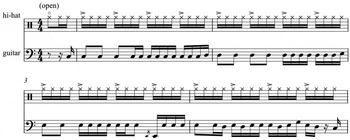
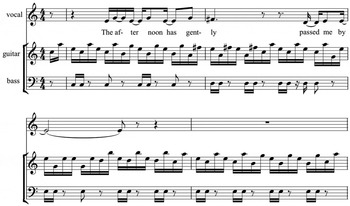
What is immediately apparent both visually and aurally is the even and regular manner in which the hi-hat strokes organise themselves into groups of four, so that it feels ‘right’ to view the initial eighth/two 16ths gesture as a beat four leading to a downbeat with the onset of regularly occurring 16th notes. This interpretation is reinforced by the straightforward, symmetrical divisional relationships of the guitar pitches (two eighths, eighth and two 16ths, four 16ths, four 16ths, etc.) such that the listener is drawn in to treat the guitar's first 16th note as a pickup to a strong beat (the first eighth note in the guitar is also louder than the 16th note that precedes it).Footnote 16 Further metrical/bar accents are provided by the guitar's pitch changes on the 16th-note pickup to bars two and three, suggesting harmonic changes that align with these downbeats. Figure 2 provides a 4/4 realisation of this interpretation, one that fits every listener's impression I have ever met (including my own).
‘Bring On the Night’ opening four bars (first phrase).Footnote 18

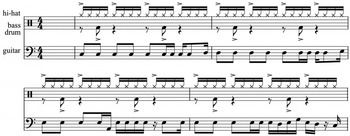
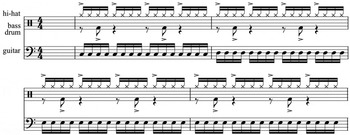
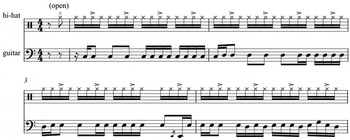
With the entrance of the ‘syncopated’ bass drum hits in the third phrase (beginning bar nine), this order is generally not disturbed (see Figure 3). For perhaps overly sensitive or ‘radical’ listeners,Footnote 17 especially those familiar with Copeland's love of placing bass drum strokes squarely on beats 2 and 4 (idiomatic of much of reggae drumming), the entrance of the bass drum signals the first clue as to where the downbeat might actually be. For most audiences, however, the continuation of the strongly marked hi-hat and guitar pitch groupings create a bass drum line that feels syncopated through the entirety of the first verse. Such a conservative or ‘musicological’ listening is potentially bolstered by familiarity with the song ‘Edge of Seventeen’ by Fleetwood Mac's Stevie Nicks from her 1981 solo album Bella Donna. Not only was the song released within two years of ‘Bring on the Night’ – with many of the audiences then and now fans of both groups – but Nicks’ guitarist, Waddy Wachtel, has admitted that the intro to ‘Edge of Seventeen’ was directly lifted from the Police's composition (Simons Reference Simons1999). The similarities are numerous and unmistakable, with the ‘Edge of Seventeen’ mimicking the Police's instrumentation and instrumental timbres, organisation and accentuation of the hi-hat 16th notes and syncopated bass drum hits, and guitar pitches and harmonic changes (moving from C to D to E), such that the ‘wrong’ metrical interpretation (in the context of the Police song) is in fact correct (refer to Figure 4). Whether or not Nicks was ‘faked out’ or preferred this metrical shift is an interesting (and as yet unresolved) question.
Entrance of bass drum (third phrase) with same metrical realization.

‘Edge of Seventeen’, bars 5–8.

Four bars later (bar 13) marks the last change in texture before the beginning of the chorus (‘Bring on the Night’). Here Sting's presence is finally felt, with his bass taking over the previous guitar line (C-D-E root movement) and his singing of the first line of the verse (‘The afternoon has gently passed me by’); Summers (guitar) then switches to the distinctive arpeggiated pattern (refer to Figure 5). The metrical shift/fakeout that has been felt up to this point, however, is not altered by the entrance of the voice and new instruments. Bass gestures – an interesting mix of eighth- and 16th-note activity – all begin squarely on beats, with pitch/harmonic changes similarly falling on the downbeats of measures (C-D-E). The highly syncopated guitar line, which could be bracketed any number of ways, nevertheless supports this metrical interpretation by reinforcing the tonic (E) on the strong beats of every bar (beats 1 and 3). And the vocal line, which almost floats over the rest of the ensemble, starts on the beginning of a beat (beat two) with its first resting point (the longer pitch F#) falling on a downbeat.
Entrance of arpeggiated guitar, bass and vocal.

It is only with the onset of the first chorus that most listeners realise they have been tapping exactly one eighth note behind. The metrical reorientation occurs as Sting shifts from what was an offbeat bass line – although interpreted up to this point as on the beat – to the stereotypical reggae rhythmic pattern of <four 16ths-two eighths-four 16ths-two eighths> aligned with the beginnings of beats. The deception was maintained this far because of the highly syncopated approach the Police employed during the verse – offbeat accentuations in the hi-hat, a guitar part that begins on the ‘and’ of one, and later a bass line that plays primarily on the ‘ands’ of beats – coupled to a stripping away of beat markers for a significant period of time (bass drum hits and later guitar arpeggiations which all fall squarely on the beats).Footnote 19 Even with an intellectual understanding of such reggae conventions, the opening pull of the hi-hat and guitar accentuations are too strong for listeners to ignore (see Figure 6, the correct way of notating the opening four bars).
Correct metrical realisation of opening four bars.

Within the terms set out by the cognitive scientist and musicologist David Huron, the intro to ‘Bring On the Night’ is a classic example of the ‘garden path’ phenomenon, one in which a listener feels they have understand a particular utterance or passage correctly, but must then reanalyse such knowledge in light of later information (Huron Reference Huron2006, pp. 29–81). The experience is also remarkably similar to Daniel Levitin's roadmap and joke-telling analogy:
When a joke works, we follow a narrative path and, at the very end, the joke-teller has to surprise us to show us that we are not ‘where’ we thought we were. If you can clearly see the punch line coming and there is no surprise, the joke isn't funny. The joke is, in essence, a joke on you: you realise that you thought you were going here and in fact, in the hands of the storyteller, you've ended up way over there. Ha! There are more ways than one to complete this path, this puzzle; this road leads to places I didn't foresee. (Levitin Reference Levitin2009, p. 110; italics in original)
The published scores to ‘Bring On the Night’, while differing in minor surface details, nevertheless follow the correct contours of the guitar line and, importantly, begin at the correct place (the ‘and’ of beat four) (Luttjeboer Reference Luttjeboer1996, p. 85; Farncombe Reference Farncombe2007, pp. 66–7). Critically, however, these scores leave out the hi-hat part, so that the rhythmic tension or fakeout that unfolds doesn't show.
That the construction of the intro to ‘Bring On the Night’ and its effect as documented above was deliberately planned by the Police was established in an interview with Copeland in a 2006 issue of Modern Drummer (Micallef Reference Micallef2006, pp. 52–53). But do the members of the Police respect the attentiveness and listening capabilities of their audiences, really expect them to ‘get’ such rhythmic play? Again, all three members have been articulate in interviews and print with regard to how they feel about their fans:
Why underestimate the record-buying public? Why do you imagine that they have to be spoon-fed all the time? Does it have to be so utterly simple? I don't think so. … It confirms my belief that sophistication, or intended sophistication, is not the kiss of death. As long as you're grounded somewhere in common sense. (Sting, quoted in Fricke Reference Fricke1988, p. 117)
What's characterised the music of The Police is space and the ability to draw audiences in by not playing things. We let it be suggested, so that they can come in themselves. (Summers, quoted in Goldsmith Reference Goldsmith and Sutcliffe2007, p. 158)
This is how it was always supposed to be. I get to go onstage with two titans of music playing songs that (1) are beautiful songs that beguile and challenge us night after night and (2) are hymns of glory to the gathered masses. Music that is known has a particular potency. If it has cool musical rips and curls, that raises the temperature, but when you get to play challenging and popular music with challenging and inspiring players this is as good as it gets. (Copeland Reference Copeland2009, p. 300)
This trust in and respect for their audiences was unfortunately dismissed by an early reviewer of the album who felt that such attention paid to compositional craft was ‘calculatedly middlebrow’,Footnote 20 an anxiety other critics would rehearse in their search for a misguided (in my opinion) sense of ‘authenticity’ in rock music (voices which the consistency and sophistication of the Police's music would eventually silence).
Anecdotal evidence suggests that many fans are aware of the subtle play that occurred at the beginning of ‘Bring On the Night’.Footnote 21 More important, however, is the attitude that is manifest by the Police in their compositions with the end goal of a special kind of communication with their audiences. It is an approach that celebrates and revels in rhythmic play in the company of their listeners as a kind of insider knowledge, a badge of shared identity. And while of course the same craft is employed in their harmonies, larger formal structure and lyrics, to my mind it is the rhythmic complexity and interplay that contributes so significantly to the enduring quality of their music. For Sting, such play took on metaphysical dimensions: ‘When you watch a musician play – when he enters that private musical world – you often see a child at play innocent and curious, full of wonder at what can only be described as a mystery, a sacred mystery even’ (quoted in Charlton Reference Charlton2003, p. 213).
Rhythmic ambiguity: ‘Pyramid Song’
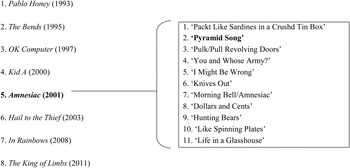
Unlike the members of the Police who came from differing social circles and regional alliances, Radiohead was formed in 1985 by local friends at the elite Abingdon (Secondary) School in Oxfordshire (UK). Composed of Thom Yorke (lead vocals, guitars, keyboards), Phil Selway (drums/percussion), Ed O'Brien (guitars, backing vocals), and brothers Jonny Greenwood (guitars, keyboards) and Colin Greenwood (bass), the band's personnel has remained constant over its nearly 27 years of existence. Radiohead's early splash on the international scene came with the release of their single ‘Creep’ in 1992, its eventual success often credited to its musical and historical proximity to work on Nirvana's Nevermind (1991) during grunge's commercial heyday (Randall Reference Randall2011, pp. 52–3). While Radiohead was initially pigeonholed (and misunderstood) as a pseudo-grunge band with their first full-length album Pablo Honey (1993), beginning with their second album The Bends (1995) and continuing on through their most recent release (The King of Limbs, 2011) their compositions revealed a diverse and complex world of influences ranging from classic and progressive rock, post-punk, classical music, jazz, Dixieland and the avant-garde to electronic music (including techno and post-serialist studio work; refer to Figure 7).Footnote 22
Radiohead full-length studio releases (with track listings for Amnesiac).Footnote 23

The very first strains of the opening song on their first album – ‘You’ from Pablo Honey – heralded the central role rhythmic play would serve in Radiohead's overall compositional strategy. Alternating between bars of 12/8 and 11/8 (the last eighth note dropped every other measure), the song quickly and decisively signalled a departure from rock/pop norms that would only become accentuated over the course of their career. Other notable examples include ‘Pop is Dead’, a 1993 non-album single featuring 4/4 verses broken up by 10/4 instrumental breaks: ‘yet another example of the band's taste for subtle rhythmic play’ (Randall Reference Randall2011, p. 79); the multi-part ‘Paranoid Android’ (OK Computer) with contrasting metres within a single song, including phrases of 7/4: ‘[r]hythmic play comes to the fore once again’ (Randall Reference Randall2011, p. 151); the rhythmically shifting and unfolding of the intro to ‘Pakt like sardines in a crushd tin box’ (Amnesiac) in which audiences are temporarily deceived – a kind of fakeout akin to the previous Police example – through the use of an accumulative beginning, ‘a defining feature of Radiohead's style’ (Spicer Reference Spicer2004, p. 33, note 14); and the intro to ‘2 + 2 = 5′ (Hail to the Thief) which features Thom's voice floating over a complex metre of 7/8.
Within the larger spheres of meaning Radiohead has created through their lyrics, music and artwork, however, such rhythmic play is properly understood as part of the broader project of ambiguity. Beginning with The Bends, Radiohead has purposefully nurtured a relationship based on trust and creative play with its audiences by creating imagery, sounds and words – including videos, websites and clothing – rife with intentional vagueness and/or multiplicity of meanings that reward careful readings/listenings.Footnote 24 ‘Such deliberate ambiguity has become a hallmark of Radiohead's presentation and has created a community of fans joined by their shared interpretations of the band's projects’ (Letts Reference Letts2005, p. vi; see also Letts Reference Letts2010, p. 43); ‘The band's reflexive esthetic effectively disrupts naïve consumption, confronting the listener with music and art that adheres to opacity versus authenticity as a guiding principle’ (Tate Reference Tate and Tate2005, p. 115; see also Forbes and Reisch Reference Forbes and Reisch2009; Randall Reference Randall2011, p. 106). Drummer Phil Selway's response in an interview with the music critic Alex Ross revealed a vision of Radiohead's music as akin to play through the solving of puzzles:
What fans seem to like, even more than the content of the songs, is the sense that the band members have labored over every aspect of the product. They are skilled, first of all, at inventing the kinds of riddles that people enjoy unraveling. The records, the videos, the official website, even the T-shirts all cry out for interpretation. Why are the words spelled funny? What are all these charts and diagrams? … ‘We liked worrying over that kind of thing when we were kids, and we're still in the same mind-set a lot of the time’, Selway said. ‘But it's a bit incidental. We're dead set on the music. That's the thread running through this whole thing. We met at school playing music together, and we still get together over music now. We like solving musical puzzles. That's what Thom gives us’. (Ross Reference Ross2010, p. 89)
For many (including myself) the release of their fifth album Amnesiac (2001) and its flagship track ‘Pyramid Song’ represented the perfect encapsulation of their approach to rhythmic play, ambiguity and audience participation. The recording was initially released in three different formats – standard CD, deluxe box set (standard CD, CD with B-sides, DVD and three postcards), and Special Edition Book (CD with bound book)Footnote 25 – unified by a cover image of an ambiguous cartoon figure with its hands over its eyes in a gesture that appears to be crying (one only discovers that this is a ‘weeping Minotaur’ if one goes to Radiohead websites or reads print interviews). Each format came with slightly different artwork, a mélange of human-produced drawings, photographs and computer-generated art with no immediate connection to each other or the music. Text was scattered throughout the artwork – some of it from the songs, others not – in snippets and out of order, while electronic experimentation, eclectic choices in instrumentation, and band members switching musical roles often made it impossible to match a particular sound with a specific individual/personality. As former Guardian music critic Garry Mulholland observed, ‘No one else on Radiohead's creative and commercial level makes music like Amnesiac and Kid A [its companion release] that felt so open to individual interpretation [and] gave so much credit to their fans for an adventurous ear’ (Mulholland Reference Mulholland2006, p. 348).
Called both ‘Nothing to Fear’ (a reference to the refrain of the song) and ‘Egyptian Song’ during its gestation period, what came to be known as ‘Pyramid Song’ is regarded by both the band and its fans to be one of their finest efforts (Paytress Reference Paytress2005, p. 59). With no direct references to Egypt or the pyramids in the lyrics – a river, angels, celestial bodies and a passage to heaven via rowboat make up the body of the text – the larger community has been tireless in its efforts to nail down the meaning and inspiration behind the otherworldly images evoked.Footnote 26 Thom Yorke has also admitted to being inspired by jazz great Charles Mingus's song ‘Freedom’ when composing ‘Pyramid Song’, which has led some researchers to draw parallels between the earlier ‘Egyptian Song’ title and references in Mingus's work to the flight of Moses and the Israelites (Letts Reference Letts2010, p. 135), although the musical connection to jazz is more important to the following analysis below. Taken as a composite whole – complete with the arresting music to be discussed momentarily – ‘Pyramid Song’ holds a particular power over many of its audiences beyond the purely cerebral, captured in the following website observation that is both unique to the observer but representative of a larger audience base held in sway of the mystery of this song:
This is the song you hear in an ambient dream/nightmare. This is what a trapped soul in purgatory listens to as a lost being wandering aimlessly through an endless desert. This is beauty at the maximum of beauty. I was walking one night when this song played on my iPod. A bright lightning storm was in the distance. And the moon shined bright on the ocean. It overwhelmed me to the point of tears of beauty and sadness. From then on my life changed with how I felt about the world in a better way. (‘speedybill47’ at http://www.youtube.com/watch?v=zbKQPqs-cqc, accessed 21 June 2011)
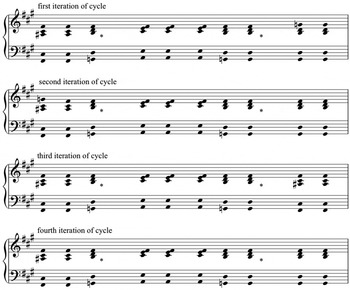
‘Pyramid Song’ opens with what appears to be a cycle of 10 piano chords, all played at an even dynamic level with slight pauses occurring after the third and eighth chords (these pauses are repeated at the same structural points throughout the remainder of the piece; Figure 8 provides the first four iterations of the cycle). The length of this cycle is confirmed by the symmetry of the placement of the pauses, the upward and downward movement of the base line and inner voices, and the return to the F#-C# dyad in the left hand every 10 chords. There is otherwise nothing provided for the listener to latch onto in terms of metre: no beat or regular pulse, no drum part or text. After two iterations of the piano cycle, Yorke enters with a melodic line sung entirely on the syllable ‘ooh’; after two more cycles we are finally introduced to the verse. The vocal part in both manifestations, however, seems to float over the chords so that we are still left with a feeling of being rhythmically unanchored. As the song unfolds we realise that, while the harmonies occasionally change, the ‘rhythm’ of the piano part continues unfailingly as an ostinato. It is this opening ambiguity with regard to metre that has fuelled a tremendous outpouring of fans’ (and academics’) interpretive and analytical effort, opinions ranging from no metre to complex metre to systematically placed rubatoFootnote 27 (to be addressed later below). As the philosopher Michael Thompson noted:
After hearing ‘Pyramid Song’ from Amnesiac, most people say, ‘Something's not quite right with that song’. … Yet neither the vocals nor Yorke's delivery seems to account for the arresting qualities of ‘Pyramid Song’. It is, rather, the mood of the song that seems to grab and keep your attention. And that mood has everything to do with the song's rhythm. (Thompson Reference Thompson, Forbes and Reisch2009, p. 221)
First four iterations of piano cycle in ‘Pyramid Song’ (no rhythm indicated, apparent pause marked by asterisk).

Clarification seems to be promised during the intro to the second verse (which is actually the first verse sung a second time). Here an orchestral string section enters, followed soon thereafter by drums and an acoustic bass (later enhanced by the sounds of the ondes Martenot).Footnote 28 It is important to note again that ‘Pyramid Song’ was musically inspired by a jazz song (‘Freedom’ by Charles Mingus), so that the jazz texture of drums and upright bass is expected, as is the assumption that a compound metre (triple divisions of the beat) will emerge. What is also key to this analysis is establishing a direct relationship between the drum and piano parts so that a connection can be made between the opening of the song and the texture that emerges with the second verse (otherwise the argument can be made that ‘Pyramid Song’ is essentially two separate entities, joined only by a common text). This relationship is made clear in an interview between Chris Douridas and guitarist Ed O'Brien:
Ed: I think ‘Pyramid Song’ is probably the best song we've recorded.
Chris: Everybody seems to feel that there's a real breakthrough there with ‘Pyramid Song,’ that that's a powerful moment for the band. Can you speak to how that song came together?
Ed: What happened was Thom did the vocal and the piano, Phil played the drums at the same time and they did the take – that was great. Then the strings were added and it was pretty much finished then. (Douridas Reference Douridas2001)Footnote 29
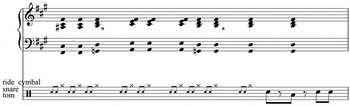
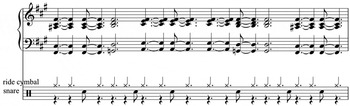
When the drum first enters, however, it plays a pattern that directly lines up with the piano chord rhythm, so that any sense of metre is further withheld for a last few fleeting moments in what I can only interpret as a gesture of playfulness (see Figure 9). After one full cycle of such ‘floating’ the drums regularise, suddenly revealing a form of compound metre that takes the listener by total surprise (refer to Figure 10). What in the piano part had felt like a metre-less pattern now matches up perfectly – but in a highly syncopated manner – with the ride cymbal of the drums, a relationship that is for all practical purposes impossible to detect at the beginning of the song.
Entrance of the drums, one full cycle of piano chords.

Regularised drum part (simplified) with piano chords.

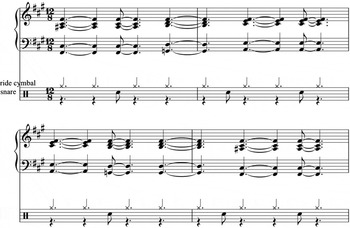
A number of grouping possibilities present themselves. One version, according to the ‘official’ score (though without any direct evidence of band input; Harvey Reference Harvey2008, pp. 6–9), is the 10-chord cycle spread out over four bars of 4/4, but with instructions to treat each beat as a dotted quarter note (what other scores refer to as ‘swung eighths’). In Figure 11 I have rewritten this as 12/8, to reflect visually more accurately what is sounded. Even with this more straightforward interpretation, two notable examples of syncopation or rhythmic play are present: (1) within each subset of five piano chords (spread over two bars), only the first chord lands on a strong beat (beat one); all other chords land on weak beats or beat positions (two or four, or the third division of two and three); and (2) snare drum hits are asymmetrically placed over these two bars – the third division of beat two in the first bar, the third division of beats one and three in bar two – so that the expectation of regularly occurring back beats is thwarted.
12/8 realisation of ‘Pyramid Song’.

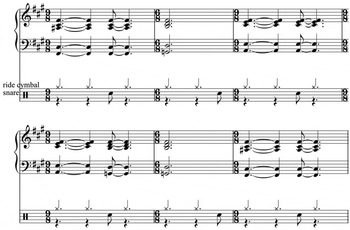
The changes in piano chords and the placement of the snare drum hits, however, also suggest a repeating metre of 9/8, 6/8 and 9/8, as notated in Figure 12. My own personal favourite (though other fans and scholars have chosen this version as well), such a configuration keeps harmonic changes within the bars and places the snare drum hits consistently on the third division of every beat two. This option and the 12/8 (or swung 4/4) version, however, are only two out of a constellation of listeners’ interpretive attempts to establish the rhythm that run the full gamut of simple, compound and mixed metres.Footnote 30
9/8, 6/8, 9/8 realisation of ‘Pyramid Song’.

As I previously noted, the response to ‘Pyramid Song’ by audiences, critics and academics has been nothing short of astounding. During the four-year period from 2007 to early 2011 alone there were more than a dozen websites and hundreds of individual entries logged pertaining specifically to its opening rhythm (if one includes all threads related to the song and/or its album Amnesiac, the numbers run well over a thousand; see Hesselink Reference Hesselink2013). As the music theorist Leonard Meyer already documented more than 50 years ago, the expectation that results from a doubtful or ambiguous musical passage – a feeling of suspense – is often pleasant for a listener, depending on how long it takes for such clarification/resolution to occur (Meyer Reference Meyer1956, pp. 26–8). While the length of time that expectation was set up in ‘Pyramid Song’ was notably longer than that in ‘Bring On the Night’ by the Police, the Radiohead example also followed David Huron's ‘garden path’ phenomenon in which any understanding or interpretation had to be re-evaluated in the face of later information (Huron Reference Huron2006, pp. 29–81; see also Levitin Reference Levitin2009, pp. 31–2).Footnote 31 The withholding of metrical cues at the beginning of the song – in combination with the ambiguity of the song's title and lyrics – created a fertile space for Radiohead's fans to construct their own rich body of meanings, foregrounding uncertainty and openness over predictability:
Delaying a cadence, or creating uncertainty about any other learnt musical pattern, boosts the eventual reward (assuming that it comes at all). And the hiatus sharpens our attention, obliging us to concentrate and search for clues about what the music will do, rather than riding on a wave of tepid, blithe predictability. The music, in short, becomes more interesting when it is less predictable. And when the final tonic chord arrives [or meter becomes apparent, in the case of ‘Pyramid Song’], what would have been a mildly pleasant sense of completion becomes a flood of delight, even awe. (Ball Reference Ball2010, p. 285; emphasis in original)
Radiohead has been quite clear in print and media interviews about their trust in their fans’ ability to ‘get’ the subtlety of their work:
People underestimate what the general public is capable of listening to. … It's not above people's heads. People get it. We're [just] people making it, [so] other people are capable of getting it. (Ed O'Brien, quoted in Randall Reference Randall2011, p. 182)
You want to slap [industry] people and say, ‘Why don't you go back and look at all the beautiful things that have been made in the music business and realise that you have to have faith in people?’ In the long run, the industry wants to make money, but if a company wants to make money then it has to take a risk. These people don't take risks. They make quick money and then that's it. And the world isn't a nicer place for it. (Thom Yorke, quoted in Ross Reference Ross2010, pp. 100–101)
But the real proof is in the ongoing relationship that has been nurtured and maintained between Radiohead and its audiences from the very beginning, how the members have placed their trust in the fans’ interpretive insights, ruminations and, critically, their ability to make the right ethical choices. As has already been amply documented, in 2007 Radiohead first released In Rainbows digitally with the option left open for what to pay for the download (including nothing at all). Fans were also encouraged to create and donate their own music videos, were provided access to original music files to create their own original works, and were given outlets to write their own reviews before the press was sent the standard media packet (see Lawson Reference Lawson2009, pp. 61–79; Randall Reference Randall2011, pp. 235–40, 254–6). Since that time Radiohead has also released a concert DVD free of charge in which the band donated the audio masters and cover art, but the fans were responsible for providing all of the video footage (‘Strictly Not for Sale – By the Fans for the Fans, Please Share and Enjoy’),Footnote 32 and in 2011 various DJs around the world were given masters to The King of Limbs to produce their own mixes, released later as a collection titled Radiohead TKOL RMX 1234567.
Conclusion
The theorist David Temperley (Reference Temperley1999, p. 35), in an article on syncopation in rock music, argued that metrical ambiguity and the blurring of an underlying pulse was common in classical music, but was infrequent in most kinds of rock. While I understand the importance he placed on metrical regularity and identification in rock and popular music, I believe that the examples provided in my analysis – while perhaps exceptional in the degree to which they are challenging – are nevertheless indicative of a broader trend. Rhythmic play through metrical-structural manipulation was a central and defining feature not only of the two songs examined here, but of most of the output of both the Police and Radiohead, as it is of many bands who achieved great commercial (and critical) success (not to mention the realms of jazz-rock and ‘math metal’). Entire books could be filled with examples of rock music in which rhythmic-metrical ambiguity takes place in different parts of the song, instrumental and vocal lines overlap while sectional markers become unclear, or two (or more) different metres occur at the same time.
With ‘Bring On the Night’ and ‘Pyramid Song’ it was Spicer's accumulative form – achieved through metrical fakeout and ambiguity, respectively – that came to the fore. In both cases the opening groove provided only snippets of the forthcoming texture, the compositional process laid bare as listener expectations were toyed with until clarification finally occurred. For such a process to take hold, I believe, a delicate balance must be achieved between complexity and intelligibility: expectations and interest must be aroused – whether or not listeners are cognisant of such play – without excessive deception that leaves audiences frustrated or merely confused. In the example provided by ‘Bring On the Night’ a full (but relatively brief) verse must pass before aware listeners realise they have been tapping their foot exactly one eighth note off the main beat. Part of the fun of this track for myself – as it must be for others, including members of the Police I would imagine – is that a number of audience members are not entirely aware of what has just happened. As the chorus enters they might interpret the ‘new’ beat as a kind of hiccup, perhaps even a skip in the CD player. With ‘Pyramid Song’ clarification occurs as well after an iteration of the verse, although in this case it is much longer in the making (and when the drums do finally enter, the exact metre still remains a mystery to many).
The significance of such play beyond the structural-compositional interest is the special form of communication that takes place between the composer-performer and the listener. When artists engage in such activity with their audiences specifically in mind – as did the Police and Radiohead – the act reflects the unfolding of a collaborative aesthetics, one in which the concerted effort of the fans is rewarded with a kind of shared insider knowledge. Bands and their audiences thus become joined through an understanding of such compositional-performative play, an extended community based on trust, respect and shared ownership. Distances that are otherwise inherent to the modern listening experience – those of space, time and context – are brought that much closer, even collapsed, when such communication is the goal. Expanding our gaze outward, this celebration of rhythmic play further links us with music making around the globe, even with humanity itself.