Introduction
Pulmonary arterial hypertension is characterised by elevated pulmonary arterial pressure secondary to CHD, pulmonary vascular disease, pulmonary embolism, or idiopathic diseases. It is a progressive, fatal, and rare disease, usually with a poor prognosis. Reference Jiawang, Qiguang and Xianyang1 It may be idiopathic, genetic, or related to CHD or other causes. Reference Humbert, Sitbon and Guignabert2 Pulmonary arterial hypertension is characterised by pathological changes of distal pulmonary arterioles, including pulmonary artery intimal proliferation, fibrosis, media, and adventitia thickening with perivascular inflammatory cell infiltration, leading to pulmonary artery stenosis, increased resistance, and lumen thrombosis. When the pulmonary artery pressure increases, the right ventricle reacts to the increase in afterload and produces compensatory myocardial hypertrophy. Continuous pressure overload impairs the systolic function of the right ventricle and progresses to myocardial fibrosis, which is manifested as right ventricular dilatation, left ventricular septal shift, diastolic dysfunction, decreased cardiac output, right heart failure, and eventually total heart failure and even death. The remodelling period of chronic right heart failure from a state of compensation to the state of a decompensation is possibly an ideal intervention period for targeted anti-heart therapy in patients with pulmonary arterial hypertension. In the era of traditional treatment without targeted drugs for pulmonary arterial hypertension, the 1 -, 3 -, and 5-year survival rates of idiopathic pulmonary arterial hypertension in the United States were 68, 48%, and 34%, respectively. Reference D’Alonzo, Barst and Ayres3 Early reports showed that the median survival time of idiopathic pulmonary arterial hypertension in children was only 10 months, and the 1 -, 3 -, and 5-year transplantation-free survival rates were 89, 76%, and 57%, respectively. Reference Moledina, Hislop, Foster, Schulze-Neick and Haworth4,Reference Barst, McGoon, Elliott, Foreman, Miller and Ivy5 In the past decade, a breakthrough has been made in the targeted drug therapy of pulmonary arterial hypertension. The combination therapy prostacyclin, endothelin receptor antagonist, phosphodiesterase-5 inhibitor, and soluble guanylate cyclase stimulator can significantly improve the 5-year survival rate of pulmonary arterial hypertension patients, even reaching 80%. Reference Jiang, Wu and Huang6,Reference Gali`e, Humbert and Vachiery7 Although targeted drug therapy has improved the health quality and life expectancy of patients, pulmonary arterial hypertension is still not cured. Clinical deterioration and early death of pulmonary arterial hypertension patients are still inevitable, and the treatment of end-stage pulmonary arterial hypertension remains challenging. Because the efficacy of targeted drugs reduces over time, it is estimated that there is a prevalence of nearly a quarter of all patients who do not respond to treatment. Reference van Loon, Roofthooft and Delhaas8 Children in World Health Organization functional class IV exhibit a median life expectancy of under 2 years despite pulmonary arterial hypertension-specific therapy. Reference Ploegstra, Douwes, Roofthooft, Zijlstra, Hillege and Berger9 In China, the monthly cost of triple oral targeted therapy is more than 15,000 RMB, which is prohibitive for poor families. Reference Qian, Quan and Chen10 LTx is the only surgical procedure available at present, but the median survival time of children after lung transplantation is 7 years. Reference Ahya and Diamond11 At the same time, LTx is limited by the shortage of donors, the difficulty of matching, and the need for lifelong immunosuppressive therapy, which is difficult in China and other resource limited countries. In addition, the limited availability of paediatric grafts and the huge financial burden pose significant clinical barriers, resulting in nearly 46% of patients not receiving LTx and about 27% of children with pulmonary arterial hypertension dying on the waiting list. Reference de Perrot, Granton and Mcrae12 Therefore, for patients with end-stage pulmonary arterial hypertension who do not respond to drug therapy, there is an urgent need to find new treatment methods to improve the end-stage clinical status, prolong the survival time and delay the timing of LTx.
The Potts shunt originated in 1945 and was used for the palliative treatment of refractory hypoxia in children with congenital right ventricular outflow tract stenosis when cardiopulmonary bypass technology was not widely used. Reference Potts, Smith and Gibson13 The traditional Potts shunt established a route for left-to-right shunt for pulmonary oligaemia, which ensured pulmonary artery blood supply and systemic oxygen supply. In 2004, reverse Potts shunt was first used to treat severe pulmonary arterial hypertension after complex CHD surgery and achieved good results. Reference Blanc, Vouhe and Bonnet14 More and more studies have shown that reverse Potts shunt has the characteristics of a relatively simple operation, comparable early survival rate, better long-term prognosis, and less medical cost compared with conventional LTx. Reverse Potts shunt has been applied in the treatment of idiopathic pulmonary arterial hypertension and Eisenmenger syndrome after CHD surgery, as a bridge to prolong the life and improve the quality of life of patients before LTx, and has been recently included in the treatment guidelines for pulmonary arterial hypertension. Reference Hansmann, Koestenberger and Alastalo15 Reverse Potts shunt establishes extracardiac pulmonary to systemic shunt and alleviates fatal right heart failure. However, it has a short history in the treatment of refractory pulmonary arterial hypertension, and the scope of application is still limited. More evidence is needed to support the specific indications, contraindications, surgical strategies, and long-term prognosis is unknown. There are few reviews on the topic of reverse Potts shunt in the treatment of severe pulmonary arterial hypertension. This article reviews the physiological mechanisms, past and present, surgical indications, surgical procedures, benefits, future application prospects, and key unsolved problems of reverse Potts shunt in the treatment of severe pulmonary arterial hypertension in children.
Physiological mechanisms
Pulmonary arterial hypertension can aggravate right ventricular afterload and lead to right ventricular failure. At the same time, the dilated right ventricle causes the ventricular septum to shift to the left, severely impairing the left ventricular preload and systolic function, leading to systemic hypoperfusion and hypoxia, and eventually to syncope and sudden death. The 5-year mortality rate is 25–60% with right ventricular failure being the main cause. Reference Baruteau, Belli and Boudjemline16 Clinical studies have shown that patients with idiopathic pulmonary arterial hypertension who undergo atrial septostomy have a better prognosis. Reference Micheletti, Hislop and Lammers17,Reference Diller, Dimopoulos and Broberg18,Reference Kurzyna, Dabrowski and Bielecki19 At present, the treatment methods to increase systemic-pulmonary circulation traffic mainly include atrial septostomy and reverse Potts shunt. In 1983, Rich et al. Reference Kula and Atasayan20 tried to use atrial septostomy as a palliative treatment for right heart failure in patients with end-stage pulmonary arterial hypertension. Haemodynamically, atrial septostomy is expected to relieve excessive right ventricular afterload and improve left ventricular function through right-to-left shunt at the atrial level. Its effectiveness depends on the tricuspid regurgitation that is common in patients with end-stage pulmonary arterial hypertension. Limitations include high operative mortality (up to 15% at 1 month after surgery) and long-term central nervous system and coronary hypoxia. It may not be possible if right atrial pressure is more than 20 mmHg mean due to sudden systemic desaturation. Role of atrial flow regulator needs to be incorporated. In addition, about 10% of patients may have spontaneous closure of the atrial fenestration and require secondary surgery. Reference Lammers, Haworth and Diller21 These factors limit the clinical utility of this approach. However, reverse Potts shunt appears to make up for the above shortcomings. Reverse Potts shunt is a shunt from the pulmonary artery (usually the left pulmonary artery) to the descending aorta. The shunt site ensures that there is oxygenated blood supply to the central nervous system and upper limbs, while the blood supply to the abdominal organs and lower limbs is a mixture of oxygenated and deoxygenated blood. Although the right ventricle of pulmonary arterial hypertension patients with artificially created haemodynamic physiological state of Eisenmenger syndrome is under systemic pressure for a lifetime, the right ventricle still maintains a physiological function similar to that in fetal period: the thickness of the right ventricular wall is unchanged, the interventricular septum remains flat, and the function of the right ventricle is preserved. Reference Kempny, Sorensen and Li22 The theoretical advantage of this phenomenon is that right-to-left shunt can reduce right ventricular afterload, delay right ventricular failure, and preserve biventricular function, which may be the main reason for the better prognosis of pulmonary arterial hypertension patients with Eisenmenger syndrome than other pulmonary arterial hypertension patients without Eisenmenger syndrome.
Past and current status of reverse Potts shunt in the treatment of severe pulmonary arterial hypertension in children
Clinical outcomes of reverse Potts shunt
In 2004, Blanc et al. Reference Blanc, Vouhe and Bonnet14 performed reverse Potts shunt on two children (4 and 14 years old) with pulmonary arterial hypertension after the repair of transposition of the great arteries, which was the first attempt of reverse Potts shunt in the management of pulmonary arterial hypertension. The operation was successful in these two children, with relief of right heart failure post surgery. The NYHA functional class improved to class II. In 2012, Alban-Elouen Baruteau et al. Reference Baruteau, Serraf and Levy23 retrospectively analysed the long-term results of eight children with idiopathic pulmonary arterial hypertension who underwent reverse Potts shunt. All patients had higher pulmonary artery pressure than aortic pressure and were in NYHA heart function class IV, and were on long-term pulmonary vasodilators. The drug therapy was continued post reverse Potts shunt. After a mean follow-up of 63.7 ± 16.1 months, the six children who were discharged from the hospital were alive. Functional status improved markedly in the six survivors, with NYHA heart function class I (n = 4) or II (n = 2) at last follow-up, consistent with significant improvement of 6-minute-walk distance (302 ± 95 m [51% ± 20% of theoretical values] versus 456 ± 91 m [68% ± 10% of theoretical values]; p = 0.038) and decrease of brain natriuretic peptide levels (608 ± 109 pg/mL versus 76 ± 45pg/mL; p = 0.035). Subsequently, in 2015, Alban-Elouen Baruteau et al. Reference Baruteau, Belli and Boudjemline16 conducted a retrospective multicentre study to evaluate the short-term and long-term efficacy of reverse Potts shunt in 24 children with suprasystemic pulmonary arterial hypertension. From 2003 to 2014, 24 children underwent reverse Potts shunt [19 surgical, median age: 7.7 years (1.5–17 years), median weight: 19.5 kg (10.2–47 kg) and five transcatheter, median age: 8.1 years (2.3–9.7 years), median weight: 22 kg (12.5–31 kg)] for drug-refractory pulmonary arterial hypertension. Severe postoperative complications occurred in six patients (25.0%, all from the surgical group), including three early deaths (12.5%) related to low cardiac output. The median follow-up time was 2.1 years (3 months to 14.3 years, including 7 cases ≥8 years). The World Health Organization functional class was 1 or 2 in 21 surviving patients (P < 0.05). The mean 6-minute walk distance improved from (42.3 ± 10.0%) m to (81.2 ± 9.7%) m (P < 0.001) after adjustment for age and sex. Brain natriuretic peptide levels normalized in all patients. Intravenous epoprostenol was discontinued in all patients who received triple therapy as preoperative treatment for potts anastomosis. Finally, all survivors caught up to normal growth curves. Arterial oxygen saturation gradient between upper and lower limbs persisted at the last follow up (94.7 ± 3.6% versus 81.6 ± 5.1%, P < 0.001). One patient required LTx 6 years after reverse Potts shunt. Therefore, reverse Potts shunt can prolong survival and improve function significantly and durably in children with severe drug-refractory pulmonary arterial hypertension. Reverse Potts shunt can be used as the first choice of surgical or transcatheter intervention for children with refractory severe pulmonary arterial hypertension as a bridge to future LTx if necessary. In 2016, R. Mark Grady et al. Reference Grady and Eghtesady24 reported the results of five patients with pulmonary arterial hypertension who underwent reverse Potts shunt at their institution. All five children survived the procedure without significant complications. Four of the five children were successfully discharged from the hospital and have had sustained clinical improvement with follow up ranging from approximately 5 to 16 months. Their findings further suggested that: (1) reverse Potts shunt should be considered early in a child’s clinical course, before right ventricular deterioration develops; (2) reverse Potts shunt should be considered in any child with severe, intractable pulmonary arterial hypertension, regardless of aetiology; (3) one might consider reverse Potts shunt instead of intravenous prostacyclins; and (4) reverse Potts shunt should be considered before LTx and does not preclude future transplantation candidacy. In 2017, Sergey V. Gorbachevsky Reference Gorbachevsky, Shmalts, Barishnikova and Zaets25 from the Bakoulev Center for Cardiovascular Surgery, Moscow, Russia, reported early results in eight children with pulmonary arterial hypertension who underwent reverse Potts shunt. Eight patients with suprasystemic pulmonary arterial hypertension (pulmonary artery-to-aorta mean pressure ratio [Pp/Ps] of 1.39 ± 0.30) underwent reverse Potts shunt at the median age of 13.5 months. Six patients were followed up for 2–32 (median 17) months after the operation. In all cases, reverse Potts shunt caused a decrease in arterial blood oxygen saturation at the lower extremities and was the genesis of the arterial blood oxygen saturation gradient between the upper and lower extremities (10.5 ± 1.8% at discharge). Postoperative echocardiography revealed flattening of the ventricular septum as well as a decrease in the right ventricle-to-left ventricle end-diastolic diameter ratio from 1.36 ± 0.14 preoperatively to 0.99 ± 0.22 at discharge (P = 0.010). The two patients with the highest preoperative Pp/Ps (1.79–1.86) died during the early postoperative period from repeated pulmonary hypertension crises and uncontrolled hypoxaemia. There were no deaths during the follow up period. The functional class of the patients improved from IIIb–IV to I–II, syncopal episodes no longer persisted, and the weight deficit decreased from 21.8 ± 7.5% preoperatively to 11.5 ± 5.9% at the latest follow-up examination (P = 0.004). In 2018, Manish Aggarwal et al. Reference Aggarwal, Grady, Choudhry, Anwar, Eghtesady and Singh26 retrospectively analysed the clinical data of 11 children with pulmonary arterial hypertension who underwent reverse Potts shunt in St Louis Children’s Hospital from 2013 to 2017. Of 11 patients, two died, one required lung transplant, and eight survived for a median of 27 months postshunt. In survivors, World Health Organization functional class significantly (P = 0.01) improved and the majority (5 of 8) came off pulmonary vasodilators at the most recent follow-up. Postshunt right ventricular systolic function improved (P = 0.03), right ventricle afterload decreased (P < 0.01), right ventricle work decreased (P = 0.02), and right ventricle-proximal pulmonary artery coupling improved (P < 0.01). This proof of concept study shows that reverse Potts shunt allows improvement in functional status and mid-term transplant-free survival in the majority of the recipients by improvement in right ventricular systolic function and right ventricle-proximal pulmonary artery coupling in children with suprasystemic pulmonary arterial hypertension. In 2021, Zhang Hao Reference Hao, Yongxuan, Yanjun, Zhuoming and Jie27 from Shanghai Children’s Medical Center reported a case of reverse Potts shunt for a 3-year-old child with idiopathic pulmonary arterial hypertension, which was the first case reported in China. The operation was successful, and the child was followed up by telephone at 15 days and 3 months after discharge, respectively. The child had no syncope, cyanosis, fatigue, or limitation of activity, and the World Health Organization functional class was grade I. In the same year, Prashant Bobhate et al. Reference Bobhate, Mohanty and Tailor28 from Kokilaben Dhirubhai Ambani Hospital reported a prospective study from their institution. Sixteen patients with functional World Health Organization class III or IV pulmonary hypertension (no significant intracardiac and extracardiac shunts), on maximal medical therapy, were recommended to undergo reverse Potts shunt/patent ductus arteriosus stenting. Potts shunt was established surgically in 14 patients, and transcatheter patent ductus arteriosus stenting was performed in two patients. Twelve of the 16 patients survived. The patients who did not survive the procedure were older and had severe right ventricular systolic dysfunction and were in World Health Organization functional class IV. The median follow uptime was 17 months (1–40 months). After surgery, the clinical, echocardiographic, and biochemical indicators of 11/13 patients continued to improve, and 10/13 patients did not need to use pulmonary vasodilator after surgery. One patient died of lower respiratory tract infection 16 months after operation. R. Mark Grady et al. Reference Grady, Canter and Wan29 reported that the largest number of cases in the world spanned 20 years, covering five Western countries and 13 centres, and 110 children with severe pulmonary arterial hypertension. Among them, 17 cases (15%) died early, the average follow-up was 3.1 years, and the 1-year survival/freedom from transplantation rate of discharged children was 92%. The 5-year survival/freedom from transplantation rate was 68%. Prostacyclin-targeted drugs were discontinued during the postoperative follow up, compared with the proportion of triple therapy before surgery (56%). In 2024, Yu Xiafeng et al. Reference Xiafeng, Yanjun and Lijun30 from Shanghai Children’s Medical Center reported the single-centre experience of reverse Potts shunt in the treatment of severe pulmonary arterial hypertension in children, which was the first cohort study in China. The clinical data of 10 children with severe pulmonary arterial hypertension who underwent reverse Potts shunt in Shanghai Children’s Medical Center from September 2022 to September 2023 were retrospectively analysed. There were one male and nine females with an average age of 8.1 ± 4.2 years. There were six cases in World Health Organization functional class III and four cases in World Health Organization functional class IV. The preoperative pulmonary vascular resistance index was (24.2 ± 6.0) WU×m2, and the Pp/Ps was (1.1± 0.2). All patients received triple drug therapy for 1–8 months before operation. Three patients died early and seven patients survived. The oxygen saturation difference between the upper and lower limbs was (13.3 ± 7.7) % at discharge. During the follow up period of 1–11 months, N-terminal pro-brain natriuretic peptide decreased by 46.3%, right ventricular end-diastolic volume index increased by 10. 9%, and tricuspid annular plane systolic excursion increased by 15.3%. All patients were treated with targeted drug dual therapy during the follow up period.
Comparison of outcomes between reverse Potts shunt and LTx in children with severe pulmonary arterial hypertension
There are relatively few clinical studies that directly compare the outcomes of reverse Potts shunt versus LTx for the management of severe pulmonary arterial hypertension in children. In 2021, Lancaster et al. Reference Lancaster, Shahanavaz, Balzer, Sweet, Grady and Eghtesady31 reported the first single-centre clinical study with a large sample in the United States to compare the mid-term prognosis of reverse Potts shunt and LTx in the treatment of refractory pulmonary arterial hypertension in children. In this study, 23 children with preoperative right ventricular pressure higher than systemic pressure underwent reverse Potts shunt and 31 underwent LTx. After a median follow-up time of 1.8 years, postoperative survival in the reverse Potts shunt group was not significantly different from that in the LTx group. Subsequently, in 2024, Estibaliz Valdeolmillos et al. Reference Valdeolmillos, Le Pavec and Audie32 reported the first single-centre clinical study with a large sample in France. Compared with the 20 patients managed by reverse Potts shunt, the 41 transplant waitlist patients, of whom 28 were transplanted, were older (14.9 versus 8.0 years, P = .0001), had worse right ventricular impairment (tricuspid annular plane systolic excursion,12.5 mm versus 18.0 mm, P = .03), and were managed later in the evolution of the disease (6.0 versus 1.7 years, P = .002). After implementation of a high-priority allocation programme in 2007, waitlist mortality decreased from 52.6% to 13.6% (P = .02), and 5-year survival increased from 57.1% to 74.7% after reverse Potts shunt and 55.6% to 77.2% after transplantation. At a median follow up of 8.6 years after reverse Potts shunt and 5.9 years after transplantation, functional capacity had improved significantly, and pulmonary arterial hypertension-specific drug requirements had diminished markedly in the reverse Potts shunt group. Two patients successfully underwent LTx 6 and 9 years after reverse Potts shunt. So, these studies support the fact that reverse Potts shunt deserves earlier consideration in the paediatric pulmonary arterial hypertension.
Modification of reverse Potts shunt
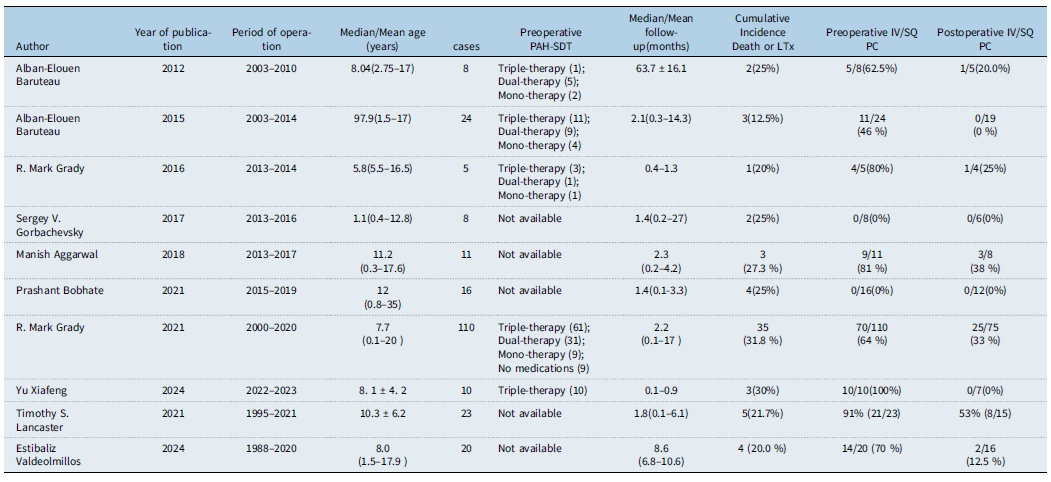
After reverse Potts shunt, when the pulmonary artery pressure is lower than the aortic pressure, there may be a left-to-right shunt, resulting in increased left ventricular volume load, aggravated left atrioventricular valve regurgitation and pulmonary vascular disease. Therefore, it has been proposed that unidirectional-valved conduit can be used in reverse Potts shunt to prevent the shunt from left to right. Minh Thanh Bui et al. Reference Bui, Grollmus and Ly33 first reported unidirectional-valved shunt in an animal model. In this study, acute pulmonary arterial hypertension model was successfully established by intrapulmonary injection of Erciplex glue in 14 pigs. Reverse Potts shunt was performed with unidirectional valve made of polytetrafluoroethylene patch. The results showed that during the acute phase of pulmonary hypertension, when pulmonary artery pressure increased, the unidirectional valve opened and a right-to-left shunt appeared, resulting in a decrease in right ventricular afterload. When the pulmonary artery pressure returned to equal to or lower than the aortic pressure, the unidirectional valve closed, preventing the left-to-right shunt. Based on the results of animal experiments, Rosenzweig et al. Reference Rosenzweig, Ankola, Krishnan, Middlesworth, Bacha and Bacchetta34 reported the early experience of unidirectional-valved shunt in the treatment of five adolescent and adult patients with end-stage pulmonary arterial hypertension (four females, 12–22 years old, four cases of idiopathic pulmonary arterial hypertension and 1 case of repaired transposition of the great arteries). This novel unidirectional (right-to-left) shunt, in which a 12-mm long unidirectional mobile valve is sutured to an artificial conduit, optimises the right-to-left shunt design and avoids the potential complications of bidirectional shunts. All patients had higher pulmonary artery pressure than aortic pressure, poor right ventricular function, and were in World Health Organization functional class IV. All patients were on triple-targeted drug therapy for pulmonary arterial hypertension. All patients survived and were followed up for 3–33 (6 ± 11) months without LTx. Unidirectional-valved shunt may provide an alternative to LTx in adolescents and adults with idiopathic pulmonary arterial hypertension, but longer follow up is needed to determine the ultimate effect of unidirectional valve on the right ventricle in these patients. Table 1 summarises the clinical cohort studies of children with severe pulmonary arterial hypertension treated with reverse Potts shunt in various heart centres around the world over the past 20 years.
Previous clinical studies of RPS in children with severe PAH

Indications and contraindications of reverse Potts shunt in the treatment of severe pulmonary arterial hypertension in children
Indications
-
1. Group I pulmonary arterial hypertension as defined by the World Symposium on Pulmonary Hypertension – arterial pulmonary hypertension, including idiopathic pulmonary arterial hypertension and pulmonary arterial hypertension caused by CHD, with a Pp/Ps greater than 0.7. Reverse Potts shunt aims to create a “Relief Valve” that decompresses pressure and delays right heart failure. In theory, a Pp/Ps of > 1.0 is an indication for reverse Potts shunt, and patients can benefit from it. Unidirectional-valved shunt avoids the risk of reverse flow, expanding the applicability to pulmonary arterial hypertension patients with Pp/Ps < 1.0. There is currently no discussion or definition of the cutoff value for Pp/Ps below which reverse Potts shunt is deemed unsuitable. Among the 10 patients in Shanghai Children’s Medical Center, only one patient had a Pp/Ps of 0.67 < 0.7. This patient had a transient pulmonary haemorrhage 3 days after surgery, which may have been caused by excessive pulmonary haemorrhage from left-to-right shunting across the reverse Potts shunt. Reference Xiafeng, Yanjun and Lijun30 Baruteau et al. Reference Bobhate, Mohanty and Tailor28 of the Melbourne Children’s Hospital successfully performed reverse Potts shunt in one child with a Pp/Ps of 0.56, which is the smallest ratio recorded so far in a pulmonary arterial hypertension patient receiving reverse Potts shunt. Therefore, taking together the previously published series of cohort studies, we believe that a Pp/Ps > 0.7 in specific clinical or echo situations may be an indication for reverse Potts shunt.
-
2. Maximum doses of PDE5i medications-targeted pulmonary arterial hypertension therapy for more than 1 month prior to surgery, and deterioration of patient’s condition even after maximum dose of prostacyclin drug treatment. Aggarwal suggests that an “observation window” should be set for patients with suprasystemic pulmonary arterial hypertension to determine the optimal timing for surgery, where if condition does not improve after a period of medical treatment, reverse Potts shunt should be considered. Reference Aggarwal and Grady35 However, there is currently no consensus on the duration of this observation period. The experience of Bobhate in India is 6 months, while Zhang Hao in Shanghai sets it at a minimum of 1 month. Reference Xiafeng, Yanjun and Lijun30 A possible approach is to perform reverse Potts shunt as soon as signs of right ventricle dysfunction appear. If the right ventricular function is already severely compromised, reverse Potts shunt is unlikely to yield significant improvement, and the risks outweigh the potential gains. Reference Castro, Oliveira, Nunes, Oliveira, Almeida and Barbosa36 Therefore, in order to prevent the occurrence of acute right ventricular failure, we suggest adopting a more aggressive attitude towards intervening with reverse Potts shunt in children with severe pulmonary arterial hypertension.
-
3. Patients in World Health Organization functional class III or above, with preserved right ventricular function. Estibaliz Valdeolmillos et al. Reference Valdeolmillos, Le Pavec and Audie32 found that after implementation of a high-priority allocation programme in 2007, waitlist mortality decreased from 52.6% to 13.6% (P = .02) and 5-year survival increased from 57.1% to 74.7% after reverse Potts shunt. This suggests that in selected children with suprasystemic pulmonary arterial hypertension, reverse Potts shunt is associated with functional capacity improvements and decreased pharmacotherapy needs over the midterm. Reverse Potts shunt deserves consideration earlier in the course of paediatric pulmonary arterial hypertension, with transplantation being resorted to in the event of refractory right ventricle failure. The risk of surgery is higher when the child is older, the drug therapy is ineffective, and the heart function is significantly reduced.
Contraindications
-
1. Obvious intracardiac and extracardiac malformations (such as ventricular septal defect, patent ductus arteriosus, etc.).
-
2. There are obvious surgical contraindications, such as severe bleeding, liver failure, severe infection, etc.
-
3. Patients with poor preoperative conditions, like use of intravenous inotropes, mechanical ventilation, or extracorporeal membrane oxygenation, are not suitable candidates. Grady et al. Reference Grady, Canter and Wan29 reported in a multicentre study that preprocedural factors that impacted early survival, specifically ICU admission, use of intravenous inotropes, use of mechanical ventilation, and use of extracorporeal membrane oxygenation, also carried a strong negative association with late survival or transplant. Bobhate et al. Reference Hao, Yongxuan, Yanjun, Zhuoming and Jie27 summarised the preoperative indicators of poor prognosis: age > 16 years; right atrial pressure > 8 mmHg (1 mmHg = 0.133 kPa); tricuspid annular plane systolic excursion < 13 mm. The use of inotropes is not in itself a contraindication to reverse Potts shunt, but the severe cardiac dysfunction it reflects is a real issue that needs to be weighed carefully when deciding whether to perform reverse Potts shunt. There is increasing evidence that right ventricular dysfunction is a major cause of early mortality after reverse Potts shunt, and several studies have shown a strong association between the two. Reference Jiang, Wu and Huang6,Reference Baruteau, Belli and Boudjemline16,Reference Grady, Canter and Wan29,Reference Valdeolmillos, Le Pavec and Audie32
-
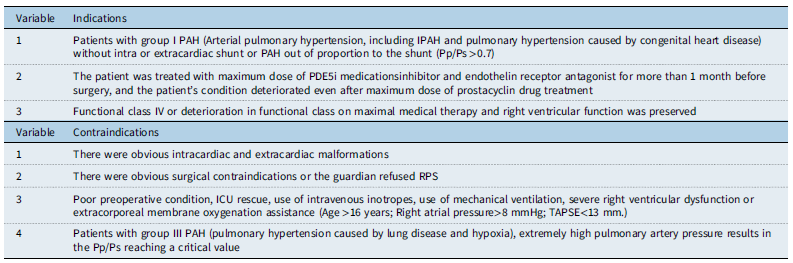
4. Patients with World Symposium on Pulmonary Hypertension group III pulmonary arterial hypertension (pulmonary hypertension caused by lung disease and hypoxia) or extremely high pulmonary arterial pressure causing Pp/Ps to reach critical values were not candidates. In Gorbachevsky SV’s experience, the two patients in his case with the highest Pp/ Ps (1.79 and 1.86) both died after surgery, leading him to believe that any form of reverse Potts shunt is contraindication when pulmonary hypertension is critical and LTx is a more appropriate alternative. Reference Gorbachevsky, Shmalts, Barishnikova and Zaets25 However, there is a lack of evidence that pulmonary vascular resistance level is a risk factor for reverse Potts shunt, and there is no clear consensus on whether a high Pp/Ps is a contraindication for reverse Potts shunt. But it is certain that “unrestricted” shunts are not appropriate when pulmonary vascular resistance is extremely high. This occurs because excessive pulmonary blood flow from the catheter to the descending aorta leads to insufficient blood supply to the lungs, which triggers systemic hypoxia. Further research and exploration will determine the Pp/Ps at which the risks of RPS outweigh its benefits and must therefore be converted to LTx . Table 2 summarises the indications and contraindications of reverse Potts shunt in the treatment of pulmonary arterial hypertension in children.
Indications and contraindications for RPS in the treatment of PAH in children

Surgical procedures
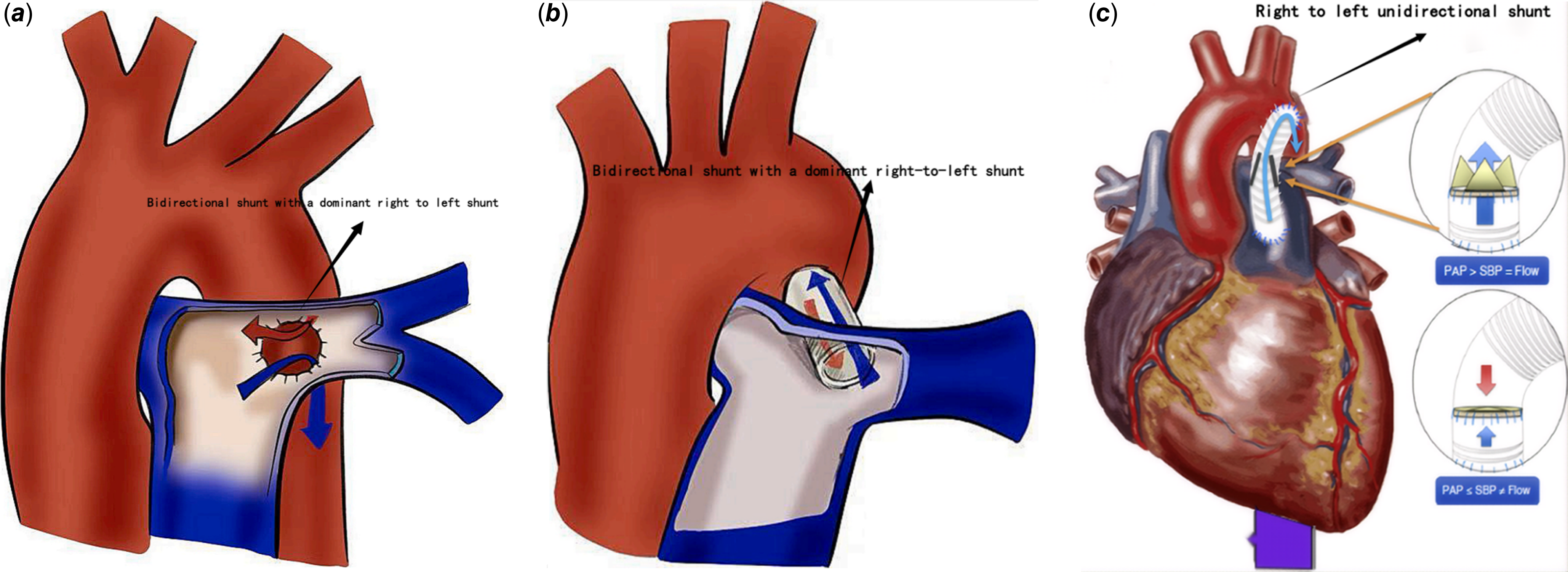
The descending aorta is directly anastomosed to the left pulmonary artery without any conduit placement and long-term postoperative anticoagulation (Figure 1a). This approach is mainly used in the early stages of reverse Potts shunt development. However, the anastomotic shape is often oval, and it is difficult to accurately control the size of the shunt. In older children, the anatomical distance between the pulmonary artery and the aorta makes suturing more challenging with higher tension. Furthermore, the difficulty of reisolating the vessels increases the risk of morbidity and mortality in future LTx. Reference Grady and Eghtesady24,Reference Pasupneti, Dhillon, Reitz and Khush37 Latus et al. Reference Latus, Apitz and Schmidt38 first reported the use of the artificial conduit to create reverse Potts shunt in 2013 (Figure 1b), which can effectively solve the above problems. The patient is placed in the right lateral decubitus position with one-lung ventilation and left posterolateral fourth intercostal chest entry. The descending aorta and left pulmonary artery are exposed free, and an artificial conduit of 50–70% diameter of the descending aorta is taken to connect the proximal branches of the left pulmonary artery and the nearest descending aorta.30 4D flow MRI has proved that almost all patients with reverse Potts shunt have a certain degree of regurgitation, mainly diastolic regurgitation. Reference Schafer, Frank and Grady39 This is contrary to the original intention of reverse Potts shunt because left-to-right shunting may overload the pulmonary circulation and aggravate pulmonary vascular disease and heart failure, a phenomenon that often occurs in patients with Pp/ Ps ratio < 1. With this in mind, Marie Lannelongue Hospital in France first attempted to perform a univalve Potts anastomosis in a child with a pulmonary to systemic pressure ratio (Pp/Ps) of 0.82. A polytetrafluoroethylene patch is used to create a structure similar to the foramen ovale between the pulmonary artery and the aorta. Allowing only right-to-left shunts expands the indication for reverse Potts shunt. Reference Bui, Grollmus and Ly33 In 2019, Rosenzweig et al. Reference Rosenzweig, Ankola, Krishnan, Middlesworth, Bacha and Bacchetta34 achieved ideal results by using a valved bovine jugular catheter to construct unidirectional-valved shunt in five pulmonary arterial hypertension patients (Figure 1c). In 2020, Swati Garekar used a hand-sewn expanded polytetrafluoroethylene valved conduit to perform unidirectional-valved shunt. Reference Bui, Grollmus and Ly33 With the application of various techniques in reverse Potts shunt, valve shunt and controlled shunt can be further realised, and the outcome of reverse Potts shunt is expected to become more safe and controllable. However, calcification, degeneration, and stenosis may be problems faced by valved conduits and require further clinical observation.
(a) Side-to-side direct anastomosis of the descending aorta and the left pulmonary artery; ( b ) conduit connection between the descending aorta and the left pulmonary artery; ( c ) unidirectional-valved shunt.

Advantages of reverse Potts shunt in the treatment of severe pulmonary arterial hypertension in children
Reverse Potts shunt has been used in the treatment of pulmonary arterial hypertension and has achieved considerable efficacy. Compared with traditional LTx, reverse Potts shunt is relatively simple; there is no donor involved, so waitlist period is eliminated, and the early postoperative survival rate is not inferior to LTx. There are no high-risk complications such as immune rejection, infection, transplant organ failure, etc. Reverse Potts shunt can effectively improve the symptoms of children with severe pulmonary arterial hypertension and delay LTx. In addition, from the perspective of health economics, there may be less reliance on expensive intravenous/subcutaneous prostaglandin analogues after reverse Potts shunt. Reference Gorbachevsky, Shmalts, Barishnikova and Zaets25,Reference Bobhate, Mohanty and Tailor28,Reference Xiafeng, Yanjun and Lijun30,Reference Valdeolmillos, Le Pavec and Audie32 It is roughly estimated that in China, the monthly cost of triple-targeted drugs alone for an adolescent child with pulmonary arterial hypertension is more than 15 000 RMB. Therefore, the indications of reverse Potts shunt may be relaxed for children who cannot tolerate or are not able to accept expensive medications. The unidirectional-valved shunt may expand the indication of reverse Potts shunt, and may control the risk of reverse Potts shunt in patients with Pp/Ps ratio < 1 within an acceptable range.
Application prospect of reverse Potts shunt in the treatment of severe pulmonary arterial hypertension in children
Percutaneous interventional creation of reverse Potts shunt
The risk of surgical intervention for reverse Potts shunt is high; therefore, there is a need for a novel reverse Potts shunt based on cardiac catheterisation techniques, of which only a few reports are available. Based on the methods of establishing the connection between the aorta and the pulmonary artery, transcatheter intervention methods are mainly divided into three categories: radiofrequency perforation stenting, interarterial perforation stenting, and percutaneous patent ductus arteriosus stenting.
In 2010, Sabi et al. Reference Garekar, Meeran, Dhake and Malankar41 used pig as an animal model to try to establish a shunt by implanting a coronary stent after radiofrequency perforation of the descending aorto-pulmonary artery without using the residual patent ductus arteriosus. Based on the success of animal models, Younes Boudjemline et al. Reference Sabi, Schmitt and Sigler42 sought to assess the safety, feasibility, and haemodynamic efficacy of the radiofrequency perforation stenting in children. The transcatheter Potts shunt procedure was performed using radiofrequency energy for vessel perforation and deployment of a covered stent to connect the descending aorta and the left pulmonary artery. A transcatheter Potts shunt was successfully created in six children (mean age,11.0 ± 4.2 years) with drug-refractory suprasystemic pulmonary arterial hypertension and deteriorating right ventricular function. All patients exhibited nearly complete equalisation of aortic and pulmonary pressures and improvement in right ventricle contractility within days after transcatheter Potts shunt. Two patients with preexisting severe biventricular dysfunction and pericardial effusion experienced acute low-output states immediately after shunt creation because of sudden reductions in left ventricular preload, resulting in cardiac arrest, irreversible brain damage, and death. Stent dislodgement and embolisation into the iliac artery occurred in one patient. The stent was successfully secured and followed by placement of a second stent at the target location. The procedure was uncomplicated in four patients, who remained alive after a mean follow-up of 10 ± 2.6 months. The study shows that transcatheter Potts shunt creation in children is feasible and results in haemodynamic improvement. In the same year, Malekzadeh Milani et al. Reference Boudjemline, Sizarov and Malekzadeh-Milani43 reported that the same transcatheter Potts shunt was successfully performed in eight children with pulmonary arterial hypertension. The average age was 11.1 (5.9–17.9) years, the average weight was 38.8 (17.5–79) kg, and all patients were in NYHA class III-IV. All patients were treated with triple therapy of drugs. Among them, six patients were idiopathic pulmonary arterial hypertension, three patients with poor right ventricular function assessed by preoperative clinical status and echocardiography died, two patients died of acute left ventricular dysfunction after transcatheter Potts shunt, and one patient died of respiratory failure. The other five patients had significant improvement and discontinued intravenous prostacyclin. The results show that transcatheter Potts shunt is technically feasible and can improve the prognosis of children with end-stage pulmonary arterial hypertension.
Referring to the principle of atrial septal puncture technique, Esch et al. Reference Haddad, Levy, Szezepanski, Malekzadeh-Milani and Bonnet44 performed transcatheter Potts shunt on four adult patients with end-stage pulmonary arterial hypertension by using interarterial perforation under X-ray guidance. Among them, one patient died of intraoperative massive haemorrhage and one patient died of postoperative haemodynamic complications. Multicentre retrospective data demonstrate that transcatheter Potts shunt is an independent predictor of early postoperative mortality, with a mortality rate of 40%. Reference Grady, Canter and Wan29 Magnetic catheters may offer a safer alternative for interarterial perforation, but they remain in the experimental phase in animal models. Reference Esch, Shah and Cockrill45 In the future, mature MRI-mediated technology is expected to provide better surgical conditions.
In 2013, Boudjemline Y et al. Reference Levi, Danon and Gordon46 attempted to carry out transcatheter Potts shunt based on natural shunt, that is, reverse Potts shunt was established by implanting bare metal stents into the incompletely closed ductus arteriosus in children. All the three patients were discharged 1 day after operation, and the right ventricular function was significantly improved. In 2015, Barutea et al. Reference Baruteau, Belli and Boudjemline16 reported that five patients with drug-refractory pulmonary arterial hypertension underwent percutaneous patent ductus arteriosus stenting to achieve reverse Potts shunt, which also achieved good results. In 2021, Shanghai Children’s Medical Center reported the first case of idiopathic pulmonary arterial hypertension treated with percutaneous patent ductus arteriosus stenting in China Reference Boudjemline, Patel, Malekzadeh-Milani, Szezepanski, Levy and Bonnet47 After 6 months of outpatient follow up, the clinical symptoms of the child were significantly improved. Current clinical evidence seems to support percutaneous patent ductus arteriosus stenting as a safer modality for establishing pulmonary to aorta shunting. Its unique clinical advantage is that it allows for the stepwise expansion of the stent during the process, guided by the changes in the ratio of pulmonary to systemic circulation pressure and the oxygen saturation of the upper and lower limbs, enabling real-time adjustment of the shunt size to achieve an optimal state.
Selection of shunt size
The selection of shunt size is a complex issue. If the diameter of the shunt is small, too small shunt will lead to insufficient “discharge” of the right ventricle, and the reduction of the right ventricular preload is not obvious, so it cannot delay the progressive aggravation of right ventricular dysfunction. If the diameter of the conduit is too large, the too large shunt will lead to insufficient preload and increased afterload of the left ventricle. Some children will have severe hypoxia of the lower limbs, and other children with large diameter shunts will have severe hypoxia of the whole body. This is believed to be so because excessive pulmonary blood flow through the conduit to the descending aorta will lead to absolute insufficient blood flow through the pulmonary artery to the lungs, which will cause systemic hypoxia. It may induce cardiac arrest Reference Tianliu, Yiwei, Jinjin, Fen, Hao and Lijun48 Different centres have different experiences in choosing the size of the shunt, which is usually 50 to 90% of the diameter of the descending aorta at the level of the diaphragm. Reference Jiang, Wu and Huang6,Reference Gorbachevsky, Shmalts, Barishnikova and Zaets25,Reference Xiafeng, Yanjun and Lijun30,Reference Lancaster, Shahanavaz, Balzer, Sweet, Grady and Eghtesady31,Reference Rosenzweig, Ankola, Krishnan, Middlesworth, Bacha and Bacchetta34,Reference Mirabile, Malekzadeh-Milani and Bojan49 Gorbachevsky et al. Reference Gorbachevsky, Shmalts, Barishnikova and Zaets25 selected 60–70% of the diameter of the descending aorta at the diaphragm, Lancaster et al. Reference Lancaster, Shahanavaz, Balzer, Sweet, Grady and Eghtesady31 and Rosenzweig et al. Reference Rosenzweig, Ankola, Krishnan, Middlesworth, Bacha and Bacchetta34 selected 70–80%. The team of Shanghai Children’s Medical Center Reference Xiafeng, Yanjun and Lijun30 selected 50–70%. At the Bakoulev Center in Russia, the following guidelines are used: for a Pp/Ps ratio of 1.2–1.5, the shunt-to-descending aorta cross-sectional area ratio is selected to be 0.4–0.5 (diameter ratio approximately 0.6–0.7), and for a Pp/Ps ratio greater than 1.5, a lower ratio of less than 0.4 (diameter ratio less than 0.6) is chosen, which is of significant clinical importance Reference Grady and Eghtesady24 We believe that there is no need to excessively pursue postoperative Pp/Ps = 1, and deliberately increasing the shunt diameter may lead to a sharp decrease in left ventricular preload and an excessive increase in afterload, resulting in catastrophic consequences, especially for patients with poor cardiac function. If acute left heart failure or retrograde aortic arch filling occurs after surgery, the shunt should be made narrower or even blocked. The selection of shunt size is not only closely related to Pp/Ps, cardiopulmonary function, and other factors but also involves complex fluid dynamics. The length and angle of the shunt can significantly affect blood flow resistance. Reference Haddad, Levy, Szezepanski, Malekzadeh-Milani and Bonnet44 Given this, Schranz suggested that different forms of reverse Potts shunt, such as direct and conduit anastomosis, should be evaluated separately Reference Mirabile, Malekzadeh-Milani and Bojan49 A 20-year retrospective review examined the relationship between shunt size and patient age, weight, body surface area, and Pp/Ps values by linear correlation analysis. The results showed a strong correlation between shunt size and body surface area. The ratio of shunt size to body surface area was normally distributed, and 50% of the values were concentrated between 8.2 and 13.5 mm/m2 Reference Jiang, Wu and Huang6 It is of clinical significance to select the appropriate shunt size for patients with different body surface area. At present, the selection of shunt size is mainly related to the experience and preference of surgeons in a single centre, and there is a lack of evidence-based guidelines. We believe that with the development of more multi-centre and large-sample prospective studies in the future, the selection of shunt size rule will be standardised and written into the guidelines. Therefore, the outcome of reverse Potts shunt is expected to become safer and predictable.
Multidisciplinary collaboration
The treatment of children with severe pulmonary arterial hypertension depends on the close cooperation of multiple disciplines. Preoperative conditions and surgical indications should be evaluated by a multidisciplinary team led by cardiology. The surgical, anaesthesia, and intensive care teams play a vital role in the perioperative period. The early postoperative period demands dynamic adjustment of various pulmonary vaso regulatory medications, inclusive of inhaled nitric oxide. Reference Schranz50 Also vital are sedation, anti-infection, anticoagulation, and multiple organ function evaluation. Regular evaluation of cardiac function, exercise tolerance, laboratory indexes, and adjustment of drugs to reduce pulmonary hypertension after discharge depend on the efficient communication and cooperation between multiple disciplines. We believe that the perioperative and long-term outcomes of reverse Potts shunt in children with severe pulmonary arterial hypertension will be greatly improved with the promotion of the concept of multidisciplinary cooperation in heart centres around the world in the future. Preoperative stabilisation and postoperative management are also very important.
Conclusions
In the last 20 years, reverse Potts shunt has achieved satisfactory results as a new palliative treatment for end-stage pulmonary arterial hypertension. Reverse Potts shunt is not difficult to operate, the training curve is short, it can prolong the time of lung transplantation, and lung transplant can be done technically after Potts Shunt. Reverse Potts shunt in the treatment of severe pulmonary arterial hypertension can improve postoperative cardiac function, delay LTx, and prolong overall life in children. It is a feasible and effective alternative operation for LTx. Reverse Potts shunt deserves earlier consideration in the course of paediatric pulmonary arterial hypertension with favourable haemodynamic features, worsening functional status despite maximal pulmonary arterial hypertension-specific pharmacological treatment, and preserved or mildly impaired right ventricular function, but should be discouraged in children with severe heart failure. In the future, as unidirectional-valved shunt and transcatheter Potts shunt gain more acceptance, more children are likely to be helped. The formulation of guidelines for the selection of shunt size rules and the promotion of the multidisciplinary approach will also help.
Data availability statement
All data are incorporated into the article, and the data underlying this article are available in the article.
Acknowledgements
We acknowledge the roles of our colleagues, perfusionists, nurses, and others involved in the care of the study participants.
Author contributions
Zhangwei Wang: Conceptualisation; Data curation; Formal analysis; Investigation; Methodology; Software; Validation; Visualisation; Writing – original draft. Honghao Fu: Writing – review & editing. Shoujun Li: Writing – review & editing.
Financial support
No funding was received for this work.
Competing interests
None declared.