1. Introduction
The climate and sea surface circulation in the Arabian Sea are influenced by seasonal reversals in the Indian monsoon system (Schott et al. Reference Schott, Xie and McCreary2009). The intensity of the southwest monsoon had a significant influence on river sediment discharge (Goodbred & Kuehl, Reference Goodbred and Kuehl2000), as well as human populations in Asia during the Holocene Period (Gupta et al. Reference Gupta, Anderson and Overpeck2003; Gupta, Reference Gupta2004). Coastal circulation in the eastern Arabian Sea, like in other parts of the Arabian Sea, experiences a complete seasonal reversal associated with reversals in the Indian monsoon (Shetye et al. Reference Shetye, Shenoi, Gouveia, Michael, Sundar and Nampoothiri1991; Schott & McCreary, Reference Schott and McCreary2001). During winter, the West India Coastal Current (WICC) flows poleward, leading to downwelling off the west coast of India and well-oxygenated water over the shelf (Schott & McCreary, Reference Schott and McCreary2001; Agnihotri et al. Reference Agnihotri, Kurian, Fernandes, Reshma, D’Souza and Naqvi2008). In contrast, the summer season is marked by an equatorward-flowing WICC, a poleward undercurrent and coastal upwelling and a decrease in oxygenation (Agnihotri et al. Reference Agnihotri, Kurian, Fernandes, Reshma, D’Souza and Naqvi2008). The area is unique as, in addition to being marked by seasonal changes in the oceanic conditions, it also receives very high rainfall: ~3 m in four months in Goa (Agnihotri et al. Reference Agnihotri, Kurian, Fernandes, Reshma, D’Souza and Naqvi2008).
In the eastern Arabian Sea, very large freshwater input results in a warm, low-salinity lens that often masks the upwelled water, leading to near-surface thermohaline stratification (Agnihotri et al. Reference Agnihotri, Kurian, Fernandes, Reshma, D’Souza and Naqvi2008). Despite surface water stratification, the productivity is still high owing to the high nutrient concentration in the upwelled water (Naqvi et al. Reference Naqvi, Naik, Jayakumar, Shailaja and Narvekar2006; Agnihotri et al. Reference Agnihotri, Kurian, Fernandes, Reshma, D’Souza and Naqvi2008). The high nutrient concentration leads to intense denitrification in the deeper waters. During the winter season, the eastern Arabian Sea receives low-salinity water from the Bay of Bengal (Wyrtki, Reference Wyrtki and Zeizschel1973). These changes in surface conditions off the west coast of India drive significant changes in the coastal faunal and floral population, including shallow-water benthic and planktonic foraminifera.
Benthic foraminifera hold great potential for understanding shallow and deep palaeoceanographic changes in the geological past (e.g. Schönfeld, Reference Schönfeld2002; Altenbach et al. Reference Altenbach, Lutze, Schiebel and Schönfeld2003; Saravanan et al. Reference Saravanan, Gupta, Zheng, Panigrahi and Prakasam2019). On the other hand, the planktonic foraminifera capture changes in the surface ocean that are driven by wind stress and upwelling (Gupta et al. 2003, Reference Gupta, Yuvaraja, Prakasam, Clemens and Velu2015; Saravanan et al. Reference Saravanan, Gupta, Zheng, Panigrahi and Prakasam2019). This study aims to understand centennial-scale changes in the shelf environment condition in the eastern Arabian Sea off the coast of Goa during the middle to late Holocene transition and how marine productivity changes coupled with monsoon climate. We have carried out a multi-proxy analysis of shallow-sea benthic and planktonic foraminifera, carbon (δ13CAmmonia gaimardii) and oxygen (δ18OAmmonia gaimardii) isotopes of benthic foraminifera as well as total organic carbon (TOC) from sediments of the western continental margin of India off Goa, eastern Arabian Sea, to understand changes in the surface water conditions.
2. Materials and methods
The core samples were collected during the 291st cruise of the ORV Sagar Kanya organized by the National Center for Polar and Ocean Research (NPAOR), Goa. A total of 243 sediment samples of 4.5 cc volume were analysed up to 100 cm depth and 9.1 cc volume in the remaining samples encompassing a time slice of ~6100 calibrated years before the present (cal yr BP) from Core SK291/GC13 (14° 42.5′ N; 74° 00.82′ E; water depth 25 m; core length 3.90 m). The core is located on the upper continental shelf off Goa, eastern Arabian Sea (Fig. 1). The recovered sediments from Core SK291/GC13 represent a single lithologic unit, predominantly composed of clay and fine sand. Sediments that appear to be clayey in nature vary from light grey to dark grey homogeneous facies. Biogenic mass consists predominantly of different forms of foraminiferal oozes. The foraminiferal specimens are well preserved from the top to the bottom of the recovered core.
Location map of Core SK291/GC13 (modified after Saravanan et al. Reference Saravanan, Gupta, Zheng, Panigrahi and Prakasam2019). Green and red colour arrows indicate summer and winter currents, respectively; green shaded areas represent major upwelling systems in the Arabian Sea.

Each sample from Core SK291/GC13 was soaked in water with half a teaspoonful of baking soda for 8–10 hr and washed with a jet of water over a 63 μm size sieve. Samples with a high clay content were soaked in water with 3–4 drops of diluted H2O2(2%) for clay segregation. Washed samples were oven-dried at ~50 °C and transferred to labelled glass vials. Dry samples were sieved over a 125 μm size sieve and split into suitable aliquots to obtain ~300 individuals of benthic foraminifera. The census counts of planktonic foraminifera were obtained from the >149 μm size fraction and percentages of each species were calculated.
The age model of the core was developed using five accelerator mass spectrometry (AMS) 14C dates (Table 1). The AMS 14C measurements were made on five samples of mixed planktonic foraminiferal tests at NOSAMS (National Ocean Sciences Accelerator Mass Spectrometry) Laboratory, Woods Hole Oceanographic Institution, USA. Approximately 8–10 mg of mixed planktonic foraminifera from each sample were picked and pre-treated with Millipore water by using an ultrasonic vibrator for 40 minutes to remove any foreign material. The AMS 14C ages were converted into calendar ages via the Calib7.1 software using the Marine13 calibration dataset (http://calib.org/calib/calib.html) and a reservoir age of 640 years estimated for the location near Goa (Southon et al. Reference Southon, Kashgarian, Fontugne, Metivier and Yim2002) (Table 1). The best-fit line for the age versus depth has an R2 value of >0.98 (Fig. 2). The age uncertainty is about ±35 years (Table 1). The average sedimentation rate is 67 cm ka−1 ranging from 42 to 94 cm ka−1. The average age per sample is 25 years based on interpolation of ages between the two points (Table 1).
AMS 14C radiocarbon dates from Core SK291/GC13 analysed by National Ocean Sciences Accelerator Mass Spectrometry Facility (NOSAMS) at Woods Hole Oceanographic Institution (USA)

All dates were calibrated using Calib7.1 software (http://calib.org/calib/calib.html). Mixed planktonic foraminifera mainly include Globigerina bulloides, Globigerinoides sacculifer, Gs. ruber and Neogloboquadrina dutertrei.
Age versus depth plot showing that all the ages fall close to the linear line, indicating accuracy of the dates.

For measuring δ13C and δ18O values, ~8–10 specimens of the benthic foraminifer Ammonia gaimardii were picked from each sample for stable isotope analysis, since this species is the most dominant taxon in Core SK291/GC13. Samples were measured using a GasBench II attached to a stable isotope ratio mass spectrometer (Delta V plus model from Thermo Fisher) at the Wadia Institute of Himalayan Geology, Dehradun. Carbon and oxygen isotope ratios are reported as δ values relative to the Vienna PeeDee Belemnite (VPDB) using per mil notation (‰). We used the international standard NBS-18 (δ13C = –4.9446‰ VPDB; δ18O = –22.5856‰ VPDB), as well as internal standard Merck carbonate analysed repeatedly in every analytical batch; its reported value was δ13C = –46.97 ± 0.12‰ VPDB; δ18O = –13.33 ± 0.05‰ VPDB, respectively, against NBS-18. For the accuracy and consistency of results, reproducibility was checked by replicate analyses of laboratory standards (Merck carbonate); the precision was ±0.1‰ for δ18O and ±0.1‰ for δ13C (1 sigma).
TOC analysis was performed on samples from the core following the method of Gupta et al. (Reference Gupta, Mohan, Sarkar, Clemens, Ravindra and Uttam2011). Total organic carbon and inorganic carbon (an estimate of calcium carbonate) were measured from Core SK291/GC13 using a Total Organic Carbon Analyser (TOC-VCPH; Shimadzu Corporation, Japan) at the TOC-GC Laboratory, Department of Geology and Geophysics, IIT Kharagpur. A Solid Sample Module (SSM) on the Total Organic Carbon Analyser (SSM-5000A) was used to run the TOC analysis. The machine was standardized using potassium hydrogen phthalate and dextrose. The SSM was calibrated separately for total carbon (TC) and inorganic carbon (IC). The IC calibration curve (best-fit line) was drawn through the scatter of readings of five standard NaCO3 samples (0, 5, 10, 15 and 20 mg) with different concentrations. For TC calibration, we took five standard dextrose powders (0, 2.5, 5, 7.5 and 10 mg) with different concentrations.
3. Results
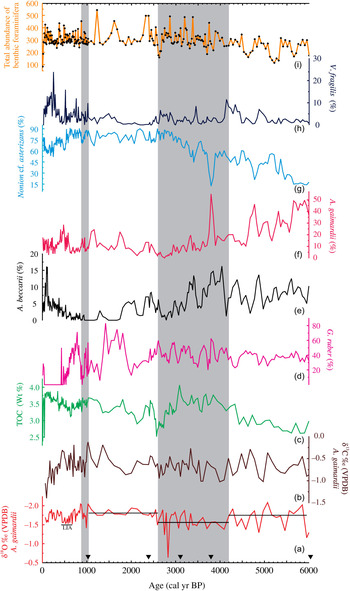
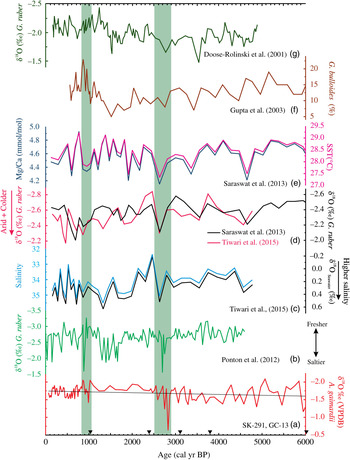
The most dominant benthic foraminiferal species in Core SK291/GC13 are Nonion cf. asterizans, Ammonia beccarii, A. gaimardii and Virgulinella fragilis (Fig. 3), each of which was selected on the basis of a population of 10% or more in any three samples analysed (Fig. 4). The planktonic foraminiferal population is marked by the highest abundances of Globigerinoides ruber, whereas other species of planktonic foraminifera are sporadic and rare. The relative abundances of selected species of benthic foraminifera and planktonic foraminifer G. ruber are plotted with TOC (wt%) and δ13C and δ18O values of Ammonia gaimardii (Fig. 4). We have also compared our dataset with proxy records from adjacent cores from the eastern and northeastern Arabian Sea and from ODP Hole 723A, western Arabian Sea, to understand regional climatic variability and its impact on the shallow Arabian Sea (Gupta et al. Reference Gupta, Anderson and Overpeck2003) (Fig. 5). The δ18O curve shows negative values with an average of −1.75‰ during ~6100 to 4200 cal yr BP, indicating a relatively fresher shallow eastern Arabian Sea. The values increase from 4200 to 2600 cal yr BP, with an average of about −1.5‰, coinciding with a cold and arid phase in the Indian subcontinent. The δ18OA. gaimardii record shows a short-lived abrupt increase from 2900 to 2600 cal yr BP, which has also been observed in the proxy records from the adjacent cores (Figs 4, 5). The oxygen isotope values show a modest decrease from ~2600 to 1000 cal yr BP, with an average value of −1.8‰ (Fig. 4a). The δ18OA. gaimardii values show a short-lived increase from ~1000 to 900 cal yr BP, coinciding with the early phase of the Medieval Climate Anomaly (MCA), followed by a short-lived decrease (Fig. 4a). During the Little Ice Age (LIA), the δ18OA. gaimardii values remained relatively higher (Fig. 4a). The record suggests that the shallow sea off the coast of Goa was marked by highly variable conditions with an overall increasing trend of nutrients (decreasing δ13C) during the last 1000 cal yr BP (Fig. 4b).
Scanning electron micrographs of Ammonia gaimardii, A. beccarii, Virgulinella fragilis, Nonion cf. asterizans used in reconstructing palaeoenvironmental conditions in Core SK291/GC13 off Goa, eastern Arabian Sea.

Proxy record from Core SK291/GC13, off Goa, eastern Arabian Sea. (a) δ18O values of benthic foraminiferal species Ammonia gaimardii (horizontal lines represent the mean value); (b) δ13C values of Ammonia gaimardii; (c) total organic carbon (TOC) values; (d) Globigerinoides ruber percentage; (e–h) percentage of benthic foraminifera Ammonia beccarii, A. gaimardii, Nonion cf. asterizans and Virgulinella fragilis, respectively; (i) total abundance of benthic foraminifera. Grey bars indicate cold intervals when shallow sea off Goa was cooler and Indian summer monsoon was weaker. Radiocarbon dated intervals are shown by inverted triangles in the bottom panel. LIA – Little Ice Age.

(a) δ18O values of benthic foraminifer Ammonia gaimardii from SK291/GC13 combined with continental and marine proxy records from the Indian Ocean region (horizontal lines represent the mean value). (b) δ18O values of Globigerinoides ruber from Core NGHP 16A, Bay of Bengal (Ponton et al. Reference Ponton, Giosan, Eglinton, Fuller, Johnson, Kumar and Collett2012). (c) δ18O of seawater and salinity records from eastern Arabian Sea Core SN-6 (Tiwari et al. Reference Tiwari, Nagoji and Ganeshram2015). (d) δ18O (‰) of Gs. ruber from eastern Arabian Sea Site SN-6 (Tiwari et al. Reference Tiwari, Nagoji and Ganeshram2015) and Core SK237-GC04 (Saraswat et al. Reference Saraswat, Lea, Nigam, Mackensen and Naik2013). (e) Gs. ruber Mg/Ca and SST (°C) record from eastern Arabian Sea Core SK237-GC04 (Saraswat et al. Reference Saraswat, Lea, Nigam, Mackensen and Naik2013). (f) Globigerina bulloides (%) from ODP Hole 723A, Oman margin (Gupta et al. Reference Gupta, Anderson and Overpeck2003). (g) δ18O (‰) of Gs. ruber from Core 39KG/56 KA, northeastern Arabian Sea (Doose-Rolinski et al. Reference Doose-Rolinski, Rogalla, Scheeder, Lückge and von Rad2001). Green colour vertical bar indicates cold events.

The TOC was higher between 4200 and 2600 cal yr BP, although the values show a variable but overall increasing trend from 6100 cal yr BP to the present (Fig. 4c). The TOC values decreased from 2800 to 2600 cal yr BP. Globigerinoides ruber shows a more secular trend from 6100 to 2000 cal yr BP, and a major increase from 2000 to 1400 and 900 to 600 cal yr BP (Fig. 4d). This species almost disappeared at ~400 cal yr BP and reappeared in the top samples. Ammonia beccarii and A. gaimardii show higher abundances in the older interval (6100–3000 cal yr BP) and again from 1000 cal yr BP to the present (Fig. 4e, f). Nonion cf. asterizans, in general, shows close parallelism with TOC values and an increasing trend from 6100 to 3000 cal yr BP. Nonion cf. asterizans and TOC values show opposite trends from 3000 to 1000 cal yr BP. Nonion cf. asterizans abundances decreased over the last 500 years (Fig. 4g). Ammonia beccarii and Nonion cf. asterizans show more or less opposite trends during the studied interval (Fig. 4). Virgulinella fragilis indicates low populations with secular variations from 6100 to 1000 cal yr BP (Fig. 4h). This species shows abrupt changes over the past 1000 years (Fig. 4h). The total abundance of benthic foraminifera increases from 4100 to 2700 cal yr BP, with a relatively stable trend from 1000 to 100 cal yr BP (Fig. 4i).
4. Discussion
Coastal environments along the western continental margin of India are highly variable owing to their vulnerability to continental and oceanic climatic changes. These environments experience abrupt changes in the wind and wave energy levels and mixing of freshwaters in the surface ocean. The life in such environments is also distinct from the deep sea. Centennial- to millennial-scale changes in the coastal environments of India are driven by the Indian monsoon system and resultant coastal surface currents. These monsoon-driven currents impact benthic foraminifera and occasionally planktonic foraminifera since the latter do not prefer coastal waters. Benthic foraminifera have been widely used in palaeoenvironmental reconstructions during the Neogene Period as well as in the most recent epoch, the Holocene. The structure and composition of benthic foraminifera are influenced by numerous environmental factors including temperature, salinity, sediment properties and bottom flow of the sea water. Living benthic foraminiferal communities have been found to be related to the flux of particulate organic matter to the sea floor (Lutze & Coulbourn, Reference Lutze and Coulbourn1984; Loubere & Fariduddin, Reference Loubere, Fariduddin and Sen Gupta1999), the oxygen content of ambient bottom waters (Hermelin, Reference Hermelin, Summerhayes, Prell and Emeis1992; Bernhard & Sen Gupta, Reference Bernhard, Sen Gupta and Sen Gupta1999) and energy levels (Hess & Kuhnt, Reference Hess and Kuhnt1996; Stott et al. Reference Stott, Hayden and Griffith1996). Water turbulence in shallow seas also has a great impact on benthic foraminiferal assemblages. Thus, palaeoenvironmental studies based on benthic foraminifera in coastal sediments may offer an opportunity to study both past continental and marine climate conditions. Changes in foraminiferal δ18O are mainly controlled by continental ice volume or freshwater input, glacial–interglacial cycles, as well as local sea surface temperature (SST) and evaporation–precipitation (E-P) changes (Shackleton, Reference Shackleton1967; Imbrie et al. Reference Imbrie, Hays, Martinson, McIntyre, Mix, Morley, Pisias, Prell, Shackleton, Berger, Imbrie, Hays, Kukla and Saltzman1984; Doose-Rolinski et al. Reference Doose-Rolinski, Rogalla, Scheeder, Lückge and von Rad2001).
The ecological preferences of shallow-sea benthic foraminifera indicate varied living conditions owing to variable surface ocean energy levels and salinity as well as food supply in the shallow sea. Except for Ammonia beccarii, not much is known about the ecological preferences of the species used in this study. Ammonia beccarii is a common cosmopolitan, euryhaline species living in littoral and neritic environments (Debenay et al. Reference Debenay, Bénéteau, Zhang, Stouff, Geslin, Redois and Fernandez-Gonzalez1998). This species has been widely used in environmental reconstructions and geological studies because of its higher abundance in neritic sediments, wide geographic distribution and long stratigraphic range since Miocene time (Debenay et al. Reference Debenay, Bénéteau, Zhang, Stouff, Geslin, Redois and Fernandez-Gonzalez1998). Ammonia beccarii can be epipelic or endopelic in coarser sands, but can also be epiphytic during spring and summer (Debenay et al. Reference Debenay, Bénéteau, Zhang, Stouff, Geslin, Redois and Fernandez-Gonzalez1998). The high abundances of A. beccarii are indicative of a shallow-marine environment with a sandy bottom (Sgarrella & Moncharmont Zei, Reference Sgarrella and Moncharmont Zei1993). Living A. beccarii were also reported on the rocky shore of the Mediterranean and Atlantic coasts of France (Le Campion, Reference Le Campion1968; Vénec-Peyré & Le Calvez, Reference Vénec-Peyré and Le Calvez1981) and rocky shore of Japan (Kitazato, Reference Kitazato1988). A strict interpretation based on the known modern distribution of A. beccarii would confine the species to upper shoreface environments (Hayward et al. Reference Hayward, Holzmann, Grenfell, Pawlowski and Triggs2004). Debenay et al. (Reference Debenay, Bénéteau, Zhang, Stouff, Geslin, Redois and Fernandez-Gonzalez1998) proposed that the seasonal variability in microhabitat preference of A. beccarii is a function of food availability, as the surface of seagrass growing in the intertidal zone can be densely covered by diatoms, fungi and bacteria that constitute a valuable food source for foraminifera. Based on these earlier studies, A. gaimardii is inferred to indicate oligotrophic conditions, preferring better oxygenated environments. Ammonia gaimardii has been reported from the inner sub-littoral zone under the influence of the Kuroshio Current in the Japan Sea, preferring higher salinities and living under the influence of warm-water sources such as the Tsushima Warm Current (Akimoto & Hasegawa, Reference Akimoto and Hasegawa1989; Inoue, Reference Inoue1989; Takata et al. Reference Takata, Khim, Cheong, Shin, Takayasu, Park and Lim2016).
Virgulinella fragilis can tolerate more severe oxygen deficiencies and adjust to long periods of low-oxygen conditions in coastal lagoon environments, as well as in pelagic to hemi-pelagic settings (Takata et al. Reference Takata, Seto, Sakai, Tanaka and Takayasu2005). Ammonia beccarii abundance varies, possibly due to climate, temperature and salinity (Poag, Reference Poag1978) or to food availability, feeding strategy, oxygen concentration and/or a change in the sediment type (Jorissen, Reference Jorissen1988). In this study, A. beccarii shows a high percentage from 6100 to 2600 cal yr BP. A significant shift (increase) of A. beccarii in the younger interval (around 100 years) association and an extreme drop in TOC values all indicate decreased productivity and unfavourable neritic environmental conditions (Fig. 4c, e).
Nonion cf. asterizans has been observed associated with a high-productivity assemblage in conditions of comparatively low benthic oxygen respiration on the shelf in the Gulf of Cadiz and Gulf of Guinea (Schönfeld, Reference Schönfeld2002; Altenbach et al. Reference Altenbach, Lutze, Schiebel and Schönfeld2003). In the Gulf of Cadiz, this species is reported in association with A. beccarii and a shelf edge assemblage (Schönfeld, Reference Schönfeld2002), whereas in the Gulf of Guinea, higher abundances of N. asterizans have been observed in areas of coarse-grained sediments and higher organic carbon content (Altenbach et al. Reference Altenbach, Lutze, Schiebel and Schönfeld2003). Nonion cf. asterizans shows an increasing percentage and A. gaimardii a decreasing percentage from 6000 to 1000 cal yr BP, indicating high primary productivity in the shallow sea (Fig. 4f, g). Ammonia beccarii and V. fragilis show an increasing abundance trend (Fig. 4e, h), and G. ruber, A. gaimardii and Nonion cf. asterizans show a decreasing trend from 1000 to 100 cal yr BP (Fig. 4d, f, g). This period is marked by moderate oxygen levels in the studied core. The genus Fursenkoina is an infaunal taxon that feeds on phytodetritus (Gooday, Reference Gooday1993; Schumacher et al. Reference Schumacher, Jorissen, Dissard, Larkin and Gooday2007) and is considered a high-productivity and low-oxygen content indicator (Leutenegger & Hansen, Reference Leutenegger and Hansen1979). The elongate, cylindrical forms, in general, prefer a moderately infaunal habitat tolerant of lower oxygen conditions (Gupta, Reference Gupta1993).
Our data from Core SK291/GC13 show a close parallelism between N. cf. asterizans abundances and TOC values, indicating a general increase in organic flux in the study core from 6100 to 3000 cal yr BP (Fig. 4). The δ18OA. gaimardii data suggest decreasing salinity and/or a warm shallow eastern Arabian Sea between 6100 and 4600, or perhaps to 4200 cal yr BP (Fig. 4a). This was an interval of wet conditions in South Asia as well as SW China owing to intense Indian and southwest monsoons (Gupta et al. Reference Gupta, Anderson and Overpeck2003; Zhang et al. Reference Zhang, Zhao, Xue, Liu, Yu, Chen and Shen2017). The study core SK291/GC13 experienced relatively colder conditions from ~4200 to 2600 cal yr BP, contemporaneous with lower SSTs in the northeastern Arabian Sea than the present day (Doose-Rolinski et al. Reference Doose-Rolinski, Rogalla, Scheeder, Lückge and von Rad2001) and an arid (or colder) phase in the Indian subcontinent (Staubwasser et al. Reference Staubwasser, Sirocko, Grootes and Segl2003; Dixit et al. Reference Dixit, Hodell and Petrie2014; Dutt et al. Reference Dutt, Gupta, Wünnemann and Yan2018). During the interval between ~2900–2500 and ~1000 cal yr BP the sea-level was higher in the northern Arabian Sea, whereas the eastern Arabian Sea experienced arid and cold conditions. Reef records from the Maldives show a sea-level highstand in the Central Indian Ocean from 4000 to 2100 cal yr BP (Kench et al. Reference Kench, Smithers, McLean and Nichol2009). Our data from Core SK291/GC13 show cooling from 4000 to 2100 cal yr BP when the sea-level was relatively higher (Kench et al. Reference Kench, Smithers, McLean and Nichol2009), indicating that it was a local phenomenon.
The TOC was higher and δ13CA. gaimardii values were relatively negative (average value of −0.71‰) from ~4200 to 3000 cal yr BP in the study core, indicating a more productive shallow sea (Fig. 4b, c). At the same time, a higher abundance of benthic foraminifera (Fig. 4i) and higher values of δ18OA. gaimardii indicate favourable environmental conditions for the benthic foraminiferal population off the coast of Goa. The TOC values decreased from 3100 to 2500 cal yr BP and thereafter show a continuous increase in Core SK291/GC13 (Fig. 4). The interval ~2900–2600 cal yr BP is marked by abrupt cold events, as has also been observed in the northeastern Arabian Sea, off Pakistan (Doose-Rolinski et al. Reference Doose-Rolinski, Rogalla, Scheeder, Lückge and von Rad2001; Ponton et al. Reference Ponton, Giosan, Eglinton, Fuller, Johnson, Kumar and Collett2012). The surface salinities increased (Tiwari et al. Reference Tiwari, Nagoji and Ganeshram2015) and SST decreased by 1 °C in the eastern Arabian Sea during this time (Fig. 5; Saraswat et al. Reference Saraswat, Lea, Nigam, Mackensen and Naik2013; Tiwari et al. Reference Tiwari, Nagoji and Ganeshram2015). Continental proxy records show a dry phase in the East Asian monsoon during this time (Wang et al. Reference Wang, Cheng, Edwards, He, Kong, An, Wu, Kelly, Dykoski and Li2005; Hu et al. Reference Hu, Henderson, Huang, Xie, Sun and Johnson2008). The significant short-term changes in the SST between ~2800 and 1000 cal yr BP might be linked to the cooling of northern latitudes as well as global cooling effects.
Core SK291/GC13 witnessed a short-lived pronounced cooling event during 1000 to 900 cal yr BP within the MCA. During the LIA, the shallow sea off Goa was cooler when the N. cf. asterizans population shows a gradual decrease. During the last 1000 years, the Goa coast, in general, was productive but marked by more frequent changes in both temperature and organic carbon fluxes (Fig. 4). The G. ruber population witnessed abrupt changes during the last 2000 years in contrast to the benthic foraminifera, suggesting that the conditions in surface and subsurface waters of the shallow eastern Arabian Sea were different during this time (Fig. 4). G. ruber shows a near absence during the last 400 years owing to seasonal variation affecting its survival (Fig. 4). Recently, the record based on sediment trap data by Jonkers & Kučera (Reference Jonkers and Kučera2015) revealed that the seasonality of individual planktonic foraminifera is predominantly related to the timing of primary productivity or temperature. The warm-water species G. ruber exhibits moderately uniform annual fluctuation patterns with less of a seasonal peak in the tropical–subtropical areas of the ocean basins (Jonkers & Kučera, Reference Jonkers and Kučera2015). Even this species, however, displays vertical habitat variability, and its seasonal occurrence outside the tropics is limited to the warm surface layer that grows at the end of the warm season. Numerous studies have exhibited that the seasonality of temperate and cold-water planktonic foraminifer species is closely tied to phytoplankton bloom events that are principal to an increased food supply (e.g. Northcote & Neil, Reference Northcote and Neil2005; Storz et al. Reference Storz, Schulz, Waniek, Schulz-Bull and Kučera2009; Jonkers & Kučera, Reference Jonkers and Kučera2015).
The oxygen isotopic composition (δ18O) is strongly affected by salinity in the shallow sea area. The δ18O isotopic composition of sea surface water and its relationship to salinity are directly controlled by the hydrological processes, such as runoff, evaporation and precipitation, advection/upwelling and diffusion (Rohling, Reference Rohling2007). The salinity versus δ18O relationship in the northern Indian Ocean is highly sensitive to monsoon overflow as suggested by Singh et al. (Reference Singh, Jani and Ramesh2010). The difference in the salinity and δ18O in the eastern Arabian Sea is mainly directed by the southwest monsoon runoff from the Western Ghats (Deshpande et al. Reference Deshpande, Muraleedharan, Singh, Kumar, Rao, Dave, Sivakumar and Gupta2013). In the month of June to September, the summer monsoon current (flowing eastward) transports the high-salinity water from the Arabian Sea to the Bay of Bengal (Kumar & Prasad, Reference Kumar and Prasad1999). Throughout the summer monsoon, the Bay of Bengal receives freshwater runoff from the Ganga–Brahmaputra rivers and through rainfall. During the winter (October to February), the low-salinity water is carried from the Bay of Bengal to the eastern Arabian Sea by the winter monsoon current mainly driven by the northeasterly wind system. A study by Kumar & Ramesh (Reference Kumar and Ramesh2016) investigated the δ18O–salinity relationship in the eastern Arabian Sea, dividing it into four major regions, three of which fall under the impact of the WICCs and one under the result of the winter monsoon current.
5. Conclusions
We conclude that the western continental margin of India witnessed highly variable climatic and surface oceanic conditions during middle and late Holocene times, mainly driven by changes in monsoonal wind and rainfall intensity since 6100 cal yr BP. We further conclude that the shallow sea off the Goa coast, the eastern Arabian Sea, witnessed pronounced changes in SST, salinity and organic productivity as observed along the Pakistan Margin, northeastern Arabian Sea. During the period ~4200 to 2600 cal yr BP we observe lower SSTs in the eastern Arabian Sea than the present day, suggesting that the eastern Arabian Sea experienced relatively colder conditions. The low-salinity values signify that the summer monsoon weakened and perhaps the winter monsoon intensified. The interval ~2900–2600 cal yr BP is characterized by abrupt cold events, as has also been observed in the northeastern Arabian Sea. A short-lived pronounced cooling event is observed from 1000 to 900 cal yr BP within the MCA, coinciding with cooling of the northern hemisphere. These changes were captured by shallow-marine benthic foraminifera and the isotopic fingerprint. The higher salinities are associated with higher SSTs and high rates of evaporation when the Indian summer monsoon was stronger and wind intensity increased.
Acknowledgements
AKG and PS acknowledge financial support from the Ministry of Earth Sciences, Government of India (sanction number MoES/16/49/09/RDEAS) and a J.C. Bose Fellowship (SR/S2/JCB-80/2011). AKG thanks the Department of Science and Technology, New Delhi for a J.C. Bose Fellowship. PS and HZ acknowledge the financial support from the National Basic Research Program of China under grant (No. 2015CB953800) supported by 973 Program. The Department of Geology and Geophysics, IIT Kharagpur and Wadia Institute of Himalayan Geology, Dehradun are acknowledged for analytical facilities. The study samples were procured under NCAOR 291th ORV Sagar Kanya cruise by AKG.