INTRODUCTION
The problem of where to die is one of the most bothersome and difficult questions that has been increasingly discussed in recent years. Indeed, rather than an issue of location or site, place of death has turned into a basic psychosocial indicator of end-of-life quality for the terminally ill (Houttekier et al., Reference Houttekier, Cohen and Bilsen2010). As in many cases, the answer depends on whom you ask. The majority of patients (at least 70%) prefer to die at home. This holds for many countries, ranging from the European states to Japan (Higginson & Sen-Gupta, Reference Higginson and Sen-Gupta2000; Higginson et al., Reference Higginson, Astin and Dolan1998; Wilkinson, Reference Wilkinson2000). A population survey in South Australia with 2652 participants above the age of 15 showed that the majority of respondents (70%) in all sociodemographic categories preferred to die at home, as compared to lower percentages that preferred a hospital (19%), a hospice (10%), or a nursing home (<1%) (Foreman et al., Reference Foreman, Hunt and Luke2006). In Japan, nearly 90% of terminally ill patients stated a preference to die at home (Tang, Reference Tang2003). The reported percentages are based both on studies in which patients were questioned early in the disease and on longitudinal studies in which they were questioned throughout their illness (Hinton, Reference Hinton1994; Storey et al., Reference Storey, Pemberton and Howard2003). The preference of most patients to die at home reflects a view that the home is an environment providing a feeling of safety, proximity to loved ones, and the possibility of living a somewhat normal life, in short, of “being at home” (Gott et al., Reference Gott, Seymour and Bellamy2004; Murray et al., Reference Murray, O'Connor and Fiset2003).
Predictors of preferred home death include younger age, male, born in the United Kingdom/Ireland or Italy/Greece, better physical health, poorer mental health, and fewer concerns about dying at home (Foreman et al., Reference Foreman, Hunt and Luke2006). In Japan, the predictors include considerations of quality of life, of availability and ability of family caregivers, of being a burden to others, and relationships with healthcare providers (Tang, Reference Tang2003). A study with an Israeli sample of 171 patients showed that those who preferred to die at home were predominantly women who had breast cancer and patients 50–59 years old with few mobility problems (Gilbar & Steiner, Reference Gilbar and Steiner1996).
But the reality is that many patients die elsewhere, namely, not in the location of their choice. Thus, in South Australia in the years 2000–2002, only 14% died at home (Foreman et al., Reference Foreman, Hunt and Luke2006). An examination of 18,078 death certificates for 1995–2005 in Ireland showed that only 29% died at home, as compared to 53% who died in hospitals, 12% in hospices, and 4% in nursing homes (Sharp et al., Reference Sharp, Foll and Deady2010). In the United Kingdom, only 25% were found to have died at home (Marie Curie Cancer Care, 2004), while more than 50% died in hospital, 20% in care homes, and 4% in specialist palliative care units (Higginson et al., Reference Higginson, Astin and Dolan1998; Marie Curie Cancer Care, 2004). In a small sample of 44 Israeli patients, 54% died at home (Arad et al., Reference Arad, Geva and Rosin1999).
In view of this discrepancy between the preferred and actual place of dying, it is of great importance to investigate the factors that determine whether a patient who prefers to will die at home (Wheatley & Baker, Reference Wheatley and Baker2007). There is only limited information about this issue. Alsirafy et al. (Reference Alsirafy, Mesidy and Abou-Elela2010) found that in Egypt patients who were visited by a palliative care physician at home were significantly more likely to die at home compared to others (92 vs. 64%).
In the Netherlands and England, countries known to have high standards of palliative care and symptom control, patients living in cities were less likely to die at home than the rural terminally ill. A lower degree of social support could contribute to partially explaining this metropolitan/nonmetropolitan discrepancy (Houttekier et al., Reference Houttekier, Cohen and Bilsen2010).
A review based on 58 carefully selected studies (1966–2004) involving more than 1.5 million patients (>80% of whom had cancer) from 13 countries identified 17 factors affecting place of death (Gomes & Higginson, Reference Gomes and Higginson2006). Six factors were strongly related to death at home: patient's low functional status, patient's preference, existence of home care, intensity of home care, living with relatives, and extended family support. Of the three major classes of variables they tested—illness factors, individual factors, and environmental factors—the largest effect was found for patients living in cities. In spite of provided home healthcare, they were less likely to die at home than nonmetropolitan terminal patients.
OBJECTIVE AND HYPOTHESIS
The present study was designed to examine the factors that determine the issue of where a person actually dies. In view of the literature survey, we focused at this stage on three sets of variables: demographic, medical, and sociological. This retrospective nonrandomized study was designed for patients with advanced disease close to the end of life. The principal aim was to investigate the desire of patients to continue treatment at home and the ability of the family to care for and support them. Thus, the study focused on the patient's sociopsychological environment and not on medical variables. Medical variables were not included in the objectives of the study.
The hypothesis was that factors of all three sets would be found to contribute to determining where a person dies.
METHODS
Participants
The total number of participants was 326. These included all patients who died during the period 2000–2008 and had been treated by the palliative care unit at the Barzilai Hospital in Ashqelon. The age range of participants was 30 to 89, with a mean of 63.25, and a mode (35.9%) at 60–69 years. Participants included 49.5% men and 50.2% women, 49% married and 50.2% nonmarried individuals (i.e., widowed or separated), and 79.6% with European (Ashkenazi) ethnic background and 19.5% with non-Ashkenazi background (i.e., North African, Middle Eastern, Iran). Almost 40% of patients had lived in Israel for a period of 5 to 10 years, 20% for more than 10 years, 30% for 1–5 years, and 3% for 1 year or less. All participants were cancer patients with varied diagnoses: gastrointestinal cancer (36.2%), lung cancer (21.3%), breast cancer (14%), and gynecological cancer (8.2%), and others.
Dying at home was defined as having spent most of the time after the end of active treatment at home, even though there may have been some brief hospitalizations, even prior to death itself. The number of those who died at home was 216 (65.7%) and at the hospital 110 (33.4%). Actually, the group of those who died at home included 61.57% of patients whose last 48 hours were spent in the hospital. Among those who died in a hospital, 34.54% died in an oncology ward or hospice and the rest in a general hospital.
Only agonized or unconscious patients who were hospitalized in internal therapy departments for the final 48 hours or less prior to their death were considered as subjects who had died at home. They were usually transferred to the hospital because their family members were afraid to care for an agonizing patient at home, or were not sure that home care was right and satisfying for a patient in such a state. This information is highly reliable because it is based on the reports of the institutional social workers who provide sociopsychological support to families in bereavement. One of the major issues under discussion subsequent to a patient's death is the family's decisions during the last days and hours of life.
In the Barzilai Oncology Institute, in which the study was performed, each patient in the phase of palliative chemotherapy and radiotherapy receives consultation and support through the social work services. This includes help in organizing hospitalization for shorter or longer periods, maintaining liaison with the medical community services and with the general community services, and providing help in decision-making and psychological support to the patient and the family. A social worker visits the patient at home according to the needs of patient and family. Contact with patients begins when they are still in the hospital getting curative treatment, and continues after the patient's death in providing help to the bereaved family.
COLLECTION OF DATA
The material was extracted from patient files (with their consent) posthumously by the social workers in the hospital.
The variables in the study were from three major categories: demographic, medical, and sociological:
Demographic variables: age, gender, marital status, ethnic background, number of years in Israel from immigration to death
Medical variables: age at diagnosis, diagnosis, kind of last treatment (e.g., chemotherapy, hormonal therapy, radiotherapy), patient receiving nursing care, patient obtaining care of social worker, patient receiving care of a psychologist, family having the care of a social worker, and patient having a special caregiver
Sociological variables: having insurance, having worked in Israel, living alone or with family, living with one's children, living in a house/apartment that one owned or rented, family members working
RESULTS
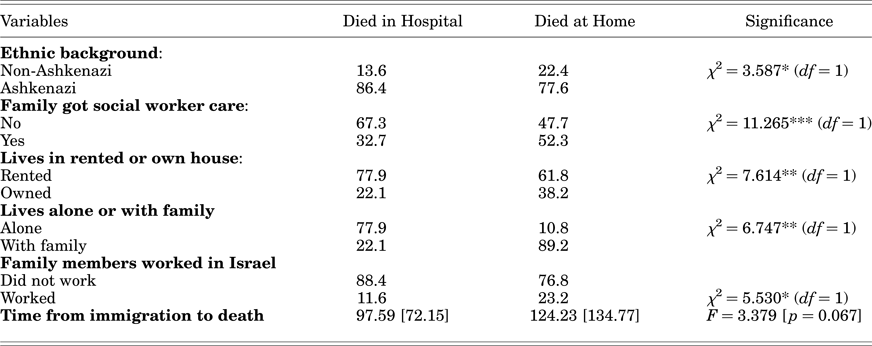
The first step in the analysis of findings consisted in examining each of the above-listed study variables with regard to place of death (home vs. hospital). The analysis was done mostly by using the nonparametric chi-square test. Table 1 presents the significant results of these analyses, which demonstrates that only a relatively small number of the examined variables yielded significant results in the comparison of those who died in the hospital and those who died at home. These findings indicate that the chances of dying at home are higher if the patient has a non-Ashkenazi background, if the family got social worker care, if the patient lived in a house owned by him or her and not rented, if the patient lived with his family, if family members worked, and if the patient's stay in Israel since immigration was longer.
Variables that yielded significant results for comparison of patients who died in hospital and those who died at home

Note: Numbers in the first five rows are percentages; those in the last row are months.
*p < 0.05, **p < 0.01, ***p < 0.001.
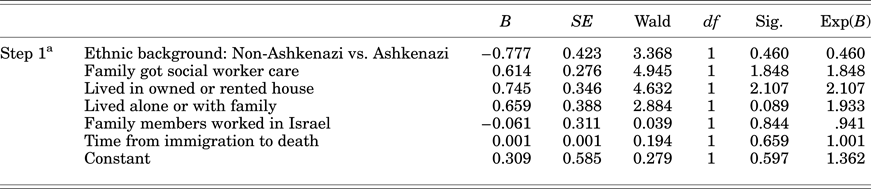
In the second step, all the variables that produced significant results (see Table 1) were used in a logistic regression (Table 2), which shows that, though none of the six variables introduced as predictors had a significant contribution, all six predictors together yielded a significant model (χ2 = 22.06, df = 6, p < 0.001) and that the total variance explained by all these variables amounts to 10.9% (Nagelkerke R 2 = 0.109, –2 log-likelihood = 318.128). The B exponents of the logistic regression show that social worker care for the family, living in a self-owned house, and living with one's family doubled the patient's chances of dying at home, whereas having an Ashkenazi ethnic background reduced the chances by almost half. However, in this context, whether one's family members worked or not and the length of one's stay in the country barely affected the chances of dying at home.
Logistic regression with dying in hospital or at home as dependent variable and the following predictors: ethnic background, social work support for family, living in owned or rented house, living alone or with family, family members working in Israel, and time since immigration
aFor step 1: χ2 = 22.061, df = 6, p < 0.001. Model summary: –2 log-likelihood = 318.128, Nagelkerke R 2 = 0.109.
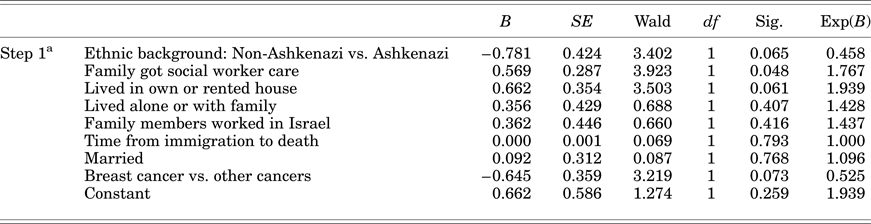
The regression analysis presented in Table 3 differs from the regression analysis in Table 2 in that two further predictors were added. These variables had in the crosstab analyses only marginal significance: being married and diagnosis (breast cancer or other cancers). The effects of these variables included: (1) being married increased the chances of dying at home and (2) having a breast cancer diagnosis decreased such chances. Of the eight variables used as predictors, only the variable of the family having social worker care had a significant effect in this context, while three others made a significant contribution in the range 0.05–0.10 (having a non-Ashkenazi background, living in a self-owned house, and having a cancer other than breast cancer). However, regardless of these results, the model as a whole was again significant: the level of significance was χ2 = 24.270, df = 8, p < 0.002—comparable to the value obtained in the logistic regression presented in Table 2. The amount of variance accounted for increased slightly (12.3%), and also the –2 log-likelihood showed an improvement of the model compared to the logistic regression in Table 1 (Nagelkerke R 2 = 0.123, –2 log-likelihood = 302.718). The B exponents of the logistic regression show that social worker care for the family and living in a self-owned house almost doubled the patient's chances of dying at home, while living with one's family and the work of one's family increased that number by about 1.5, whereas having an Ashkenazi ethnic background or a cancer other than breast cancer reduced the chances of dying at home by almost a half. However, in this context, one's marital status and the length of one's stay in the country barely affected the chances of dying at home.
Logistic regression with dying in hospital or at home as dependent variable and the following predictors: ethnic background, social work support for family, living in owned or rented house, living alone or with family, family members working in Israel, time since immigration, marital status, and diagnosis
aFor Step 1: χ2 = 24.270, df = 8, p < 0.002; Model summary: –2 log-likelihood = 302.718, Nagelkerke R2 = 0.123.
According to both logistic analyses, variables of all three sets—demographic, medical, and sociological—contribute to affecting the chances of dying at home.
DISCUSSION
Our study showed that there is a set of variables that predict whether a patient will die at home. The chances of dying at home are higher if the patient has a non-Ashkenazi background, if the family received social worker care, if the patient lived in a house owned by him or her and not rented, if the patient lived with his family, if family members worked, and if the patient's stay in Israel since immigration was longer. In addition, being married and having a diagnosis other than breast cancer contributed positively to the chances of dying at home.
The importance of non-Ashkenazi background seems to be based on two factors. One may be that Ashkenazi patients do not expect to die at home. Most of the Ashkenazi in our study immigrated from previously Soviet-influenced countries, where the habit and general procedure was to be hospitalized and to die in hospital. A further factor may be the tendency of non-Ashkenazi families to keep patients within the framework of the family as much as possible.
The importance of owning an apartment becomes apparent if one considers cultural differences in the mentality of the population under study. Our investigation focused on a multicultural Jewish population, born mainly in Europe, and mainly consisting of new immigrants from the former Soviet Union, and being in general of Ashkenazi origin. For individuals of these groups, owning a home or an apartment is to be the landlord of one's personal territory, to have security in the present and the future, in the sense of “My home-my castle.” Our patients frequently used the old Yiddish expression “At my own home even the walls take care of me” (Reich et al., Reference Reich, Signorell and Busato2013).
The length of living in a country of immigration plays a particularly important role: the longer one lives in a country, the better one can speak the language and deal with the bureaucracy.
Finally, the finding that breast cancer patients are less likely to die at home corresponds to the findings reported by others. Higginson and colleagues (Reference Higginson, Astin and Dolan1998) found that women in general and breast cancer patients in particular die at home less often than men or patients with lymphatic or hematological cancers. This may be due to socioeconomic factors. However, because of the relatively small number of patients in our study, this assumption cannot be tested. Yet, even in a study with a much larger sample, based on analyzing the pattern of care at the end of life in 2400 breast cancer patients, no definite conclusions in regard to this issue could be reached (Gagnon et al., Reference Gagnon, Mayo and Hanley2004).
The results of our study are interesting in several respects. First, the variables that proved to be predictors of site of death are of varied character. The predicting variables are partly economical (e.g., living in an owned, not a rented house), partly sociological (e.g., being non-Ashkenazi, living with one's family), and partly medical (e.g., having a diagnosis other than breast cancer). The predicting variables cover the whole range of domains that may affect a patient.
Notably, considering each separately, the predicting variables are related significantly to place of death. Thus, when they are considered together, the contributions of the separate variables add up to a total effect, resulting in a model providing an appreciable prediction of a patient's chances of dying at home.
The percentage of the variance accounted for by the model is from 10.9 to 12.3%. The dependence of the significance of this contribution on the context suggests that in applying the findings it is advisable to rely on several variables rather than on individual predictors.
Second, the results are remarkable because they conform largely to previously reported findings, especially the existence of home care and living with relatives (e.g., Gomes & Higginson, Reference Gomes and Higginson2006). In the context of palliative care, the important roles played by home care (Devlin & McIlfatrick, Reference Devlin and McIlfatrick2009) and family support (Cherny et al., Reference Cherny, Coyle and Foley1996) have often been emphasized. Both these factors contribute to integrating palliative care for the patient at home into the services rendered by the community and the hospital. This reduces any feeling of seclusion on the part of the patient and the family and increases quality of life during the final phase of life.
These conclusions are in accord with the goals of providing continued care for the patient whose medical state is deteriorating while maintaining a good professional relationship between the hospital and community services for the benefit of the patient and his or her family. It is to be hoped that the conclusions of this study will contribute to changing policy and medical procedures so as to improve the chances of dying at home for those patients who desire to do so, and thereby provide more beds for acute patients who need to be cared for in hospital.
The study has several limitations that need to be considered in further study of the issue of site of death. There are two major ones: (1) many potentially relevant variables, mainly medical ones, have not been assessed or considered and (2) the retrospective nature of the study as a whole. Further, until this or a similar study is performed in other cultural contexts or countries, there is no way to evaluate the extent to which the findings are culturally dependent.
ACKNOWLEDGMENTS
We gratefully acknowledge the Israel Cancer Association for supporting this project.