1. Introduction
A notable characteristic of the mortuary practices of post-Scythian cultures in the Minusinsk Basin of Southern Siberia was the deliberate and extended preservation of the deceased in the form of treated bodies, effigies, or dolls within the social space of the living community prior to their final interment. The implementation and development of this tradition resulted in a remarkable array of mortuary treatments, including inhumation, cremation, secondary and partial burials, complex postmortem body manipulation, and the creation of anthropomorphic effigies and dolls, as well as in the emergence of diverse burial constructions (Kuzmin Reference Kuzmin2011; Vadetskaya Reference Vadetskaya1986, Reference Vadetskaya1999).
There are only a few other regions in the ancient world that can exhibit such an extensive range of complex, multitiered funerary practices. Some traditions, particularly the systematic crafting of anthropomorphic effigies and dolls within multistage funerary rituals, have no close archaeological parallels in other regions in terms of their scale, internal diversity, and long-term continuity. This phenomenon was likely facilitated by the relative geographic isolation of the Minusinsk Basin, encircled by the Sayan and Kuznetsk Alatau mountains.
The remarkable and diverse archaeological material has sparked a range of scholarly interpretations, which are sometimes irreconcilable, regarding the evolution of post-Scythian cultures. Yet, these debates consistently focus on the Tes’ and Tashtyk traditions, their reciprocal influence, and associations with the preceding Tagar culture from the Scythian period.
During the Tes’ period, which is conventionally dated by most researchers to the 2nd century BC–2nd century AD (Gryaznov Reference Gryaznov1968; Pshenitsina Reference Pshenitsina and Gryaznov1979; Vadetskaya 1986, 101; Reference Vadetskaya1999, 66–72, 171; Savinov Reference Savinov2009, 87), the dead were interred in both monumental crypts of various constructions and in inhumation graves. The main types of graves included: burials within stone enclosures in simple pits, niches, chambers; stone boxes; under stone platforms and tower-like stone structures; in wooden constructions, as well as numerous variations and combinations thereof (Kuzmin Reference Kuzmin2011; Savinov Reference Savinov2009; Vadetskaya Reference Vadetskaya1986).
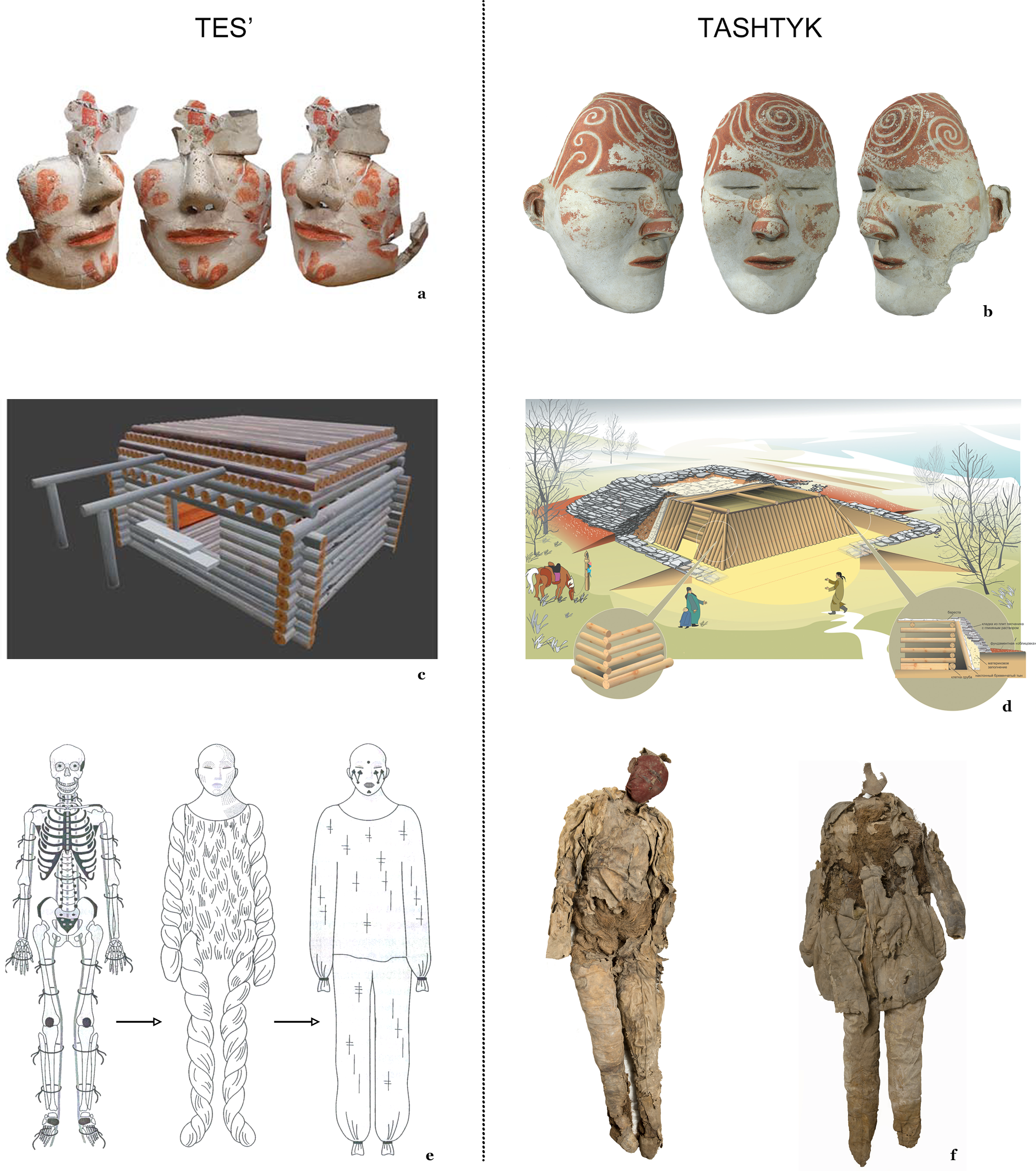
Perhaps the most significant difference between the Tes’ burial traditions and those of the preceding Tagar culture, known for its primary inhumation, was the emergence of intricate body manipulations. In the early Tes’ stage, the funerary practices involved conducting trepanations, removing internal organs, and filling the heads and bodies with plant material. Later, more elaborate rituals emerged, which included the crafting of anthropomorphic “mannequins” (Kuzmin Reference Kuzmin2011, fig. 35). Skulls underwent trepanation and were subsequently cleaned, after which they were filled with grass; soft tissues were excised from the body, and the bones were secured together using sticks and straps, occasionally with a wooden rod inserted through the vertebrae. Clay was modeled over the skull, and in some instances, it was coated with a layer of plaster to provide a more detailed representation of facial features. These plastered heads were often painted red, with female masks displaying more elaborate ornaments (Figure 1a). The “effigy,” featuring a clay-plaster head, was then clothed (Figure 1e).
Distinctive features of the Tes’ and Tashtyk burial traditions: a – a female plaster mask from the mound crypt of Skalnaya-5 (after: Bogdanov Reference Bogdanov2024, fig. 5); b – a female plaster mask from grave 4 of the Oglakhty cemetery; c – a visual reconstruction of the Skalnaya-5 crypt (after: Bogdanov and Borodovsky Reference Bogdanov and Borodovsky2025, fig. 7); d – a visual reconstruction of the Abakan-8 crypt (after: Amzarakov Reference Amzarakov2015, fig. 2); e – the reconstruction of artificial manipulations with human bodies in the manufacture of funerary effigies (after: Kuzmin Reference Kuzmin2011, fig. 35); f – life-sized funerary dolls stuffed with grass and cremated bones, from grave 4 of the Oglakhty cemetery (after: Pankova and Shirobokov Reference Pankova and Shirobokov2021, fig. 2).

Figure 1. Long description
The image consists of six elements: three photos, two illustrations, and one diagram, all side-by-side and separate. The primary focus is on the mortuary practices of post-Scythian cultures, specifically the Tes and Tashtyk traditions. Panel A shows a photo of a female plaster mask from the mound crypt of Skalnaya-5, displaying intricate details and red ochre patterns. Panel B presents a photo of another female plaster mask from grave 4 of the Oglakhty cemetery, also adorned with red ochre designs. Panel C features an illustration of a visual reconstruction of the Skalnaya-5 crypt, depicting a layered structure with wooden beams and stone supports. Panel D shows an illustration of a visual reconstruction of the Abakan-8 crypt, illustrating a thatched-roof structure with surrounding landscape elements. Panel E contains a diagram reconstructing artificial manipulations with human bodies in the manufacture of funerary effigies, showing a progression from a skeleton to a fully dressed figure. Panel F displays a photo of life-sized funerary dolls stuffed with grass and cremated bones from grave 4 of the Oglakhty cemetery, highlighting the detailed craftsmanship and materials used.
In this form, human effigies were placed and accumulated in monumental crypts, sometimes containing up to 300 individuals. In the closing ceremony, the crypts were incinerated. A notable characteristic of the Tes’ period was the inclusion of miniature or votive objects instead of real artifacts as grave goods.
The mortuary practices associated with the Tashtyk culture were equally noteworthy, as it is conventionally believed to have followed the Tes’ period at the onset of the Common Era and endured in the Minusinsk Basin for at least 500 years (Vadetskaya Reference Vadetskaya1999). The Tashtyk burials were found in both graves and collective crypts (Figure 1d). Trepanations remained a common practice, alongside secondary burials. As in the Tes’ period, clay-plaster masks were utilized, with female masks often displaying more elaborate designs. Grave goods typically comprised miniatures and votive objects rather than utilitarian artifacts once again.
Concurrently, new elements came to light. First, Tes’ effigies composed of human bones and clay heads were replaced by life-sized leather dolls stuffed with plant material and cremated human remains inside (Pankova and Shirobokov Reference Pankova and Shirobokov2021; Vadetskaya Reference Vadetskaya1999). The emergence of cremation, alongside the ongoing tradition of secondary inhumation, produced the unique phenomenon referred to as Tashtyk biritualism (Zaitceva et al. Reference Zaitceva, Vodyasov, Shirin and Slyusarenko2021). Notably, “mummies” featuring trepanned skulls and dolls were often buried together, apparently establishing collective family tombs.
Second, the diverse stone-built grave constructions from the Tes’ culture transitioned to wooden log-cabin inhumations, which became the predominant type of adult burial for the Tashtyk tradition. Additional variations of burial practices were also present: cremations in small stone boxes, partial cremations in shallow pits beneath slabs, individual cremations in simple graves under stone coverings, and other forms (Kyzlasov Reference Kyzlasov1960, 151; Mitko Reference Mitko and Derevyanko2006; Poselyanin Reference Poselyanin and Tishkin2005, Reference Poselyanin2016). Children were often buried in simple flat graves near crypts.
The Tashtyk crypts constituted another commonly practiced form of burial. In contrast to log-cabin structures, which typically featured paired or collective burials of both inhumed and/or cremated individuals, the Tashtyk crypts were primarily utilized for the collective deposition of anthropomorphic dolls filled with cremated remains (Vadetskaya Reference Vadetskaya1999).
This remarkable diversity of mortuary practices raises fundamental questions regarding the chronology and variability within the Tes’ and Tashtyk traditions. What is their absolute chronology? How do the different Tes’ burial types relate to one another? What is the calendar age of Tashtyk crypts, and how do they correlate with inhumation graves? Addressing these issues was the primary objective of our research.
One of the main challenges in understanding Tashtyk mortuary practices has been the lack of absolute chronologies for crypts. Despite the long history of their study, radiocarbon dating has seldom been employed, with the only exception being a log from a Tashtyk crypt (kurgan 8) located at the Markelov Mys II site (Slyusarenko et al. Reference Slyusarenko, Safonova, Skobelev and Mitko2017). The lack of radiocarbon data is particularly confusing given that materials from the crypts have long been instrumental in defining chronological phases of the Tashtyk culture.
It is commonly noted that archaeologists tend to have major disagreements about the chronological relationship between crypts and burial grounds. Some argued that both were built concurrently during the early Tashtyk stage, with only crypts persisting into the final phase (Kyzlasov Reference Kyzlasov1960; Gryaznov Reference Gryaznov1971). Others hold the view that Tashtyk graves were present during the 1st–4th centuries AD, whereas crypts should be assigned to a more recent period, spanning from the 5th to the 7th century AD (Ambroz Reference Ambroz1971; Azbelev Reference Azbelev, Nevinsky and Tishkin2007; Vadetskaya Reference Vadetskaya1999). E.B. Vadetskaya, a prominent advocate of this latter perspective, suggested a linear evolution of crypts, advancing from simple structures to more sophisticated monumental constructions (Vadetskaya Reference Vadetskaya1999, 80–87, 129). Similarly, P.P. Azbelev explicitly stated that it can be considered a well-established fact that Tashtyk crypts were built from the second half of the 5th century AD (Azbelev Reference Azbelev, Nevinsky and Tishkin2007). Yu.V. Teterin also asserted that there were no Tashtyk crypts that predated the 4th century AD in the Middle Yenisei basin (Teterin Reference Teterin and Piotrovsky2002, 285). By contrast, other scholars argued that the Tashtyk crypts were a direct continuation of the Tes’ architectural traditions (Kuzmin Reference Kuzmin2011: 109) and existed alongside cemeteries throughout the entire Tashtyk period (Kiselev Reference Kiselev1949).
Understanding the chronological relationship between crypts and graves is crucial for interpreting the broader post-Scythian mortuary system. Therefore, the secondary objective of our study was to produce a representative set of radiocarbon measurements for the Tashtyk crypts.
2. Materials and methods
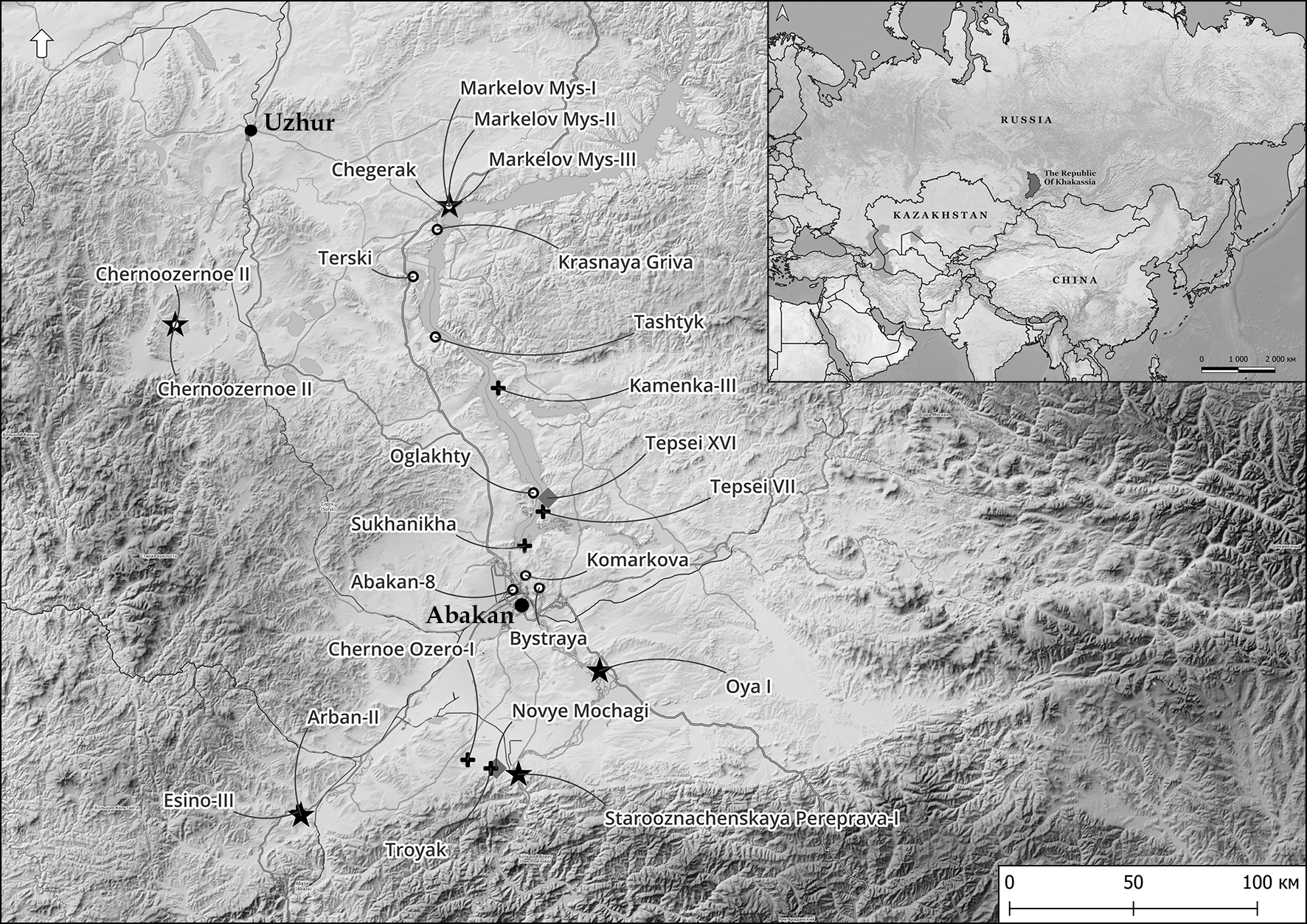
Our research involved the study of 29 burial complexes associated with the Tes’ and Tashtyk cultures, located in the Minusinsk Basin within the Middle Yenisei River basin (Figure 2). The dated materials originate from 8 complexes attributed to the Tes’ culture (six cemeteries and two crypts) and 21 complexes from the Tashtyk culture, comprising 11 burial grounds and 10 crypts.
Map of radiocarbon-dated sites from the Tes’ and Tashtyk cultures. Gray rhombuses – Tes’ crypts; black crosses – Tes’ burial grounds; black stars – Tashtyk crypts; white circles – Tashtyk burial grounds.

To investigate the cultural variability within the Tes’ and Tashtyk mortuary traditions, we analyzed a total of 168 radiocarbon dates (Supplementary S1). Of these, 62 age estimates are reported here for the first time, whereas the rest were sourced from earlier publications (Ermolova and Markov Reference Ermolova, Markov and Masson1983; Gorsdorf et al. Reference Gorsdorf, Parzinger, Nagler, Marian Scott, Alekseev and Zaitseva2004; Hall Reference Hall1999; Kuzmin Reference Kuzmin2011; Mitko Reference Mitko and Derevyanko2006; Pankova et al. Reference Pankova, Vasilyev, Dergachev and Zaitseva2010, Reference Pankova, Makarov, Simpson and Cartwright2021; Polyakov and Svyatko Reference Polyakov and Svyatko2009; Slyusarenko et al. Reference Slyusarenko, Safonova, Skobelev and Mitko2017; Svyatko et al. Reference Svyatko, Schulting, Poliakov, Ogle and Reimer2017; Tarasov et al. Reference Tarasov, Pankova, Long, Leipe, Kalinina, Panteleev, Ørsted Brandt, Kyzlasov and Wagner2022; Vadetskaya Reference Vadetskaya1999; Zaitceva et al. Reference Zaitseva, Sementsov, Lebedeva, Pankova, Vasiliev, Dergachev, Junger and Sonnin2007, Reference Zaitceva, Shirobokov, Vodyasov, Uchaneva and Kasparov2024). All radiocarbon determinations were recalibrated using a standardized procedure in OxCal v4.4, with the IntCal20 calibration curve (Reimer et al. Reference Reimer, Austin, Bard, Bayliss, Blackwell, Bronk Ramsey and Talamo2020) as a reference.
The final statistical analysis does not incorporate two previously published legacy dates. The first date (Le-3254: 2140 ± 40 BP) was obtained for grave 8 at the Terski cemetery associated with the Tashtyk culture. Calibrated ages fall within the 4th–1st centuries BC and show no chronological continuity with other radiocarbon determinations produced for that culture. The wood sample was derived from log structures and may therefore have been subject to the “old wood” effect, which in this case likely resulted in false pre-dating (Vodyasov and Zaitseva Reference Vodyasov and Zaitceva2023). Similarly, we excluded one date for wood (Le-2015: 2230 ± 40 BP) from the grave 23b, identified as belonging to the Tes’ culture, at the Troyak cemetery, which has been calibrated to the 4th–3rd centuries BC, resulting in a chronological gap of roughly 200 years from the other graves in this burial site. The inclusion of these dates (Le-3254: 2140 ± 40 BP and Le-2015: 2230 ± 40 BP) into an overlapping two-phase model (Tes’ and Tashtyk) using a general outlier model resulted in low overall agreement (A = 44.7). For these reasons, the two dates were excluded from further analysis.
Given the great diversity of burial constructions and mortuary practices in the post-Scythian period within the Middle Yenisei basin, we sought to obtain samples from a wide variety of Tes’ and Tashtyk contexts to follow the succession of different traditions. This approach enabled us, for the first time, to correlate radiocarbon dates directly with specific burial types and ritual practices.
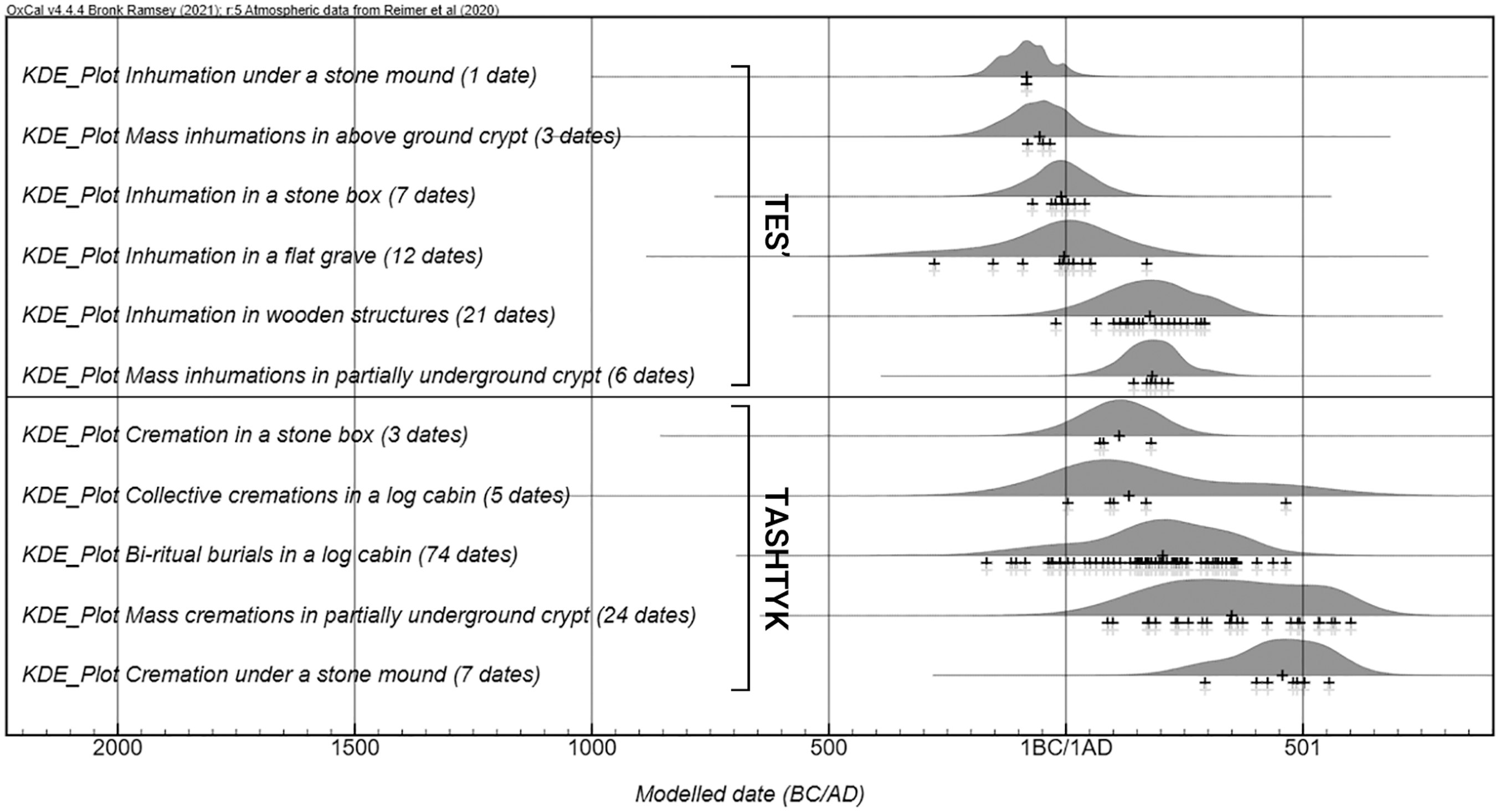
We use KDE (Kernel Density Estimate) plots (Bronk Ramsey Reference Bronk Ramsey2017) to estimate the dates available for each type and variant of burial rites (Figure 3). However, important gaps continue to be present. Certain Tes’ burial constructions—such as partial interments beneath stone ‘towers’ and in niche graves—as well as some types of Tes’ crypts are still lacking radiocarbon determinations. Similar issues are relevant in the Tashtyk contexts: for example, partial cremations in small stone boxes or simple pits lack adequate dating for reliable conclusions. Therefore, this study should be considered an initial effort to establish a more complete chronology for the Tes’–Tashtyk traditions.
KDE (kernel density estimates) Plots for the Tes’ and Tashtyk types of burial constructions and rituals. The light gray crosses show the medians of the likelihood distributions from the simulated 14C measurements and the black crosses show the medians of the marginal posterior distributions for the events from the KDE_Model analysis.

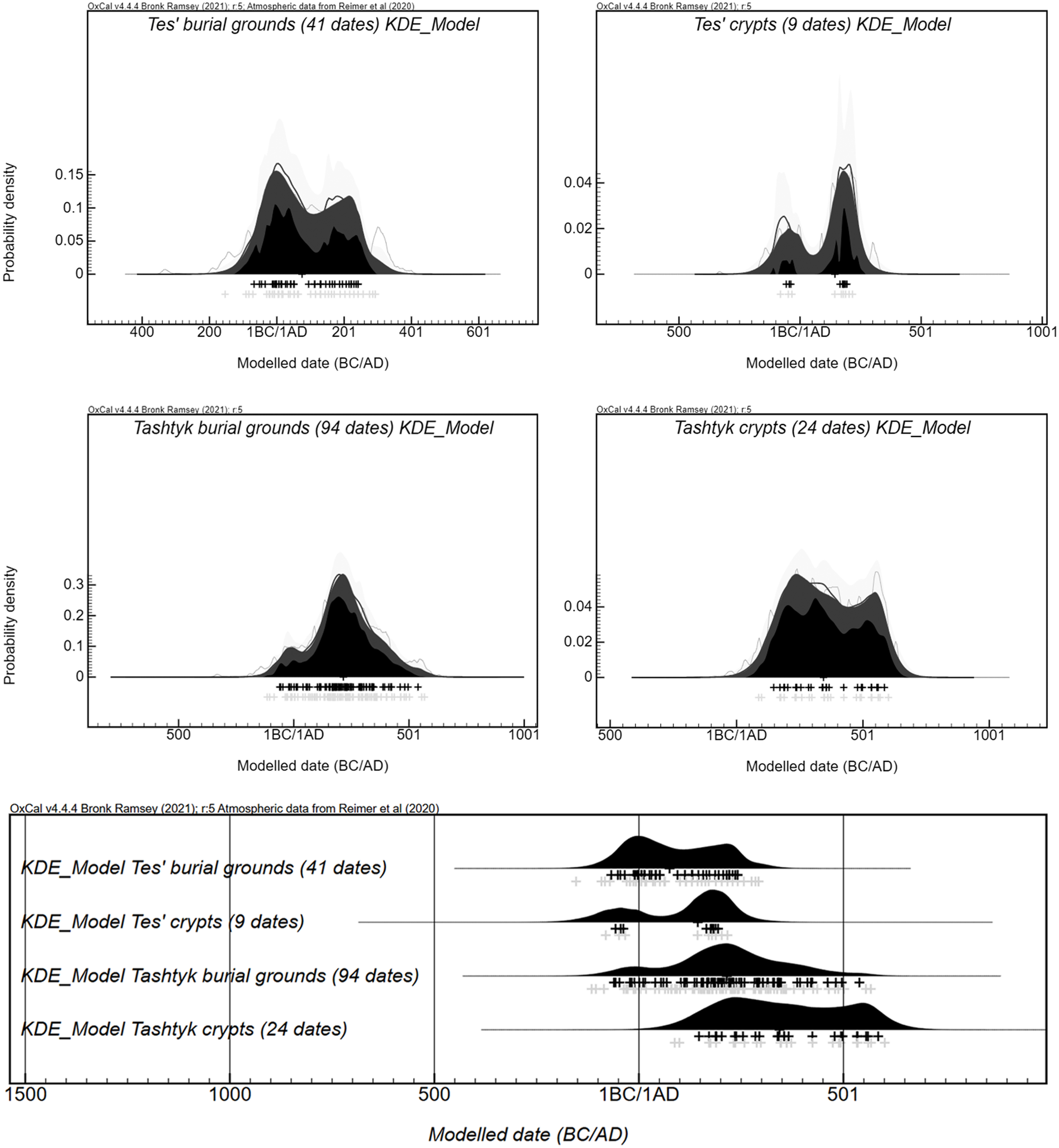
We then constructed a KDE model (A = 92.6) for Tes’ and Tashtyk flat graves and crypts in order to compare their chronological sequences (Figure 4).
KDE models for burial grounds and crypts of Tes’ and Tashtyk cultures. The features of the plot are the same as Figure 3.

Figure 4. Long description
Panel A: A probability density graph for Tes burial grounds with 41 dates. The x-axis represents modeled dates in BC/AD, ranging from 400 BC to 600 AD. The y-axis represents probability density. The graph shows two prominent peaks around 1 BC/1 AD and 201 AD. Panel B: A probability density graph for Tes crypts with 9 dates. The x-axis represents modeled dates in BC/AD, ranging from 500 BC to 1000 AD. The y-axis represents probability density. The graph shows two peaks around 1 BC/1 AD and 501 AD. Panel C: A probability density graph for Tashtyk burial grounds with 94 dates. The x-axis represents modeled dates in BC/AD, ranging from 500 BC to 1000 AD. The y-axis represents probability density. The graph shows a prominent peak around 1 BC/1 AD. Panel D: A probability density graph for Tashtyk crypts with 24 dates. The x-axis represents modeled dates in BC/AD, ranging from 500 BC to 1000 AD. The y-axis represents probability density. The graph shows two peaks around 1 BC/1 AD and 501 AD. Panel E: A combined probability density graph for all four datasets. The x-axis represents modeled dates in BC/AD, ranging from 1500 BC to 1000 AD. The y-axis represents probability density. The graph shows the overlapping probability densities for Tes burial grounds, Tes crypts, Tashtyk burial grounds, and Tashtyk crypts, with peaks around 1 BC/1 AD and 501 AD.
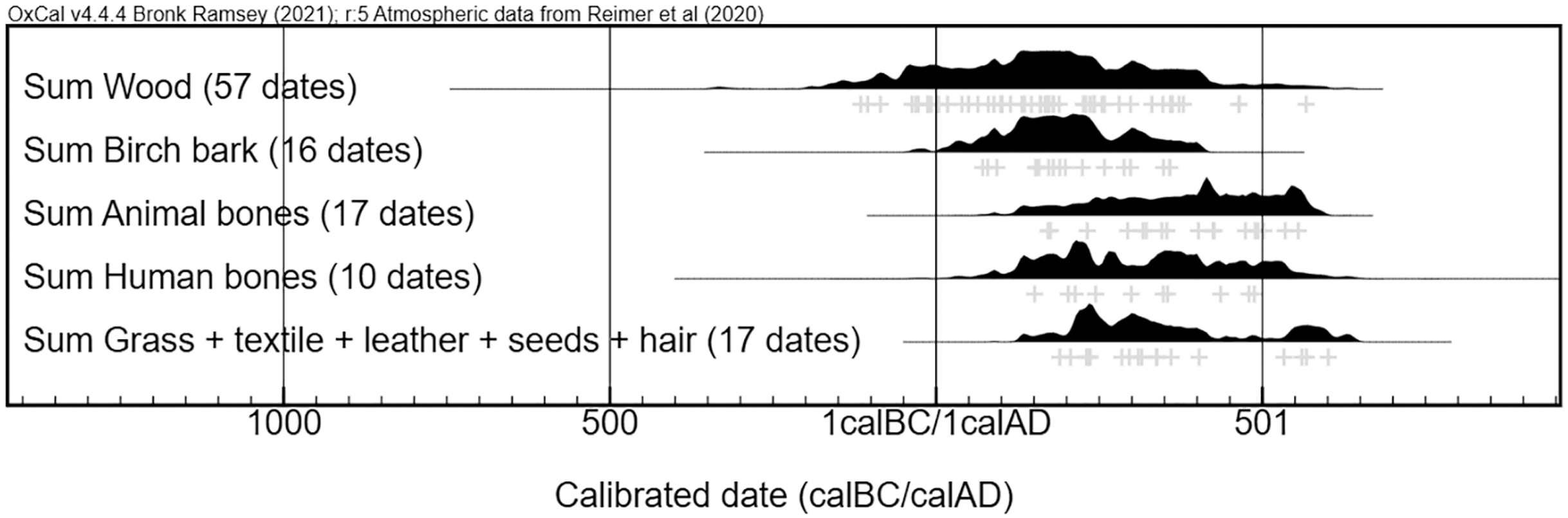
Given that the Tashtyk culture is represented by a series of 118 dates obtained from different types of material, we grouped all Tashtyk samples by material type, with a separate category for short-lived samples (grass, textiles, leather, seeds, and human hair) (Figure 5). While processing radiocarbon data, we encountered the common issue of wood samples being pre-dated relative to those obtained from other materials (Figure 5). This discrepancy is most plausibly explained by the “old wood” effect and by the secondary use of timber in grave constructions.
Summed radiocarbon dates for the Tashtyk culture, obtained from different materials. The light gray crosses show the medians of the likelihood distributions from the simulated 14C measurements.

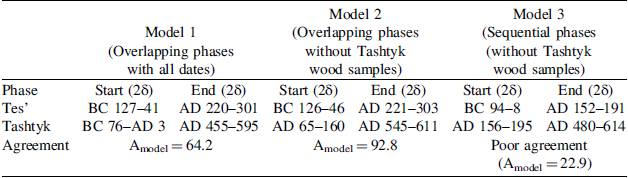
To solve the issue of the chronological relationship between Tes’ and Tashtyk cultures, we use a comparison of two types of Bayesian models (Bronk Ramsey Reference Bronk Ramsey2009) available in OxCal software: sequential and overlapping phases (adding a general outlier model in both models) (Table 1).
Results of modeling of radiocarbon dates for Tes’ and Tashtyk cultures.

Table 1. Long description
The table compares the phases of Tes and Tashtyk cultures using two types of Bayesian models: overlapping phases with all dates and overlapping phases without Tashtyk wood samples, and sequential phases without Tashtyk wood samples. The table has three rows and four columns. The columns are labeled Model 1, Model 2, and Model 3. The rows are labeled Phase, Start, and End. Row 1: Phase, Tes, Tes, Tes. Row 2: Start, BC 127-41, BC 126-46, BC 94-8. Row 3: End, AD 220-301, AD 221-303, AD 152-191. Row 4: Phase, Tashtyk, Tashtyk, Tashtyk. Row 5: Start, BC 76-AD 3, AD 65-160, AD 156-195. Row 6: End, AD 455-595, AD 545-611, AD 480-614. Row 7: Agreement, A model = 64.2, A model = 92.8, Poor agreement (A model = 22.9).
The sequence of overlapping phases (Model 1), which allows for partial overlap between the two chronological phases, showed low model agreement (A = 64.2) when all dates were used, including the earlier Tashtyk wood dates. However, the same model, after excluding the Tashtyk dates of wood samples (Model 2), produced high model agreement (A = 92.8).
We also constructed sequential phases (Model 3), which assumes that the Tashtyk phase begins after the Tes’ phase and does not chronologically overlap with it. In this case, we obtained the lowest overall model agreement (A = 22.9). Therefore, in comparing the chronologies of the two cultures, we relied on Model 2 (Table 1), in which the Tashtyk culture is represented by dates obtained from bones and short-lived materials, considered the most reliable for AMS dating.
The main issue with the available 50 Tes’ radiocarbon dates is that 40 of them were obtained from wood samples, while only 10 derive from human bone. Despite the potential “old wood” effect, we did not exclude the wood samples for the following reasons. First, Bayesian modelling including all Tes’ dates did not identify any statistical outliers and resulted in a well-agreeing model for the Tes’ phase (Amodel = 105.7). Second, in contrast to the Tashtyk dataset, the Tes’ dates obtained from wood are, on average, noticeably younger than those derived from human bone from Tes’ stone-built structures. This pattern cannot be explained by the “old wood” effect and most likely reflects the later chronological position of wooden constructions in ground graves. This is particularly evident in the case of the late Tes’ crypt Tepsey XVI and the nearby synchronous ground cemetery Tepsey VII (Supplementary S1). For this complex, 26 closely clustered radiocarbon dates obtained from wood are available, none of which were identified as statistical outliers.
Thus, excluding Tes’ wood samples from the overall analysis would prevent the reconstruction of the chronology of later wooden constructions and would also lead to incorrect conclusions regarding the chronological relationship between the Tes’ and Tashtyk cultures.
3. Results
3.1. Chronology of Tes’ sites
Analysis of previously published ages (Polyakov and Svyatko Reference Polyakov and Svyatko2009; Vodyasov and Zaitceva Reference Vodyasov and Zaitceva2023) along with new radiocarbon dates from the burial grounds of Esino-III and Chernoe Ozero-I (Supplementary S1) places the Tes’ sites within the time range between the 2nd century BC and the 3rd century AD (Figures 3 and 4). Throughout this period, collective crypts coexisted with a variety of burial grounds containing both complete and partial burials (Figure 3).
Unfortunately, only two Tes’ crypts have so far been dated by radiocarbon methods, which prevents more detailed conclusions regarding the evolution of architectural traditions. However, it is evident that the burial of effigies with clay-plaster heads was practiced both in the above-ground crypt of Novye Mochagi (1st century BC–1st century AD) and in the more recent crypt of Tepsei XVI, which is securely dated to the 2nd–3rd centuries AD (Supplementary S1).
Radiocarbon dates for different types of Tes’ burial grounds show that burials featuring stone constructions were the most common during the 2nd century BC to 1st century AD (Figure 3). Importantly, several burial practices, such as simple pits within stone enclosures, stone boxes, and burials beneath stone platforms, were practiced concurrently, sometimes even within the same cemetery. This pattern becomes particularly evident at Esino-III (Supplementary S1), where different types of burial constructions were built in proximity, forming a single ritual complex (Savinov Reference Savinov2009, 51).
In the 1st–2nd centuries AD, the tradition of burying the dead in wooden log-cabin graves emerged in the Tes’ culture (Figure 3). Importantly, this new practice persisted at the same cemeteries where earlier stone burials were situated. This continuity has been archaeologically recorded across various Tes’ sites in different regions of the Minusinsk Basin (Kuzmin Reference Kuzmin2011; Pshenitsina Reference Pshenitsina and Gryaznov1979; Savinov Reference Savinov2009). A comparison of calibrated ages for stone and wooden constructions at the cemeteries of Troyak and Tepsei-VII (Supplementary S1) demonstrates that log-cabin burials are consistently more recent than the stone structures. By the 2nd century AD, this type of burial became broadly established, and in the late Tes’ period (2nd–3rd centuries AD), stone-built graves disappear completely.
3.2. Radiocarbon chronology of the Tashtyk culture
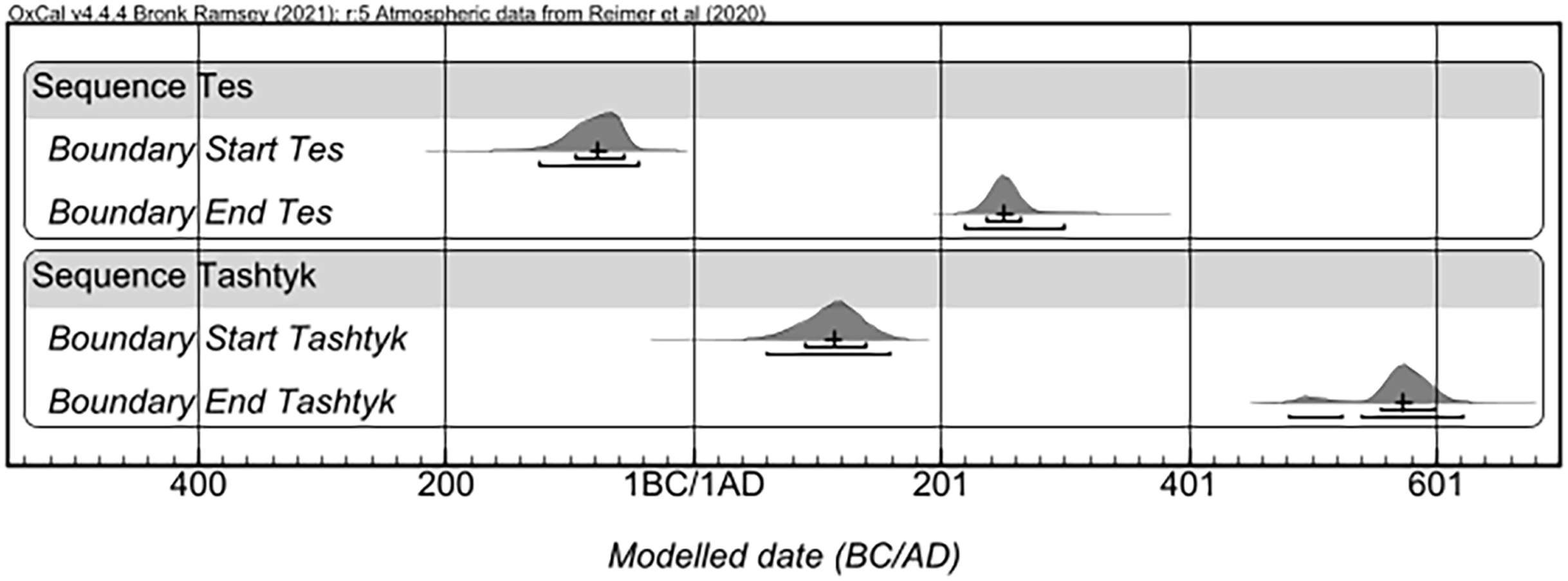
Dating of Tashtyk samples obtained from different materials showed that the earliest boundary of the Tashtyk culture is most likely placed at the turn of the 1st–2nd centuries AD (Table 1; Figures 4 and 6), whereas some wood samples appeared to be 100–200 years older due to the “old wood” effect (Figure 5).
Model 2 (with overlapping phases) for Tes’ and Tashtyk sites showing two confidence intervals (1 and 2δ) and median values (crosses). Amodel = 92.8.

Notably, the chronological ranges of the most reliable samples (grass, textile, leather, seeds, hair) fully coincide with those collected from human and animal bones. This indicates that the impact of the freshwater reservoir effect was minimal, as the Tashtyk population depended mainly on agriculture and pastoralism instead of fish consumption (Shishlina et al. Reference Shishlina, Pankova, Sevastyanov, Kuznetsova and Yu2016; Svyatko et al. Reference Svyatko, Schulting, Poliakov, Ogle and Reimer2017). Excluding excessively old age estimates produced for wood, the Tashtyk culture can be securely placed within the late 1st– 6th centuries AD (Figures 3–6).
Analysis of burial types suggests that partial cremations in stone boxes may represent some of the earliest Tashtyk rites. A particularly remarkable case is grave no. 9 of the Chernoozernoe II cemetery, where a square stone box (0.8 × 0.8 m) was found. Inside, there was a receptacle made of birch bark, shaped like a small boat, which held a human tooth (likely that of a child) along with some small burnt bones. Particularly noteworthy is the birch-bark cover, adorned with a mythical carnivore and symbols that S.G. Klyashtorny has interpreted as runic inscriptions (Gotlib Reference Gotlib, Derevyanko and Molodin2006). Two close AMS dates (GV-5286: 1953 ± 41 BP and GV-5287: 1947 ± 41 BP) allow us to date this birch bark artifact to the 1st–2nd centuries AD. This may represent the earliest known instance of runic symbols found in Southern Siberia.
Collective cremations in log cabins also appear relatively early, predating or contemporary with bi-ritual burials combining inhumation and cremation. At the large Oglakhty cemetery, collective cremations were excavated in both the Central sector (grave 0/1969) and the Western sector (grave 9/1973). For both, radiocarbon dates (a legacy LSC date for wood and a new AMS date for birch bark) converge on the 1st–2nd centuries AD. A comparable chronology can be recognized for collective cremation burials in dolls at the Tashtyk cemetery (Supplementary S1). However, the older LSC estimates obtained for wood have yielded falsely pre-dated ages (the 1st century BC–1st century AD), again reflecting the “old wood” effect. Reliable dates for this type are scarce; therefore, the suggested chronology should be approached with caution.
In the following period, the Tashtyk burial grounds are dominated by bi-ritual log-cabin burials that include trepanned “mummies” and “dolls” containing cremated remains (Oglakhty, Krasnaya Griva, Abakan-8, Bystraya, Chegerak), which most likely dated back to the 2nd–4th centuries AD (Figures 3 and 4). Around the 4th–5th centuries AD, mortuary practices changed: bi-ritual log-cabin burials were replaced by single cremations under stone coverings. According to new radiocarbon dates from the Markelov Mys II cemetery (graves 91, 92, 96, 127, 154), these practices persisted into the 5th–6th centuries AD (Figure 3). L.R. Kyzlasov (Reference Kyzlasov1960) referred to this as the “Kameshkovsky stage.” At this stage, each grave contained the remains of only one cremated individual, with no evidence of inhumation. Besides, such burials are notable for the lack of plaster masks, along with the vanishing of miniature and votive items that were common in earlier periods (Mitko Reference Mitko and Derevyanko2006).
A key result of this research is the first radiocarbon evidence that reveals the contemporaneous presence of the Tashtyk crypts and burial grounds during the late 1st–6th centuries AD, which encompasses the entire Tashtyk era (Figure 4).
Dendrochronological dating that was conducted earlier on wood from the Crypt 8 of the Markelov Mys II cemetery and from the nearby Tashtyk burial ground of Chegerak, located about 500 m away, established their synchronicity within the 3rd–4th centuries AD (Slyusarenko et al. Reference Slyusarenko, Safonova, Skobelev and Mitko2017). The radiocarbon data we have recently obtained for Crypts 4 and 5 of the same Markelov Mys II site confirms this chronological attribution (Supplementary S1). Furthermore, the dates produced for the burial chamber of Crypt 34 at the Markelov Mys I and for the adjacent eponymous cemetery likewise indicate the coexistence of the crypt and the burial ground during the 1st–3rd centuries AD. Therefore, the prior assumption suggesting that the Tashtyk crypts dates to the 5th–6th centuries AD is no longer tenable. New data supports N.Yu. Kuzmin’s hypothesis (2011, 109) that the Tashtyk crypts directly continued the Tes’ architectural traditions.
Another important outcome is the evidence that the Tashtyk crypts functioned for extended periods, sometimes spanning centuries. For example, based on the date of the annual rings of the logs from the Arban II crypt (GV-5372: 1686 ± 33 BP), considering the age of the tree, it can be concluded that the crypt chamber was built roughly within cal AD 296–476 (2σ), whereas two close dates from a seed found in the same crypt (GV-5295a, GV-5295b) have yielded a combined age of cal AD 547–640 (2σ). This suggests that the crypt, which contained around 70 cremated remains (Vadetskaya Reference Vadetskaya, Froyanov and Astakhov2001), may have been used for over 150 years.
Similarly, birch bark from the floor of the Markelov Mys III crypt (GV-5292: 1790 ± 33 BP) dates back to cal AD 170–365 (2σ), and is most likely indicative of the construction period, while an animal bone from the same structure (GV-5291: 1645 ± 33 BP) suggests that offerings of sacrificial food took place between cal AD 261–538 (2σ). Thus, this crypt may have remained in use for nearly two centuries. Even more striking are the age determinations produced for diverse materials (grass, textiles, wooden rods, animal bones) from the Chernoozernoe II crypt (Supplementary S1), suggesting that its use may have extended across much of the Tashtyk period.
Conversely, the narrower chronological ranges observed for crypts at Oya I (crypt 7) and Markelov Mys I (crypt 16), both dating to the 5th–6th centuries AD (Supplementary S1), likely result from the small number of samples available (one or two animal bones) and the lack of construction-related samples. Future research should therefore consider the possibility of extended crypt use and aim for reliable series of dates, including samples from wooden construction elements, to establish building phases.
The durability of Tashtyk crypts may provide insight into the long-standing archaeological disagreements about their chronology. Some scholars (Azbelev Reference Azbelev, Nevinsky and Tishkin2007, Reference Azbelev2008; Vadetskaya Reference Vadetskaya1999) have correctly dated crypts based on certain categories of items (belts, stirrups, ornaments, etc.), but they have mistakenly extended the narrow age ranges of these objects to the entire duration of the crypts or to the crypt tradition as a whole.
4. Discussion and conclusion
Our radiocarbon analysis offers compelling evidence for the continuity of many burial traditions in the post-Scythian communities of the Middle Yenisei River basin. The relative geographic isolation of the Minusinsk Basin, along with close internal cultural ties, may have fostered the long-term persistence of complex and multistage burial customs. In this context, the tradition of collective burials in crypts is of particular interest. Archaeological and radiocarbon evidence indicates that this practice emerged in the preceding Scythian period and is associated with the Saragash stage of the Tagar culture (Kuzmin Reference Kuzmin2011; Polyakov and Svyatko Reference Polyakov and Svyatko2009; Vadetskaya Reference Vadetskaya1986). However, the available radiocarbon dates for this stage show a very wide scatter, covering almost the entire Scythian period. This is largely explained by the so-called Hallstatt plateau and by the sampling of inner tree rings (Polyakov and Svyatko Reference Polyakov and Svyatko2009). Therefore, the question of the initial emergence of the crypt burial tradition in the Minusinsk Basin remains unresolved.
As for the post-Scythian period, it can now be confidently claimed that the practice of collective burials in crypts existed synchronously with a different type of burials throughout the post-Scythian period (2nd century BC–6th century AD). Thus, taking into account the Saragash materials of the Tagar culture, we may suggest that the tradition of crypt burials existed in the Middle Yenisei region for nearly a millennium, and possibly even longer.
The ideological concept of multistage funerary rituals, including postmortem preservation of the body and the crafting of anthropomorphic effigies, often with clay–plaster masks, remained in practice for at least 700 years, spanning both the Tes’ and Tashtyk periods (Figure 6).
It is equally noteworthy that all significant Tes’ traditions persisted into the Tashtyk period, although each underwent considerable transformation. Trepanation rituals continued but during the Tashtyk era their anatomical emphasis shifted considerably (Uchaneva et al. Reference Uchaneva, Malyutina and Pankova2023). The concept of anthropomorphic effigies persisted; however, the dolls from the Tashtyk culture were markedly distinct from the effigies of the Tes’ tradition, as they incorporated cremated remains inside. Plaster masks remained in use, yet Tashtyk specimens introduced new spiral ornaments, while earlier Tes’ patterns disappeared. Collective crypts continued to be built but Tashtyk structures displayed novel architectural features. Pottery followed Tes’ traditions but new ceramic forms emerged (Vadetskaya Reference Vadetskaya1999). Likewise, the tradition of furnishing the dead with votive models rather than real objects persisted, although in the more recent period, new types of objects were introduced. These examples demonstrate that while the underlying ideological concept—preservation of the body or image of the deceased and staged funerary ceremonies—remained consistent, the tangible representation of this concept underwent considerable transformation.
E.B. Vadetskaya (Reference Vadetskaya and Troitskaya1981) correctly noted that the most characteristic elements of the Tashtyk funerary rites originated in the Tes’ tradition. Archaeologists have consistently documented Tashtyk artifacts found in the Tes’ burial contexts and Tes’ artifacts at the Tashtyk cemeteries (Kuzmin Reference Kuzmin2011; Vodyasov and Zaitceva Reference Vodyasov and Zaitceva2023). The archaeological parallels are supported by new radiocarbon dates and Bayesian modelling. The application of concurrent evaluation of competing Bayesian models for assessing the chronological boundaries between the two cultures clearly demonstrates that the only model type with the best agreement (Amodel = 92.8) implies an overlap rather than a sequential succession of the Tashtyk culture after the Tes’ culture. It should be noted that under the theoretical assumption of a strictly sequential (non-overlapping) existence of the Tes’ and Tashtyk cultures, we obtained the least reliable Bayesian sequential model, which failed the agreement test (Amodel = 22.9).
The comparison of several competing Bayesian models highlights the importance of their concurrent evaluation, particularly in cases where the degree of temporal overlap between phases remains poorly defined. In such situations, different model structures may produce slightly divergent chronological estimates, which should be considered when interpreting the results.
Most likely, Bayesian modelling reveals the coexistence of the Tes’ and Tashtyk sites during the 1st–3rd centuries AD (Table 1; Figures 4 and 6) allowing us suggesting a smooth and gradual transition from one culture to another. This raises the important question of whether the Tashtyk traditions represent a slow transformation of the Tes’. In other phrasing, might the Tashtyk culture be interpreted as the late stage of the Tes’ culture, given such evident cultural links and chronological interactions?
The persistence of intricate multitiered funeral practices over centuries, along with considerable alterations in their form and execution, represent a crucial challenge for future research in archaeology, anthropology, and genetics. Understanding the mechanisms that enabled both continuity and change within these traditions is crucial for reconstructing the social and religious dynamics of post-Scythian societies in the Minusinsk Basin.
Supplementary material
To view supplementary material for this article, please visit https://doi.org/10.1017/RDC.2026.10249
Acknowledgments
We express our gratitude to the staff of the AMS radiocarbon laboratories in Poland (Poznań Radiocarbon Laboratory, Adam Mickiewicz University), Japan (Radiocarbon Dating Laboratory, The University Museum, The University of Tokyo), Taiwan (National Taiwan University Laboratory), and Russia (AMS Golden Valley Laboratory, Novosibirsk State University) for conducting the radiocarbon analyses.