

%20--%3e%3c!DOCTYPE%20svg%20PUBLIC%20'-//W3C//DTD%20SVG%201.0//EN'%20'http://www.w3.org/TR/2001/REC-SVG-20010904/DTD/svg10.dtd'%3e%3csvg%20version='1.0'%20id='Layer_1'%20xmlns='http://www.w3.org/2000/svg'%20xmlns:xlink='http://www.w3.org/1999/xlink'%20x='0px'%20y='0px'%20width='64px'%20height='64px'%20viewBox='5.5%20-3.5%2064%2064'%20enable-background='new%205.5%20-3.5%2064%2064'%20xml:space='preserve'%3e%3cg%3e%3ccircle%20fill='%23FFFFFF'%20fill-opacity='0'%20cx='37.785'%20cy='28.501'%20r='28.836'/%3e%3cpath%20fill='%23595959'%20d='M37.441-3.5c8.951,0,16.572,3.125,22.857,9.372c3.008,3.009,5.295,6.448,6.857,10.314%20c1.561,3.867,2.344,7.971,2.344,12.314c0,4.381-0.773,8.486-2.314,12.313c-1.543,3.828-3.82,7.21-6.828,10.143%20c-3.123,3.085-6.666,5.448-10.629,7.086c-3.961,1.638-8.057,2.457-12.285,2.457s-8.276-0.808-12.143-2.429%20c-3.866-1.618-7.333-3.961-10.4-7.027c-3.067-3.066-5.4-6.524-7-10.372S5.5,32.767,5.5,28.5c0-4.229,0.809-8.295,2.428-12.2%20c1.619-3.905,3.972-7.4,7.057-10.486C21.08-0.394,28.565-3.5,37.441-3.5z%20M37.557,2.272c-7.314,0-13.467,2.553-18.458,7.657%20c-2.515,2.553-4.448,5.419-5.8,8.6c-1.354,3.181-2.029,6.505-2.029,9.972c0,3.429,0.675,6.734,2.029,9.913%20c1.353,3.183,3.285,6.021,5.8,8.516c2.514,2.496,5.351,4.399,8.515,5.715c3.161,1.314,6.476,1.971,9.943,1.971%20c3.428,0,6.75-0.665,9.973-1.999c3.219-1.335,6.121-3.257,8.713-5.771c4.99-4.876,7.484-10.99,7.484-18.344%20c0-3.543-0.648-6.895-1.943-10.057c-1.293-3.162-3.18-5.98-5.654-8.458C50.984,4.844,44.795,2.272,37.557,2.272z%20M37.156,23.187%20l-4.287,2.229c-0.458-0.951-1.019-1.619-1.685-2c-0.667-0.38-1.286-0.571-1.858-0.571c-2.856,0-4.286,1.885-4.286,5.657%20c0,1.714,0.362,3.084,1.085,4.113c0.724,1.029,1.791,1.544,3.201,1.544c1.867,0,3.181-0.915,3.944-2.743l3.942,2%20c-0.838,1.563-2,2.791-3.486,3.686c-1.484,0.896-3.123,1.343-4.914,1.343c-2.857,0-5.163-0.875-6.915-2.629%20c-1.752-1.752-2.628-4.19-2.628-7.313c0-3.048,0.886-5.466,2.657-7.257c1.771-1.79,4.009-2.686,6.715-2.686%20C32.604,18.558,35.441,20.101,37.156,23.187z%20M55.613,23.187l-4.229,2.229c-0.457-0.951-1.02-1.619-1.686-2%20c-0.668-0.38-1.307-0.571-1.914-0.571c-2.857,0-4.287,1.885-4.287,5.657c0,1.714,0.363,3.084,1.086,4.113%20c0.723,1.029,1.789,1.544,3.201,1.544c1.865,0,3.18-0.915,3.941-2.743l4,2c-0.875,1.563-2.057,2.791-3.541,3.686%20c-1.486,0.896-3.105,1.343-4.857,1.343c-2.896,0-5.209-0.875-6.941-2.629c-1.736-1.752-2.602-4.19-2.602-7.313%20c0-3.048,0.885-5.466,2.658-7.257c1.77-1.79,4.008-2.686,6.713-2.686C51.117,18.558,53.938,20.101,55.613,23.187z'/%3e%3c/g%3e%3c/svg%3e)
%20--%3e%3c!DOCTYPE%20svg%20PUBLIC%20'-//W3C//DTD%20SVG%201.0//EN'%20'http://www.w3.org/TR/2001/REC-SVG-20010904/DTD/svg10.dtd'%3e%3csvg%20version='1.0'%20id='Layer_1'%20xmlns='http://www.w3.org/2000/svg'%20xmlns:xlink='http://www.w3.org/1999/xlink'%20x='0px'%20y='0px'%20width='64px'%20height='64px'%20viewBox='5.5%20-3.5%2064%2064'%20enable-background='new%205.5%20-3.5%2064%2064'%20xml:space='preserve'%3e%3cg%3e%3ccircle%20fill='%23FFFFFF'%20fill-opacity='0'%20cx='37.637'%20cy='28.806'%20r='28.276'/%3e%3cg%3e%3cpath%20fill='%23595959'%20d='M37.443-3.5c8.988,0,16.57,3.085,22.742,9.257C66.393,11.967,69.5,19.548,69.5,28.5c0,8.991-3.049,16.476-9.145,22.456%20C53.879,57.319,46.242,60.5,37.443,60.5c-8.649,0-16.153-3.144-22.514-9.43C8.644,44.784,5.5,37.262,5.5,28.5%20c0-8.761,3.144-16.342,9.429-22.742C21.101-0.415,28.604-3.5,37.443-3.5z%20M37.557,2.272c-7.276,0-13.428,2.553-18.457,7.657%20c-5.22,5.334-7.829,11.525-7.829,18.572c0,7.086,2.59,13.22,7.77,18.398c5.181,5.182,11.352,7.771,18.514,7.771%20c7.123,0,13.334-2.607,18.629-7.828c5.029-4.838,7.543-10.952,7.543-18.343c0-7.276-2.553-13.465-7.656-18.571%20C50.967,4.824,44.795,2.272,37.557,2.272z%20M46.129,20.557v13.085h-3.656v15.542h-9.944V33.643h-3.656V20.557%20c0-0.572,0.2-1.057,0.599-1.457c0.401-0.399,0.887-0.6,1.457-0.6h13.144c0.533,0,1.01,0.2,1.428,0.6%20C45.918,19.5,46.129,19.986,46.129,20.557z%20M33.042,12.329c0-3.008,1.485-4.514,4.458-4.514s4.457,1.504,4.457,4.514%20c0,2.971-1.486,4.457-4.457,4.457S33.042,15.3,33.042,12.329z'/%3e%3c/g%3e%3c/g%3e%3c/svg%3e)
Power has been studied for many years in the disciplines of sociology and psychology. Throughout former studies, many researchers have defined power from different aspects. Some considered power as authoritarianism (Adorno, Frenkel-Brunswik, Levinson, & Sanford, Reference Adorno, Frenkel-Brunswick, Levinson and Sanford1950). Some argued that power is control (Pfeffer, Reference Pfeffer1992) and dependence (Emerson, Reference Emerson1962; Mintzberg, Reference Mintzberg1983). In these cases, power is conceived more as an attribute of a character in a specific context. But psychologists argue that power is also a psychological state of an individual. From the view of psychology, power is a psychological state; it is defined as the ability to control resources of one’s own and others, without social interference (Galinsky, Gruenfeld, & Magee, Reference Galinsky, Gruenfeld and Magee2003; Keltner, Gruenfeld, & Anderson, Reference Keltner, Gruenfeld and Anderson2003). Thus, psychology studies have focused more on individuals’ feeling of power and its downstream consequences. Published empirical studies include questionnaire measurement and mind-set priming.
In multiple studies, many paradigms have been developed to manipulate power. Chen, Lee-Chai, and Bargh (Reference Chen, Lee-Chai and Bargh2001) primed power with power-related words in a word-search puzzle task. Galinsky et al. (Reference Galinsky, Gruenfeld and Magee2003) primed power with an episodic recall task. Participants were asked to write down a specific experience in which they had or had no power over others. Inspired by embodied cognition, recent researchers found that power can also be manipulated by holding a series of specific body postures (Carney, Cuddy, & Yap, Reference Carney, Cuddy and Yap2010). In the study by Carney et al. (Reference Carney, Cuddy and Yap2010), researchers assumed that holding specific body postures for 2 minutes could manipulate individuals’ sense of power and thus yield an effect on the risk-taking tendency, the self-reported feeling of power, and specific hormone levels. Participants (undergraduate students) were told to hold expansive or closed postures for 2 minutes; after the manipulation, risk-taking behavior, self-reported feeling of power and hormone levels were measured. Also, while holding the postures, participants were asked to watch a series of neutral faces as a “filler task”. The results showed a significant difference between high- and low-power groups on the three different measures. Along with multiple studies focused on posture manipulations, these findings suggest that posture is a valid way to manipulate power. Further studies have replicated the findings and discussed a series of mediators and moderators that can affect the results, such as culture norms (Huang, Galinsky, Gruenfeld, & Guillory, Reference Huang, Galinsky, Gruenfeld and Guillory2011) and different instructions given to participants before the experiment (Cesario & McDonald, Reference Cesario and McDonald2013), but the results were inconsistent (Carney, Cuddy, & Yap, Reference Carney, Cuddy and Yap2015). The following replication studies could not obtain the same result: Bailey, Lafrance, and Dovidio (Reference Bailey, LaFrance and Dovidio2017); Cesario and Johnson (Reference Cesario and Johnson2018); Garrison, Tang, and Schmeichel (Reference Garrison, Tang and Schmeichel2016); Keller, Johnson, and Harder (Reference Keller, Johnson and Harder2017); Ranehill et al. (Reference Ranehill, Dreber, Johannesson, Leiberg, Sul and Weber2015); Ronay, Tybur, Huijstee, and Morssinkhof (Reference Ronay, Tybur, van Huijstee and Morssinkhof2017). These findings are confusing, because while some researchers examined the effect and explored its mechanism, others could not replicate them. Simmons and Simonsohn (Reference Simmons and Simonsohn2017) conducted a P-Curve analysis on the “power pose effect” and concluded that it was lacking in empirical support. Later, Cuddy, Schultz, and Fosse (Reference Cuddy, Schultz and Fosse2018) conducted their own P-Curve analysis by including more diverse and comprehensive published studies and concluded that the power pose effect possesses evidential value. Therefore, it is necessary to collect more evidence before drawing any universal conclusions.
Having the experience of being powerful or powerless in a particular situation generates an effect on both cognition and behavior (Keltner et al., Reference Keltner, Gruenfeld and Anderson2003). Former studies indicate that having powerful feelings affects individuals’ risk-taking behaviors. In a lottery game, participants with high power believe that they have a higher probability of winning and therefore they tend to make more risky choices (Fast, Gruenfeld, Sivanathan, & Galinsky, Reference Fast, Gruenfeld, Sivanathan and Galinsky2009). A higher power was also found to lead to more optimistic expectations in risk-taking tasks (Anderson & Galinsky, Reference Anderson and Galinsky2006). Results from multiple studies also support the same conclusion: power can yield an effect on the risk-taking tendency (Brinol, Petty, Valle, Rucker, & Becerra, Reference Brinol, Petty, Valle, Rucker and Becerra2007; Inesi, Reference Inesi2010; see also Morrison, Rothman, & Soll, 2011). Although researchers explain their conclusions from different aspects and views, all their studies support the conclusion that a higher feeling of power tends to exhibit more risky behaviors: even when power was manipulated in different tasks and risk-taking behaviors were measured in different ways, this result remained stable.
The present study
Although past researchers have focused on the same body postures to deploy their experiments, their procedures have differed substantially. For instance, Park, Streamer, Huang, and Galinsky (Reference Park, Streamer, Huang and Galinsky2013) asked participants to hold one particular body posture for 3 minutes, while Carney et al. (Reference Carney, Cuddy and Yap2010) instructed them to hold two body postures for 1 minute each. In the study by Huang et al. (Reference Huang, Galinsky, Gruenfeld and Guillory2011), the instructions were provided by the experimenters, while in Ranehill et al.’s (Reference Ranehill, Dreber, Johannesson, Leiberg, Sul and Weber2015) study, participants received instructions through computers. In the study by Bailey et al. (Reference Bailey, LaFrance and Dovidio2017), the materials of the filler task while holding postures is a series of pictures of postures held by models, while the original study used a series of neutral faces. Thus, the procedures used in these studies differed. Under this premise, we carried out a series of experiments to conceptually replicate the study of Carney et al. (Reference Carney, Cuddy and Yap2010). Before replicating this study, we performed a pilot study to verify the validity of the postures studied by previous researchers. According to Park et al. (Reference Park, Streamer, Huang and Galinsky2013), body postures may not naturally express power due to different cultural backgrounds. For instance, some postures (i.e. a feet-on-desk posture) are perceived as powerful in a Western culture background while it can be perceived as rude under some implicit and restraint culture backgrounds. Thus, a scale was used to identify whether a specific body posture is consistent with a specific cultural norm or value, which is cultural consistency, according to Park et al. (Reference Park, Streamer, Huang and Galinsky2013). Therefore, we collected almost all postures that had been used in previous studies and developed 10 pictures of 10 different body postures. Based on the criteria, we chose two high-power postures and two low-power postures for the following two studies. Details and data can be accessed in the supplementary material.
EXPERIMENT 1
In the study of Carney et al. (Reference Carney, Cuddy and Yap2010), three dependent variables were measured: manipulation check (power feeling), hormone levels and risk-taking behaviors. All three variables were significantly affected after posture manipulation. Experiment 1 was a conceptual replication of Carney et al.’s study (Reference Carney, Cuddy and Yap2010) using the four selected postures from the pilot study. In this study, we hypothesized that based on the work of our pilot study, individuals’ risk-taking tendency can be affected by the manipulation of body postures. Different from the original study, only a risk-taking tendency measure was included as a dependent variable in Experiment 1. Notably, Experiment 1 is not a preregistered experiment.
Method
Participants
Sixty undergraduate students (15 male, 45 females; M age = 18.93, range = 18–22) were recruited and assigned to the high-power (N = 29) or low-power (N = 31) postures groups. All participants volunteered to be a part of this experiment without major and grade requirements. They received ¥3 after the completion of all the tasks. All participants had normal visual acuity and none had any medical history or psychological disorders according to self-report. Written informed consent was given prior to the experiment. The experimental protocol was approved by the local Ethics Committee at Qufu Normal University.
Materials
Postures
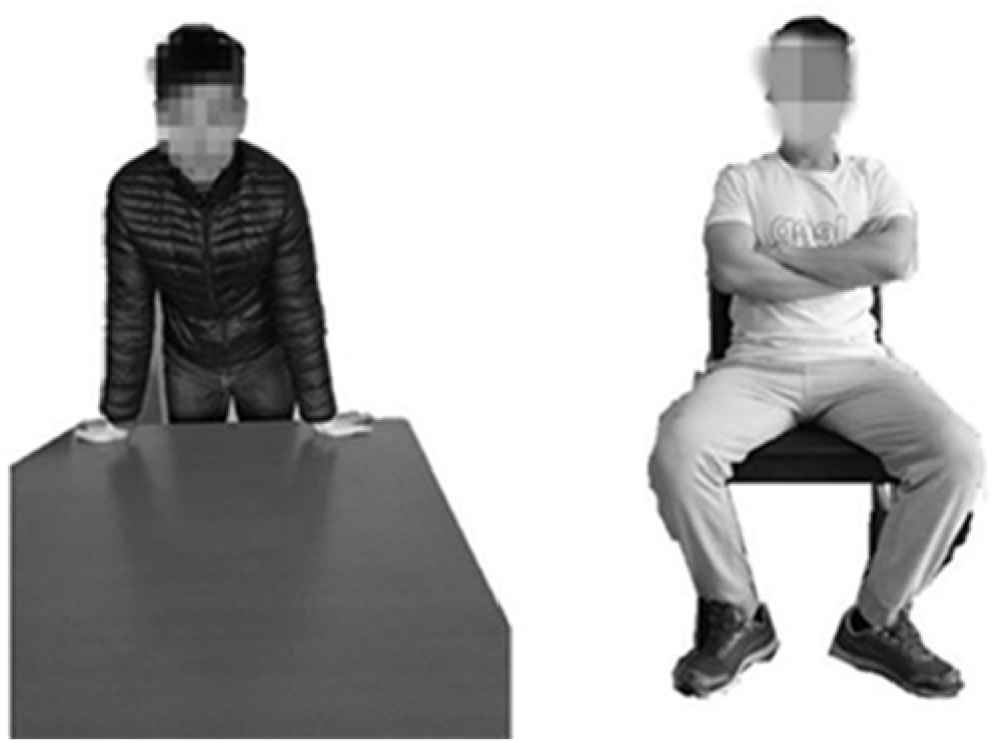
Posture manipulation requires participants to hold either two high-power postures or low-power postures for 2 minutes in total. The experimenter was allowed to give both verbal and body guidance during the manipulation. All body postures were selected based on the results of the pilot study. The postures in Experiment 1 are shown in Figures 1 and 2.
High power postures.
Low-power postures.

The gambling task
After completing the power manipulation, participants were asked to perform a paper-and-pencil gambling task. The task consists of 10 different hypothetical scenarios of investments. Participants were asked to choose between two different investment choices: one with larger earning potential but riskier and one with normal earning but relatively safe. Following each scenario, participants were asked to rate the item “To what extent would you like the investment you choose” from 0 (prefer option A), 3 (neutral) to 5 (prefer option B). The total score of the five tasks (0 = no gamble, 1 = gamble) represents the participants’ risk-taking tendency. Invalid data (chose option A but rated prefer option B, or chose option B but rated prefer option A) will be excluded. The earning for each investment varied from ¥50 to ¥500; the percentage of the probability to earn money in each task also varied as follows: 10–90%, 20–80%, 30–70%, 40–60%, and 50–50% (Harbaugh, Krause, & Vesterlund, Reference Harbaugh, Krause and Vesterlund2002). The full version of the task can be accessed in the supplementary material.
Procedure
According to research, body changes affect the mind only when it is in context (Cesario & McDonald, Reference Cesario and McDonald2013). Therefore, Cesario and McDonald (Reference Cesario and McDonald2013) suggest that the instructions provided to the participants before the power manipulation are important. Thus, we adopted the instructions used by Cesario and McDonald. Participants were randomly assigned to conditions and guided into the behavioral observation room. They were manipulated one at a time. Each participant entered the room and was told that the study concerned “how people remember and maintain different physical positions and how they form impressions of others”. The experimenter then helped participants pose in a specific posture by providing verbal instructions, or lightly touching their arms and legs if needed (e.g., “Please sit on the chair and naturally hang your arms between your legs, then clamp your legs”). The experimenter then left the room after giving the instructions. Another experimenter observed and recorded the participants holding the postures through one-way glass. Any data from participants who failed to maintain postures was excluded from further analysis. All participants learned the postures correctly and held them correctly. They were randomly assigned to hold either two high-power or two low-power postures for 1 minute each. While holding the postures, participants were shown a series of neutral faces with an iPad as a filler task. Participants were instructed: “Imagine the faces shown on the iPad as a real person.” The faces were extracted from the Chinese Facial Affective Picture System after receiving authorization. In this study, the iPad was placed on a table that was about 0.9 m high. After posture manipulation, participants were then asked to finish the gambling task.
Data analysis
The null hypothesis significance testing (NHST) approach was applied in Experiment 1 and data analysis was performed using SPSS software (version 19.0, SPSS Inc., Chicago, IL, USA). The threshold of the alpha level was set at .05.
Results
Two datasets were excluded because the participants did not keep still during posture manipulation. The results show no significant differences between the high-power (M = 3.59, SD = 2. 338) and low-power groups (M = 3.10, SD = 1.795), t(58) = 0.91, p =.37, Cohen’s d = 0.24, 95% CI [-0.27, 0.74]. This indicates that the manipulation of holding powerful or powerless postures did not affect individuals’ risk-taking tendency.
Discussion
Experiment 1 was designed on the basis of previous research. We also deployed a pilot study to ensure the validity of the postures. However, the results indicate that posture manipulation failed to affect the participants’ risk-taking tendency; that is, the results of former research failed to be replicated, although participants in the high-power group rated slightly higher on risk-taking measures than participants in the low-power group. Experiment 1 also had its disadvantages. First, the sample size was determined based on former research other than a power analysis; second, as a replication study, we did not preregister Experiment 1 on the Open Science Framework or any other website. As an improvement, we further designed Experiment 2 to investigate the topic.
EXPERIMENT 2
This experiment was a preregistered study (https://osf.io/upmv5/). Different from Experiment 1, Experiment 2 contains two dependent variable measurements: a self-reported power feeling measure and a gambling task. As mentioned in the original study, the measure of self-reported power feeling acts both a rule of the dependent variable and as a “manipulation check item”. This can distinguish a failed independent variable manipulation from other negative results. Furthermore, studies have mentioned that the eye gaze direction during posture manipulation is an affecting factor (Garrison, Tang& Schmeichel, Reference Garrison, Tang and Schmeichel2016). Thus, we also controlled gaze direction in Experiment 2. Marsman and Wagenmakers (Reference Marsman and Wagenmakers2017) suggest that Bayesian statistics can express research confidence for a parameter being in any range; and it can express the evidence for or against hypotheses on a continuous scale, and monitor the evidential trajectory in real time as the data accumulate. Pivoting from former suggestions, we also adopted the Bayesian approach in Experiment 2 to make up for the deficiency of NHST in Experiment 1 to some extent.
Method
Participants
A power analysis before the experiment indicated that a sample size of 72 was suitable for this study. In total, 72 undergraduate students (21 male, 51 females; M age = 19.83, range = 18–22) were recruited and randomly assigned to the high-power (n = 36) or low-power (n = 36) posture groups. All participants had normal visual acuity and none had any medical history or psychological disorders, according to self-report. Participants were recruited without major or grade requirements. Written informed consent was provided prior to the experiment. The experimental protocol was approved by the local Ethics Committee at South China Normal University.
Materials
The postures and risk-taking measurements were the same as Experiment 1. Additionally, we also added a self-report item to measure participants’ power feeling at the end of the experiment. Participants indicated how “powerful” they felt at the moment on a scale from 1 (not at all) to 7 (a lot).
Procedure
Experiment 2 had the same procedure in Experiment 1, except for the filler task as previously discussed. In order to control the participants’ gaze directions, the iPad was put on a carton and then the carton was put on the desktop to keep participants’ gaze direction horizontal when they were holding a standing posture. This step is operated by the experimenter. Thus, the participants’ gaze directions were kept horizontal in all conditions.
Data analysis
Two datasets were excluded because the participants failed to maintain postures during posture manipulation. We used a two-sided Bayesian hypothesis test (with a default Cauchy prior width of r = .707 for an effect size on the alternative hypothesis). The analysis is achieved with JASP 0.9.2.0 (JASP Team, Reference Team2016; jasp-stats.org). According to Wagenmakers, et al. (Reference Wagenmakers, Beek, Rotteveel, Gierholz, Matzke, Steingroever and Gronau2015), the results show a medium-sized (1/10–1/3) support for H0. This indicates that posture manipulation yielded no effect on both power feelings and risk-taking behavior. According to the discussions and suggestions about reporting the Bayes factor in psychological studies (Appelbaum et al., Reference Appelbaum, Cooper, Kline, Mayowilson, Nezu and Rao2018; Hu, Kong, Wagenmakers, Ly, & Peng, Reference Hu, Kong, Wagenmakers, Ly and Peng2018; Kruschke, Reference Kruschke2014; Marsman & Wagenmakers, Reference Marsman and Wagenmakers2017), the analysis and reporting statistics of this study will follow Marsman and Wagenmaker (Reference Marsman and Wagenmakers2017).
Results
Main results
The results of an NHST analysis based on the data from Experiment 2 shows no difference in risk-taking tendency between the high-power (M = 4.15, SD = 0.24) and low-power groups (M = 3.97, SD = 0.19), t (70) = - 0.57, p = .57, Cohen’s d = -0.14, 95% CI [-0.79, 0.44]. The results supported the same conclusion of Experiment 1, that power postures do not affect individuals’ risk-taking tendency. As stated, we also ran a Bayesian analysis based on the same data. For participants’ self-reported power feelings, the Bayes factor is BF10 = 0.30, indicating that the observed data provided medium evidence to support the null hypothesis, which suggests that there is no significant difference in self-reported power feelings between different posture manipulations. A similar BF10 = 0.24 was observed for participants’ risk-taking tendency measure. In sum, the results of Experiment 2 indicate that the manipulation of holding powerful or powerless postures does not affect individuals’ risk-taking tendency.
Exploratory analysis 1: Sequential analysis of the Bayes factor
Figures 3 and 4 shows the development of the Bayes factor as a function of the number of participants that were tested. According to Hu et al. (Reference Hu, Kong, Wagenmakers, Ly and Peng2018), this result shows medium to strong evidence for the null hypothesis that there is no difference between high- and low-power posture manipulations. Furthermore, as the number of participants grows, the Bayes factor increasingly supports the null hypothesis.
The development of the Bayes factors for the self-reported power feeling.

The development of the Bayes factors for the risk-taking tendency.

Exploratory analysis 2: Assessing robustness
The dot on Figures 5 and 6 indicates that as the scale parameter r increases (i.e. the prior becomes progressively wider), the Bayes factor increasingly favors the null hypothesis. In addition, it is evident that, even under the prior setting that most favors the alternative hypothesis, the Bayes factor is still indicating ambiguous evidence.
Bayes factor robustness check of self-report power feeling.

Bayes factor robustness check of risk-taking tendency.

Discussion
Experiment 2 was a preregistered experiment with a strict sample size based on a power analysis and a different statistical approach. However, the results of Experiment 2 still supported the non-significant conclusion of Experiment 1. The results proved that postures do not affect either power feeling or risk-taking behaviors. Based on the results, we concluded that holding a specific series of body postures perceived as high or low power does not affect either individuals’ feeling of power or their risk-taking tendency.
General discussion
We aimed to replicate the study of power postures reported by Carney et al. (Reference Carney, Cuddy and Yap2010). On the experiment design level, we reviewed multiple former experiments of power postures. Many factors that may influence the results were controlled for conditions; for example, experimental instruction (Cesario & McDonald, Reference Cesario and McDonald2013), gaze direction (Garrison et al., Reference Garrison, Tang and Schmeichel2016), and cultural background difference (Huang et al., Reference Huang, Galinsky, Gruenfeld and Guillory2011. Our pilot study proved that particular body postures, as a body language, were consistently rated as high or low on power. On the data analysis method level, we adopted null hypothesis significance testing and the Bayesian approach. However, the results of our experiment failed to replicate former findings, despite two attempts. The results of this study, along with former failed-to-replicate studies, suggest that the effect that powerful postures affect individuals’ actual power is a false positive result. However, there is no simple decisive rule for declaring success or failure in replication or for detecting positive results (Benjamin et al., Reference Benjamin, Berger, Johannesson, Nosek, Wagenmakers, Berk and Johnson2018; Camerer et al., Reference Camerer, Dreber, Holzmeister, Ho, Huber, Johannesson and Wu2018; Open Science Collaboration, 2015). Any research on exemplary quality may have irreproducible empirical findings because of random or systematic error (Open Science Collaboration, 2015). We can only conclude that postures yield no effect based on present works, and the crucial factor regarding posture and behavior is still unknown. Future research should continue to explore whether a potential factor lies between posture and risk-taking behavior.
Previous researchers have tried to explain the effect by embodied cognition, that is, changes in our body can yield an effect on our cognition. However, the main proposition of embodied cognition is that cognition lies in the body, and the body lies in the context (Gabbay, Woods, & Thagard, Reference Gabbay, Woods and Thagard2006). Embodiment mainly concerns the relationship between mind, body, and context. Researchers claim that context is an important part of the embodiment. Cesario et al. (2013) changed the instruction given to participants during posture manipulation. We believe this is an important operation to build a context while participants are posing. However, the results from previous studies failed to be replicated in our study. From the perspective of embodiment, it is inappropriate to discuss mind and behavior without context. Power, as an important dynamic social factor, lies in the relationship among individuals. Under this premise, future studies may focus on field studies in which the study variables are examined in a specific context.
Previous studies have also mentioned how different postures yield an effect on participants’ hormone levels and described how high-power postures can cause a significant increase in the testosterone level and a decrease in the cortisol level. We did not collect participants’ saliva samples in our study. However, evidence from the field of physiology has already proven that cortisol can act within minutes to help us respond to stressful situations and that relaxation can be accompanied by a decrease in cortisol levels. But the same is not observed regarding testosterone levels. The result of a previous study (Van Honk et al., Reference Van Honk, Will, Terburg, Raub, Eisenegger and Buskens2016) showed that when women’s testosterone levels were manipulated to high levels, fear, anger, and risk-taking behaviors were affected — but these changes occurred after hours, not within minutes. Thus, there is still a more to discuss regarding hormone changes. It would be interesting to explore whether hormone levels are the key factor to determine the embodied effects of power postures or whether the hormone change is a false positive result, as observed in the previous findings.
In addition, our study also helped to alleviate the replicability issue by preregistering the study and sharing our data and materials on the Open Science Framework. As suggested by former researchers, open data can contribute to a reduction in the freedom of researchers and reduce questionable manipulations to reduce false positives, while preregistration can reduce problematic manipulations of researchers, restrict experimental freedom and openly publish major research findings to reduce publication bias (Hu et al., Reference Hu, Wang, Guo, Song, Sui and Peng2016). Accumulating evidence is the scientific community’s method of self-correction and is the best available option for achieving that ultimate goal: truth (Open Science Collaboration, 2015). However, how we proceed in open science will require a change in mindset and a lot more openness, including “open data, open collaboration, and above all, open minds” (Ong, Reference Ong2016, p. 6). To further address the replication issue, more open studies are needed.
Limitations
We conducted two experiments to explore the effect of body posture. However, it was only a conceptual replication of research on the power pose effect. We copied the posture manipulation procedure from Carney et al. (Reference Carney, Cuddy and Yap2010) but with a few modifications. The sample was comprised of undergraduate students. As discussed, we did not collect hormone levels as a dependent variable. Moreover, we replaced a posture that is regarded as rude in the Chinese culture. Throughout our studies, the results indicated that body postures do not affect either power feelings or risk-taking tendency (p > .05 and BF01 between 1/3 to 1/10). Also, the sample size varied between the two studies due to specific conditions.
Author ORCIDs
Outong Chen 0000-0001-5236-1025
Supplementary material
To view supplementary material for this article, please visit https://doi.org/10.1017/prp.2019.17
Acknowledgments
The authors would like to thank Ms. Hui Yang for her careful proofreading and revision of the manuscript during the review process.
Conflict of interest
None.
Funding
The present study was funded by the MOE Project of Key Research Institute of Humanities and Social Sciences at Universities, 2016 (No. 16JJD190002). Research of adolescents’ psychological mechanism and cultivation of belief in communism (2017WT015). Research of psychological mechanism and cultivation of firm belief in communism in adolescents (2018GZMZYB10).
Note
All data and materials have been made publicly available on Open Science Framework and can be accessed at https://osf.io/a367x/?view_only=581a656bedfb4b5dbaca3e16b4fe860b


 Open access

