On March 1, 2003, a small train derailed and crashed in a mountain touring area of Alishan Township, Chiayi County, Taiwan. In this incident, 17 people were killed and another 188 were injured. The ensuing emergency response to the accident was hindered by persistent confusion between different response agencies and command centers. The respective responsibilities of agencies from health sectors, fire agencies, and private services were overloaded, and the integration of directing and coordinating the agencies and their resources lacked uniformity, similar to the emergency response of mass casualty incidents (MCIs) that occurred in Lebanon.Reference Sayed 1 The result was that the onsite coordination and utilization of resources were inefficient and exacerbated the impact of the incident.
In response to these problems, the Department of Health (DOH) of Taiwan has established research projects in 6 regional medical emergency operation centers (EOCs) since 2005 to improve the coordination of the health, fire, and medical agencies (including hospitals, health centers, and other facilities) during MCIs.
On April 27, 2011, another train accident occurred at the same location as the 2003 derailment. This later event killed 5 people and injured 118 more. The injured were taken to 7 hospitals across 3 counties. During this incident, the EOC played a role in the communication and coordination among different response agencies and resources. They integrated horizontally the emergency medical service system (EMSS) of the neighboring cities/counties and conveyed messages vertically between central and local authorities. However, in this event, the EOC could not control the situation and the resources simultaneously, causing difficulty for the command structure operation regarding simple triage, rapid treatment, and casualty evacuation.
For effective disaster preparedness, response, and recovery, an integrated effort is needed between professionals and to actually apply these activities during critical conditions.Reference Walsh, Subbarao and Gebbie 2 From a disaster management perspective, close coordination among different agencies and the effective use of resources can mitigate the impact and consequences of such disasters.
In the past decade, since the Chi-Chi earthquake (1999), Toraji and Nari typhoons (2001), and severe acute respiratory syndrome (SARS) epidemic (2003), Taiwan has highlighted the importance of different disaster management phases. Taiwan’s current medical resources are predominantly concentrated in urban and metropolitan areas, and the emergency departments (EDs) of the larger hospitals in these areas are commonly congested.Reference Hu 3 , Reference Shih, Ma and Chen 4 Approximately 3.5% to 4% of patients in the ED account for 14.3% to 18% usage of emergency medical treatment,Reference Hansagi, Olsson and Sjoberg 5 , Reference Huang, Tsai and Chen 6 indicating that a relatively small number of patients utilize a high ratio of total emergency medical treatment.Reference Okuyemi and Frey 7 , Reference Olsson and Hansagi 8 This finding may mean that less critically ill patients who use the ED more frequently will crowd out critically ill patients who are in greater need, resulting in an imbalance of medical resource usage. It also suggests that the high usage of EDs has no association with disease severity.Reference Huang, Weng, Lai and Hu 9
In MCIs, local medical resources would be overwhelmed by large numbers of casualtiesReference Stopford 10 that require close cooperation and mutual assistance with neighboring medical facilities. These MCIs that would cause mass casualties include terrorist acts, floods, nuclear incidents, aircraft incidents, and earthquakes.Reference Hoffner, Keck, Hemphill and Wells 11 During such incidents, full-scale and precise medical attention given to large numbers of victims with serious and diverse injuries would be hindered.Reference Frykberg 12
Typically, a disastrous event causes a lack of medical resources.Reference Bostick, Subbarao, Burkle, Hsu, Armstrong and James 13 Therefore, emergency medical response to disasters not only includes providing medical services for casualties of the MCI but also medical need assessments, command coordination, and public health intervention. All of these elements are important in disaster response.Reference Bechtal, Hansberry and Brown 14 In addition, the pre-hospital medical service should be closely coordinated with the health care function, public health, and public safety agencies.Reference Yancey, Fuhri, Pillay and Greenwald 15
The Emergency Medical Care Law (EMCL) was promoted and implemented in 1995. Since then, pre-hospital care for critically ill patients has greatly improved, but information sharing and coordination between city/county health, fire, and medical agencies were still underdeveloped. The EMCL was further revised in 2007, focusing on MCIs, to entrust the EOCs with the following 8 legislative mandates:
-
1. Monitor the progression of incidents in their jurisdictional regions.
-
2. Regularly update the emergency medical resources database during peace time.
-
3. Maintain the human resources database and manage the information-sharing platform that integrates medical information and resources related to emergency response.
-
4. Assist in planning disaster-related emergency medical incident rehabilitation.
-
5. Establish disaster response protocols and assessment models for disasters and organize/participate in such exercises.
-
6. In the event of trans-municipality/city/county disaster, assist the DOH in coordinating and integrating resources related to emergency response.
-
7. Assist the DOH in commanding regional medical agencies in dispatching relevant personnel to assist in handling mass casualties.
-
8. Provide disaster-related medical response training and other matters related to regional emergency medical disaster response.
The EOCs have played a valuable role among the health, fire, and medical agencies. However, when an MCI occurs, the operation, communication, and coordination for those agencies need to be integrated, necessitating an improved process. From a disaster management perspective, this study not only reviews the problems that EOCs encountered during the coordination and resources integration of individual command structures, but also proposes a solution for improving the emergency medical operations through the coordination of the 3 agencies.
Methods
This prospective study was conducted using 2 approaches to conduct the EOC operation analysis: a self-assessment survey conducted by EOC personnel and an assessment performed by external experts. For the self-assessment survey, 30 randomly selected representatives from 6 regional EOCs served as survey subjects. The subjects received the self-assessment survey electronically, and they were given a deadline to return the data for analysis.
For the external expert assessments, 13 representatives from fire, health, and medical agencies that worked closely with the EOC operation were invited to become investigators. The investigators were to visit each regional EOC and evaluate the EOC personnel using a structural survey and open questions.
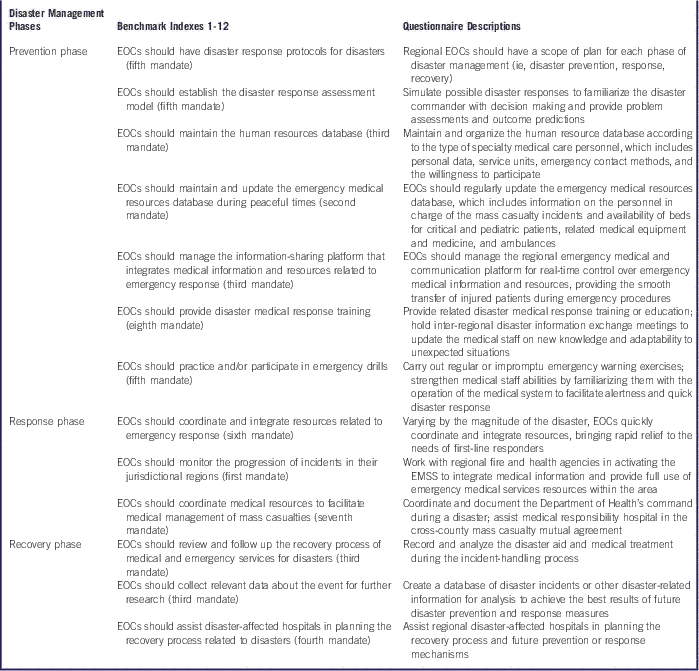
The questionnaire was prepared according to the legislative mandates of EOC determined by the EMCL before the interviews. A panel comprising 18 specialists in health administration, fire, and emergency medical specialties were invited to adjust the terminology and content validity. The survey benchmark index for each question in the questionnaire was established by the panel and categorized according to different disaster management phases, namely, prevention mitigation and preparedness before disaster, response, and recovery. Reliability analysis was determined by using the Cronbach α coefficient of consistency. Table 1 shows the questions used for the consensus indexes.
Questionnaire Regarding Benchmark Index Descriptions of Legislative Mandates by Taiwan’s Emergency Medical Care Law

Abbreviations: EMSS, emergency medical services system; EOCs, emergency operation centers.
The Likert scale was used to indicate the strength of each question, with 1 indicating strongly disagree; 2, disagree; 3, neutral; 4, agree; and 5, strongly agree. The score of every index was calculated according to the benchmark indexes categorized in different disaster management phases to reflect current operation effectiveness. The results from the survey were analyzed statistically (independent 2-sample t test), and then compared to those of the self-assessment and external assessment to find differences between them and to investigate which areas the current EOC operation needs to improve.
Results
A total of 30 surveys were sent, and 29 were returned and were valid for analysis. Among the 29 surveys, 1 was from a managing director and 1 was from a deputy managing director. The remainder was received from first-line personnel. The Cronbach α reliability analysis showed a score of 0.905, indicating that the survey results were reliably consistent.
Thirteen external scholars and/or experts in fields related to emergency medical operations were invited as assessment investigators. Five with health administrative expertise worked in the city (county) health agency, and 5 with emergency rescue and pre-hospital care expertise and 3 with an emergency medical specialty worked in the city (county) fire agency.
Results of the Benchmark Index Survey
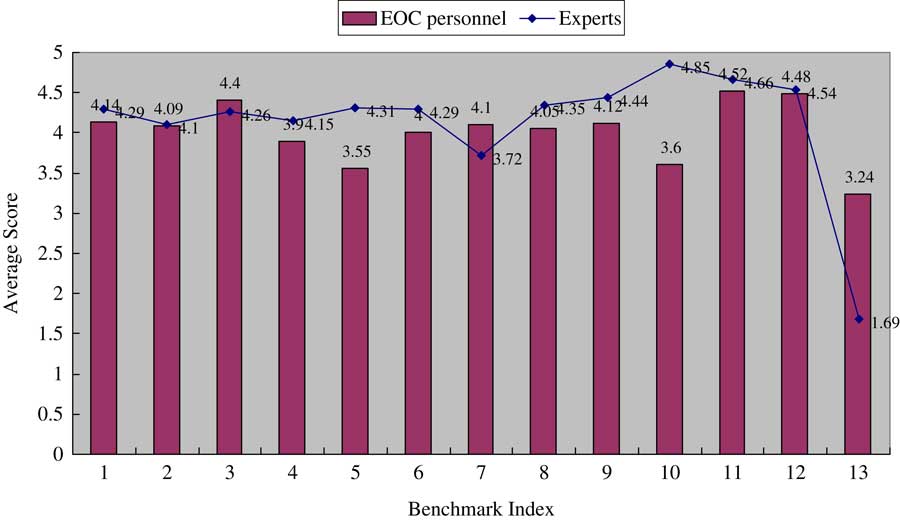
As shown in Figure 1, EOC personnel and external experts had consistent results in indexes 1 to 4, 6, 8 and 9, and 11 and 12. The score, however, was substantially lower between the EOC personnel and experts in index 13 (scoring 3.24 and 1.69, respectively) regarding “EOC should assist disaster-impacted hospitals in planning the recovery process related to disasters.” Also, in indexes 5, 7, 10, and 13, differences reached the level of significance. These differences occurred because EOC personnel and external experts scored inconsistently. The benchmark index t test is shown in Table 2 .
Survey Results of the Benchmark Index as a Line and Column Chart.

The Benchmark Index t Test Results

Statistical significance: a P<.01; b P<.05; c P<.001.
Levels of Competency in Disaster Management Phases
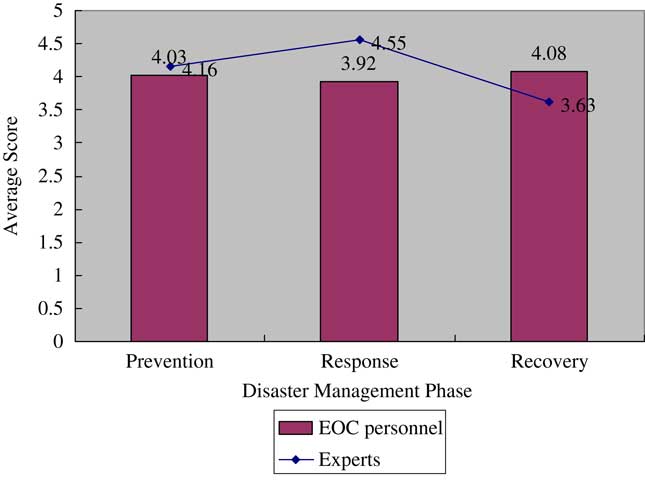
As shown in Figure 2, the EOC personnel and external experts scored higher than 4 on all items except the response of emergency medical operations, in which EOC personnel scored 3.92, and external experts scored 4.55.
Survey Results From the Disaster Management Phases as a Line and Column Chart.

The major differences were in the benchmark index 10: “EOC should coordinate medical resources to facilitate medical management of mass casualties,” in which EOC personnel scored significantly lower (3.6) than the external experts, and the differences between them reached the level of significance. For the recovery of emergency medical operations, EOC personnel scored 4.08, while external experts scored 3.63. Also, on benchmark index 13, “EOC should assist disaster-impacted hospitals in planning the recovery process related to disasters,” the external experts scored 1.69, which was significantly lower than the EOCs, and differences between them reached the level of significance (Figure 1; Table 2).
Discussion
Both EOC personnel and external experts suggested improving index 13: “EOC should assist disaster-affected hospitals in planning the recovery process related to disasters.” The most likely reason for this suggestion may be because EOC personnel have no authority to participate and assist in recovery.
For example, in recovery from an earthquake, the tasks of rescue and recovery belong to the fire agency; the hospitals’ disaster response and recovery plan are planned and corrected by themselves under supervision of the health agency; and the EOCs have no have clearly mandated responsibility. As a result, the EOC has no role in the entire process, precluding it from having a wide impact in this mandated operation.
To improve this situation after each major incident, hospitals should evaluate their emergency plansReference Reilly and Markenson 16 and include EOCs in the process as advisors, assisting the hospitals during the recovery process and planning future prevention or response mechanisms.
In index 7, “EOC should practice and/or participate in emergency drills,” differences between the EOC personnel and the experts reached the level of significance. The experts suggested that to accomplish this directive, the DOH should set requirements and authorize EOCs to request the relevant agencies to participate in drills and achieve the designated goals.
In index 5, “EOC should manage the information-sharing platform that integrates medical information and resources related to emergency response,” and index 10, “EOC should coordinate medical resources to facilitate medical management of mass casualties,” differences between the 2 groups also reached the level of significance. It was found that in subjects regarding the information-sharing platform (EMSS was established by the DOH), a gap still remained between current status and expectation from the community. This difference may have occurred because EOCs were not the front-line response agency, even though the EOCs actively traced and recorded disaster information and provided emergency medical information to front-line health, fire, and medical agencies, which then reported to the DOH.
With regard to disaster and patient information handling, however, the EOCs needed to coordinate with all 3 professional agencies. The response information system of the fire agency and pre-hospital care businesses were directly under the National Fire Agency (NFA), whereas the health resource and management and post-hospital care business belonged to the DOH. Each system worked independently, and they were not integrated because they had different administrative systems. In addition, the regulatory regimens of these different administrative systems were not yet integrated. Because no lead agency was appointed to integrate the EMSS, the process of transition from pre-hospital to post-hospital could not be done seamlessly.Reference Ma, Ko and Lin 17 Furthermore, EMSS information classification and frequency of updates were insufficient, resulting in the inability of response operations to synchronize full scale immediately.Reference Wu, Chen and Yeh 18 Guidelines were needed to prevent confusion and miscommunication during disasters.Reference Lerner, Cone and Weinstein 19
Regarding index 10, the experience of mass casualty cross-county medical resources and manpower application during the Chi-Chi earthquake showed that the EOCs played a more ancillary and impromptu role, and the crucial actions were conducted by the local health agency. As found in the other indexes, integrating and unifying the actions of 3 different administrative agencies during disaster response operations were difficult,Reference Meeds 20 and controlling and handling the pre-hospital/post-hospital patient status information were challenging.
Conclusions
As noted in the findings of this study with EOC personnel and external experts, the completion of the EMCL amendment should allow EOCs to act as the official lead agency, with regular funding and expanded statutory functions. Given sufficient budget resources, the EOCs can take the lead and be responsible for unified leadership, command coordination, and managementReference Tseng, Kuo and Liu 21 during MCIs.
Current disaster management commonly emphasizes response and coordination and neglects the planning and correction of the recovery process, which has a profound effect on future prevention and response actions. It is recommended that detailed corrections be made to the EMCL so that after each MCI the EOCs reserve the right to invite the health, fire, and medical agencies to convene for a review meeting. At these meetings, through discussion and feedback, the agencies can review and refine measurements to improve future operation, communication, and coordination during such events.
Also, it is recommended that the EMSS be modified according to the operating interface demand of the described EOCs and agencies and integrated in an online collaborative network response operation for an information-sharing platform (eg, including disaster integration and control, management of patient flow, and coordination and management of resources). Systems from different agencies should be able to achieve greater effectiveness if they function efficiently and share the latest information.Reference Tseng, Shu, Horng, Kuon and Hsu 22
The issues described here are viewed as emerging concepts for the support of health-specific EOCs developing a unified decision-making, coordination, and resource management system.Reference Burkle, Hsu and Loehr 23 An integrated and collaborative network approach can be used to address all aspects of relief work.Reference Mattox, McSwain and Frykberg 24 This approach would allow EOCs to handle large numbers of injured patients and take the role of casualty evacuation commander, effectively integrate medical resources and use them to coordinate patients who are appropriately classified, and triage these patients to the appropriate medical agency.
Support and Funding
Part of this study was from research project number DOH97-TD-H-113-97008, which was funded by the Department of Health, Executive Yuan, Taiwan, Republic of China.
Acknowledgments
Cheng-Mau Wu, Mu-Fan Tsai, and Ping-Zu Tsai assisted with the research for this study.