Implications
The β-mannan accounts for 15% to 35 % (soy-based to palm-based) of total non-starch polysaccharides content of the pig diets, β-galactomannan, is a polysaccharide with repeating units of mannose, with galactose or glucose, or both, often found attached to the β-mannan. Pig digestive tract lacks the enzymes targeting β-1, 4-mannosyl bond and α-1, 6-galactosyl bonds, which limits the nutrient utilization and growth performance. These results indicate that β-mannanase have potential to improve the performance of growing pigs, and palm kernel meal may partially replace corn–soybean meal without reducing pig performance.
Introduction
The agro-industrial byproducts like palm kernel meal, rapeseed meal and distiller dried grains have recently received great attention because of their relatively comparable nutritional value and low price as compared with soybean meal (SBM) and corn (Fang et al., Reference Fang, Peng, Liu and Liu2007; Seo et al., Reference Seo, Kim, Kim, Kim, Kim, Jang, Jang, Kim, Kim, Park and Park2015). However, high concentrations of non-starch polysaccharides (NSP) such as β-mannan have restricted their use in swine diets (Ao et al., Reference Ao, Zhou, Meng, Lee, Jang, Cho and Kim2011). The β-mannan accounts for 150 to 370 g/kg of total NSP content of the pig diets (Centraal Veevoeder Bureau, 1998). The β-mannan is a polysaccharide which the molecular structure comprises of β-1, 4-mannopyranosyl residues or mannose residues substituted by single units of α-1, 6-linked galactose (Buckeridge et al., Reference Buckeridge, Dietrich and Lima2000). The lower nutrient utilization and growth performance refers to the lack of enzymes in pig digestive tract to break β-1, 4-mannosyl bond and α-1, 6-galactosyl bonds (Veum and Odle, Reference Veum and Odle2001). Previous studies have reported that dietary supplementation of β-mannanase or enzyme complex with β-mannanase can improve the growth performance and nutrient digestibility of growing pigs by removing the negative effect of mannan (Pettey et al., Reference Pettey, Carter, Senne and Shriver2002; Ao et al., Reference Ao, Zhou, Meng, Lee, Jang, Cho and Kim2011; Jo et al., Reference Jo, Ingale, Kim, Kim, Kim, Lohakare, Lee and Chae2012; Kim et al., Reference Kim, Ingale, Lee, Kim, Kim, Lee and Chae2013).
The beneficial effects of the exogenous enzymes depend upon the type of the substrate, physiological status of pigs and the amount of the NSP content in the diet (Ji et al., Reference Ji, Casper, Brown, Spangler, Haydon and Pettigrew2008; Li et al., Reference Li, Fang, Dai, Partridge, Ru and Peng2010; Adeola and Cowieson, Reference Adeola and Cowieson2011). Therefore, identification of type and amount of NSP content in pig diets is essential for selection on the exogenous enzyme and dose of dietary supplementation. Therefore, the objectives of the present experiments were to investigate the effects of dietary level of mannan and β-mannanase supplementation on growth performance, apparent total tract digestibility (ATTD) of energy and nutrients, and blood metabolites of growing pigs.
Material and methods
The protocol for the two experiments was approved by the Institutional Animal Care and Use Committee of Kangwon National University, Chuncheon, Republic of Korea.
These experiments were conducted at the facility of Kangwon National University farm, and growing barrows (Landrace×Yorkshire×Duroc) were housed in partially slatted and concrete floor pens with a pen size of 2.8×5.0 m. All pens were equipped with a self-feeder and a nipple drinker to allow ad libitum access to feed and water. The exogenous enzyme, β-mannanase (patent 100477456-0000; CTC Bio, Seoul, South Korea), was produced by using Bacillus subtilis (WL-7) grown on Luria broth and contained 800 000 U of β-mannanase/kg. One unit of β-mannanase is the amount of enzyme, liberating 1 μmol of total reducing sugar (glucose equivalence)/min at pH 4.0 and 30°C.
Animals, diets and management
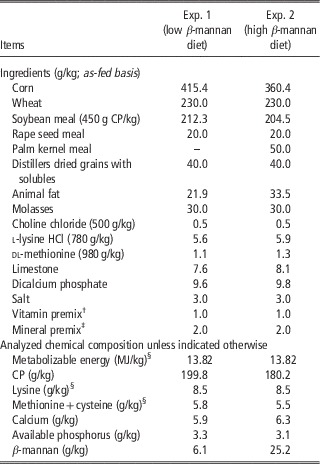
In Exp. 1, a total of 96 growing barrows (initial BW, 45.6±0.34 kg) were allotted randomly to one of four dietary treatments on the basis of initial BW. Each treatment had four replicate pens with six pigs per pen as group housed. The dietary treatments were a corn–SBM-based control diet (6.1 g β-mannan/kg diet) and the control diet supplemented with 400, 800 or 1600 U of β-mannanase/kg diet. Diets were formulated to contain 13.82 MJ/kg of metabolizable energy (ME) and 8.5 g/kg lysine (Table 1) and fed in meal form for 42 days. All the diets met or exceeded nutrient requirements for grower pigs (National Research Council (NRC), 1998).
Ingredient and chemical composition of experimental diets (Exp. 1 and 2)

† Supplied per kilogram of diet: 8000 IU vitamin A, 1500 IU vitamin D3, 16 mg vitamin E, 1.0 mg vitamin B1, 8.0 mg vitamin B2, 1.6 mg vitamin B6, 0.03 mg vitamin B12, 1.0 mg vitamin K3, 16 mg pantothenic acid, 30 mg niacin, 0.06 mg biotin, 0.26 mg folic acid and 4.8 mg ethoxyquin.
‡ Supplied per kilogram of diet: 150 mg Fe as ferrous sulfate, 96 mg Cu as copper sulfate, 72 mg Zn as zinc sulfate, 46.5 mg Mn as manganese sulfate, 0.9 mg I as calcium iodate, 0.9 mg Co as cobalt sulfate and 0.3 mg Se as sodium selenite.
§ Values were calculated according to NRC (1998).
In Exp. 2, a total of 288 barrows (initial BW, 34.85±0.64 kg) were allotted randomly to six treatments. There were four replicates in each treatment with 12 pigs/pen as group housed. Pigs were fed corn–SBM-based low-mannan (6.1 g/kg) or high-mannan (25.2 g/kg) diets in which corn and SBM was partially replaced with 50 g/kg diet palm kernel meal. The two types of diets were supplemented with 0, 400 or 800 U of β-mannanase/kg diet. All diets were provided for ad libitum consumption for 42 days and the feed was in mash form (NH Co., Wonju, Korea). Corn was replaced by β-mannanase on an equal percent basis. Diets were formulated to contain 13.82 MJ/kg of ME and 8.5 g/kg lysine (Table 1). All the diets met or exceeded nutrient requirement for grower pigs (NRC, 1998).
Experimental procedures, measurements and analyses
Pigs were weighed individually, and feed consumption was measured at the end of each experiment to calculate average daily gain (ADG), average daily feed intake (ADFI) and feed to gain (F : G). For calculations, all data were expressed per pen and per day with average of six and 12 pigs/pen in experiments 1 and 2, respectively. The total feed intake for calculating the growth performance was estimated by dividing ADG of each pen by the F : G measured in the total pigs in pens.
To evaluate the effects of dietary treatments on the ATTD of energy, nutrients and NSP, chromic oxide (2.5 g/kg diet) was included in the diets as an inert indicator. The pigs were fed diets containing chromic oxide during the last 7 days of each experiment, and fecal samples were collected from the floor of each pen during the last 4 days. The fecal samples were pooled within pen and dried in a forced air drying oven at 60°C for 72 h, and ground in wiley mill (Thomas Model 4 Wiley Mill; Thomas Scientific, Swedesboro, NJ, USA) using a 1-mm screen and later on used for chemical analysis. On the last day of each experiment, a 10-ml blood sample was collected by jugular vein puncture from two randomly selected pigs in each pen using a disposable vacutainer tube containing sodium heparin as an anticoagulant (Becton Dickinson, Franklin, NJ, USA). After centrifugation (3000×g for 15 min at 4°C), plasma samples were stored at −20°C for further analysis of total cholesterol, triacylglycerides, glucose and blood urea nitrogen.
Experimental diets and fecal samples were analyzed in triplicate for dry matter (DM) (Method 930.15), CP (Method 990.03), ash (method 942.05), calcium and phosphorus (Method 985.01) according to Association of Official Analytical Chemist (2007) methods. Gross energy (GE) of diets and feces were measured by a bomb calorimeter (Model 1261; Parr Instrument Co., Moline, IL, USA), and chromium concentrations was determined with an automated spectrophotometer (Jasco V-650, Jasco Corp., Tokyo, Japan) according to the procedure of Fenton and Fenton (Reference Fenton and Fenton1979). The content of β-mannan in feed ingredients, diets and excreta samples was estimated from the total mannose contents according to the method of Englyst and Cummings (Reference Englyst and Cummings1984). Commercial kits (Fujifilm Corp., Saitama, Japan) were used for analysis of (total cholesterol, triacylglycerides, glucose and blood urea nitrogen) plasma metabolites using an automated chemistry analyzer (Fuji Dri-chem 3500i; Fujifilm Corp.)
Statistical analysis
In Exp. 1, statistical analysis was conducted using GLM procedure of SAS (SAS Institute Inc., Cary, NC, USA). Orthogonal polynomial contrasts were used to evaluate linear and quadratic effects of dietary β-mannanase supplementation. In Exp. 2, data were analyzed as a 2×3 factorial arrangement of treatments in randomized blocks. The main effects of β-mannan levels of diet, β-mannanase supplementation and their interactions for all the items were analyzed by the GLM procedure of SAS. As no interaction was significant for any analyzed variables, they were removed from final model. Tukey’s honestly significant difference was used to identify differences among treatments means.
In both experiments, pen was used as the experimental unit for the analysis of growth performance and ATTD of energy and nutrients. For the analysis of blood metabolites, the mean of two pigs from each pen was used as the experimental unit. Probability values of ⩽0.05 were considered significant in both experiments.
Results
Dietary analysis
The β-mannan content of corn, wheat, SBM, rapeseed meal, palm kernel meal and corn distillers dried grains with solubles used for formulation of experimental diets were 2.0, 3.3, 11.6, 132.8, 343.2 and 110.2 g/kg, respectively. The β-mannan content was 6.1 g/kg for the basal (Exp. 1) and low-mannan diets (Exp. 2) and 25.2 g/kg for the high-mannan diets (Exp. 2) as shown in Table 1.
Growth performance
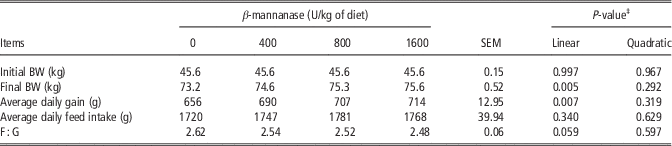
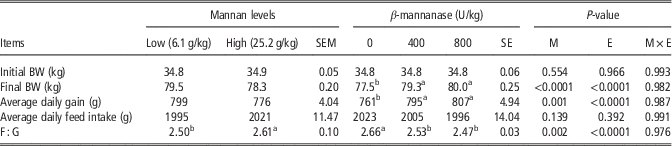
In Exp. 1, pigs had an increased final BW and ADG (linear, P<0.05) as dietary supplementation with β-mannanase increased, whereas no differences (P>0.05) were observed for initial BW, ADFI and F : G among treatments (Table 2). In Exp. 2, pigs fed diets supplemented with β-mannanase had greater (P<0.05) final BW, ADG and F : G (P<0.05) compared with those fed diets without β-mannanase (Table 3). The final BW, ADG and F : G were lower (P<0.05) in pigs fed high-mannan diets in comparison with animals fed low-mannan diets. The dietary level of mannan and β-mannanase supplementation had no effects (P>0.05) on ADFI of pigs.
Effects of levels of supplementation of β-mannanase on growth performance of growing pigs (Exp. 1) Footnote †

† Data represent means based on four replicate pens per treatment and six pigs per replicate.
‡ Linear and quadratic effects of increasing β-mannanase concentration.
Effects of mannan levels of diet and β-mannanase supplementation on growth performance of growing pigs (Exp. 2) Footnote †

M=main effect of mannan levels of diet; E=main effect of β-mannanase.
a,bValues with different superscripts of the same row are significantly different (P<0.05).
† Data represent means based on four replicate pens per treatment and 12 pigs/replicate.
Nutrient digestibility
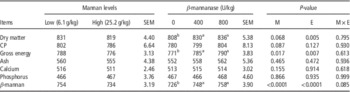
In Exp. 1, pigs fed increasing levels of β-mannanase had improved (linear, P<0.05) ATTD of DM, GE and β-mannan, whereas no difference (P>0.05) was observed on ATTD of CP, ash, calcium and phosphorus (Table 4). In Exp. 2, there were no interactions (P>0.05) between mannan levels of diet and β-mannanase supplementation. Pigs fed the diets supplemented with β-mannanase had greater (P<0.05) ATTD of DM, GE and β-mannan than that of pigs fed diets without β-mannanase supplementation (Table 5). The ATTD of GE and β-mannan was greater (P<0.05) in pigs fed low-mannan diets than that of pigs fed high-mannan diets.
Effects of levels of supplementation of β-mannanase on apparent total tract digestibility (g/kg) of nutrients and β-mannan of growing pigs (Exp. 1) Footnote †

† Data represent means based on four replicate pens per treatment and six pigs per replicate.
‡ Linear and quadratic effects of increasing β-mannanase concentration.
Effects of mannan levels of diet and β-mannanase supplementation on apparent total tract digestibility (g/kg) of nutrients and β-mannan of growing pigs (Exp. 2) Footnote †

M=main effect of mannan levels of diet; E=main effect of β-mannanase.
a,bValues with different superscripts of the same row are significantly different (P<0.05).
† Data represent means based on four replicate pens per treatment and 12 pigs/replicate.
Blood metabolites
In Exp. 1, blood glucose concentrations increased (linear, P<0.05) as β-mannanase was added to the diets (Table 6). The concentrations of blood total cholesterol, triacylglycerides and blood urea nitrogen were not affected (P>0.05) by dietary treatments. In Exp. 2, no interactions (P>0.05) were observed between the two factors. Pigs fed diets supplemented with β-mannanase had increased blood glucose concentration (P<0.05) than that of pigs fed diets without β-mannanase (Table 7). The mannan levels of diet and the β-mannanase supplementation had no effects (P>0.05) on the concentrations of blood total cholesterol, triacylglycerides, glucose and blood urea nitrogen.
Effects of levels of supplementation of β-mannanase on concentrations of serum metabolites of growing pigs (Exp. 1) Footnote †

† Data represent means based on four replicate pens per treatment and six pigs per replicate.
‡ Linear and quadratic effects of increasing β-mannanase concentration.
Effects of mannan levels of diet and β-mannanase supplementation on concentrations of serum metabolites of growing pigs (Exp. 2) Footnote †

M=main effect of mannan levels of diet; E=main effect of β-mannanase.
a,bValues with different superscripts of the same row are significantly different (P<0.05).
† Data represent means based on four replicate pens per treatment and 12 pigs/replicate.
Discussion
The positive effects of exogenous enzymes are quite variable and seem to depend on physiological status of the pigs and the content of NSP (Ji et al., Reference Ji, Casper, Brown, Spangler, Haydon and Pettigrew2008; Li et al., Reference Li, Fang, Dai, Partridge, Ru and Peng2010; Adeola and Cowieson, Reference Adeola and Cowieson2011). Therefore, exogenous enzymes should be selected on the basis of type and amount of the NSP in the pig diets. In the present study, the β-mannan concentrations in various ingredients including corn, wheat, SBM, rapeseed meal, palm kernel meal and corn distiller dried grains with solubles were analyzed and diets with low or high mannan levels were formulated to investigate the effects of mannan level and β-mannanase supplementation on growth performance, nutrient digestibility and blood metabolites in growing pigs.
The improved growth performance of growing pigs fed diets supplemented with β-mannanase observed in Exp. 1 is in good agreement with data reported by Yoon et al. (Reference Yoon, Yang, Shinde, Choi, Kim, Kim, Yun, Jo, Lee, Ohh, Kwon and Chae2010) and Kim et al. (Reference Kim, Ingale, Lee, Kim, Kim, Lee and Chae2013) who observed improvement in ADG of pigs fed diets supplemented with increasing levels of β-mannanase. The main reason that could have contributed to the influence of β-mannanase enzyme may be due to the mannan hydrolysis which can increase permeability of the cell walls and cut the long-chain polysaccharides to improve the digestibility of nutrients. Similarly, it was reported that β-mannanase improved growth performance of nursery and growing-finishing pigs (O’Quinn et al., Reference O’Quinn, Funderburke, Funderburke and James2002; Pettey et al., Reference Pettey, Carter, Senne and Shriver2002). However, no effect of β-mannanase on growth performance was reported (Schneider et al., Reference Schneider, Carter, Morillo and Park2003; Lenehan et al., Reference Lenehan, Goodband, Tokach, DeRouchey, Nelssen and Dritz2004; Jacela et al., Reference Jacela, Dritz, DeRouchey, Tokach, Goodband and Nelssen2010). This discrepancy might be due to variation in age of pigs, NSP contents of the diets, and dose of β-mannanase supplemented. Results for Exp. 2 are consistent with Jo et al. (Reference Jo, Ingale, Kim, Kim, Kim, Lohakare, Lee and Chae2012) who observed that growing pigs fed corn–SBM-based (low NSP) or complex diets that contained corn, SBM, rapeseed meal, copra meal and palm kernel meal (high NSP) supplemented with enzymes blend containing β-mannanase had greater ADG and F : G than pigs fed diet without enzymes. Similarly, it was reported that weaned pigs fed simple or complex diets supplemented with β-mannanase had greater F : G than pigs fed non-supplemented diet (Pettey et al., Reference Pettey, Carter, Senne and Shriver2002). The current study showed that β-mannanase has its positive effects on the performance of growing pigs regardless of the amount of mannan in the diet. There were large amounts of SBM in both high- and low-mannan diets. Soybean contains galactomannans which are associated with higher viscosity rate (Veum and Odle, Reference Veum and Odle2001). The high intestinal viscosity of mannans has been previously shown to have negative effects on nutrient utilization (Passos et al., Reference Passos, Park, Ferket, von Heimendahl and Kim2015). The lower ADG and F : G might be associated with lower digestibility of nutrients. High mannan level decreased the digestibility of GE and had negative effect on the digestibility of DM (P=0.068) and CP (P=0.087). Mannans occur in the forms of glucomannan, galactomannan, glucogalactomannan and glucuronomannan in plant cell walls (Aman and Graham, Reference Aman and Graham1990). They are able to encompass the nutrients in their complicate structure and suppress their absorption in gastrointestinal tract because of their viscous nature. In addition, β-mannan also stimulates innate immunity, potentially leading to unnecessary energy expenditure and less efficient nutrient utilization (Jackson et al., Reference Jackson, Anderson, Hsiao, Mathis and Fodge2003). The lack of an effect on ADFI of β-mannanase in the present experiments is in agreement with previous experiments (Jacela et al., Reference Jacela, Dritz, DeRouchey, Tokach, Goodband and Nelssen2010; Yoon et al., Reference Yoon, Yang, Shinde, Choi, Kim, Kim, Yun, Jo, Lee, Ohh, Kwon and Chae2010). The improved growth performance of growing pigs fed diet supplemented with β-mannanase found in these trials might be partly due to enhanced digestibility of DM, GE and β-mannan, which was in agreement with Kim et al. (Reference Kim, Ingale, Lee, Kim, Kim, Lee and Chae2013) who reported higher final BW, digestibility of DM and GE in β-mannanase supplemented diet.
High levels of NSP in pig diets can cause an increase in digesta viscosity, preventing interaction between substrate and digestive enzymes and, hence, reducing the nutrient digestibility (O’Connell et al., Reference O’Connell, Sweeney, Callan and O’Doherty2005; Passos et al., Reference Passos, Park, Ferket, von Heimendahl and Kim2015). Previous studies demonstrated that supplementation of exogenous enzymes to high-NSP diets reduced the viscosity of digesta and enhanced the nutrient utilization (Parkkonen et al., Reference Parkkonen, Tervila Wilo, Hopeakoski-Nurminen, Morgan, Poutanen and Autio1997; Grandhi, Reference Grandhi2001; Ji et al., Reference Ji, Casper, Brown, Spangler, Haydon and Pettigrew2008; Tapingkae et al., Reference Tapingkae, Yachai, Visessanguan, Pongtanya and Pongpiachan2008). In the present study, pigs fed diets supplemented with β-mannanase had greater digestibility of β-mannan, which might reduce digesta viscosity and improve nutrient utilization. Improvement of the ATTD of DM and GE by β-mannanase in the present experiments is consistent with report by Radcliffe et al. (Reference Radcliffe, Robbins, Rice, Pleasant and Kornegay1999) who observed improvement of the ATTD of DM and GE in pigs fed diets supplemented with β-mannanase. Similarly, Yoon et al. (Reference Yoon, Yang, Shinde, Choi, Kim, Kim, Yun, Jo, Lee, Ohh, Kwon and Chae2010) reported that dietary supplementation of β-mannanase to the corn–SBM and distiller dried grains with solubles-based diet led to an increase in ATTD of DM and CP, but had no effect on ATTD of GE in growing pigs. Contrary to the present results, Pettey et al. (Reference Pettey, Carter, Senne and Shriver2002) observed no effect of β-mannanase on ATTD of DM and GE in pigs. The discrepancy may be associated with the amount of mannan in diet and type and dose of β-mannanase.
In the present trials, dietary β-mannanase increased blood glucose concentrations, but had no effects on the blood total cholesterol, triacylglycerides nor urea nitrogen. Dietary supplementation of β-mannanase may improve glucose absorption by hydrolyzing β-mannan, thus partly explaining the observed growth response to β-mannanase. Rainbird et al. (Reference Rainbird, Low and Zebrowska1984) noticed that supplementing β-mannanase resulted in a decrease in glucose and water absorption in pigs. Present findings are consistent with data reported by Yoon et al. (Reference Yoon, Yang, Shinde, Choi, Kim, Kim, Yun, Jo, Lee, Ohh, Kwon and Chae2010) and Kim et al. (Reference Kim, Ingale, Lee, Kim, Kim, Lee and Chae2013) who observed increase in blood glucose concentrations but no effects on the total cholesterol and triacylglycerides in pigs fed diets supplemented with β-mannanase. In contrast to the report by Yoon et al. (Reference Yoon, Yang, Shinde, Choi, Kim, Kim, Yun, Jo, Lee, Ohh, Kwon and Chae2010), Kim et al. (Reference Kim, Ingale, Lee, Kim, Kim, Lee and Chae2013) and the present results, Jo et al. (Reference Jo, Ingale, Kim, Kim, Kim, Lohakare, Lee and Chae2012) reported that dietary inclusion of enzyme blend containing β-mannanase to the corn–SBM-based simple diet or complex diet had no effects on blood glucose concentrations. The current study showed a higher digestibility of mannan and mannan is a sort of NSP that breaks down by β-mannanase to be fermented in hindgut. The produced volatile fatty acids during fermentation of dietary NSP, play a role to be used as an energy resource instead of blood glucose (Rerat, Reference Rerat1996). In the current study, high mannan level did not change blood glucose, however, some other studies reported that the high mannan level in the diets reduce the absorption of glucose (Rainbird et al., Reference Rainbird, Low and Zebrowska1984; Yoon et al., Reference Yoon, Yang, Shinde, Choi, Kim, Kim, Yun, Jo, Lee, Ohh, Kwon and Chae2010). The ability of glucomannan to lower blood glucose appears related to its viscous and soluble nature (Vuksan et al., Reference Vuksan, Jenkins, Spadafora, Sievenpiper, Owen, Vidgen, Brighenti, Josse, Leiter and Bruce-Thompson1999). Unhydrolyzed β-mannan in the diet can interfere with glucose metabolism and insulin secretion rates in swine (Torki and Chegeni, Reference Torki and Chegeni2007). The insulin suppression can alleviate the intestinal absorption of glucose in peripheral tissues such as striated muscle by monogastric animals (Torki and Chegeni, Reference Torki and Chegeni2007).
Conclusions
In conclusion, results obtained in the present study indicated that supplementation of 400 IU of β-mannanase/kg to low- and high-mannan diets had potential to improve the performance of growing pigs. In addition, palm kernel meal can partially replace corn and SBM without reducing pig performance if β-mannanase is added to the diet.
Acknowledgments
This study was supported by CTC Bio, Inc. and the Institute of Animal Resources at Kangwon National University, Chuncheon, Republic of Korea. The authors sincerely acknowledge the technical facilities provided by the Institute of Animal Resources, Kangwon National University, Chuncheon, Republic of Korea.