

Flood, as the most common disaster caused by natural hazards, is the main cause of drowning deaths all over the world.Reference Hamilton, Peden and Pearson1 It is also one of the most common natural hazards in the Mediterranean region.Reference Llasat, Llasat-Botija and Prat2, Reference Peden and Işın3 Flood can cause a significant number of casualties and economic losses every year.Reference Priest, Wilson and Tapsell4 The risk of flood-related drowning has been often estimated as high, especially in low- and middle-income countries. Just between 1980 and 2009, there were over 500 000 flood-related drowning deaths worldwide.5 Currently, Iran is also facing the same problem. Because of its climatic, topographic, and geomorphological conditions, many areas are in danger of this disaster caused by natural hazards, and many studies have indicated flood-related phenomena throughout the country.Reference Mohammadinia, Ahmadi Marzaleh and Peyravi6-Reference Sharifi, Samadi and Wilson9 Most floods in Iran are flash floods, such as the recent floods in Tehran, Fars, Kerman, Isfahan, and Sistan and Baluchestan.10 Flash floods are a common type of disaster occurring in the form of severe and short-term storms. Sometimes, water currents lead to sudden and violent changes in river conditions. These changes happen in a short period and can potentially lead to miscalculation of risk by nearby people, especially vehicle occupants who use the roads in the vicinity of these waterways.Reference Diakakis and Deligiannakis11
Driving through flooded waterways has been considered a risk factor for many deaths due to flood-related drowning.Reference Hamilton, Peden and Pearson1 Research conducted around the world also indicates that driving through floodwaters is a common type of flood experience,Reference Franklin, King and Aitken12 and it has one of the highest fatality rates of any type of land motor vehicle accident. Driving through floodwaters accounts for 10% of all drowned people in high-income countries such as Australia, Canada, Finland, New Zealand, and America.Reference McDonald and Giesbrecht13 However, there is little data about the risk factors for driving and land motor vehicle–related drowning and its prevention strategies.Reference Yale, Cole and Garrison14 In Iran, there are no accurate reports about this type of drowning.
Various causes have been identified as risk factors for driving and drowning a motor vehicle in a flooded situation, including factors related to the driver such as age and gender,Reference Sharif, Jackson and Hossain15-Reference Peden, Franklin and Leggat17 blood alcohol level (0.1% or greater),Reference Staes, Orengo and Malilay18 previous flood experiences (people who successfully experience driving through a flooded waterway are more likely to repeat this risky behavior), normative factors,Reference Hamilton, Price and Keech19, Reference Pearson and Hamilton20 technology,Reference Hamilton, Price and Keech19 and physicalReference Maples and Tiefenbacher21 and socioeconomic environment.Reference Sharif, Jackson and Hossain15 In addition, risk perception is also one of the most important risk factors related to drivers that increases the liklihood of drowning.Reference Διακάκης and Δεληγιαννάκης16, Reference Peden, Franklin and Leggat22 Research conducted in America shows that people who deliberately drive through flooded roads lack sufficient knowledge about its potential dangers. They do not consider flood warnings as a sign of a real threat.Reference Drobot, Benight and Gruntfest23 To deal with these risk factors, several strategies have been suggested to prevent land motor vehicle–related drowning in flooded roads, such as taking physical and structural measures to improve road safetyReference Yale, Cole and Garrison14, Reference Sharif, Jackson and Hossain15 and taking nonstructural measures to promote awarenessReference Drobot, Benight and Gruntfest23-Reference Sharif, Hossain and Jackson25 and risk management.Reference Yale, Cole and Garrison14-Reference Hamilton, Price and Keech19
This study aimed at identifying the risk factors associated with land motor vehicle–related drowning and its prevention strategies worldwide using a systematic review. The results of this study will help policymakers in charge to minimize and ultimately prevent this type of drowning in Iran by detecting the risk factors and enforcing preventive strategies.
Methods and Materials
In this article, we conducted a systematic review of studies related to the risk factors of land motor vehicle–related drowning and its prevention strategies. This systematic review was conducted according to PRISMA guidelines (Appendix 1).Reference Moher, Liberati and Tetzlaff26
Search Strategy
Studies were selected using a systematic search of the literature. The search strategy was developed by the research team and medical information specialists. International and Iranian databases such as Web of Science, PubMed, Scopus, Magiran, SID, and Google Scholar were searched by using the following keywords: “motor vehicle,” “car,” “truck,” “bus,” “motorcycle,” “submersion,” “floating,” “near drowning,” and “drowning.” The search time span was from January 2000 to May 2022. The PubMed, Scopus, and Web of Science search strategies are provided in Appendix 2.
Eligibility Criteria
All quantitative and qualitative studies published in Persian and English languages were included in the present research, which was about the risk factors regarding land motor vehicle–related drownings in floodwaters and its prevention strategies. The risk factors and prevention strategies are those introduced by studies as effective factors in the occurrence and prevention of the incident, respectively. Land motor vehicles include all types of motor vehicles (i.e., motorcycles, public and private cars, taxis, vans, buses, and trucks) that are mainly meant to move/be driven on land. Moreover, because driving on flooded roads was one of the effective risk factors for the occurrence of motor vehicle–related drowning, the studies that examined the opinions, attitudes, and experiences of drivers for driving on flooded roads were included. Unpublished, systematic, and review articles; articles without abstract or full text; and studies about drownings related to the fall of land motor vehicles in aquatic environments such as rivers, canals, and lakes were excluded.
Study Selection
All the articles were entered into EndNote X8 software. Initially, duplicates were removed. Then 2 authors (the first and second author) selected the articles independently. They omitted articles with irrelevant titles and abstracts. Then they reviewed the full text of related articles based on the inclusion criteria, and each of them prepared a list of related articles. A third author was consulted in case of disagreement. The results were explained based on PRISMA guideline a (Figure 1).
Flowchart of study search and selection procedures. Seven hundred and eighteen articles were added to the study initially and after screening and assessing the articles, 14 ones were remained for final review.

Data Collection and Extraction
The remaining articles at the end of the screening process were read line by line by the authors, and the data were collected using the data extraction form (Appendix 3). The extracted data included the name of the first author, title of the article, year of publication, country, type of study, aim, and results (Table 1).
Characteristics of the included articles

To avoid any bias, 2 authors (the first and second authors) performed the process of data extraction and analysis independently. In case of disagreement, a third author was consulted. The process of data collection, formation, and analysis were discussed with the research team. Whenever the full text of the article was not available, the first author of the present article contacted the corresponding author by email. If no response was received, a second email was sent within a week.
Quality Assessment
Standard quality assessment of the articles was done by CASP27 and STROBEReference von Elm, Altman and Egger28 checklists. Two authors independently evaluated the quality of the articles. In case of disagreement, the third author was consulted to reach a consensus.
Data Analysis
Data were analyzed by the research team using thematic content analysis. After identifying the primary codes, themes were formed and defined, and the manuscript was written.
Results
Study Selection Process
In the initial search of different databases, 602 studies were found, of which 130 studies were removed due to duplication. After reviewing the titles and abstracts, 23 studies remained. The full texts of the selected articles were evaluated, and only 14 articles met the criteria for entering the systematic review process (Figure 1). Most of the studies were cross-sectional (57/1%) and were conducted in America and Australia (85/7%).
Quality assessment based on related checklists revealed that about 80% of the studies had a high quality.
Results of Analyzing the Studies
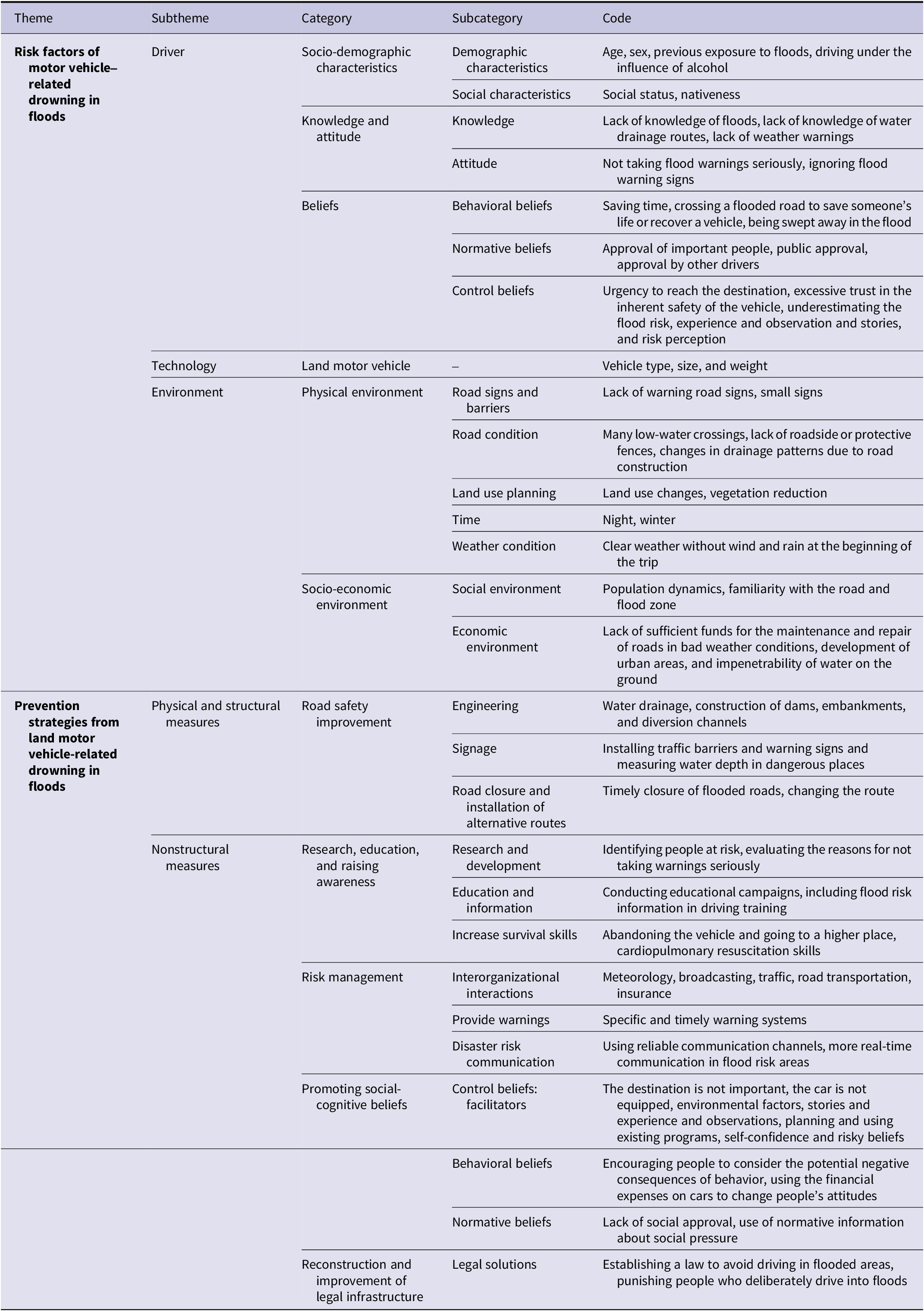
Based on the findings of this research, 14 eligible studies were selected and entered into the analysis process. Risk factors relevant to land motor vehicle–related drowning in flood in 3 subthemes were identified and categorized, including driver (with 3 categories of sociodemographic characteristics, knowledge and attitude, and beliefs), technology (1 category of land motor vehicles), and environment (2 categories of the physical and socioeconomic environment). Then, physical and structural measures (1 category of road safety improvement) and nonstructural measures (4 categories of research and education and raising awareness, risk management, promoting sociocognitive beliefs, and rebuilding and improving legal infrastructure) were proposed as drowning prevention strategies of motor vehicles (Table 2).
Risk factors of land motor vehicle–related drowning in flood and prevention strategies
Risk Factors for Land Motor Vehicle–Related Drowning in Flood
Driver
Sociodemographic characteristics
Some of the sociodemographic characteristics reported as the most common risk factors for land motor vehicle–related drownings in floods include being young (18-35y),Reference Sharif, Jackson and Hossain15, Reference Drobot, Benight and Gruntfest23-Reference Sharif, Hossain and Jackson25 being male,Reference Διακάκης and Δεληγιαννάκης16, Reference Peden, Franklin and Leggat22, Reference Drobot, Gruntfest and Barnes24 having a previous experience in floods,Reference Hamilton, Price and Keech19, Reference Pearson and Hamilton20, Reference Drobot, Benight and Gruntfest23, Reference Drobot, Gruntfest and Barnes24 and driving under the influence of alcohol.Reference Yale, Cole and Garrison14, Reference Peden, Franklin and Leggat17, Reference Peden, Franklin and Leggat22 Physical problems such as vision in the study of Sharif et al.Reference Sharif, Jackson and Hossain15 and mental and behavioral disorders such as dementia, autism, and depression in Peden et al.’s study were introduced as other effective factors in the risk of drowning.Reference Peden, Franklin and Leggat17
Awareness and attitude
The findings showed that some drivers in the United States usually do not take weather warnings or barriers seriously due to a lack of knowledge and attitude about flood risks and the increase in motor vehicle–related drowning death in floods. And by ignoring flood warning signs, the possibility of the driver being in the flood path—and, as a result, the possibility of motor vehicle–related drowning—increases.Reference Yale, Cole and Garrison14, Reference Drobot, Benight and Gruntfest23, Reference Drobot, Gruntfest and Barnes24
Beliefs
In this category, based on the studies of Hamilton et al. in Australia, the 3 subcategories of behavioral, normative, and control beliefs are considered the most important risk factors for drowning. Behavioral beliefs include 2 categories: benefits and costs. Benefits such as saving time, reaching the destination sooner, or crossing the flooded road to save someone’s life or recover a vehicle encourage the driver to cross the flooded road. Furthermore, the life-related and financial costs due to being stuck on the flooded road and the car being swept away can affect the intensity of people’s understanding of the risk and decrease the possibility of land motor vehicles drowning. Normative beliefs also include 2 categories: approval with positive outcomes and approval with negative outcomes. The public and important people’s approval, such as family and friends, as well as thinking of the rescuers, has a positive effect on reducing risky driving. On the contrary, encouraging passengers and other drivers or thrill-seekers to engage in risky activities puts drivers at greater risk of flood-related drowning. Control beliefs in the form of barriers and facilitators were recognized as an important effective factor in the occurrence of drowning. Beliefs such as the urgency to reach the destination due to assigned responsibilities, observing the successful passage of other drivers through the flooded road, overtrusting the inherent safety of the vehicle, underestimating the flood risk, and shortening the driving time are barriers to the occurrence of safe behaviors—and lead to deliberate driving through floodwaters. However, seeing and hearing the experiences and stories of other people’s unsuccessful attempts to drive through the flooded water, the presence of passengers, environmental factors such as darkness, the driver’s awareness of lack of car safety to cross the flooded road, and people’s risk perception and planning can reduce the possibility of driving into floodwater.Reference Hamilton, Peden and Pearson1, Reference Hamilton, Price and Keech19
Technology
Land motor vehicle
The results showed that land motor vehicles are not designed to be safe against floods.Reference Maples and Tiefenbacher21 Various studies have stated that factors such as the increase in the number, type, size, weight, and speed of the vehicles, in addition to the fact that the vehicles are not equipped to cross the flooded road, increase the drowning risk in floodwater in American and Australian countries.Reference Maples and Tiefenbacher21, Reference Peden, Franklin and Leggat22 For example, drivers of large vehicle, such as trucks, SUVs (sport utility vehicles), and vans, are more inclined to cross waterways due to overconfidence in vehicle safety and wrong assumption about crossing the low-lying flood. As a result, the probability of drowning is higher in this group of drivers.Reference Diakakis and Deligiannakis11, Reference Coles29
Environment
Physical environment
The physical environment is a risk factor for land motor vehicle–related drowning in 5 subcategories, including road signs and barriers, road condition, land use planning, time, and weather condition. Based on studies, the most common environmental factors affecting motor vehicle–related drowning in floods included lake, small size of road warning signs, dense road networks, numerous low-water crossings, asphalt roads adjacent to waterways, the absence of protective borders or fences to prevent the car from being swept away, lack of alternative routes,Reference Maples and Tiefenbacher21, Reference Sharif, Hossain and Jackson25 changes in drainage patterns due to road construction, changes in land use and reduction of vegetation following population growth and urbanization,Reference Sharif, Jackson and Hossain15 paved river crossings on dry riverbeds,Reference Diakakis and Deligiannakis11 and evenings, weekends, and holidaysReference Peden, Franklin and Leggat22 at night due to the driver’s inability to see the depth, speed, and flow of water in the dark.Reference Maples and Tiefenbacher21
Socioeconomic environment
The socioeconomic vulnerability of the victims may reveal important information. For example, Zahran et al. showed that socially vulnerable populations experience significantly more flood casualties.Reference Zahran, Brody and Peacock30 News and media reports of hurricanes Katrina and Rita have indicated that most deaths and injuries belonged to poor communities.Reference Sharif, Jackson and Hossain15 Furthermore, the insecurity and vulnerability of the road infrastructure in flooded areas in Greece, along with insufficient funds for their maintenance and repair, especially in bad weather conditions, can ultimately lead to motor vehicle–related fatal drowning. Road familiarity encourages drivers to cross the flooded road, which increases the possibility of drowning. Comparing the urban and rural environments, Diakakis and Deligiannakis stated that these drownings are more likely to occur in rural areas due to poor road lighting and road infrastructure and the lack of warning signs,Reference Diakakis and Deligiannakis11 while the same authors in another study introduced urban areas as a risk factor for the occurrence of these accidents due to the population dynamics and the high number of vehicles.Reference Διακάκης and Δεληγιαννάκης16
Prevention Strategies of Land Motor Vehicle–Related Drowning in Floods
In line with the article by Peacock and Husein, the strategies for preventing land motor vehicle–related drowning were covered by 2 subthemes: physical/structural and nonstructural. Physical and structural measures include the use of engineered safety features and placement of signs to protect from disaster impacts. The nonstructural measures include a wide range of measures including land use laws, cooperation with other responsible organizations, and public education to reduce any impact of hazards.Reference Peacock, Husein and Center31
Physical and Structural Measures
Improving road safety
Based on the results, improving road safety in the form of physical and structural measures is considered one of the effective prevention strategies for motor vehicle–related drowning in floods. Yale et al. stated that flood events can be reduced by engineering measures to manage floodplains, such as draining water and building dams, embankments, and diversion channels to prevent floods; identifying and repairing high-risk places; and repairing bridges and other road infrastructures that are at risk of frequent floods.Reference Yale, Cole and Garrison14 In addition, installing traffic barriers and permanent warning signs in places at risk of flooding, measuring water depth in dangerous places,Reference Sharif, Hossain and Jackson25 closing flooded roads at an appropriate time, choosing alternative routes with the help of local residents, using radio sources and maps, and following other vehicles are the preventive strategies for vehicles to avoid drowning in flooded roads.Reference Hamilton, Price and Keech19
Nonstructural Measures
Research and education and promotion of awareness
Based on the findings of this systematic study, research and development, education and information, and enhanced survival skills play a role as key nonstructural strategies in the prevention of land motor vehicle–related drowning. Health system policymakers should identify people at risk of driving on flooded roads, and to reduce these dangerous behaviors, qualitative and psychological studies should be performed to determine the underlying motivations of these dangerous behaviors.Reference Peden, Franklin and Leggat22 Moreover, establishing educational campaigns and improving flood safety by warning people and drivers about the dangers of walking or driving in the middle of floodwaters has led to an increase in risk perception, and it has a significant effect on reducing these risky behaviors. In addition, Hamilton et al. stated that education, using the fear appeal and threatening consequences to change the drivers’ attitude, is an effective solution to reduce risky driving behaviors on flooded roads.Reference Hamilton, Peden and Pearson1 Furthermore, promoting skills such as evacuation and sheltering and cardiopulmonary resuscitation can be effective in saving the lives of victims.Reference Peden, Franklin and Leggat17
Risk management
The findings of the present study showed that risk management with 3 subcategories of interorganizational interactions, providing warnings, and establishing disaster risk communication is considered an effective strategy in reducing land motor vehicle–related drownings in floods. Cooperation between different organizations, such as improving weather forecasts by meteorological organizations,Reference Sharif, Jackson and Hossain15 developing media coverage with the creation of fiction content and documentaries about drivers getting caught in floods or deaths,Reference Hamilton, Price and Keech19 examining the roads at risk of flood by the road organization and marking and sending warnings in these areas,Reference Yale, Cole and Garrison14 including flood hazard information for vehicle occupants in driving training by the Ministry of Transportation,Reference Diakakis and Deligiannakis11 noncompensation of damages caused by deliberate driving in flooded roads by insurance companies,Reference Hamilton, Price and Keech19 and timely and appropriate action of local emergency and safety authorities,Reference Sharif, Jackson and Hossain15 is proposed to reduce the drowning risk of land motor vehicles in floods. Early warning systems,Reference Peden, Franklin and Leggat22 providing visual warning messages instead of verbal ones,Reference Drobot, Benight and Gruntfest23 and using the fear appeal and threatening consequences of driving in floodplains to form people’s positive attitudeReference Hamilton, Price and Keech19 are effective in preventing driving in floodplains. Drobot et al. showed that another effective strategy to reduce drownings is the use of risk communication management. Using reliable communication channels to provide information about flood warnings and alternative routesReference Drobot, Gruntfest and Barnes24 and more real-time communication, especially in flood-risk areas, can reduce the risk of fatal drowning.Reference Sharif, Jackson and Hossain15
Social cognitive beliefs
Social cognitive beliefs are the foundation of driving behavior. These beliefs with 3 subcategories of control, behavioral, and normative beliefs are a prevention strategy for land motor vehicle–related drowning. Control beliefs in the role of facilitating control beliefs affect the reduction of risky driving behaviors on flooded roads in the following ways:
-
1. The destination is not important: changing the meeting place to avoid driving on the flooded road
-
2. Not equipped car: evaluating the efficiency of the vehicle and considering that the vehicle is not equipped to cross the flood
-
3. Environmental factors: describing the conditions of the physical environment such as flood depth, flooded distance, water movement, and road type are all important for drivers to assess the dangerous situation and get familiarized with the place to avoid underestimating the dangers of the area
-
4. Story, experience, and observations: changing the route from the flooded road as a result of seeing vehicles sinking, having a bad experience of driving in floods in the past, reminding people that all efforts related to risky driving behavior on the flooded road can have negative consequences, seeing or hearing the unsuccessful attempts of others to cross the floodwater
-
5. Planning and using existing programs: having a program in place to make decisions, shortening and canceling the trip, staying at home after hearing the weather report, using more public transportation, calling family at home to inform them that you will arrive late because of changing the route that was flooded
-
6. Self-confidence and risk beliefs: challenging people’s self-confidence in crossing the flooded road and people’s beliefs about their ability to perform or avoid the behavior
Using the financial costs of the car to change people’s attitudes; encouraging people to consider the potential negative consequences of risky behavior—for example, getting stuck/facing hidden dangers—compared with any positive consequences of behavior, such as reaching destination; changing people’s attitudes by providing information about consequences of behavior; the importance of paying close attention to the warnings and inherent dangers driving on flooded roads in the form of behavioral beliefs; using social disapproval strategies and normative information about social pressure; and controlling the driver’s behavior because of the presence of a passenger as normative beliefs are effective in changing attitudes and safe driving behaviors.Reference Hamilton, Price and Keech19
Reconstruction and improvement of legal infrastructure
Legal restrictions are another nonstructural strategy to reduce the risk of land motor vehicles drowning in flooded roads. Based on previous studies, policymakers in the field of traffic accidents can reduce the risk of driving through a flood by establishing laws to avoid driving in flooded areas,Reference Hamilton, Price and Keech19 punishing people who deliberately drive between floods and endanger the lives of others,Reference Peden, Franklin and Leggat22 issuing traffic warnings for drivers ignoring the rules, and applying financially restrictive laws.Reference Yale, Cole and Garrison14 Furthermore, establishing laws to hold the driver responsible for the expenses incurred by passengers while rescuing them in floods is the practical solution introduced by Peden et al. to prevent driving through flooded roads.Reference Peden, Franklin and Leggat22
Discussion
This study identified several risk factors related to land motor vehicle–related drowning in flooded roads and its prevention strategies. The results revealed that most of the drowned are young drivers because they have more risk-taking behavior.Reference Musselwhite32, Reference Yari, Ardalan and Ostadtaghizadeh33 They do not take warning signs seriously and are not aware that more than half of all flood deaths involve motor vehicles.Reference Drobot, Benight and Gruntfest23 Also, men are more inclined to drive through flooded waterways than womenReference Hamilton, Peden and Keech34 due to having high self-confidenceReference Peden, Franklin and Leggat22 and having lower barrier self-efficacy, risk perception, anticipated regret, perceived sensitivity, and perceived intensity. There are conflicting beliefs about the experience. Yale et al. stated that having the experience of driving and taking short trips in wind and storms make the drivers feel safe against flood hazards.Reference Yale, Cole and Garrison14 On the contrary, Ouellette and Wood introduced having a past unfavorable experience of driving in floodwater as a facilitating belief for the implementation of the safe driving action (i.e., avoiding driving through water). This finding is supported by other researchers expressing that past behavior is a strong and significant predictor of future behavior.Reference Ouellette and Wood35, Reference Pearson and Hamilton20
According to studies reviewed, beliefs are risk factors for land motor vehicle–related drowning. Behavioral beliefs are the basis of people’s attitudes. These beliefs are formed by experiencing the perceived advantages and disadvantages of engaging in a specific behavior and are influenced by the perceived consequences that have been experienced.Reference Ajzen36 Investing the behavioral beliefs indicated that when deciding to drive through flooded waterways, people evaluate both the positive results and the negative consequences of their possible future actions,Reference Nelson, Atchley and Little37 but they may easily have access to negative outcomes compared with the positive ones in measuring their willingness to engage in this risky driving behavior. Challenging drivers to consider whether the condition potentially outweighs the risks associated with driving through floodwaters can help them in proper decision-making.Reference Hamilton, Peden and Pearson1 Attitude change is one of the effective ways to reduce risky behaviors. Positive attitudes toward avoiding driving through floodwaters significantly predict avoidance intentions, which indicates that people’s behavioral beliefs are important when deciding to avoid driving through floodwaters.Reference Hamilton, Price and Keech19 Personal safety research has shown that the reasons for feeling safe often resonate with the person’s own behaviorReference Chen and Skillen38; in this case, they choose to avoid an uncertain and potentially dangerous situation. Therefore, persuasive messages that highlight responsibility for safety for both self and others can help form positive attitudes toward avoiding driving through floodwaters. One should be careful in using messages emphasizing negative behavioral consequences. Based on studies, research on fear appeal and threatening messages in relation to road safety behavior seem inconclusive, and research shows that positive emotional appeals may be more successful in changing behavior.Reference Lewis, Watson and White39, Reference Sibley and Harré40 Financial costs of car damage in a flood can change people’s attitudes by targeting beliefs and rescue efforts.Reference Brubacher, Chan and Brasher41, Reference Meirambayeva, Vingilis and Zou42
Normative beliefs are suggested as a source of pressure from important others to do a certain behavior and underlie the subjective normative construct in the theory of planned behavior. Research shows that proximal people compared with distal ones have the greatest influence on people’s decisions to drive through flooded waterways. The more the people believe that the police or other family members and their partners approve driving into flooded waterways, they feel more pressure to perform this behavior.Reference Scott-Parker, Watson and King43 Conversely, the perception of pressure to avoid driving through floodwater significantly predicts avoidance intentions. Therefore, people’s normative beliefs are an important consideration for safe behaviors, because in uncertain situations, people often turn to others for information and guidance.Reference Eiser, Bostrom and Burton44
Control beliefs are the basis of perceived behavioral control and are formed from people’s assessment of the difficulty or ease of behavioral performance and their perceived power over resources, skills, and behavioral opportunities.Reference Ajzen36 Findings related to these beliefs provide important information about facilitators and barriers to understanding risky driving behavior. The results show that people usually assume that there is only a short distance of water, so they believe they can drive through a flooded waterway. Therefore, targeting this belief may be useful in challenging people’s perceptions based on their asssumptions and discouraging them from driving in flooded waterways.Reference Elliott and Thomson45, Reference Luszczynska, Tryburcy and Schwarzer46 Furthermore, based on previous research, determining the time, place, and way of achieving a goal increases access to the specified answer.Reference Gollwitzer and Sheeran47 Thus, drivers who plan are successful in avoiding driving in floodwaters. Reports have shown that environmental symptoms are often insufficient in deterring risky behavior,Reference Drobot, Benight and Gruntfest23 but if synchronized with a predetermined program, environmental or contextual symptoms can be effective in encouraging positive behaviors.Reference Gollwitzer and Sheeran47, Reference Hagger, Luszczynska and De Wit48 Moreover, signs may also affect people’s willingness to drive through a flooded waterway; therefore, increasing the prominence of this belief and providing more informative signs about the dangers of entering a floodway can be an additional strategy to consider in water safety campaigns to increase the effectiveness of road signs during floods.Reference Hamilton, Peden and Pearson1
In some studies, people report vehicle capability as a reason for driving through floodwaters.Reference Hamilton, Peden and Pearson1 They consider staying in the car during the flood as a way to survive in a safe place, underestimating the risk of flooding.Reference Yari, Ardalan and Ostadtaghizadeh33, Reference Heidari, Sayfouri and Miresmaeeli49 Drivers should assess their vehicle’s performance and know that they are not equipped to drive through floods. This is important because as little as 6 inches of water can cause loss of control and stalling and 2 feet of rushing water can sweep away most vehicles.50 This is a critical issue needing urgent attention because current efforts to emphasize the poor performance of vehicles in floodwaters contradict what car manufacturers claim about the capability of their products in crossing great depths of water in their advertisements, which use special effects.
People’s interaction with development affects the occurrence of such incidents.Reference Heidari, Sayfouri and Miresmaeeli49 Road construction and dense road networks have changed drainage patterns, but drivers are still unaware of the transient dangers. Highly developed suburbs and expanding urban areas are places with increasing amounts of new impervious cover that impede rainwater absorption and increase the likelihood of flooding. This adds water not only to the roads where it rains but also to the surrounding areas that are at lower altitudes; more volume of water leads to floods.Reference Maples and Tiefenbacher21, Reference Sharif, Hossain and Jackson25, Reference Karimi, Safaval and Behzadi51 In such a situation, automatic physical closure of roads (such as barriers) based on real-time floodwater data is likely to be effective.Reference Franklin, King and Aitken12 Closing roads, especially in night incidents, are related to the increasing difficulty of people in understanding the rapidly changing conditions of the road and estimating the depth and speed of the flood in the dark, so improving signage can help inform people and increase understanding. Several studies have reported that the road protective signs (closed roads and depth markers) are not very effectiveReference Sharif, Hossain and Jackson25; over 60% of nonaquatic transport accidents occurred in remote and very remote areas of roads that were open to the public at the time of the drowning. Providing information about alternative routes and providing information before reaching floodwater to allow for rerouting may also help.Reference Franklin, Scarr and Bierens52 Based on these findings, it is recommended that authorities map all high-risk locations in the road network and provide the possibility of safe travel in flood-prone areas with better design of cities, such as the construction of infrastructure and bridges. In addition, measures should be taken to improve road lighting and permanent warning signs in these locations that emphasize the dangers associated with flooding. Temporary traffic restrictions should also be considered as a preventive measure in emergencies.Reference Diakakis and Deligiannakis11, Reference Peden, Franklin and Leggat22
Overall, the most effective approaches to flood mitigation are the implementing land management strategies for protection of the forests and desertification, planting appropriate vegetation,Reference Khosravi, Panahi and Golkarian53 and preventing urban expansion and new constructions in very flood-prone areas. Watershed management plans should be developed and flood control structures should be constructed according to the topographic features of the catchment.Reference Khosravi, Panahi and Golkarian53, Reference Davoudi Moghaddam, Pourghasemi, Rahmati, Pourghasemi and Rossi54
Improving this behavior requires public education about flood hazards and the importance of flood warnings through public health campaigns and short seminars because it seems that the level of awareness and understanding of flood hazards in communities is relatively low.Reference Hamilton, Peden and Pearson1, Reference Diakakis and Deligiannakis11, Reference Goldenbeld, Twisk and Houwing55, Reference Yari, Yousefi Khoshsabegheh and Zarezadeh56 Hence, skills such as decision-making, evacuation, escape, rescue, and swimming techniques can be taught, which can be effective in rescuing people caught in a flood incident.Reference Yari, Ardalan and Ostadtaghizadeh33, Reference Yari, Yousefi Khoshsabegheh and Zarezadeh56 Based on previous research, having awareness of the risks of driving through floods and understanding a flooded waterway and the flood consequences are facilitating beliefs to avoid driving through floods. However, despite this knowledge, annual coroner’s reports indicate that drowning as a result of driving through floodwaters is a persistent issue.57 This shows that having accurate information may not always create favorable behavior because drivers underestimate the risks of being involved in floodwaters.Reference Shevellar and Riggs58 Or although recognizing the potential consequences of driving through flooded waterways, they do not consider what potential consequences can put them at risk. This is consistent with previous research on health risk behaviors showing that although people estimate relative risk, they believe that others are more vulnerable to risks than they areReference Wahlberg and Sjoberg59—also known as unrealistic optimismReference Weinstein and Klein60—or the driver may have difficulty understanding the road conditions such as the depth and speed of the flood and its potential impact on the vehicle stability.Reference Yeo and Blong61, Reference FitzGerald, Du and Jamal62 Therefore, it is recommended to focus efforts on the psychological effects of a driver’s behavior by gaining insight into the beliefs about the behavior. In translating this insight into intervention, beliefs that oppose or support desired behavior can be challenged or strengthened, respectively. More qualitative studies should be performed to focus on people who live in flood-prone areas with driving experience in floodwaters. This can help us develop effective preventive strategies in this group.Reference Peden, Franklin and Leggat22, Reference Drobot, Benight and Gruntfest23 Future research is recommended to examine the dissemination of weather warnings, especially in areas with tropical climates and wet seasons that have a high risk of flooding,Reference Peden, Franklin and Leggat22, Reference Khan, Qin and Noyce63 to determine whether improvements in media (television vs. Internet) or communication mode (icons vs. verbal) can make a difference in people’s reaction.Reference Yari, Yousefi Khoshsabegheh and Zarezadeh56, Reference Hayden, Drobot and Radil64
Siegrist and Gutscher found that people can imagine the physical danger of a flood, but they cannot imagine its negative impact. To strengthen mitigation motivation, they suggested that risk communication helps people imagine the negative emotional consequences of a flood.Reference Siegrist and Gutscher65 Disaster risk communication was defined by Mileti and O’BrienReference Siegrist and Gutscher65 and BellvilleReference Belville67 as a process that begins when a person at risk receives a warning. Then the person tries to confirm the warning by talking to other people or seeking information from another source until they understand their risk. If people believe that the warning information is accurate and personally relevant, the individual is ready to decide what to do to reduce their risk and react appropriately. Weather services should regularly publish warnings to avoid driving on flooded roads through commercial media and during popular television programs and make them available to the public who are at risk.Reference Maples and Tiefenbacher21, Reference Drobot, Benight and Gruntfest23 Local government emergency management units should be specifically trained to respond to disasters caused by natural hazards, improve warning systems, and increase public awareness of extreme weather events.Reference Yale, Cole and Garrison14 State transportation authorities should also inspect roads that pass through floodplains to identify flood-prone places Reference Tierney, Lindell and Perry68 and disseminate warnings in these areas.Reference Staes, Orengo and Malilay69 Therefore, increasing public trust in authorities, and people’s participation in social activities, can be effective in improving social capital and reducing vulnerability to flood incidents.Reference Yari, Ardalan and Ostadtaghizadeh33, Reference Khosravi, Panahi and Golkarian53
Finally, previous researchers have proposed legal solutions as a preventive strategy. Legislation can reduce flood incidents through impacting preventive measures and improving preparedness programs.Reference Yari, Ardalan and Ostadtaghizadeh33 For example, traffic fines should be issued to drivers who refuse to pay attention to warnings or who try to avoid obstacles. Simultaneously, information about flood risk for vehicle occupants should be included in driving training.Reference Diakakis and Deligiannakis11 Financial deterrents are needed, such as enforcing regulations of holding the drivers responsible for the costs incurred during flood rescueReference Peden, Franklin and Leggat22 or relieving insurance companies of the obligation to pay for damages caused when driving intentionally in floodwaters.Reference Gissing, Haynes and Coates70 Workplace policies should provide financial disincentives or other incentives for employees to commute to work during flooding, except for public health and safety employees. Moreover, the establishment of laws such as the “stupid motorist law” in Arizona state bans the drivers responsible for emergency responses in flooded areas.Reference Chang, Lafrenz and Jung71
The results of this work can help administrative organizations and policymakers by specifying the risk factors and prevention strategies, such as modifying physical structure modification and road engineering. Nonstructural measures should also be considered. Shaping targeted campaigns to increase public awareness and change people’s risky behavior are recommended. Society should be educated by receiving regular warning messages through different media including radio and TV programs and social media platforms. It is suggested that legal authorities pass stricter laws for driving in flooded waterways to minimize vehicle-related drowning and save more lives and properties in flooded areas of the country.
Limitations
The present study has several limitations. First, some of the reviewed articles were excluded from the study because they did not report whether the drowning was caused by motor vehicles. Secondly, only Persian and English articles were reviewed because the researchers were fluent in only these 2 languages. Moreover, we only examined peer-reviewed articles; however, there could be articles that were not peer reviewed. There were student theses that were excluded from the study due to lack of access to the data.
Conclusions
The present study is one of the first studies that introduces the key risk factors in land motor vehicle–related drowning in floodwaters with a systematic search, which should be considered when developing preventive strategies. The findings of the present study elucidate the importance of an approach that considers the impact of the driver’s knowledge, attitude, and beliefs along with the impact of technology and the environment in designing programs and physical/structural and nonstructural strategies to prevent motor vehicle–related drowning. This study can be a useful initiative to better understand driving in flooded areas. The findings of the current study to identify these risk factors, combined with the implementation and evaluation of a wide range of prevention strategies, have led to the prevention of driving in flooded waterways. These measures can minimize the number of deaths as a result of flood drowning in the world.
Data availability statement
Data are available from the corresponding author to all requests by Email.
Acknowledgments
The researchers hereby thank Ms. Fatemeh Javadi, the translator based at Guilan Road Trauma Research Centre and PhD candidate in Translation Studies at Allameh Tabataba’i University, Tehran, for editing the language of the article.
Author contribution
EHR proposed the title, designed the systematic search, searched the databases, and critically apprised the articles. ZH searched the databases, critically apprised the articles, wrote the article, and analyzed the results. SY supervised the study. All the authors reviewed the manuscript.
Funding statement
None.
Competing interest
The authors have no conflicts of interest to declare.
Appendices
Appendix 1

Appendix 2
PubMed
((((((((motor vehicle) OR motor-vehicle) OR car*) OR truck*) OR bus*) OR motorcycle*)) AND ((submersion) OR floating)) AND ((near drowning) OR drowning)
Scopus
( TITLE-ABS-KEY ( motor AND vehicl* ) OR TITLE-ABS-KEY ( motor-vehicl* ) OR TITLE-ABS-KEY ( car* ) OR TITLE-ABS-KEY ( truck* ) OR TITLE-ABS-KEY ( bus* ) OR TITLE-ABS-KEY ( motorcycle* ) ) AND ( TITLE-ABS-KEY ( submersion* ) OR TITLE-ABS-KEY ( floating* ) ) AND ( TITLE-ABS-KEY ( drowning* ) OR TITLE-ABS-KEY ( near-drowning* ) OR TITLE-ABS-KEY ( "near drowning*" ) ) AND PUBYEAR AFT 2000
Web of Science
(TS=( motor AND vehicl*) OR TI=( motor AND vehicl*) OR AB= (motor AND vehicl*) OR TS=( motor-vehicl*) OR TI=( motor-vehicl*) OR AB= (motor-vehicl*) OR TS=(car*) OR TI=(car*) OR AB= (car*) OR TS=( truck*) OR TI=(truck*) OR AB= (truck*) OR TS=(bus*) OR TI=( bus*) OR AB= (bus*) OR TS=( motorcycle*) OR TI=( motorcycle*) OR AB= (motorcycle*) )
Appendix 3



