




No CrossRef data available.
Article contents
Delayed transmission of a parasite is compensated by accelerated growth
Published online by Cambridge University Press: 28 June 2005
Abstract
Compensatory or ‘catch-up’ growth following prolonged periods of food shortages is known to exist in many free-living animals. It is generally assumed that growth rates under normal circumstances are below maximum because elevated rates of growth are costly. The present paper gives experimental evidence that such compensatory growth mechanisms also exist in parasitic species. We explored the effect of periodic host unavailability on survival, infectivity and growth of the fish ectoparasite Argulus coregoni. Survival and infectivity of A. coregoni metanauplii deprived of a host for selected time periods were age dependent, which indicates that all metanauplii carry similar energy resources for host seeking. Following the periods off-host, metanauplii were allowed to settle on rainbow trout and were length measured until they reached gravidity. During early development on fish, body length of attached A. coregoni was negatively correlated with off-host period indicating a mechanism that creates size variance in an attached parasite cohort originally containing equal amounts of resources. However, over time the size differences between parasites became less pronounced and eventually parasites that were kept off-host for longest periods of time reached the length of those individuals that had been allowed to infect a host sooner. A. coregoni thus appears to compensate for delayed growth resulting from an extended host searching period by elevated growth rates, although we show that such accelerated growth incurred a cost, through decreased life-expectancy.
Keywords
Information
- Type
- Research Article
- Information
- Copyright
- © 2005 Cambridge University Press
INTRODUCTION
Many animals face unpredictable and sometimes prolonged periods of food shortage during their development. Poor nutrition has immediate effects on growth rates and may lead to an alternative life-history trajectory (Metcalfe and Monaghan, 2001). Compensatory growth responses, which refer to an animal's ability to recover from a growth deficit to its original growth trajectory by accelerated growth rates, have been shown to exist across a number of animal taxa but not in parasites (Arendt, 1997). Traditionally it was believed that an organism's growth rate should be at its physiological maximum outside its reproduction period (e.g. Ricklefs, 1969). However, the idea that growth in normal conditions is adjusted to submaximal levels, presumably due to a range of trade-offs and costs during elevated growth rates, has received growing support (Broekhuizen et al. 1994; Arendt, 1997; Metcalfe and Monaghan, 2001; Morgan and Metcalfe, 2001). Given limited resources, such costs are manifested within the energy budget of an organism, and nutrients allocated to elevated growth cannot be used for other functions such as body maintenance and reproduction (Sibly and Calow, 1986; Stearns, 1992). Hence, growth rates are usually established at optimal rather than maximal levels, because fast growth can have negative effects on subsequent performance and life-span outweighing the benefits (Metcalfe and Monaghan, 2001).
Many aquatic macroparasites are transmitted by free-living stages, which have a finite nutrient reserve for host seeking and thus a short longevity (e.g. Karvonen et al. 2003). Together with temporal and spatial heterogeneity in the availability of a suitable host, limited energy resources make successful infection a very stochastic event. If some parasites are able to find a host faster than others, this may lead to heterogeneity in the amount of remaining energy resources within the parasite cohort following settlement (e.g. Patel, Stolinski and Wright, 1997). Once attached to a host it is unlikely for parasites to experience food shortages unless density-dependent factors like ‘crowding effects’ are involved (e.g. Heins, Baker and Martin, 2002). In fact, high amounts of energy to parasites might weaken some classic trade-offs seen in life-history traits of free-living species (e.g. Timi, Lanfranchi and Poulin, 2005). One option traditionally not appreciated is that parasites can effectively perceive their external and physiological environment and respond in an adaptive, state-dependent manner to enhance their fitness (Thomas et al. 2002; Fenton and Rands, 2004). One such response could be accelerated growth following extended host searching periods assuming that delayed infections are costly for parasites, i.e. late starts result in exhaustion of energy and tissue resources that first should be replenished (e.g. De Roos, Diekmann and Metz, 1992). This can lead to high size variance in a settled parasite cohort, smaller individuals of which might accelerate their growth, for example, to reach optimal mating size at the right time as seen in some animals with annual life-cycles (Gotthard, Nylin and Wiklund, 1994; Jespersen and Toft, 2003).
Argulus coregoni Thorell (Crustacea: Branchiura) is a specific ectoparasite found primarily on salmonid hosts (Shimura, 1983; Hakalahti and Valtonen, 2003; Pasternak, Mikheev and Valtonen, 2004). The metanauplii stages responsible for the transmission hatch from over-wintered eggs in spring (Mikheev et al. 2001; Hakalahti and Valtonen, 2003) and search for a host using primarily visual cues (Mikheev, Pasternak and Valtonen, 2004). These free-living stages rely on energy reserves obtained from the egg-laying females. Once attached to a host A. coregoni feed on fish blood and tissues (Kabata, 1970) and proceed through several size-dependent moulting stages, the first of which takes place several days after hatching (Shimura, 1981). Sexual size dimorphism during the ontogeny of A. coregoni has been observed and was suggested to be due to differences in residence time on the host (Pasternak et al. 2004). In this study, we determined the transmission ability of A. coregoni metanauplii and the consequences of late starts in terms of delayed host location on growth rates of both sexes by simulating conditions in which the host-seeking period was extended. Sexes were followed separately since males and females might have a distinct relative balance between fitness benefits and costs at different growth rates (Metcalfe and Monaghan, 2003). We addressed 3 specific questions: (1) how long do metanauplii survive without a host? (2) what is their infection potential in relation to period off-host? and (3) are late starts in terms of submaximal energy levels reflected in the growth trajectory or life-expectancy of attached argulids? The idea that parasites can exhibit adaptive, state-dependent plasticity in their life-history strategies in response to prevailing conditions is gaining considerable interest (Thomas et al. 2002; Fenton and Rands, 2004) and this paper presents some of the first empirical evidence for this phenomenon.
MATERIALS AND METHODS
Source of parasites
Stones carrying egg clutches of A. coregoni were collected from a commercial fish farm in central Finland. Egg clutches were scraped off the stones and kept in the dark at 4 °C to prevent egg hatching (see Hakalahti and Valtonen, 2003). In the beginning of each experimental day, egg clutches immersed in cold water were transferred to room temperature (21 °C) and were allowed to acclimatize to their new temperature environment naturally. To facilitate hatching, eggs were exposed to continuous light (Sylvania standard daylight, 85 W). Hatched metanauplii were collected every 2 h and were used immediately in the experiments.
Survival
The off-host survival characteristics of A. coregoni metanauplii were examined at a temperature of 16·5 °C (±0·5). The experiment was performed in 10 plastic containers filled with 0·7 l of lake water, each containing 10 newly-hatched metanauplii (maximum age 2 h). Mortality of parasites was monitored by removing and counting the number of dead individuals from each container every 6 h until all parasites had died. Death of motionless metanauplii was ensured by gently touching them with the side of a pipette. The background light level during the experiment was adjusted to 15 Lux and was continuous. Variation between the containers was considered insignificant.
Infectivity in relation to off-host period
Rainbow trout (Oncorhynchus mykiss) with a total length of 24 cm (S.E.±0·28) were obtained from a commercial fish farm. Fish were checked for attached argulids to make sure that they were uninfected. Prior to the experiment, fish were acclimatized for 2 weeks in a 4000 l flow-through tank and fed ad libitum with a commercial fish feed (Biomar A/S, Denmark).
The effect of host searching period on infectivity of A. coregoni was tested by exposing individual fish to metanauplii of selected ages and measuring the infection success. On the basis of a previous survival experiment, off-host periods between 1 (±1 h) to 180 h (±1 h) with steps of 20 h were chosen. The order of treatments was assigned randomly. Preparation of A. coregoni for each treatment, replicates (n=20) of which were conducted at the same time, was performed by picking 400 newly-hatched metanauplii. Parasites were maintained in 2 groups of 200 individuals in 0·9 l containers of lake water. The temperature was 16 °C and the background light level was constant 15 Lux. Variation between the containers was considered insignificant. Near the end of each off-host period, the water of the maintaining containers was combined. Groups of 20 parasites were picked from the container on small dishes, one group at a time. The water was mixed between successive collections to ensure randomness.
The exposures of fish to A. coregoni were conducted in plastic containers with one rainbow trout in 30 l of water. Aeration was provided by air pumps (Mouse Air Pump, Model M-106) and the air flow of each pump was shared among two containers using identical pipes and air-stones in each container. Since vision played an important role in host searching of both A. foliaceus (Mikheev, Valtonen and Rintamäki-Kinnunen, 1998) and A. coregoni (Meyer-Rochow, Au and Keskinen, 2001), grey coloured containers were used to reduce unnatural light reflection. The mean lighting intensity between the containers was 15 Lux (S.E.±0·57), and the water temperature was adjusted to 16 °C. Each fish was transferred from the maintenance tank to an exposure tank and was allowed to acclimatize over 2 h before being exposed.
Following the acclimatizion, fish were exposed to a dose of 20 metanauplii by pouring the content of one dish into each container. Metanauplii were allowed to settle on their host for 2 h, after which the fish was removed. The number of attached A. coregoni on each fish was determined by counting the number of unattached metanauplii in the water. Since the average length of fish used in the experiment was 24 cm, loss of metanauplii (average size of 0·7 mm) by active fish predation was considered negligible (see Keeley and Grant, 1997, 2001). Every treatment consisted of 20 replicate fish with different fish and metanauplii being used in all cases. After the exposure, infested fish were confined to separate flow-through tanks according to treatment (20 fish each), and A. coregoni on fish were size measured in the following experiments.
Growth rate in relation to off-host period and handling
Each group of rainbow trout infected with A. coregoni of one selected off-host period was maintained in identical 300 l flow-through tanks over a period of 50 days in order to measure the size of parasites. The flow-through in each tank was adjusted to 6 l per min and the water temperature was 16 °C. During the maintenance period fish were fed ad libitum with the commercial fish feed administered daily.
To reduce the impact of handling on parasite growth, 3 time-intervals were chosen for size measurements: the time between hatching and start of maturity after 21 days (Hakalahti, unpublished observations), and after 42 and 50 days maintenance. For A. coregoni size measurements, each fish was captured, anaesthetized with clove oil (Hoskonen and Pirhonen, 2004) and measured for total length. A. coregoni were gently removed and collected. Parasites collected from all fish within each treatment were mixed and stocked in a water container to diminish the possible effect of individual host quality on growth of the parasite. Then 10 female and 10 male A. coregoni were chosen randomly from each stocking container and measured for total length under an ocular micrometer in a dissecting microscope. The sexes were differentiated by the morphology of the abdomen (Shimura, 1981). Following the measurements, parasites within each treatment were randomly grouped and equal numbers of parasites were allowed to resettle on each fish in separate water containers. After all parasites had attached, fish were captured and placed back into the maintenance tanks. For each fish group a new tank (one in which it had not been previously) was always used to diminish the tank effect. Average daily growth rates in each treatment were calculated by subtracting mean body length from initial body length and dividing the difference by the growth period.
Fish carrying control parasites, that were kept off-host over 1 h, became diseased following 42 days maintenance. Fish showed clinical signs of Flavobacterium spp. (Shotts and Starliper, 1999) and were killed, because it was not possible to account for fish mortality on the survival and size data of the parasite. As there was no statistical difference between the lengths of A. coregoni kept off-host over 1 h or 20 h, the latter group was used as a control group in the later statistical analyses.
In a separate tank we controlled for the effect of detaching on the length of parasites. Twenty fish were infected with A. coregoni, which were kept for 1–10 h off-host, and infested fish were maintained for 42 days, after which parasites were measured for length. Infection doses were the same as in the main experiment.
Statistical analyses
The survival of A. coregoni metanauplii was fitted both by age-independent and age-dependent survivorship models (Anderson and Whitfield, 1975). The age-independent model of survival assumes that the mortality rate is constant in relation to time and the survival decreases throughout the life according to following relationship:

where P(t) is the proportion of individuals alive in each time-point and μ is the instantaneous per capita mortality rate. The age-dependent survivorship model assumes that the death rate increases exponentially with time according to the following relationship:

where constant a represents intrinsic death rate at birth and constant b represents the relationship between the instantaneous mortality rate and age (Anderson and Whitfield, 1975). The age-dependent survival model was fitted by a survivorship curve of the form:

Models were fitted using the computer software GraphPad Prism (version 4.0). The median survival time for A. coregoni metanauplii was estimated by using a Kaplan-Meier survival analysis (Lee, 1992).
The effect of off-host period on infection success of A. coregoni was analysed by using a 1-way ANOVA. To meet the normality assumption of ANOVA, proportions of parasites attached on fish were arcsin transformed (Anscombe, 1948; Zar, 1999). Post-hoc comparisons were made by using a Tukey's test. The effect of off-host period and sex on size of A. coregoni was analysed by separate 2-way ANOVAs for parasites that were maintained for 21, 42 or 50 days. Total length of each A. coregoni was used as a dependent variable. In all analyses, post-hoc comparisons were made by using a Dunnett's test. For the maintenance periods of 21 and 42 days, the reference category was parasites that spent 1 h off-host before infection. The reference category for the maintenance period of 50 days was parasites that spent 20 h off-host. Analyses were performed by using SPSS (version 12.0).
RESULTS
Survival
At a water temperature of 16·5 °C (±0·5) no mortality was observed until newly-hatched A. coregoni metanauplii reached the age of 90 h. Thereafter, the mortality rate increased rapidly and the maximum life-span recorded for metanauplii was 174 h (Fig. 1). The median survival time was 138 h (S.E.±4·52). The age-dependent survival model provided a better fit to the data (R2=0·975), than the constant mortality model (R2=0·572).

Fig. 1. Transmission capacity of Argulus coregoni metanauplii in relation to times spent without a host. Open circles represent cumulative survivorship of A. coregoni at 16·5 °C (±0·5). The fitted age-dependent survival curve is based on the equation P(t)=exp [(a/b) (1 – exp (bt))], where a=1·50×10−4 and b=0·0364. Closed squares represent mean infectivity of A. coregoni (±S.E.) in relation to times spent host searching at 16 °C.
Infectivity in relation to off-host period
The infectivity of A. coregoni decreased as they were aged (ANOVA: F8,170=13·613, P<0·001). Metanauplii that were kept off-host between 1 and 140 h at 16 °C were equally infective (Tukey's test: P>0·05) with a total of 81% attaching (Fig. 1) on rainbow trout. A. coregoni that were kept off-host for over 160 h were less infectious than metanauplii which were kept off-host from 1 to 140 h (Tukey's test: P<0·001). At 180 h of age only 1% (n=4) of parasites were alive, but appeared very weak. They did not start to swim when touched with a pipette, and thus were considered to be unable to infect.
Growth rate in relation to off-host period and handling
The size of A. coregoni after 21 days on rainbow trout was affected both by off-host period (2-way ANOVA: F8,159=51·617, P<0·001) and the sex of parasite (F1,159=43·988, P<0·001; Table 1, Fig. 2A). Parasites that spent more than 40 h unfed searching for a host were shorter than control parasites kept for 1 h period off-host (Dunnett's test: P<0·001). A highly significant negative association between the length and off-host period of metanauplii was found (Pearson correlation: r=−0·783, P<0·001; Fig. 2A). In all treatments, females were, on average, 6·8% (S.E.±0·74) shorter in length than males after 21 days on fish.


Fig. 2. Mean length of female and male Argulus coregoni measured within groups kept off-host for certain periods before infection. (A) Body lengths after 21 days; (B) body lengths after 42 days; (C) body lengths after 50 days maintenance on rainbow trout (Oncorhynchus mykiss) under constant laboratory conditions.
After 42 days of development on the host, the mean length of females had reached that of the males (2-way ANOVA: F1,143=0·139, P=0·710), but the negative effect of delayed attachment on parasite length was still seen (F7,143=10·431, P<0·001; Table 1, Fig. 2B). At this stage, the body lengths of parasites that were kept off-host for either 20, 40, 60 or 100 h did not differ from the control group kept off-host for 1 h (Dunnett's test: P>0·05). A. coregoni that were kept off-host for either 80 h or more than 100 h were still shorter in length than the control parasites (Dunnett's test: P<0·05).
After 50 days of development, the mean length of females had exceeded that of males (F1,91=17·732, P<0·001; Table 1, Fig. 2C). Females were, on average, 6·9% (S.E.±1·67) longer than males. The effect of off-host period on mean length of A. coregoni was significant (F6,91=4·379, P=0·001). Pair-wise comparisons, however, did not indicate any differences between the control and other treatment levels (Dunnett's test: P>0·05).
The cumulative growths of male and female A. coregoni within each treatment from hatching until 50 days of development were fitted to an exponential curve; for all off-host periods R2>0·97. The growth rates of individuals that found the host faster than the others did not slow down, but the absolute growth rates of females in all treatment groups were increasing during the development (Fig. 3A). Male growth rates were increasing until day 42 in all treatment groups. Growth rates were declining between 42 and 50 days of development in male groups that were kept off-host for less than 80 h but increased or were constant in all other groups (Fig. 3B). The size variances of both sexes in between the off-host periods were constant during all maintenance periods (Levene's test: P>0·05).

Fig. 3. Daily growth rates of (A) female and (B) male Argulus coregoni counted from 0 to 21 days, 21 to 42 days and 42 to 50 days of maintenance on rainbow trout (Oncorhynchus mykiss) under laboratory conditions.
In a separate tank, A. coregoni infected fish were maintained over 42 days to account for the effect of handling on growth rate of the parasites. These control parasites had reached an average length of 7·5 mm (S.E.±0·09), which is significantly larger than parasites that were detached after 21 days maintenance, which were on average 7·3 mm (S.E.±0·10) in length at day 42 (Student's t-test: t38=2·130, P=0·040).
Persistence on fish
Of all A. coregoni that were kept off-host over 1–160 h and had attached to the fish, a range of 53% to 12% were found on fish after 21 days and 42% to 1% after 42 days maintenance, respectively (Table 2). An association between the persistence of parasites on fish and time spent host searching was found after 42 days of maintenance (Pearson correlation: r=−0·829, P=0·006), suggesting the cost of an extended host searching period was manifested through increased on-host mortality (Table 2).

DISCUSSION
It has been suggested that parasites may vary their life-history strategies in a state-dependent manner in order to maximize their fitness (Thomas et al. 2002; Fenton and Rands, 2004). Here we explored how survival and infectivity patterns of the fish ectoparasite Argulus coregoni varied between individuals kept off-host for different periods. We experimentally withheld A. coregoni metanauplii from a host and followed their growth trajectory after they attached to rainbow trout (Oncorhynchus mykiss). Off-host period clearly had an effect on A. coregoni growth following settlement; parasites that had spent more than 40 h off-host were significantly shorter than parasites that attached to the host earlier. Although size differences between A. coregoni kept off-host for different time-periods decreased in magnitude as the parasites developed, a difference was still seen after 42 days on host, at which point parasites had reached maturity (Shimura, 1981). After 50 days on the host, when A. coregoni had exceeded the minimum size of 8 mm after which they were considered gravid adults (see Hakalahti, Häkkinen and Valtonen, 2004), all parasites were of equal size independent of off-host period. This catch-up in size demonstrates a compensatory growth response following a delayed growth due to an extended host searching period. Catch-up growth is a known response to nutrient deficiencies in many animals including crustaceans (e.g. Arendt, 1997; Wu and Dong, 2002; Ali, Nicieza and Wootton, 2003; Jespersen and Toft, 2003), but this is, to our knowledge, the first study showing compensatory growth in a parasite.
Parasites that experienced an extended host searching period used more of their energy resources compared to individuals that infected a host faster (Patel et al. 1997). Under these circumstances organisms first attend to tissue repair and maintenance before energy is allocated to growth (De Roos et al. 1992). Hence, we assumed that A. coregoni metanauplii with longer off-host periods had an initially smaller energy budget available for growth that resulted in the significant size differences of settled parasite cohorts observed in this study. The observed catch-up in size of A. coregoni with longest off-host periods could be explained by two mechanisms: either those that attached to a host early slowed down their growth, or those that attached to a host late showed a compensatory growth response. Since body lengths of all attached A. coregoni were increasing, the results are supporting the latter hypothesis that delayed transmission was compensated by accelerated growth. As the size variances of both sexes were remaining stable and sizes were normally distributed among the treatments, the observed catch-up growth is unlikely to be explained by a differential mortality amongst A. coregoni size classes.
What might be the benefits of compensatory growth for parasites? Life-history theory predicts that a trait is selected for when benefits outweigh the costs (Stearns, 1992). Possible benefits of compensatory growth for A. coregoni might be to obtain larger size at gravidity as seen in the parasitic copepod Lernanthropus cynoscicola, where a strong link exists between body size and fitness (Timi et al. 2005). Also mate choice and sexual selection are known to exist in parasitic crustaceans (Heuch and Schram, 1996). The transmission of A. coregoni to their hosts was characterized by peak recruitment in spring followed by extended, but slower recruitment (Hakalahti and Valtonen, 2003). Thus, compensatory growth response could be beneficial for individual A. coregoni to reach the optimal mating size when availability of mating partners is high. As only one A. coregoni generation, with highly seasonal population abundance, thrives annually in Finland, the option to delay maturity and fertilize as a robust male/female at a later time seems to be less advantageous, when considering the scarcity of mating partners later in the season (Hakalahti and Valtonen, 2003). To test these hypotheses, more experimental studies on reproductive behaviour and mate finding of A. coregoni are needed. However, both sexes of A. coregoni appeared to compensate for delayed growth resulting from an extended host searching period by accelerated growth and reached the initial growth trajectory. Our data indicate, however, that delayed starts of A. coregoni negatively influence survival as juveniles on fish (see below).
Large increases in ingestion rate (hyperphagia) under recovery conditions can be responsible for compensatory growth in mammals (Blum, 1997; Friedman, 1998) and fish (Jobling and Johansen, 1999). However, a fundamental difference between parasites and free-living animals is that, once a host has been located, parasites do not need to search for food and therefore would not experience nutrient shortages, unless detached from the host. In contrast to many free-living animals, parasite life histories are usually characterized by fast growth and short generation times, although there may be a trade-off between parasite virulence and transmission, mediated by host survival, such that parasite growth rates may be constrained by the risk of host mortality (Dybdahl and Storfer, 2003). However, this cost is probably of less importance for A. coregoni, because they can detach from a dead fish and find a new host (Pasternak, Mikheev and Valtonen, 2000), which is likely to be an advantageous strategy in dense fish populations. Thus it is reasonable to assume that attached A. coregoni feed at relatively high levels. However, variability could be caused by behavioural differences if, for example, parasites with low nutrient status invest less energy for reproductive behaviour. Alternatively, increasing growth rates can be achieved by either decreasing the metabolic rate (e.g. O'Connor, Taylor and Metcalfe, 2000) or by altering energy allocation (Finch and Kirkwood, 2000).
Length measurements showed that A. coregoni females were significantly smaller at early developmental stage compared to males. With time, females reached a similar size and eventually were bigger than males after 50 days on the host. A similar dimorphism in the growth pattern of A. coregoni was seen by Pasternak et al. (2004). Mature male A. foliaceus detached more often than females during their search for a mating partner (Pasternak et al. 2000). Thus, the observed sex dimorphism in growth rates following maturation could be due to reproductive behaviour of the parasite, as males allocate more energy than females into mate finding instead of using it for growth (see Pasternak et al. 2004). This is supported by data of this work as it was shown that A. coregoni removed from its host followed by re-attachment were significantly smaller than A. coregoni that did not experience detachment. Although females invest energy into producing eggs, the effects on size seemed to be less restrictive compared to energy allocated to mate finding, because females were bigger than males even following egg-production after 50 days maintenance. At present it is unclear why males are growing at a faster rate than females during early development. It might be possible that it is crucial for males to be big during the mating period to increase their fitness (Andersson, 1994).
The results of the survival experiment showed that the death rate of A. coregoni metanauplii off the host increased rapidly as the parasites aged beyond 90 h and the maximum life-span was about 174 h at 16·5 °C. The mortality of younger argulids (<90 h) was negligible. Such patterns have been observed in other free-living parasite stages such as monogeneans (Gannicott and Tinsley, 1998, Cable, Tinsley and Harris, 2002), nematodes (Thomas and Ollevier, 1993), digeneans (Anderson and Whitfield, 1975, Karvonen et al. 2003, Whitfield et al. 2003) and are usually associated with the depletion of limited energy resources. The age-dependent model provided a good fit to the A. coregoni metanauplii survivorship data suggesting that all metanauplii carry fairly similar energy reserves. Previous studies showed risk-spreading to be a part of the infection strategy of A. coregoni; the hatching of eggs was extended within the clutches laid by individual females (Hakalahti et al. 2004). Such variations in a life-history trait (bet-hedging) allow that at least some offspring of a female can endure unfavourable periods and thus reduce the risk of total reproduction failure (Seger and Brockman, 1987; Philippi and Seger, 1989; Hopper, 1999; Fenton and Hudson, 2002). Differences in activity level, rather than bet-hedging at resource allocation between the metanauplii, could explain the variability in survivorship after 90 h of age.
Interestingly, A. coregoni that were kept off-host over 1–140 h were all equally infectious as metanauplii and able to attach to rainbow trout at 16 °C. In earlier detailed studies on survival and infection patterns of Argulus spp. infective stages are lacking. However, Kollatsch (1959) in his preliminary experiments observed that A. foliaceus only less than 48 h old were able to settle on the host and grow till adulthood. The present study showed, however, that some A. coregoni kept off-host for over 160 h were able to attach to the host and mature. Although not supported by the infectivity data, our expectation that delayed infection due to extended host searching period may pose a fitness cost for parasites is supported by the present observations on survival of A. coregoni metanauplii after settlement on host. The survival of parasites that had spent a longer period for host searching seemed to be lower than those that found the host earlier. On average, 34% of A. coregoni that were kept off-host less than 120 h before infection reached adulthood, but only 1% of attached parasites that were kept for 160 h off-host were found on fish after 42 days maintenance. However, it appears that there is a cost to early nutrient deprivation and subsequent accelerated growth rates, manifested in parasite survival.
In general, metanauplii were swimming actively in the plastic container during the survival experiment. However, while counting surviving individuals, we noticed that the majority of metanauplii in advanced off-host periods (>100 h) was resting motionless on the bottom of the container but displayed rapid movements towards the pipette for a short period of time until again falling back into a motionless state. This might reflect state-dependent behaviour of A. coregoni metanauplii, which possibly switch their host searching pattern from actively swimming to an ambushing tactic when their energy reserves fall below a critical level (Fenton and Rands, 2004). Indeed, variations in host searching behaviour of adult A. foliaceus have been shown to be influenced by extreme starvation (Mikheev et al. 2000). It is thus reasonable to study further the state-dependent behaviour characteristics of Argulus metanauplii.
This study showed that individual parasites are able to accelerate their growth in a state-dependent manner, i.e. in relation to delayed growth resulting from an extended host searching period, and reach the body size of specimens of the same cohort that found the host earlier. We suggest that variability in host searching times was the main factor creating heterogeneity in size among attached juvenile A. coregoni in the laboratory, because the off-host survival of metanauplii was age dependent, indicating that all parasites initially carried equal amounts of energy resources. The varying host searching period from 1 h to 140 h did not affect infection ability of the parasite, but delayed growth coupled with a catch-up growth response seemed to decrease the life-expectancy of A. coregoni creating a cost of late infection. This study shows that individual parasites are more flexible in their life-history strategies as has been hitherto understood.
We thank Konnevesi Research Station for providing the facilities for this study. Savon Taimen Ltd kindly donated the required fish specimens. We thank Andrew Fenton, Anssi Karvonen and Daniel Benesh for useful comments on the manuscript. T.H. was funded by the University of Jyväskylä and the Foundation for Research for Natural Resources in Finland. M.B. was funded by the SUNARE project (Research Program for Sustainable Use of Natural Resources) financed by the Academy of Finland.
References
REFERENCES
Ali, M.,
Nicieza, A. and
Wootton, R. J. (
2003).
Compensatory growth in fishes: a response to growth depression.
Fish and Fisheries
4,
147–190.CrossRefGoogle Scholar
Anderson, R. M. and
Whitfield, P. J. (
1975).
Survival characteristics of the free-living cercarial population of the ectoparasitic digenean Transversotrema patialensis (Soparker, 1924).
Parasitology
70,
295–310.CrossRefGoogle Scholar
Andersson, M. (
1994).
Sexual Selection.
Princeton University Press,
Princeton, USA.
Anscombe, B. (
1948).
The transformation of Poisson, binomial and negative binomial data.
Biometrika
35,
246–254.CrossRefGoogle Scholar
Arendt, J. D. (
1997).
Adaptive intrinsic growth rates: an integration across taxa.
Quarterly Review of Biology
2,
149–177.CrossRefGoogle Scholar
Blum, W. F. (
1997).
Leptin: the voice of the adipose tissue.
Hormone Research
48,
2–8.CrossRefGoogle Scholar
Broekhuizen, N.,
Gurney, W. S. C.,
Jones, A. and
Bryant, A. D. (
1994).
Modelling compensatory growth.
Functional Ecology
8,
770–782.CrossRefGoogle Scholar
Cable, J.,
Tinsley, R. C. and
Harris, P. D. (
2002).
Survival, feeding and embryo development of Gyrodactylus gasterostei (Monogenea: Gyrodactylidae).
Parasitology
124,
53–68. DOI: 10.1017/S0031182001008861.CrossRefGoogle Scholar
De Roos, A. M.,
Diekmann, O. and
Metz, J. A. J. (
1992).
Studying the dynamics of structured population models: a versatile technique and its application to Daphnia.
The American Naturalist
139,
123–147.CrossRefGoogle Scholar
Dybdahl, M. F. and
Storfer, A. (
2003).
Parasite local adaptation: red queen versus suicide king.
Trends in Ecology and Evolution
18,
523–530. DOI: 10.1016/S0169-5347(03)00223-4.CrossRefGoogle Scholar
Fenton, A. and
Rands, S. A. (
2004).
Optimal parasite infection strategies: a state-dependent approach.
International Journal for Parasitology
34,
813–821. DOI: 10.1016/j.ijpara.2004.02.003.CrossRefGoogle Scholar
Fenton, A. and
Hudson, P. J. (
2002).
Optimal infection strategies: should macroparasites hedge their bets?
Oikos
96,
92–101.Google Scholar
Finch, C. E. and
Kirkwood, T. B. L. (
2000).
Chance, Development, and Aging.
Oxford University Press,
Oxford, UK.
Friedman, J. M. (
1998).
Leptin, leptin receptors and the control of body weight.
Nutrition Reviews
56,
38–46.CrossRefGoogle Scholar
Gannicott, A. M. and
Tinsley, R. C. (
1998).
Larval survival characteristics and behaviour of the gill monogenean Discocotyle sagittata.
Parasitology
117,
491–498.CrossRefGoogle Scholar
Gotthard, K.,
Nylin, S. and
Wiklund, C. (
1994).
Adaptive variation in growth rate: life history costs and consequences in the speckled wood butterfly, Pararge aegeria.
Oecologia
99,
281–289.CrossRefGoogle Scholar
Hakalahti, T. and
Valtonen, E. T. (
2003).
Population structure and recruitment of the ectoparasite Argulus coregoni Thorell (Crustacea: Branchiura) on a fish farm.
Parasitology
127,
79–85. DOI: 10.1017/S0031182003003196.CrossRefGoogle Scholar
Hakalahti, T.,
Häkkinen, H. and
Valtonen, E. T. (
2004).
Ectoparasitic Argulus coregoni (Crustacea: Branchiura) hedge their bets – studies on egg hatching dynamics.
Oikos
107,
295–302. DOI: 10.1111/j.0030-1299.2004.13213.x.CrossRefGoogle Scholar
Heins, D. C.,
Baker, J. A. and
Martin, H. C. (
2002).
The ‘crowding effect’ in the cestode Schistocephalus solidus: density-dependent effects on plerocercoid size and infectivity.
Journal of Parasitology
88,
302–307.Google Scholar
Heuch, P. A. and
Schram, T. A. (
1996).
Male mate choice in a natural population of the parasitic copepod Lernaeocera branchialis.
Behaviour
133,
221–239.CrossRefGoogle Scholar
Hopper, K. R. (
1999).
Risk-spreading and bet-hedging in insect population biology.
Annual Review of Entomology
44,
535–560.CrossRefGoogle Scholar
Hoskonen, P. and
Pirhonen, J. (
2004).
Temperature effects on anaesthesia with clove oil in six temperate zone fishes.
Journal of Fish Biology
64,
1136–1142. DOI: 10.1111/j.1095-8649.2004.00359.x.CrossRefGoogle Scholar
Jespersen, L. B. and
Toft, S. (
2003).
Compensatory growth following early nutritional stress in the Wolf Spider Pardosa Prativaga.
Functional Ecology
17,
737–746.CrossRefGoogle Scholar
Jobling, M. and
Johansen, S. J. S. (
1999).
The lipostat, hyperphagia and catch-up growth.
Aquaculture Research
30,
473–478.CrossRefGoogle Scholar
Kabata, Z. (
1970).
Diseases of Fishes: Book I. Crustacean as Enemy of Fishes.
T.F.H. Publications,
New Jersey,
USA.
Karvonen, A.,
Paukku, S.,
Valtonen, E. T. and
Hudson, P. J. (
2003).
Transmission, infectivity and survival of Diplostomum spathaceum cercariae.
Parasitology
127,
217–224. DOI: 10.1017/S0031182003003561.CrossRefGoogle Scholar
Keeley, E. R. and
Grant, J. W. A. (
1997).
Allometry of diet selectivity in juvenile Atlantic salmon (Salmo salar).
Canadian Journal of Fisheries and Aquatic Science
54,
1894–1902.CrossRefGoogle Scholar
Keeley, E. R. and
Grant, J. W. A. (
2001).
Prey size of salmonid fishes in streams, lakes and oceans.
Canadian Journal of Fisheries and Aquatic Science
58,
1122–1132.CrossRefGoogle Scholar
Kollatsch, D. (
1959).
Untersuchungen über die Biologie und Ökologie der Karpfenlaus (Argulus foliaceus L.).
Zoologische Beiträge
5,
1–36.Google Scholar
Lee, E. T. (
1992).
Statistical Methods for Survival Data Analysis.
John Wiley & Sons,
New York,
USA.
Metcalfe, N. B. and
Monaghan, P. (
2001).
Compensation for a bad start: grow now, pay later?
Trends in Ecology Evolution
16,
254–260. DOI: 10.1016/S0531-5565(03)00159-1.CrossRefGoogle Scholar
Metcalfe, N. B. and
Monaghan, P. (
2003).
Growth versus lifespan: perspectives from evolutionary ecology.
Experimental Gerontology
38,
935–940.CrossRefGoogle Scholar
Meyer-Rochow, V. B.,
Au, D. and
Keskinen, E. (
2001).
Photoreception in fish lice (Branchiura): The eyes of Argulus foliaceus Linné, 1758 and A. coregoni Thorell, 1865.
Acta Parasitologica
46,
321–331.Google Scholar
Mikheev, V. N.,
Mikheev, A. V.,
Pasternak, A. F. and
Valtonen, E. T. (
2000).
Light-mediated host searching strategies in a fish ectoparasite, Argulus foliaceus L. (Crustacea: Branchiura).
Parasitology
120,
409–416.Google Scholar
Mikheev, V. N.,
Pasternak, A. F.,
Valtonen, E. T. and
Lankinen, Y. (
2001).
Spatial distribution and hatching of overwintered eggs in a fish ectoparasite Argulus coregoni Thorell (Crustacea: Branchiura).
Diseases of Aquatic Organisms
46,
123–128.CrossRefGoogle Scholar
Mikheev, V. N.,
Pasternak, A. F. and
Valtonen, E. T. (
2004).
Tuning host specificity during the ontogeny of a fish ectoparasite: behavioural responses to host-induced cues.
Parasitology Research
92,
220–224. DOI: 10.1007/S00436-003-1044-x.CrossRefGoogle Scholar
Mikheev, V. N.,
Valtonen, E. T. and
Rintamäki-Kinnunen, P. (
1998).
Host searching in Argulus foliaceus L. (Crustacea: Branchiura): the role of vision and selectivity.
Parasitology
116,
425–430.Google Scholar
Morgan, I. J. and
Metcalfe, N. B. (
2001).
Deferred costs of compensatory growth after autumnal food shortage in juvenile salmon.
Proceedings Royal Society of London, B
268,
295–301. DOI: 10.1098/rspb.2000.1365.CrossRefGoogle Scholar
O'Connor, K. I.,
Taylor, A. C. and
Metcalfe, N. B. (
2000).
The stability of standard metabolic rate during a period of food deprivation in juvenile Atlantic salmon.
Journal of Fish Biology
57,
41–51.CrossRefGoogle Scholar
Pasternak, A. F.,
Mikheev, V. N. and
Valtonen, E. T. (
2000).
Life history characteristics of Argulus foliaceus L. (Crustacea: Branchiura) populations in Central Finland.
Annales Zoologici Fennici
37,
25–35.Google Scholar
Pasternak, A.,
Mikheev, V. and
Valtonen, E. T. (
2004).
Growth and development of Argulus coregoni (Crustacea: Branchiura) on salmonid and cyprinid hosts.
Diseases of Aquatic Organisms
58,
203–207.CrossRefGoogle Scholar
Patel, M. N.,
Stolinski, M. and
Wright, D. J. (
1997).
Neutral lipids and the assessment of infectivity in entomopathogenic nematodes: observations of four Steinernema species.
Parasitology
114,
489–496.CrossRefGoogle Scholar
Philippi, T. and
Seger, J. (
1989).
Hedging one's evolutionary bets, revisited.
Trends in Ecology and Evolution
2,
41–44.CrossRefGoogle Scholar
Ricklefs, R. E. (
1969).
Preliminary models for growth rates in altricial birds.
Ecology
50,
1031–1039.CrossRefGoogle Scholar
Seger, J. and
Brockmann, H. J. (
1987).
What is bet-hedging? In
Oxford Surveys in Evolutionary Biology, Vol. 4. (
ed. Harvey, P. H. and Partridge, L.), pp.
182–211.
Oxford University Press,
Oxford, UK.
Shimura, S. (
1981).
The larval development of Argulus coregoni Thorell (Crustacea: Branchiura).
Journal of Natural History
15,
331–348.CrossRefGoogle Scholar
Shimura, S. (
1983).
Seasonal occurrence, sex ratio and site preference of Argulus coregoni Thorell (Crustacea: Brachiura) parasitic on cultured freshwater salmonids in Japan.
Parasitology
86,
537–552.CrossRefGoogle Scholar
Shotts Jr., E. B. and
Starliper, C. E. (
1999).
Flavobacterial diseases: columnaris disease, cold-water disease and bacterial gill disease. In
Fish Diseases and Disorders, Vol. 3: Viral, Bacterial and Fungal Infections. (
ed. Woo, P. T. K. and Bruno, D. W.), pp.
559–659.
CABI Publishing,
Wallingford,
UK.
Sibly, R. M. and
Calow, P. (
1986).
Physiological Ecology of Animals.
Blackwell Scientific,
Oxford, UK.
Stearns, S. C. (
1992).
The Evolution of Life Histories.
Oxford University Press,
New York.
Thomas, F.,
Brown, S. P.,
Sukhdeo, M. and
Renaud, F. (
2002).
Understanding parasite strategies: a state-dependent approach?
Trends in Parasitology
18,
387–390.Google Scholar
Thomas, K. and
Ollevier, F. (
1993).
Hatching, survival, activity and penetration efficiency of second-stage larvae of Anguillicola crassus (Nematoda).
Parasitology
107,
211–217.CrossRefGoogle Scholar
Timi, J. T.,
Lanfranchi, A. L. and
Poulin, R. (
2005).
Is there a trade-off between fecundity and egg volume in parasitic copepod Lernanthropus cynoscicola?
Parasitology Research
95,
1–4.Google Scholar
Whitfield, P. J.,
Bartlett, A.,
Khammo, N. and
Clothier, R. H. (
2003).
Age-dependent survival and infectivity of Schistosoma mansoni cercariae.
Parasitology
127,
29–35. DOI: 10.1017/S0031182003003263.CrossRefGoogle Scholar
Wu, L. and
Dong, S. (
2002).
Compensatory growth responses in juvenile Chinese shrimp, Fenneropenaeus chinensis, at different temperatures.
Journal of Crustacean Biology
22,
511–520. DOI: 10.1043/0278-0372.2002)022<0511:CGRIJC>2.0.CO;2.2.0.CO;2>CrossRefGoogle Scholar
Zar, J. H. (
1999).
Biostatistical Analysis.
Prentice-Hall,
New Jersey,
USA.

Fig. 1. Transmission capacity of Argulus coregoni metanauplii in relation to times spent without a host. Open circles represent cumulative survivorship of A. coregoni at 16·5 °C (±0·5). The fitted age-dependent survival curve is based on the equation P(t)=exp [(a/b) (1 – exp (bt))], where a=1·50×10−4 and b=0·0364. Closed squares represent mean infectivity of A. coregoni (±S.E.) in relation to times spent host searching at 16 °C.

Table 1. Statistical analyses for comparing the body lengths of Argulus coregoni maintained on rainbow trout (Oncorhynchus mykiss) over various time-periods
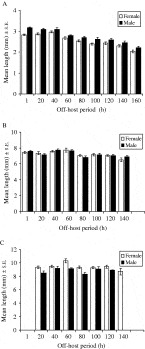
Fig. 2. Mean length of female and male Argulus coregoni measured within groups kept off-host for certain periods before infection. (A) Body lengths after 21 days; (B) body lengths after 42 days; (C) body lengths after 50 days maintenance on rainbow trout (Oncorhynchus mykiss) under constant laboratory conditions.

Fig. 3. Daily growth rates of (A) female and (B) male Argulus coregoni counted from 0 to 21 days, 21 to 42 days and 42 to 50 days of maintenance on rainbow trout (Oncorhynchus mykiss) under laboratory conditions.

Table 2. Relative persistence of Argulus coregoni on rainbow trout (Oncorhynchus mykiss) following settlement
 You have
Access
- 14
- Cited by