Introduction
Handaxes are bifacially worked stone tools that were made by several hominin species throughout Africa, the Middle East, Asia and Europe over a period of 1.5 million years (c. 1.8–0.2 million years bp) and constitute the index fossil of the Acheulean technocomplex (Beyene et al. Reference Beyene, Katoh and Woldegabriel2013; de la Torre Reference de la Torre2016; Iovita et al. Reference Iovita, Tuvi-Arad, Moncel, Despriée, Voinchet and Bahain2017; Lepre et al. Reference Lepre, Roche and Kent2011; Schick & Toth Reference Schick and Toth2017; Shipton Reference Shipton2018; Reference Shipton, Overmann and Coolidge2019a; Stout et al. Reference Stout, Apel, Commander and Roberts2014; Wynn Reference Wynn2002).
The huge spatiotemporal span and archaeological prevelance of handaxes has resulted in extensive research. Modern handaxe research generally draws from three interlinked apsects: their function, their manufacture and subsequent morphology, and their social significance.
Handaxe function was historically the earliest area of interest, with Frere (Reference Frere1797, 204) interpreting them as ‘weapons of war’. Later functional hypotheses ranged from handaxes being seen as a Swiss Army Knife type multi-tool (Schick & Toth Reference Schick and Toth1993), to more questionable interpretations such as thrown projectiles (Jeffreys Reference Jeffreys1965) and parts of ground traps (Wayman Reference Wayman2010). Given the vast spatiotemporal range of the Acheulean, many authors have been rightly cautious in applying a one-size-fits-all functional interpretation. There are, however, functional interpretations based on experimental approaches, use-wear and residue analysis and archaeological context which suggest they were primarily butchery tools (Keeley Reference Keeley1977; Mitchell Reference Mitchell1998; Schick & Toth Reference Schick and Toth1993; Solodenko et al. Reference Solodenko, Zupancich, Cesaro, Marder, Lemorini and Barkai2015).
The highly skilled and refined nature of later Acheulean handaxes has led some authors to postulate that, as well as being utiltarian tools, they held social significance. One of the most widely discussed is the ‘sexy handaxe hypothesis’ (Kohn & Mithen Reference Kohn and Mithen1999), which views the over-elaboration in design as a form of costly signalling analagous to a peacock's tail.
The complexity of manufacture has also generated debate over how handaxe production is learned, focusing on two linked aspects of social learning. First, what social learning mechanisms are involved: are complex mechanisms like teaching necessary, or are procedurally focused passive learning, i.e. imitation, or product-based passive learning, i.e. emulation, sufficient (Lycett Reference Lycett, Overmann and Coolidge2019; Morgan et al. Reference Morgan, Uomini and Rendell2015)? Secondly, what social learning modes are more likely: i.e. vertical transmission from parents to offspring, or more culturally extended modes such as many to one, or horizontal (Lycett & Gowlett Reference Lycett and Gowlett2008)?
Despite exhibiting morphological variation and differing methods of, and techniques in, manufacture, handaxes do appear to share common morphological features (Coolidge & Wynn Reference Coolidge and Wynn2009; Herzlinger et al. Reference Herzlinger, Wynn and Goren-Inbar2017; Li et al. Reference Li, Kuman, Lotter, Leader and Gibbon2017; Roberts & Parfitt Reference Roberts and Parfitt1999; Sharon Reference Sharon2010; Shipton Reference Shipton2018; Stout et al. Reference Stout, Apel, Commander and Roberts2014; Wynn & Gowlett Reference Wynn and Gowlett2018). This ‘variable sameness’ (Isaac Reference Isaac1977) is considered by some as evidence of the social transmission and intentional imposition of a ‘mental template’ by hominins (Gowlett Reference Gowlett and Foley1984; Pelegrin Reference Pelegrin, Berthelet and Chavaillon1993; Reference Pelegrin, Roux and Bril2005; Wynn Reference Wynn1995; Reference Wynn2002; Wynn & Berlant Reference Wynn, Berlant, Overmann and Coolidge2019). Others suggest that the handaxe shape ‘template’ was partly under genetic control (Corbey et al. Reference Corbey, Jagich, Vaesen and Collard2016).
Whichever the explanation, many consider handaxes to be the first evidence of intentional shaping and purposeful symmetry which constituted a ‘mental template’ that was imposed on the material world by our hominin ancestors. This view, however, has been recently challenged by those who see form as not imposed by a ‘mental template’, but emergent in action (Malafouris Reference Malafouris2013). Addressing this debate will be the main focus of this paper.
Background to imposition versus emergence debate
The ‘mental template’ approach
Traditional cognitive archaeological approaches to the Acheulean and to handaxe morphology promote the idea of hominins possessing an internal ‘mental template’ for the bifacial form that is then realized externally in the material (Gowlett Reference Gowlett and Foley1984; Pelegrin Reference Pelegrin, Berthelet and Chavaillon1993; Reference Pelegrin, Roux and Bril2005; Wynn Reference Wynn1995; Reference Wynn2002). The general shape, or end-goal, a knapper intends to produce and the actions they aim to perform exist before manufacture begins, as well as during the process.
The implementation of symmetry to handaxes is considered part of the ‘mental template’ approach also. Its significance has been debated in multiple ways: testing symmetry's relation to the functional effectiveness of a handaxe for butchery (Machin et al. Reference Machin, Hosfield and Mithen2007), investigating it as an indicator of greater skill (Hodgson Reference Hodgson2015; McNabb & Cole Reference McNabb and Cole2015; McNabb et al. Reference McNabb, Cole and Hoggard2018; Schick & Toth Reference Schick and Toth2017; Shipton Reference Shipton2018; Shipton & Nielsen Reference Shipton, Nielsen, Di Paolo, Di Vincenzo and De Petrillo2018; White & Foulds Reference White and Foulds2018), as well as symmetry possibly being socially significative of status (Machin Reference Machin2009) or reproductive ‘fitness’ (Kohn & Mithen Reference Kohn and Mithen1999). Whatever its significance, symmetry is generally considered a purposeful consideration (McNabb & Cole Reference McNabb and Cole2015; White & Foulds Reference White and Foulds2018; Wynn & Berlant Reference Wynn, Berlant, Overmann and Coolidge2019).
Using a ‘mental template’ to explain handaxe production, however, is argued by some (Ingold Reference Ingold2000; Reference Ingold2013; Malafouris Reference Malafouris, Malafouris and Renfrew2010; Reference Malafouris2013) to be hylomorphic (giving form to the material) and too rigid, neglecting the agency of the material substrate in the production of an artefact. Yet Pelegrin (Reference Pelegrin, Berthelet and Chavaillon1993), a ‘mental template’ proponent, notes that no one knapping process is exactly reproducible due to the variability of the raw material driving constant correction of the state of the stone. Therefore, material agency is not overlooked, but principal agency is given to the knapper's ability to bypass material hurdles and produce the mental image desired.
Indeed, even when raw material is attributed greater agency, in Ashton and McNabb (Reference Ashton, McNabb, Ashton and David1994) and White's (Reference White1998) raw material hypotheses, hominins were still thought of as possessing an internal mental template. Both sets of authors proposed that raw material type, size and quality were the principal determining factors affecting handaxe morphology, but when raw material constraints were fewer it allowed hominins to realize their ‘preferred’ generalized templates (Emery Reference Emery2010; White Reference White1998). However, Bridgland and White's (Reference Bridgland and White2014; Reference Bridgland and White2015) recent research indicating chronological patterning in handaxe variation and Eren et al.'s (Reference Eren, Roos, Story, Von Cramon-Taubadel and Lycett2014) experimental study challenge the raw material hypothesis.
However, others have suggested that handaxes were the unintended consequences of exhausting a core for flake production (Davidson Reference Davidson and Wray2002; Davidson & Noble Reference Davidson, Noble, Gibson and Ingold1993; Noble & Davidson Reference Noble and Davidson1996). Alternatively, McPherron's (Reference McPherron1994) re-sharpening hypothesis implies that biface shape variability is a by-product of the re-sharpening of handaxes as they became blunted through use. However, these hypotheses cannot be universally applied. For example, although Iovita and McPherron (Reference Iovita and McPherron2011) apply the re-sharpening hypothesis to Boxgrove handaxes, they do not present any direct evidence of re-sharpening other than shape analysis by size. In fact, Shipton and Clarkson (Reference Shipton and Clarkson2015), McNabb (Reference McNabb2017) and García-Medrano et al. (Reference García-Medrano, Ollé, Ashton and Roberts2019) found that the shape of Boxgrove handaxes was consciously conserved independently of reduction intensity or methods—suggesting imposition of a purposeful shape.
More broadly, Shipton and Clarkson (Reference Shipton and Clarkson2015) find that raw material dimensions, quality or type do not influence the pattern of shape variability among British handaxes. Following Bridgland and White's (Reference Bridgland and White2014; Reference Bridgland and White2015) work, they argue that similarities in shape among handaxes of broadly similar age can be related to cultural ‘traditions’ that shared ‘mental templates’ (Shipton & Clarkson Reference Shipton and Clarkson2015).
Key (Reference Key2019) and Key and Lycett's (Reference Key and Lycett2017) research agrees with handaxe planform shape reflecting cultural traditions/templates. Key and Lycett's (Reference Key and Lycett2017) experimental investigations showed that handaxe planform shape variation can occur independently of cutting efficiency. Additionally, Key's (Reference Key2019) comparative analysis of archaeological and experimentally made handaxes showed that archaeological handaxes in profile display decreased variability compared to their planform shape. Key (Reference Key2019) argues lower profile shape variability represents functional constraints on the use of handaxes and suggests that increased planform shape variability may demonstrate its non-functional significance and its susceptibility to cultural drift.
Therefore, handaxe planform design was changeable, while remaining functional. Why, then, do sites like Boxgrove exhibit such morphological similarity? Is this evidence of a socially transmitted ‘mental template’? What social transmission processes limited the range of handaxe shapes produced, when handaxe shape is particularly prone to copying error (Kempe et al. Reference Kempe, Lycett and Mesoudi2012; Schillinger et al. Reference Schillinger, Mesoudi and Lycett2014)?
Schillinger et al.'s (Reference Schillinger, Mesoudi and Lycett2015) experimental study using modern human participants claimed that imitation is superior to emulation in reducing copying error of the ultimate handaxe produced, because imitation constitutes the copying of another's actions, not just the final product (Wynn & Berlant Reference Wynn, Berlant, Overmann and Coolidge2019). Lycett (Reference Lycett, Overmann and Coolidge2019) argues that imitation could produce the patterns we see in the Acheulean, yet proposes that a range of social transmission methods may occur in one learning context. Shipton (Reference Shipton, Overmann and Coolidge2019a), however, suggests that imitation, and even over-imitation, would have been insufficient to transmit difficult behaviours, such as platform preparation, seen in Late Acheulean handaxes. Indeed, Morgan et al. (Reference Morgan, Uomini and Rendell2015) showed, experimentally, that transmission improves with purposeful teaching, which they suggest may have been necessary for the transmission of more complex Acheulean biface technology.
Whatever social transmission methods were employed in the Acheulean, those discussed suggest that specific actions can be imposed by hominins on the material substrate, so long as the template can be transmitted and understood. However, as Pargeter et al.'s (Reference Pargeter, Khreisheh and Stout2019; Reference Pargeter, Khreisheh, Shea and Stout2020) experimental research demonstrates, considerable motivation is needed to become skilled enough to replicate a ‘mental template’. This suggests that trial-and-error learning was necessary in becoming skilled (Lycett Reference Lycett, Overmann and Coolidge2019) and social transmission methods were limited in aiding learners to recreate handaxe forms. Such a view is supported by opponents to the ‘mental template’ approach.
The ‘emergent’ approach
Opponents to the internalist notion of a ‘mental template’, such as proponents of Material Engagement Theory (MET), argue that the maker does not possess the finished form in their mind before imposing it on the material during production. Instead, they argue that the form of artefact emerges from their engagement with the material during manufacture (Knappett Reference Knappett, DeMarrais, Gosden and Renfrew2004). Such engagement ‘brings forth’ (Malafouris Reference Malafouris2013, 173) the knapper's intention that is constituted by the possibilities the material ‘affords’ (Gibson Reference Gibson1979). Intentions and affordances are relational products of material engagement in the specific knapping action, rather than inherent properties of people and things that exist outside their engagement (Malafouris Reference Malafouris, Malafouris and Renfrew2010; Reference Malafouris2013; Reference Malafouris2020).
Regular engagement with the material develops one's skills and their embodied understanding of sensorimotor contingency. Practical know-how, or ‘savoir-faire’ (Pelegrin Reference Pelegrin1990; Reference Pelegrin1991), does not develop by using a ‘mental template’, but through repeated experience of a task and acquiring an external memory, or repository, of the sensory consequences of behaviours (Degenaar & O'Regan Reference Degenaar and O'Regan2017; Friston Reference Friston2009; Reference Friston2010; Reference Friston, Tschacher and Bergomi2011; Friston et al. Reference Friston, Daunizeau and Kiebel2009; Reference Friston, Daunizeau, Kilner and Kiebel2010; Reference Friston, Mattout and Kilner2011; Iliopoulos Reference Iliopoulos2019; O'Regan & Noë Reference O'Regan and Noë2001). This repository, or ‘body schema’, is a non-conscious system that regulates the proprioceptive, or kinaesthetic, sense of the body's movement and is updated by the sensory inputs with which it is supplied (i.e. visual, auditory, haptic/touch and motor) (Bruner & Iriki Reference Bruner and Iriki2016; Clark Reference Clark2007; Hirose Reference Hirose2002; Holmes & Spence Reference Holmes and Spence2004; Iriki Reference Iriki2006; Malafouris Reference Malafouris2020; Maravita & Iriki Reference Maravita and Iriki2004; Miller et al. Reference Miller, Longo and Saygin2014). The artefacts an individual produces are the result of this embodied knowledge.
This highlights to Malafouris (Reference Malafouris2013) that intention is ‘discovered in action’: flake removal is related to the behaviour of the material and not the knapper's pre-planned intentions. In this way, artefact form grows in action through the engagement of human intentionality with material affordance (Malafouris Reference Malafouris2013).
Malafouris (Reference Malafouris2020) uses the notion of ‘skilled intentionality’ to describe a person's ability to distinguish relevant material affordances in action and rationalizes that there can be intentionality without specific preconceived mental content. Separately, Bruineberg and Rietveld (Reference Bruineberg and Rietveld2014) describe this as ‘optimal grip’ on such affordances. This ‘grip’, as Malafouris (Reference Malafouris2020) explains, is not reflective or conscious but is, in fact, an unreflective and subconscious ability developed through repeated experience.
This ‘ecological approach’ is used by Malafouris (Reference Malafouris2020), specifically in the context of handaxe manufacture, to argue that normative standards and constraints regarding aspects of the technical process can develop and be maintained over time as part of a groups’ skilled activity. He disagrees with the notion that normative standards are necessarily established by groups through sharing ‘mental templates’ consisting of conscious intentions (Malafouris Reference Malafouris2020).
However, this approach does not deal with the social learning aspect of becoming skilled. As noted above, handaxe manufacture, especially in the Late Acheulean, may have necessitated teaching within complex social environments (Machin Reference Machin2009; Morgan et al. Reference Morgan, Uomini and Rendell2015; Shipton Reference Shipton, Overmann and Coolidge2019a). This may suggest that handaxe assemblages exhibiting a consistent shape design across multiple generations, such as at Boxgrove (García-Medrano et al. Reference García-Medrano, Ollé, Ashton and Roberts2019; McNabb Reference McNabb2017; Pope Reference Pope2002; Roberts & Parfitt Reference Roberts and Parfitt1999; Wynn & Berlant Reference Wynn, Berlant, Overmann and Coolidge2019), may result from conscious, internal representations of what constitutes acceptable handaxe shape design being socially shared by a group. This does not contradict the notion that ‘skilled intentions’ emerge unreflectively in action due to individuals possessing embodied understanding of the knapping process. In fact, we agree that the specific content of one's intentions is discovered in action and partly constituted by the material being worked (Malafouris Reference Malafouris2013; Reference Malafouris2020). Nevertheless, we propose that specific knapping intentions contributing to ultimate handaxe shape simultaneously exist in the mind of the knapper and may constrain the emergence of the ultimate form.
We use Boxgrove as a case study and the concept of ‘communities of practice’ below to test this notion.
Boxgrove as a case study
Boxgrove, West Sussex, dated to MIS 13 (524,000–478,000 bp) yields one of the finest collections of handaxes in Britain (Roberts & Parfitt Reference Roberts and Parfitt1999). Handaxes found within the Unit 4c palaeosol, formed over 10–100 years, are found in primary context on near-contemporary surfaces spread over a wide area (Pope Reference Pope2002).
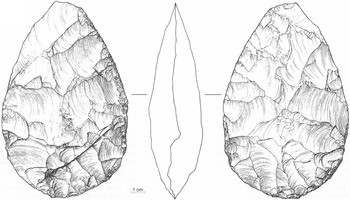
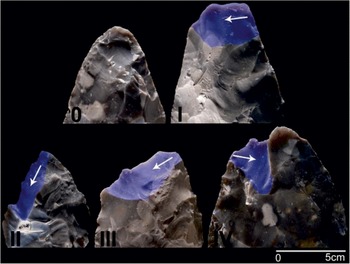
Boxgrove handaxes are, in general, ovate and highly refined (Fig. 1). They also exhibit platform preparation, and many display tranchet removals at the tip (Fig. 2) (García-Medrano et al. Reference García-Medrano, Ollé, Ashton and Roberts2019; Leroyer Reference Leroyer2016; McNabb Reference McNabb2017; Pope Reference Pope2002; Roberts & Parfitt Reference Roberts and Parfitt1999; Stout et al. Reference Stout, Apel, Commander and Roberts2014). The raw material used by hominins in this coastal landscape eroded out of nearby chalk cliffs and therefore was of superior quality to flint found in gravels (Pope Reference Pope2002; Roberts & Parfitt Reference Roberts and Parfitt1999).
Planform and profile views of handaxe no. 150 from Unit 4C at Boxgrove. Handaxe orientated with tip at top of image. Sinuous central line in profile view denotes edge. (Source: Roberts et al. Reference Roberts, Parfitt, Pope, Wenban-Smith, Macphail, Locker and Stewart1997)

Distal (tip) ends encountered at Boxgrove: type 0, no tranchet removals; type I, distal tranchet: a transverse blow producing a straight or convex tip; type II, lateral-distal tranchet: longitudinal blow, long lateral edge and shorter distal (tip) edge; type III, invasive tranchet: often deriving from successive phases of oblique tranchet retouch, or perhaps an overshooting of intended outcome; type IV, unsuccessful tranchet: produced when force does not go far enough across the face of the piece and ends with breakage of distal tip. (Source: García-Medrano et al. Reference García-Medrano, Ollé, Ashton and Roberts2019.)

The handaxes vary greatly in size but exhibit a remarkable similarity in shape (García-Medrano et al. Reference García-Medrano, Ollé, Ashton and Roberts2019; McNabb Reference McNabb2017; Wynn & Berlant Reference Wynn, Berlant, Overmann and Coolidge2019). The variation in size was due to the different size of nodules available, but also to the fact that some were made on nodules and others on flakes (García-Medrano et al. Reference García-Medrano, Ollé, Ashton and Roberts2019; Pope Reference Pope2002; Roberts & Parfitt Reference Roberts and Parfitt1999).
In terms of explaining the slight variance in shape, McNabb (Reference McNabb2017) adapted Lycett and von Cramon-Taubadel's (Reference Lycett and von Cramon-Taubadel2008) calculation of handaxe shape variance to investigate variation among Boxgrove handaxes and those from two other contemporary sites (c. 500,000 bp): Olduvai Bed IV, Tanzania, and Cave of Hearths, South Africa. Boxgrove handaxe shape exhibits the lowest overall variance of the three sites, except for the tip (McNabb Reference McNabb2017). The greater tip variance at Boxgrove can be explained by the predominant technological feature of tranchet sharpening, a removal which can cause truncation of handaxes (Leroyer Reference Leroyer2016; Shipton Reference Shipton, Henley, Rossano and Kardas2019b; Shipton & Clarkson Reference Shipton and Clarkson2015; White Reference White, Goren-Inbar and Sharon2006).
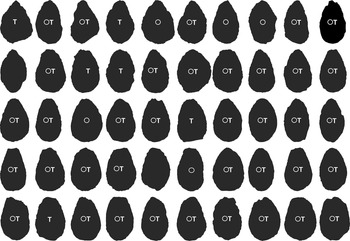
Significantly lower variance below the tip of Boxgrove handaxes led McNabb (Reference McNabb2017, 405) to conclude that Boxgrove knappers were reproducing a ‘relatively standardised template’. McNabb's (Reference McNabb2017) randomly chosen sample of 50 handaxes from Unit 4c (Fig. 3) demonstrates the similarity of the Boxgrove design (Lycett & Gowlett Reference Lycett and Gowlett2008)). McNabb (Reference McNabb2017) and Wynn and Berlant (Reference Wynn, Berlant, Overmann and Coolidge2019) both propose that this regularity in handaxe shape at Boxgrove is the best available evidence for social group influences affecting individual handaxe manufacture.
The planform outlines of a randomized sample of handaxes from Unit 4c at Boxgrove. (Source: McNabb Reference McNabb2017.)

In addition, García-Medrano et al.'s (Reference García-Medrano, Ollé, Ashton and Roberts2019) analysis of the considerable assemblage of handaxes from area Q1/B (n = 358) at Boxgrove shows heterogenous handaxe sizes but homogenous ultimate shapes. García-Medrano et al. (Reference García-Medrano, Ollé, Ashton and Roberts2019) argue that, despite raw material size and shape differences and highly variable reduction sequences, there is a ‘standardized’ shape attempted by Boxgrove knappers. They explain that initial dimensions were circumvented to achieve a ‘common goal’ towards the latter stages of manufacture. We agree with García-Medrano et al. (Reference García-Medrano, Ollé, Ashton and Roberts2019, 416) that the end goal of the operational chain exists in the knapper's mind; however, we do not agree that the ‘pathways to production’ were set beforehand as it would not be possible to predict a nodule's internal character.
Similarly, Shipton and White's (Reference Shipton and White2020) analysis of multiple British sites, including Boxgrove, show that similarity within assemblages and variation between them is not driven by rock or blank type, but can be explained by normativity. Shipton and White (Reference Shipton and White2020) suggest that to reproduce similar forms over extended periods of time, makers would have had to recognize them as particular types linked to a socially shared understanding of expected norms of handaxe shape.
Continuity in handaxe shape at Boxgrove is likely to reflect a consolidation of a shared goal over multiple generations being socially learned. The specifics of social transmission are still up for debate and are not our principal focus of investigation. However, given the complexity of handaxe manufacture, we would agree with Morgan et al. (Reference Morgan, Uomini and Rendell2015) that some form of basic teaching, in addition to imitation (Lycett Reference Lycett, Overmann and Coolidge2019), was necessary to aid learning and communicate the preference for a certain form.
Communities of practice
Lave and Wenger's (Reference Lave and Wenger1991) concept of ‘communities of practice’ can help explain how, with some form of teaching (Morgan et al. Reference Morgan, Uomini and Rendell2015; Shipton & Nielsen Reference Shipton, Nielsen, Di Paolo, Di Vincenzo and De Petrillo2018), the consolidation of handaxe design by Boxgrove knappers over multiple generations was driven by adherence to social norms. Additionally, it points to how handaxe similarity could relate to a shared identity.
Key aspects of this approach explain that a deeper social meaning associated with a community of practice is developed and negotiated by individuals in groups participating in a shared history of learning (Wenger Reference Wenger1998). First, the individual learner has to invest in becoming a skilled member. Secondly, motivation of all participants (experienced and inexperienced) is required to reproduce meaningful practice and community identity (Wenger Reference Wenger1998).
Group membership thus relates to ‘regimes of competence’ (Wenger Reference Wenger1998, 136–7). Competent membership requires members of a community to engage with each other, negotiate the direction of their joint enterprise and take responsibility for the realization of the stated goal through ‘regimes of accountability’ (Wenger Reference Wenger1998, 81). Through the production of a shared repertoire of actions and artefacts, members make material the abstract ideas related to their membership and identity (Wenger Reference Wenger1998).
Despite Knappett's (Reference Knappett2011) alternative viewpoint that considers artefacts’ ability actively to ‘scaffold’ (Stout Reference Stout2002) the learning process, the motivation for learners to adhere to a joint enterprise is driven by human agents. Community members apply and share specifications of meaning, i.e. through teaching, to a practice in context (Wenger Reference Wenger1998). This shared meaning (the signified) underscores, constrains and affects individual and group behaviour towards the ultimate acceptably formed handaxe (or signifier) and contributes to decreased variance (Knappett Reference Knappett, Malafouris and Renfrew2010). Within a ‘community of practice’ the signifier is meaningful in that it is the expression of social norms (the signified) already in existence. However, it is important to note that it also brings forth the shared social norms once reproduced. This can contribute to the replication of homogenous forms among knappers related in practice over time (e.g. Boxgrove). The handaxe icon refers to and confers social norms, which arguably demonstrates the primary importance of human actors (Iliopoulos Reference Iliopoulos2020; Knappett Reference Knappett, Malafouris and Renfrew2010).
A useful illustration of the engagement of human and non-human agents in the consolidation of a coherent ‘community of practice’ amongst toolmakers is provided by the modern-day Langda adze-makers of Indonesian Irian Jaya (Knappett Reference Knappett2011; Stout Reference Stout2002; Wenger Reference Wenger1998). The Langda imbue the lithic raw materials with intentionality, perceiving them as living subjects that grow and age as people do (Coward & Gamble Reference Coward, Gamble, Malafouris and Renfrew2010; Stout Reference Stout2002). Moreover, care must be taken to avoid angering pieces through improper practice (Coward & Gamble Reference Coward, Gamble, Malafouris and Renfrew2010; Stout Reference Stout2002). For the Langda, social relations and identity are critical components of stone-adze production, and the formal apprenticeships, that take place over a number of years, reiterate a correct way of doing things. By maintaining correct procedure, one preserves a link to the past and the ways of one's ‘community of practice’ (Coward & Gamble Reference Coward, Gamble, Malafouris and Renfrew2010; Stout Reference Stout2002).
Although they cannot be used as a direct proxy for the past, the Langda provide an example of how social groups can constrain the actions of group members during their general development, as well as specific intentions in action. In order to become skilful, one must develop embodied, non-declarative, procedural knowledge of the practice, i.e. savoir-faire. However, Stout's (Reference Stout2002) study suggests that declarative, conceptual knowledge cannot be separated rigidly from embodied knowledge (Knappett & van der Leeuw Reference Knappett and van der Leeuw2014). Embodied knowledge develops as part of a social process of learning that uses conceptual, declarative knowledge to distribute and instill the shared meaning and enterprise of the practice as part of a ‘helical curriculum’ (Knappett Reference Knappett2011; Knappett & van der Leeuw Reference Knappett and van der Leeuw2014; Stout Reference Stout2002; Whiten Reference Whiten2015). This provides the necessary motivation for learners to continue practising in a certain way (Botha Reference Botha2015; Terashima Reference Terashima, Akazawa, Nishiaki and Aoki2013).
On one hand, we agree with Malafouris’ (Reference Malafouris2020) arguments that bodily movements cannot be controlled before action and that a skilled agent's actions can be normative yet unreflective, or subconscious, which is a result of an individual's ‘skilled intentionality’. On the other hand, we agree with Stout's (Reference Stout2002) study of the Langda that there are also simultaneous reflective intentions occurring during manufacture that relate to the social norms of the group one belongs to. They form a model for correct action that exists prior to and during action.
In essence, there are two levels of intentions that are socially influenced: unreflective and embodied intentions that result from the development of skill within a socially constrained environment, and reflective intentions imposed on production that are referred to consciously by the knapper in action. The former are emergent and relate to an agent's sensorimotor memory of the knapping task; the latter are imposed and relate to the normative model of acceptable action. This way, a knapper's emergent, subconscious intentions can maintain normative standards but are not completely separated from the conscious referral by an agent to a mental model they have of acceptable manufacture. The specific content of one's intentions cannot be foreseen in full detail prior to manufacture. Based on their embodied memory of prior experience, however, a knapper can intend the actions they expect to make prior to the material affordances emerging.
Evidence for this can be found at Boxgrove. Despite variable raw materials and reduction processes, the repeated reproduction of similar handaxe shapes over multiple generations indicates that a shared goal did impose constraints on the emergence of handaxe shape. Therefore, the concepts of normativity and ‘communities of practice’ help frame the imposition versus emergence debate discussed here. The pattern at Boxgrove indicates that handaxe shape was both imposed and emergent. Broad knapping intentions were shared regarding handaxe shape, but the specific intentions in action were realized individually each time. An additional example of how intentions work on two levels is provided by the behaviour of tranchet sharpening at Boxgrove.
Tranchet sharpening was regularly applied by Boxgrove knappers and, as such, can be argued to be part of a generalized model held in their minds (García-Medrano et al. Reference García-Medrano, Ollé, Ashton and Roberts2019; Leroyer Reference Leroyer2016). In fact, Leroyer (Reference Leroyer2016) claims a pre-determination for it. However, as Malafouris explains, the specific tranchet flake action was not pre-planned in an accurate and specific way in the mind of the knapper, but emerged as possible at a specific point in action in relation to the prior intentions and expectations of the knapper and the affordances the material allowed at a specific point in the manufacture process.
To clarify, tranchet sharpening is both imposed before action (in terms of the knapper's intentions) and emergent in action, given the explanation above. The variability of tranchet removals shown in Figure 2 demonstrates that there was a conscious plan to remove a tranchet flake; however, it emerged differently each time.
Summary
We have utilized the notions of normativity and ‘communities of practice’ to demonstrate that the debate whether handaxe form was imposed or emergent can be resolved by situating handaxe manufacture in its social context. We propose that homogeneity of handaxe shape at Boxgrove resulted from the continual negotiation of a knapper's conscious understanding of what is socially acceptable with their own embodied knowledge.
The above discussion arguably demonstrates that Lave and Wenger's (Reference Lave and Wenger1991) and Wenger's (Reference Wenger1998) notions of mutuality of engagement, joint enterprise and shared repertoire are visible in the handaxe assemblage of Boxgrove.
Although Wenger (Reference Wenger1998, 76) states ‘homogeneity is [not necessarily] a requirement for, nor the result of, the development of a community of practice’, the homogeneity of handaxe morphologies at Boxgrove conceivably reflects a coherent ‘community of practice’. Boxgrove knappers adhered to regimes of competence and accountability over multiple generations which propagated socially specific and potentially meaningful handaxe design constituting a part of the broader community's identity (Wenger Reference Wenger1998).
The concepts of ‘communities of practice’ and normativity are used here to suggest that handaxe design at both individual and community level at Boxgrove was imposed and emergent. The dichotomy between imposition of a mental template and emergence should be dissolved.
Therefore, we suggest handaxe form emerges during manufacture in relation to the intentionality of the knapper (held prior to and during manufacture), its engagement with the affordances of raw material, and the knapper's skill level.
The intentionality of the knapper is related to communally held conceptions of design ‘acceptability’ that impose themselves onto individuals during their skill development. This results in emergent and unreflective, yet normative, embodied individual actions. However, acceptable practice is also consciously referred to by the individual. We agree with Morgan et al. (Reference Morgan, Uomini and Rendell2015) that some form of basic teaching was probably involved in transferring the criteria for acceptable handaxe manufacture from skilled individuals to unskilled learners.
As individuals become skilled, they develop subconscious sensory models of action that are necessarily influenced by their group's role in detailing what are acceptable outcomes of action, while simultaneously developing a declarative model of what they intend to do.
As outlined in our arguments above, the specific content of intentions in action are emergent and relate to the changing affordances of the material being worked. However, with experience, one is able to intend before any knapping takes place. Reflection on their embodied experiences allows them to predict certain actions before they do them. We submit that intentions regarding handaxe manufacture are both imposed and emergent because community constraints are held ‘within’ and ‘without’, or ‘prior to’ and ‘during’, individual knapping actions. Notions of ‘imposition’ and ‘emergence’ are not mutually exclusive and are both useful in understanding how handaxe shape is created.
Limitations and areas for future research
Our view that the dichotomy between imposition versus emergence of form should be dissolved has not been tested in practice. We suggest that ethnographic observation and questioning of modern-day flintknappers of differing skill levels would allow for a more detailed discussion. This approach would provide pertinent testimony regarding how intentions work, and whether knappers identify the two levels of intentions outlined here.
In addition, the efficacy of our conclusions would be tested more effectively if they were applied to other crafts and technologies in general. Although these areas for future research rely on indirect modern human data, we propose that resolving the imposition versus emergence debate in a modern context will aid future discussion of the Acheulean ‘mental template’ and relate it more to the specifics of skill development in the Acheulean.
Acknowledgements
We are thankful to Mark Roberts for permission to reproduce Figure 1, Paula García-Medrano for Figure 2 and John McNabb for Figure 3. The advice and comments of Antonis Iliopoulous, Nick Barton and the anonymous reviewers markedly improved previous drafts. Thank you to our respective funding bodies for providing us with the resources to produce this paper. Thank you also to Ophelia and Ben for their unwavering encouragement.