In the Act I finale of Vincenzo Bellini and Felice Romani’s La straniera, Arturo launches himself into a lake to save Valdeburgo, whom moments earlier he has stabbed. It is the screams of his beloved Alaide that alert him to the fact that the wounded man in the lake is her brother (not her lover, as Arturo had assumed) and occasion the rescue mission. The waves steal the two men’s breath, but Alaide is unable to reach them. Instead, she holds the discarded weapon in her hands and intones an aria about loss and love:
This is an aria about impossible distance, and the theme is one that runs through the opera as a whole. La straniera, like the Gothic novel L’étrangère (1825) by Victor-Charles Prévôt on which it is based, is all about the inaccessible, about that which lies beyond reach. Across the opera Alaide is burdened with a secret: she was once the Queen of France but her husband married another and banished her to a remote castle. In search of human contact, Alaide has moved into a hut near her brother’s estate on a lake in Brittany. Seen on occasion from a distance, she is a veiled and troublesome presence whom the locals label ‘la Straniera’ (the foreigner). She is unable to communicate with others and instead haunts their minds and commandeers their bodies. When Arturo seeks her out and the two reveal a mutual love, there can still be no true communication, since the secret alienates Alaide from her past and is simultaneously a barrier to her immersion in the present. To disclose her secret and breach the barrier would – as Gothic convention dictates – unleash untold violence.Footnote 1 Indeed, it is Alaide’s revelation in the final moments before ‘Un grido io sento’ that causes Arturo to submit to those waves. With both Arturo and Valdeburgo lost in the water, Alaide is accused of murder. Unable to tell the locals who she is or what has happened, she descends into delirium.
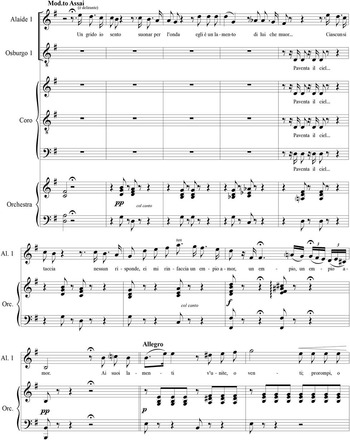
But it is an uncommonly measured delirium. The aria is in a truncated ABA form and in the initial two quatrains, which form the A section, Alaide hears groans but does not call out to either Arturo or Valdeburgo – the sound of the groans alone is allowed to breach the divide between the characters (Ex. 1). While the text cues the audience to listen for them, the groans are meanwhile inaudible to us: lingering imperfect cadences in the strings only draw attention to their absence. The most understated aspect of this aria, however, is the uncompromisingly syllabic manner in which the vocal line is locked to the text. While the penultimate quatrain, set as the B section, does introduce coloratura, Alaide’s is nonetheless a delirium that turns in on itself and reveals little about her interior world, so restrained and devoid of melisma is her music.
Alaide, ‘Un grido io sento’: aria from the Act 1 finale of La straniera.

The sound here is of course continuous with the bare tone of the opera as a whole. La straniera and to a lesser extent Il pirata (1827), which was also based on a Gothic text about an exile’s impossible love for another, were described at their premieres as almost radical in their use of anti-Rossinian canto declamato, a strictly syllabic setting of words.Footnote 2 While commentators at the time noted – sometimes with considerable alarm – that Bellini had banished the sorts of melodiousness and ornamentation that distorted words in order to ensure their clear articulation, this has since become a celebrated fact. Those same commentators ushered in another critical tradition, one that uses canto declamato as evidence that in the late 1820s Bellini became more sensitive to the nuances of words. It is a claim that has been bolstered by (now discredited) anecdotes about Bellini locked in his room with Romani’s text in hand, on an almost obsessive mission to understand the meaning that individual words could call forth.Footnote 3
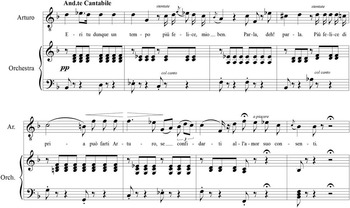
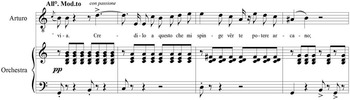
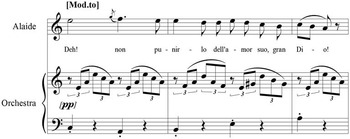
If it is somewhat curious that the communicative force of words should have been foremost in Bellini’s mind as he wrote a work about none other than the unutterable, the music of La straniera could also prompt us to reassess whether canto declamato in fact entails substantial commitment to both ideals. However much the texture enhanced clear articulation of words in La straniera, its most radical dimension was that it allowed Bellini to match the large-scale narrative turns of his text; less so the sense of individual words, for which he sometimes showed almost careless disregard.Footnote 4 Consider those moments before Alaide’s delirium when characters are overcome with her distant presence. Bellini does not fail to mark them all with the same, striking arioso texture – that is, a treatment of versi sciolti recitative as melodious lines, within a periodic phrase structure, that burst out of the texture. When in Act I Arturo reaches the Straniera’s hut and exclaims in secco recitative that an irresistible force detains him there to breathe the air she breathes, he chances on a portrait of her in her former life and commands her to speak, in an intense arioso (Ex. 2). The incantation seems to work, for she intones a romanza from a distance – wordless at first and accompanied with a harp – unaware that she can be heard. Moments later she takes control of Arturo and that same brilliant arioso marks the transition: she enters the hut and their recitative conversation soon slides into arioso as he concedes that a hidden power draws him towards her; she reacts in turn with her own arioso admission of love (Ex. 3a and 3b). This texture, so unusually prominent in this opera, here makes audible the invisible act of possession.Footnote 5 But it is only in a stark musical texture which slides between recitative and canto declamato that arioso can sound so liminal; that it can create the illusion that the impossible distance between characters is close to collapse.Footnote 6
Arturo, ‘Eri tu dunque un tempo’: arioso from Act 1 of La straniera.

Arturo, ‘Credilo a questo’: arioso from Act 1 of La straniera.

Alaide, ‘Deh! non punirlo’: arioso from Act 1 of La straniera.

Canto declamato creates the conditions under which arioso can measure the distance between Alaide and other characters, but its subdued sound also encodes something more fundamental about the Gothic world these characters inhabit. When Alaide is allowed to possess others, to control their bodies, arioso can mark that narrative turn. But when, in ‘Un grido io sento’, she must remain disconnected from those around her and conceal how Arturo and Valdeburgo came to harm, she resorts to a texture which leaves her sounding almost imprisoned as a result of the constant demand that her vocal line move in lockstep with each successive syllable. Canto declamato might, then, have liberated words from ornamentation and allowed them to be heard, but in tandem it created another sort of enclosure: this is not a traditional mad scene in the mould Bellini used in his later pastoral opera La sonnambula (1831), where judiciously placed flights of coloratura leave open the possibility that the heroine Amina can resist the forces which confine her.Footnote 7 Representational ambiguities in this aria are minimal by comparison.
Famously, Bellini was never so committed to canto declamato as in La straniera: the works that followed saw him return to an ornamentation much more reminiscent of Rossini. This has caused scholars some unease and even embarrassment; after all, the use of canto declamato in La straniera is so innovative and consistent that it seems to amount to a vision about how words and music can be held in an ideal balance, a vision that would foreshadow decisive directions in music–text relations in the later nineteenth century. But in its historical reach, this narrative overlooks a remarkable detail: that the distinctive sound of both Il pirata and La straniera reveals an aesthetic predicated on meaningful connections between canto declamato and the Gothic. The starkest moments of Il pirata are also reserved for the horror of being close to a loved one but unable to reach them, as in the heroine Imogene’s dream narration ‘Lo sognai, ferito, esangue’, where the novel texture works to withhold the momentum that the coloratura at the close of the cantabile allows, the slow pace hinting at the unreality Imogene experiences. While Bellini could indeed have intended the distinctive balance of words and music in these works to be a model for composition writ large, Imogene and Alaide’s roaming voices instead offer a rather more fantastic vision: that music can trace the elemental moves of Gothic texts.