1. Introduction
Dinosaurs originated, radiated and became the dominant vertebrate group in continental tetrapod communities of the world during most of the Mesozoic (Benton, Reference Benton1983; Brusatte et al. Reference Brusatte, Benton, Ruta and Lloyd2008, Reference Brusatte, Nesbitt, Irmis, Butler, Benton and Norell2010). An important part of their history is preserved in the sedimentary successions cropping out in Patagonia, Argentina (e.g. Casamiquela, Reference Casamiquela1964; Bonaparte & Vince, Reference Bonaparte and Vince1979; Salgado & Bonaparte, Reference Salgado and Bonaparte1991; Coria & Salgado, Reference Coria and Salgado1995; Novas, Reference Novas2009), ranging from the early stages after their origin in the Late Triassic up to their extinction in the uppermost Cretaceous rocks (see Novas, Reference Novas2009, and references therein). Nevertheless, the history is far from being completely known and any new data will be crucial to understand both the early radiation of Dinosauria in Patagonia and the first steps of the Mesozoic tetrapod fauna that evolved in Gondwana.
During the 1950s, a new dinosaurian track-bearing layer was found in a flagstone quarry in the Lower Jurassic age (pre-middle Pliensbachian; see below) Marifil Volcanic Complex (MVC), in the SE of Río Negro province, Patagonia, Argentina. To date, there have been no discoveries of vertebrate remains in the MVC. For the large temporal interval of c. 26Ma from the Rhaetian (uppermost Triassic) to the Pliensbachian (middle Early Jurassic), dinosaur remains have been very scarce in South America (Barrett et al. Reference Barrett, Butler, Moore-Fay, Novas, Moody, Clark and Sánchez-Villagra2008, Reference Barrett, Butler, Mundil, Scheyer, Irmis and Sánchez-Villagra2014; Martínez, Reference Martínez2009; Apaldetti et al. Reference Apaldetti, Martínez, Alcober and Pol2011; Pol, Garrido & Cerda, Reference Pol, Garrido and Cerda2011; Langer et al. Reference Langer, Rincón, Ramezani, Solórzano and Rauhut2014). This contrasts with the abundant information available from younger and older levels (e.g. Bonaparte, Reference Bonaparte1971; Báez & Marsicano, Reference Báez and Marsicano2001; Arcucci, Marsicano & Caselli, Reference Arcucci, Marsicano and Caselli2004; Salgado & Gasparini, Reference Salgado and Gasparini2004; Langer, Reference Langer2005; Rauhut et al. Reference Rauhut, Remes, Fechner, Cladera and Puerta2005; Pol & Powell, Reference Pol and Powell2007; de Valais, Reference De Valais2011; Pol, Rauhut & Becerra, Reference Pol, Rauhut and Becerra2011; Pol & Rauhut, Reference Pol and Rauhut2012).
This study aims to present, describe and analyse the new ichnological material found in the MVC. In addition, the biochronological and palaeobiogeographical significance of these dinosaur footprints is discussed in the context of the geological evolution and global tetrapod faunal composition of Patagonia and also Gondwana.
2. Geological setting
The MVC represents a large magmatic Mesozoic event in the eastern North Patagonian Massif, Argentina (Pankhurst et al. Reference Pankhurst, Leat, Sruoga, Rapela, Márquez, Storey and Riley1998, and references therein). It comprises a large volume of acidic (rhyodacites to rhyolites) ignimbrites with minor rhyolitic and andesitic lava flows, and sedimentary lenses interbedded within the acidic volcanic succession (Cortés, Reference Cortés1981). A variety of igneous rocks from the MVC have been dated by several radiometric methods (Rb–Sr, K–Ar, Ar–Ar and U–Pb), ranging from 221 to 165Ma (Cortés, Reference Cortés1981; Pankhurst et al. Reference Pankhurst, Leat, Sruoga, Rapela, Márquez, Storey and Riley1998, Reference Pankhurst, Riley, Fanning and Kelley2000; Féraud et al. Reference Féraud, Alric, Fornari, Bertrand and Haller1999, and references therein). Because of its overall rhyolitic composition and the proposed Jurassic age, the MVC has been included in the Chon Aike Large Silicic Igneous Province (Pankhurst et al. Reference Pankhurst, Riley, Fanning and Kelley2000).
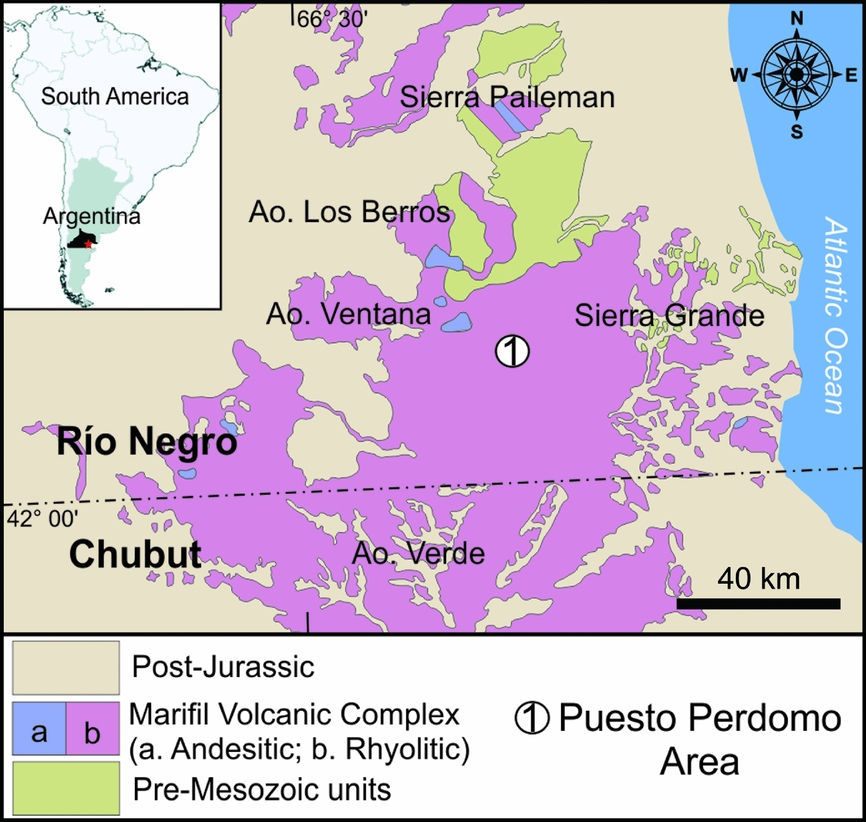
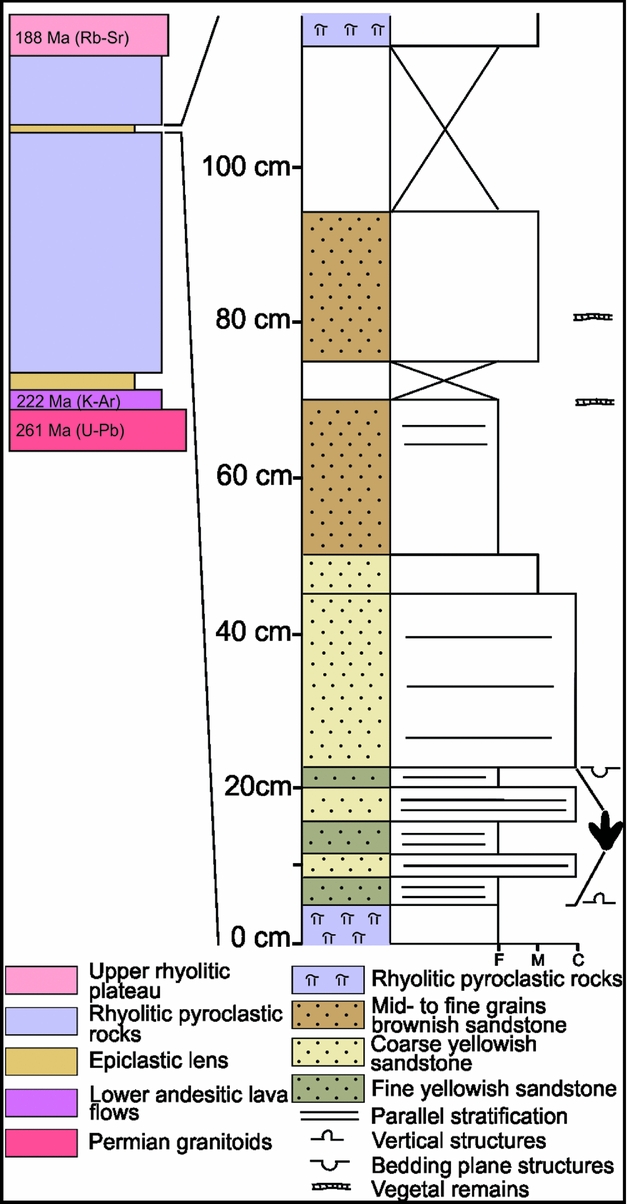
In the study area, rhyolitic ignimbrites of 188Ma (Rb–Sr age, in Pankhurst & Rapela, Reference Pankhurst and Rapela1995) overlay a series of acidic to mesosilicic igneous and pyroclastic rocks and thin epiclastic lenses. The ichnosite is located 50km SW of Sierra Grande, Río Negro province, in a farm owned by the Perdomo family (Fig. 1). The 30m succession containing the flagstone quarry, which had fielded the track-bearing slabs, is dominated by pyroclastic acidic flows with a thin volcanogenic epiclastic lens (Fig. 2). The track-bearing slabs are composed of coarse-grained light-pinkish sandstone with quartz, k-feldspar and pyroclastic material (ash and pumice fragments), which come from the base of the 1m thick epiclastic lens in the analysed succession (Fig. 2). The coarse sandstones are interbedded with fine-grained brownish sandstone on which the dinosaur probably stepped, given that the tracks studied here are the infill of the original footprints. At the top of epiclastic lenses, plant remains attributable to equisetals (M. G. Passalia & A. Iglesias, pers. comm., 2015) were found. Flat lamination and ripple marks are also present at the epiclastic levels.
Local geological map with the location of Sierra Grande – Arroyo de la Ventana area and the new dinosaurian track-bearing site.

General, simplified, stratigraphic section of MVC and detailed stratigraphic section of Perdomo's quarry. Ages are based on references in the text.

The described epiclastic rocks and dinosaur tracks are time-constrained by the andesitic rocks at the base of the MVC (221Ma, Carnian, Late Triassic) and the upper acidic rhyolitic ignimbrites at the top (188Ma, early Pliensbachian, Early Jurassic). Because of their acidic pyroclastic component precedent from the overlaying rhyolitic complex, the epiclastic lenses are assigned to the Early Jurassic gap of the Marifil Volcanism (pre-middle Pliensbachian) (Cortés, Reference Cortés1981; Pankhurst & Rapela, Reference Pankhurst and Rapela1995).
The thickness of the epiclastic succession and the observed palaeontological and sedimentological features suggest that the sedimentation occurred in a small fluvial system, where the sandstones correspond with the erosion of the ignimbrites infilling small palaeochannels by medium-energy currents. The volcanism of the MVC may have controlled the sedimentation and the development of the fluvial system.
3. Material and methods
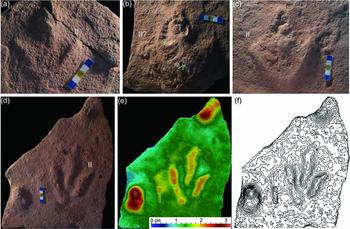
The tracks were collected in situ by the Perdomo family in the 1950s, from a flagstone quarry; in the 2000s, the material was donated to the Museo Regional Provincial de Valcheta, Valcheta town, Río Negro province, and housed under the acronym MRPV. The specimens are six trace fossils preserved as positive relief, in four sandstone slabs (Fig. 3). Their collection numbers are MRPV 427/P/13, 428/P/13, 429/P/13, 430/P/13.1, 430/P/13.2 and 430/P/13.3 (the last three specimens are in the same slab).
MVC dinosaur footprints. (a) MRPV 427/P/13; (b) MRPV 428/P/13; (c) MRPV 429/P/13; (d) MRPV 430/P/13; (e) false-coloured 3D depth analysis model of MRPV 430/P/13; and (f) contour line map with 1mm of equidistance of MRPV 430/P/13. Scale bar: 5cm. II: digit II impression.

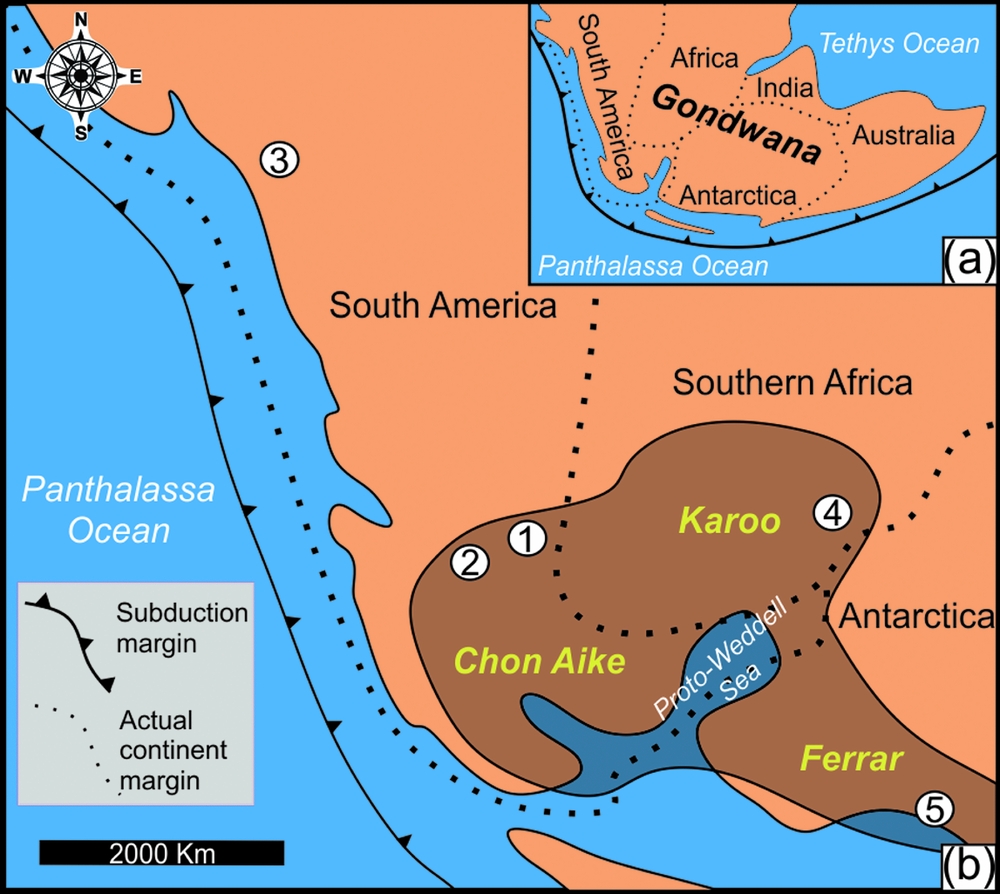
Palaeogeographic reconstruction of the SW Gondwana/Pangaea in the Late Triassic / Early Jurassic (based on Pankhurst et al. Reference Pankhurst, Riley, Fanning and Kelley2000; Golonka, Reference Golonka2007). (a) Regional view of the Gondwana landmass. (b) Detail of the reconstruction showing the Early Jurassic large igneous provinces of South Gondwana (Chon Aike, Karoo and Ferrar) and the distribution of the fossil localities mentioned in the text. 1. MVC tracksite; 2. Las Leoneras Formation; 3. Cañón del Colorado and Balde de Leyes formations; 4. Elliot Formation; and 5. Hanson Formation.

The ichnotaxonomic approaches to tridactyl footprints of Gierliński (Reference Gierliński1991), Olsen & Rainforth (Reference Olsen, Rainforth, LeTourneau and Olsen2003) and Li et al. (Reference Li, Lockley, Zhang, Hu, Matsukawa and Bai2012) have been followed. Measurements and nomenclature are mainly based on the criteria of Leonardi (Reference Leonardi1987) and Haubold (Reference Haubold1971). The measurements (Table 1) were: footprint length (FL), footprint width (FW), digit impression length (II, III and IV) and digit impression divarication angles (II–III, III–IV, II–IV). A further parameter is the ratio between the maximum height and the perpendicular transverse base of the anterior triangle (AT) formed by digit II, III and IV tip imprints (sensu Lockley, Reference Lockley2009, and references therein).
Measurements of MVC dinosaur footprints

Abbreviations: FL, footprint length; FW, footprint width; II: digit II length; III: digit III length; IV: digit IV length; II–III: angle between digits II and III; III–IV: angle between digits III and IV; II–IV: angle between digits II and IV; AT: anterior triangle. AT is an index and therefore dimensionless.
Photogrammetric models (Mallison & Wings, Reference Mallison and Wings2014) (Fig. 3) were obtained using Agisoft PhotoScan™ (version 0.8.5.1423) software (Grupo Aragosaurus, Universidad de Zaragoza License), and imported into Meshlab (version v1.3.3) and Paraview (version 3.14.1) software packages in which depth and contour line analysis was produced.
4. Results
The four pedal impressions are tridactyl, subsymmetric and mesaxonic. They are longer than wide and present the ‘heel’ impression almost directly or directly aligned with the axis of digit III impression.
MRPV 427/P/13 (Fig. 3a) is a natural cast, 131.3mm long and 100.3mm wide (length/width ratio: 1.31). The digit impressions are slender, longer than wide and are 55.5, 81 and 61mm long for digits II, III and IV imprints, respectively. Claw and pad impressions are not evident. The divarication angles are II–III 31°, III–IV 51° and II–IV 68°. The AT is 0.51.
MRPV 428/P/13 is a very irregular and poorly preserved natural cast, with a centimetric layer (undertrack cast) covering the footprint (Fig. 3b). The digit impressions are broad, wider than long. The track is about 172cm long and 135cm wide but we consider these measurements unrepresentative due to poorly-preservation.
MRPV 429/P/13 (Fig. 3c) is a natural cast that is 175mm long and 127mm wide (length/width ratio: 1.37). The digit impressions are slender and longer than wide. The digit III impression is 111mm long. The other digit impressions are too poorly preserved to provide reliable measurements. The divarication angle II–IV is 52°. The AT is 0.53.
The three impressions of MRPV430/P/13 are preserved as natural casts. MRPV 430/P/13.1 (Fig. 3d–f) is the best preserved. It is a footprint 187mm long and 128.3mm wide (length/width ratio: 1.46). The digit impressions are slender, longer than wide and show clear digital pad imprints. The digit II impression is shifted anteriorly with respect to digits III and IV, displaying a characteristic posteromedial notch, indicating this is a right pes. The relative digit lengths are III > IV > II (106, 81 and 71mm). The metatarsophalangeal pad trace is very clear, as well as the claw traces of digit II and III impressions, laterally and anteriorly directed respectively. The impression of digit IV projects slightly further than the digit II impression. The divarication angle II–IV is 58° (II–III is 19°, III–IV is 27°). The AT is 0.50. On the same slab, there are two ovoid traces positioned close to the tridactyl track MRPV 340/P/13.1 (Fig. 3d–f). One (430/P/13.2), of about 80mm diameter, is located 100mm on the left of the ‘heel’ impression, and the other (430/P/13.3), of about 50mm diameter, is 70mm in front of the anterior part of the digit III impression.
5. Discussion and conclusions
5.a. Ichnotaxonomy
The studied footprints display different kinds of preservation. With this in mind, the general and recurrent tridactyl shape shows that the tracks are all very alike and variation in the morphology may represent the product of taphonomical variability. Because of the observed preservational variants due to taphonomy, tracks were classified in different ichnotaxonomical levels, from the best-preserved track MPV 430/P/13.1, assigned to a higher ichnotaxonomical status, to the other three tracks. In fact, the poorly preserved MVP 427/P/13, 428/P/13 and 429/P/13 do not display sufficiently clear morphological details to undertake an ichnotaxonomical assignment with confidence.
The principal features shared by the footprints (i.e. tridactyl, roughly symmetrical, mesaxonic, longer than wide, ‘heel’ impression in line with the axis of digit III impression) are common in some theropod and ornithischian ichnotaxa, such as Anomoepus Hitchcock, Reference Hitchcock1848, Ornithomimipus Sternberg, Reference Sternberg1926, Saurexallopus Harris, Reference Harris1997 or Dinehichnus Lockley et al. Reference Lockley, dos Santos, Meyer and Hunt1998, among others (Wright, Reference Wright, Currie, Koppelhus, Shugar and Wright2004). MVP 428/P/13 presents broader digit impressions than the other three tracks, likely due to the natural-cast flattening phenomenon (Lockley & Xing, Reference Lockley and Xing2015). In the case of MVP 427/P/13, 428/P/13 and 429/P/13, their general features are approximately their whole description and they have no other peculiarities to relate them to a particular ichnotaxon. Therefore, we classify these footprints as indeterminate dinosaur footprints.
MPV 430/P/13.1 is the best-preserved specimen from the Perdomo site. It mainly differs from the typical Late Triassic–Early Jurassic theropod ichnotaxa Eubrontes Hitchcock, Reference Hitchcock1845, Anchisauripus Lull, Reference Lull1904 and Grallator Hitchcock, Reference Hitchcock1858 because the former is roughly symmetrical and presents a metatarsophalangeal pad impression in line with the axis of the digit III impression, while the latter are asymmetrical with the metatarsophalangeal pad impression laterally located.
MPV 430/P/13.1 displays similar ichnotaxobases to some ichnogenera that belong to the ornithischian ichnofamily Anomoepodidae Lull, Reference Lull1904 (i.e. symmetry, position and the shape of the metatarsophalangeal pad impression and digital pad impressions; Fig. 3d–f), such as Anomoepus, Moyenisauropus Ellenberger, Reference Ellenberger and Haughton1970, and Shenmuichnus Li et al. Reference Li, Lockley, Zhang, Hu, Matsukawa and Bai2012 (Anomoepus-like ichnotaxa in this work). These ichnogenera share several features (bipedal or quadrupedal trackways, pentadactyl hand prints and tridactyl or tetradactyl footprints), causing their ichnotaxonomy to be disputed. For instance, some authors have considered Moyenisauropus as a junior synonym of Anomoepus (Olsen & Galton, Reference Olsen and Galton1984; Olsen & Rainforth, Reference Olsen, Rainforth, LeTourneau and Olsen2003), while others argue that they are different ichnogenera (Gierliński, Reference Gierliński1999; Lockley & Gierliński, Reference Lockley and Gierliński2006; Dalman & Weems, Reference Dalman and Weems2013). Li et al. (Reference Li, Lockley, Zhang, Hu, Matsukawa and Bai2012) suggest that Shenmuichnus has a lower heteropody from Moyenisauropus and Anomoepus and the lack of claw impressions. Gierliński (Reference Gierliński1991) described Moyenisauropus more robust than Anomoepus (as in Shenmuichnus; sensu Xing et al. Reference Xing, Lockley, Zhang, You, Klein, Persons IV, Dai and Dong2016b) and with subequally lengthened digit impressions on the manus tracks. The MPV 430/P/13.1 footprint is gracile and preserves claw impressions, so we propose a relationship with Anomoepus. As noted above, the manus impression is important in the ichnotaxonomy of Anomoepus-like ichnotaxa. Close to MPV 430/P/13.1, there are two traces (MPV 430/P/13.2–3; Fig. 3d–f) that might be considered as manus impressions. Nevertheless, these impressions could also be interpreted as part of an undetermined, partial and poorly preserved distinctive trackway. Lockley & Gierliński (Reference Lockley and Gierliński2006) suggested that Anomoepus is hard to identify with confidence unless both manus and pes impressions were found. Therefore, we classified MPV430/P/13.1 as cf. Anomoepus due to its similarity to this ichnotaxon but lack of a clear manus impression.
5.b. Trackmaker affinity and South American coetaneous dinosaur diversity
The Anomoepus-like tracks have been related to ornithischian trackmakers by several authors (e.g. Lull, Reference Lull1904; Haubold, Reference Haubold1971; Olsen & Galton, Reference Olsen and Galton1984; Gierliński, Reference Gierliński1991; Olsen & Rainforth, Reference Olsen, Rainforth, LeTourneau and Olsen2003). A criterion has been the presence of the dinosaurian pes and the pentadactyl manus impressions (Olsen & Rainforth, Reference Olsen, Rainforth, LeTourneau and Olsen2003). These authors suggest that the manus track lacks enlarged digit I, II and III impressions, which is related to the manual phalangeal formula of Ornithischia. Within this clade, basal members of ornithischians, ornithopods or thyreophorans have been cited as possible trackmakers (e.g. Thulborn, Reference Thulborn1990; Gierliński, Reference Gierliński1999; Olsen & Rainforth, Reference Olsen, Rainforth, LeTourneau and Olsen2003; Li et al. Reference Li, Lockley, Zhang, Hu, Matsukawa and Bai2012). Therefore, Olsen and Rainforth (Reference Olsen, Rainforth, LeTourneau and Olsen2003) suggested that the producer of Anomoepus was a relatively small, gracile, facultatively bipedal ornithischian.
As stated above, dinosaur remains are very scarce in the Rhaetian–Pliensbachian of South America (Barrett et al. Reference Barrett, Butler, Moore-Fay, Novas, Moody, Clark and Sánchez-Villagra2008, Reference Barrett, Butler, Mundil, Scheyer, Irmis and Sánchez-Villagra2014; Martínez, Reference Martínez2009; Apaldetti et al. Reference Apaldetti, Martínez, Alcober and Pol2011; Pol, Garrido & Cerda, Reference Pol, Garrido and Cerda2011; Langer et al. Reference Langer, Rincón, Ramezani, Solórzano and Rauhut2014) and the studied tracks represent the first ichnological record from this time interval in the region. Moreover, if we are correct in our appraisal that the trackmaker of MPV 430/P/13.1 was an ornithischian, then the studied tracks would also repre-sent the second evidence of the occurrence of this clade in South America during the same time interval (the first is Laquintasaura venezuelae Barrett et al. Reference Barrett, Butler, Mundil, Scheyer, Irmis and Sánchez-Villagra2014, lowermost Hettangian La Quinta Formation, Venezuela). This find could confirm the presence of ornithischians in Patagonia between the Norian cf. Heterodontosaurus sp. from the Laguna Colorada Formation (Báez & Marsicano, Reference Báez and Marsicano2001), and the Toarcian Manidens condoriensis Pol, Rauhut & Becerra, Reference Pol, Rauhut and Becerra2011 and Heterodontosauridae indet. (Becerra et al. Reference Becerra, Pol, Rauhut and Cerda2016) from the Cañadón Asfalto Formation.
Prior to this study, only one Patagonian dinosaur had ever been documented from the Rhaetian–Pliensbachian lapse: the basal sauropodomoph Leonerasaurus Pol, Garrido & Cerda, Reference Pol, Garrido and Cerda2011, from the Sinemurian–Pliensbachian Las Leoneras Formation (Cañadón Asfalto basin, Chubut province; age sensu Cúneo et al. Reference Cúneo, Ramezani, Scasso, Pol, Escapa, Zavattieri and Bowring2013). The scarcity of vertebrate fossils from the Rhaetian–Pliensbachian time interval strongly contrasts with the abundant known fossil-bearing horizons from older (e.g. Casamiquela, Reference Casamiquela1964; Báez & Marsicano, Reference Báez and Marsicano2001; Pol & Powell, Reference Pol and Powell2007) and younger (e.g. Salgado & Gasparini, Reference Salgado and Gasparini2004; Rauhut & López-Arbarello, Reference Rauhut and López-Arbarello2008; de Valais, Reference De Valais2011; Pol, Rauhut & Becerra, Reference Pol, Rauhut and Becerra2011) deposits.
From out of Patagonia, there are only four records for the Rhaetian–Pliensbachian time interval in South America: (1) from Argentina, two basal sauropodomophs, Adeopapposaurus mognai Martínez, Reference Martínez2009, and Leyesaurus marayensis Apaldetti et al. Reference Apaldetti, Martínez, Alcober and Pol2011, were defined from the Lower Jurassic Cañón del Colorado Formation (Martínez, Reference Martínez2009) and Balde de Leyes Formation (Apaldetti et al. Reference Apaldetti, Martínez, Alcober and Pol2011; Colombi et al. Reference Colombi, Santi Malnis, Correa, Martínez, Fernández, Abelín, Praderio, Apaldetti, Alcober and Drovandi2015), respectively; and (2) from Venezuela, the basal ornithischian Laquintasaura venezuelae and the theropod Tachiraptor admirabilis Langer et al. Reference Langer, Rincón, Ramezani, Solórzano and Rauhut2014, have been defined from the lowermost Hettangian La Quinta Formation (Barrett et al. Reference Barrett, Butler, Moore-Fay, Novas, Moody, Clark and Sánchez-Villagra2008, Reference Barrett, Butler, Mundil, Scheyer, Irmis and Sánchez-Villagra2014; Langer et al. Reference Langer, Rincón, Ramezani, Solórzano and Rauhut2014).
In view of the above, the dinosaur footprints studied herein are an important finding because they provide new and valuable information about the scarce dinosaur record from South America during the uppermost Late Triassic– Early Jurassic. Furthermore, these tracks are the first vertebrate ichnological remains in this continent for the Rhaetian–Pliensbachian interval.
5.c. Biochronological and palaeobiogeographical inferences
Tetrapod footprints provide important data on the vertebrate record, both in space and in time distribution (Lucas, Reference Lucas2007). The footprints related to the Anomoepus-like ichnotaxa present a widespread geographical distribution and a particular temporal occurrence. Anomoepus-like footprints have been identified in the Early Jurassic from: (1) North America: USA (e.g. Olsen & Rainforth, Reference Olsen, Rainforth, LeTourneau and Olsen2003; Lockley & Gierliński, Reference Lockley and Gierliński2006; Dalman & Weems, Reference Dalman and Weems2013); (2) Europe: Poland (Gierliński, Reference Gierliński1991) and Italy (Avanzini, Gierliński & Leonardi, Reference Avanzini, Gierliński and Leonardi2001); (3) Asia: China (e.g. Lockley & Matsukawa, Reference Lockley and Matsukawa2009; Li et al. Reference Li, Lockley, Zhang, Hu, Matsukawa and Bai2012; Xing et al. Reference Xing, Lockley, Zhang, You, Klein, Persons IV, Dai and Dong2016b); (4) Oceania: Australia (e.g. Thulborn, Reference Thulborn1994); and (5) Africa: Lesotho (Ellenberguer, Reference Ellenberger and Haughton1970).
Other tracks related to the Anomoepus-like ichnotaxa from the Late Triassic of Poland (Niedźwiedzki, Reference Niedźwiedzki2011) and the USA (Baird, Reference Baird1964), and from the Middle Jurassic of China (Xing et al. Reference Xing, Lockley, Tang, Klein, Zhang, Persons IV and Ye2015, Reference Xing, Lockley, Tang, Klein, Zhang, Persons IV and Ye2016a) and Morocco (Belvedere et al. Reference Belvedere, Dyke, Hadri and Ishigaki2011) have been published. However, their ichnotaxonomical affinity or the proposed ages of the tracksites were questioned. Lockley & Gierliński (Reference Lockley and Gierliński2006) suggested that the Late Triassic tracks from the USA classified as ?Anomoepus isp. by Baird (Reference Baird1964) are indeed chirotheriid tracks. The Poland tracks cf. Anomoepus isp. are partly eroded and slightly deformed (Niedźwiedzki, Reference Niedźwiedzki2011), so it is difficult to relate them with confidence to this ichnogenus. The Middle Jurassic Anomoepus-like tracks of Morocco (Belvedere et al. Reference Belvedere, Dyke, Hadri and Ishigaki2011) and the Henan province of China (Xing et al. Reference Xing, Lockley, Tang, Klein, Zhang, Persons IV and Ye2016a) are similar in shape. These tracks have very slender digit impressions and narrow metatarsophalangeal pad impressions, being closer to an avian-like ichnotaxon than to Anomoepus. The Middle Jurassic tracks of Shensipus tungchuanensis Young, Reference Young1966, were first related to theropods (Young, Reference Young1966; Lockley et al. Reference Lockley, Jianjun, Rihui, Matsukawa, Harris and Lida2013). Recently, Xing et al. (Reference Xing, Lockley, Tang, Klein, Zhang, Persons IV and Ye2015) proposed the new combination Anomoepus tungchuanensis. Actually, the specimens are lost (sensu Xing et al. Reference Xing, Lockley, Tang, Klein, Zhang, Persons IV and Ye2015), and according to the original photographs they are poorly preserved (e.g. thin layer infill tracks, very shallow anterior surface; see Young, Reference Young1966), so a confident conclusion is not possible. The Anomoepus tracks from Shaanxi province, also in China (Xing et al. Reference Xing, Lockley, Tang, Klein, Zhang, Persons IV and Ye2015), originally determined as Middle Jurassic in age, have recently been included in Lower Jurassic layers based on detailed stratigraphic work (Wang et al. Reference Wang, Li, Bai, Gao, Dong, Hu, Zhao and Chang2016).
The age of MVC footprints is consistent with the known temporal distribution of Anomoepus-like tracks and may represent a spatially near-global biostratigraphic occurrence (Early Jurassic biochron) of this ichnotaxon (see Haubold, Reference Haubold and Padian1986; Lucas, Reference Lucas2007). In addition, this material represents the unique Anomoepus-like tracks from South America, increasing its record almost worldwide (except in Antarctic rocks).
The palaeobiogeographic connections between the vertebrate Gondwanan palaeofaunas during the Late Triassic–Early Jurassic have been widely recognized (e.g. Yates, Reference Yates2003; Langer, Reference Langer2005; Pol & Powell, Reference Pol and Powell2007; Bittencourt & Langer, Reference Bittencourt and Langer2011). Similarities have previously been noted among the basal sauropodomophs from the Norian Los Colorados Formation, Argentina (age sensu Kent et al. Reference Kent, Malnis, Colombi, Alcober and Martínez2014), and the Norian Caturrita Formation, Brazil (age sensu Langer & Ferigolo, Reference Langer, Ferigolo, Nesbitt, Desojo and Irmis2013), and the palaeofauna from the Norian–Rhaetian lower Elliot Formation, southern Africa (age sensu Knoll, Reference Knoll2005). These similarities support the hypothesis of a palaeofaunal interchange between the southern African and South American tetrapods during the Late Triassic. The Early Jurassic fauna of South America also presents phylogenetic affinities with the upper Elliot Formation, southern Africa (Rauhut & López-Arbarello, Reference Rauhut and López-Arbarello2008; Martínez, Reference Martínez2009; Apaldetti et al. Reference Apaldetti, Martínez, Alcober and Pol2011; Pol, Garrido & Cerda, Reference Pol, Garrido and Cerda2011; Sereno, Reference Sereno2012), although relationships with other Gondwanan (Antarctica) and Laurasian (China) zones have also been identified (see Smith & Pol, Reference Smith and Pol2007; Rauhut & López-Arbarello, Reference Rauhut and López-Arbarello2008; Apaldetti et al. Reference Apaldetti, Martínez, Alcober and Pol2011). This happens with the Early Jurassic footprints studied herein which are close to Moyenisauripus ichnotaxon from the southern African upper Elliot Formation (sensu Ellenberger, Reference Ellenberger and Haughton1970). Nevertheless, MPV 430/P/13.1 is also similar to some Early Jurassic Anomoepus-like tracks found in other places of Gondwana (Australia; Thulborn, Reference Thulborn1994) and Laurasia (North America, Europe and Asia; e.g. Gierliński, Reference Gierliński1991; Avanzini, Gierliński & Leonardi, Reference Avanzini, Gierliński and Leonardi2001; Olsen & Rainforth, Reference Olsen, Rainforth, LeTourneau and Olsen2003; Lockley & Gierliński, Reference Lockley and Gierliński2006; Lockley & Matsukawa, Reference Lockley and Matsukawa2009; Li et al. Reference Li, Lockley, Zhang, Hu, Matsukawa and Bai2012). This idea is consistent with the Jurassic palaeoflora from Patagonia that is comparable with the Antarctica record, but present Pangaean relationships as well (Wilf et al. Reference Wilf, Cúneo, Escapa, Pol and Woodburne2013).
The break-up of Pangaea initiated during the Early Triassic (see Golonka, Reference Golonka2007, and references therein). Nevertheless, South America has remained connected to almost all the landmass of Pangaea through the Jurassic (Wilf et al. Reference Wilf, Cúneo, Escapa, Pol and Woodburne2013). As well, Rapela et al. (Reference Rapela, Pankhurst, Fanning, Herve, Vaughan, Leat and Pankhurst2005) suggested Permian–Triassic proximity between Patagonia and southern Africa according to their palaeoflora record (Archangelsky, Reference Archangelsky, Taylor and Taylor1990; Artabe, Morel & Spalletti, Reference Artabe, Morel and Spalletti2003). Additionally, the uppermost Early Jurassic magmatism of Chon Aike (in which is included the MVC), Ferrar and Karoo large igneous provinces has been correlated by many authors and associated with a mantle plume precursor of the Weddell Sea opening and the separation of Gondwanan terranes (Elliot & Fleming, Reference Elliot and Fleming2000; Pankhurst et al. Reference Pankhurst, Riley, Fanning and Kelley2000; Rapela et al. Reference Rapela, Pankhurst, Fanning, Herve, Vaughan, Leat and Pankhurst2005). This supports the idea that the current Patagonia, Africa, Antarctica and others areas of Pangaea were connected during the Early Jurassic, at least until the Weddell Sea development. Therefore, it is understandable that the Early Jurassic palaeofauna from southern South America and especially Patagonia presents a heterogeneous composition, with elements of Pangaean distribution, and others with Gondwanan relationships with prevalent southern African affinities.
Acknowledgements
We are grateful to Romina Rial, museum curator of the Museo Provincial ‘María Inés Kopp’, Valcheta, for providing access to the studied tracks in her care. This work was funded by project PIP 0053 (SdV) from CONICET. We are especially grateful to the Perdomo family, owners of the farm, for sharing the specimens with the museum, and also, together with Gaspar Rosales, helping us with the fieldwork. Xabier Pereda-Suberbiola helped with the general logistics. We also thank Paul Upchurch for editorial assistance. Two anonymous reviewers and Paolo Citton made valuable comments that greatly improved the manuscript.