Can corruption fuel economic growth? Based on countrywide macro-level analysis, international organizations, such as the IMF and the OECD, and academics believe that corruption harms the economy and that controlling corruption increases a state's capacity for development.Footnote 1 Their critiques of corruption are based on the premise that the state has already established effective formal institutions and an efficient bureaucracy to promote economic development. Drawing on empirical data collected from China, this article aims to advance the understanding of the relationship between corruption and growth at the local level. It investigates the impact of corruption, in the form of extravagant position-related consumption, on the efficiency of bureaucrats trying to develop local economies in China, where the political structure is fragmented and the formal incentive system is incomplete. An undemocratic political system, inefficient government bureaucracy and the absence of rule of law are major impediments to local economic growth; under these circumstances, extravagant position-related consumption can grease the wheels of a deficient institutional framework.Footnote 2 The article also examines the causal link between the anti-extravagance campaign and the rise of bureaucratic slack among local administrators in the development of a local economy.
We find that local bureaucrats use extravagant hospitality, an important form of corruption in China, to personalize bureaucratic ties, build patronage networks within the bureaucratic system and mobilize public resources for local economic development.Footnote 3 Lavish banquets and gift-giving are used by bureaucrats to increase the efficiency of the bureaucratic system in promoting economic growth in three ways. First, local governments offer extravagant hospitality and gift-giving to build patronage networks and mobilize resources in order to stimulate the local economy. Second, given that heads and Party chiefs of different levels of government (agency) are periodically rotated, higher-level officers regard banqueting as a solution to the problem of asymmetric information. “Wining and dining” provide excellent opportunities for superiors and subordinates to forge emotional bonds that ensure policies are properly implemented and public services are effectively delivered. Third, the personalization of bureaucratic ties is essential for government officials who want to seek the protection of patronage networks to assure their political survival. The uncertainties and risks resulting from China's bureaucratic reforms have encouraged local officials to spend large amounts of time socializing/banqueting with others in order to form or join protective social networks.Footnote 4
Xi Jinping's 习近平 anti-corruption campaign specifically targets excessive position-related consumption. Since the launch of this campaign, bureaucrats at all levels have lived in fear of President Xi's stance of “governing the Party in a strict manner,” which holds them accountable for their administrative errors and bad decisions, past and present. Although the campaign has managed to solve the problem of extravagance, it has brought uncertainty to China's bureaucratic system, reduced incentives for local cadres to implement policies and promote economic growth, and prompted bureaucratic slack in local governments. To maintain their political survival and lower the risk of being investigated, government officials opt to do as little as possible, becoming lazy and slack at implementing policies and developing their local economy. The interview data collected in 2017 and 2018 show that patronage networks or personalized bureaucratic ties, established mainly through the improper use of public funds for banquets and gift-giving, are no longer important for furthering local economic growth. The risky political environment created by the zero-tolerance policy has led to local cadres abandoning the traditional practice of gaining credit through developing the economy and instead they have developed a new coping strategy: avoiding blame and punishment by being lazy.
This research contributes to the existing literature in three ways. First, it contributes to the study of corruption and economic growth, which remains an important topic in economics and political science. It investigates the impact of corruption on economic growth at the local level and shows how the common practice of using corrupt methods (for example, using public funds to pay for banquets and gift-giving) to build patronage networks helps local governments mobilize resources for economic growth. Second, it adds to the “fragmented authoritarianism” literature by investigating how local cadres respond to China's fragmented bureaucratic structure. As this research shows, establishing personalized bureaucratic ties (patronage networks) is an effective solution to China's fragmented and non-transparent bureaucracy and uncertain political environment.Footnote 5 Third, it is one of the first English-language scholarly accounts of bureaucratic slack in China. The research reveals how Chinese government officials avoid risk and responsibility and how they shield themselves in a hostile environment, enriching the wider literature on the blame-avoidance behaviour of public officials.Footnote 6
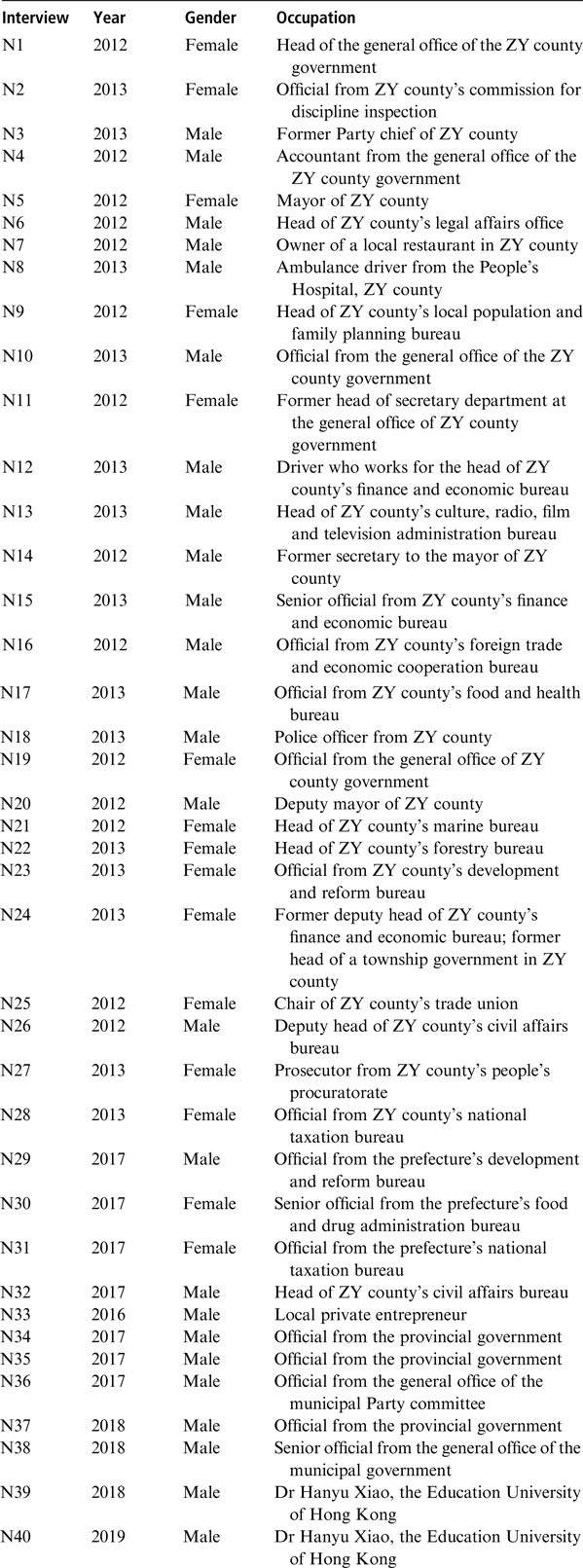
The empirical data for this article are based on 98 days of participant observation and 40 in-depth interviews conducted in mainland China between mid-2012 and early 2019 (see Appendix). Most empirical data were collected in one county in a province in south-west China. We conducted interviews with officials from different administrative levels including the county's Party chief and mayor, senior officials from different departments, township cadres and low-ranking civil servants. We also interviewed senior officials from the general office of the provincial government, who offered a broad picture of local governments’ desire for socio-economic development during Xi Jinping's anti-corruption campaign. Government documents and media accounts of extravagant hospitality and gift-giving were incorporated into our analysis. To preserve confidentiality, the names of all individuals and places mentioned in this article have been anonymized. The data span a lengthy period of time and have produced a clear picture of the changes in position-related consumption before and during Xi Jinping's anti-extravagance campaign. The data also show clear causal links between the anti-extravagance campaign and the loss of motivation among local officials tasked with implementing central government's socio-economic policies.
Corruption in Economic Development: Grease or Sand?
Does corruption grease or throw sand onto the wheels of economic growth? The “grease the wheels” hypothesis argues that corruption may compensate for poorly functioning bureaucracy. For example, bribes may fuel economic growth by boosting sluggish administration,Footnote 7 improving the quality of civil servants,Footnote 8 and limiting the adverse effects of bad public policies.Footnote 9 Corruption may foster growth in a country characterized by an undemocratic political system, inefficient government bureaucracy and the absence of rule of law.Footnote 10 The “sanding the wheels” hypothesis, on the other hand, suggests that corruption is a significant impediment to economic development.Footnote 11 It argues that corruption lowers the rate of investment and reduces the efficiency of resource allocation in the public sector.Footnote 12 Corrupt public officials have an incentive to cause delays and create other distortions in order to compel private actors to buy “grease” from them.Footnote 13 In addition, corrupt transactions are subject to a high risk of opportunism, detection and punishment owing to the absence of state regulation and formal systems of enforcement.Footnote 14 Despite the fact that the relationship between corruption and economic development at the macro level remains inconclusive, our review of the existing literature suggests that the “sand on the wheels” hypothesis has received more empirical support than the “greasing the wheels” hypothesis.Footnote 15
The relationship between corruption and growth in China has also attracted much scholarly attention. Research has been carried out at the country (macro), company (micro) and local government (meso) levels. For instance, Andrew Wedeman's macro-economic analysis aims to explain China's “double paradox”: the co-existence of rapid economic growth and rising corruption.Footnote 16 Wedeman supports the “sand on the wheels” view. He argues that corruption has not strangled China's economic growth because the continued anti-corruption efforts “have prevented corruption from spiralling out of control.”Footnote 17
Researchers studying the relationship between corruption and growth from a micro-level perspective offer a more dynamic view. For example, based on firm-level evidence of the correlation between corruption and growth, Yuanyuan Wang and Jing You find that “corruption is likely to contribute to firms’ growth” in China where there is a lack of a well-developed financial market.Footnote 18 Examining the effects of corruption as well as anti-corruption measures on firms with different kinds of ownership, Dongmin Kong and colleagues conclude that corruption acts “as ‘sand-the-wheel’ in central state-owned enterprises (SOEs) but ‘greasing-the-wheel’ in non-state-owned enterprises (non-SOEs)” and that the anti-corruption campaign improves the performance of SOEs but hinders the performance of non-SOEs.Footnote 19
At the local government level, China scholars investigating corruption and growth focus on the beneficial side of corruption. They see the role of corruption, in the form of lavish hospitality and gift-giving, as an efficient grease for local economic development under a fragmented authoritarian regime.Footnote 20 China's bureaucracy has long been viewed as “fragmented and disjointed,”Footnote 21 and China scholars have developed the concept of “fragmented authoritarianism” to explain the “structural distribution of resources and authority” and “processes of decision-making and policy implementation.”Footnote 22 Since 1978, China's decentralization reforms, especially in planning and fiscal systems, have brought significant changes to central–local relations, diffused “authority over budgets and resources vertically and horizontally” and increased bargaining in the bureaucratic system.Footnote 23 The fragmentation of authority, as Kenneth Lieberthal argues, encourages “the search for consensus among various organs” in order to develop policies and initiate major projects.Footnote 24 The intention of the policymakers has frequently been distorted at the policy implementation stages because the interests of bureaucratic actors at all levels throughout the system have to be taken into account.
In such a fragmented authoritarian regime, corruption can grease the wheels of China's local economic growth. In Patronage and Power, Ben Hillman demonstrates that local bureaucrats employ corrupt means such as extravagant position-related consumption and bribes to establish patronage networks within the bureaucratic system, which is a rational response to the fragmentation of authority and the secrecy of government communications.Footnote 25 According to Hillman, patronage networks are used to coordinate across Party and government agencies and mobilize resources (for example, gaining special purpose funds) for furthering local and private interests. Since the mid-1990s, a system of fiscal transfers “has been adopted to distribute funds from the central government through intermediate ones (e.g. provincial governments) to the lower levels (e.g. counties).”Footnote 26 Nevertheless, veto players at various levels can block applications for special purpose grants submitted by lower-level governments (agencies); they can also stall the receipt of funds after a grant application has been approved by a central government ministry. As a result, local bureaucrats must resort to lobbying, bribes and lavish banquets to ensure that multiple higher-level offices support their grant applications.Footnote 27
Xia Yan and Ning Wang show that the informal institution of extravagant position-related consumption can compensate for China's weak formal institutions.Footnote 28 As they point out, formal institutions suffer from a number of problems: they are “too abstract and ambiguous,” “unrealistic” and “fragmented.”Footnote 29 The dearth of strong formal institutions encourages those officials from subordinate organizations who want to obtain favourable resource allocations for local economic growth to develop reciprocal relationships (i.e. patronage networks) with upper-level officials by hosting lavish drinking and dining events.Footnote 30
Similarly, Ting Gong and Hanyu Xiao point out that the prevalence of extravagant position-related consumption in local governments can be understood as a rational response to the horizontal and vertical fragmentation of the bureaucratic system.Footnote 31 A local government that wishes to seek financial support from upper-level governments has to navigate the fragmented vertical bureaucratic hierarchies by “going through complex procedures, exhausting evaluations, and cumbersome paperwork.”Footnote 32 It must also deal with horizontal bureaucratic fragmentation and competition from same-level local governments or agencies that are primarily interested in pursuing their own interests in the bureaucratic system. The fragmentation of authority gives rise to the persistent use of three types of illegal position-related consumption – “lavish drinking and dining, misuse of government vehicles for private purposes, and sightseeing trips in the guise of study tours” – to obtain development resources, administrative approvals and political support from superiors.Footnote 33
Extravagant Position-related Consumption, Patronage Networks and Local Economic Development
Personalized bureaucratic ties (patronage networks) are commonly used by local bureaucrats to mobilize resources for the growth of local economies. In patronage networks, the more powerful bureaucratic actor (patron) is able to offer protection and distribute state resources (for example, promotion opportunities and financial support) to the less powerful bureaucratic actor (client) who reciprocates by offering loyalty, bribes, personal services and political support to the patron.Footnote 34 In other words, those at the top of the bureaucratic hierarchy generate resources that are channelled down through patronage networks, while political support, loyalty and bribes flow upwards.Footnote 35
Bureaucratic ties are largely personalized through informal practices such as gift-giving and entertaining with expensive food and drink. Personalized bureaucratic ties have become important for stimulating the growth of local economies because Chinese bureaucracy is disjointed and its inner workings are greatly influenced by reciprocal relationships between bureaucrats. A notable characteristic of bureaucracy, as Max Weber points out, is its impersonality.Footnote 36 Officials within a bureaucracy are “organizational men” following official authority and rules and disregarding personal emotions and judgements. Bureaucrats involved in an implementation process automatically follow orders and implement policies set at higher levels, and the criterion for promoting these bureaucrats is professional competence. However, Weber's concept of impersonality does not fit Chinese bureaucracy. Officials in the Chinese bureaucratic structure are human beings embedded in reciprocal relationships, and they normally bring “their own emotions, judgements, and interests into the implementation process.”Footnote 37
A defining feature of political patronage is the reciprocal nature of exchanges between patrons and clients. When making decisions, for example about promotion and resource allocation, Chinese bureaucrats will take the demands of reciprocal relationships into consideration. Chinese bureaucrats do this because of cultural norms and institutional uncertainties. First, bureaucrats in China are heavily influenced by the traditional Chinese cultural emphasis on reciprocal relationships.Footnote 38 In contrast with individuals in Western countries such as the US and the UK whose behaviour is formed by individual will and the rule of law, individuals in Chinese society have to follow norms of reciprocity in order to maintain interpersonal harmony.Footnote 39 Norms of reciprocity, as Kwang-Kuo Hwang points out, imply “not only a normative standard for regulating social exchange but also a social mechanism that an individual can use to strive for desirable resources within a stable and structured social fabric.”Footnote 40 Chinese government officials are socialized human beings whose behaviour is also regulated by the norms of reciprocity. As a result, the distribution of resources and authority and the processes of decision-making and policy implementation are heavily influenced by the same norms.
Organizing banquets and giving gifts are important strategies for Chinese government officials seeking to build reciprocal relationships with others in order to mobilize resources, meet policy targets and develop the local economy. The acceptance of a banquet, gift or favour places the obligation to reciprocate on the recipient. As Mayfair Yang argues, “[what is] implicit in the very act of accepting is an agreement in trust to repay in another form at a later date.”Footnote 41 In order to cultivate and maintain reciprocal relationships with their superiors and with colleagues in other government agencies, Chinese bureaucrats spend a great deal of time and money eating and drinking together.
Second, the persistence of reciprocal relationships within the Chinese bureaucracy stems from the uncertainty created by public administration reforms. China's increasing formalization of its bureaucracy, with the establishment of the target responsibility system and incentive levels (for example, various “one item veto” responsibilities), has brought great uncertainty and risk to local bureaucrats, who increasingly need to resort to personalized administrative ties in order to survive.Footnote 42
Corruption, in the form of extravagant position-related consumption and gift-giving, contributes positively to the efficiency of bureaucracy when it comes to implementing policies and furthering local economic growth. As this section shows, to further local economic development, a lower-level government (or agency) makes use of lavish official hospitality to foster patronage networks with its supervising government (or agency) in order to access resource distribution and gain support from supervising governments or agencies.Footnote 43 At the same time, the supervising government or agency employs patronage networks to solve the problem of information asymmetry, coordinate bureaucratic interactions and ensure that policies are properly implemented.
Lavish banqueting and resource mobilization for development
Since the launch of the tax-sharing reform in 1994, the Chinese government has gradually introduced transfer payment schemes. These schemes were intended to reduce regional development disparities and payments are made via special purpose grants.Footnote 44 A transfer payment is a top-down process, from the central government, via its ministries or agencies, to different levels of local governments or agencies. A major problem with these schemes is the lack of checks and balances, which means the higher-level government or agency has excessive discretion over the allocation of fiscal resources.Footnote 45 As a result, officials from the lower-level government aim to develop reciprocal relations with officials from the supervising government, mainly through extravagant consumption and gift-giving, in order to obtain more resources.
In 2012, shortly before Xi Jinping's anti-extravagance campaign began, the mayor of ZY county, in a routine meeting, tasked subordinate units with improving the effectiveness of official banqueting, with the aim of winning funds transferred from above and obtaining approval for construction projects:
Regarding work, everybody should still insist on “more at the office, less at the dining table.” What could be solved in the office should not be dragged to the dining table. However, if it is for the purpose of striving for funds, securing a special purpose grant, then it is fine. However, such banqueting must guarantee “efficiency” and “quality”: if no special project or fund is involved, then do not organize or participate in any banquet. You can initiate invitations with regard to superior departments, regardless of the officer's rank, as long as he or she can secure funds and special projects; you have to entertain him with great hospitality … whenever my attendance is necessary, you can let me know, no problem, I will strive with you [to secure special purpose grants]. If we do not go for it, then we will be missing golden opportunities to share the money.Footnote 46
The mayor of ZY county did not view lavish banqueting as a problem: what he cared about was the efficiency and effectiveness of official banqueting at securing special purpose grants. Heads of subordinate units also noticed the benefit associated with using official banqueting to cultivate personal ties with resource allocators from higher-level departments. In an interview, the deputy head of the county's civil affairs bureau pointed out the importance of lavish hospitality in maintaining close ties with officials from the supervising agency. These ties helped them to secure more relief funds from above. As he mentioned,
When someone from the department above comes, I will receive him with great hospitality, I am seeking to acquire his funds or his projects. Having developed a good relationship with him, he will at least take care of me in various ways. Say, for instance, if he [the superior leader] allocated more relief funds to me, then I can give more resources and money [to the subordinate departments, for example, towns]. When the amount is large, it is easier for me to distribute. If the amount is small, the towns below will probably fight with one another for the resources.Footnote 47
Extravagant position-related consumption has become a common way in which lower-level officials can please higher-level officials who have the discretionary power to allocate financial resources to their favoured subordinate units.Footnote 48 Moreover, local officials believed lavish official hospitality to be a cost-effective investment.Footnote 49 As the head of the county's population and family planning bureau noted:
Treating the superior leader to a high standard of hospitality is to hope for the allocation of special purpose grants from him. Think about it. In small counties like ours, a banquet merely costs two or three thousand, at most a few tens of thousands. However, hospitality can help us to secure hundreds of thousands, millions, even tens of millions [of yuan]. Hence, lavish hospitality is necessary when a leader comes to visit. If [for the purpose of achieving the goal] it is necessary to give a red envelope [containing cash], then it must be done.Footnote 50
In addition to seeking top-down support, attracting investment is another essential task that local governments must achieve in order to hit economic targets and develop the local economy. The former mayor of ZY county informed us that:
The government has two primary tasks: one is to seek guanxi 关系 (personal connections); the other is to seek money through the mobilization of personal connections. In terms of finding money, besides applying for funds from the supervising units, we also have to seek out businesspeople. This is what we call “attracting investment” to increase total taxation revenue. Nowadays, the superior will assign annual tax tasks. Some poor towns in our county have very limited resources; they also do not have strong enterprises. As the target set by the superior must be met, they must therefore go outside to attract investment.Footnote 51
Wining and dining at public expense is a crucial part of the process of attracting investment. As a senior official from XY county's finance and economics bureau stated:
We Chinese people do not like direct straightforward deals. Discussions about attracting investment always involve drinking alcohol. The act of drinking shows that you are giving face [showing respect] to the businessman. I often hear things like “you finish this drink, I will do this and that …” Basically, they [potential investors] want to force you to finish the drink to demonstrate your sincerity. Finish the drink and the deal is sealed. If not, there is no deal.Footnote 52
The standard of hospitality also matters. As an interviewee commented,
The degree of hospitality indicates the degree of importance local officials place on recruiting investors, the degree of urgency and the degree of desire. This ultimately determines the success or failure of the matter.Footnote 53
The pressure to attract investment significantly contributes to the extravagant level of spending on lavish banqueting and luxury hotel accommodation.
To sum up, the empirical data mentioned above reveal both the institutional logic of the personalization of administrative ties and the importance of lavish banqueting in mobilizing resources. In order to meet economic development targets, lower-level local governments or agencies commonly use extravagant position-related consumption as a cost-effective way to develop patronage networks with supervising governments or agencies when competing for resource allocation. Local governments also use official extravagance to show their respect and appreciation of investors. Extravagant consumption, although prohibited by Party regulations, has become a key means through which local states can promote economic development within a Chinese bureaucracy characterized by centralized decision-making and resource allocation.
Patronage networks and bureaucratic interactions
Local governments depend heavily on their supervising institutions for the allocation of resources; this does not mean that the higher-level institution does not depend on its subordinates. To increase the efficiency of coordination and policy implementation among government organizations, superiors feel obliged to attend banquets organized by subordinates. Empirical data we collected suggest that attending and sometimes organizing banquets functions as a mechanism by which superiors can solve the problem of asymmetric information, create emotional bonds with subordinates and form a protective social network.
Wining and dining with subordinates facilitates the flow of information within the organization and improves bureaucratic coordination. Party chiefs and heads of governments at all levels are periodically rotated in order to reduce localism.Footnote 54 However, frequent transfers lead to information asymmetry between superior and subordinate. In addition to formal channels and practices such as document flows, meetings, supervision and inspections, banqueting and socializing with subordinates has become a common way for superiors to adapt to a new job and grasp essential information, such as personnel arrangements and policy implementation, within a short period of time. As an interviewee pointed out:
Because local officials are regularly rotated, there is a new group of officers in charge every three to five years. The newly arrived officer is usually unfamiliar with his new work environment and personnel/human resource affairs. He needs to get to grips with his job within a short period of time. How does he do this? Relying on eight hours of work is insufficient; sometimes he needs to rely on the time outside of the eight hours, to become familiar at the dining table.Footnote 55
Extravagant position-related consumption offers excellent opportunities for government officials to build emotional bonds with each other. Affective commitment is a significant factor affecting officials’ daily work performance. Emotional bonds with their superiors foster subordinates’ affective commitment, which ensures policies and bureaucratic orders are properly implemented and enforced.Footnote 56 The concept of gongshi siban 公事私办, which refers to carrying out bureaucratic tasks by relying on affective commitment embedded within social relations, is widely accepted and practised by Chinese people. In his classic work, Hou heixue 厚黑学 (Thick Black Theory), Li Zongwu 李宗吾 investigated the major ways in which Chinese people obtain and use power.Footnote 57 One important observation made by Li is that compared with official procedures, it can be easier, quicker and better to “get things done” using personal relations. Empirical data we collected support Li's observation. During an interview in 2017, a senior official from the provincial government stated:
In order to achieve cooperation and coordination within local governments, officials [including higher- and lower-ranking officials] have to become familiar with one another and build emotional bonds. There is a significant difference between working with emotional bonds and working without emotional bonds. For instance, every county's or district's information office reports information to the supervising unit. The lower-ranking officer can choose to report one single piece of information a day or choose to report ten pieces a day. The lower-ranking officer can choose to write 10,000 words in the report or choose to write 100 words in the report. What can we do as higher-ranking officials to help lower-ranking officials do a better job? First of all, we can strengthen the incentive mechanism. However, the problem is we do not have assessment methods for all kinds of work. So, how do we stimulate lower-ranking officials to take the initiative? This depends on interpersonal emotional bonds … From a general point of view, personal relations have become an indispensable component that helps local governments effectively execute administrative orders, strategies and plans, conduct the government's public administrative business and effectively achieve the government's targets.Footnote 58
Interpersonal ties act as an important mechanism for superiors to mobilize their subordinates to “accomplish important but challenging governing tasks,” especially when the formal incentive structure is incomplete.Footnote 59 Superiors throw official banquets for hardworking subordinates to demonstrate their appreciation. Although this practice increases public expenditure, it cultivates affective commitment among subordinates and motivates them to work. Furthermore, lower-level officials often demonstrate great attachment to their superiors in Chinese bureaucracy.Footnote 60 Loyalty to superiors exerts a greater influence on subordinates’ behaviour than loyalty to the party-state. As a government official noted:
In government organizations, “following the right leader” is crucial. In determining whether a leader is the “right leader,” on top of the leader's capability and potential for career advancement, another equally important criterion is whether the leader will be sympathetic to his subordinates and fight for his subordinates’ interests. The subordinate officers will willingly follow a leader who is sympathetic to his subordinates. In times when immediate rewards are not achieved, they will still take their job seriously, guard their post and protect and support the leader. If the leader did not use this method of reward [dinners and banquets] to express his gratitude to his subordinates, negative sentiments would accumulate and the subordinate officers would not be motivated to work; they would even oppose the leader in secret and disobey the leader's orders.Footnote 61
Personal ties among bureaucrats also work to cover up wrongdoers and encourage innovative policy implementation. Given that the Chinese government has not established a fault-tolerant mechanism for policy implementation, government officials rely on the safety net of patronage networks for protection and to avoid punishment. The centralized nature of policymaking in China leads to uniformity in state policy, but policies are not always suited for every locality.Footnote 62 Flexible or innovative local adaptation leads to “a better fit of policy goals and local conditions,” but this means that local governments have to deviate from the original policy design.Footnote 63 In response to uncertainties in policy implementation, malfeasant local officials seek protection or leniency via their bureaucratic ties and ensure their political survival through the hosting of lavish official banquets.Footnote 64 As an interviewee informed us:
When the inspection team sent by the higher-ups arrives to inspect how a policy is being implemented, inspectors usually find problems and they prefer to gongshi gongban 公事公办 [handle things by adhering to formal policies and regulations without considering personal connections] in the formal meeting … but during dinner or lunch, they are usually willing to offer informal advice on how to solve these problems and avoid punishment.Footnote 65
It is in the interests of higher-level officials (patrons) to help malfeasant subordinates (clients) escape punishment, because “punishment would not only imply that they had promoted the wrong person, it would also weaken their power base.”Footnote 66 Although the protective network fuels corruption, to a certain extent it also encourages innovative implementation and promotes the growth of the local economy.Footnote 67
The above discussion illustrates the importance of extravagant position-related consumption in developing personalized bureaucratic relationships and emphasizes the positive aspect of corruption in the development of local economies as these ties aid the mobilization of economic resources. The discussion also suggests that patronage networks within the bureaucratic system help superiors to solve the problem of asymmetric information, build emotional bonds to motivate subordinates to work harder for the government, and encourage innovative and tailored implementation.Footnote 68
However, the negative aspects of such extravagant consumption and patronage networks cannot be ignored. Official reports, media accounts and the academic literature all highlight the problems associated with lavish official banqueting: it wastes public money, fuels corruption and advances personal gain at social cost.Footnote 69 Furthermore, the prevalence of patronage networks within the bureaucratic system encourages the higher-level government or agency to distribute fiscal resources based on norms of reciprocity, which disrupts fairness in resource allocation and undermines the rational-legal principle that is essential for sustained economic prosperity. The tolerance of extravagance and bribes also may create incentives for upper-level officials to throw more sand (i.e. more red tape and extra bureaucratic hurdles) on to the wheels in order to further their own interests, further reducing the efficiency of Chinese bureaucracy.
Although extravagant hospitality and patronage networks may benefit the local governments that can only obtain fiscal resources through informal means, this extravagance hinders the country's economic development and should not be tolerated by the central government.
The Anti-corruption Campaign and Bureaucratic Slack in China
Although extravagant position-related consumption is regarded as illicit conduct by policymakers, it is viewed as an acceptable institutional practice by local governments and their supervising agencies, which have to use personalized bureaucratic ties in order to further the local economy. Prior to the Xi Jinping administration, there was little pressure from the centre to curb such practices and local governments offered symbolic compliance with any clampdown measures without actual implementation.Footnote 70
However, immediately after assuming office in December 2012, Xi Jinping outlined “eight directives” (baxiang guiding 八项规定) that were designed to strengthen Party discipline and combat “four undesirable working styles” (sifeng 四风) – formalism, bureaucratism, hedonism and extravagance.Footnote 71 In response to the directives, provinces and municipalities quickly rolled out detailed guidelines to streamline bureaucracy and put a stop to informal institutional practices (for example, the improper use of public funds for vehicles, banquets and trips overseas).Footnote 72 From December 2012 to October 2015, a total of 138,867 officials were investigated. Of these, 55,289 were disciplined for violations of the eight directives.Footnote 73 Most of those investigated (94.2 per cent) were officials at the township/section level, and 5.3 per cent were at county/division level or the equivalent.Footnote 74 Among a total of 104,934 cases, there were 20,295 cases of unauthorized use of official vehicles, 8,662 cases of extravagant weddings and funerals, 5,305 cases of opulent banquets, and 4,790 cases of improper ways of giving and accepting gifts.Footnote 75
The campaign against “four undesirable working styles” primarily targets informal institutional practices in the bureaucratic system without addressing the root cause: the inefficiency of Chinese bureaucracy. China's zero-tolerance approach to the “undesirable” working styles generated great anxiety among local bureaucrats.Footnote 76 And, as argued by Erik Wang, the “anti-corruption effort may reduce productivity of bureaucrats by frightening them away from informal practices that would otherwise help efficiently accomplish tasks.”Footnote 77
In order to adapt to the changing political environment, local governments are choosing to reduce all kinds of position-related consumption.Footnote 78 They have instead developed a new informal institutional practice: laziness and slack implementation of polices and economic development. Bureaucratic slack (for example, failing to spend government funds and delaying development projects) is used by lower-level officials to avoid the scrutiny of disciplinary officers.Footnote 79 Local bureaucrats show little interest in using patronage networks to mobilize resources for developing local economies but are increasingly interested in employing these patronage networks to avoid scrutiny and punishment.Footnote 80 The changing significance of patronage networks signals the decline of informal practices in developing local economies in China.
Despite the fact that the laziness of local officials has drawn wide media attention, this phenomenon has not been examined in the literature. Based on empirical data, we attribute local governments’ laziness and non-performance to three major factors: the choice between gaining credit and avoiding risk; the incompatibility between policy design and reality; and the mismatch between responsibility and personal interests.
The choice between gaining credit and avoiding risk
Local officials face a dilemma: should they pursue the credit and praise for taking the initiative with regard to economic development or avoid any risk to their position by selectively ignoring their duties?Footnote 81 The target responsibility system, which links “local officials’ career prospects to local economic performance,” has significantly contributed to China's economic development in the last four decades.Footnote 82 The fulfilment of economic targets relies on the personalization of bureaucratic ties, which prompts local governments to employ extravagant position-related consumption when mobilizing resources for development; however, under the anti-graft drive, this strategy inevitably brings with it a high risk of being investigated and punished. Government officials, as Yongshu Cai suggests, are primarily “motivated to avoid blame and ensure their political survival” rather than to seek credit through taking the initiative.Footnote 83 As a result, local officials prefer to reduce bureaucratic interactions and avoid providing official hospitality in order to protect themselves.Footnote 84
Moreover, the Chinese government has introduced a lifelong accountability mechanism in many policy areas, such as environmental protection and economic development, in order to prevent government officials from making irresponsible decisions.Footnote 85 The lifelong responsibility system makes public officials accountable for their administrative errors and the losses resulting from their decisions. An adaptive response from local officials, as China Daily reveals, is “trying to do as little as possible” because “the more work one does, the more chances there are for one to commit an error, which will possibly result in disciplinary penalties.”Footnote 86 In parallel, in mid-2018 a senior government official told us that:
The efficiency of local governments [in implementing policies and initiating major projects] is low, because local cadres would rather do nothing in order to prevent trouble … local bureaucrats fear being held accountable for the decisions they made and the projects they lead or coordinate; no one is therefore willing to take the initiative to do things.Footnote 87
The gap between policy design and reality
There is the question of why particularistic ties among bureaucrats cannot be forged using less extravagant official hospitality. The fact is that the formal hospitality standards set by the local government are unrealistically low and do not take into account how hospitality works.Footnote 88 In 2013, a senior official from the county's finance and economics bureau informed us that the standard allowance for catering for a provincial-level official was 60 yuan and 50 yuan for a prefecture-level official.Footnote 89 Local officials viewed these allowances as rather low, so they felt they were unable to show proper respect and appreciation to those higher-level officials; what was even worse, higher-level officials might feel offended by the poor hospitality offered to them. As the head of the county's maritime safety bureau noted:
The local government's hospitality standards are unrealistic … if the [formal] hospitality standards are strictly enforced, you will easily offend the leaders. If you offend the higher-level officer today, he might cut your project tomorrow.Footnote 90
Policymakers take the view that official hospitality should be frugal and local bureaucrats should rely on formal channels to promote cooperation and bureaucratic coordination. But local bureaucrats believe they should have discretion over the level of official hospitality they offer: it is seen as an essential strategy for building connections with officials from superior institutions in order to increase the chance of being promoted and to compete for resources. The incompatibility between policy design and reality creates a dilemma for local officials: if they stick to the rules on official hospitality they risk offending their superiors; if they disregard the rules, they risk being investigated and punished. As a response, local government officials have reduced their interactions with different government departments in order to avoid this dilemma. This has directly led to the decline of the use of personalized bureaucratic ties in developing local economies.
When President Xi launched his anti-extravagance campaign in 2012, the gap between policy design and reality led to many complaints from local bureaucrats; however, interview data collected in 2017 and 2018 show that this incompatibility has become less of a concern. High-ranking officials (provincial-level governments or agencies) are also under great pressure to adhere to the new rules.Footnote 91 But compliance with the formal hospitality regulations does not resolve the problem of bureaucratic slack because high-ranking officials, who are primarily interested in avoiding violating the eight directives, prefer to eschew contacts with lower-level officials. As a government official mentioned, the acceptance of the formal hospitality standards has not increased interactions between officials from supervising governments and those from subordinate governments. This is owing to superior officials’ fear of being held accountable for their improper actions and administrative errors.Footnote 92 “Not hoping for merit, just avoiding the risks” (buqiu yougong, danqiu wuguo 不求有功,但求无过) has become the survival strategy of Chinese bureaucrats in a highly uncertain political environment.
The mismatch between responsibility and personal interests
One of the objectives of Xi's anti-corruption campaign is to stop the widespread practice by local governments of maintaining “small coffers” (off-budget accounts) to pay for lavish hospitality and reward local bureaucrats who perform well in maintaining stability, obtaining special purpose grants and attracting investments.Footnote 93 The current campaign ensures that local governments’ extra-budgetary revenues are incorporated into their official budgets; as a result, local bureaucrats no longer have the financial resources to offer lavish hospitality and lack monetary incentives to promote economic growth. As a consequence of the loss of these incentives, local bureaucrats have become slack. Local officials are confronted with arduous tasks, multiple goals and enormous challenges in their daily duties but are not well paid.Footnote 94 According to one interviewee:
To be honest, the salaries of civil servants and cadres in the government are not high. What I mean by “not high” here is that the salary does not match public officials’ abilities and qualifications … in fact, many local cadres, especially senior ones, are very capable of doing things [developing local economies] and building interpersonal connections. If they quit their current jobs and join private companies, they would receive very high salaries, maybe more than ten times higher than the salaries they get from the government.
Before Xi Jinping assumed office in 2012, extra-budgetary bonuses, although illicit, were tolerated by the central government.Footnote 95 Local cadres viewed this tolerance as a green light for offering extravagant hospitality and gifts in their bids for fiscal resources and economic development. Soliciting investment in this way was beneficial for the growth of the local economy in general and motivated the cadres. Investment helped these cadres, especially the township head and the Party secretary, meet economic targets set by their superiors and obtain both budgetary and extra-budgetary bonuses. An interviewee informed us that:
Extra-budgetary bonuses set up by different levels of government trigger great enthusiasm and passion among local bureaucrats. For example, a township head who performs very well in attracting investment and maintaining stability can get an annual [extra-budgetary] bonus of 200,000 to 500,000 yuan [the equivalent of two to five years’ salary].Footnote 96
Investment also offered opportunities for local officials to make an illicit profit through rent-seeking activities. However, the current campaign against corruption and extravagance has targeted local governments’ “small coffers” and has largely extinguished officials’ motivation to deliver a better performance.
To sum up, the current anti-corruption campaign has significantly reduced local governments’ reliance on personalized bureaucratic ties to grow local economies. The primary concern now of local officials is to avoid being blamed for errors and ensure their own political survival. The current zero-tolerance attitude towards informal institutional practices encourages these officials to minimize bureaucratic interactions, reduce position-related consumption and to be slack and lazy about policy implementation.
Conclusion
This article enriches our knowledge about the relationship between corruption and economic growth at the local level by investigating the rise and fall of extravagant position-related consumption and its impact on the efficiency of the Chinese bureaucratic system in stimulating local economic growth. It examines the role of extravagance and patronage networks in obtaining fiscal resources from a higher-level government (or agency) and attracting investment that is essential for developing a local economy. Banqueting and gift-giving are used by government officials to personalize bureaucratic ties and build patronage networks within the bureaucratic system. In patronage networks, officials from the supervising government or agency distribute state resources to officials from the subordinate government or agency. These client officials reciprocate by supplying loyalty, bribes and political support to their patrons. Patronage networks also become a safety net, protecting wrongdoers and encouraging innovative policy implementation.
Our research also examines the causal relationship between China's current anti-corruption campaign and the rise of bureaucratic slack among local cadres. President Xi's campaign against corruption and extravagance has fostered an uncertain political environment. In order to survive within the system, bureaucrats at all levels try to minimize the risk of being blamed and punished. The zero tolerance of informal institutional practices such as lavish hospitality and extra-budgetary bonuses has meant that local officials are no longer using patronage networks to mobilize resources, so they become lazy about implementing policies and developing the local economy. The empirical data we collected show the decline in the use of patronage networks when mobilizing resources for local economic growth. Yet, this does not mean that patronage networks are no longer important in China; such networks play an increasingly important role in securing the survival of local bureaucrats in China's highly uncertain and risky political environment. The changing significance of patronage networks in Chinese bureaucracy therefore deserves further empirical research.
We do not attempt to argue that the Chinese government should tolerate extravagant position-related consumption and patronage networks among local bureaucrats. These strategies contribute to the development of local economies in the short term, but they provide fertile soil for corruption and harm the country's sustainable development in the long term. In other words, corruption, in the form of extravagant hospitality and extra-budgetary bonuses, may grease the wheels of a deficient institutional framework at the local level in the short term, but it slows the wheels of growth at the macro (country) level in the long run.
The use of public funds to organize banquets, offer bribes and build patronage networks is an improper use of those funds. Higher-level officers (patrons) who are committed to patronage networks prefer to distribute public resources and promotion opportunities to lower-level officers (clients) with whom they have close personal connections, regardless of official procedures, administrative regulations and the rule of law.Footnote 97 This practice enhances personal interests but erodes public trust and exacerbates the imbalance in China's regional economic development. The role of patronage networks in distributing state resources also encourages the personal attachment of lower-level officers to higher-level ones; this negatively affects the legitimacy of the state, because government officials are loyal to their superiors rather than the party-state. China's continuing reform therefore needs to address the problems of its fragmented bureaucratic structure and weak formal incentive system in order to reduce local cadres’ motivation for building patronage networks and encourage local governments to pursue economic development through formal channels.
Acknowledgements
The authors thank Hanyu Xiao, Maria Csanadi, Jing Vivian Zhan, Jiangnan Zhu, Yongshun Cai, Ning Wang, Tai-Lok Lui, Cheris Shun-ching Chan, Hualing Fu, Hilary Wright, Jingyi Wang, the anonymous referees and staff seminar participants at the department of sociology, the University of Hong Kong, for their valuable comments and suggestions. All errors remain ours.
Biographical notes
Peng WANG is assistant professor in the department of sociology, the University of Hong Kong, China. His research interests include crime, policing, corruption, anti-corruption measures and informal institutions.
Xia YAN is a postdoctoral fellow at the School of Sociology and Anthropology, Sun Yan-Sen University, China. She gained her PhD from the University of Hong Kong. Her research interests include Chinese governance and consumption as well as work and employment in the high-tech industry.
Appendix
List of Interviewees