Introduction
This article offers a systematic study of multiple requests made by customers at convenience stores. By adopting this specific focus, the main objective of the study is to contribute not only to ongoing research on requests, but more broadly to the discussions on action formation and sequence organization within Conversation Analysis (CA) and related fields. In short, the study of multiple requests in shop encounters reveals the importance of acknowledging that actions are designed not only in relation to the sequences that they are most proximally associated with but also in relation to larger forms of organization, such as sequences of sequences. In addition, this empirical focus highlights the importance of considering actions in their situatedness, embodiment, and ecology, occasioning specific and yet systematic multimodal formats of action.
Action, sequences of action, and the sequential organization of interaction are central pillars of research in Conversation Analysis. Conversation analysts have demonstrated the fundamental importance of sequential position for the interpretation of action (Schegloff Reference Schegloff2007), and interactional linguists have drawn more extensive attention to the role of the linguistic format of turns (Ochs, Schegloff, & Thompson Reference Ochs, Schegloff and Thompson1996). These viewpoints emphasize different aspects of the analyses of ‘action formation’ (Levinson Reference Levinson, Sidnell and Stivers2013; Drew Reference Drew, Sidnell and Stivers2013). Further developments have underscored the importance of embodied resources for the formatting of actions (e.g. Goodwin Reference Goodwin2000; Mondada Reference Mondada2014a,Reference Mondadab; see Streeck, Goodwin, & LeBaron Reference Streeck, Goodwin and LeBaron2011).
The formatting of requests has been researched extensively in CA, as well as in other fields of study, such as speech act theory (Searle Reference Searle1969), politeness theory (Brown & Levinson Reference Brown and Levinson1987), sociolinguistics (see e.g. Vine Reference Vine2004), and pragmatics (Ervin-Tripp Reference Ervin-Tripp1976; Blum-Kulka, Houser, & Kasper Reference Blum-Kulka, House and Kasper1989). Previous research has predominantly focused on the linguistic format of requests (direct vs. indirect, on-record vs. off-record, etc.) and its variation (see e.g. Salgado Reference Salgado2011). Moreover, research has largely focused on requests for future action (e.g. Curl & Drew Reference Curl and Drew2008) in everyday settings, and often not in face-to-face interaction (but rather in telephone conversations). By contrast, requests to do something immediately in face-to-face situations have started to gain more intensive attention recently (but see Wootton Reference Wootton1997; Lindström Reference Lindström, Hakulinen and Selting2005; Heinemann Reference Heineman2006; Mondada Reference Mondada2011, Reference Mondada2014a; Rossi Reference Rossi2012; Zinken & Ogiermann Reference Zinken and Ogiermann2013; Drew & Couper-Kuhlen Reference Drew and Couper-Kuhlen2014; Goodwin & Cekaite Reference Goodwin and Cekaite2014; in service encounters, see Vinkhuyzen & Szymanski Reference Vinkhuyzen, Szymanski, Richards and Seedhouse2005; Sorjonen & Raevaara Reference Sorjonen and Raevaara2014; Fox & Heinemann Reference Fox and Heinemann2016). This focus on actions performed immediately in face-to-face situations has recently generated attention in terms of their multimodal formatting and their embeddedness in material-spatial environments.
Our article contributes to these lines of research by discussing several aspects of action formation that have not been investigated in detail. First, we examine what the participants of face-to-face interactions do in situ when formatting their requests in a multimodal way. This prompts us to investigate language and the body in an integrated manner, without attributing a priori a privileged status to one or the other; instead, we analyze how the participants in interaction select the relevant resources within the unfolding organization of the activity (Mondada Reference Mondada2014b). This also involves the ecology of the action: (i) social interaction occurs in an architectured and embodied space, which together generate possibilities for action and constraints on it; (ii) embodied conducts are adjusted to the local surroundings and to the objects that are manipulated; and (iii) technologies both facilitate and constrain the types of gestures, body positions, and sequences of action that constitute the activity.
Second, we focus not merely on single actions (requests) but on series of actions, constituting sequences of sequences (Schegloff Reference Schegloff2007:ch. 10) that are oriented to by participants while formatting their subsequent actions. This demonstrates the relevance of previous and projected actions to how a particular action is formatted in detail. While series of sequences have been identified as typical of some institutional settings (e.g. questions during medical consultations, Robinson Reference Robinson2003; calls to emergency numbers, Zimmerman Reference Zimmerman, Drew and Heritage1992; interviews, Maynard, Houtkoop-Steenstra, Schaeffer, & van der Zouwen Reference Maynard, Houtkoop-Steenstra, Schaeffer and van der Zouwen2002), few studies have investigated the consequences of serial organization in action formation. By studying requests in series in shop encounters—the institutional setting in which they typically recur—this article highlights how participants orient to the position of their action within a series when formatting it by both tying it to the previous actions and projecting further actions within the same series.
Third, we emphasize the importance of these aspects in an institutional setting, as they are made particularly observable in convenience-store interactions. While some prior studies have been conducted on shop encounters, the topic has rarely been studied in CA so far (see, however, Merritt Reference Merritt1976; Lappalainen & Raevaara Reference Lappalainen and Raevaara2009; De Stefani Reference De Stefani2011; Haakana & Sorjonen Reference Haakana and Sorjonen2011; Dausendschön-Gay & Krafft Reference Dausendschön-Gay and Krafft2009). For our current focus, convenience-store interactions are particularly interesting because they are centered on requests for objects, the products being sold. These requests are routinely made, they constitute a legitimate category-bound action (Sacks Reference Sacks and Jefferson1992:175) that customers address to sellers, and they therefore make issues of entitlement relatively settled (Lindström Reference Lindström, Hakulinen and Selting2005; Heinemann Reference Heineman2006; Curl & Drew Reference Curl and Drew2008). This allows us to explore other dimensions that are crucial for the formation of both individual actions and series of actions.
The data we use are from two video corpora recorded in Finland and France. The Finnish corpus, which contains approximately 800 ‘kiosk’ (convenience-store) encounters (circa ten hours in total), was collected from 1999 through 2002 for a research project on service encounters conducted at the Institute for the Languages of Finland. The French corpus was collected by Jacques Cosnier in 1986 in a ‘tabac presse’ in Lyon, France, and it consists of more than 120 encounters (approximately two hours in total). The data for this article comprise sixty encounters in each language. Each analyzed encounter from both corpora involves the customer buying more than one product.
The use of data in two different languages raises questions concerning possible comparative issues. In CA, interactional linguistics, and linguistic anthropology, research on linguistic diversity in relation to interactional practices has gained increasing attention (see, for example, Sidnell Reference Sidnell2007; Stivers, Enfield, & Levinson Reference Stivers, Enfield and Levinson2010; Sidnell & Enfield Reference Sidnell and Enfield2012; Zinken & Ogiermann Reference Zinken and Ogiermann2013). The typological differences between Finnish and French might be regarded as providing a productive basis for a comparison between the verbal request design in the two languages. The present study, however, is motivated by an interest in multiple requests as an activity implemented through multimodal resources, and aims to examine how sellers and customers routinely orient to and solve the practical problems related to the organization of buying as an intelligible practice. Over the course of our study, we observed clear similarities between the French and the Finnish data. The differences we discovered, however, are more related to the different ways of organizing the buying activity than to grammatical differences. They are in crucial ways related to the fact that buying and selling routines are sensitive to historically situated technologies and regulations, such as the obligation of the seller to register each purchase and to issue a receipt. The use of barcode readers characterizes contemporary convenience stores (Finland in 1999–2002), whereas in older shops (France in 1986), transactions are not registered, prices are calculated manually, and money is kept in drawers. We demonstrate how these aspects become relevant for the sequential organization of the requesting actions.
Our analysis of multiple requests made by customers at convenience stores is motivated by an interest in multimodal action formation, which is related not only to single actions or sequences, but also to series of actions. We describe how actions in a series are tied together and thus form a global project of buying, which might be projected from the beginning of the activity or constructed retrospectively. Analyzed in this type of framework, requests might be made at different stages of the encounter: after its opening, during the evolving encounter, and in closing (and even postclosing) environments. These positions within the overall organization of the service encounter seem to affect the way in which the purchase as an overall project is designed and brought into completion.
The article examines the specific practical problems that customers and sellers face when they format requests: (i) a request can concern one or more products, as well as different types of products (products picked up in the shop and ones requested by the customer and retrieved by the seller), which affects how the request is designed and responded to; (ii) the action of requesting can be implemented verbally, as embodied conduct without talk, or multimodally, affecting its temporal trajectory and the response it makes relevant; and (iii) in the sequence, the request (first pair part) and complying with it (second pair part) can be either contiguous or separated by intercalary inserted sequences, which affects how subsequent requests are tied to previous ones.
We begin with multimodal action formats that characterize the first requests in the opening, buying various items with parallel embodied and verbal actions. We then examine how series of requests can be issued as successive contiguous actions, both projecting the next and orienting to the previous action. We contrast these cases with ones of noncontiguity involving two requests that are tied together as a global buying project, even though they are separated by an expansion of the sequence dealing with the first request, or by small talk. Finally, we focus on the last opportunity to request a product when the closing of the encounter is imminent. These different formats and sequential contexts for multiple requests forefront features that the participants of the encounter orient to and make relevant—enriching our understanding not only of requests in convenience-store encounters but also the multimodal and situated features of actions and series of actions in general.
Requesting a picked-up and an asked-for product as parallel actions after the opening
The first requests made directly after the opening greetings have recurrent features in both sets of data. When the customer requests a product that she has picked up herself and another one that has to be retrieved by the seller, the picked-up product is typically presented by the customer as an embodied action without words, and the latter product is requested with a verbal turn. These two requests are produced roughly in parallel. Thus, the customer first initiates the embodied request and then, almost simultaneously, the verbal one. This distribution of resources for formatting requests makes it possible to produce two parallel sequences, each concerning one product.
In the following two extracts from Finnish kiosks, the two sequences are initiated successively yet continue in parallel. The customer approaches the counter with the product(s) he picked up, carrying them in his hand and placing them on the counter. Even before the seller responds by taking the product and registering the price using the barcode reader, the customer initiates a new sequence by verbally requesting another product.
In extract (1), the customer has walked to the counter with a bottle of soft drink he has picked up, and is passing it toward the counter (line 1). While doing that, he initiates a verbal request (line 2). After the first syllable of his turn (Mal), he places the bottle on the counter. The seller grasps the bottle and shortly thereafter (line 3) registers the verbal request with a response token, implying that the request will be fulfilled later. The seller then moves to read the barcode on the bottle (line 3).
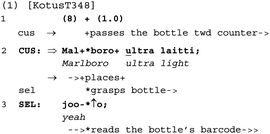
The multimodal transcript (see the conventions in the appendix) reveals the temporal-sequential trajectory of the actions: each numbered line in bold—presenting either talk, which is translated in italics in the next line (see lines 2, 3), or a pause (see line 1)—is followed by a nonbolded line in which embodied conducts are not only described but also temporally related to the previous talk or silence with symbols that occur on both lines. For example, in line 1, after eight seconds, the + symbol indicates the beginning of an embodied action (the customer passing the bottle onto the counter), which continues until the next line, as indicated by −>+, where a new action (the customer placing the bottle on the counter) begins after the first syllable of Marlboro (indicated again by a +). In response, the seller immediately grasps the bottle (line 2). This type of transcript is indispensable for revealing how multimodal resources are temporally mobilized for formatting the action, and how request sequences are initiated at slightly different moments but then continued in parallel.
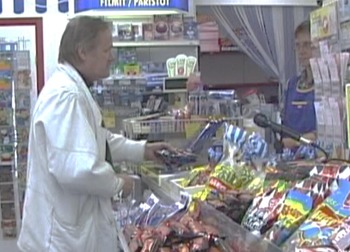
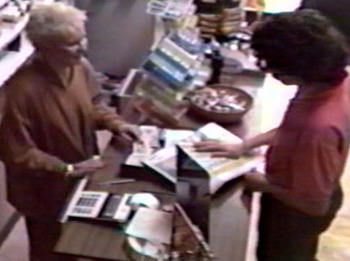
Likewise, in the next extract, the customer approaches the counter bearing two candy bags; the seller raises the barcode reader in her right hand (line 1). While these actions are underway, the customer initiates a verbal request (line 2, Figure 1).
-

Figure 1.
Figure 2.
-
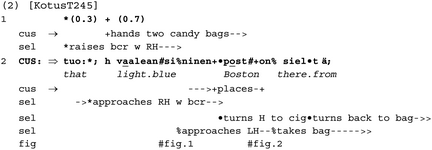


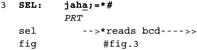
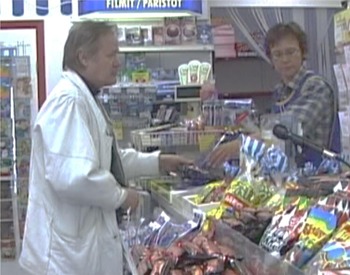
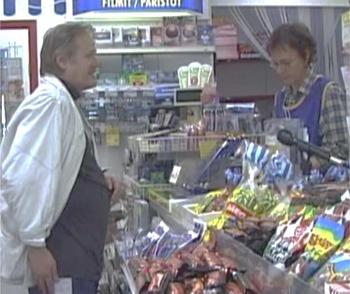
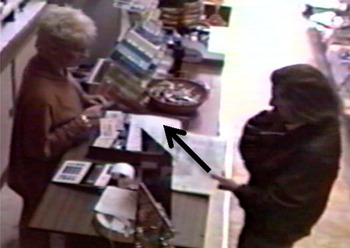
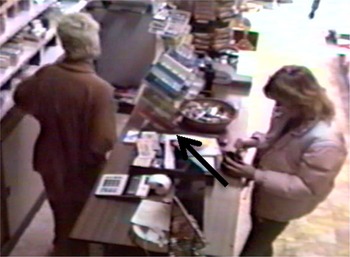
The customer places the candy bags on the counter during his request (line 2), the seller reaches for them and simultaneously momentarily turns her upper body and gazes toward the cigarette shelf (Figure 2). As in extract (1), she produces a response token to register the request and then begins to read the barcodes of the candy bags (line 3, Figure 3).
Figure 3.

These two extracts show the role of technology in the organization of buying at a contemporary convenience store, and the fine-grained orientation by customers and sellers to that organization in sequencing their actions and conduct. The seller immediately and successively processes each product to be purchased by reading its barcode with a machine. The customers orient to that action by placing the product they have picked up on the counter and withdrawing their grasp from it. By taking the product and reading its barcode, the seller responds to the customer's embodied action with another embodied action. In so doing, she produces the second pair part of the sequence initiated by the customer. Performing these actions as embodied allows the customer to initiate another sequence, verbally requesting another product while the seller is still processing the first product.
The French data exhibit a similar distribution of embodied and verbal actions, but the distribution is constrained differently by the local ecology. The customer first presents the object he picked up himself, and then verbally requests a product to be retrieved by the seller from the shelf, prefacing his turn with et ‘and’.
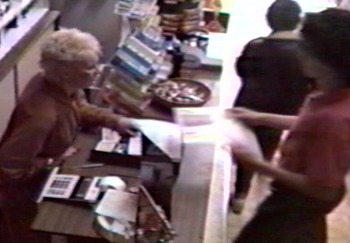
In the next extract, the customer is standing in line. As soon as the customer before him walks away, he approaches the counter, and a greeting sequence initiated by the seller opens the encounter (Figure 4).
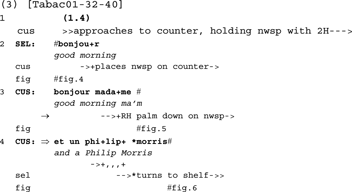
Figure 4.

During the seller's greeting (line 2), the customer places the newspaper that he picked up from the display at the store entrance on the counter (Figure 4). As he responds to the seller's greeting (line 3), he puts his right hand on the newspaper (Figure 5). While holding his hand there, he utters the verbal request (line 4) and moves his hand aside before its completion. In response, the seller immediately turns to the shelf to retrieve the cigarettes (Figure 6).
Figure 5.

Figure 6.

Through the way the customer formats his turn, beginning it with et ‘and’, he indicates that placing the newspaper on the counter is to be treated as his first request. The et-preface then builds his subsequent turn (line 4) into a second request following the previous embodied one, and tying them together as two successive actions, as part of a larger project.
The encounter in the next extract begins with an exchange of greetings when the customer walks into the store and approaches the counter.
-
Figure 7.
Figure 8.
-
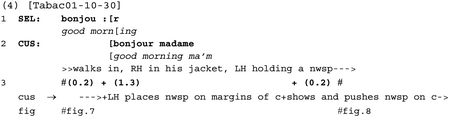



After he reaches the counter, the customer first places the newspaper at the edge of the counter (Figure 7) and then pushes it to the center, clearly displaying it (Figure 8). He then requests another product, a road tax disk, with an et-prefaced turn (line 4).
In these two excerpts, the customer approaches the counter holding a selected item for the cashier to see. This display of an item occurs before a verbal request and is initiated during the greetings. The gesture of displaying the first product may be maintained during the beginning of the turn, but it is retracted before the completion of the second request. The use of an et-preface explicitly articulates the gesture as a first request and the et-prefaced turn as a second request, building the continuity of action between them (see, for instance, Heritage & Sorjonen Reference Heritage and Sorjonen1994).
Tying the embodied action and the verbal action together through the et-preface constructs a succession of products that are being purchased. It should be noted that the first item is no longer acknowledged by the customer or the seller; there is no verbal response to the gesture and the seller does not touch the product. Contrary to the Finnish cases, the seller's glance at the customer's displaying gesture is sufficient to register the request; the product remains on the counter (or can even be placed in the customer's bag), and it will only be processed at the end of the encounter, when the seller calculates the total price. This fact accounts for the importance of the gesture that the customer uses to exhibit the product she has picked up: one part of the transaction—transforming the object from a product for sale (a buyable) into a product in the client's possession (a bought item)—is accomplished by the very action of picking it up, followed by the action of exhibiting it for the seller. The latter has a moral and normative dimension: contrary to the Finnish kiosks, there is no barcode reading, and the purchase is explicated only through this visible handling of the object (which distinguishes the request from a theft). While the barcode reading generates a series of gestures successively managing the registration of each item—officially registering the transaction—the accumulation of the purchased objects is achieved in the French convenience store by articulating a gestural and a verbal request. The connector et ‘and’, which is often absent from similar cases in the Finnish corpus, establishes the incremental list of items. In Finnish stores, the list of purchases is formed through the seller registering the price with the barcode reader and the customer issuing the next, verbal request while the registering is still in process.
The formatting and timing of requests is thus adapted in detail to the local constraints of the ecology of the buying activity, accounting for the differences in the Finnish and French cases. These differences have implications for the general understanding of the temporality and multimodality of actions and sequences with respect to their adjustment to the specific ecology of the activity.
Requesting more than one product as successive contiguous actions
As demonstrated in the previous section, immediately after the opening of the encounter, the first products are requested by articulating succinctly and almost simultaneously a request for picked-up products and asked-for products. When purchasing two asked-for products, customers tend to package each purchase into temporally separate successive actions. Let us now examine the formats used in such cases. The organization of these separate actions indicates the customer's orientation to the location of the products in the shop, to their availability, and to what is required for the seller to bring the products to the counter. Again, the formatting of the requests, the verbal and embodied resources they mobilize, and their timing all orient to the specific ecology of the activity. This accounts for the fact that in most cases, customers produce separate requests for separate products, so that asking for two different products in one single action is rather exceptional (see extract (6) below).
This has a series of consequences. First, multiple requests are not merely produced as isolated sequences of actions. They are tied together and display ‘belonging together’, that is, they incrementally build a global purchase achieved through a series of interrelated sequences. Second, a request conveys not only its linkage to the previous ones, but also whether it is the last one, or whether there will be more requests. This tying of requests orients to the possible completion of the purchase and establishes it as a global project. This orientation to completion has particular relevance for convenience stores where the seller only begins to calculate the total cost, either manually or in her head, when the purchase is completed, as is the case in the French stores. Completion is, however, also oriented to in the Finnish cases where the seller, after reading the barcode of the products, presses a button on the cash register in order to produce the total amount to be paid. In all of these cases, the customer orients to the relevance of displaying whether the series of actions is about to close or whether something further is projected. This is typically expressed in two ways: prospectively projecting more to come (prosody) and retrospectively tying the current product to the previous one (connectors).
As was explained earlier, clients generally tend to produce distinct requests for distinct products: requesting two different objects within one single action is rather exceptional, exemplified by the following case.
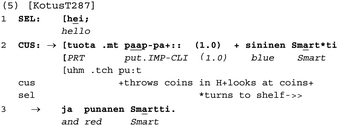
The customer's request is formatted with an imperative verb form (paappa ‘give’, lit. ‘put’, line 2), followed by two arguments of the verb, mentioning two products coordinated with the conjunction ja ‘and’. The projective force of the transitive verb paappa sustains the unity of the turn and the action, while the client is deciding what he can afford to buy (see his embodied action in line 2). The seller's response consists only of turning away from the counter once, retrieving both products together.
Contrary to this case, most of the requests only concern one product at a time. In such cases, the first request is completed with prosody, which projects more to come (rising final intonation that is often associated with listing; Selting Reference Selting2007). After a silence, the customer begins a turn prefaced by a connector that projects a continuation, most notably ja in Finnish and et in French (‘and’), sitte in Finnish and puis in French (‘then’), or a combination of the two. The rest of the turn then requests a product, and due to the connector, that request is tied to the previous one, marking this request as following.
The customer in the next extract brings a magazine to the counter (first request) and then requests some cigarettes. We focus here on the relationship between the second and third request (double arrows, lines 2 and 4).
-
Figure 9.
Figure 10.
-
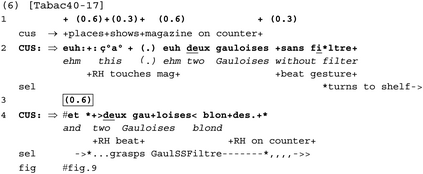


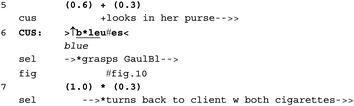
After showing the magazine at the counter and referring to it with a demonstrative that has a final rise (line 2, ç°a°↑; the rise is marked with ↑), in addition to a quick touching and pointing gesture (lines 1–2), the customer proceeds to request the second product, cigarettes (line 2). The last element is also produced with a final rise (filtre↑, line 2). As this request is nearly complete, the seller turns to the shelf. The customer visibly monitors her complying action: during the pause that follows (line 3), while the seller searches for the cigarettes, the customer gazes at her. The next request, prefaced with et, is produced (line 4) while the seller is still leaning over the shelf where the Gauloises sans filtre are located (see Figure 9). This request, naming another product of the same brand, is presented as the last item on the list by way of using final falling intonation. The list is not only made audible through prosody and series of noun phrases (NPs), but it is also made visible through beat gestures (noniconic repetitive movements; McNeill Reference McNeill1992) that co-occur with each item.
The last product is carefully timed, monitoring the seller in order to allow her to retrieve both types of cigarettes without having to turn back twice. The customer even repairs her reference to the last product (line 6) and does so quickly, orienting to the timing of the seller's response to his request, as she grasps the cigarettes (Figure 10). In other words, this is an example of multiple requests being formatted so that they orient to the movements of the seller, minimizing them in an economical manner.
In the previous case, the products were requested through two separate actions—connected by et ‘and’—but in a way that allowed a single responsive movement by the seller, turning to the shelf in order to successively achieve complying responses to both requests, retrieving the two products. In the following cases, the requests are complied with by the seller's two separate movements, turning to the shelf and then back to the customer for each item. In extract (7), this can be seen in the longer pause (line 4) that occurs after the first item has been uttered with a rising final intonation (line 3). During that pause, the customer monitors and waits for the seller to turn back before requesting the second item.
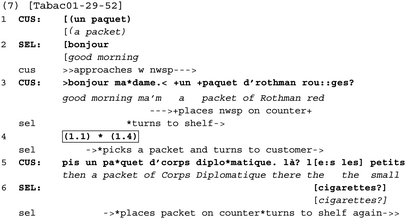
In line 3, the last lexical item that names the first product (rou::ges?) is produced not only with a rising final intonation, but also through stretching the vowels, which is a recurrent pattern in the listings in the French data. The description of the product has already begun in overlap with the greetings (line 1), projecting the subsequent request for cigarettes. This accounts for the seller turning almost immediately towards the shelf. During the pause after the first request, the seller retrieves the cigarettes and turns to the customer (line 4). Only then does the customer continue with the next item (line 5), prefaced by pis.
As opposed to extract (6), in which the customer timed her requests so that the seller was able to retrieve both products before turning back to the customer, the customer in extract (7) waits for the seller to turn back to him before proceeding. This difference in the timing of the requests—and in the segmentation of the seller's responsive actions—is also manifested by the connective (et ‘and’ in extract (6), pis ‘then’ in extract (7)).
In the Finnish data, the connector ja ‘and’, similar to the French et, is used for including two items in a single request (see extract (6) above). Similarly to French, the use of ja contrasts with the use of sitten ‘then’, which typically articulates two different requests that are responded to by two distinct movements by the seller turning to the shelf, as in the following extract.
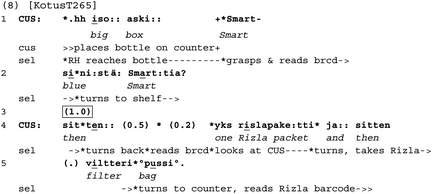
While he places a picked-up product (a soft drink) on the counter and the seller responds by reading the barcode, the customer requests the next product (lines 1–2). The brand name of the cigarettes at the end of the turn is uttered by using a rising final intonation (marked as ? in Smart:tia?), projecting a continuation (see Ogden & Routarinne Reference Ogden and Routarinne2005). The seller turns to the shelf and locates the cigarettes (line 3). When she is about to turn back, the customer continues his list (line 4), prefacing his turn with the connector sitten. The final consonant is stretched and followed by a pause. Once the seller has read the barcode, the customer proceeds to name the second (‘Rizla’) and third item (‘bag of filters’, line 5). As in the previous extract, the customer waits for the seller to turn back and even process the product, before uttering his next request.
If sitten and pis ‘then’ can be interpreted as expressing more clearly a temporal movement from one action to another, as opposed to ja and et ‘and’, which indicate that the requests are more closely connected, the use of complex connectors links requests that are more heterogeneous or disconnected. Ja sitte ‘and then’ was used in the previous excerpt after an item initiated only with sitten ‘then’ (line 4). In the next extract, et puis is used after a request that is completed by s'il vous plait? ‘please’ (line 2).
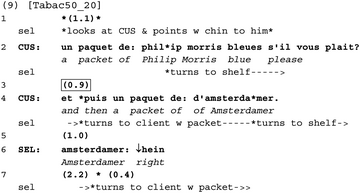
In this case, the customer requests the first product with an NP followed by s'il vous plait? (line 2). While the prosody here is clearly projective, the final phrase s'il vous plait indexes the completion of the request. The next request is designed to orient to the latter rather than to the former. In this case, where several possible subsequent actions are implied, the customer prefaces his request with the stronger connector et puis (line 4). Furthermore, this connector is more clearly articulated than the more succinct et pis, and it is produced at the exact moment when the seller is turning back, which is similar to extracts (7) and (8).
The distribution of the connectives ja/et, sitten/puis, and ja sitten/et puis is consistent and similar in French and Finnish. The first pair (ja/et ‘and then’) is used for more compact requests, constituting either one action (extract (5)) or two similar actions (extract (6), where the requested cigarettes are of the same brand and thus located close to each other). The second pair (sitten/puis) is used to connect distinct requests that require the seller to not only respond by two grasping actions, but also by making two distinct pivoting movements towards the shelf. The third pair of connectives (ja sitten/et pui ‘then’) is used to connect requests that are more discontinuous. The format of these requests is a result of the customer calibrating the temporal production of his actions (see the pauses that occur before making the next request) and the resources (prosody and connectors), adjusting them according to the emerging responses of the seller. This indicates that both French and Finnish adopt similar distinctive multimodal Gestalts by organizing multiple requests successively within the same serial order and incrementally to build a consistent global project—a coherent purchase.
Intervening actions between the first and the second request
In the previous sections, we have focused on the ways in which the first and subsequent requests for a product were organized temporally and multimodally at the beginning of the encounter. The requests were contiguous, and both their timing and design served to connect them in a compact serial organization. Let us now examine cases in which the customer cannot necessarily rely on the contiguity between requests but, instead, may need some additional effort to connect them as part of a larger project. In these instances, the serial organization of actions is looser, with intervening actions occurring between two requests. We first present situations that involve intervening actions that are related to the business at hand, expanding the request sequence with further specification of the product. We then turn our attention to examples of small talk that are unrelated to the commercial activity being inserted between requests.
Insert-expansions related to the previous request
The sequence initiated by the customer's request may be expanded by insertion sequence(s) initiated by the seller in order to further specify the product before compliance. These insertion sequences delay the request of the next product. When this occurs, the customers tend to connect the second request to the first one with the et or ja ‘and’ preface.
This is illustrated by the following French excerpt. The customer is holding a newspaper and first asks for letter writing paper (line 2) and then for stamps (line 17).
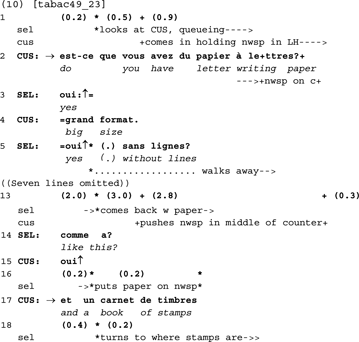
The customer approaches the seller and asks for letter writing paper while placing the newspaper on the counter. She begins with a pre-request (Schegloff Reference Schegloff2007), checking the availability of the product (line 2). The seller responds positively, and the customer proceeds to specify the size of the paper she wants (line 4). The seller acknowledges this and asks for further specification (line 5) before beginning to search for the requested item. The request for the first product is constructed through a series of adjacency pairs, and then finally complied with by the seller, who then leaves the counter to retrieve the product and returns shortly (line 13).
The second request is produced after the first one is concluded—after the paper is confirmed as the correct variety (line 14–15) and the seller has placed it on the counter. This request is formed with an et-prefaced NP (line 17). The request is complied immediately by the seller, who walks away from the counter. The simple format of this request and the minimal connector prefacing it (et) both display and utilize the link between the letter paper and the stamps—two objects that ‘go together’ (see Sacks Reference Sacks and Jefferson1992:757, on objects that have a co-membership relation with each other).
In other cases, the link between the first and second requested product is less straightforward. This is manifested in the format of the second request as well as the choice of connector, as in the following Finnish extract.
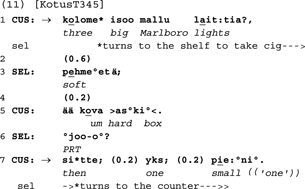
As the customer begins his first request for cigarettes, he is looking at the shelf. The seller starts to comply with the request early (line 1), and while doing so, initiates an insertion sequence by offering a candidate understanding of the type of packages needed. After the customer's response (line 5) and the seller's compliance-implicative acknowledgement and her passing the cigarettes (line 6), the customer proceeds to the second request, naming the second item in a sitte-prefaced turn (line 7). Sitte marks the request as subsequent and connected to the previous one, and consequently as part of a larger project. Here, choosing the connector sitte instead of ja may be related to the untypical nature of the purchase. The customer is buying different types and amounts of cigarettes, and the second request concerns a smaller size of the first product; he might be buying on behalf of other people. Therefore, the choice of sitte can be understood as orienting to the heterogeneity of the purchase.
A combination of two connectors can be used for objects that ‘do not go together’, as in the French extract below. The customer first asks for envelopes (line 1) and then, after a long expansion of this first request, for candy (line 27).
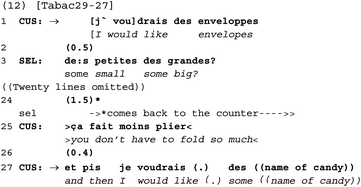
The request for envelopes, uttered with a clause (the verb ‘to want’ in the conditional form, line 1), first generates an insertion sequence concerning the size of the envelopes (line 3) and then a long expansion. Finally, the seller returns with the requested item (line 24), and the customer provides for an account why he requested that particular type of envelope (maybe orienting to its possible unavailability) (line 25). The next request is made immediately afterwards, prefaced by et pis and followed by the request formatted as a clause (line 27; the same format as in the first request). Using the same verbal format for both requests creates coherence between them and unifies the global purchase, whereas the use of et pis addresses the heterogeneity of the objects bought (envelopes and candy).
Thus, when designing their requests, customers orient to and display features that make their purchase coherent and diverse. They exhibit sensitivity regarding the relation between the objects they buy and the way they are requested. This is particularly evident in the following case. The customer repairs his way of connecting the second request to the first.
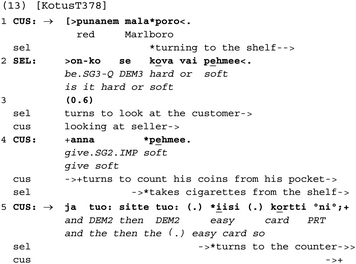
After an insertion sequence, while the seller is responding to the customer's first request, the customer begins naming the second product (line 5). At this point, he is looking slightly aside and counting his coins. He prefaces his utterance with ja, constructing a close connection between this product and the preceding one. From ja he proceeds to the demonstrative tuo, stretching the last vowel. Instead of then naming the product, however, he produces the connector sitte, followed by tuo, which is again stretched. Thus, he revises the closeness of the connection between the two types of products (cigarettes and a prepaid phone card) from a close one to a more distant one.
In previous literature, pre-response inserted sequences have been analyzed as being typical of institutional interactions (Merritt Reference Merritt1976; Robinson Reference Robinson2003). We have focused less on these expansions and more on how they affect the formatting of subsequent requests: the subsequent request orients to the fact that the previous request has been expanded, and it links back to it so that it retrospectively presents both requests as part of a global buying project. As we see below, this also applies to insertions that are not related to the commercial business at hand.
Small talk inserted between a previous and subsequent request
Let us now examine another type of inserted action—small talk. While insertion sequences that focus on specifying the product sustain the progressivity of the commercial encounter, small talk directs the activity away from its main course. The customer is then faced with the practical problem of how to resume the main activity line and link a new request to both the previous request and the emergent overall buying project (on small talk in service encounters, see Toerien & Kitzinger Reference Toerien and Kitzinger2007 and Raevaara Reference Raevaara2011; on forms of hierarchy between multiple courses of action, see Haddington, Keisanen, Mondada, & Nevile Reference Haddington, Keisanen, Mondada and Nevile2014).
In the French encounters, small talk is inserted in the commercial activity after some request sequences have been completed. Small talk then becomes the main activity, suspending the purchase. We now examine how the customer resumes the commercial activity and connects a further request back to previous requests.
In the following extract, the customer has picked up a newspaper, and the way she has taken it has evoked joking. Upon the completion of this sequence, she has asked the seller a question concerning her hairdresser. Consequently, they engage in a discussion on hairdressers for approximately three minutes. The excerpt below begins as they initiate the closing of this topic with a further compliment made by the customer (line 1), rejected by the seller (line 2), and re-issued by the customer (line 3).
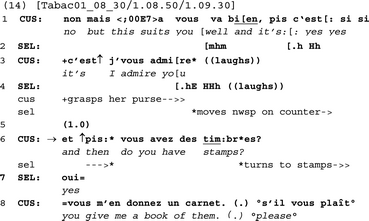
The participants orient bodily towards the closing of the small talk: the customer grasps her purse, and in so doing projects that she is about to pay. The seller then touches the customer's newspaper on the counter, refocusing on the product to be bought (line 4). At the end of the final laughter, the customer initiates a new sequence by asking whether the seller has stamps (line 6). This turn is prefaced by et ↑ pis: ‘and then’ and formatted as a pre-sequence initiation. There is a change in the prosodic production of the connector and the subsequent question. The composite connector is uttered with a rising pitch that begins on its second element. Furthermore, the vowel of that element is stretched (↑pis:). The pitch then falls during the question. This prosodic movement indicates that the turn accomplishes two tasks. First, it expresses a return to the commercial activity as well as a connection to the previous request, and second, it initiates a new sequence. The pre-sequence initiation receives a positive response and is followed by the customer's request proper (line 8), specifying the number of stamps wanted.
Resuming the process of buying in the French data is often achieved by using a clause-formatted turn and different types of clauses, as is the case in the next instance.
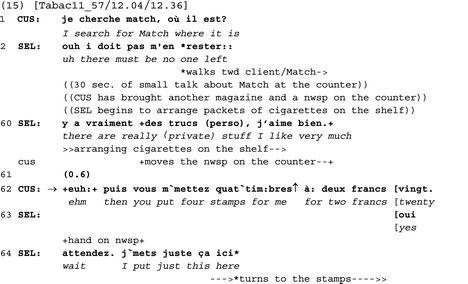
At the beginning of this fragment, the customer is still in the middle of the shop. From there, she poses a question (line 1), concerning a magazine she is looking for. The seller responds by expressing doubt as to whether there are any copies left, and moves towards the customer to join her in her search for the magazine (line 2). This occasions a conversation regarding good stories that can be read in Paris Match.
As in extract (14), the small talk is closed by the customer's bodily re-orientation to the items that she is purchasing (line 60), while the seller produces a final assessment of the magazine. At this moment, the seller continues talking, still arranging packets of cigarettes on the shelf—engaged in a continuous multiactivity (Haddington et al. Reference Haddington, Keisanen, Mondada and Nevile2014). The customer initiates a new request sequence (line 62) with a hesitation, followed by the connector puis and a clause-formatted request. By using this clause, she displays orientation to the departure from the buying activity, as well as to the limited availability of the seller, and even to the obligations of the seller towards customers. She does this by using a second-person declarative clause with a pronominal reference to both herself and the seller (vous me ‘you to me’, the doer and the beneficiary), which portrays herself as being fully entitled to make the request and the seller having no contingencies to fulfill it. Furthermore, puis re-establishes the continuity of the buying agenda and normalizes its continuation. The seller acknowledges the request (line 63) and postpones her complying response until she has finished her ongoing work (line 64).
In the two previous cases, small talk becomes for a moment the main activity of the encounter, suspending the buying. Consequently, when the customers resume the commercial activity and verbally formulate the second request, they use forms that express a connection to the previous phase of their buying (extract (14)) or a move forward, followed by a clausal initiation of the second request (extract (15)).
By contrast, in the following case from the Finnish corpus, small talk is inserted within the actions of buying. This is made possible by the long silences and some searches occasioned by the buying actions. Small talk is thus subordinated and embedded in the main activity of buying (Haddington et al. Reference Haddington, Keisanen, Mondada and Nevile2014). Embedding the activity of small talk in the buying activity allows further request(s) to be produced with fewer verbal resources than in the previous two extracts. The customer has come to buy several products on behalf of her co-workers. She has to collect the products herself and it takes her some time to find them. As she is looking for the items, the seller initiates small talk by asking her some questions (lines 10, 20, 22; single arrows point at the requests and double arrows at the small talk).
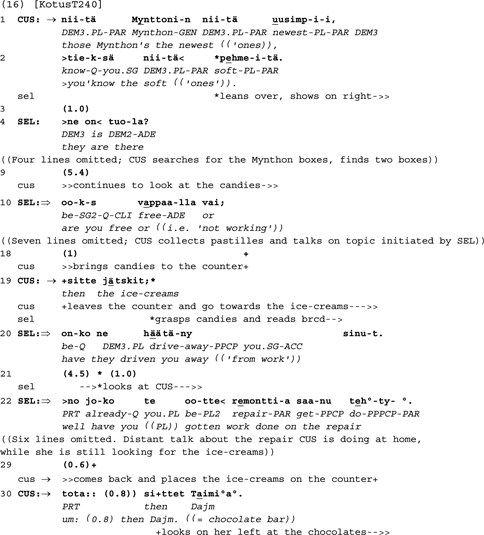
After looking at the candy displayed in front of the counter, the customer requests assistance from the seller by naming the first type of product to be searched for (line 1). She then searches, finds, and takes the candies. As she is moving to the other side of the counter to look for other types of candy, the seller initiates small talk by asking the customer whether she is having a day off from work (line 10). The customer responds by saying that she was sent by her co-workers to buy some pastilles for them. She then brings the candy to the counter and begins to turn away, simultaneously naming the second item on her list, ice cream, thus accounting for leaving the counter. To name the products, she uses an NP that is prefaced with the connector sitte ‘then’; she also uses a similar practice for naming the third product (line 30).
Unlike the previous two cases from the French convenience store where small talk became the main activity, the small talk here is subordinated to the activity of buying, which sustains the line of buying so that further requests are presented only with an NP (as opposed to a clause in the French cases). That type of embeddedness of the commercial activity and small talk can be regarded as being partially due to the placement of the products that the customer wanted to buy relative to the counter: the customer's search for the sought-after items occurs around the counter.
Episodes of small talk reveal how the participants actively maintain and re-establish the orientation towards the global buying agenda, even when the serial organization of requests is less tight. In the French data, the buying activity is suspended and small talk is exclusively attended to until the buying is resumed. The resuming phase reveals certain specific features of the buying activity, such as the rights and obligations of customers and sellers, as well as re-orientation to the buyables and to the previous request sequence. In the Finnish extract, the multiactivity is achieved differently. The progressivity of the ongoing buying process is sustained, and the small talk is initiated by the seller and retained by both participants, as the customer searches for the products and the seller reads the barcodes. As a result, the participants embed small talk in the buying process.
Requesting the last product in a closing environment
Throughout the incremental serial organization of multiple requests, the production and identification of the customer's request as ‘the last one’ is of the utmost relevance. In the overall sequential organization of the encounter, a final request possibly closes the phase of going through the things to be paid (requesting and providing products) and makes relevant a transition into the phase of paying, where the seller announces the total price of the purchase and the customer actually pays (Koivisto & Halonen Reference Koivisto and Halonen2009). Initiating the payment is a result of both participants monitoring each other's actions closely. In this section, we examine how customers make accountable their ‘last’ request in a sequential context where the completion of the purchase is achieved and moving to the payment has become imminent.
After ‘anything else?’
In commercial encounters, the seller's question ‘anything else?’ orients to the possible completion of the buying project, eventually expanded for a ‘last’ item (Koivisto & Halonen Reference Koivisto and Halonen2009). This question has become standardized and routinized in some shops. In the corpus of Finnish kiosks, we find cases, such as the following, in which the relevance of yet another request by the customer is topicalized by the seller with the aforementioned inquiry (line 3), which is issued after the customer's request for cigarettes in line 1.
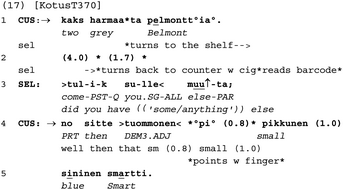
The customer formats his request with a turn that does not project further requests. After retrieving the cigarettes and reading their barcodes, the seller treats the customer's purchase as potentially but not absolutely completed by asking a question about possible other products (line 3). This provides the customer with an opportunity to request another product. He seizes this opportunity by formatting his request as ‘the last one’ and as ‘occasioned’ (vs. ‘planned’), using an NP, prefaced with the particle no and followed by the connector sitte. With the particle no, he indexes a departure from some line of action, implying that the last request is a response to the seller's question. Using sitte, he connects this request to the prior one and marks it as being subsequent. Thus, ‘anything else’ is an inquiry that orients to the possible completion of the buying while still offering an opportunity to present further requests.
After the total price has been calculated
In the French data, there are no ‘anything else’ inquiries. The completion of the purchase is projected by the final calculation of the price, which is done by the seller counting aloud or calculating with a machine, or simply announcing the total price. This moment raises practical organizational issues for both participants. The seller monitors the progression of the buying activity until she detects its possible completion. At this point, she either initiates the calculation, or she announces the price. The issue for her is to avoid announcing the total price too early, before the customer is finished, since this might curtail the buying of the last product(s). The customer also orients to this moment, managing her multiple requests in a way that projects more to come, preventing the seller from calculating the price before she is finished. Their orientation to these issues is displayed in their managing and formatting the last request.
Divergent orientations to the possible completion of multiple requests are observable in the following cases, in which the seller announces the total price of the transaction and the customer, in partial overlap, rushes through with a last request.
In the following extract, the customer asks for a packet of cigarettes in overlap with the previous client (CU0) who is saying goodbye to the seller and leaving (line 1).
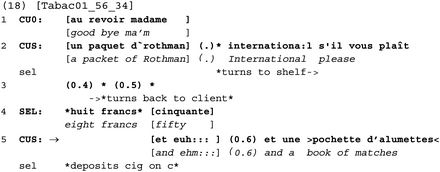
The customer's request is formatted as an NP and completed with the final phrase s'il vous plait (line 2). The final phrase both treats the turn as being completed and indicates the action done by it, a request. This—together with the early position of the request (in overlap with the greetings of the other client), which may be interpreted as the customer being in a hurry—might increase the possibility of the seller treating the entire purchase as being complete: once she has turned back from the shelf and is placing the cigarettes on the counter, she begins to announce the price (line 4).
At that moment, in overlap with the last part of the price, the customer adds another request (line 5). It begins with et euh::: (which continues until the seller has completed her turn). The first element et indicates a connection with the first request and the second item euh::: projects more to come. Moreover, after a pause, the customer continues with et followed by an NP naming the product, uttering this part of his turn as accelerated. By doing this, he displays that this second request is ‘late’.
Another instance of a ‘late’ last request is provided in the following excerpt, in which the customer has picked up a newspaper and is holding it under his arm.
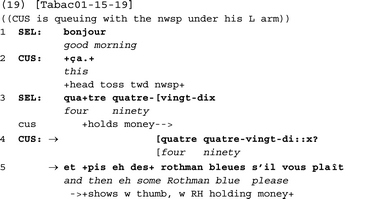
The customer refers to the picked-up item with the demonstrative ça ‘this’ and with a head toss towards it (line 2). In response, the seller announces the price (line 3). As in the previous case, the customer begins a turn in overlap with the seller. In this case, however, he does not immediately utter his next request, but repeats the price announced by the seller (line 4). He does so with the specific prosody of a rising intonation and a stretched final vowel. This prosody reconfigures the initial announcement of the final price into the first element of a list, projecting a second element. That second element is only produced afterwards (line 5). It is prefaced with et pis, referred to with an NP and a pointing gesture, and the turn is closed with s'il vous plait. Thus, the customer aligns with the seller by repeating the price but also transforms its sequential value and position, employing prosodic resources to create a sequential environment for the second request.
These two instances demonstrate how closely the customers orient to the possible completion of multiple requests, and how they manage in detail a divergent identification of the relevant moment for closing as well as the format of their ‘late’ final requests.
Given that the customers can add requests after the seller has initiated the closing, it is worth examining how late a request can still be made. Our final extract shows evidence that this is possible even while paying.
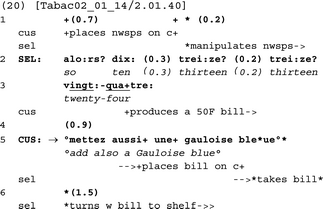
The customer places various newspapers and magazines on the counter without saying anything. The seller immediately begins to process them and initiates the progressive calculation of the price aloud (lines 2–3). The customer aligns with what is projected by the calculation (contrary to the previous extract), by producing a bill (line 3). However, while placing the bill on the counter (line 4–5), he presents an additional request: he begins with an imperative formatted verb (‘add’)—relatively rare in the data—followed by another tying device, the word aussi ‘also’ or ‘too’. The seller responds to both actions: she takes the bill, accepting the payment, but also turns to the shelf and retrieves the requested cigarettes. This configures the customer's action as the ‘last’ request and projects a definitive closing of the encounter.
If announcing the price initiates the closing of the encounter in both the Finnish and the French convenience stores, the fact that the price is not produced by a machine, but is calculated by a person, as in this case, creates an environment in which some emerging action can be intercepted, stopped, transformed, or neutralized. This provides additional opportunities for positioning the ‘last’ request.
Conclusion
This study has offered a systematic exploration of different sequential environments for making multiple requests during shop encounters. On the basis of video recordings in convenience stores in France and Finland, we have described the practices by which sellers and customers build multiple requests progressively and emergently as a global buying project. The analysis demonstrates how multiple requests can be combined as relatively simple actions achieved simultaneously or successively by employing both embodied and verbal resources, as subsequent contiguous sequences of actions, or as sequences of actions separated by inserted actions. The analysis also shows how first and subsequent requests are tied together and how ‘late’ requests can be made by orienting to the last sequential opportunities offered by the unfolding of the commercial encounter. Both sellers and customers, for different practical purposes, orient to the relation between the previous and the next request in a series, as well as to the final request and the completion of the purchase. Hence, the study of multiple requests contributes to the understanding of both sequence organization and the specific practices that characterize shop encounters.
Sequence organization is a long-established field of investigation for conversation analysis. The ways in which actions are formatted within adjacency pairs have been widely researched as constituting a fundamental form of sequence. However, far less attention has focused on the way sequences of sequences are organized within action-type sequence series (Sacks Reference Sacks and Jefferson1992:287–88; Schegloff Reference Schegloff2007:207ff.) and the consequences of this type of serial organization for both individual actions and the global organization of social interaction. This article demonstrates how the serial organization of sequences constrains the specific formatting of actions depending on their sequential position within the series. It also shows that participants orient to these features and actively achieve their ordered character by treating unfolding actions as belonging to the series and consequently to a global project. This ‘project’ is reflexively achieved by a double orientation by the customers, prospectively projecting that a sequence of actions will be followed by another similar sequence and is therefore not the last one, and retrospectively by tying an action to a previous one.
These features characterize both general sequence organization and specific forms of institutional interactions. This study shows how multiple requests and the particular multimodal formats of requesting actions and their responses are deeply embedded within the ecology of the activity—in this case, a shop encounter. For instance, verbal vs. embodied vs. multimodal formats are characterized by different temporalities that afford their organization in rather parallel (simultaneous) or successive ways, which in turn are reflexively adjusted to the local environment: the participants’ embodied orientation towards the products picked up by the customer in the accessible surroundings, and to the location of products retrieved by the seller. So, the multimodal format of requests discloses their sensitivity to the local environment: to the specificity of products, their relevant features in relation to the tasks at hand, their location, and their praxeological dimension. It also shows the sensitivity of the requests to the technological and economic environments, as they are implemented in specific trajectories of actions—the reading of barcodes and the management of payment, as well as regulations concerning cash registers. In more general terms, this article demonstrates the manifold indexicality of action formats.
The findings of this study have important consequences for how we think about diversity and comparisons. Multimodal resources for action adjust to the specificities of the material and spatial settings in remarkably similar ways in both French and Finnish convenience stores. Although the grammars of French and Finnish are different, speakers can mobilize similar resources in both languages for similar interactional purposes, as shown by the analysis of the connectives ja/et and sitte/pis along with their combinations. The differences we observed between these two sets of data rather relate to differences in technologies, regulations, and paying systems (characterizing stores in the 1980s vs. the 2000s), which differently constrain the temporality and successivity of actions and create different sequential slots for them. The lesson we learned is that issues of diversity are—in line with the ethnomethodological and conversation analytic mentality—to be discovered on the basis of the relevant features of the activity to which the participants orient, rather than on the basis of a priori ‘etic’ expectations. This invites further exploration of possible relevant dimensions accounting for the situated diversity of human actions, which might be found in institutional, material, and linguistic realms that are yet to be discovered and whose specific relevance cannot be a priori presupposed.
Appendix: Transcription and glossing conventions of talk
Talk has been transcribed according to conventions developed by Gail Jefferson. An indicative translation is provided line per line in italics. In the Finnish extracts, there can be a gloss line that provides grammatical information. Glossing symbols are listed below.
Case endings (the items in parentheses are often dropped in colloquial Finnish)

Other abbreviations
- cli
-
clitic
- imp
-
imperative
- pl
-
plural
- ppcp
-
past participle
- pppcp
-
passive past participle
- prt
-
particle
- pst
-
past tense
- q
-
question clitic
- sg
-
singular
- dem
-
demonstrative pronoun (1 ‘this’; 2 ‘that’; 3 ‘it, that, the’)
- 2
-
second person ending
- 3
-
third person ending
Multimodal details have been transcribed according to the conventions developed by Mondada (see https://franz.unibas.ch/fileadmin/franz/user_upload/redaktion/Mondada_conv_multimodality.pdf).
- **
-
each participant's actions are delimited by the use of the same symbol
- *--->
-
action described continues across subsequent lines
- *--->>
-
action continues until and after excerpt's end
- ---->*
-
action continues until the same symbol is reached
- >>--
-
action begins before the excerpt's beginning
- ….
-
action's preparation
- ,,,,,
-
action's retraction
- cus
-
participant doing the action is identified in small characters when s/he is not the current speaker
- fig
-
screen shot
- #
-
the exact moment at which the screen shot has been captured
- brc
-
barcode reader
- c
-
counter
- nwsp
-
newspaper
- w
-
with
- H
-
hand
- LH
-
left hand
- RH
-
right hand