Introduction
Hydatid disease is very common in Indian buffaloes. The fertility rate of the cysts is very high in buffalo isolates. Although work has been carried out, in India, on characterization of Indian buffalo isolates on the basis of their phenotypic (Gill & Rao, Reference Gill and Rao1967; Singh et al., Reference Singh, Joshi and Singh1992; Maity et al., Reference Maity, Bhattacharya, Batabyal, Chattopadhyay, Bera and Karmakar2007) and genotypic characters (Reddy et al., Reference Reddy, Rao, Butchaiah and Sharma1998; Bhattacharya et al., Reference Bhattacharya, Bera, Bera, Maity and Das2007), the literature has remained silent on the pattern of protein expression in Indian buffalo isolates and its stage-wise changes after induction of stressors.
In the present investigation we have studied the effects of anthelmintics, namely albendazole (ABZ), ivermectin (IVM) and their combined effects, on protoscoleces.
Materials and methods
Collection of parasites and viability test
Indian buffalo isolates were collected from the slaughterhouse of Kolkata Municipality Corporation. Cysts were kept ice cold and carried to the laboratory. Protoscoleces were isolated from cysts. The protoscoleces were washed three times in phosphate-buffered saline (PBS) (pH 7.2). Viability of protoscoleces was assessed using a methylene blue dye exclusion test. Organisms having 90% viability were selected for the study. Viability estimates were performed in triplicate.
Maintenance of protoscoleces
A total number of 25,000 protoscoleces were maintained in 10 ml of culture medium 199 (M199; with Hanks' salts, l-glutamine and 0.35 g of sodium bicarbonate) with 0.1 mg ml− 1 of either ivermectin or albendazole, these two anthelmintics in combination or with no anthelmintic. The organisms were incubated at 37°C. Observations were made at 24-h intervals for a period of 72 h. All experiments were performed in triplicate. Prestressed protoscoleces were prepared by moist heat after incubation at 42°C for a period of 2 h (Martinez et al., Reference Martinez, Perez-Serrano, Bernadina and Rodriguez-Caabeiro1999a).
Morphology and viability of protoscoleces
The morphology and viability of the organisms were recorded at 24, 48 and 72 h. Protein was precipitated from the medium using 50% saturated ammonium sulphate solution at 4°C. The precipitated protein was collected after centrifugation at 10,000 g for 15 min at 4°C. The pellet was dissolved in PBS (pH 7.2) and dialysed against the same buffer for a period of 6 h. Protein concentration was measured as described by Lowry et al. (Reference Lowry, Rosebrough, Farr and Randall1951).
Results
Morphology and viability of test organisms
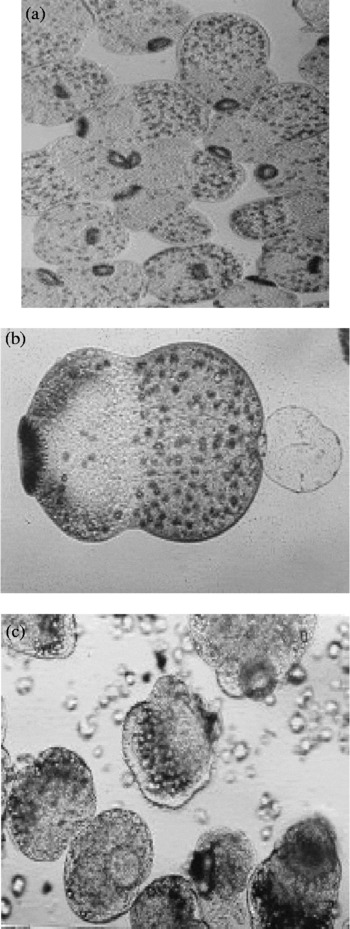
The morphology of the organisms did not change up to 72 h when they were kept in artificial medium without addition of an anthelmintic (fig. 1a). The viability of protoscoleces was 90, 85 and 80% after 24, 48 and 72 h of incubation, respectively. The viability of protoscoleces was 70, 50 and 10%, respectively, 24, 48 and 72 h after albendazole treatment. In ivermectin-treated protoscoleces viability was 70, 40 and 5% at 24-h intervals. After use of a combination of albendazole and ivermectin the viability was 80, 50 and 4% after 24, 48 and 72 h, respectively.
Morphological appearance of protoscoleces of Indian buffalo isolate of Echinococcus granulosus: (a) before treatment; (b) 24 h after treatment; and (c) 72 h after treatment.

In both prestressed and anthelmintic-treated protoscoleces a vesicle-like body was formed after 24 and 48 h in all viable organisms (fig. 1b). The vesicle-like structure was not seen in the control group. Distortion of the morphology of protoscoleces was observed in all treated groups after 72 h (fig. 1c).
Expression of excretory–secretory product
The relative molecular weight (Mr) of excretory–secretory products was evaluated in prestressed, treated and normal protoscoleces. No visible peptides were seen when the organism was harvested in M199 medium without any treatment. However, in prestressed protoscoleces two prominent protein bands were visible in the medium, with relative molecular weights (Mr) of 70 and 40 kDa. Expression of the peptide of Mr 40 kDa was recorded 24 h after incubation with albendazole, ivermectin and their combination. Both the peptides were seen 48 h after treatment with albendazole, ivermectin and their combination.
Discussion
The present study of protoscoleces has provided a model system to study viability, morphopathology and characterization of expressed proteins in Indian buffalo isolates. Morphological changes have indicated injury to the organism. This could be appreciated on the basis of distortion of protoscoleces 72 h after treatment. The preliminary study also indicated that vesicle-like formations, termed bladders, were produced in all test organisms. This has also been observed by Martinez et al. (Reference Martinez, Perez-Serrano, Bernadina and Rodriguez-Caabeiro1999a). The presence of this type of structure in treated groups might be indicative of morphological changes due to induction of stress.
Studies of the expression of protein in the treated groups indicated the presence of two types of peptides, of 70 and 40 kDa. Earlier studies had indicated that similar expression was observed after 48 h of incubation with albendazole, ivermectin and a combination of both. The present result indicated that heat stress and use of anthelmintics induced the expression of excretory–secretory products in vitro. These two peptides might be stress proteins or heat shock proteins of 40 kDa and 70 kDa. Previous reports have indicated the expression of hsp60 and hsp70 in sheep isolates (Martinez et al., Reference Martinez, Perez-Serrano, Bernadina and Rodriguez-Caabeiro1999a, Reference Martinez, Perez-Serrano, Bodega, Casado and Rodriguez-Caabeirob). They claimed the existence of hsp60 and hsp70 for the first time in the culture medium as excretory–secretory products and as a bioindicator for evaluation of anthelmintics. In our study, besides the existence of a 70 kDa peptide, the presence of a 40 kDa peptide has also been shown. The latter peptide may be hsp40, which might be expressed by Indian buffalo isolates. However, this statement demands further evaluation on the basis of its immunoreactivity and genetic characterization. A complex pattern of peptides observed 72 h after treatment may be correlated with the distortion of protoscoleces.