Introduction
As the international community has become concerned about the status and fate of animal genetic resources (AnGR), a number of countries have turned to gene banking semen, embryos or tissues for the purpose of safeguarding these resources. The need for such conservation measures is necessary given the decline in genetic variation among and within breeds of livestock (FAO, 2007a). Driving much of the contraction in genetic resources is the inability of certain breeds to be economically competitive under current market conditions that exist in their respective countries. This situation is not likely to change in the short term owing to the increasing demand for livestock products and the need to mitigate environmental pollutants generated by the livestock industry (Steinfeld et al., Reference Steinfeld, Gerber, Wassenaar, Castel, Rosales and de Haan2006). In addition, in situ maintenance of populations is costly and vulnerable to negative perturbations to populations and the environment they are maintained within (Gollin and Evanson, Reference Gollin and Evanson2003).
In principle, the concept of gene banking animal tissues is similar to the plant gene banks that have been in operation since the 1950s (NRC, 1993a). Since 2000, there has been a substantial increase in the number of gene banks storing AnGR (Danchin-Burge and Hiemstra, Reference Danchin-Burge, Hiemstra and Planchenault2003; Blackburn, Reference Blackburn2009). Furthermore, at a workshop on gene banking AnGR held in Tunisia more than half of the 25 countries in attendance had initiated or were in the process of developing animal gene banks.
During the past decade, gene banks for AnGR have been initiated on a national level in all geographic regions. In several regions, the gene banking process is quite well developed with substantial numbers of breeds or populations being conserved. This action represents a relatively new approach for the conservation of AnGR and as a result, in some instances, the infrastructure, policies and legal aspects are still evolving on a within-country basis. An important aspect in the development of animal gene banks is that they are country-driven processes and there has been little to no involvement from the international centres of the Consultative Group on International Agricultural Research (CGIAR), particularly in comparison with plants.
For both plants and animals, samples are acquired from targeted populations, stored for unspecified periods of time, and can be requested and used by industry or the research community. However, across the livestock sector policies and best practices are still being developed and implemented. These activities are nationally focused and no extensive dialogue has been initiated about the types of policies and practices necessary for multinational exchange. Therefore, the objective of this paper is to highlight the policy issues of importance for gene banking of AnGR on national and multinational levels, discuss the existing national and international agreements, legislation and regulations that may be relevant for cryoconservation of AnGR and present options for countries considering to establish AnGR cryoconservation programmes.
Gene banks for AnGR
To provide a basis for discussing the types of policies and regulations that might be needed for gene bank operation, the following discussion provides an overview of how gene banks can be used and how they might access material for collection development. There is a general consensus that gene bank collections have multiple functions that include:
• a source of genetic variability for reintroduction into the in vivo populations when needed;
• the ability to reconstitute entire breeds or populations as needed, particularly following catastrophic events such as disease epidemics or civil strife;
• development of new breeds or research populations; and
• a source of DNA for molecular studies.
As a result of these benefits, a number of national gene banks have already accumulated significant stores of germplasm that cover a wide range of species, breeds and special populations (Danchin-Burge and Hiemstra, Reference Danchin-Burge, Hiemstra and Planchenault2003; Blackburn, Reference Blackburn2009). As an example, the United States has developed, to date, a germplasm collection that contains 560 000 samples from 12 500 animals and has increased annually by approximately 50 700 samples per year since inception (www.ars.usda.gov/Main/docs.htm?docid=16979). In addition, this gene bank has had samples from over 2 000 animals exit the repository to (1) add genetic variability to in situ populations, (2) reconstitute populations that had been discontinued and (3) be used in genomic studies.
Collection development
The physical acquisition of germplasm for national collections can be accomplished in a number of different ways. For example, samples can be obtained from public or private artificial insemination (AI) collection centres or on farms, or in the case of epididymal sperm or ovaries collection can occur in slaughterhouses and meat packing plants. Determining where samples are collected will depend on the costs of collection activities and the type of genetic resources that are available for collection via these approaches. When conducting field collections it may be feasible to make arrangements with livestock producers to transport their animals to an AI centre or a common meeting area where the animals can be collected and the germplasm can be either frozen in the field or shipped to a laboratory for processing.
Although gene bank managers must be flexible in the approaches used to execute collections, any approach taken warrants a degree of caution. Whether collections occur within an AI stud or in the field, there are several technical concerns. The first issue regards collection of semen. The ability to obtain viable samples from any male is always a concern, but it is particularly important if males have been inactive. Therefore, it is desirable, whenever possible, to collect males more than once. A second issue is, to the extent possible, to determine that the animal being sampled is free of any sexually transmitted diseases for which the pathogen may be present in the semen or attached to an embryo or oocyte. Many potential diseases can be tested for using blood samples or the germplasm itself and some disease evaluations can be performed after the animal is collected. Then the final decision on whether the sample should be kept for breeding purposes can be made based on the results of these tests. Although such collection approaches may not meet the official international export standards (which will be discussed later in this paper), managers of the national gene bank may find such tests to be necessary to ensure that no transmission of diseases within the country can occur.
In collection development, a number of experiences have illustrated the importance of maintaining a high degree of flexibility in terms of actual collection strategies. Such flexibility is needed because different species and breeds within species can be produced in varying production systems and in different geographic locations. In addition to being flexible in technical terms, varying animal ownership patterns may require different approaches or agreements (these will be discussed in the next section).
Laws and regulations of relevance for gene banking of AnGR
Private property
Across nations the most prevalent law concerning livestock and AnGR are private property laws. Without exception nations consider livestock as private property and therefore the owner of the animal also owns the genetics of a particular animal (NRC, 1993b; Neeteson, Reference Neeteson2010). In addition to national laws, protection is prescribed in the UN Universal Declaration of Human Rights, Article 17 and in the European Convention on Human Rights, Protocol 1.
On a general level, the relationship between property rights as a social compact between constitutions and legislators and the natural rights of man has been made over time (e.g. VanHorne's Lessee vs Dorrance, 2 U.S. 304 (1795) 2 U.S. 304 Dallas; http://laws.findlaw.com/us/2/304.html). The roots for the association of private property rights and protection under law date back to the early works of Adam Smith, who stressed that the expectation of profit from improving one's stock of capital rests on private property rights. Therefore, it is a central assumption of capitalism that property rights encourage the owner to develop the property, generate wealth and efficiently allocate resources based on the operational markets; this point has generally been argued to apply to AnGR (Blackburn, Reference Blackburn2007).
In addition to property laws, the next most common set of laws impacting livestock producers deals with production and marketing, some of which have the potential to affect gene banking directly or indirectly for the conservation of AnGR. Many of these regulations were summarized in a review by Food and Agriculture Organization of the United Nations (FAO) of the policy framework regarding AnGR (FAO, 2005). These regulations vary widely in their target and scope. For example, they range from national to international and from “soft law” to legally binding instruments. Regulations may also have positive or negative influences on the management of AnGR and operation of gene banks for their conservation.
National legislation and regulations
In addition to the legal review (FAO, 2005), in recent years FAO has undertaken two surveys from which information regarding the existence of national regulations on national or multinational gene banks was collected. In both cases, such policies and regulations were not the main focus of the survey, but were collected along with more general information on AnGR and gene banking.
In the first instance, information on policies and legislation regarding national management of AnGR was collected as part of the process undertaken to prepare Country Reports for the SoW-AnGR (FAO, 2007a). A more recent survey on AnGR conservation activities (Boettcher and Akin, Reference Boettcher and Akin2010) included a single question on national policies and regulations that could affect the participation of a given country in multinational gene banks.
General animal and animal breeding legislation
In the information collected, no country noted specific legislation on cryoconservation of AnGR; however, as previously mentioned these areas fall under the protection ensured through laws concerning private property. Nevertheless, a number of countries have in place either general agricultural or livestock policy that could have indirect effects on cryoconservation of AnGR or specific policy on the management of AnGR (FAO, 2007b), whereas others have policies dealing directly with AnGR conservation in general. In both these cases, the policies address in vivo, particularly in situ, more directly than in vitro conservation. For example, a number of countries, including the United States, Norway, Pakistan, Botswana and Mali, have laws regarding access to grazing lands and water, supporting the pastoralist farming system and indirectly the maintenance of their livestock populations. Other countries, such as Poland and Mexico, have legislation regarding farmers' and breeders' organizations. Such legislation could indirectly impact in vitro conservation when the gene bank is operated by such organizations. Other countries, particularly in Europe and the Caucasus region, reported having regulations and policies related to the use of reproductive biotechnologies such as artificial insemination and embryo transfer (FAO, 2007b). Although these policies were generally developed with a focus on genetic improvement and in situ production, these technologies are fundamental in the establishment of gene banks and the eventual use of the stored genetic material.
Other policies have been designed to foster and support trade in local animal products. These policies can take a number of forms. Some, such as the “White Revolution” Programme in Mongolia, supported the production and consumption of local livestock products (Ser-Od and Dugdill, Reference Ser-Od and Dugdill2006). Others support the exportation of local products or impede the importation of animal products from other countries. Where these policies clearly do not directly address conservation of local AnGR, especially cryoconservation, they do assist in the generation of income from local AnGR, increasing the financial resources available for AnGR management, a portion of which could eventually be directed at conservation.
Animal health and disease
The primary objective of establishing a gene bank is to collect and preserve a significant proportion of the genetic variability that exists in a livestock population of interest. In many countries, especially those without extensive pedigree recording, sampling of animals in the field, across a wide geographical range, will help ensure greater variability. Such a process may also increase the possibility of sampling animals with a range of pathogens. In addition, animals may be transported to a central facility for germplasm collection, which also has the potential for spreading disease.
Although AI is generally considered to be superior to natural mating with regard to animal health, various livestock diseases can be transmitted through cryopreserved germplasm (e.g. OIE, Reference Hare1986; Givens et al., Reference Givens, Heath, Carson, Brock, Edens, Wenzel and Stringfellow2003; Kirkland et al., Reference Kirkland, Poynting, Gu and Davis2009). In addition, pathogens may be able to survive in the liquid nitrogen used to freeze and store preserved germplasm (Grout and Morris, Reference Grout and Morris2009). That said, no evidence exists of pathogens that were present in a liquid nitrogen tank contaminating the germplasm within the storage vessel. For these reasons, many countries have animal health policies that address the collection and cryopreservation of germplasm from those animals.
Collection of germplasm for gene banking may involve the movement of donors to a collection centre. Transport of animals can facilitate the transfer of disease and therefore many require regulation. Clearly, transport creates the opportunity for movement of a pathogen from an infected area to one that had previously been free from a pathogen. In addition, transport may often involve the mixing of animals from different farms, increasing the possibility of farm-to-farm disease transmission. Movement of animals is also a stressful activity, which may weaken their immune systems, leaving them more prone to contract disease. Transport of animals also involves issues regarding animal welfare; in addition to animal health, some regulations may exist that address this aspect. All these types of regulations may be relevant for national or multinational gene banks and are particularly important when animals are transported across national borders.
In certain countries with federal governments such as the United States and Canada, states or provinces may have their own regulations on transport of animals within and across their borders. In addition, Canada has regulations prohibiting the off-farm transfer and use of germplasm that has not been collected in a certified AI collection centre (Canadian Food Inspection Agency, 2010).
Another factor that must be considered is that national animal health and general sanitary regulations change over time, for instance, as new diseases and threats emerge and as technology improves the ability to detect and control pathogens can change. If cryopreserved germplasm is shipped out of a given country, to be banked for many years in another country, changes in health and sanitary regulations in the original donor country over the duration of the storage period may effectively prevent or provide an obstacle to its eventual re-entry.
Biodiversity, the environment and access to AnGR
Some countries have enacted legislation or adopted policies on biodiversity or access to AnGR that may be relevant with respect to national and international gene banks (e.g. ELBARN, 2009). For example, in South Africa, the Livestock Improvement Acts of 1977 and 1998 (Republic of South Africa, 2002) dictate that a biological impact study must be undertaken prior to the importation of exotic livestock germplasm. The results of the study must demonstrate that the impact of the importation would be positive. Similar regulations in Algeria allow the government to prohibit importation of exotic germplasm that may be detrimental to local breeds or that are not adapted to local conditions (FAO, 2007b). These regulations are generally directed towards immediate commercial use and as a result it may be possible to obtain a waiver to such regulations to import germplasm needed for storage in a gene bank (Boettcher et al., Reference Boettcher, Stella, Pizzi and Gandini2005).
Other countries have developed legislation with regard to provisions of the Convention of Biological Diversity (CBD) that deal with obtaining prior informed consent from the government before exportation of native AnGR. One motivation for such measures is to protect against biopiracy. For example, issues regarding export of AnGR are addressed in the recently established “Stock Breeding Law of the People's Republic of China” (http://faolex.fao.org/docs/texts/chn61879.doc). The law directs provincial governments to establish a “protection list” of AnGR with particular significance. Any export of genetic material from these breeds, or even cooperation within China with a foreign entity, is subject to special conditions and procedures. These conditions include the necessity to obtain permission from the provincial and state governments, along with the development of a use and access agreement. Exported AnGR are also subject to a quarantine period. “Newly found” AnGR must be characterized by national authorities before they can be exported or be subject to research with a foreign collaborator. The law also has provisions dealing with the importation of AnGR, requiring that an import application is filed with the provincial government for approval and that special measures, including quarantine, are taken if the imported AnGR may be harmful to the local AnGR or environment. The law also calls for the creation and updating of “gene databanks” to further protect AnGR.
In general, it is unlikely that existing national legislation would prevent governments from participating in multicountry AnGR gene banking activities, because any such legislation could be changed or waived by the government, if necessary. However, such legislation could prevent individuals or other non-government entities from depositing local AnGR in gene banks based in other countries.
Survey of national regulations with implications on gene banking of AnGR
As previously stated, the most prevalent national laws concerning the exchange of genetic resources are those involving private property. However, countries might have additional laws that are relevant or specifically tailored to the exchange of AnGR. To answer this question, a survey (Boettcher and Akin, Reference Boettcher and Akin2010) of national and multinational gene banking activities that included one question regarding the existence of relevant national regulations was performed. Specifically, the survey asked whether respondents were aware of (1) national legislation regarding exchange of genetic material, (2) regulations regarding animal health and welfare, (3) individual contracts between the gene bank operators and providers of genetic material, and (4) other relevant legislation or regulations.
The survey had 169 respondents from 92 countries. For the purpose of this analysis, one pooled response per country was used and the indication by any single respondent of the presence of a given regulation was considered sufficient to conclude that such a regulation exists. For example, if two persons responded from a given country and only one of them said that the country had relevant regulations on animal health, such regulations were assumed to be present.
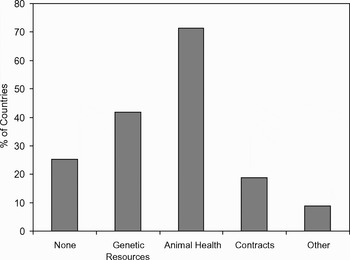
Figure 1 shows the proportions of countries with the various types of regulations. Approximately 25 percent (N = 23) of the countries had no regulations that would be relevant for participation in multinational gene banking activities, according to the respondents. Only six of these countries reported having national activities for cryoconservation of AnGR. Among the countries with some regulations, 59 percent had within-country cryoconservation activities, which probably indicates a relationship between having cryoconservation activities and awareness of the importance of regulations on germplasm exchange. The largest proportion (71 percent) of the countries reportedly had regulations on animal health and welfare that are important for cross-border exchange of genetic material. Approximately 40 percent of the countries had legislation regarding genetic resources. Finally, about 20 percent of the countries required a material transfer agreement between the owner of the germplasm and the gene bank.
Proportions of countries that have various types of legislation that may be relevant for regional gene banking of animal genetics resources.

International regulations and agreements
Genetic resources
With regard to international regulations and agreements, the most relevant instrument is the Interlaken Declaration and Global Plan of Action for Animal Genetic Resources (GPA-AnGR; FAO, 2007b). This agreement was adopted by 109 countries at the International Technical Conference on Animal Genetic Resources in Interlaken, Switzerland. The Interlaken Declaration recognizes the important role of private ownership in the management and conservation of AnGR (para 12) and thereby the necessity for animal owner concurrence in the collection of germplasm for gene banking purposes. The Global Plan of Action is a rolling plan aimed at decreasing the loss of genetic variability of AnGR and increasing their sustainable use. The GPA-AnGR has 23 strategic priorities (SP) grouped into four strategic priority areas (SPA). One of these four SPA is Conservation of AnGR. The SPA 9 is to “Establish or strengthen ex situ conservation programmes” and includes an action regarding modalities to facilitate the use of stored genetic material in a fair and equitable way. The SPA 10 is to “Develop and implement regional and global long-term conservation strategies” and actions include the establishment of regional networks of gene banks of AnGR and harmonization of approaches to facilitate their exchange. The SPA 4 on policies, institutions and capacity-building includes SP 20 and 21, which address the review and development of policies and legal frameworks for AnGR on national and international levels, respectively. However, the GPA-AnGR is not a legally binding agreement.
The CBD is another international instrument with possible ramifications on gene banking activities. With possible regard to national gene banks, the CBD stipulates that nations have the duty to conserve their own genetic resources, which include AnGR. In terms of relevance to international gene banking, the CBD also indicates that access to and exchange of genetic resources among countries should be done on mutually agreed terms and subject to the prior informed consent of the provider of the genetic resources. The CBD is in the process of negotiating an international regime on access and benefit sharing. Such a regime could have negative ramifications on exchange of AnGR, including regional gene banking efforts. The Commission on Genetic Resources for Food and Agriculture is currently working with the CBD to ensure that agricultural genetic resources are recognized as having special qualities that are distinct from other types of genetic resources and will thus require particular access and benefit sharing systems to prevent circumstances that could impede conservation efforts.
In addition to global instruments, some regions of the world have legislation regarding AnGR that may be relevant for cryobanking. The European Union, for example, has been particularly active in developing AnGR-related legislation. For example, EC Regulation 870/2004 established a programme that has supported coordination and exchange of information among member states with the objective of increasing conservation and sustainable use of agricultural genetic resources.
Animal health
The World Organization for Animal Health (OIE) is the main body responsible for setting animal health standards for the World Trade Organization Agreement on the Application of Sanitary and Phytosanitary Measures with respect to international trade. The goal of these activities is to have standards that help prevent the transboundary spread of livestock diseases while preventing countries from using such standards unfairly to block trade. The set of standards that may be relevant for multinational gene banking projects is the Terrestrial Animal Health Code (TAHC) (www.oie.int/eng/normes/mcode/en_sommaire.htm). The TAHC outlines the measures that should be taken by exporting and importing countries to ensure that exchange of animals and animal products (including germplasm) does not result in the transmission of disease. The TAHC has chapters dealing with semen collection, collection and processing of embryos, somatic cell nuclear transfer, import and export of animals, and welfare of animals during transport, all of which may be of relevance to gene banking. For example, the chapter on semen collection and processing has standards for pre-quarantine and the health of the animal prior to collection, diseases for which donor animals should be tested, and conditions and procedures for the collection, handling and processing of semen. Strict adherence to the TAHC would likely preclude the inclusion of genetic material such as semen or oocytes collected in abattoirs or field conditions in multicountry gene banks.
Eventually, it is the responsibility of the countries involved to ensure that the standards are applied. Therefore, the OIE standards will generally be covered by national animal health and sanitary regulations. Most regulations come into play only when animals or animal germplasm cross territorial borders. For example, the Russian Federation has a law, Veterinary and Sanitary Requirements 13-8-01 (FAO, 2007b), regarding the importation of boar semen. This law addresses the sanitary conditions of the semen collection station, the length of quarantine periods, the conditions of feeding and housing, vaccination protocols, semen collection methods and shipping conditions, and requires pathogen- and toxin-free status of the semen. Certified documentation confirming that these various requirements are met must be written in Russian and the language of the exporting country, be signed by the national veterinary inspector and accompany the semen during importation. Most countries have similar regulations for the import of frozen germplasm and require permits regarding animal health and sanitation.
Achieving and maintaining a disease-free status according to OIE is an expensive process, in terms of money, time and effort. Therefore, a gene bank host country with a disease-free status may be unwilling to accept genetic materials from countries where the disease is present, out of concern about losing their status. The disease-free country could provide germplasm to a host in a country without disease-free status, but there would be little direct motivation to do so, as the disease-free country may be reluctant to withdraw the germplasm in the future. In various forums it has been suggested that regional gene banks among countries of a similar status with regard to OIE standards are likely to be more feasible than a single global gene bank. However, South Asia, countries have tried to form a regional gene bank for aquatic species and have been unable to do so owing to national health concerns; as a result countries have initiated the development of national gene banks (Amirt Bart, 2010, personal communication). This anecdotal example underscores the difficulty in the transboundary movement of AnGR for gene banking purposes.
Policy and legal framework for gene banking of AnGR
Within country
Livestock are most broadly considered private property (NRC, 1993b); thereby livestock owners have ownership over AnGR of their livestock. Deviating from this general precept are situations involving individual producers and breeders who are producing animals under contract for another breeder. In this situation, appropriate aspects of contract law are in effect, affording each party the agreed-upon levels of protection and financial incentive. The prevalence of private property and contract law in effect throughout the livestock sector are two primary elements that gene bank management will have to take into account at the national and international level as they collect, distribute and exchange germplasm.
As gene banks build collections, they may choose to either have outright ownership to the germplasm in the repository or have working arrangements with individuals, companies or breed associations that maintain the ownership of the germplasm. Ownership of the germplasm can be achieved by soliciting the germplasm as a donation from individual producers, companies or organizations, or if the germplasm is considered to be of particular importance they may choose to purchase the germplasm from the breeder.
How the gene bank decides to acquire germplasm, from an ownership perspective, will govern, in part, the types of agreements necessary when releasing the germplasm for use or if the germplasm is to be stored outside the country.
From the standpoint of repository development within country policies and laws may not be well developed. However, the creation of additional laws or policies may not be needed, especially if existing mechanisms are sufficient to ensure the functioning of the gene bank. From a national perspective, relevant laws may already be in place but are written in a wider scope than AnGR. For example, generally livestock are considered private property, and therefore the access and use of livestock and their germplasm fall under laws dealing with private property rights. National laws dealing with gene banks and genetic resources may also be quite generic. For example, in the United States the national legislation directs the Department of Agriculture to develop programmes dealing with the conservation of genetic resources, including AnGR, and that material in the gene bank should be distributed to requestors at no charge. No further detail concerning the acquisition and distribution of germplasm or tissue was provided. That said, it is also recognized that other laws are in effect, which govern the acquisition and use of germplasm.
As national gene banks proceed in developing collections of genetic resources, the ownership of the germplasm should be clearly established. As Neeteson (Reference Neeteson2010) points out, animals are not owned by governments but are privately and cooperatively owned. Therefore, for gene banks to acquire germplasm and tissue, they need to develop various types of agreements with the animals' owners. In many instances, it has been the United States experience that animal owners see the utility of gene banking animal germplasm by a national entity and as a result freely contribute samples to the repository. In other instances, owners or their associations may wish to maintain a level of control over the germplasm, and therefore place germplasm samples in the repository but retain ownership or the right to influence how the samples are distributed upon request (Danchin-Burge and Hiemstra, Reference Danchin-Burge, Hiemstra and Planchenault2003; Blackburn, Reference Blackburn2009).
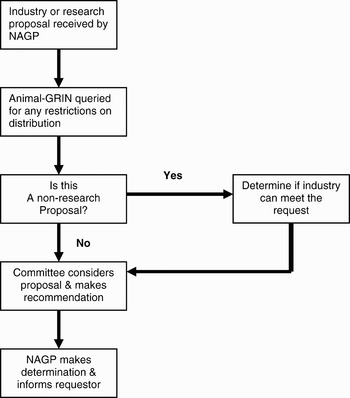
In the development of the gene bank, a policy or set of policies needs to be established concerning how and who can access the samples contained in the collection. In the case of the French, Dutch and United States collections, similar protocols have been developed for requesting and subsequent release of material (Danchin-Burge and Hiemstra, Reference Danchin-Burge, Hiemstra and Planchenault2003; Blackburn, Reference Blackburn2009). For each of these three repositories, there are committees that provide input as to the usefulness and validity of the request. For example, in the United States situation one particular function of a relevant species committee is to ensure that the request cannot be met from other private sector sources, instead of utilizing the limited resources of the repository. Figure 2 presents the process for reviewing and approving requests made on the United States gene bank. Establishment of such a process adds transparency to the process of requesting material for livestock producers and the research community.
Process for reviewing industry or research requests for animal germplasm or tissue (from Blackburn, Reference Blackburn2009).

In addition to developing policies on germplasm release, gene banks may also choose to develop policies concerning the return of germplasm or tissue samples from persons requesting the material. In instances where material is requested for genomic studies, a policy could be developed that ensures that the results obtained from repository animals are transferred to the repository for entry into its database and that the information is publicly available. Such a policy can help replenish the germplasm requested or assist in better quantifying the genotypes of animals stored in the repository.
Multilateral exchange of banked germplasm
There has been discussion in various forums about countries transferring germplasm, which may or may not be a duplicate proportion of their national collections, to other countries or to a yet to be defined regional gene bank. However, at this point in time there are no well-established regional gene banks and their development would be based on the assumption that they would be able to offer significantly better security measures than an individual country. An alternative to a regional approach is development of bilateral germplasm exchange programmes between two countries as a security measure. Having duplicate collections stored outside national boundaries may appear to be a useful mechanism to secure cryopreserved genetic resources, but there are a number of substantial limitations to their implementation, which will become apparent in the following discussion.
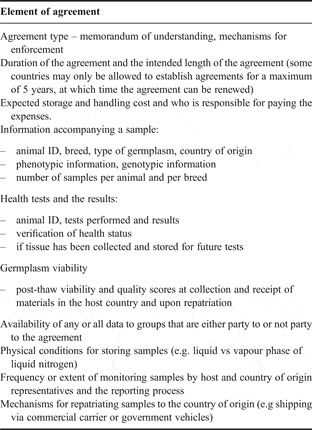
As governments consider the question of storing germplasm samples at non-sovereign locations, they should determine if the site for the redundant collection provides improvement in security over other potential storage sites within the country. In doing so, the provider of germplasm should consider if the proposed site has the infrastructure and physical security a country might deem as necessary for considering such a transfer and agreement. As part of this review process, relevant officials may wish to tour the facility where samples are to be stored. In addition to such practical issues, there are a number of administrative details to be considered. Primary among these are the establishment of an agreement between the appropriate government ministry and the regional gene bank entity or the appropriate government ministry that will be storing the samples. Elements for consideration in such an agreement are given in Table 1.
Potential elements for countries to consider when developing a bilateral agreement for backup storage.

It should be noted that the plant community makes frequent use of what is termed “black box” collections, where the receiving country does not open or have information about the samples being stored in their facility. While this might work, technically, for plants because black box shipments can be placed in their entirety into –18 C storage, for AnGR this approach presents challenges. The long-term storage vessel for AnGR is usually a large liquid nitrogen tank and materials will likely have to be transferred from a shipping container into the storage vessels; during the transfer, breed codes and animal ID will be apparent. These factors complicate the black box approach. As a result, it would not appear that the black box concept has utility for AnGR.
At the national level, gene banks are usually operated by appropriate government agencies. Therefore, the acquisition and release of germplasm is subject to whatever policies and laws the government wishes to develop. It is suggested that if additional laws or regulations are to be formulated, then the robust nature of sample acquisition should be fully considered. For example, Canada's regulations regarding the collection, transfer and use of germplasm from non-certified collection centres (Canadian Food Inspection Agency, 2010) greatly impede or eliminate the possibility of collecting germplasm from rare breeds, which are widely dispersed across the country and in all likelihood will never be taken to a certified centre for collection.
Conclusions
Gene banks for conserving AnGR have been established in all major geographic regions. This development has coincided with a growing awareness of the contraction of AnGR on a global basis (FAO, 2007b). As AnGR gene banks have become established, they have had to develop a set of protocols on how to acquire and exchange germplasm samples. As a result, gene bank managers have to be aware of their national laws and policies that set operational boundaries. The most generic law across countries for gene bank managers to deal with is property rights, for it is this set of laws that determines the acquisition and eventual distribution of germplasm stored in a repository. National and international animal health regulations are another major set of laws and regulations that may enter into the acquisition, movement and distribution of genetic resources. Within a country, a portion of the health protocols may take the form as recommendations and not legally binding. Therefore, gene bank managers need to assess their specific situation and determine under what set of conditions certain health protocols will be employed in collection development.
In the area of transferring germplasm across international borders, following health protocols established by OIE may be more critical. However, such a decision will be significantly influenced by the scope of the agreement developed by the two or more countries involved. Based on this agreement and the disease situation in the countries developing the agreement, it may be necessary to comply with OIE and the receiving country's health regulations. However, because the purpose of transferring samples across an international border could be exclusively a backup for national collections, gene bank managers may wish to seek a waiver to any or all health protocols. In addition, it may be desirable to initiate development of OIE protocols for groups of countries wanting to transfer and back up AnGR.
The release of genetic resources from the gene bank need not be only in the case of crisis situations. It is totally feasible for semen, embryos or DNA to exit the repository for routine breeding and research activities. As a result, policies for the release of genetic resources also need to be in place. Concepts guiding the use of the material include ownership of the requested samples. If the gene bank owns the samples, then their technical considerations for release will apply; however, if the gene bank does not hold title to the samples in question, then permission to release the samples will have to be obtained from the owner.
As gene banks have become established, it has become clear that their role can be much larger than a collection of AnGR for use only in emergency situations. As a result, the development of policies for acquisition, release and exchange of genetic resources needs to be established. Because of the diverse mechanisms used to acquire samples and potentially release samples, it becomes evident that gene bank policies need to be flexible enough to ensure that the livestock sector is able to garner maximum benefit from the collection developed by the gene bank.