INTRODUCTION
The Iraqi territorial marine waters, subjected to a subtropical climate, are located in the north-west corner of the Arabian Gulf, a shallow marginal northern extension of the Indian Ocean (Pous et al., Reference Pous, Carton and Lazure2012). The Iraqi marine coastal area receives huge amounts of fluvial input via the River Shatt Al-Arab, the confluent delta of the Rivers Tigris and Euphrates. During the winter season, low precipitation leads to an increased salinity in the northern parts of the Arabian Gulf. High plankton productivity, as a result of high nutrient levels, occurs in the north-western parts of the area (Al-Kandari et al., Reference Al-Kandari, Al-Yamani and Al-Rifaie2009; Al-Yamani & Saburova Reference Al-Yamani and Saburova2010, Reference Al-Yamani and Saburova2011), where a specimen of the pineapplefish (sometimes called the pineconefish) Monocentris japonica (Houttuyn, 1782) was collected.
The work of Heckel (Reference Heckel, Fenzl, Heckel and Redtenbacher1843) provided some of the earliest information on the ichthyofauna of Iraq. There are several works providing additional information on the marine fish fauna of Iraq in recent decades (Mahdi & George, Reference Mahdi and George1969; Mahdi, Reference Mahdi1971; Al-Daham, Reference Al-Daham1982; Hussain et al., Reference Hussain, Naama and Al-Hassan1988), but there are few thorough accounts (Jawad, Reference Jawad2012).
In the present paper, we report on the presence of pineapplefish, Monocentris japonica in the Iraqi marine waters of the Arabian Gulf.
The specimen is deposited in the ichthyological collection of the Marine Science Centre, University of Basrah, Iraq (MSCUB 0113). Standard length (SL), measured from tip of snout to base of caudal fin, was used for proportional measurements, and total length (TL) for the maximum length of specimen. The specimen was fixed in 10% formalin and stored in 70% ethanol. Measurements were made with dial callipers to the nearest 0.1 mm and follow the method of Fischer & Bianchi (Reference Fischer and Bianchi1984). Nomenclature follows that of Eschmeyer (Reference Eschmyer2014) and Fricke (Reference Fricke2014).
RESULTS
Family MONOCENTRIDAE
Monocentris japonica (Houttuyn, 1782)
MATERIAL EXAMINED
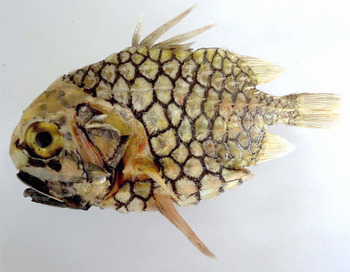
MSCUB 0113, 1: 125 mm TL, Khor Abdullah, north-west corner of the Arabian Gulf, Iraq, 29°51′59.25″N 48°26′14.56″E, gill net, 16 m depth, 6 June 2014 (Figure 1).
Monocentris japonica, MSCUB 0113, 125 mm total length.

DESCRIPTION
Body orbicular, moderately deep and compressed, covered with enlarged united scales forming rough shield. Snout broad. Wide lacrimal and anterior portion of following infraorbital. Eye large. Light organ at the symphysis of the lower jaw. Villiform teeth in mouth, but vomer with no teeth. Dorsal fin with 6 spines having no connecting membrane, followed by soft dorsal fin. Yellowish, with dark scale edges; light organ covered with black pigment.
REMARKS
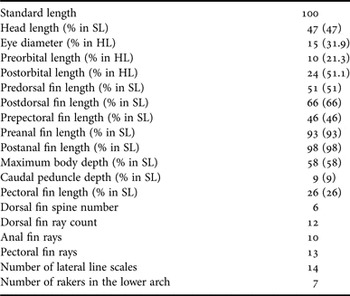
The total length of the present specimen (125 mm) is smaller than the recorded maximum size given for this fish (170 mm; Sainsbury et al., Reference Sainsbury, Kailola and Leyland1985). The description of the present specimen agrees with the description given by Kotlyar (Reference Kotlyar1985), Randall (Reference Randall1995), Paxton (Reference Paxton, Carpenter and Niem1999) and Heemstra & Heemstra (Reference Heemstra and Heemstra2004). It differs from the congener M. reedi in having deeper body, short gill rakers, shorter caudal peduncle, larger anterodorsal distance, fewer gill rakers on the 1st gill arch, and fewer scales on lateral line (Table 1). Cleidopus gloriamaris has no light organ on the mandible, narrow lacrimal bone and absence of vomerine teeth.
Morphometric and meristic characters of Monocentris japonica collected from Khor Abdullah, Arabian Gulf, Iraq. HL, head length; SL, standard length.

Fischer & Bianchi (Reference Fischer and Bianchi1984) indicated that this species is expected to occur, but not yet reported from off the coasts of South Africa, Mauritius and Sri Lanka. It also occurs in the Gulf of Aqaba (Baranes & Golani, Reference Baranes and Golani1993) and extends east and north to Australia and Japan and south to New Zealand (Paulin et al., Reference Paulin, Stewart, Roberts and McMillan1989). The nearest locality to the Iraqi marine waters of the Arabian Gulf where this species has been recorded from previously is the Arabian Sea coasts of Oman (Randall, Reference Randall1995; Manilo & Bogorodsky, Reference Manilo and Bogorodsky2003). This is the first documented occurrence in the Arabian Gulf waters of Iraq in particular and the Arabian Gulf area in general, indicating a range extension of its previously known distribution. The lack of previous records of this species from the northern part of the Arabian Gulf may be due to the lack of ichthyological surveys or that it has only recently arrived in the area. In the case of the latter, the current record may represent a natural range extension, or possibly the present specimens may be the result of released aquarium fish. We do not know whether it has established a sustainable population in this region, but interviewing the fishermen working in the same area where the specimen of M. japonica was obtained revealed that specimens of this species have been caught from the same area since 2008. With the distinctive shape and coloration of this species, it is possible to consider the narrative of the fishermen to be correct and hence to consider that this species has established a population in the area. More generally, the existence of such a noteworthy specimen in the Iraqi marine waters since 2008 highlights once again our limitations in monitoring the arrival of invasive species in the marine environment.
The importance of the present record of M. japonica comes as a result of extensive ichthyological collections in the area and in the context of the absence of any previous record of members of this family from the Iraqi marine waters.
ACKNOWLEDGEMENTS
We thank the Marine Science Centre, University of Basrah for providing the facilities to collect fish specimens in the Iraqi marine waters and for all other technical assistance; Jon Moore, Wilkes Honors College, Florida Atlantic University USA and Ofer Gon, South African Institute of Aquatic Biodiversity, South Africa for the confirmation of the identity of the species; and Daniel Pauly, Fisheries Centre, University of British Columbia, British Columbia, Canada for his valuable advice and suggestions during his reading and editing of the manuscript.