I. INTRODUCTION
Borates are always attracting a great interest among functional materials because of their rich varieties in crystal structure, large band gap, low synthesis temperature, and environmental benignity (Heller, Reference Heller1986; Xue et al., Reference Xue, Betzler, Hesse and Lammers2000; Gravereau et al., Reference Gravereau, Chaminade, Pechev, Nikolov, Ivanova and Peshev2002; Yang and Dolg, Reference Yang and Dolg2006; Zhao et al., Reference Zhao, Yao, Zhang, Zhang, Zhang, Fu and Wu2012; Lou et al., Reference Lou, Li, Li, Jin and Chen2015a, Reference Lou, Li, Li, Zhang, Jin and Chen2015b). There are lots of borates discovered with outstanding chemical and physical properties, such as, BBO (β-BaB2O4), LBO (LiB3O5) (Kellner et al., Reference Kellner, Heine and Huber1997), and CBO (CsB3O5) (Wu et al., Reference Wu, Sasaki, Nakai, Yokotani, Tang and Chen1993) for second-harmonic generation or Li6GdB3O9, Ca3Y(GaO)3(BO3)4, KSr4B3O9, YCa4O(BO3)3, LiLa2BO5, and GdB5O9 for promising host of phosphor (Jubera et al., Reference Jubera, Chaminade, Garcia, Guillen and Fouassier2003; Huang and Chen, Reference Huang and Chen2011; Haque et al., Reference Haque, Asraf, Hossen, Hossan, Kim and Lee2012; Wu et al., Reference Wu, Zhang, Gui, Lu, Zhao, Tian, Kong and Xu2012; Ingle et al., Reference Ingle, Gawande, Sonekar, Omanwar, Wang and Zhao2014; Sun et al., Reference Sun, Gao, Yang and Cong2015), and the M3BO5 (M = Co, Fe) ludwigite family as magnetic materials (Bordet and Suard, Reference Bordet and Suard2009; Norrestam et al., Reference Norrestam, Nielsen, Sotofte and Thorup1989).
Experience of earlier studies has taught us, ternary borates of alkaline metals and rare earths form another group of compounds, in which the appearance of new promising materials with unusual properties can be expected as a result of systematic studies. In fact, several sodium borate families with the formula Na3Ln2(BO3)3 (Ln = La, Nd, Sm), Na3Ln(BO3)2 (Ln = La, Nd, Gd), Na18Ln(BO3)7 (Ln = La, Nd), and Na2Ln2O(BO3)2 (Ln = La, Nd, Sm, Gd, Eu,Y, Er), respectively, have been isolated in the ternary systems Na2O–Ln2O3–B2O3, and their structures and some properties have been investigated and determined (Mascetti et al., Reference Mascetti, Classe and Fouassier1981, Reference Mascetti, Fouassier and Hagenmuller1983; Corbel et al., Reference Corbel, Leblanc, Antic-Fidancev and Lemaitre-Blaise1999; Ivanova et al., Reference Ivanova, Pechev, Nikolov and Peshev2000; Zhang et al., Reference Zhang, Wu, Fu, Wang, Pan and Chen2001, Reference Zhang, Wu, Fu, Wang, Liu, Fan and Chen.2002; Gravereau et al., Reference Gravereau, Chaminade, Pechev, Nikolov, Ivanova and Peshev2002). In a recent paper (Naidu et al., Reference Naidu, Boudin, Varadaraju and Raveau2012), the authors reported the preparation and photoluminescence properties of Eu3+ and Tb3+ activated Na3Ln(BO3)2 (Ln = Y, Gd) borates.
As part of a project searching for new functional materials, our group recently completed a systematic survey on the Na2O–Sm2O3–B2O3 system, based on exploratory syntheses via solid-state reaction. One of the results was the observation and confirmation of a new ternary borate, Na3SmB2O6. Other substituted derivatives, Na3REB2O6 (RE = Pr, Eu), were then synthesized successfully. It was found that Na3REB2O6 (RE = Pr, Sm, Eu) could be synthesized by a solid-state reaction between oxides in an equimolecular ratio at 800–920 °C. Incongruent melting leads to decomposition of these compounds before melting. In addition, we confirmed the existence of Na2Sm2B2O7 and Na3Sm2B3O9 first reported by Corbel et al. (Reference Corbel, Leblanc, Antic-Fidancev and Lemaitre-Blaise1999) and Zhang et al. (Reference Zhang, Wu, Fu, Wang, Liu, Fan and Chen.2002). Establishing the crystal structure and thermal stability of the new compounds Na3REB2O6 (RE = Pr, Sm, Eu) is the principal subject of this paper.
II. EXPERIMENTAL DETAILS
Samples were all synthesized by conventional high-temperature solid-state reaction. Stoichiometric mixtures of Na2CO3 (analytical reagent), Pr6O11 (spectrum reagent), Sm2O3 (spectrum reagent), Eu2O3 (spectrum reagent), and H3BO3 (analytical reagent) were blended and ground thoroughly into powders of 200–300 mesh in an agate mortar, and pressed into pellets of 10 mm in diameter and 3–5 mm in thickness. Subsequently, the mixtures were preheated in platinum crucibles for 12 h at 600 °C to decompose H3BO3. Then, they were naturally cooled to room temperature, reground and sintered at 750–920 °C for 15–24 h (depending on their compositions). Finally, the samples were naturally cooled to room temperature along the furnace. The samples were ground at room temperature between successive heatings. The solid-state reaction involved in the new stoichiometry compounds are: 3Na2CO3 + RE2O3 (RE = Pr, Sm, Eu) + 4H3BO3 → 2Na3REB2O6 (RE = Pr, Sm, Eu) + 6H2O + 3CO2 (Pr ion in Pr6O11 is reduced to Pr3 + at reaction temperature because of the reducing atmosphere in air).
The powder X-ray diffraction (XRD) data for phase identification were collected on an X-ray Rigaku diffractometer D/MAX-2500 with CuKα radiation and graphite monochromator operated at 40 kV, 150 mA. The MDI software Jade 5.0 and International Centre for Diffraction Data (ICDD) software powder diffraction file (PDF)-4 + 2011 were used for phase analysis of the samples. It is worth mentioning that the sample was considered to reach phase equilibrium when its powder XRD pattern showed no change upon successive heat treatments. The chemical compositions of the single-phase samples were further measured by inductively coupled plasma atomic emission spectrometry using a Perkin Elmer ICP/6500 spectrometer. The data of Na3REB2O6 (RE = Pr, Sm, Eu) with 2θ range of 10°–120° used for indexing and Rietveld refinement were collected on a PANalytical powder X-ray diffractometer X'Pert Pro with CuKα radiation (40 kV, 40 mA) at room temperature.
With the objective of specifying and comparing the coordination of boron in the title compounds, the mid-infrared (IR) spectrum was carried out and obtained at room temperature via a Perkin-Elmer 983G IR spectrophotometer with KBr pellets as standards. It was collected in a range from 500 to 2000 cm−1 with a resolution of 1 cm−1.
The thermal stability was investigated by differential thermal analysis (DTA), with a WCR-DTA high-temperature differential thermal instrument employed. Sample and alumina reference were enclosed in Pt cups. The heating rate was 20 °C min−1 in a temperature range from room temperature to 600 °C, and the heating rate was changed to 10 °C min−1 in a temperature range from 600 to 1020 °C.
III. RESULTS AND DISCUSSION
A. Subsolidus phase relations in Na2O–Sm2O3–B2O3 system
Based on the literature (Hyman et al., Reference Hyman, Perloff, Mauer and Block1967; Krogh-Moe, Reference Krogh-Moe1972, Reference Krogh-Moe1974a, Reference Krogh-Moe1974b; Abdullaev et al., Reference Abdullaev, Mamedov and Dzhafarov1975; Bubnova et al., Reference Bubnova, Shepelev, Sennova and Filatov2002; Penin et al., Reference Penin, Touboul and Nowogrocki2002, Reference Penin, Touboul and Nowogrocki2004; Kanishcheva et al., Reference Kanishcheva, Egorysheva, Gorbunova, Kargin, Mikhailov and Skorikov2004), in the pseudo binary system Na2O–B2O3, there are seven pseudo binary compounds having been reported, namely, Na3BO3, Na2B4O7, NaBO2, NaB3O5, Na3B7O12, Na2B8O13, and Na4B2O5. Among these, Na2B4O7 (Krogh-Moe, Reference Krogh-Moe1974a, Reference Krogh-Moe1974b; Kanishcheva et al., Reference Kanishcheva, Egorysheva, Gorbunova, Kargin, Mikhailov and Skorikov2004), NaB3O5 (Krogh-Moe, Reference Krogh-Moe1972, Reference Krogh-Moe1974a, Reference Krogh-Moe1974b), and Na2B8O13 (Hyman et al., Reference Hyman, Perloff, Mauer and Block1967; Bubnova et al., Reference Bubnova, Shepelev, Sennova and Filatov2002; Penin et al., Reference Penin, Touboul and Nowogrocki2002) are polymorphic. According to previous work (Hyman et al., Reference Hyman, Perloff, Mauer and Block1967; Krogh-Moe, Reference Krogh-Moe1972, Reference Krogh-Moe1974a, Reference Krogh-Moe1974b; Bubnova et al., Reference Bubnova, Shepelev, Sennova and Filatov2002; Penin et al., Reference Penin, Touboul and Nowogrocki2002, Reference Penin, Touboul and Nowogrocki2004; Kanishcheva et al., Reference Kanishcheva, Egorysheva, Gorbunova, Kargin, Mikhailov and Skorikov2004), most of them were synthesized by fusing borax and boric acid. Under our experimental conditions, only glass phases were obtained. These results lead to uncertain three phase sections, which are indicated by dashed lines in Figure 1. Na3B7O12 was synthesized in a nitrogen atmosphere (Penin et al., Reference Penin, Touboul and Nowogrocki2004), which cannot be obtained in our experimental condition. So, in our studies only existence of NaBO2 and Na4B2O5 were confirmed.
(Color online) Subsolidus phase relations in the system of Na2O–Sm2O3–B2O3.

In the work of Abdullaev et al. (Reference Abdullaev, Mamedov and Dzhafarov1975) on the binary system Sm2O3–B2O3, they report that SmB3O6 was a metastable phase. Only the compound SmBO3, which was reported by Bartram and Felten (Reference Bartram and Felten2002), was confirmed in our experiments.
As for the binary system Na2O–Sm2O3, there is one binary compound NaSmO2, which has ever been reported (Hashimoto et al., Reference Hashimoto, Wakeshima and Hinatsu2003). We did not observe NaSmO2 because of the relative low sintering temperature.
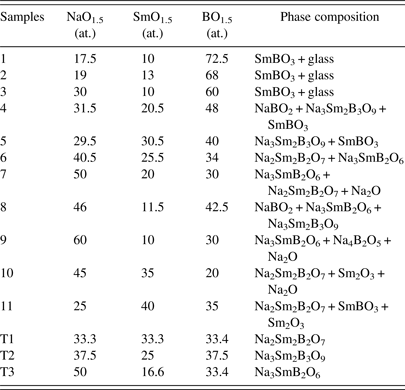
In the Na2O–Sm2O3–B2O3 pseudo ternary system, borates Na2Sm2B2O7 (Corbel et al., Reference Corbel, Leblanc, Antic-Fidancev and Lemaitre-Blaise1999) and Na3Sm2B3O9 (Zhang et al., Reference Zhang, Wu, Fu, Wang, Liu, Fan and Chen.2002) were confirmed in this work. In addition, a new borate Na3SmB2O6 was observed and synthesized for the first time. Based on the phase identifications of 14 samples with different compositions as listed in Table I, the subsolidus phase relations of Na2O–Sm2O3–B2O3 system were determined under present experimental conditions. There are nine definite three-phase regions and three ternary compounds in this system, as shown in Figure 1.
List of phase identification in the system of Na2O–Sm2O3–B2O3.

B. Structure determination and refinement
All the reflections before 2θ = 50° of new compound Na3SmB2O6 was used and can be indexed on the basis of a monoclinic unit cell with lattice parameters a = 6.564(4) Å, b = 8.767(5) Å, and c = 10.185(9) Å, and β = 90.88(4)° using the program DICVOL04 (Boultif and Louer, Reference Boultif and Louer2004). The systematic absences (h0l: h + l = 2n + 1; 0k0: k = 2n + 1; h00: h = 2n + 1; 00l: l = 2n + 1) are consistent with space group P121/n1, which can be changed into the standard space group P121/c1 by the Tidy transformation method. A Comparison of the crystal system, the lattice parameter and the powder XRD pattern between Na3SmB2O6 and Na3REB2O6 (RE = Nd, Gd) (Mascetti et al., Reference Mascetti, Classe and Fouassier1981; Naidu et al., Reference Naidu, Boudin, Varadaraju and Raveau2012) shows that the new Sm compound is isostructural to Na3REB2O6 (RE = Nd, Gd). So we choose the space group P21/c. The lattice parameters for this setting are a = 6.571(1), b = 8.779(6), c = 12.0399(8), and β = 122.16(2).
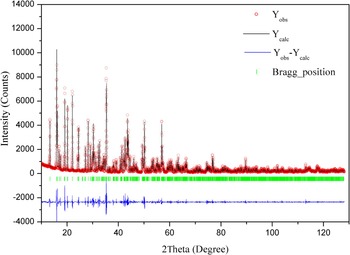
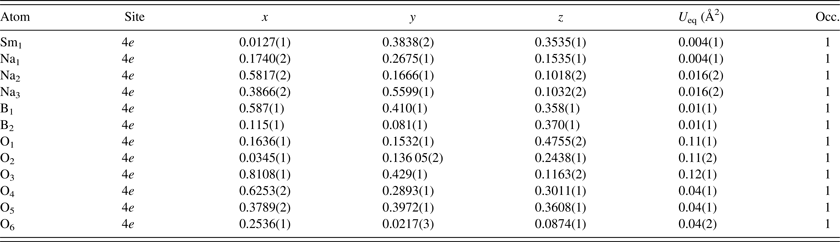
According to the structural model of Na3NdB2O6, we refined the cell and atomic parameters of Na3SmB2O6 using the powder XRD data by combination of the Rietveld method (Rietveld, Reference Rietveld1967) and the program FullProf_suite (Rodriguez-Carvajal, Reference Rodriguez-Carvajal1990). The profile range of data used for the refinement was 10°–120° in 2θ. The refinement finally converged to agreement factors of R B = 2.12%, R P = 9.23%, and R WP = 12.3% with S = 2.56. The final refinement pattern is shown in Figure 2. Positional parameters obtained by the Rietveld refinement are listed in Table II.
(Color online) Final refinement pattern of Na3SmB2O6. Small dots represent the experimental values and solid lines for the calculated pattern. The blue line at the bottom is the difference between the experimental and calculated values. The green vertical bars show the positions of the calculated Bragg reflections.

Atomic coordinates and isotropic displacement parameters for Na3SmB2O6.

C. Crystal structure of Na3REB2O6 (RE = Pr, Sm, Eu)
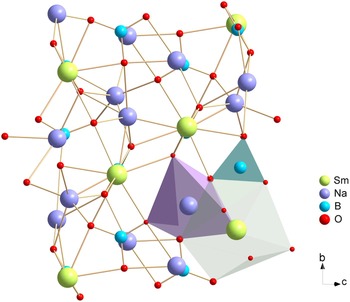
As the similar crystal structure of Na3REB2O6 (RE = Nd, Gd), the new borate Na3SmB2O6 crystallizes in the space group P21 /c. Figure 3 shows crystal structure of Na3SmB2O6 along the a-axis. Its crystal structure results from SmO8 polyhedron, NaO6 distorted octahedral, and trigonal BO3 groups. In this structure, the boron ions remain at the centres of planar trigonal BO3 groups, each corner of which is a corner of different SmO8 polyhedron and NaO6 distorted octahedra. More information about this type structure can be seen in the previous works for Na3NdB2O6 (Mascetti et al., Reference Mascetti, Classe and Fouassier1981) and Na3GdB2O6 (Naidu et al., Reference Naidu, Boudin, Varadaraju and Raveau2012).
(Color online) Crystal structure of Na3SmB2O6 along the a-axis.

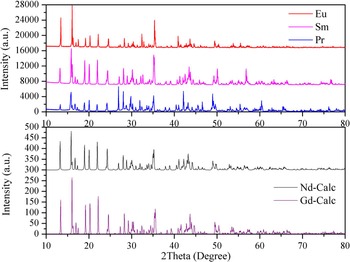
Syntheses of other substituted derivatives were attempted after Na3SmB2O6. Fortunately, the attempted solid-state syntheses of the following compounds were successful: Na3PrB2O6 and Na3EuB2O6. The powder XRD patterns of three new compounds Na3REB2O6 (RE = Pr, Sm, Eu), compared with powder XRD patterns of Na3REB2O6 (RE = Nd, Gd) calculated from literatures (Mascetti et al., Reference Mascetti, Classe and Fouassier1981) and (Naidu et al., Reference Naidu, Boudin, Varadaraju and Raveau2012), were shown in Figure 4. It can be clearly observed that the patterns for these compounds are very similar and their diffraction peaks move to lower angles regularly when the value of RE3+ radius increases. Thus, the lattice parameter and volume of Na3REB2O6 increase with the increase of the value of RE3+ radius. The results of both indexing and refinement are shown in Table III, which proves this conclusion. Moreover, as shown in Figures 5(a) and 5(b), the variational trend of lattice parameter for Na3REB2O6 (RE = Pr, Nd, Sm, Eu, Gd) obeys Vegard's rule (Vegard, Reference Vegard1921). It was found that a linear relation exists between the crystal lattice parameter and the ion radius of the constituent elements. Noticeably, from Na3GdB2O6 to Na3PrB2O6, a, b, c, and volume undergo a linear expansion. Unfortunately, powder Na3REB2O6 (RE = Pr, Sm, Eu) samples are hydrophilic and unstable in the air, especially Na3PrB2O6. In addition, the powder XRD pattern data collected for Na3EuB2O6 prefers to preferred orientate. So, it is hard to complete the crystal structural refinement of Na3PrB2O6 and Na3EuB2O6.
(Color online) Comparison of experimental X-ray diffraction (XRD) powder patterns of borates Na3REB2O6 (RE = Pr, Sm, Eu) with the calculated patterns for the related Gd and Nd compounds.

(Color online) Lattice constant (a, b, and c) (a), β and volume (b) of Na3REB2O6 (RE = Pr, Nd, Sm, Eu, Gd) plotted vs. the respective RE3+ radius.

Crystal information of compounds Na3REB2O6 (RE = Pr, Nd, Sm, Eu, Gd).

a This work.
Considering the similarity of lattice parameters and XRD pattern, it can be concluded that these new phases Na3REB2O6 (RE = Pr, Sm, Eu) are isostructural and belong to the Na3REB2O6 (RE = Pr–Gd) family. The similar structure of the ternary borates in this family should lead to similar properties.
D. IR spectra of Na3REB2O6 (RE = Pr, Sm, Eu)
In order to further confirm the coordination surroundings of B–O in the representative new compounds Na3REB2O6 (RE = Pr, Sm, Eu), the IR absorption spectra for powder Na3REB2O6 (RE = Pr, Sm, Eu) samples were measured at room temperature and given in Figure 6. The results obtained for the three compounds can be compared with the characteristic values of the BO3 3− groups (Weir and Schroeder, Reference Weir and Schroeder1964). For the planar, triangular BO3 3− group, the vibrations are in the region ν 3 = 1000–1300 cm−1 (asymmetric stretch B–O), ν 1 = 900–1000 cm−1 (symmetric stretch B–O), ν 2 = 700–900 cm−1 (out-of-plane bend of B–O), and ν 4 = 580–700 cm−1 (in-plane bend of B–O), Bands below 450–550 cm−1 mainly are assigned to symmetric pulse vibrations of the borate anion group. Obviously, the IR spectra for Na3REB2O6 (RE = Pr, Sm, Eu) samples confirm the existence of the BO3 3− groups and are similar to Na3Sm2B3O9, in which isolated planar BO3 groups also exist. In addition, the O–H bending vibration of water molecule can be observed clearly in the IR spectra for Na3PrB2O6 (1652.3 cm−1) and Na3EuB2O6 (1630.2 cm−1), which confirms the hydrophilicity of Na3REB2O6(RE = Pr, Sm, Eu).
(Color online) Infrared absorption spectra for borates Na3REB2O6 (RE = Pr, Sm, Eu) at room temperature.

As the ionic radii of Pr3+ ion (1.126 Å) is larger than that of Sm3+ (1.079 Å), the change observed in the frequency of vibrations reveals that the bond nature is modified, while introducing different ions in the lattice sites of RE3+. It is in good agreement with the changes of lattice parameters as shown in Table III.
E. Thermal stability of Na3REB2O6 (RE = Pr, Sm, Eu)
The thermal stability of Na3REB2O6 (RE = Pr, Sm, Eu) was investigated in this work.
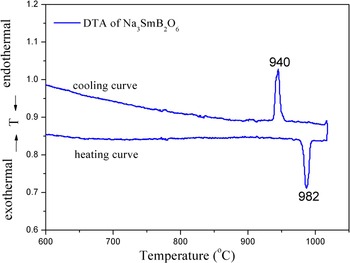
According to experimental observation and analysis of DTA, powder Na3REB2O6 (RE = Pr, Sm, Eu) samples decompose along with volatilization at about 986, 982, and 968 °C, respectively. Figure 7 presents the DTA curves for the pure Na3PrB2O6 and Na3EuB2O6. The heating and cooling DTA curves for the pure Na3SmB2O6, as the representative example, are shown in Figure 8. Because there is neither obvious endothermic nor obvious exothermic peak below 600 °C, the DTA curves were shown in the temperature range from 600 to 1020 °C. Holding at 1020 °C for 2 h lead to decomposition of the Na3REB2O6 (RE = Sm, Eu) into Na-B-O glasses. Powder XRD pattern, Figure 9, of that treated sample excluding the glassy grains, consists of dominating Na3REB2O6 (RE = Sm, Eu), a little Na2RE2B2O7 (RE = Sm, Eu) (Corbel et al., Reference Corbel, Leblanc, Antic-Fidancev and Lemaitre-Blaise1999), and few NaBO2. It is suggested that the decomposed products of Na3REB2O6 (RE = Sm, Eu) probably consist of Na2RE2B2O7 (RE = Sm, Eu), liquid including NaBO2 and Na2O compositions. From this point, the sharp endothermic peak at about 982 °C on the heating curve in Figure 8 can be ascribed to decomposing point of the compound Na3SmB2O6. As for the exothermic peak at about 944 °C on the cooling curves, it is related to the freezing point for binary compound NaBO2 (Emest and Howard, Reference Emest and Howard1975). Because of its departure or volatilization, Na2O was not observed in the power XRD pattern of the product.
Differential thermal analysis (DTA) curve for the pure Na3PrB2O6 and Na3EuB2O6.

(Color online) Heating and cooling differential thermal analysis (DTA) curves for the pure Na3SmB2O6. Pure Na3SmB2O6 was quickly heated to 600 °C, then heated to 1020 °C with a heating rate of 10 °C min−1 (heating curve), kept for 5 min and cooled to 600 °C with a cooling rate of 10 °C min−1 (cooling curve).

(Color online) Powder XRD patterns of samples Na3SmB2O6 and Na3EuB2O6 heat-treated at special temperatures: (top) pure Na3SmB2O6 was heated at 1020 °C for 2 h; (middle) pure Na3SmB2O6 obtained at 850 °C for 24 h; (bottom) pure Na3EuB2O6 was heated at 1020 °C for 2 h.

In general, the combination of DTA analysis and XRD observations shows that borates Na3REB2O6 (RE = Pr, Sm, Eu) incongruent melt and are deliquescent in the air.
IV. CONCLUSIONS
In conclusion, we have successfully established part of the subsolidus phase relations of Na2O–Sm2O3–B2O3 system and observed one new ternary compound Na3SmB2O6. The crystal structure of new borate Na3SmB2O6 along with two substituted derivatives Na3REB2O6 (RE = Pr, Eu) was investigated and determined. The XRD of powder Na3REB2O6 (RE = Pr, Sm, Eu) samples established a monoclinic structure (space group P21 /c, Z = 4). It was found that all three compounds obtained by solid-state interaction in equimolecular oxide mixtures are isostructural and belong to the Na3REB2O6 (RE = Pr–Gd) family. The three-dimensional network of their crystal structures is built up from REO8 polyhedra, NaO7 polyhedra, distorted NaO6 octahedra, and trigonal BO3 groups. As a result of the replacement of larger RE3+ with smaller RE3+ ion making the lattice expanded, the lattice constants of Na3REB2O6 (RE = Eu, Sm, Pr) compounds increase and obey Vegard's rule. IR spectra of the Na3REB2O6 (RE = Pr, Sm) compounds are consistent with the crystallographic studies. The DTA and experimental analysis show that powder Na3REB2O6 (RE = Pr, Sm, Eu) samples are stable below about 986, 982, and 968 °C, respectively, in dry vacuum condition.
ACKNOWLEDGEMENTS
Financial supports by the National Natural Science Foundation of China (Grant number 51472273) and Major State Basic Research Development Program (Grant number 2014CB6644002) are gratefully acknowledged. The work was also supported through a Grant-in-Aid from Department for Science and Technology of Hunan Province (Grant number 2014FJ4099) and the Project of Innovation-driven Plan in Central South University (Grant number 2015CX004). The authors thank Yanping Xu (Beijing National Laboratory for Condensed Matter Physics, Institute of Physics, Chinese Academy of Sciences, Beijing 100190, PR China) for her kind help in collecting the powder XRD data.