Clostridioides difficile (C. difficile) infections (CDIs) are the most common healthcare-associated infections (HAIs) in the United States, with an estimated 500,000 cases and 15,000–30,000 deaths per year.Reference Lessa, Mu and Bamberg1,Reference Magill, Edwards and Bamberg2 These infections carry a significant financial and hospital burden accounting for ~$6.3 billion and 2.4 million inpatient days per year in the United States.Reference Zhang, Palazuelos-Munoz, Balsells, Nair, Chit and Kyaw3
The diagnosis of CDI typically relies on the presence of diarrhea (≥3 unformed stools in 24 hours) plus a positive stool test for C. difficile.Reference McDonald, Gerding and Johnson4 However, stool testing remains imperfect because antigen tests (eg, glutamate dehydrogenase [GDH]) detect Clostridioides spp (including non–C. difficile spp), rather than the toxin. Thus, its utility as a stand-alone test is limited because it can lead to overdiagnosis. On the other hand, commercially available C. difficile toxin tests are more specific but lack sensitivity (50%–90%).Reference Alcalá, Sánchez-Cambronero and Catalán5–Reference Humpries, Uslan and Rubin7 Polymerase chain reaction (PCR) testing is often utilized as a “tie breaker” in indeterminate cases (antigen+/toxin−); however, this strategy can also lead to overdiagnosis because it detects toxin-carrying C. difficile but does not specifically test for the production and excretion of toxin associated with actual disease.Reference Gould, Edwards and Cohen8,Reference Koo, Van and Zhao9
Clinicians commonly attribute hospital-onset diarrhea to CDI. However, hospital-onset diarrhea is most commonly noninfectious: CDI accounts for only 10%–25% of cases.Reference Polage, Solnick and Cohen10 Common inpatient causes of diarrhea include medications (antibiotics and laxatives) and tube feeding.Reference Carter and Malani11 Because asymptomatic colonization with C. difficile is common (3%–26% depending on patient characteristics including healthcare exposures), overuse of PCR testing for C. difficile often detects asymptomatic colonization rather than true disease.Reference McDonald, Gerding and Johnson4,Reference Loo, Bourgault and Poirier12,Reference Zacharioudakis, Zervou, Pliakos, Ziakas and Mylonakis13 The overdiagnosis of CDI has several potential negative consequences: (1) falsely ascribing a clinical scenario (eg, elevated white blood count [WBC]) to CDI and missing other causes; (2) unnecessary CDI treatment leading to avoidable antibiotic-related adverse effects such as drug interactions, side effects, increased risk of colonization with multidrug-resistant organisms, and disruption of intestinal microbiotaReference Lewis, Buffie and Carter14,Reference Lawley, Clare and Walker15 ; (3) increased healthcare costs (antibiotic use and isolation); (4) stigma; and (5) potential reduced healthcare time with the patient due to enhanced contact isolation.Reference Abad, Fearday and Safdar16 Furthermore, falsely elevated CDI rates due to overdiagnosis may reduce hospital reimbursement by the Centers for Medicare and Medicaid Services because healthcare-facility–onset CDI (HO-CDI; ie, occurring on day 4 or later of admission) is considered a preventable hospital-acquired condition.17
Streamlining testing for C. difficile is a significant opportunity for diagnostic stewardship to optimize both patient care and to potentially reduce healthcare costs. Therefore, we modified our healthcare systemʼs C. difficile testing algorithm from reflexive PCR testing among antigen positive-only cases (ie, toxin negative cases) to PCR testing that required a separate clinician order. The requirement for clinician ordering encouraged re-evaluation to assess whether the diarrhea was still present and to assess for other attributable causes (eg, laxative use, etc) of diarrhea.
Methods
Study design
This multicenter, before-and-after, quasi-experimental study was conducted within our healthcare system comprising 4 hospitals totaling 1,400 available beds in San Diego, California. The study protocol was approved by the institutional review board. Hospitalized adult patients with a C. difficile enzyme immunoassay (EIA) indeterminate result (antigen+/toxin−) over a 1-year period, 6 months before and after the algorithm change, were included in the study. The preintervention period was September 5, 2016, through March 5, 2017, and the postintervention period was March 6, 2017, through September 6, 2017. Only the first stool sample per patient was included for each study period, and patients were excluded if they were receiving CDI antibiotic treatment prior to C. difficile antigen+/toxin− testing.
Laboratory testing
All stool samples were tested using a US Food and Drug Administration (FDA)–approved C. difficile rapid membrane EIA that simultaneously detects C. difficile GDH antigen and toxins A and B (C. DIFF QUIK CHEK COMPLETE, Abbott, Abbott Park, IL).18 Prior to March 6, 2017, all indeterminate C. difficile EIA results were automatically referred for C. difficile toxin B PCR testing for C. difficile toxin B gene (tcdB) using BD MAX Cdiff (Becton Dickinson, Franklin Lakes, NJ).19 Starting on March 6, 2017, C. difficile toxin B PCR test performance required a separate clinician order.
Data collection
Data were extracted from electronic and hardcopy medical records and were recorded on a standardized data collection form. Data included demographics, underlying medical conditions, laboratory data (C. difficile test results, WBC count, and serum creatinine [SCr]), procedures (colonoscopy, fecal microbiota transplant [FMT]), and hospital data (length of stay, CDI treatment). Data on all readmissions and all cases of new or recurrent CDI at any Scripps facility within 30 days were also collected. HO-CDI was defined as C. difficile that occurred on day 4 or later of hospital admission, whereas community-onset (CO) CDI occurred at ≤3 days of admission.20
Study outcomes
The a priori primary outcome of this study was the change in number of CDI diagnoses between the preintervention period and the postintervention period among those with indeterminate EIA results. CDI diagnosis was defined as PCR-positive stool testing among patients with a compatible clinical presentation (eg, diarrhea). Secondary outcomes included differences in number of PCRs performed between the periods; number of missed true cases of CDI and adverse health outcomes; and potential cost savings. Costs included billed amounts for C. difficile PCR testing, CDI treatments, enhanced isolation products (eg, isolation carts, single rooms, and gowns), and excess healthcare days.
Statistical analysis
Descriptive data on baseline characteristics, comorbid diagnoses, and study outcomes are presented. Univariate statistical comparisons of categorical variables utilized χ2 tests without continuity correction unless specified for frequencies <5. Continuous measures were analyzed using the Student t test or for nonparametric continuous data using the Mann-Whitney U test. All tests were 2-tailed, and P < .05 was considered significant. Statistical analyses were performed using R Studio version 1.1.463 software running R version 3.5.0 (R Foundation for Statistical Computing, Vienna, Austria).
Results
Study population characteristics
For the preintervention period, a total of 2,150 (1,752 GDH−/toxin−, 115 GDH+/toxin+, 283 GDH+/toxin−) C. difficile tests were sent and 13% of the total C. difficile tests were GDH+/toxin−. For the postintervention period, a total of 2,028 (1,664 GDH−/toxin−, 140 GDH+/toxin+, 224 GDH+/toxin−) C. difficile tests were sent and 11% of the total C. difficile tests were GDH+/toxin−. The percentage of EIA-indeterminate results (13% in the preintervention period and 11% in the postintervention period) was lower for the postintervention period (P = .04).
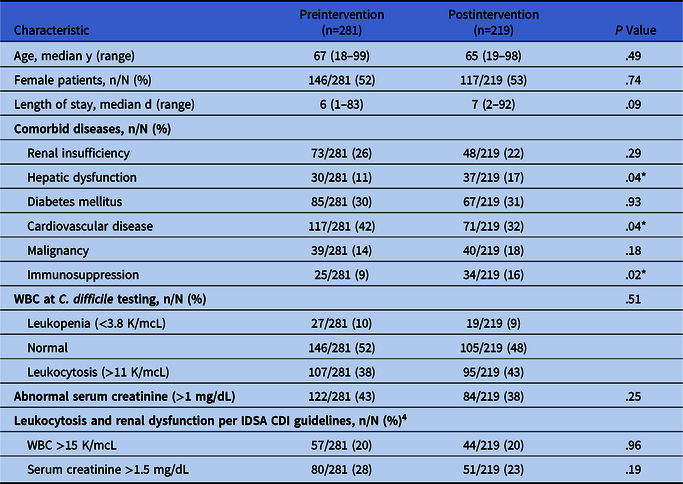
In the current study, we identified 507 hospitalized patients with a C. difficile antigen+/toxin− test. Seven patients (2 in the preintervention group and 5 in the postintervention group) were excluded due to receiving antibiotics for CDI prior to C. difficile EIA stool testing for a total of 500 patients, 281 in the preintervention group and 219 in the postintervention group. Baseline characteristics by each period are shown in Table 1. The median age of these patients was 66 years (range, 18–99) and 47% were male. The median hospital stay was 6 days (range, 1–92); 40% had leukocytosis (WBC >11 K/µL) and 41% had renal dysfunction (SCr >1 mg/dL). There were no significant differences in age, sex, length of hospital stay, and laboratory data (WBC, SCr) between the 2 periods. Overall, 77% of these patients had at least 1 medical condition, most commonly cardiovascular disease. Differences in underlying conditions by study period are shown in Table 1.
Study Population Characteristics

Note. WBC, white blood cell count; IDSA, Infectious Diseases Society of America; CDI, Clostridium difficile infection.
* Significant at alpha ≤0.05 level.
C. difficile diagnoses
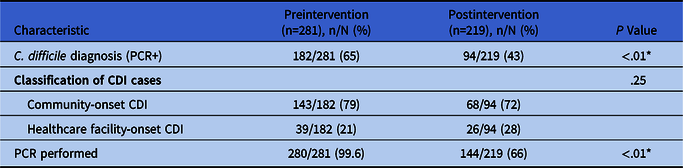
The primary study outcome was the difference in the number of CDI diagnoses among indeterminate cases between the pre- and postintervention periods. We observed a significant reduction in the percentage and number of CDI diagnoses among indeterminate cases: 182 of 281 (65%) in the preintervention group and 94 of 219 (43%) in the postintervention group (P < .01) (Table 2). The difference between CO-CDI and HO-CDI did not differ between groups: 79% and 72% for CO-CDI and 21% and 28% for HO-CDI for the preintervention and postintervention periods, respectively.
Clostridioides difficile Test Results

Note. PCR, polymerase chain reaction; CDI, Clostridium difficile infection.
* Significant at alpha ≤0.05 level.
C. difficile testing and treatment
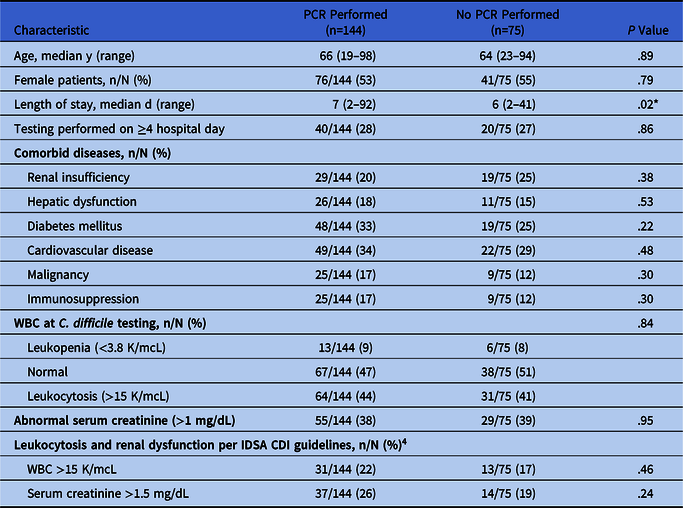
Significantly fewer patients with indeterminate EIA results had PCR testing performed in the postintervention versus preintervention group (66% vs 99.6%; P < .001); 1 patient in the preintervention group did not have a PCR result due to an inhibitor in the stool sample. Comparing the groups that did and did not have PCR performed in the postintervention group, we observed no significant differences in age, sex, C. difficile testing on hospital day ≥4, comorbidities, WBC, or SCr (Table 4). Those who underwent PCR testing had a slightly longer median length of stay: 7 days versus 6 days (P = .02).
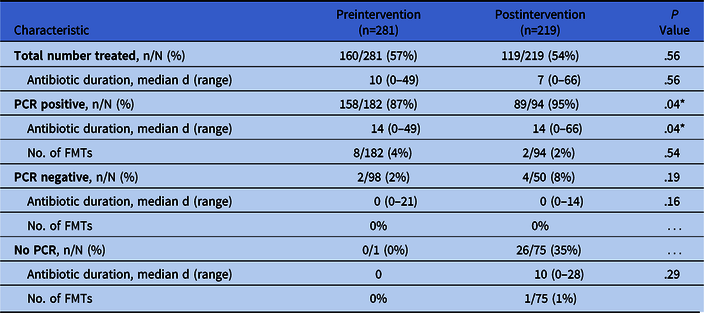
Clostridium difficile Treatments

Note. PCR, polymerase chain reaction; FMT, fecal microbiota transplant.
* Significant at alpha ≤0.05 level.
Characteristics of Postintervention Group by PCR Testing Performed

Note. PCR, polymerase chain reaction; WBC, white blood cell count; IDSA, Infectious Diseases Society of America; CDI, Clostridium difficile infection.
* Significant at alpha ≤0.05 level.
In total, 49 patients underwent a colonoscopy: 27 in the preintervention period and 22 in the postintervention period. Pseudomembranous colitis was present on colonoscopy (visualization and/or histology) in 8 patients (16%): 5 of 27 patients (18.5%) in the preintervention group versus 3 of 22 patients (14%) in the postintervention group. These proportions did not differ by period. All patients with pseudomembranous colitis had positive PCR testing.
Regarding CDI treatment, we detected no significant differences in the number of patients treated for CDI between the 2 groups (Table 3). For the 276 patients with a positive PCR, those in the postintervention period were more likely to be treated: 87% in the preintervention period versus 95% in the postintervention period (P = .04). They also had a slightly longer antibiotic duration, with a median of 14 days (range, 0–49) in the preintervention period versus 14 days (range, 0–66) in the postintervention period (P = .04). Regarding treatment in the 148 patients with a negative PCR test, 6 patients were treated with antibiotics: 2 of 98 (2%) in the preintervention period and 4 of 50 (8%) in the postintervention period. Of these 6 patients, 4 patients (1 in the preintervention period and 3 in the postintervention period) were treated when the PCR test was still pending at time of discharge and no documentation was available regarding whether antibiotics were discontinued thereafter. The other 2 patients (1 patient from each group) continued treatment despite a negative PCR test due to improved symptoms while on treatment. We detected no statistically significant differences in antibiotic treatment initiation or duration between the 2 periods among those with a negative PCR result. Of the 76 patients without a PCR test performed, only 1 patient in the preintervention period did not receive treatment, and 26 of the remaining 75 patients (35%) in the postintervention period received treatment despite no PCR test being performed. The following reasons were given for treatment in those with no PCR test performed according to medical records: (1) the patient was discharged or transferred on the day EIA resulted (6 of 26, 23%); (2) the clinician did not realize that PCR testing was important for CDI diagnosis (6 of 26, 23%); (3) the patient was immunocompromised (5 of 26, 19%); (4) PCR testing was recommended or ordered but not performed (4 of 26, 15%, including 1 having an inhibitor in sample); (5) the clinician commented on EIA indeterminate result, but decided to treat (3 of 26, 12%); and (6) the patient improved while on treatment (2 of 26, 8%).
Adverse outcomes
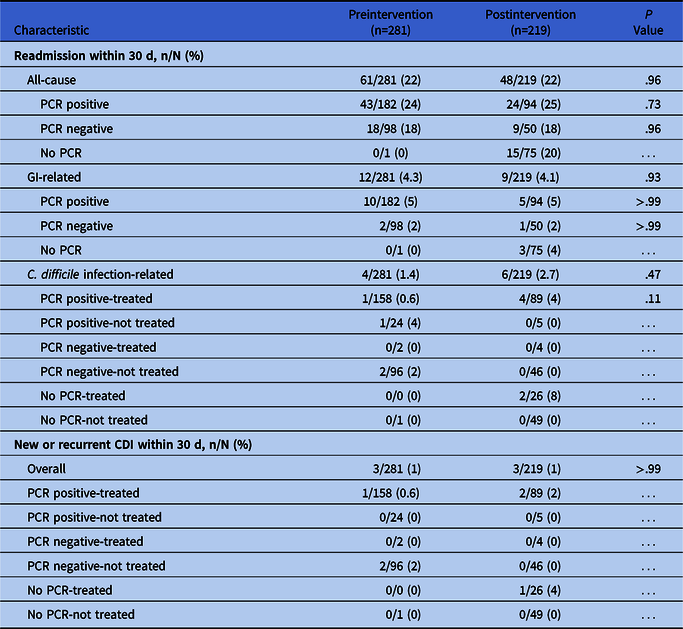
Both groups had similar frequencies of adverse outcomes including 30-day readmissions to the Scripps Healthcare system for all-cause, gastrointestinal-related illness, or CDI-related admissions. Additionally, we observed no difference between new or recurrent CDI within 30 days after discharge between the 2 study periods. Details of adverse outcomes by PCR testing are shown in Table 5. None of the patients without a PCR performed and not treated in the postintervention period were subsequently diagnosed with CDI within 30 days.
Adverse Outcome Evaluation

Note. PCR, polymerase chain reaction; CDI, Clostridium difficile infection.
Cost analysis
The potential cost avoidance with each reflexive PCR not performed per patient was calculated to be $4,498. This cost included the PCR test ($296), a 14-day course of oral vancomycin 125 mg every 6 hours ($119), isolation supply cost for 5 days ($250), and 1 additional day of hospital admission ($3,833) since patients without a PCR performed had a median of 1 fewer day of hospitalization.Reference Ellison21
Discussion
Accurately diagnosing CDI is an ongoing challenge, and its overdiagnosis is associated with many potential adverse effects and costs. Diagnostic stewardship is an emerging area of interest, especially for C. difficile testing. In our study, changing C. difficile PCR testing from a reflexive to a clinician-order algorithm for EIA indeterminate cases resulted in significant reductions in C. difficile PCR testing and diagnoses among indeterminate cases in the inpatient setting. Importantly, we did not document any adverse outcomes as the result of the testing change, and the change resulted in significant cost savings.
No optimal CDI diagnostic test is commercially available at this time. Although PCR testing is very sensitive (93%),Reference Peterson, Manson and Paule22 it leads to overdiagnosis by detecting organisms colonizing the colon that carry the toxin B gene without necessarily producing or excreting the toxin or causing disease. Institutions that have relied on PCR testing (instead of other laboratory methods such as EIA and/or cell culture cytotoxicity assay) have demonstrated an increase in CDI incidence rates by ~50%.Reference Longtin, Trottier and Brochu23–Reference Fong, Fatica and Hall25 Polage et alReference Polage, Gyorke and Kennedy26 reviewed a total of 1,416 hospitalized adults who underwent C. difficile testing and found that those patients (n = 162) with a negative toxin and positive C. difficile PCR test (toxin−/PCR+) had similar outcomes to those with no C. difficile detected (toxin−/PCR−). Additionally, patients with C. difficile toxin−/PCR+ had milder symptoms (ie, fewer of these patients had leukocytosis or diarrhea) and lower C. difficile bacterial load, toxin concentration, and fecal inflammation compared to those in the toxin+/PCR+ group. Patients in the toxin−/PCR+ group had no CDI-related complications (ie., megacolon, colectomy for fulminant colitis, and ICU care related to CDI) and significantly fewer deaths compared to the toxin+/PCR+ patients: 1 of 162 (0.6%) versus 11 of 131 (8.4%) (P < .001). Other researchers that evaluated toxin−/PCR+ versus toxin+/PCR+ or toxin+ alone also found that the former group was less symptomatic.Reference Baker, Leeming, Reynolds, Ibrahim and Darley27,Reference Origüen, Corbella and Orellana28 Furthermore, studies that compared PCR+ alone to toxin+/PCR+ revealed that patients with only PCR+ were less likely to develop C. difficile complications including intensive care unit (ICU) admission, colectomy, 30-day mortality, or CDI recurrence or readmission.Reference Longtin, Trottier and Brochu23,Reference Beaulieu, Dionne, Julien and Longtin29
Our study is unique in that we evaluated a change in C. difficile PCR testing algorithm in the inpatient setting among patients with indeterminate EIA results in whom the likelihood of C. difficile colonization is high. This simple modification in testing strategy significantly reduced percentage of PCR tests performed in indeterminate cases (99.6% vs 66%; P < .01) and translated to a ~50% decrease in C. difficile cases. The number of CO-CDI cases decreased by 52% and the number of HO-CDI cases decreased by 33%. We believe that this additional step in PCR ordering created greater scrutiny to ensure patients had clinical findings consistent with CDI (ie, unexplained, new-onset ≥3 unformed stools in 24 hours) rather than alternate reasons for inpatient diarrhea.Reference McDonald, Gerding and Johnson4 Additionally, by the time PCR testing was considered (ie, EIA results were available), some patients likely had resolution of diarrhea signifying a non-CDI cause. There were no missed CDI cases in those patients without a PCR being performed; none of the patients without a PCR performed and not treated were later diagnosed with CDI. However, more than one-third of patients without a PCR received CDI treatment, which may have limited detection of potential missed cases in the postintervention period. Finally, the cost avoidance per patient for not ordering a PCR test in our healthcare system was estimated to be ~$4,500.
Since completion of this study, Scripps Healthcare hospitals have transitioned to a new electronic system with computerized provider order entry. With the new electronic system, clinicians receive notification if the patient has received a laxative within 48 hours and if C. difficile testing is ordered on hospital day ≥4. The clinician is prompted to ensure appropriate criteria are present signifying likely HO-CDI (eg, elevated WBC not attributed to other infectious/inflammatory process, abdominal pain/cramping) to further enhance diagnostic stewardship. A recent retrospective study demonstrated that an embedded electronic medical record decision-support matrix for ordering C. difficile testing resulted in a 27% reduction in total C. difficile testing, suggesting that electronic prompts are important in bolstering C. difficile diagnostic stewardship strategies.Reference Fleming, Hess and Albert30
Our study has several limitations, including potential shortcomings of the electronic health record (EHR) during the study periods. For example, documentation of CDI parameters, such as the number and consistency of stool (ie, Bristol stool type), was not consistently recorded and thus was not collected in this study. Also, documentation was lacking for patients with pending PCR results prior to discharge and whether those initiated on antibiotic therapy subsequently had it discontinued if the PCR result was negative. Additionally, adverse events or recurrent CDI infections outside of Scripps Healthcare system may have been missed; patients may have presented to outside facilities or the emergency department without admission.
The study results presented here highlight the importance of diagnostic stewardship in ordering C. difficile PCR tests in the inpatient setting and the benefits of a simple change from reflexive to clinician-required ordering for PCR testing among EIA antigen+/toxin− cases. Modification of C. difficile testing algorithms along with EHR pop-ups when CDI tests are ordered can dramatically improve appropriate diagnostic testing for CDI.
Acknowledgments
We thank Samantha Spierling, PhD, MSE for statistical analyses.
Financial support
This study was conducted in part with support from Topol (grant no. #UL1TR002550) for statistical analysis.
Conflicts of interest
None of the authors have conflicts of interest to declare related to this manuscript.