1. Introduction
During the final stage of solidification of large layered intrusions, residual magmas may intrude cumulates to form late-stage dykes with evolved compositions. Generally, these dykes are enriched in all incompatible components compared to the cumulates because of their progressive concentration in the residual melt. However, during our study of the Bayantsagaan layered intrusion in Mongolia we discovered a late-stage troctolitic dyke that is adcumulate and extremely depleted in all incompatible components. Adcumulates are a specific type of plutonic rock in layered intrusions (Wager & Brown, Reference Wager and Brown1968; Morse, Reference Morse1986) that are commonly explained by the almost complete removal of all interstitial liquid, either during crystal growth or due to some post-cumulus process such as compaction, compositional convection or thermal migration. These processes are not generally thought to take place in narrow dykes, however; the discovery of an adcumulate dyke, especially one with such a high degree of depletion in incompatible elements, is therefore quite unexpected. In this paper we attempt to explain this enigma by invoking in situ crystallization from magma flowing through the dyke.
2. Geological background
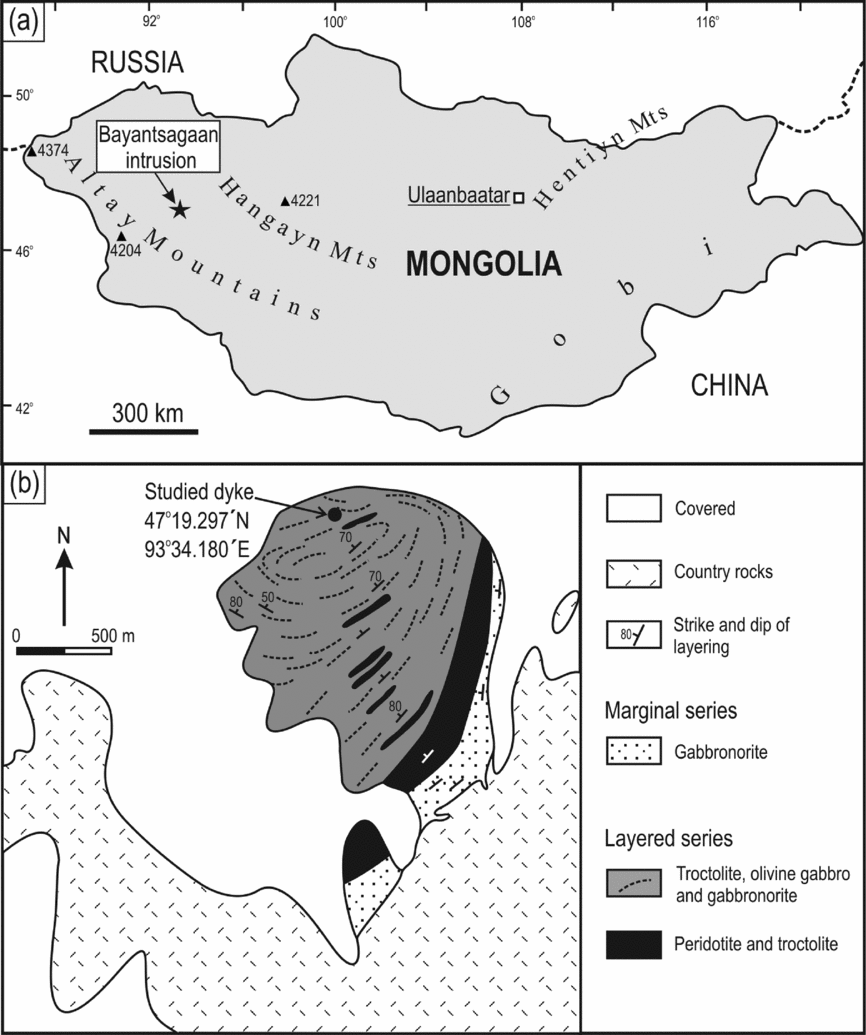
Layered mafic/ultramafic intrusions are common on the territory of Mongolia that, geologically, is considered part of the Central Asian Fold Belt (CAFB). Usually these intrusions are lopolith- and funnel-shaped bodies with a concentrically zoned internal structure. According to Tsygankov & Konnikov (Reference Tsygankov and Konnikov1995), they were formed by magmatic gravitational differentiation of basaltic melts but their rhythmic zonation is the result of the repeated filling of magma chamber. Based on the location, all mafic/ultramafic intrusions of CAFB are grouped in so-called belts and zones. The Bayantsagaan pluton that is the subject of our study (Fig. 1), together with Marinkin, Zaoblachnyi, Nomgon, Ortsogula, Zapevalikha and other mafic/ultramafic layered intrusions, forms a narrow belt of more than 2000 km in length in western Mongolia. Most intrusions including Bayantsagaan pluton were emplaced into lower Palaeozoic sedimentary and volcanic rocks. The latter are island-arc tholeiitic and calc-alkaline basalts. Host rocks are usually deformed and metamorphosed into greenschist faices. Sm–Nd isotope dating and geochemical studies of the Bayantsagaan pluton (531 Ma; Khain, Amelin & Izokh, Reference Khain, Amelin and Izokh1995) and host basalts (527±43 Ma; Kovalenko et al. Reference Kovalenko, Pukhtel and Yarmolyuk1996), as well as their similar geochemical (including ɛNd) and isotopic characteristics, indicate that they are both coeval and comagmatic (Izokh et al. Reference Izokh, Polyakov, Gibsher, Balykin, Zhuravlev and Parkhomenko1998).
(a) Simplified geographical map showing the location of the Bayantsagaan layered intrusion, western Mongolia and (b) its simplified geological map (modified from Izokh et al. Reference Izokh, Polyakov, Krivenko, Bognibov and Bayarbileg1990). The intrusion comprises marginal and layered series with layering dipping steeply towards the centre of the body. The location and GPS coordinates of the depleted troctolite dyke cutting through the layered series are indicated.

At the present level of erosion, the intrusion represents a concentrically zoned body of about 2–3 km in diameter with pronounced layering that dips steeply towards the centre of the body. Two-pyroxene hornfels is developed along the contact of the intrusion, indicating formation at a pressure of <2 kbar, corresponding to a depth of about 6–7 km (Izokh et al. Reference Izokh, Polyakov, Krivenko, Bognibov and Bayarbileg1990). The Bayantsagaan intrusion can be subdivided into a marginal and a layered series (Izokh et al. Reference Izokh, Polyakov, Krivenko, Bognibov and Bayarbileg1990). The 200-m-thick marginal series (Fig. 1) consists mainly of massive gabbronorite that becomes more primitive inwards (Izokh & Bayarbileg, Reference Izokh and Bayarbileg1988). The marginal series has a 1–3-m-thick outermost chilled zone that is made up of fine-grained gabbro/diorite with ophitic texture. The layered series (Fig. 1) occupies the centre of the intrusion and has a thickness of >1 km. Its lower part is mainly composed of alternating peridotite and troctolite, whereas the middle and upper parts are made up of alternating circle units composed of three or four types of rocks, including troctolite, olivine gabbro, gabbronorite and locally anorthosite. No systematic overall chemical variations in whole-rock and cumulus minerals (plagioclase and olivine) are however present through the layered series (Izokh et al. Reference Izokh, Polyakov, Krivenko, Bognibov and Bayarbileg1990). The layered series is locally cut by late-stage dykes, one of which is the focus of this study. The most complete rock sequence records the following generalized sequence of crystallization of the parental magma: Ol + Mgt → Ol + Pl + Mgt → Ol + Pl + Cpx + Mgt→ Ol + Pl + Cpx + Opx + Mgt → Pl + Cpx + Opx +Mgt. It is commonly believed that all of the mafic/ultramafic intrusions of western Mongolia, including the Bayantsagaan intrusion, were shallow-level staging chambers for island-arc, high-alumina basalt volcanism (Izokh et al. Reference Izokh, Polyakov, Gibsher, Balykin, Zhuravlev and Parkhomenko1998). For more details on the petrology, geochemistry and geochronology of the Bayantsagaan layered intrusion and the general geology of the region see Izokh et al. (Reference Izokh, Polyakov, Krivenko, Bognibov and Bayarbileg1990, Reference Izokh, Polyakov, Gibsher, Balykin, Zhuravlev and Parkhomenko1998), Khain et al. (Reference Khain, Amelin and Izokh1995), Badarch, Cunningham & Windley (Reference Badarch, Cunningham and Windley2002) and Rudnev et al. (Reference Rudnev, Izokh, Kovach, Shepelev and Terent’Eva2009).
3. Sampling and analytical methods
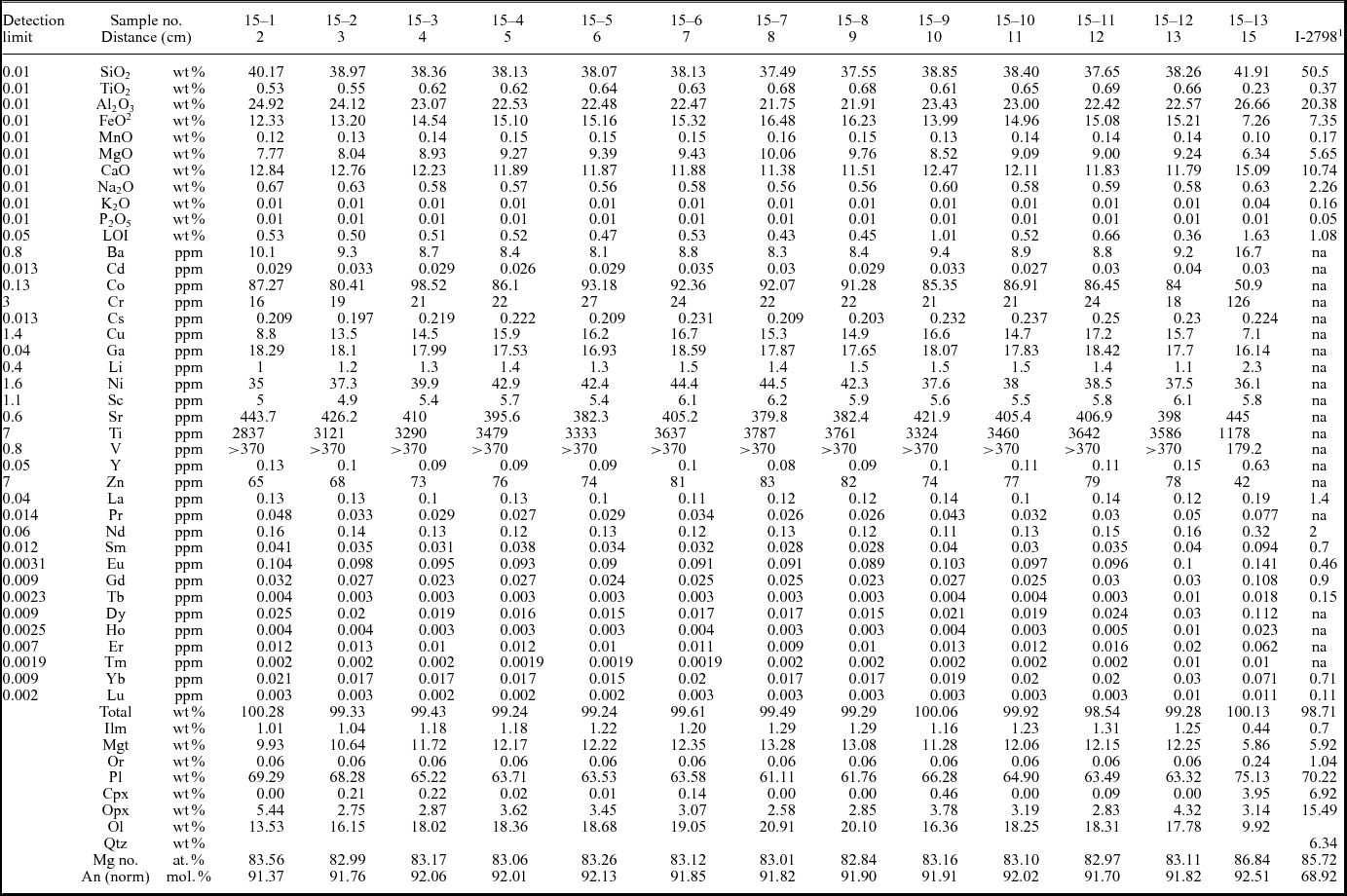
We have studied whole-rock major- and trace-element concentrations as well as mineral compositions in one section through a late-stage troctolite dyke (Fig. 2a). A sample containing the whole section of the dyke was collected in the field (Fig. 2b) and then sliced using a diamond saw. The major and trace elements were analysed at the Geoscience Laboratories of the Ontario Geological Survey in Canada. The major elements were determined by X-ray fluorescence (XRF) using a PANalytical Axios spectrometer with a Rh tube. Calibration curves were based on a suite of 16 certified reference materials. The standards BIR-1, GSD-11, MRG-1 and SY-4 were used to monitor the quality of the analyses. A summary of the long-term analyses of the standards is provided by Schweyer (Reference Schweyer2006). Precision and accuracy were better than 1% for all major elements. Inductively coupled plasma mass spectrometry (ICP-MS) following a four-acid digest was used for the determination of the trace elements. Accuracy of the analyses is within 10–12%. The certified reference materials BHVO-2, AGV-2 and GSP-2 were used to monitor the analyses. A summary of the analytical methods and long-term precision of the analyses can be found in Burnham & Schweyer (Reference Burnham and Schweyer2004) and Burnham (Reference Burnham2008). Mineral compositions were determined at the University of Oulu using a JEOL JXA-8200 electron microprobe. Operating conditions were 15 kV acceleration voltage, 10 nA beam current, 10–40 s counting times and 10 μm beam diameter. Table 1 presents whole-rock major, trace and rare Earth element concentrations as well as CIPW (Cross–Iddings–Pirsson–Washington) norms for the dyke, its host rocks and the chilled margin of the Bayantsagaan intrusion. For a complete list of microprobe analyses of plagioclase and olivine, see Supplementary Tables A1 and A2 (available at http://journals.cambridge.org/geo).
Whole-rock major, trace and rare earth elements and CIPW normative composition (calculated using the atomic ratio Fe3+/Fe2+ = 1/5) of troctolite dyke (samples 15–1–15–12), its host leucotroctolite (sample 15–13) and chilled margin (sample I-2798) of the Bayantsagaan intrusion (na – not analysed).

1From Izokh et al. (Reference Izokh, Polyakov, Gibsher, Balykin, Zhuravlev and Parkhomenko1998);
2Total Fe presented as FeO.
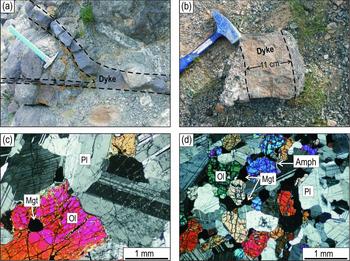
(a, b) Field photographs showing distinct contacts between the troctolite dyke and its host leucotroctolite in the Bayantsagaan layered intrusion. Photomicrographs (with crossed polars) are of (c) the host leucotroctolite (sample 15-13; Table 1) and (d) the troctolite dyke (sample 15–6; Table 1). Both rock types are characterized by medium-grained granular textures but the host leucotroctolite is coarser grained than the dyke. Texturally, both rock types are plagioclase-olivine-magnetite cumulates. The long dimension of the fields of view is about 3.8 mm. Pl – plagioclase; Or – orthoclase; Ol – olivine; Opx – orthopyroxene; Cpx – clinopyroxene; Ilm – ilmenite; Mgt – magnetite; Amph – amphibole.

4. Field relations and petrography
The 11-cm-thick troctolite dyke cuts massive leucotroctolite of the layered series (Fig. 1). In the study area, the dyke splits into two narrower branches that disappear beneath vegetation and alluvium at the limits of the outcrop (Fig. 2a). The contacts between the dyke and host rocks are distinct (Fig. 2b). The entire dyke is composed of fresh, crystalline troctolite with no signs of chilling against the host leucotroctolite. Both dyke and host leucotroctolite show granular textures. They are both medium-grained although the host leucotroctolite (Fig. 2c) is coarser grained than the dyke (Fig. 2d). Texturally, both rock types are plagioclase-olivine-magnetite cumulates, with the host leucotroctolite being notably more leucocratic than the dyke. The leucotroctolite consists of 75 vol.% plagioclase, 10 vol.% olivine, 5 vol.% magnetite and 10 vol.% of interstitial amphibole, whereas the dyke is composed of 63 vol.% plagioclase, 20 vol.% olivine, 14 vol.% magnetite and 3 vol.% of interstitial amphibole. In the leucotroctolite, plagioclase forms subhedral crystals about 0.3–3.0 mm long (Fig. 2c). Olivine occurs as large subhedral grains about 0.5–2.0 mm in diameter. Small sub- to anhedral grains of magnetite of about 0.2–1.0 mm in size with lamellae of ilmenite are also present. In the dyke, plagioclase forms subhedral crystals about 0.2–2.0 mm long (Fig. 2d). Olivine occurs as small equidimensional grains 0.2–0.9 mm across. Magnetite with lamellae of ilmenite forms small sub- to anhedral grains about 0.1–0.3 mm in diameter. Plagioclase in both the dyke and host rock is slightly zoned. Both normal and reverse zoning is present with a core–rim difference of less than 2–3 at.% An. Olivine grains are quite homogeneous. The dyke is uniform in texture, grain size and modal composition throughout its width (Fig. 3a). It is more of an adcumulate than the host leucotroctolite as witnessed by the smaller volume of interstitial material, mainly amphibole (3 vol.% versus 10 vol.%).
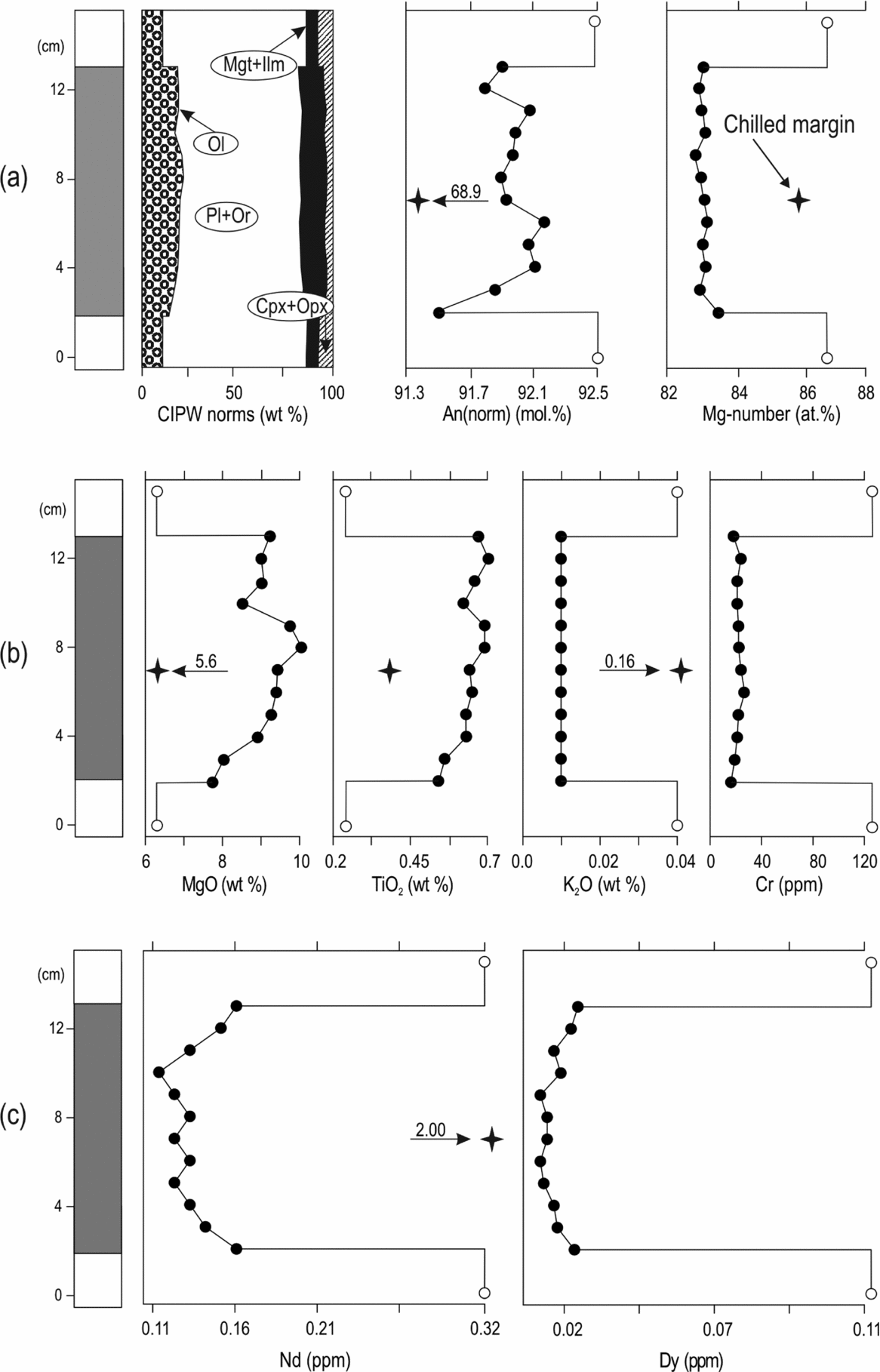
Variations in CIPW norms, normative An, Mg number, whole-rock MgO, TiO2, K2O, Cr, Nd and Dy across the late-stage troctolite dyke in the Bayantsagaan layered intrusion. The dyke is compositionally more evolved than the host leucotroctolite as indicated by normative An content, whole-rock Mg number and Cr. However, the dyke is strongly depleted in all incompatible elements (e.g. K2O, Nd and Dy). In addition, the dyke tends to become more primitive inwards as shown by the increase in MgO and decrease in Nd and Dy. For comparison, the chilled margin composition of the intrusion is indicated by the star symbol (based on Izokh et al. Reference Izokh, Polyakov, Gibsher, Balykin, Zhuravlev and Parkhomenko1998). An(norm) = 100×An/(An+Ab); Mg number = 100×Mg/(Mg+Fetotal).

5. Geochemistry and mineralogy
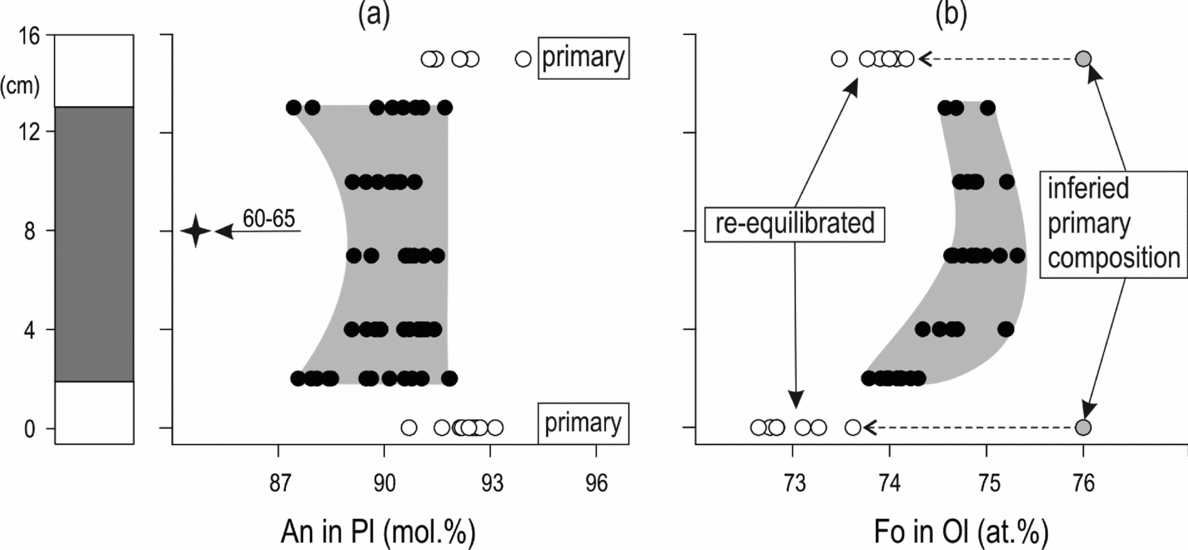
The troctolite dyke has three distinctive geochemical features. First, it is compositionally more evolved than the host leucotroctolites as indicated by lower normative An, Cr and Mg number (Fig. 3, Table 1) as well as its plagioclase (An87–92 v. An92–94) (Fig. 4a). The higher whole-rock TiO2 content of the dyke in this case reflects a higher content of cumulus magnetite. The more evolutional nature of the dyke appears to contradict its higher olivine and MgO contents (Fig. 3) as well as the higher Fo content of olivine (Fig. 4b). This puzzle is discussed in Section 6.d. Interestingly, the dyke is more primitive (normative An content = 91–92 mol.%; real An content = 88–92 mol.%; MgO = 8–10 wt%) than the chilled margin of the intrusion which has a lower normative An content (69 mol.%) and MgO (6 wt%) (Fig. 3, Table 1) as well as a less anorthitic plagioclase (60–65 mol.%) (Fig. 4a; Izokh & Bayarbileg, Reference Izokh and Bayarbileg1988).
Variations in the composition of (a) plagioclase and (b) olivine across the late-stage troctolite dyke of the Bayantsagaan layered intrusion. The An content of plagioclase in the host leucotroctolite is higher than in the dyke and is interpreted to be primary. In contrast, olivine in the host leucotroctolite has a lower Fo than the dyke and is interpreted as a secondary feature caused by post-cumulus re-equilibration of olivine with trapped interstitial melt. The inferred primary composition of olivine is shown for comparison. Note that the range in the composition of plagioclase narrows towards the centre of the dyke, reflecting a decrease in the amount of trapped melt. The inwards increase in Fo of olivine is probably due to the decreasing degree of re-equilibration with trapped melt. An(norm) = 100×An/(An+Ab); Fo = 100×Mg/(Mg+Fe).

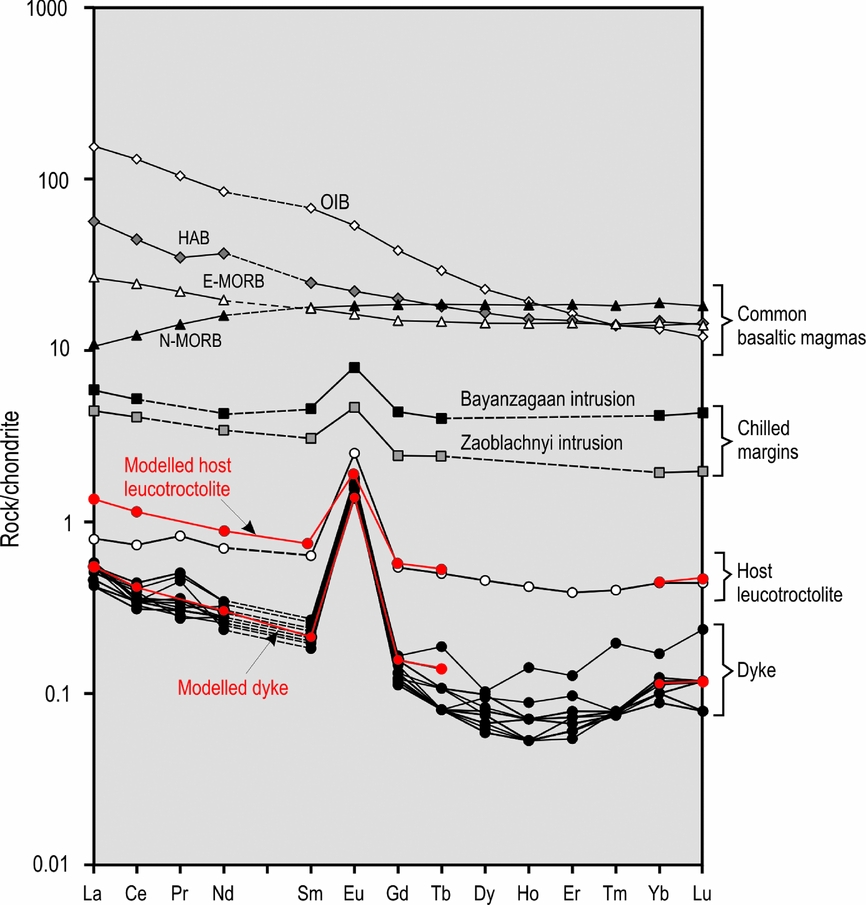
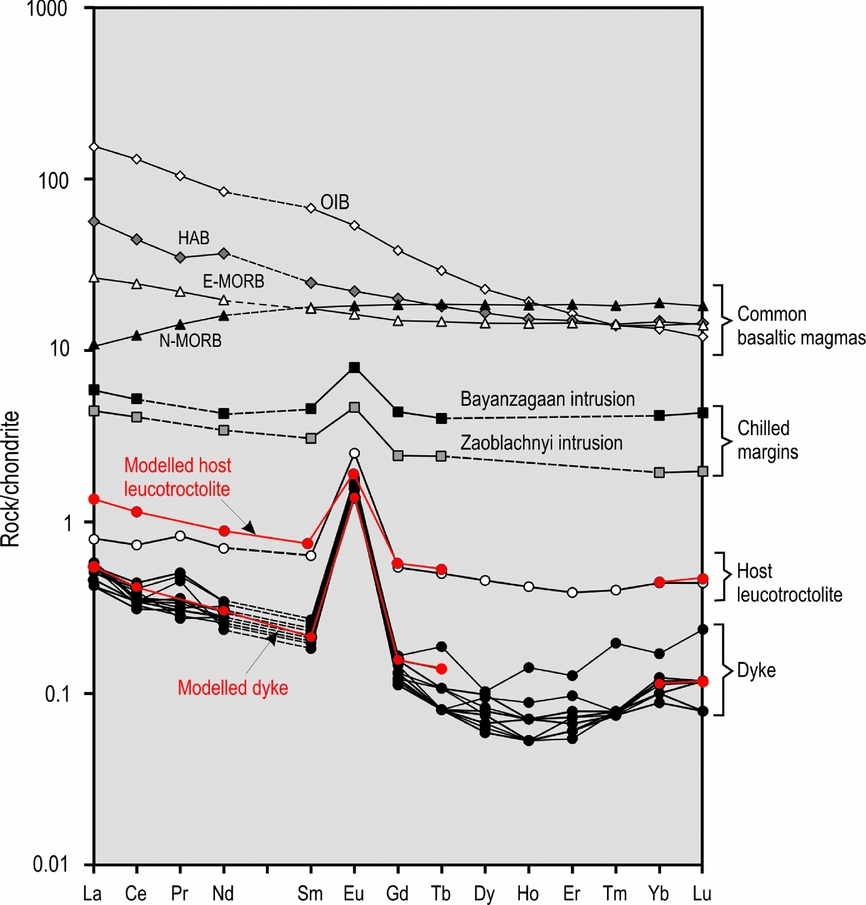
Second, the dyke is highly depleted in all incompatible elements relative to both the chilled margin and the host leucotroctolite. For instance, the dyke contains 0.01 wt% K2O v. 0.04 wt% in the host leucotroctolite and 0.16 wt% in the chilled margin; it also contains 0.13 ppm Nd versus 0.32 ppm in the host leucotroctolite and 2 ppm in the chilled margin (Fig. 3b, c). The difference between the rocks is especially evident from their rare earth elements (REE) patterns. In particular, REE concentrations in the dyke are 2–7 times lower than in the host leucotroctolite and 14–36 times lower than in the chilled margin (Fig. 5). The dyke shows slightly fractionated REE patterns (La/Yb<7) and a strong positive Eu anomaly (Eu/Eu* = 7.5–10.5) that probably results from the accumulation of plagioclase. The extreme depletion and Eu anomaly point to the adcumulate nature of the dyke. The chilled margin of the Bayantsagaan and another similar mafic/ultramafic layered intrusions (Zaoblachnyi) have unfractionated REE patterns and small Eu anomalies (Eu/Eu* = 0.6).
Chondrite-normalized REE patterns of the late-stage troctolite dyke, the host leucotroctolite and the chilled margins of the Bayantsagaan and Zaoblachnyi layered intrusions, compared to common basaltic magmas N-MORB (normal mid-ocean-ridge basalt), E-MORB (slightly more enriched in incompatible elements), OIB (ocean island basalt) and HAB (high-alumina basalt). Also plotted is the result of modelling of the dyke as an adcumulate containing 3 wt% of trapped liquid and host leucotroctolite as mesocumulate containing 20 wt% of trapped liquid. Note the good match between the modelled and actual compositions of the dyke and host leucotroctolite. Chondrite, N-MORB, E-MORB, OIB patterns are from Sun & McDonough (Reference Sun, Mcdonough, Saunders and Norry1989). The HAB curve is from Conte et al. (Reference Conte, Palladino, Perinelli and Argenti2010).
Third, the dyke reveals an internal zonation, becoming more primitive inwards from the margins as evident from an inwards increase in MgO and normative An and a decrease in Nd and Dy (Fig. 3). In addition, plagioclase shows a narrower range in An and olivine becomes richer in Fo towards the centre of dyke (Fig. 4).
6. Discussion
Cross-cutting relationships and the lack of chilled margins indicate emplacement of the dyke during the final stages of solidification when the host rocks were still hot. The more evolved chemical and mineralogical composition of dyke suggests that it crystallized from residual melt that channelized along a fissure in the solidifying cumulates. This implies that the late-stage dyke should be enriched in all incompatible elements relative to the parental magma and the cumulate rocks of the intrusion, but the opposite is the case. Our troctolite dyke is adcumulate and, for this reason, strongly depleted in REE relative to parental magmas of the Bayantsagaan and Zaoblachnyi layered intrusions as reflected by their chilled margins (Fig. 5). In addition, the dyke is highly depleted compared to its host cumulates (Figs 3, 5). To the best of our knowledge, such an extreme depletion in REE has not been reported previously for troctolitic rocks in any mafic–ultramafic intrusions. Just how did the dyke become adcumulate?
6.a. Mechanisms for the formation of adcumulate rocks
The formation of adcumulate rocks that are depleted in highly incompatible elements is a longstanding petrological problem. As a rule, adcumulate growth of crystals occurs in large magmatic bodies, such as layered intrusions, and implies an almost total removal of interstitial liquid enriched in incompatible elements, either by diffusion or compositional convection at the crystal liquid interface (Campbell, Reference Campbell1987; Morse, Reference Morse1986) or by post-cumulus processes such as compaction (Tegner et al. Reference Tegner, Thy, Holness, Jakobsen and Lesher2009; McKenzie, Reference McKenzie2011), compositional convection (Jaupart & Tait, Reference Jaupart and Tait1995; Tait & Jaupart, Reference Tait and Jaupart1996; Toplis, Brown & Pupier, Reference Toplis, Brown and Pupier2008) and thermal migration within the cumulate pile (Lesher & Walker, Reference Lesher and Walker1988). All these processes may be potentially involved and operate during crystallization and solidification of layered intrusions (Wager & Brown, Reference Wager and Brown1968; Campbell, Reference Campbell1978; Charlier, Vander Auwera & Duchesne, Reference Charlier, Vander Auwera and Duchesne2005; Tegner et al. Reference Tegner, Thy, Holness, Jakobsen and Lesher2009), but are highly unlikely to be effective in small mafic dykes (Chistyakova & Latypov, Reference Chistyakova and Latypov2009b ). There is, however, a process of adcumulate formation that has so far received little attention from igneous petrologists: this involves the in situ growth of crystals from continuously flowing magma along the base of the intrusion (Hill et al. Reference Hill, Barnes, Gole and Dowling1995; Latypov et al. Reference Latypov, Hanski, Lavrenchuk, Huhma and Havela2011). The process can be easily extended to a case of a dyke that crystallizes from through-flowing magma.
6.b. Origin of adcumulates in a late-stage dyke during magma flow
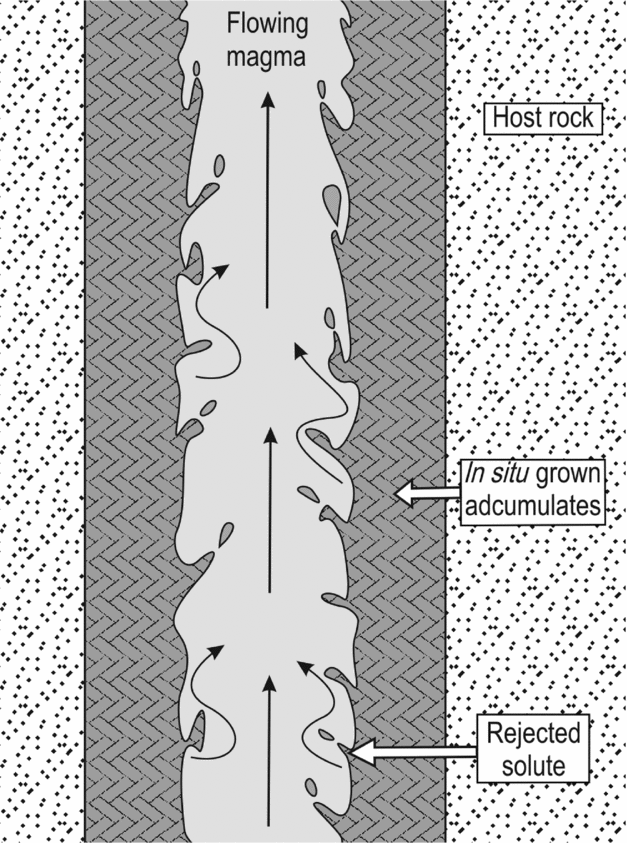
The studied dyke is finer grained and compositionally more depleted in all incompatible components compared to the host cumulate rocks. We attribute these characteristic features of our late-stage dyke to in situ adcumulate growth of crystals on dyke sidewalls from magma continuously flowing through the channel (Fig. 6). Our recent work has shown that in situ growth is a common process in narrow mafic dykes (Chistyakova & Latypov, Reference Chistyakova and Latypov2009a , Reference Chistyakova and Latypov b , Reference Chistyakova and Latypov2010, Reference Chistyakova and Latypov2012). Flowing magma may result in very effective removal of evolved melt from attached crystals growing in situ by magma continuously flowing (Hill et al. Reference Hill, Barnes, Gole and Dowling1995). Morse (Reference Morse1986) was the first to realize that magma flow in a chamber must aid adcumulus growth. In his analysis, he suggested thermal convection as a mechanism to strip a compositional boundary layer from growing crystals. The velocity of inflowing magma during emplacement is, however, many million times higher than that resulting from thermal convection (0.5–5 m s−1, Turcotte, Reference Turcotte and Mysen1987 v. 0.5–5 km a−1, Morse, Reference Morse1986). For our case this means that inflowing magma forming the dykes must be much more effective in the removal of a liquid boundary layer than thermally convecting magma in the chamber producing host rocks. In addition, the smaller crystals in dykes may assist more efficient packing and decrease initial porosity of dykes (Chistyakova & Latypov, Reference Chistyakova, Latypov and Srivastava2011). This may explain why our late-stage dyke is more depleted in all incompatible components than host cumulate rocks. The dyke can therefore be regarded as an example of primary adcumulate (Campbell, Reference Campbell1987). Another good example of primary adcumulates, although not fine-grained, is olivine adcumulates in komatiite-related dunites that are believed to form by in situ growth of olivine crystals from flowing komatiitic lavas (Hill et al. Reference Hill, Barnes, Gole and Dowling1995). The physics of this process is still poorly understood; detailed experimental and theoretical studies are required.
Formation of the late-stage troctolite dyke emplaced into hot cumulates (modified from Chistyakova & Latypov, Reference Chistyakova, Latypov and Srivastava2011). Solidification of the dyke occurs by in situ crystallization along its walls. Magma flowing along the fissure effectively removes the boundary layer of evolved liquid (rejected solute) from the growing crystals, resulting in an adcumulate strongly depleted in all incompatible elements.

6.c. Geochemical modelling for depletion of the late-stage dyke in incompatible elements
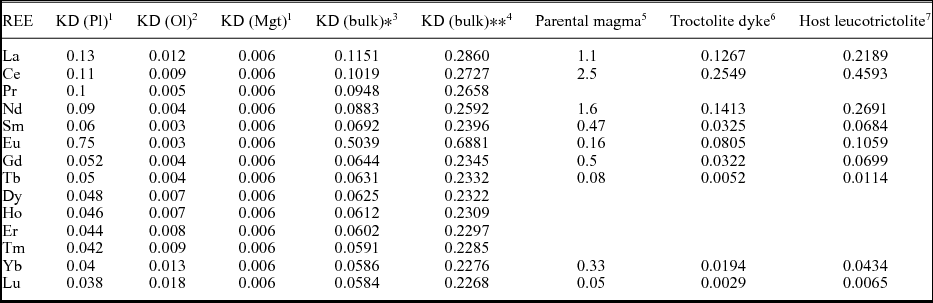
Simple calculations can be carried out to determine whether or not the observed depletion in REE is consistent with an adcumulate origin (assuming 3% of trapped melt). The calculations require estimation of the parental magma composition. It is commonly believed that chilled margins may be representative of the parental magmas of intrusions. The chilled margin of the Bayantsagaan intrusion is, however, an integral part of a basal reversal (Izokh & Bayarbileg, Reference Izokh and Bayarbileg1988), which is generally attributed to the emplacement of magma that becomes more primitive with time (Latypov et al. Reference Latypov, Hanski, Lavrenchuk, Huhma and Havela2011; Egorova & Latypov, Reference Egorova and Latypov2012). This implies that the chilled margin may be compositionally more evolved than the true parental magma of the Bayantsagaan intrusion. The true parental magma must have had a similar REE pattern but lower concentrations of REE, a feature that is characteristic of the chilled margin of the Zaoblachnyi layered intrusion. For lack of a better choice, the chilled margin of this intrusion has been used as representative of the parental magma composition. Appropriate mineral/melt distribution coefficients for basaltic magma with a troctolitic trend of crystallization were taken from Namur et al. (Reference Namur, Charlier, Toplis, Higgins, Hounsell, Liégeois and Auwera2011). We used them to calculate the bulk REE distribution coefficients for the observed mineral paragenesis (63 wt% Pl, 20 wt% Ol, 14 wt% Mgt and 3 wt% interstitial melt) in the studied dyke and hence the REE concentrations in the modelled dyke (Table 2). As shown in Figure 5, the modelled REE pattern matches that of the dyke well. The modelling is admittedly crude, especially given the uncertainties involved in the choice of the parental magma composition, but it does illustrate the important point that the unusual composition of the dyke is consistent with it being a nearly perfect adcumulate. The host leucotroctolite does not show such a strong depletion in compatible elements because they are much less adcumulate in origin. Similar REE modelling shows that at least 20% of trapped melt is required to reproduce their composition from the same parental magma (Fig. 5). The higher proportion of trapped liquid results in a flatter REE pattern and a smaller Eu anomaly in the leucotroctolite.
Trace element partition coefficients (KD) selected for geochemical modelling and results of modelling of trace element composition (ppm) in the studied dyke and host rock.

1Demaiffe & Hertogen (Reference Demaiffe and Hertogen1981)
2Frey (Reference Frey1969)
3KD(bulk)* = 0.63KD(plag)+0.2KD(ol)+0.14KD(Mgt,Ilm)+0.03KD(liquid)
4KD(bulk)** = 0.65KD(plag)+0.1KD(ol)+0.05KD(Mgt,Ilm)+0.2KD(liquid)
5Chilled margin of Zaoblachnyi intrusion (Izokh et al. Reference Izokh, Polyakov, Gibsher, Balykin, Zhuravlev and Parkhomenko1998)
6Calculated using KD(bulk)* and parental magma composition.
7Calculated using KD(bulk)** and parental magma composition.
6.d. Primary and secondary trends in composition of rock-forming minerals
The chemical zonation in the dyke can also be explained in the context of in situ adcumulate crystallization. This process may become more effective with formation of the dyke from margins inwards since a decrease in the rate of magma crystallization allows more effective stripping of excluded evolved liquid from minerals formed in situ. The dyke becomes increasingly more depleted in incompatible elements from the margins inward (Fig. 3c), probably in response to a progressive decrease in the proportion of trapped liquid in the rocks (Fig. 6). This decrease is also indicated by the narrower range in An content of plagioclase towards the centre of dyke (Fig. 4a). This range in plagioclase composition is proportional to the amount of trapped melt: the lower the range the smaller the proportion of trapped liquid (Morse Reference Morse2012). For the same reason, olivine becomes richer in Fo content towards the centre of the dyke, reflecting the decreasing extent of re-equilibration with trapped liquid (the so-called trapped liquid shift; Barnes, Reference Barnes1986). As a result, the Fo content of olivine in the dyke is higher than in the host leucotroctolite; the opposite was initially the case however, as shown by plagioclase that preserves its primary composition (Fig. 4a) due to extremely low chemical diffusivity in this mineral (Morse, Reference Morse1984). The higher olivine and MgO contents in the dyke than in the adjacent leucotroctolite (Fig. 3) is probably a result of emplacement of the dyke into cumulates enriched in plagioclase by some physical processes. Alternatively, it can be attributed to plagioclase grains being removed from the crystallization front during magma flow along the dyke.
7. Conclusions
Late-stage dykes in layered intrusions should be strongly enriched in all incompatible elements because fractional crystallization results in their concentration in residual melts. However, we report a late-stage dyke from the Bayantsagaan layered intrusion that is extremely depleted in all incompatible elements relative to both the assumed parental magma and the cumulates in the intrusion. Our preferred explanation for this paradox is in situ crystallization from magma flowing continuously along a fissure in hot host rocks. Hot magma flow efficiently removes the compositional boundary layer from growing crystals, resulting in adcumulates strongly depleted in incompatible elements. The process is most efficient when the effect of flowing magma outweighs cooling into host rocks. In addition, the abundance of incompatible elements in the parental magma of the Bayantsagaan layered intrusion was low and contributed to depleted composition of the dyke. This study indicates that the processes responsible for late-stage dykes in layered intrusions are not yet completely understood and deserve more attention. We predict that further study of late-stage dykes in layered intrusions will result in the discovery of other dykes with extreme depletion in incompatible elements.
Acknowledgements
This research was supported by NRF innovation postdoctoral fellowships to SC and NRF grant 87677 (competitive support for unrated researchers) to RL. We would like to thank Steve Barnes and Evgeny Pushkarev for fruitful discussions of many aspects of this study. We thank Andrei Izokh and Roman Shepelev for organizing fieldwork in Mongolia as well as for help and advice with many aspects of this study. The manuscript was improved by very constructive reviews by Richard Naslund and an anonymous reviewer. We are grateful to Olivier Namur, Brian Robins and Tony Morse for critical comments that were useful in the honing of the ideas presented in this paper. Brian Robins is also thanked for thorough editing that significantly improved the manuscript.
Supplementary material
To view supplementary material for this article, please visit http://dx.doi.org/10.1017/S0016756814000545