Recent studies on the economic history of Latin America argue that the burdensome legacy of Spanish colonial institutions affected the path of growth in the region. John Coatsworth, for example, discusses how a wide array of institutional constraints, including the poor protection of property rights, oppressive regulatory systems, and the unpredictability of economic policies restricted Spanish America's potential for economic growth.Footnote 1 Despite these suggestive works, we are far from understanding the precise mechanisms by which colonial institutions affected the newly independent states. This is partially due to the fact that, to this day, we lack a comprehensive picture of the Spanish American colonial economies. One of our major limitations in this respect is the relatively small number of works on the Andean region. John Fisher's work on Bourbon Peru, for example, calls for further research on several important industries of the Peruvian economy that have been neglected.Footnote 2
One such industry is the tobacco trade. Few economic activities were more vital to the development of the Spanish American economies than the cultivation, manufacture and commercialisation of tobacco. Tobacco was the second most important export industry in Spanish America at the time.Footnote 3 The decision of the Bourbon monarchs to monopolise the industry was a critical component of their plan to increase government revenues through a renewed contract with the colonists.Footnote 4 The economic significance of the industry was certainly critical for the establishment of the Estanco, but there were other considerations that made tobacco an ideal source of government income. Since it was viewed as a luxury good, a tax on tobacco was perceived as a ‘voluntary’ contribution, which was consistent with the Bourbon view that in order to build a prosperous empire the Crown had to promote the wellbeing of the population at large.Footnote 5
The monopoly was first instituted in Cuba in 1717. Later, it was established in Peru, Chile, La Plata, New Spain, Costa Rica, New Granada, Paraguay and Venezuela.Footnote 6 The literature overall focuses on the institutional evolution of the monopoly and pays little attention to its economic rationale and microeconomic aspects.Footnote 7 In particular, the historiography on the Peruvian tobacco industry addresses only partial aspects of the trade and is rarely based on data that go beyond a few scattered years. This article aims to fill these lacunae by reconstructing and analysing state intervention in the Peruvian tobacco industry between 1752 and 1813.Footnote 8
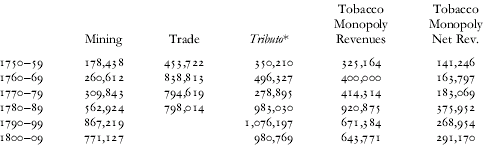
One aspect of the monopoly that has been relatively well documented for significant parts of the empire is its economic importance as a revenue-collection agency. In the Iberian Peninsula, for example, the Estanco yielded about 28 per cent of fiscal income, and in New Spain it became the second source of revenues for the Crown after silver, producing over 20 per cent of revenues in its best years.Footnote 9 In the Peruvian viceroyalty, as noted below, the magnitude of tobacco income was also impressive, especially when compared with traditional sources of revenues, like mining. Table 1 presents the distribution of Crown revenues in the Peruvian viceroyalty from 1750 to 1810.Footnote 10 Gross revenues from the tobacco monopoly surpassed silver for a good portion of the period under study. Net revenues represented around 15 per cent of fiscal income for most of the period. This result challenges the widely held view that the Peruvian Estanco produced meagre revenues, and was, overall, a failure.Footnote 11
Fiscal Revenues in the Viceroyalty of Peru, 1750–1809 (annual averages, pesos)
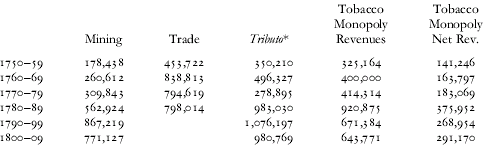
* Head tax levied on the Indian population.
Sources: Data for the Peruvian tobacco monopoly compiled from the Estados del Estanco, AGI, Lima 704, 766, 1102, 1112, 1228, 1229, 1230, 1231, 1232, 1233, 1234, 1236, 1237, 1238, 1242, 1243, 1245 and Chile: 368, 369. The data have been adjusted by changes in inventories. The remaining columns come from Klein, The American Finances of the Spanish Empire: Royal Income and Expenditures in Colonial Mexico, Peru, and Bolivia, 1680–1809 (Albuquerque, 1998), chap. 3.
Notwithstanding, the explanation of how the Bourbons managed to control such a dynamic industry remains elusive. In particular, the dispersion of tobacco production and its great significance for domestic markets underscore the challenges of controlling smugglers and illegal producers. How did Bourbon bureaucrats manage to enforce regulations in such a large and varied industry and generate sizeable rents? Based on an analysis of monopoly policies, this article suggests that Bourbon officials had a good understanding of the managerial challenges of the industry and developed sensible strategies to address them. The success of the Peruvian monopoly owed as much to the firm political will of José de Gálvez (Minister of the Indies from 1776 to 1787) as to the skilful handling of contraband.Footnote 12
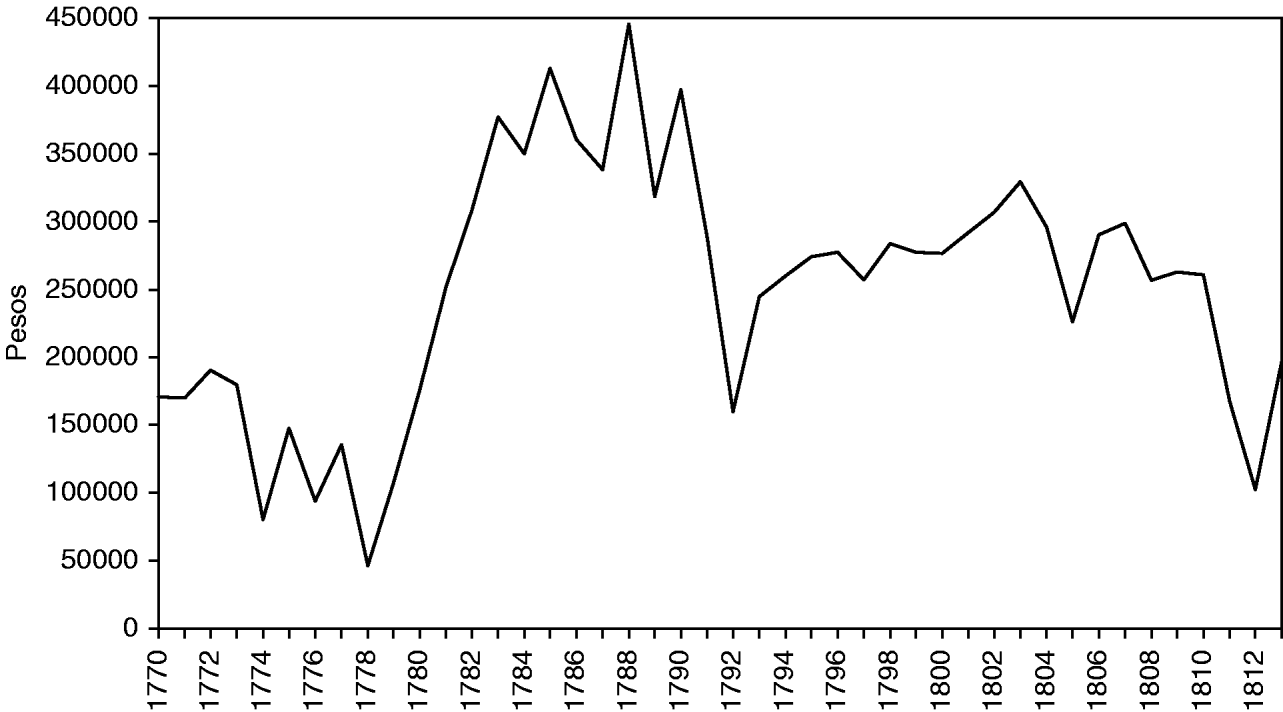
It took a number of years for the Peruvian monopoly to achieve its peak. Soon after its institution in 1752, the monopoly took control of tobacco production and distribution, thus assuming the power to determine output quotas and prices. In these years, however, the Estanco did not provide the fiscal bonanza that was anticipated. It was only later, under Gálvez, that the monopoly was reformed with the introduction of a number of policies aimed at increasing revenues and controlling contraband, including the centralisation of manufacture. As Figure 1 shows, the years of the Gálvez reforms (1780–1791) were the most successful in the extraction of revenues. However, the rise in revenues was not the product of centralisation per se (the establishment of factories did not imply major changes in transformation costs), but rather resulted from a more effective control of illegal markets in combination with higher prices.Footnote 13
Net Revenues of the Peruvian Tobacco Monopoly, 1770–1813. Source: The data comes from the Estados del Estanco (see Table 1). Revenues were adjusted by changes in inventories and administrative changes in the viceroyalty in order to be able to compare with more accuracy the yields in the different phases pre-factory, factory, and post-factory periods. The data have been corrected for the separation of the viceroyalty of Río de la Plata and the captaincy-general of Chile in 1776 and 1786 respectively, and the addition of Guayaquil in 1807. Guayaquil revenues have been subtracted from the total for the years 1807–10, but they are included thereafter because they were no longer separately distinguished. Between 1807 and 1810 these revenues averaged around 20,000 pesos annually. Adjustments have been made for Chile by subtracting revenues from the Chilean administration and adding to the Peruvian accounts the revenues received by the Peruvian viceroyalty from tobacco sales to Chile. Starting in 1794, there is no data on Chilean consumption, so the revenue figures include the tobacco sent to Chile rather than that consumed. This implies that from 1794 Peruvian revenues are overestimated.
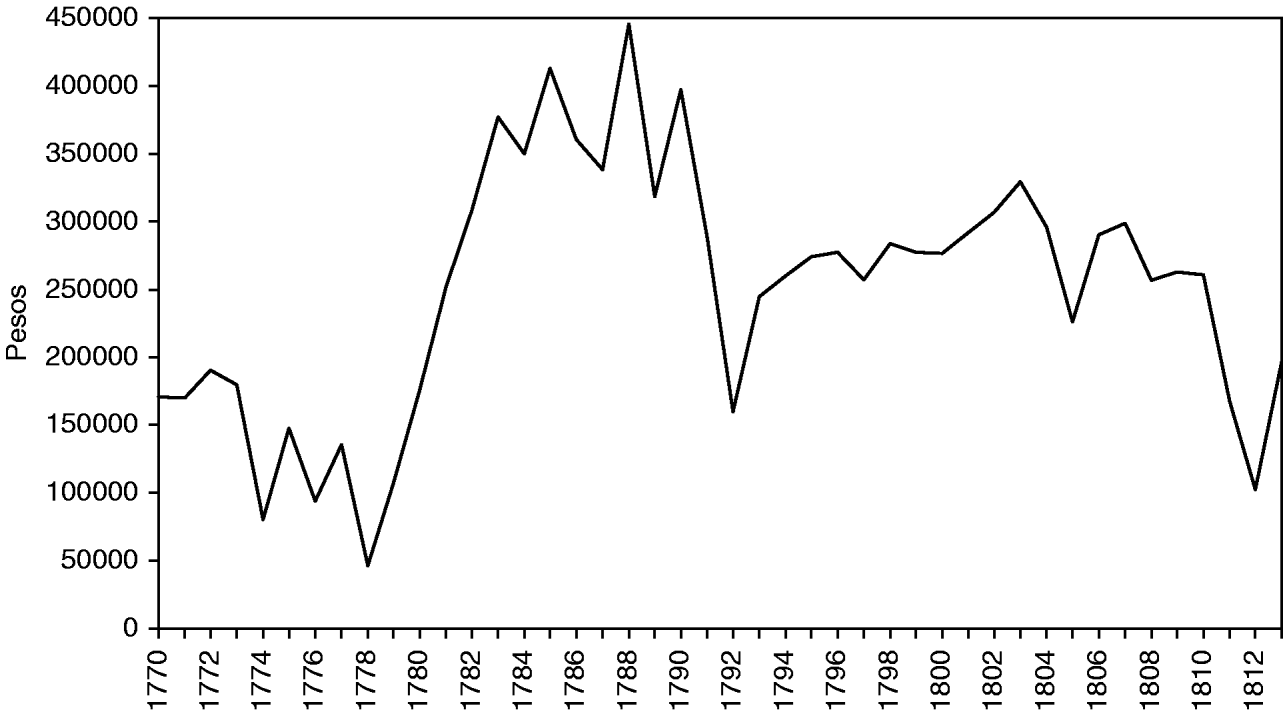
The archival evidence, including correspondence among high-ranking officials, indicates that the Bourbons viewed the centralisation of manufacture as a means to exert better control over the flow of tobacco and tobacco products, and to economise on the costs involved in monitoring the daily activities of workshop managers and final retailers.Footnote 14 The state's anti-contraband policies, however, went well beyond the centralisation of manufacture, affecting the industry at all levels, including tobacco production and distribution. The monopoly introduced higher purchase prices for tobacco leaf and made production quotas conditional on planters' performance. It also increased the severity of punishments for smugglers and added to the number of monopoly police in the provinces, making contraband trade more costly. The result was higher revenues.
The reforms, however, were short-lived. The evolution of monopoly policies demonstrates important limits to the Crown's revenue-raising efforts from the 1790s onwards. In particular, the Peruvian tobacco factories were closed, in spite of their financial success, as a result of Charles IV's cautious approach to colonial administration in the turbulent years that followed the death of Gálvez and Charles III. Although this article cannot claim to provide a definitive account of the rationale of the counter-reform, it does present evidence that suggests that political considerations explain, at least in part, the dramatic change in policies regarding Crown monopolies that occurred in the last decades of the empire.
The origins of the Estanco
The Royal Order that authorised the creation of the Real Estanco in Peru granted Viceroy José Antonio Manso de Velasco full discretion over the design of policies. As a result, the Viceroy requested Tomás Chavaquey Herreros, a prominent accountant of the Tribunal de Cuentas in Lima, to undertake a study of the industry and to formulate a plan with alternative regulatory options.Footnote 15
Chavaque reported that tobacco consumption was extensive among the white population at the time. An important proportion of tobacco leaf consumed in the Peruvian realm, approximately 800,000 mazos a year, was produced in the northern coastal province of Saña.Footnote 16 Nonetheless, tobacco of better quality was produced in the Andean provinces of Jaen de Bracamoros and Chachapoyas, which had an estimated annual production of about 380,000 mazos. As described in Table 2, the viceroyalty also consumed large quantities of snuff tobacco imported from Havana and Mexico, as well as tobacco leaf from Havana and Guayaquil.
Tobacco Industry and Colonial State Revenues in the Viceroyalty of Peru, 1725–1743 (Annual Averages)

Source: Based on Tomás Chavaque y Herreros' report, 1746, AGI, Lima 1229.
(1) Tobacco of this kind was also produced in Luya and Chillaos (Chachapoyas). In the records any tobacco brought from either area was recorded as from Jaen de Bracamoros. Total production in Chachapoyas (Luya and Chillaos) was 80,000 and in Jaen de Bracamoros 200,000. Tobacco was also produced in the nearby province of Moyobamba. This area produced approximately 100,000 mazos. Legal consumption from Moyobamba was only 1,956, and total taxes were 58.68 pesos. The figures include data of the three areas.
(2) These are Chavaque's estimates.
(3) 8 reales is equivalent to a peso.
Tobacco was generally consumed in the form of cigarettes, cigars and limpiones. Footnote 17 The most important consumption centres were Lima and the Gobernación de Chile. Lima accounted for about 40 per cent of the market, followed by Chile (Santiago and Concepción), which took around 35 per cent. Other important centres were Arequipa, with a market share of about 7 per cent, and Potosí and Cuzco with 5 per cent each.Footnote 18 Chileans consumed Saña tobacco and snuff exclusively. All the other regions consumed tobacco from Chachapoyas, Guayaquil and Havana.Footnote 19 This consumption pattern was maintained, with slight variations, throughout the monopoly period.
Chavaque's account of the industry also drew attention to the high level of contraband. The colonial state charged both the alcabala and the almojarifazgo on the tobacco trade in these years. By comparing the amount of legal trade with Chavaque's estimates of total tobacco consumption, it seems that around 70 per cent of tobacco was traded illegally. As shown in Table 2, the average amount of taxes collected annually between 1725 and 1743 was no more than 11,000 pesos in total.Footnote 20 Chavaque believed that a monopoly over the tobacco industry would increase revenues because it would enable the state to exert better control of contraband and charge a higher tax rate, commenting that it would provide:
… a tool with which it will be possible to deter the defrauding of the Royal Rights and at the same time achieve a sizeable increase to the Real Hacienda. This can be achieved through the establishment, at the expense of His Majesty, of a Royal Monopoly of all types of tobacco that this Realm produces including the imports of tobacco from Mexico and from the island of Havana, inasmuch leaf as snuff. This will result in annual revenues for His Majesty equal to 1,088,664 pesos 6¼ reales.Footnote 21
Chavaque presented his report to the Viceroy in 1746, but the institution of the Real Estanco came six years later, on 24 April 1752. According to the viceroy its establishment was delayed due to the disruption caused by an earthquake in Lima in the same year as the report was completed. Footnote 22
The early years
The first Administración General for the monopoly was instituted in Lima. Shortly afterwards, the monopoly established the Administraciones Generales of Santiago, Trujillo, Cuzco, Arequipa, Huamanga, Concepción, Alto Perú and Río de La Plata.Footnote 23 All spheres of the industry were tightly regulated. The regulations followed those of the Spanish tobacco industry closely. The highest administrative agency was the Real Junta de Tabaco. Its permanent members comprised the viceroy, who presided over it, a member of the Church, and the director of the Estanco. The Tribunal de la Dirección General (analogous to an executive committee) was formed by the Estanco's director, its general accountant, and the treasurer.Footnote 24
The state determined all prices and fixed agricultural production quotas. Licensed planters were compelled to sell all their production to the monopoly. The tobacco leaf was later transported by licensed mule drivers from the production areas to the main consumption centres and stored at monopoly warehouses. The final sales of tobacco leaf and snuff were entrusted to licensed retailers (estanqueros) who earned a commission of between 5 and 10 per cent of total sales. At this early stage the manufacture of tobacco products was left in the hands of artisans, who traditionally produced cigars, cigarettes and limpiones for domestic consumption.Footnote 25
Initially, tobacco planters remained in the industry and for the most part maintained their pre-monopoly market shares. In addition, the colonial state set purchase prices higher than pre-monopoly levels. In 1756, for example, the average purchase prices for bracamoro tobacco and for Saña leaf were around 0.3 and 0.28 reales per mazo respectively.Footnote 26 There were differences in the administration of the two producing areas, which were to a great extent shaped by their contrasting factor endowments. In the province of Saña, which was located on the Peruvian coast about 700 kilometres north of the capital, the planters included hacendados who owned large extensions of lands, medium-size planters who either produced on their own lands or rented lands from the hacendados, and small farmers, Indians and poor mestizos who cultivated their land by themselves. The largest production quota in Saña in the 1760s was 20,571 mazos.Footnote 27 In Chachapoyas, on the other hand, which was also located in the northern region, but on the tropical eastern side of the Andes, approximately 1,200 kilometres from Lima, most planters were Indians and poor mestizos, who rarely had production quotas exceeding 2,000 mazos. Tobacco cultivation in Saña was not only concentrated in a much smaller geographical area than in Chachapoyas, but it was far closer to reliable and well frequented transport arteries. Marine transport was a viable means of transporting tobacco from Saña to Lima and farther south to Chile, whereas this was not an alternative in Chachapoyas. From Chachapoyas, mules were the only practical means of carrying large quantities of tobacco over the mountain passes and the several dangerous river crossings.Footnote 28
In Saña the factoría originally had only one employee, the factor who, together with planters' representatives, was in charge of monitoring production in the region. They organised the remittances of tobacco leaf to Lima, distributing ‘receipts’ among legal producers, which entitled the planters to sell their product to the Dirección General. The Administración General paid them in cash shortly after their quota of tobacco was deposited at the warehouse in Lima. In Chachapoyas, in contrast, the contract between the cosecheros and the colonial state was much more hierarchical. There was no role for planters' representatives, leaving the factor in charge of most administrative decisions. The factor decided production quotas and organised transportation of the plant to Lima.Footnote 29
The monopoly expanded considerably in the years of Viceroy Amat (1761–1776), especially under the direction of Feijoo de Sosa (1767–1774). In these years, the administration was strengthened by the expansion of the bureaucracy in the production areas and new estanquillos (final retailers) in Lima and other provinces. In 1767, for example, seven new employees (one guarda mayor and six guarda veedores) were hired to control the production process in Saña. There were also a number of institutional changes in Chachapoyas, where new officials were employed to supervise four areas of production in the region: Sesuya, Chillaos, Sipasbamba and Guayabamba.Footnote 30 By the end of Amat's administration the Estanco had established two Juntas Generales (one in Lima, and the other in Chile), ten Administraciones Generales, 35 Administraciones Particulares, 160 estanquillos and 2 factorías.Footnote 31
In spite of the improved administration, legal production did not change significantly in the period. Net revenues for the Crown increased only marginally. The latter fluctuated from an average of 141,246 pesos in the first decade of the Estanco to an average of 183,069 pesos in the 1770s.Footnote 32 Nonetheless, the net revenues of the monopoly constituted a good portion of the value added of the industry even at this early stage, which, as shown in Table 1, was the least profitable for the Crown. On the basis of Chavaque's figures it can be estimated that the industry's value added was about 652,817 pesos annually in the late 1740s. Net monopoly revenues were equivalent to around 21.6 per cent of this figure, which signals a relatively effective administration.Footnote 33
Gálvez's reform and the battle against contraband
A critical turning point in the administration of the Estanco came in 1776, with the appointment of José de Gálvez as Minister of the Indies. Shortly after taking office, Gálvez sent visitador José Antonio de Areche to Lima to evaluate the Peruvian Real Hacienda and other revenue-generating agencies. The viceroyalty was facing a deep financial crisis at the time due, among other reasons, to the administrative separation of the viceroyalty of Río de la Plata. Public officials were thus understandably eager to increase revenues from any available sources.
Under the auspices of Gálvez a major reform of the monopoly took place, which strongly endorsed the adoption of the Mexican system.Footnote 34 Not surprisingly, one of the two directors of the Mexican monopoly, José de la Riva Aguero, was assigned the mission of reforming the Peruvian Estanco. Footnote 35 De la Riva and two other monopoly officials arrived in Peru in 1779. Their early reports expressed concerns about the high levels of contraband in the viceroyalty and their hope that, with the correct policy adjustments, the Peruvian monopoly would produce revenues comparable to those in Mexico.Footnote 36
The reform of the Estanco, which took the commissioners' assessments as its point of departure, consisted of sweeping changes that included the centralisation of manufacture and a fully renewed administration of the production areas. The centralisation of manufacture was conceived of as the cornerstone in the state's battle against contraband.Footnote 37 In a letter to José de Gálvez, a Spanish public official discussed how ‘… tobacco allowances to producers of limpiones and cigarettes will always serve as a cloak for the growth of contraband'.Footnote 38 The director of the Peruvian monopoly, Alfonso Santa de Ortega, agreed entirely with this argument. In a letter to the viceroy he sustained that the solution for the ‘uncontrollable’ level of contraband in the Peruvian viceroyalty was to expand the monopoly to the manufacture of tobacco products.Footnote 39 In addition, Miguel de Otermín, like Santa de Ortega, took the position that state manufacture of cigars and cigarettes was essential because of the difficulties of monitoring the workshops and retailers' stores.Footnote 40
Before centralisation, there were 86 licensed cigarreros (workshop managers), and a larger number of licensed retailers, who were required to buy tobacco leaf at monopoly warehouses. The job of monopoly supervisors, who visited the workshops and retailers' stores regularly, consisted of checking accounts and inventories against the monopoly warehouses' books (which recorded sales to all workshop owners and tobacco allowances to all retailers in the viceroyalty). Monitoring costs were quite high because it was impossible to distinguish between legal and illegal tobacco at the workshops and retailer stores. Under the new system, the private workshops were banned and licensed retailers were only allowed to sell manufactured products. Packs of cigars and cigarettes were stamped with a seal of origin at the state factories. Illegal manufacturers thus faced a higher risk of detection. Smugglers could attempt to disguise their products, but this would be costly.Footnote 41
Monitoring costs at the state manufactories
Despite the improvement in the control of the flow of tobacco and tobacco products, the factories created new challenges. Factory workers had to be monitored closely and offered the right incentives in order to assure good and faithful performance. Monopoly officials who were aware of these monitoring problems instituted a number of incentives to reduce the costs of supervision.
The monopoly established two factories, one in Lima and another in Trujillo. The latter was created in order to manufacture tobacco products for the Diocese of Trujillo, where the production areas were located, so as to save in transportation costs.Footnote 42 The factory in Lima produced cigars, cigarettes and limpiones for the rest of the Peruvian viceroyalty.Footnote 43 Production was organised in five offices: grinding (labor del picado), manufacture of cigarettes, manufacture of cigars, manufacture of limpiones, and the women's office (which produced cigarettes). An additional office was in charge of packing and stamping. There was a chief supervisor (fiel) for each major office, who supervised the work of the foremen/women (sobrestantes). Each sobrestante organised and monitored his own group of workers, most of whom were piece-workers. A certain degree of division of labour took place in the production of cigarettes, but not in the production of cigars and limpiones. The production of cigarettes started in the grinding office, where leaves were selected and then ground in order to prepare them for the rollers. The cigarette rollers were in charge of cutting the paper and rolling the cigarettes. The stamping and packing office was the last stop in the production chain.
Discipline was an important feature of the organisation of work within the tobacco factories. A critical point to stress here is that discipline was not instituted for coordination purposes or as a means to extract greater levels of work effort, but to improve the administration's capacities to control quality and contraband.Footnote 44 All workers, including top employees, had to comply with a relatively strict schedule. Work started every morning at 7 a.m.. Tobacco and paper were distributed to chief supervisors by the fiel of the grinding office before 7:30 a.m.. Afterwards, chief supervisors distributed the raw material to their foremen, who in turn gave them to the piece-workers in accordance with their quotas. At 10 a.m. the foremen reported to the chief supervisor on the final allocation of the raw material, and returned all the tobacco that would not be utilised that day to the grinding office.Footnote 45 The rationale for such a strict schedule was to control tobacco circulation. It was difficult, under such a system, for an employee to embezzle raw material, or to assign tobacco of better quality – or greater quantity – to a particular worker or group of workers, for distribution took place simultaneously across offices and workers. In this way, the monopoly sought to prevent fraud:
Neither in the office of cigars, nor in the office of cigarettes, will the administrator permit any reservation of paper or tobacco for workers who were not present at the time of the distribution; not following this regulation would permit fraud and abuse from the chief supervisors and foremen …Footnote 46
Sanctions for employees and piece-workers who did not comply with these regulations were severe. For example, chief supervisors and foremen who were late, with no good excuse, paid a fee equivalent to their daily salary. However, the administrator was responsible for informing the director when an employee committed this fault for the third time, in which case the director punished the employee either with suspension or permanent exclusion from the state manufactories. Piece-workers lost their tareas, and risked being erased from the roster of tobacco workers.Footnote 47
Behaviour at work was heavily regulated as well: drinking, gambling and even minor distractions were prohibited. In the eyes of the colonial state, good order was essential to control fraud and maintain the quality of tobacco products. There were a number of regulations preventing any kind of intimacy, or familiarity, between factory employees and operarios who could generate conspiracies against the state manufactories:
Being useful and convenient the transference of the fieles and sobrestantes, not permitting them to stay in the same offices for any significant length of time so as to avoid any close links with the workers and other prejudices from being inflicted on the Estanco … , the administrator will take close care of these modifications, considering the type of responsibilities of each of these offices, and the capacities of the employees …Footnote 48
Guards controlled the exit from the factory building and searched all workers for any possible signs of fraud. Sanctions imposed on tobacco workers for these cases were harsh. Stealing tobacco and/or paper – regardless of the amount – was punished with a large monetary fee, and permanent expulsion from the state manufactories.Footnote 49 Archival records and secondary sources suggest that these regulations were repeatedly enforced.Footnote 50
Beyond discipline and sanctions, did the colonial state institute any positive incentives in order to reduce monitoring efforts? According to documentary evidence, monetary incentives, the most common means used to enhance performance elsewhere, were not significant. Even though De la Riva recognised the importance of a well paid bureaucracy, the budget constraints faced in the early 1780s due to local upheavals (the Túpac Amaru rebellion) and the wars of American Independence put restrictions on the use of high salary policies.Footnote 51 Factory workers were thus paid the same wage rates that they had received at the artisanal workshops.Footnote 52 Managerial jobs did not fare any better. The majority of individuals hired for these posts were quite experienced in the tobacco business, but most of them received lower annual incomes at the factories than they had as independent cigarreros.Footnote 53 Overall, factory managers and tobacco workers had limited monetary incentives to develop vested interests in the state manufactories.
The colonial state, however, provided a number of non-market goods that compensated somewhat for the lack of such incentives. Principal among these were job stability and security. Indeed, in practice, bureaucrats were admitted to an exclusive club that could guarantee lifetime employment. Stability and promotions were generally based on performance, and according to the roster of factory employees these principles were religiously applied.Footnote 54 Another, though more subtle, mechanism that might have helped reduce monitoring efforts was the discourse that nurtured labour relations within the factories, in effect an informal system of control. Deans-Smith, in her work on the Mexican tobacco monopoly, illustrates how paternalism functioned as a constraint on the work force:
Manufactory authority was presented in the guise of paternalism. The informal name given to the manufactory in Mexico City was the House of the King; in response the workers used the term El Rey Padre (the Father-King) when referring to their ‘employer.’ The manufactory functioned as a microcosm of colonial Spanish hegemony, in which the ideals of political authority and religious orthodoxy were constantly promoted and upheld. Supervisors at all levels were instructed that the administrator as well as the dirección general would consider workers' petitions or grievances. Grievances were channeled from workers to supervisors, the administrator, the dirección general, and ultimately the viceroy and monarch. In so doing, guided by its ‘unwritten constitution,’ the colonial state encouraged negotiation and compromise and created a channel through which to absorb conflict.Footnote 55
This system created a sort of ‘family atmosphere’ within the factories, which is generally considered to be very effective in increasing the costs of opportunism.Footnote 56
The reforms upstream
None of these reforms, however, would have sufficed in the battle against contraband without modifying the organisation and regulations of the production areas. De la Riva stated that the latter was essential because registered planters were heavily involved in contraband:
It will only be possible to control the planters, who are so embroiled in contraband as to be smuggling half or more of their crop, with the resguardo (monopoly police) … In order to emphasise even more the necessity of these expenses, I remind your lordship of the considerable expenditures made in New Spain to combat the illicit extraction of the crops of Cordova, Orizaba, and Zongolica …Footnote 57
Beginning in 1780, the monopoly heavily monitored all aspects of the production process including the location and timing of planting and harvest.Footnote 58 But, most importantly, it introduced a number of built-in incentives in the contracts with the tobacco planters that increased the opportunity cost of engaging in contraband. One of the most important modifications in this respect was the increase in the purchase price for good quality bracamoro tobacco from 0.4 to 1 real per mazo, and for Saña leaf from around 0.3 to 0.6 reales.Footnote 59 Another important change was the conditioning of future quotas on planters' performance.Footnote 60
In addition, the monopoly established much harsher penalties for illegal activities. According to the regulations that predated the reforms, each planter was required to put forward some collateral, which is typical of contracting systems where there is no effective third party enforcement. Under the new regulations, however, the collateral was eliminated and the planters faced much higher penalties and a fully renovated enforcement system. An important new clause detailed harsher punishments for smuggling: four years of incarceration for any fraud that involved more than twelve mazos.Footnote 61
Effective enforcement, however, depended not only on the matrix of incentives, but also on the efficacy of the administration. Consequently, the monopoly modified the administration of the production areas. At the time of the reforms, for example, Chachapoyas had a total of four officials: the factor and three monopoly guards, with a total budget of 900 pesos.Footnote 62 In addition to higher wages for current positions, the monopoly created several new offices. Total expenditures for the new administration in Chachapoyas rose from 900 to 9,750 pesos annually.Footnote 63 In Saña, the Administración General of Trujillo was dissolved and merged with the factoría in Lambayeque, which was at the centre of the production areas: the partidos of Lambayeque, Saña, and Chiclayo. Total expenditures in the area increased from 60 to 6,740 pesos a year.Footnote 64
In addition, the monopoly concentrated production quotas in fewer hands. Before the reforms the number of planters in Saña was approximately 87, which contrasts with only 37 planters in the early 1780s. According to the roster of registered planters the top three had quotas of 100,000 mazos, and the next three had quotas between 30,000 and 50,000 mazos. Footnote 65 The top six planters, therefore, had legal rights to produce 60 per cent of Saña's output.Footnote 66 There were also attempts to concentrate production in Chachapoyas. In Sipasbamba, for example, there were around 72 planters registered in 1781. In 1788 we find only 45, in spite of the fact that total legal production in the area was about four times larger than in 1781. In the other partidos the archival evidence also suggests increasing concentration throughout the decade.Footnote 67
The monopoly also instituted the rondas volantes, which consisted of groups of guards who inspected the areas suspected of heavy contraband, the most important of which was the one controlling the Marañón, a river that passes through Chachapoyas and connects with consumer centres in the Andean region. In the 1780s, the colonial state spent 11,400 pesos a year to police this route. Moreover, the monopoly hired employees to patrol transportation routes that connected the production areas to Lima. Before the reforms, only five employees took care of these routes, with a total expenditure of 2,400 pesos a year. In 1780, fifteen new employees were added with total salaries of 10,000 pesos.Footnote 68
Overall, the anti-contraband reforms could be summarised as follows. First, the monopoly vertically integrated downstream into tobacco manufacture, which allowed for better control over the flow of tobacco products. In addition, the factory's regulations included a complex system of incentives and sanctions directed to the control of fraud. Second, the state instituted a series of organisational changes in the production areas. Prominent among these were the incentives directed to tobacco planters such as a higher purchase price for the tobacco leaf, quotas based on planters' performance, and penalties for those planters who provided poor quality tobacco and engaged in contraband. In addition, the state improved its administration by concentrating tobacco production in the hands of a few planters, and significantly increasing the number of monopoly police in the provinces. Each of these changes acted to make smuggling activity riskier and more costly. The net effect of the state's reforms, both upstream and downstream, was to provide much more effective deterrence to smugglers than had been the case in earlier years.
The evidence on contraband
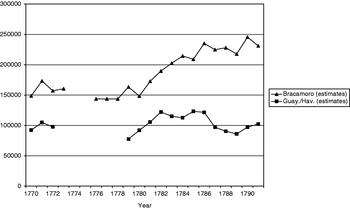
There is substantial evidence in support of the thesis that the reforms of 1780 led to a reduction in contraband. As mentioned above, accounts of the prevalence of contraband prior to the establishment of the factories are abundant. De la Riva's commission encountered widespread smuggling, especially of bracamoro tobacco. We can infer contraband levels by comparing estimates of cigarette and cigar sales before and after 1780, which are illustrated in Figure 2.Footnote 69 Estimates of ‘legal’ cigarette sales increased substantially during the 1780s, in spite of the rise in the final price of tobacco products. Interestingly, the Administración de Cajamarca, which was the nearest to the production centre of Chachapoyas, saw the value of legal consumption rise from 14,177 pesos for the period between 1771 and 1778 to 159,527 pesos for the period from 1781 until 1788, which constitutes strong evidence of a decrease in contraband of bracamoro-variety tobacco.
Legal Consumption of Bracamoro Tobacco (mazos) and Tobacco from Guayaquil and Havana (manojos). Source: Estados del Estanco (doc. cit. in Table 1). Estimations since 1780 based on data on consumption of cigars and cigarettes.

This increase in legal sales was accompanied by an increase in final prices. De la Riva raised the price of bracamoro tobacco from an average of four to sixteen reales per mazo (in Lima), and the price of Saña leaf from two to four reales.Footnote 70 The price of manufactured products, on the other hand, was nominally unchanged, at half a real a package of 24 cigarettes, although they increased somewhat in real terms since the Estanco occasionally manufactured cigarettes with lower tobacco content than artisans.Footnote 71 An increase in final prices of tobacco and tobacco products should theoretically have produced a reduction in total tobacco consumption. The increase in legal sales is therefore indicative of a reduction of contraband.Footnote 72
Nonetheless, as Figure 2 illustrates, smugglers posed new challenges in the late 1780s. The graph shows that after a substantial increase in the early 1780s legal sales of cigars made from Guayaquil and Havana tobacco decreased to pre-factory levels in the second half of the decade. Archival evidence suggests that merchants turned to smuggling tobacco coastwise from Guayaquil.Footnote 73 Overall, however, Figure 2 provides strong evidence of a relative success in the fight against contraband. The total volume of legal sales of both cigars and cigarettes combined was undoubtedly greater in the factory years than in the pre-factory period.
The cost advantages of factory organisation
In order to assess the impact of the anti-contraband reforms on monopoly revenues we need to discuss one additional factor, which is whether there were any changes in the cost of producing tobacco products when the state vertically integrated into the manufacturing process. This amounts to explaining whether the factory system achieved scale economies that were not achieved by the artisan manufacturers and why. In other words, were there technical reasons for the higher revenues under the factory system? Or can we really assert that much of the change in revenues was due to the reduction in contraband in combination with higher prices?
The discussion of the existence of scale effects is critical to evaluating changes in transformation costs that could have occurred when the colonial state integrated into the manufacture of tobacco products.Footnote 74 A full resolution of this issue, however, requires a comparison of the average total cost functions for the production of cigarettes under the two different systems: state manufactories and artisanal production. If the average total cost of the monopoly at its level of production was less than the minimum point on the average total cost curve of the artisanal producer, one can assert that the monopoly did represent a technical improvement over the prior (and subsequent) systems. Unfortunately, no data is available on artisanal production that would allow us to test this hypothesis. However, it is possible to utilise reliable estimates of returns to scale based on the factory's production function, which suggests constant returns to scale at approximately 0.23 reales per pack of puros (cigars) and 0.21 reales per pack of cigarettes.Footnote 75 As noted above, the factory achieved greater division of labour than the workshops. It is likely, however, that the improvements in costs resulting from this were exhausted at relatively low levels of production, below the normal output of the Lima factory.Footnote 76 If there were any effects of factory organisation on transformation costs, they were likely to have been minimal.
The closure of the tobacco factories and the political economy of the counter-reform
For all their accomplishments, the factories were closed after only eleven years of operation, in 1791. This major modification in the organisation of the Estanco, which took place only a few years after the institution of Gálvez's reforms, signified the relative stagnation of revenues from the monopoly, as can be seen in Figure 1.Footnote 77 Interestingly, however, legal sales did not return to pre-factory levels after the factory system ended, which explains, at least in part, why revenues in the 1790s and beyond were higher than in the pre-factory period.Footnote 78 It is likely that contraband was higher in the 1770s than in the 1790s and 1800s because although the expected benefits of smuggling were higher in the 1790s (the post-1790 price of tobacco leaf was above the pre-1780), the expected costs were still high relative to the pre-factory period. A total dismantling of the reforms that De la Riva made to police the trade did not occur, particularly in Chachapoyas.Footnote 79
This unexpected turn of events requires a discussion of some of the policy changes that took place in the metropolis after the disappearance of José de Gálvez, the death of Charles III in 1788, and the tumultuous events in Europe at the time. The latter certainly affected the attitudes and policies towards the Indies.
Under Charles IV, the Crown took a number of measures that illustrated its concerns with the security of the empire, especially its fears of upheavals in the colonies. Primary and secondary sources suggest that the Crown relaxed monopoly policies in those areas where conflicts with local elites were most apparent. The tobacco monopoly in Paraguay, for example, experienced a marked relaxation in its policies. As Cooney puts it:
Shortly before the death of the Minister of the Indies, José de Gálvez, and the subsequent termination of his ‘revenue-producing reforms’, Paula Sanz was removed from the Superintendencia of Buenos Aires … Now with a greater willingness among officials to appease the local elites and with less zeal displayed for law enforcement, the war against contraband on the rivers noticeably slackened. Thus by 1790 those former obstacles to the contraband traffic had disappeared. In 1790–91 the apprehension of downriver smugglers by the Resguardo (revenue police) had vanished …Footnote 80
But this is not the only example of drastic changes in policies in the region. In 1792 Charles IV ordered the abolition of the Estanco in Venezuela, conceding that since its institution several demands for its termination had been introduced before the Crown, and that, ‘in all justice’, the monopoly should be brought to an end. The Royal Order stated that the Ayuntamiento had to commit itself to taxing the tobacco industry either through the encabezamiento (head tax to be paid by tobacco producers) or through any other system that the local authorities deemed appropriate. According to Arcila Farias, a heated argument ensued, following the royal order, between those farmers excluded from the monopoly and those defending old privileges. In the end, those lobbying for the status quo won the battle and the Estanco continued functioning, mostly unchanged, until the wars of independence.Footnote 81
In New Spain, the monopoly lost its relative autonomy with respect to the Tribunal de Cuentas, although no other major administrative changes followed. As Deans-Smith argues, after the early 1790s attempts to reform the monopoly to adjust it to economic and political changes were silenced. Although this is merely speculative, it is likely that what lay behind the relative rigidity of Mexican regulations was the important economic role of the monopoly as collateral for government loans (the monopoly in New Spain was mortgaged for 15 million pesos by 1797). The latter generated the support that the monopoly enjoyed from leading merchants and miners.Footnote 82
The Peruvian case illustrates well the politics of Charles IV and his new ministers. The arrival, in 1790, of Viceroy Gil de Taboada y Lemos (1790–96) was crucial for the evolution of the Estanco. Viceroy Gil had strong ties with newly appointed officials in Madrid, especially with Antonio Valdés, who was in charge of the Ministry of Finance. He was appointed first as viceroy of New Granada in 1788, and then, shortly afterwards, as viceroy of Peru.Footnote 83 Allan Kuethe, in his article on the culmination of the Bourbon reforms in New Granada, gives a suggestive picture of Gil's politics. Kuethe argues that Gil fought the huge financial crisis in New Granada with the same views he would apply in Peru a few months later: reducing expenditures instead of increasing taxes and expanding the bureaucracy. Kuethe finds Viceroy Gil's policies to be consistent with Barbier's interpretation of the new regime: the Crown became more cautious under Charles IV, advancing the Bourbon programme as long as it did not threaten local vested interests.Footnote 84 Gil, for example, as viceroy of New Granada, supported the policy towards modernisation of the mining industry, whereas in Lima, where opposition from Lima's mercantile oligarchy was apparent, Gil visibly opposed those same policies.Footnote 85
Viceroy Gil's stand on the tobacco industry is consistent with this interpretation. Soon after his arrival to Lima, honouring his duties as maximum authority of the Royal Treasury, Gil sent a letter to the Crown discussing the performance of the Estanco.Footnote 86 He informed the Crown of pervasive complaints from consumers about the quality of manufactured products, and stated that the monopoly had enormous bureaucratic expenses, which had to be reduced to improve performance.Footnote 87 This was the view of members of the local elite. Hipólito Unanue, writing for the Mercurio Peruano, a publication of the Sociedad de Amantes del País, an enlightened and progressive organisation in Peru, strongly criticised the state manufactures.Footnote 88
Gil's diagnosis of the Estanco's performance was also consistent with the Crown decrees of 1787, which ‘implicitly condemned some of Minister Gálvez's policies by stressing the need to economise’.Footnote 89 The Viceroy manifested his views more extensively in a subsequent letter to the Crown:
Selling the leaf cheaply and thereby increasing the quantity sold is the most advantageous step for the people and it is that which Your Majesty should take throughout the entire monopoly if Your Majesty wishes it to flourish without the need of hiring as many monopoly police. In order to accomplish this successfully, it is indispensable to achieve economy, good order, and simplicity.Footnote 90
Finally Gil ordered a visita (audit and investigation) of the monopoly in April 1790.Footnote 91 Soon afterwards, in July of the same year, he reported to the Crown that the visita, which had been conducted by former director of the monopoly Feijoo de Sosa, was not favourable to the Estanco. According to Feijoo, the factories presented a number of challenges. The main problem was the excess of inventories that caused the deterioration of a great quantity of tobacco in the Lima's factory warehouse, which, in his view, was at the root of the low quality of tobacco manufactures.Footnote 92 According to Feijoo's report, there were other problems including the relatively low weight of the mazos of bracamoro tobacco.Footnote 93 But Feijoo's report overlooked a key issue that was at the heart of consumers' complaints against the state manufactories. The inadequate quality of manufactured products was not only related to the excessive inventories of tobacco leaf at the factory's warehouse, but also, and principally, to the substitution of domestic tobacco for imports. As a result of the disruption of commerce during the War of American Independence, the colonial state had engaged in an ‘import-substitution’ strategy experimenting with new tobacco fields that tried to reproduce Guayaquil and Havana tobacco. However, the Peruvian Estanco failed to produce tobacco that could compete with the best quality imports.Footnote 94 In the end, on the basis of the report of the visita, and arguing that the public outcry was for the closure, Viceroy Gil abolished the tobacco factories. The Crown approved the judgment of the visita, the closure of the factories, and the destitution of Director Otermín on 24 May 1791.Footnote 95
Conclusions
The historiography argues, convincingly, that the Bourbons failed to construct the absolutist state envisioned by the reformers, but there is no consensus on the nature of the organisation they actually created.Footnote 96 The reconstruction and analysis of tobacco monopoly policies sheds new light on the nature of the Bourbon administration. One of the main findings of this article, which is consistent with a good portion of the literature, is that Bourbon officials were effective in the extraction of rents.Footnote 97 The literature, however, for the most part inferred competent administration from fiscal results without directly linking policies and outcomes. Building on a detailed economic analysis of monopoly policies and performance, this study of the Peruvian tobacco monopoly has suggested that Bourbon officials had a thorough understanding of the importance of transaction costs for the formation and support of a successful bureaucracy. Indeed, the factory system was devised as a means to reduce the costs associated with the control of illegal markets, and judging by the available evidence, it was effective in doing so. Overall, the evolution of monopoly policies suggests that Bourbon officials were in no way ‘backward’ managers. They were certainly aware of the organisational problems that afflict hierarchies.
The limitations to Bourbon policies are to be found in the political economy of colonialism. The tobacco factories were closed in 1791, partly in response to public outcry. Their closure should be understood in light of the major policy changes emanating from Madrid after the tumultuous events in Europe at the time. Under Charles IV, the crown took a number of measures that illustrate its concerns with the security of the Empire. Primary and secondary sources suggest that the Crown relaxed monopoly policies in those areas where conflicts related to monopoly operations were most apparent. That, seemingly, was the case in the Peruvian viceroyalty, where the tobacco factories were closed in spite of their financial success.