Introduction
The genus Lomatogonium A.Braun of the family Gentianaceae currently includes about 24 accepted species worldwide, of which there are 16 in China, 12 in India, two in Europe and only one in North America (Liu & Ho, Reference Liu and Ho1992; Ho & Pringle, Reference Ho, Pringle, Wu and Raven1995; Dey & Maity, Reference Dey and Maity2017; Mabberley, Reference Mabberley2017). The greatest species diversity of the genus is concentrated in the cool temperate and alpine Himalayas. The number of species in India has increased recently to 12 (Dey & Maity, Reference Dey and Maity2017), almost equally shared between the Western and Eastern Himalayas. Notably, nine species grow in Sikkim (Clarke, Reference Clarke and Hooker1883; Garg, Reference Garg1987; Aitken, Reference Aitken and Long1999; Aitken & Long, Reference Aitken and Long2010; Dey & Maity, Reference Dey and Maity2017; Maity et al., Reference Maity, Maiti and Chauhan2018).
During a recent botanical expedition to the alpine mountains of North Sikkim, a few unusual populations of Lomatogonium were discovered by our research team in the lower Gurudongmar valley. At first glance, the material collected resembles the recently described Lomatogonium cherukurianum S.K.Dey & D.Maity from the Lhonak valley of Sikkim (Dey & Maity, Reference Dey and Maity2017). However, the plants grow in dense clumps, have a taller, more robust growth habit and bear much larger yellowish flowers (4–5 cm in diameter). Moreover, Lomatogonium cherukurianumis is an early-flowering species (July), whereas the proposed new species flowers in September. Detailed morphological characterisation and comparisons with morphologically similar species support recognition of these unknown populations as a distinct species new to science.
The present study is fundamentally based on a comprehensive literature search related to the taxonomy of the genus Lomatogonium and the family Gentianaceae (Clarke, Reference Clarke and Hooker1883; Garg, Reference Garg1987; Liu & Ho, Reference Liu and Ho1992; Ho & Pringle, Reference Ho, Pringle, Wu and Raven1995; Aitken, Reference Aitken and Long1999; Aitken & Long, Reference Aitken and Long2010; Dey & Maity, Reference Dey and Maity2017; Maity et al., Reference Maity, Maiti and Chauhan2018). A table and key are provided for the easy recognition and correct identification of the proposed new species and its allies.
Materials and Methods
Material (nine plants from three populations) was collected from alpine pasture in the high Himalayan mountains of the state of Sikkim. Morphological data for the new species and for its ally Lomatogonium cherukurianum were obtained from these collections and from Dey & Maity (Reference Dey and Maity2017), respectively. All previous collections, including type specimens of Lomatogonium cherukurianum, were examined critically. Morphological data for other species related to this group were obtained from Clarke (Reference Clarke and Hooker1883), Garg (Reference Garg1987), Ho & Pringle (Reference Ho, Pringle, Wu and Raven1995), Aitken (Reference Aitken and Long1999), Dey & Maity (Reference Dey and Maity2017) and Maity et al. (Reference Maity, Maiti and Chauhan2018).
Measurements of vegetative and floral parts were scored under a stereomicroscope (Leica EZ4E, Wetzlar, Germany). Type specimens were prepared and deposited in CUH and CAL. Conservation assessments were made following IUCN Red List Categories and Criteria (IUCN Standards and Petitions Subcommittee, 2017). Pollen grains were characterised through scanning electron microscopy, with description of individual pollen grains based on Erdtman (Reference Erdtman1952).
Species Description
Lomatogonium gaurgopalii D.Maity, Midday & J.Ghosh, sp. nov.
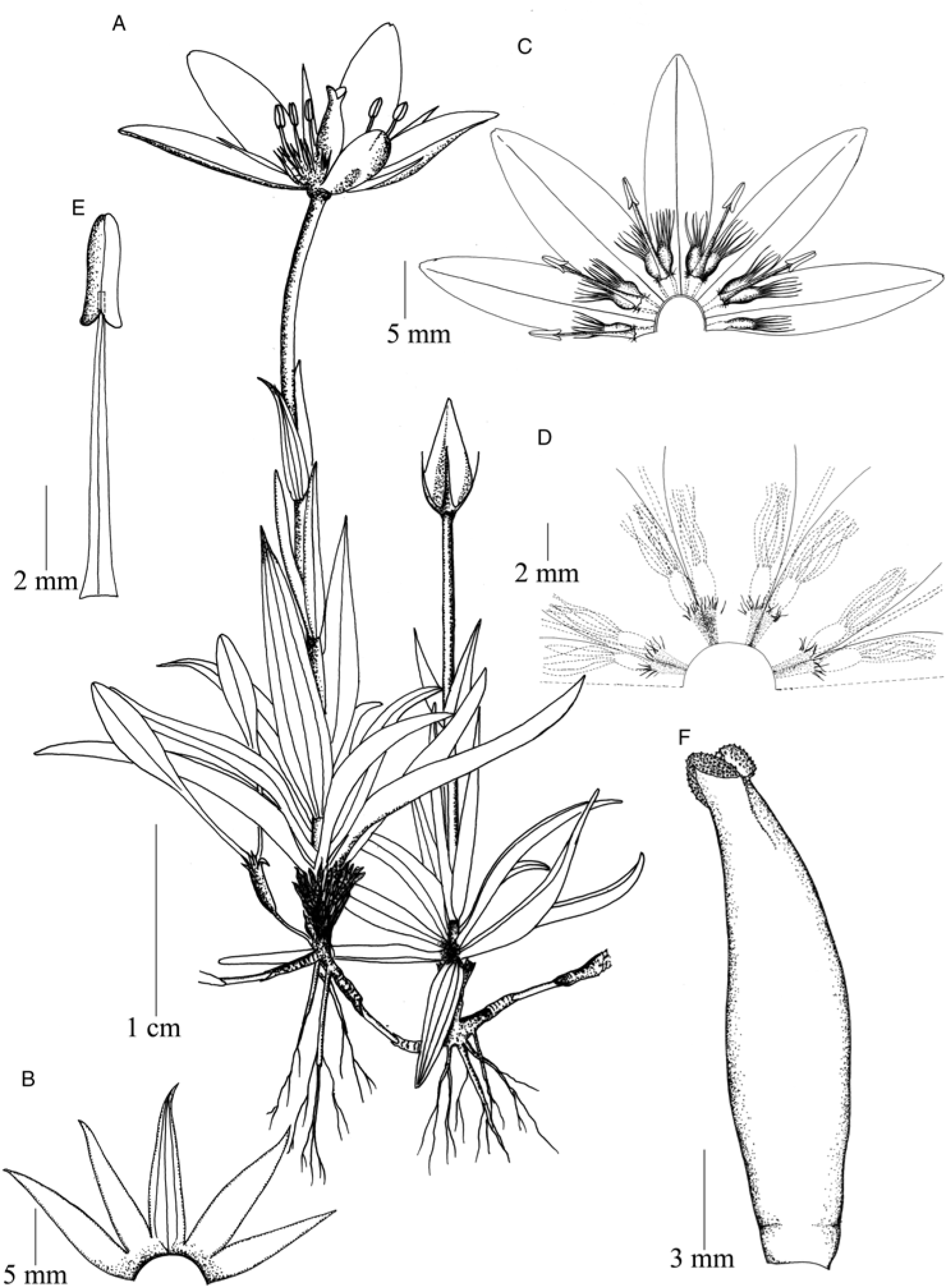
Morphologically close to Lomatogonium cherukurianum S.K.Dey & D.Maity (also in Sikkim Himalaya) but differing in its taller, more robust growth habit, many larger basal leaves, longer internodes, larger stem leaves in 2 or 3 pairs, longer pedicel, creamy yellow larger flowers (4–5 cm in diameter) and much larger floral parts; the presence of many rigid hairs on the adaxial side of the corolla in an inverted semilunar arrangement behind the filament bases; and its larger nectaries, larger filaments and much larger narrowly ovoid to narrowly ellipsoid ovary. Moreover, individuals of the new species grow in dense clumps with the stem leaves never fused at the base, and have a longer calyx and corolla tube, stamens and nectaries attached higher above the corolla base, and pollen grains with striate-reticulate ornamentation without perforations. – Type: India, Sikkim, about 5 km before Gurudongmar, about 3 km from river, 4500 m, 1 ix 2018, Midday & Ghosh 23831 (holo CUH; iso CAL, CUH). Figs 1, 2.
Lomatogonium gaurgopalii sp. nov. A, Habit; B, split calyx (dorsal face); C, split corolla, stamens and nectaries (adaxial face); D, part of split corolla (adaxial face) – note hairs in inverted semilunar pattern behind filament bases; E, stamens; F, gynoecium.

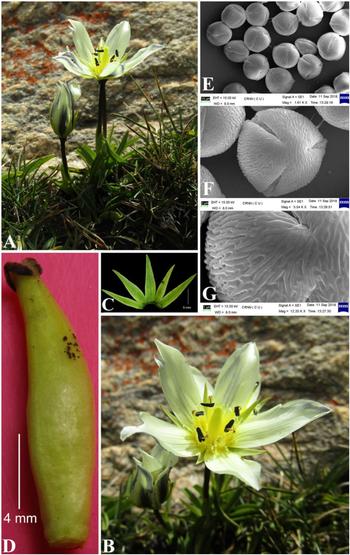
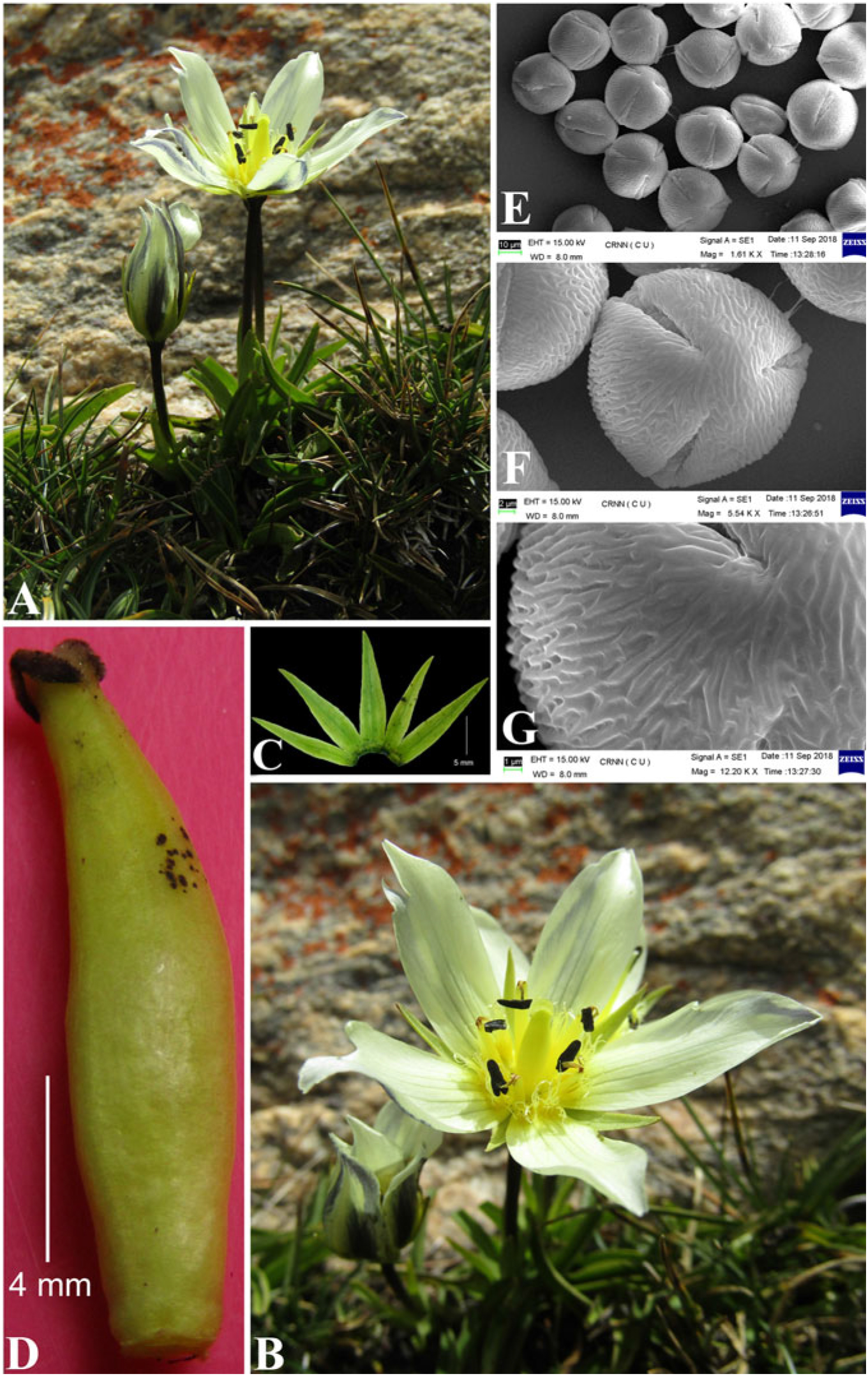
Lomatogonium gaurgopalii sp. nov. A, Habit; B, flower; C, split calyx; D, gynoecium; E–G, pollen grains (E, panoramic view; F, tricolporate pollen grain; G, exine ornamentation) – note striate reticulate nature without perforation.
Perennial, (5–)6–12.5 cm tall. Rhizomes thick, 1–1.5 mm in diameter, branched, horizontal, covered with blackish bark and sheathed by blackish remains of old petioles below basal leaves. Stems erect, simple, ± angular, glabrous. Leaves mostly basal, lanceolate, 1.5–3.5 × 0.3–0.5 cm, apex subacute, midvein distinct, raised below, with one strong lateral vein on each side, glabrous, petiolate; petioles 0.6–1.2 cm long, often weakly differentiated; stem leaves in 2 or 3 pairs, lanceolate, 1.1–3.5 × 0.2–0.5 cm, entire, acute or subacute, sessile, free; internodes (0.5–)1–2.7 cm long, shorter or longer than leaves. Flower terminal, solitary, erect, 5-merous, 4–5 cm in diameter; pedicels 2–5 cm long, glabrous, brownish, striate. Calyx tube 1–1.5 mm long, adaxial surface with many rigid hairs around ovary base; lobes unequal, lanceolate, 1.1–1.4 × 0.2–0.3 cm, margin entire, apex acute, 3-veined; midvein rarely branched; laterals usually branched. Corolla creamy yellow flushed with bluish violet outside around midvein in basal half and along one margin (overlapping part) in upper half; tube c.2 mm long, with many rigid hairs in an inverted semilunar arrangement behind filament base; lobes slightly unequal, lanceolate-elliptic, 1.9–2.2 × 0.6–0.7 cm, apex subacute, entire throughout or finely crenulate near apex. Nectaries 2 on each corolla lobe, 6–6.5 mm long, attached c.2 mm above base of corolla; nectary connate at base into a tube, apex lamellate. Stamens attached below sinus, c.2 mm above corolla base; filaments 6.5–8 mm long, dilated towards base; anthers blue, narrowly ovoid to oblongoid, 2.2–3 mm long. Pollen grains tricolporate, subprolate or prolate-spheroidal; exine striate-reticulate. Ovary narrowly ovoid or narrowly ellipsoid, 1.2–1.5 × 0.36 cm. Ovarian stipe c.1 mm long; stigma lobes hemispherical, c.1.2 × 1.4 mm, margin recurved at anthesis, ventrally minutely papillate, decurrent to apical part of ovary.
Distribution. Presently known from only three populations in the high Himalayan alpine pastures of north Sikkim, therefore likely to be endemic to Sikkim, India.
Habitat. Plants growing on open alpine pasture between 4400 and 4500 m a.m.s.l. Altogether, several mature individuals as well as young plants were observed. Common associated species include Aletris pauciflora (Klotzsch) Hand.-Mazz., Bistorta affinis (D.Don) Greene, Carex sp. and Gagea noltiei Peruzzi, J.-M.Tison, A.Peterson & J.Peterson.
Flowering. (August to) September (to October).
Proposed IUCN conservation status. Lomatogonium gaurgopalii is known only from the type locality. It is currently identified from three populations with some seven or eight mature individuals each, along with several young plants. The area of occupancy and extent of occurrence of the species are < 10 km2 and < 100 km2, respectively. The locality is highly exposed to anthropogenic threat, including grazing. Considering that the new species is restricted to a small area (c.3 km2) of the Himalayan state of Sikkim and that grazing and other anthropogenic threats may reduce the number of individuals in the future, it is suggested that the species is considered Critically Endangered (CR, B and D) (IUCN Standards and Petitions Subcommittee, 2017).
Etymology. The specific epithet honours Professor Gaurgopal Maiti (retired), University of Kalyani, for his contribution to Gentianaceae.
Additional specimens examined. India. Sikkim: before Gurudongmar, about 3.5 km from river, 1 ix 2018, 4400 m, Midday & Ghosh 23834, 23837 (CUH).
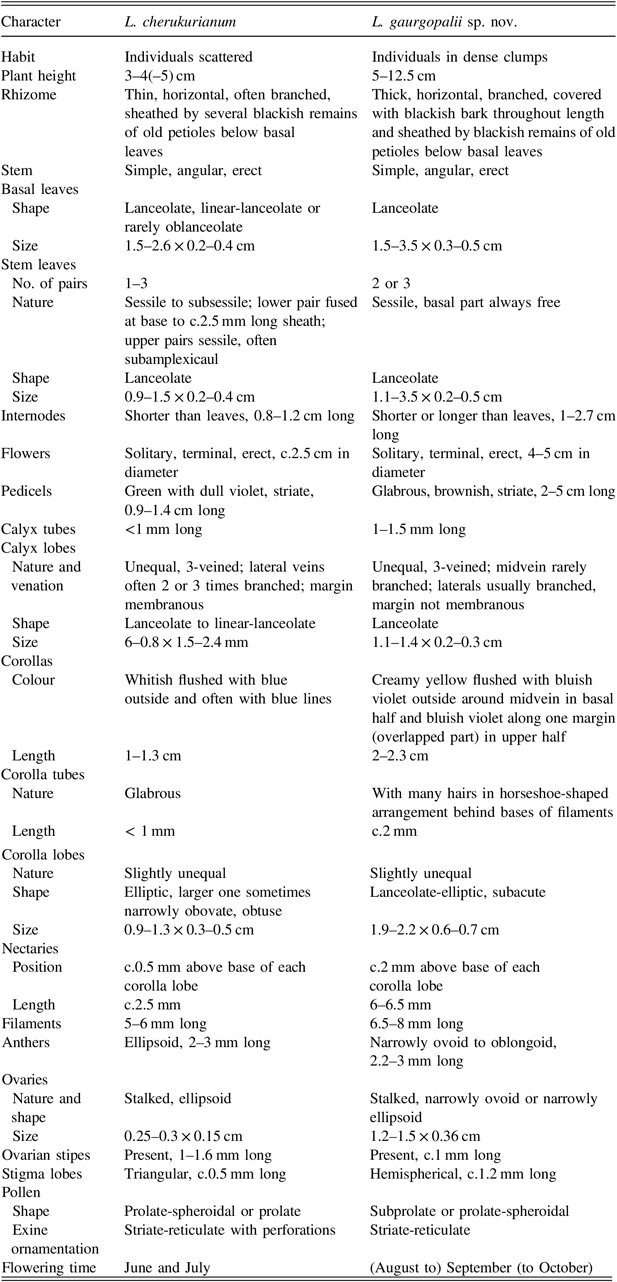
A comparison of the major morphological traits of Lomatogonium gaurgopalii and L. cherukurianumis is presented in the Table.
Comparison of morphological characters of Lomatogonium gaurgopalii sp. nov. and L. cherukurianum S.K.Dey & D.Maity

Discussion
Lomatogonium gaurgopalii is a prominent species of the genus, with a dense, clumped growth form and solitary, larger (more than 4 cm in diameter), yellowish terminal flowers. A combination of morphological characters, both vegetative and reproductive, make the new species unparalleled among Himalayan members of the genus.
The uniqueness of the species is reflected in its perennial robust growth habit, long branched rhizome and erect, simple, tall and stout stem. The species seems closely related to the recently described Lomatogonium cherukurianum (Dey & Maity, Reference Dey and Maity2017) in its perennial habit, its horizontal branched rhizome sheathed by several blackish remains of old petioles at the base of a simple erect stem, its solitary terminal flower and the nature of its nectary. However, it differs in its taller habit (versus dwarf to 5 cm high, mostly below 4 cm), much longer internodes (versus 0.8–1.2 cm long), larger flower (over 4 cm in diameter versus c.2.5 cm in diameter) with much larger floral parts, and longer pedicel (versus 0.9–1.4 cm long). Notably, the ovary in the new species is significantly larger (1.2–1.5 cm long) than in Lomatogonium cherukurianum (0.25–0.3 cm long). The shape of the ovary is also noticeably different (narrowly ovoid or narrowly ellipsoid versus ellipsoid).
The presence of many rigid hairs on the inner surface (adaxial) of the corolla in an inverted semilunar pattern behind the filament base also makes Lomatogonium gaurgopalii distinct from its relative. These hairs are not part of the nectaries. Nectaries are present between stamens, whereas these hairs are found behind the stamen bases and not attached to nectaries.
Importantly, Lomatogonium cherukurianum is an early-flowering plant (July) with sporadic individuals mostly on earth hummocks, whereas L. gaurgopalii flowers in (August to) September and individuals grow together in dense clumps usually in rock crevices. The type localities of Lomatogonium gaurgopalii and L. cherukurianum, that is, the lower Gurudongmar valley and the Lhonak valley, respectively, are well separated by high mountains, a few valleys and the Lahonak La pass (c.5500 m a.m.s.l.).
Pollen exine architecture is useful in the taxonomy of the genus, because most of the species have pollen grains with distinct exine ornamentation (Nilsson, Reference Nilsson1964; Liu & Ho, Reference Liu and Ho1992; Dey & Maity, Reference Dey and Maity2017). The pollen grains of Lomatogonium gaurgopalii have a striate-reticulate exine ornamentation. A total absence of perforations in the exine wall immediately separates the new species from Lomatogonium cherukurianum, for which a perforated exine is one of the major diagnostic traits (Dey & Maity, Reference Dey and Maity2017).
The new species has some similarity with Lomatogonium stapfii (Burkill) Harry Sm. in its perennial habit, horizontal branched rhizome sheathed by blackish remains of old petioles at the stem base, and simple stem with a solitary terminal flower. However, other attributes of Lomatogonium stapfii, such as its spathulate to obovate basal leaves, general absence of stem leaves, smaller, pale blue nodding flower, spatulate to obovate calyx lobes, broadly obovate corolla lobes and minutely verrucate exine sculpture (Liu & Ho, Reference Liu and Ho1992) clearly distinguish it from the new species.
More detailed studies of the actual distribution and status of populations of this species are required. Based on the present state of knowledge, the immediate attention of the relevant authorities is needed to protect this magnificent species through suitable conservation measures.
A key for Lomatogonium gaurgopalii and the most similar species, namely L. cherukurianum, L. longifolium and L. stapfii, is provided to facilitate correct identification.
Key to Lomatogonium gaurgopalii and similar species
1a. Leaves spatulate to obovate or spathulate to oblong; flower solitary or several _______________________________________ 2
1b. Leaves mostly lanceolate; flower solitary ____________________________________ 3
2a. Flower solitary, nodding ___________________________________ L. stapfii
2b. Flowers several in raceme-like inflorescence, erect _________________ L. longifolium
3a. Flower smaller, around 2.5 cm in diameter; ovary less than 0.5 cm long L. cherukurianum
3b. Flower larger, 4–5 cm in diameter; ovary more than 1 cm long ______ L. gaurgopalii
Acknowledgements
We are thankful to the Ministry of Environment, Forest and Climate Change, Government of India, for financial assistance to our research programme, and to the Department of Forests, Environment and Wildlife Management and the Home Department, Government of Sikkim, the Superintendent of Police, Gangtok, and the 17th Mountain Division and Indo-Tibetan Border Police Force, Indian Army, for permitting and supporting our field visit. This study was also partially supported by the University Grants Commission, Government of India. S. K. Dey and Suchandrima Siddhanta are warmly thanked for their assistance in illustration preparation and scanning electron microscopic study, respectively. We are grateful to the editor-in-chief, Dr Neil Bell, for his constant guidance during revision of the manuscript. We are also grateful to two reviewers for their constructive comments on our manuscript.