Introduction
Contact endoscopy was first introduced by Hamou in 1979, as microhysteroscopy, to examine the surfaces of the female genital tract.Reference Hamou1, Reference Hamou2 The procedure involves the tip of the endoscope making direct contact with the target tissue surface, allowing identification of the real time morphology of the superficial cells of the stained tissue.
In the field of otorhinolaryngology, contact endoscopy was first utilised to visualise superficial cells of various pathologies in the larynx.Reference Andrea, Dias and Santos3 In 1997, contact rhinoscopes with a smaller calibre (Karl Storz, Tuttlingen, Germany, 7215AA and 7215BA, 4 cm in diameter) were introduced. Since then, we have extended its use to the real time diagnosis of nasopharyngeal carcinoma, a common malignancy in South East Asia. Our experience has shown that contact rhinoscopy is accurate and efficient in providing real time in vivo diagnoses of nasopharyngeal carcinoma at different stages.Reference Pak, To, Leung and van Hasselt4–Reference Pak, Lee, Liang and van Hasselt6 Nevertheless, a few issues remain to be elucidated.
Firstly, since the introduction of contact endoscopy, 1 per cent methylene blue (methylthionine chloride) has been widely used as a chromogen (vital stain) to outline the cellular patterns of the examined tissues. However, the effect of different concentrations of methylene blue on the diagnostic reliability of contact endoscopy has not been elucidated.
Secondly, as contact endoscopy involves the real time examination of the superficial cells from a tangential axis, the experience of recognising pathologies through contact endoscopy is novel to the endoscopist. We have little knowledge of how the assessors' clinical experience and knowledge of histopathology affect their interpretation of the findings of contact endoscopy.
This study aims to evaluate how the use of different concentrations of methylene blue and the clinical background of the clinicians affect the assessment of contact endoscopy in patients with irradiated nasopharyngeal carcinoma.
Materials and methods
Between November 2000 and March 2001, all consecutive patients who had been treated with external radiotherapy for nasopharyngeal carcinoma and were attending the otorhinolaryngology clinic of the Prince of Wales Hospital were recruited into the study. Ethical approvals had been granted by the Human Review Ethics Committee and informed consents were obtained. Patients who were unwilling or unable to give informed consent were excluded. With every patient recruited, contact rhinoscopy was performed in the clinic under local anaesthesia (5 per cent cocaine spray applied 10 minutes before the procedure) by a single endoscopist (MWP) using a contact rhinoscope (Karl Storz, 7215AA, 0°; 23 cm long; 4 mm in diameter) which was connected to a 150W xenon light source, a video camera and an S-VHS video recorder.
During the procedure, after careful suction of the mucus, one side of the posterior wall of the nasopharynx was stained with 1 per cent methylene blue and the contralateral side was stained with 0.5 per cent methylene blue using a small nasal cotton ball applicator. The endoscope was then advanced slowly until its tip was in gentle contact with the surface of the posterior nasopharyngeal wall. The stained cells of the superficial layer of the nasopharynx were carefully examined under magnifications×60 and×150. The images of the stained cells were recorded using a video camera.
All the images obtained by contact endoscopy were randomised and examined by three independent assessors who had no knowledge of the staining information of each individual image. The three assessors consisted of a consultant otorhinolaryngologist, a junior trainee in radiology, and a consultant pathologist. Each assessor was instructed to gauge the visual clarity of the cellular details of each individual image by a 10 cm visual analogue scale based on his or her own perception. A score of 0 represents poor details and 10 represents excellent details. The assessment was repeated two weeks later after the order of the images was reshuffled. The paired visual scores were compared and the intra-observer and inter-observer variations were then analysed. An independent samples t-test was performed to compare the mean score of clarity of images at different concentrations of stain among the assessors. The level of significance was set at p≤0.05. Statistical analysis was performed using SPSS 14.0 for Windows (SPSS, Chicago, IL, USA).
Results
During the period of the study, 28 patients who had undergone external radiotherapy as treatment for nasopharyngeal carcinoma were recruited. Contact endoscopy could not be completed in two patients who suffered contact bleeding during the procedure and choanal stenosis secondary to external radiotherapy, respectively. They were excluded from the study. Among the 26 subjects, the male to female ratio was 18:8. The mean and standard deviation for age were 46.1±11.4. The median time interval since completion of external radiotherapy was five years. The gross appearance of the nasopharynx of all patients was normal without suspicion of recurrence of malignancy.
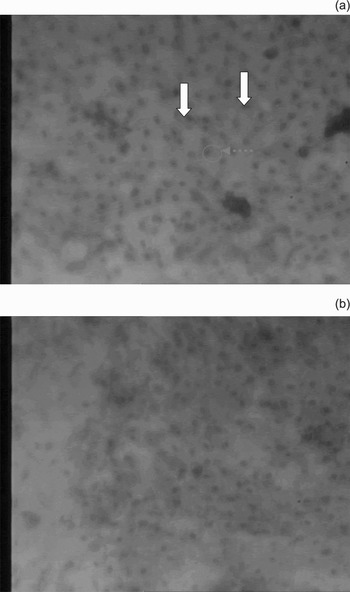
Twenty-four and twenty-one images (×150) stained with 1 per cent and 0.5 per cent methylene blue, respectively, were successfully produced and analysed by the assessors. All the images showed the cellular pattern of squamous metaplasia without recurrence and were recognised by all assessors. The cells were homogenous with round, darkly-stained nuclei and light blue cytoplasm. The nuclear to cytoplasmic ratio was low (Figure 1).
(a) High power view (×150) of contact endoscopy using 1 per cent methylene blue reveals the pattern of squamous metaplasia. The cells are homogenous with round, darkly-stained nuclei (solid arrows) and light blue cytoplasm (dotted arrow). The nuclear:cytoplasmic ratio is low. (b) High power view (×150) of contact endoscopy using 0.5 per cent methylene blue reveals the pattern of squamous metaplasia.

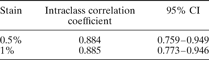
The intraclass correlation coefficients were calculated to examine the intra-observer and inter-observer reliabilities of the assessors. The intraclass correlation coefficients were 0.916 to 0.957 and 0.839 to 0.964 for intra-observer reliability of assessors in the groups of 0.5 per cent and 1 per cent stains, respectively (Table I). The intraclass correlation coefficients for inter-observer reliability of assessors were 0.884 and 0.885 in the groups of 0.5 per cent and 1 per cent stains, respectively (Table II). These values implied excellent reliability for contact endoscopy among all of the assessors.
Intra-observer reliabilities of assessors

CI=confidence interval
Inter-observer reliabilities of assessors

CI=confidence interval
The independent samples t-test showed that the mean scores of clarity of the cellular details were statistically higher in the group of 1 per cent stain than that of 0.5 per cent stain with respect to each individual assessor and all assessors (Table III).
Independent samples t-test to compare the mean scores of visual clarity of the cellular details between 0.5 per cent methylene blue stain and 1 per cent methylene blue stain

SD=standard deviation
Discussion
Chromoscopy is a term which denotes the use of stains or chromogens to enhance the accuracy of endoscopic examination. The classical example is the use of Lugol's solution, an iodine-based adsorptive stain with an affinity for the glycogen in non-keratinised squamous epithelium, in oesophagoscopy to detect early oesophageal cancer and in the evaluation of Barrett's oesophagus.Reference Shiozaki, Tahara, Kobayashi, Yano, Tamura and Imamoto7
To date, chromoscopy has been applied mostly in gastrointestinal endoscopy to enhance diagnosis, detect diseased lesions, guide endoscopic biopsies, and to obtain better visual diagnosis of small abnormalities in the gastrointestinal tract.Reference Shiozaki, Tahara, Kobayashi, Yano, Tamura and Imamoto7, Reference Canto, Setrakian, Petras, Blades, Chak and Sivak8 The classification of stains used for endoscopic purposes differs from the dyes used in histochemistry. Three classes of stains have been commonly utilised in endoscopy.
1 Contrast stains, e.g. India ink, that enter mucosal depressions and crevices to highlight the tissue topography.
2 Reactive stains, e.g. Congo red, that identify cellular products by a colour change.
3 Vital stains, e.g. methylene blue, that identify specific epithelial cells or cellular constituents by preferential colouring.
Contact endoscopy is an excellent example of chromoscopy to visualise the morphology of epithelial cells using a vital stain. Methylene blue is an adsorptive or vital stain which selectively adsorbs in the squamous epithelium and metaplastic tissue of the organs. Since the advent of contact endoscopy, it has been widely used to visualise the squamous epithelium of the cervix and larynx.Reference Hamou2, Reference Andrea, Dias and Santos3 In contact endoscopy, the stain differentially enters the cytoplasm of the adsorptive epithelium or metaplastic tissues and outlines the cellular details of the individual cells. Traditionally, only 1 per cent methylene blue was used in contact endoscopy because of its safety in optic reactions and easy accessibility.Reference Morikawa, Fukuda, Naganuma and Nakayama9 However, the effect of the stain at different concentrations was unknown.
In this study, we confirmed that 1 per cent methylene blue gives clearer images of cellular detail than its 0.5 per cent counterpart in contact rhinoscopy. It is postulated that the more dilute 0.5 per cent methylene blue contains an inadequate concentration of stain to enter the cytoplasm of the examined epithelium or metaplastic tissues and reduces the visibility of the cells. We advocate that 1 per cent methylene blue should remain the chromogen of choice to visualise the metaplastic cells of the post-irradiated nasopharynx.
Although we have found that methylene blue is a good companion to contact endoscopy, the use of other vital stains has not been studied. Lugol's staining has been used to evaluate the squamocolumnar junction of the upper gastrointestinal tract for detection of early oesophageal cancer, while toluidine blue differentially stains the nuclear material of malignant epithelial cells and has been used to stain oropharyngeal and oesophageal neoplastic lesions.Reference Misumi, Harada, Murakami, Arima, Kondo and Akagi10, Reference Seitz, Monges, Navarro, Giovannini and Gauthier11 However, according to previous experience, other colorants such as Lugol's iodine and Waterman blue did not stain the mucosa as well as methylene blue.Reference Andrea and Dias12 These stains have therefore not been used in this study.
• Contact rhinoscopy is able to provide real time in vivo diagnosis of squamous metaplasia of the irradiated nasopharynx
• It is shown that 1 per cent methylene blue gives clearer images of contact rhinoscopy than those created with 0.5 per cent methylene blue
• The assessment of squamous metaplasia by contact rhinoscopy is highly reliable irrespective of the clinical experience and knowledge of histopathology of the assessors
Previous quantitative studies have ascertained the accuracy of contact endoscopy in the diagnosis of pathology in the larynx and nasopharynx.Reference Pak, To, Leung and van Hasselt5, Reference Wardrop, Sim and McLaren13 Nevertheless, its reliability in assessment has not yet been elucidated. In this study, we found that there was excellent inter-observer and intra-observer reliability in the assessment of squamous metaplasia of the irradiated nasopharynx by contact endoscopy among assessors of different backgrounds. The reason for the close agreement of assessments may be related to the morphology of the irradiated tissues. Following radiation, the ciliated respiratory epithelium of the nasopharynx undergoes squamous metaplasia. The cellular changes are characterised by the presence of enlarged cells and nuclei with coarse chromatin. The nuclear to cytoplasmic ratio remains low.Reference Chang, Chan, van Hasselt and Gibb14 The selective affinity of methylene blue for the cytoplasm of squamous metaplastic cells makes them more recognisable in the illuminated background in contact endoscopy. This may explain why a junior clinician can identify the stained metaplastic cells as reliably as an experienced pathologist using this procedure.
Acknowledgement
We would like to thank Mr Albert Yu Kiu Cheung of the Centre for Epidemiology and Biostatistics, the School of Public Health, the Chinese University of Hong Kong, who has contributed to the statistical analysis of this study.