Why has MABL been Established?
Novel solutions are needed to improve the safety and wellbeing of vulnerable children and adolescents who are growing up in families with risk factors for maltreatment or who live away from the care of their parents as a protection from maltreatment.
Societal changes, such as decreasing employment opportunities for people at the lower end of the socio-economic spectrum, gaps in educational achievement and social inequalities combined with changes in family structure and stability, racial discrimination, intergenerational trauma and other disadvantages are having devastating effects on some families and the children developing within them. These traumas and disadvantages can often lead to domestic violence, substance misuse and mental health issues – the most common indicators of increased risk of harm to children and adolescents (the ‘toxic trio’, as Brandon and colleagues (Reference Brandon, Belderson, Warren, Howe, Gardner and Dodsworth2008) put it).
Helping children and families facing adversity so as to reduce the likelihood of children being harmed and developing serious emotional and behavioural difficulties is a considerable challenge for Australian society. In 2014–15, one in 35 children received a child protection service (were the subject of an investigation of a notification, were on a care and protection order, and/or in out-of-home care (OOHC)). Over the past 3 years, the number of child protection notifications, investigations and substantiations has increased by 11% for non-Aboriginal children and 15% for Aboriginal children (AIHW, 2016). The number of Aboriginal children in OOHC also increased by 22% in the past 5 years, whilst the number of non-Aboriginal children in OOHC increased by 7% in the same time.
Almost 50 years of programme evaluation, meta-analyses and literature reviews suggest that child and family programmes in existence today were not developed to combat contemporary social and economic challenges and do not produce robust impacts for highly vulnerable or multi-challenged families (Centre on the Developing Child at Harvard University, 2016). Very few programme models can claim effectiveness in reducing incidents of child maltreatment amongst families with a history of maltreatment or where there are risk factors for maltreatment. Replication of positive impacts beyond demonstration sites is also uncommon (Avellar et al., Reference Avellar, Paulsell, Sama-Miller, Del Grosso, Akers and Kleinman2016).
Many groups are committed to social change, but their agendas, approaches, influence and timeframes rarely align. New partnerships and methods are needed to change the status quo and deliver better outcomes for vulnerable children and adolescents.
What is MABL?
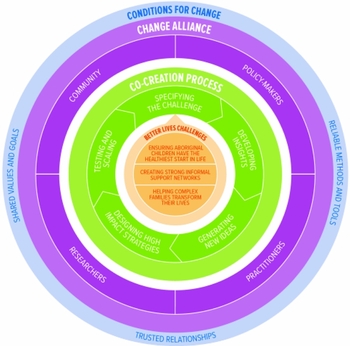
MABL is a change Alliance that solves social problems for better lives. MABL is bold, cross-sectoral and interdisciplinary and embraces science. MABL is creative, empathic and human-centred (Figure 1).
MABL: Mobilising change Alliance for Better Lives.

MABL is Bold
MABL tackles the most pressing social problems affecting the safety and wellbeing of Australian children and adolescents in order to produce impacts at scale. MABL learns from its success and the challenges it faces, and has enthusiasm for risk-taking.
MABL is Cross-Sectoral and Interdisciplinary
Leveraging existing partnerships, MABL builds trust, productive communication and partnership across disciplines and sectors. It relies on partnerships, recognising the collective effort needed to facilitate lasting change.
MABL Embraces Science
MABL's co-creation process incorporates scientific principles (such as theory of change and theory of action) and robust research methods to ensure new ideas and solutions are aligned with evidence and tackle underlying factors. MABL digs deep to identify root causes of a problem and builds solutions that have a strong evidence base.
MABL is Creative, Empathic and Human Centred
MABL embraces principles of human-centred design to keep vulnerable children and their families at the heart of the co-creation process, to stimulate creative problem-solving and accelerate the pace of change.
MABL's Mechanics
There are three main elements of MABL that are used to produce social innovations; the change Alliance, better lives challenges and the co-creation process.
The Change Alliance
The change Alliance is a national group of people and organisations across a diversity of disciplines and sectors, including the government, and other communities that work with the University of Melbourne. The Alliance works at the frontier of innovation to improve the lives of the most vulnerable children and families in Australian society. Members of the change Alliance:
-
• support MABL's values and purpose;
-
• sit on MABL's governance committee;
-
• sponsor projects;
-
• share information and resources and contribute perspectives on social issues;
-
• commit to better lives challenges and participate in design and/or implementation processes;
-
• facilitate access to service users and community members;
-
• consume the knowledge, tools and resources generated by MABL;
-
• encourage the ongoing identification of further better lives challenges.
Better Lives Challenges
Better lives challenges are well-defined challenges that are the focus of innovation and application in real world contexts. Members of the change Alliance are able to propose and/or sponsor projects. University of Melbourne academics are seeking sponsors and funders in relation to three better lives challenges. These are as follows:
-
• Ensuring Aboriginal children have the healthiest start in life;
-
• Creating strong informal support networks for vulnerable families;
-
• Helping complex families transform their lives.
The Co-creation Process
MABL utilises a structured co-creation process to produce social innovations. The co-creation process moves from a well-defined challenge or opportunity to new strategies that can produce breakthrough impacts at scale. Timelines are flexible to suit the nature of the challenge and the state of knowledge relating to a particular challenge. The following list describes the specific stages of the co-creation process:
-
• A better lives challenge is identified in collaboration with project investor/s and sponsor/s;
-
• MABL facilitators and researchers are assigned to the co-creation process;
-
• Members of the change Alliance who can help address the challenge commit to the co-creation process;
-
• A small group of subject experts, strategy developers and practitioners (thinkers, makers and doers) are brought together as a design team to define the challenge and develop a project plan;
-
• MABL researcher/s use robust methods (e.g., DELPHI technique, systematic literature review and qualitative interviews) to develop a ‘rich picture’ of the problem situation (including insight into root causes) and the desired state within a short space of time;
-
• The design team are aligned (sensitised) on the complexity of the problem situation, the desired state and the experienced realities of system functions;
-
• The design team share their thoughts, feelings, generate new ideas and explore alternative approaches;
-
• New ideas are aligned with existing knowledge, tested with stakeholders and refined and developed into an experimental initiative with a comprehensive theory of change;
-
• Experimental initiatives are applied, evaluated for feasibility, acceptability and effectiveness and replicated/expanded.
Are you MABL-minded?
If you are interested in joining the change Alliance and/or investing in the MABL infrastructure or a better lives challenge, please contact:
Dr Sarah Wise
Good Childhood Fellow
The University of Melbourne
Social Work: Melbourne School of Health Sciences
p. 03 9035 5371
Acknowledgements
MABL is supported by the Partnership for Innovation in Child Welfare. The Good Childhood Fellow is a joint position of the University of Melbourne and Berry Street. This paper is an original work that has not been submitted to nor published anywhere else.